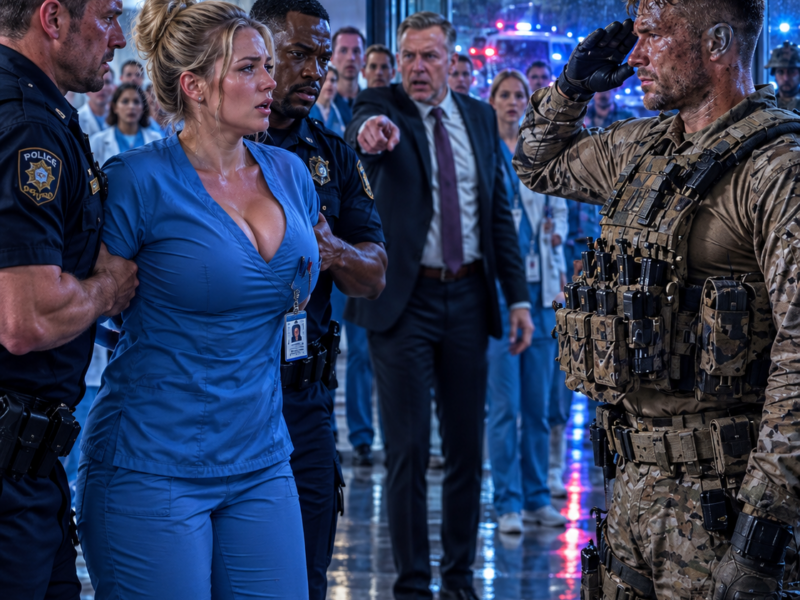
“I was standing in the emergency room with handcuffs waiting to be placed around my wrists when an Air Force transport plane landed outside the hospital
“I still hadn’t opened it, and Colonel Anderson was already asking everyone else to leave the room.”
The hospital administrator stood up.
“Colonel, this is a private medical facility. You can’t simply walk in and—”
“Mr. Collins, I understand your concerns. But this matter involves an active military investigation and a critically injured Air Force service member. I have the necessary authorization.”
He placed an identification card on the desk.
The administrator looked at it, then at the police officer.
Neither seemed eager to argue.
Dr. Hayes remained near the window, his arms folded.
I noticed that he hadn’t asked a single question about the patient.
Not one.
Colonel Anderson turned toward me.
“Sarah, may I speak with you privately?”
I glanced at the officer.
“Am I still being detained?”
The colonel looked at him.
“Not by my authority. Whether local law enforcement has grounds to hold you is a separate matter, but I can tell you that the allegations against you are now part of our investigation.”
The officer slowly lowered his hands.
“We have not formally arrested her.”
“Then let’s make sure nobody makes that mistake.”
The administrator finally stepped aside.
Within a minute, everyone except Colonel Anderson, me, and a young Air Force captain had left the office.
The colonel pulled a chair closer.
“Your father was Daniel Mitchell?”
My throat tightened.
“Yes.”
“Master Sergeant Daniel Mitchell?”
I nodded.
He looked down at the silver pin beneath my badge.
“That’s his.”
I touched it instinctively.
“It was.”
The colonel opened the sealed folder.
Inside were several photographs, a military commendation, and a document with my father’s name at the top.
I recognized his signature immediately.
For four years, I had kept that pin close because it was one of the few things I had left of him.
Now a stranger was placing documents about his military service in front of me.
“What does this have to do with the patient?”
The colonel studied my face.
“Six years ago, your father was involved in a classified medical evacuation operation overseas. A helicopter had been hit during an extraction. Several service members were injured, and one of them was a young Air Force combat controller named Lieutenant Nathan Brooks.”
I looked at the photograph.
A young man in a flight suit stood beside my father.
His face was thinner than I remembered, but there was something familiar about his eyes.
“That’s the patient?”
“Yes.”
I stared at the photograph.
“How is that possible?”
“Because your father saved his life.”
I sat back.
I remembered my father coming home from deployments with a tired smile and stories he never finished.
Sometimes he would mention a young airman who had been badly injured.
He never gave me a name.
He only said, “There are people who get a second chance because somebody refuses to give up on them.”
I had assumed he was talking about one of his fellow service members.
The colonel continued.
“During that evacuation, the medical team was ordered to prioritize a senior officer. Your father disagreed. He believed Brooks was still salvageable, despite the severity of his injuries.”
“And?”
“He refused to leave him behind.”
I looked at the photograph again.
“What happened?”
“Your father stabilized him long enough for the evacuation team to get him to a surgical facility. Brooks survived, but he suffered extensive injuries. He spent months in rehabilitation.”
I swallowed.
“Why didn’t anyone tell me?”
“Because the operation was classified. And because your father requested that his name not be used in any public recognition.”
The colonel turned another page.
There was a letter.
My father’s handwriting.
I recognized the way he wrote the letter S, slightly tilted, with a long curve at the bottom.
The first sentence read:
“If my daughter ever meets Nathan Brooks, I hope she understands that she is meeting someone who deserves the chance I was given.”
My eyes burned.
I couldn’t continue reading.
The colonel waited.
For a moment, the office was quiet except for the faint hum of the air conditioner.
Then I looked up.
“Why did you say you’ve been looking for me for six years?”
He folded his hands.
“Because Lieutenant Brooks asked us to find you when he learned your father had passed away. He wanted to thank your family. We couldn’t locate you through the military records because your father had deliberately kept his personal information separate from the operation.”
I stared at the letter.
“Then why tonight?”
“Because Nathan recognized your name.”
I looked toward the emergency department.
“He was unconscious.”
“Before he lost consciousness, he gave the paramedics a name. Yours.”
I shook my head.
“I’ve never met him.”
“Apparently, he saw your father’s pin when you leaned over him.”
I remembered the moment.
His fingers gripping my wrist.
The words he had struggled to say.
Don’t let them take it.
The colonel leaned forward.
“Sarah, the patient didn’t just recognize your father’s pin. He was trying to warn you about something.”
My hands went cold.
“What?”
The young captain finally spoke.
“We recovered a small encrypted data device from his clothing. It was missing when he arrived at the hospital.”
I thought of the ambulance team.
“Did the paramedics find it?”
“They found a damaged piece of equipment, but the storage unit wasn’t there.”
Colonel Anderson slid a photograph across the desk.
It showed a small black device with a silver strip along one edge.
“Do you recognize this?”
I shook my head.
“No.”
“Lieutenant Brooks was carrying it because he was returning from a classified assignment. The contents are connected to an investigation that has been ongoing for several months.”
I glanced toward the door.
“Does Dr. Hayes know about this?”
The colonel didn’t answer immediately.
Instead, he closed the folder.
“That’s one of the things we’re trying to establish.”
I thought about the medical report accusing me of unauthorized medication administration.
The electronic signature that wasn’t mine.
The way Dr. Hayes had refused to look at me.
“Colonel, someone changed my treatment record.”
“I know.”
He looked directly at me.
“And we have reason to believe the alteration occurred before the patient was transferred to the operating room.”
A knock interrupted us.
The young captain opened the door.
A hospital security officer stood outside.
“Colonel, we have a situation.”
“What happened?”
“Dr. Hayes is attempting to leave the building.”
The colonel stood.
“Has he been stopped?”
“He’s at the parking garage.”
The colonel looked at the captain.
“Secure the medical records. Nobody accesses that patient’s chart without authorization.”
Then he turned to me.
“Stay here.”
But I had already stood.
“Dr. Hayes was the physician who treated Nathan.”
“Yes.”
“And he ordered the medication.”
“That’s what we need to determine.”
I looked at the colonel.
“I want to know why he put my name on an order I never entered.”
The colonel studied me for a moment.
“Then I suggest you help us establish exactly what happened.”
We walked back toward the emergency department.
The hospital was beginning to wake up.
Day-shift nurses were arriving, coffee cups in their hands, unaware that the night shift had become the center of a military investigation.
At the nurses’ station, my coworker Emily Carter hurried toward me.
“Sarah, are you okay?”
I nodded.
“Where’s Nathan?”
“Still in surgery.”
She lowered her voice.
“Something happened in the medication system. The pharmacy called about an order that doesn’t match the patient’s treatment plan.”
I looked at the colonel.
“What order?”
Emily pulled up the medication record.
It showed an entry made under my credentials at 12:31 a.m.
The medication was listed as an emergency intervention.
But the dosage was different from what Dr. Hayes had verbally ordered.
I stared at the screen.
“I didn’t enter this.”
Emily nodded.
“I know. I was standing right beside you.”
“Can you retrieve the audit history?”
“I tried. Someone restricted access.”
The colonel looked toward the captain.
“Have the system preserved immediately.”
The captain stepped away to make the call.
I examined the timestamp again.
12:31 a.m.
That was the exact minute I had been performing chest compressions.
I couldn’t have entered the order even if I had wanted to.
“Emily, do you remember who was at the workstation?”
She thought for a moment.
“Dr. Hayes. He was there when you went to the medication cabinet.”
I looked up.
“Are you sure?”
“Yes. He asked me to print the latest blood results.”
I felt the room tilt slightly.
There was something else.
The medication had been ordered under my credentials, but the physician approval field was blank.
That wasn’t normal.
I pointed it out to the colonel.
He examined the screen.
“Can that happen?”
Emily shook her head.
“Not under the normal emergency workflow.”
The colonel looked at the captain.
“Get the hospital’s IT security officer here.”
A few minutes later, a technician arrived.
He examined the system and began tracing the audit history.
His expression changed.
“Someone accessed Sarah’s account from a different workstation.”
“Which one?” I asked.
He checked the log.
“Physician consultation room.”
I looked at the colonel.
“Dr. Hayes’s office.”
Nobody said anything.
Then the technician opened another record.
There was a second login.
This one had been made at 1:06 a.m.
The account belonged to the hospital administrator.
The colonel’s expression hardened.
“Preserve everything.”
I thought about the report on the desk.
The officer waiting to put handcuffs around my wrists.
The hospital administrator telling me I had caused a patient’s deterioration.
The administrator hadn’t simply accepted the report.
His account had accessed the record after the medication entry was created.
I suddenly wondered whether the two men had been working together.
But I didn’t have proof.
And I wasn’t going to accuse someone based on a suspicion.
Then the operating room doors opened.
Dr. Collins emerged.
His surgical gown was stained, and his eyes looked exhausted.
“How is he?” I asked.
He removed his cap.
“He’s alive.”
I let out a breath I hadn’t realized I was holding.
“We found a significant internal injury. There was more damage than the initial imaging suggested.”
“Will he recover?”
“He’s stable for now, but the next several hours are critical.”
The colonel approached him.
“Doctor, did you find anything unusual?”
Dr. Collins glanced at me.
Then he looked toward the colonel.
“Yes. There was a small puncture wound beneath his right shoulder. It appears to have been caused by a narrow object.”
The colonel’s face changed.
“Could it have been caused by medical equipment?”
“Possibly. But it doesn’t look like a typical procedural injury.”
“Did you recover anything?”
Dr. Collins nodded.
“We found a tiny fragment of plastic embedded in the wound. It’s been preserved.”
The colonel looked at the captain.
“Photograph it and send it for forensic examination.”
I stared at the surgeon.
“Someone injured him after he arrived?”
Dr. Collins didn’t answer directly.
“I can’t determine when the injury occurred. But it wasn’t documented in the ambulance report.”
That was when I remembered the folded fabric around Nathan’s wrist.
The piece of dark blue material.
The thing he had tried to protect.
“Did anyone remove something from his wrist?”
The colonel looked at me.
“What?”
“When he arrived, there was fabric wrapped around his wrist. I saw something folded inside it. I never got a chance to examine it.”
The captain immediately checked the property inventory.
“There’s no fabric listed.”
I felt a chill.
It had disappeared.
The colonel turned toward hospital security.
“Find the ambulance crew. We need to know who handled the patient’s belongings from the moment he arrived.”
The investigation widened quickly.
The ambulance service confirmed that two paramedics had transported Nathan Brooks.
Both insisted they had not removed anything from his clothing.
The emergency department cameras showed the patient entering Trauma Two with the fabric still wrapped around his wrist.
But the camera angle changed when the team moved the stretcher.
For nearly four minutes, the patient’s right side was hidden from view.
When the image returned, the fabric was gone.
And the nurse assigned to the adjacent trauma bay remembered seeing Dr. Hayes leave the room holding a small plastic specimen bag.
He had told her he was disposing of contaminated material.
The colonel requested an immediate review of the footage.
Dr. Hayes was found in the parking garage and escorted back into the hospital for questioning.
He was no longer wearing his white coat.
Instead, he carried a leather bag and his car keys.
When he saw me standing beside Colonel Anderson, his expression tightened.
“Sarah.”
I said nothing.
He looked at the colonel.
“What’s going on?”
“We have some questions about the patient’s treatment and missing property.”
Dr. Hayes gave a short laugh.
“I’ve been working for twelve hours. I’m not going to stand here and be interrogated in a parking garage.”
“Then you won’t mind coming upstairs.”
The colonel gestured toward the elevator.
Dr. Hayes looked at me again.
For the first time that night, I saw something in his eyes that hadn’t been there before.
Fear.
Not concern.
Not anger.
Fear.
And I knew that whatever had happened to Nathan Brooks, it was much bigger than a disagreement over medication.
The next few hours were difficult.
Hospital security restricted access to the emergency department while investigators reviewed the records.
I was temporarily removed from patient care pending the inquiry.
It felt humiliating.
I had never been asked to hand over my badge before.
Emily hugged me before I left the unit.
“Don’t let them make you believe you did something wrong.”
I tried to smile.
“I just want Nathan to wake up.”
She nodded.
“Then that’s what we wait for.”
I sat in a small conference room near the ICU.
Colonel Anderson returned around noon.
He looked more tired than he had earlier.
“Dr. Hayes has been questioned,” he said.
“Did he admit anything?”
“Not yet.”
He sat across from me.
“But we’ve recovered part of the missing material.”
“Where?”
“From a locked cabinet in the physician consultation area.”
I leaned forward.
“Was it the device?”
“Not the entire device. The outer casing.”
He placed a photograph on the table.
It showed a small black storage unit, broken into two pieces.
The silver strip was missing.
“Where’s the rest?”
“We believe someone removed the storage component before the device was damaged.”
I looked at the photograph.
“Why would Dr. Hayes take it?”
“That’s what we’re trying to establish.”
I studied the colonel.
“Does this have something to do with my father?”
He didn’t answer immediately.
Then he opened the folder again.
“Your father was part of a medical evacuation team that responded to an aircraft incident six years ago. During that mission, he discovered that a flight manifest had been altered.”
“Altered how?”
“Three personnel were listed as having been evacuated. But only two were actually transported.”
I stared at him.
“Who was the third?”
“Lieutenant Nathan Brooks.”
I felt my breath catch.
“But you said my father saved him.”
“He did. The original manifest was wrong. Your father insisted that Brooks was alive and needed immediate treatment.”
The colonel showed me another document.
It contained a handwritten note from my father.
“Patient conscious. Airway compromised. Evacuation delayed. Do not close this file.”
I recognized his handwriting.
My father had never been someone who wrote things down unless he believed they mattered.
“Why would someone alter the manifest?”
“Because the mission was supposed to have been conducted under a different authorization. If Brooks had been officially listed at the extraction point, the chain of command would have had to explain why the aircraft had been diverted.”
I stared at him.
“Who ordered the diversion?”
The colonel looked at me.
“That’s what the data device may establish.”
I thought of Nathan’s words.
Don’t let them take it.
He hadn’t been protecting a piece of equipment.
He had been protecting evidence.
And someone had been willing to let him die rather than allow that evidence to reach the authorities.
“Why did Nathan come to this hospital?”
“He requested a civilian emergency facility because he believed the military medical transport route had been compromised.”
I frowned.
“Why not go to another military hospital?”
“Because he didn’t know who he could trust.”
The colonel paused.
“Your father’s name was the only one he trusted enough to mention.”
I looked down at the silver pin.
For six years, I had worn it because I missed my father.
Now I understood that Nathan had recognized it as a promise.
A promise that someone would listen.
That afternoon, I received a call from an unfamiliar number.
I almost ignored it.
Then I answered.
“Hello?”
A man’s voice came through.
“Sarah Mitchell?”
“Yes.”
“My name is Nathan Brooks.”
I stood so quickly that my chair scraped against the floor.
“You’re awake?”
“I’m trying to be.”
His voice was weak, with long pauses between words.
“Are you safe?”
I glanced toward the colonel.
“Yes. I’m with Colonel Anderson.”
There was a silence.
Then Nathan whispered, “Did they find the silver strip?”
The colonel leaned closer.
“We found the casing. Not the storage component.”
Nathan breathed heavily.
“Then it’s still missing.”
“Do you know who has it?” I asked.
He hesitated.
“I saw him.”
“Who?”
“Someone I recognized from the hospital.”
My fingers tightened around the phone.
“Dr. Hayes?”
“No.”
Nathan swallowed.
“The administrator.”
I looked at Colonel Anderson.
His expression changed immediately.
“Mr. Collins?” he asked.
Nathan heard him.
“Yes.”
I remembered the hospital administrator sitting behind his desk.
His calm expression.
The report accusing me.
The way he had insisted that the police officer remain in the room.
“Why would he take it?”
Nathan’s breathing became uneven.
“Because he knows what’s on it.”
“What is on it?”
A pause.
Then he said something that made the colonel close his eyes.
“The original flight recording.”
Before I could ask another question, Nathan began coughing.
A nurse took the phone from him.
“He’s exhausted. We need him to rest.”
The call ended.
I looked at the colonel.
“Mr. Collins has the missing component.”
“We need evidence.”
“He was in the room when they tried to arrest me.”
“I know.”
“He accessed the medical record after Dr. Hayes entered the false order.”
“I know that too.”
The colonel stood.
“Sarah, don’t approach him. Let us handle this.”
I nodded.
But something kept bothering me.
The hospital administrator had been confident enough to accuse me in front of a police officer.
He had believed nobody would question the report.
He had believed the patient would never wake up.
And perhaps he had believed the military would never discover what was missing.
That evening, Colonel Anderson informed me that a federal investigative team would be arriving.
They planned to review the hospital’s security footage and obtain the original system logs.
Mr. Collins was asked to remain in his office.
He refused to cooperate without legal representation.
That was his right.
But when investigators requested access to his office, they discovered that a locked filing cabinet had been emptied.
The cabinet contained no documents.
Only a small envelope.
Inside was a photograph of my father.
It had been taken during the evacuation operation six years earlier.
On the back were five handwritten words.
“She must never find out.”
I stared at the photograph.
My father’s face looked younger than I remembered.
He was kneeling beside a stretcher, one hand resting on the shoulder of a wounded airman.
Nathan.
I turned the photograph over again.
The handwriting wasn’t my father’s.
It was the same handwriting used on the false medication report.
Dr. Hayes.
The colonel looked at me.
“Sarah, I think we know why you were targeted.”
I waited.
“Your father didn’t simply save Nathan Brooks. He documented what happened during that evacuation. He refused to sign the final report because he believed someone had deliberately falsified the manifest.”
“Did he ever tell anyone?”
“He submitted a sealed statement before his death.”
I stared at him.
“Where is it?”
“That’s what we haven’t found.”
I thought about my father’s belongings.
His old watch.
His military papers.
The small wooden box he had kept in his bedroom.
I remembered something suddenly.
After his funeral, I had found a letter addressed to me.
It was inside his old Air Force jacket.
I had never opened it.
Not because I didn’t want to read it.
Because I couldn’t bear to.
I had placed it in a drawer at home and forgotten about it.
Or perhaps I had chosen to forget.
I looked at the colonel.
“I think I know where he left something.”
That night, I went home under the escort of two investigators.
My father’s wooden box was still on the top shelf of my closet.
Inside were his service medals, old photographs, and a folded American flag.
At the bottom was the letter.
My name was written across the envelope.
I sat on the edge of the bed and carefully opened it.
The first paragraph was simple.
“My Sarah,
If you’re reading this, it means I’ve run out of time to explain something I should have told you years ago.”
I pressed my fingers against the paper.
He wrote about the evacuation.
About the young airman whose name had been removed from the official manifest.
About a medical team that had been instructed to follow orders even when those orders contradicted what they could see with their own eyes.
Then I reached the final page.
My father had written that he had made a copy of the original flight recording and placed it in a secure military archive.
He included a reference number.
But beneath it was another sentence.
“Do not trust the people who tell you the matter is closed. They were never interested in finding the truth.”
I read that sentence three times.
Then I noticed something tucked inside the fold.
A small photograph.
It showed my father standing beside a woman in a military uniform.
On the back was a name.
Colonel James Anderson.
I looked up.
The man who had come to the hospital was the same man in my father’s photograph.
But the photograph was dated two years before the evacuation.
And beside his name, my father had written:
“The one person who knows where the original is.”
I felt a strange mixture of relief and uncertainty.
I had trusted Colonel Anderson because he had come to defend me.
But now I wondered why my father had kept his name in that letter.
The next morning, I asked to speak with him privately.
He arrived at the hospital shortly after sunrise.
I showed him the photograph.
He studied it for a long time.
Then he sat down.
“Your father was a good man,” he said.
“I know.”
“He was also stubborn.”
I almost smiled.
“That sounds familiar.”
The colonel looked at the letter.
“Daniel kept his promise.”
I frowned.
“What promise?”
“He promised that if anything happened to him, someone would make sure the truth reached you.”
I looked at the silver pin.
“Why me?”
“Because your father believed the truth should never depend on someone’s rank.”
He leaned forward.
“Your father entrusted me with the location of the original recording. I was supposed to retrieve it when the investigation reopened. But before I could, the archive was compromised.”
“By Dr. Hayes?”
“We believe he was working with Mr. Collins.”
“Then why did you come here instead of going directly to the authorities?”
The colonel looked tired.
“Because the hospital records suggested that someone had already interfered with the evidence. I needed to know whether the person who treated Nathan was involved.”
I looked at him.
“And you found me being blamed for a medication error.”
He nodded.
“I did.”
I thought about the first moment he entered the office.
His words.
We’ve been looking for you for six years.
Now I understood.
He hadn’t been looking for a nurse.
He had been looking for the daughter of the man who had refused to let a wounded airman disappear from the record.
The investigators eventually located the original recording through the reference number in my father’s letter.
It was stored in a restricted archive under a different case designation.
The recording matched the fragment Nathan had carried.
Together, they established that the flight manifest had been altered and that the evacuation had been delayed without proper authorization.
They also revealed something neither Nathan nor I had known.
My father had recorded a conversation after the mission.
In it, he confronted the officer who had ordered the delay.
The officer admitted that he had been instructed to change the manifest.
He claimed the alteration was necessary to protect a senior command official.
That official had since retired.
The investigation was reopened.
Dr. Hayes and Mr. Collins were questioned separately.
The digital evidence eventually showed that Collins had accessed the hospital system and altered the report after Nathan’s admission.
Hayes had entered the false medication order under my credentials and removed the fabric containing the storage component.
Collins had taken the silver strip.
They had intended to make Nathan appear medically unstable, discredit the evidence, and place responsibility for his deterioration on me.
They had not anticipated that I would notice the discrepancy.
They certainly hadn’t anticipated that Nathan would recognize my father’s pin.
Both men were suspended pending formal proceedings.
The allegations against me were withdrawn.
The hospital issued a written apology and began an independent review of its medication system and patient-security procedures.
But none of that mattered as much as what happened three weeks later.
Nathan was finally strong enough to sit in a wheelchair.
His recovery would take months.
He had lost significant strength in his left arm, and doctors weren’t certain how much function he would regain.
I visited him after my shift.
He was sitting beside the window when I entered.
“Sarah Mitchell,” he said with a faint smile.
“Lieutenant Brooks.”
“Please. Nathan is fine.”
I pulled a chair beside him.
For a moment, neither of us spoke.
Then he looked at the silver pin beneath my badge.
“Your father wore that every day?”
“Almost. He said it reminded him who he was responsible for.”
Nathan nodded.
“He wore it the night he saved my life.”
I looked at him.
“You remember?”
“Not everything. But I remember a voice telling me to keep breathing.”
His eyes moved toward the window.
“I didn’t know his name until later.”
I felt tears gathering.
“He never told me about you.”
“He probably didn’t want you worrying.”
I smiled sadly.
“That sounds like him.”
Nathan reached into the drawer beside his bed.
He pulled out a small envelope.
“I’ve been waiting until I could give you this.”
Inside was a photograph.
My father stood beside Nathan in a military hospital.
Nathan looked younger, thinner, and still exhausted from his injuries.
My father was smiling.
On the back, Nathan had written:
“To the man who refused to leave me behind. I owe you the rest of my life.”
I held the photograph carefully.
“Thank you.”
Nathan shook his head.
“No. Thank you.”
He looked directly at me.
“Your father saved me once. You gave me the chance to tell the truth.”
I couldn’t answer.
For a moment, I was no longer a nurse in a hospital room.
I was simply a daughter holding a piece of her father that she hadn’t known existed.
A month later, I returned to work.
The hospital had completed its initial review, and my nursing privileges were restored.
Some colleagues hugged me.
Others simply smiled and returned to their patients.
I didn’t need a public ceremony.
I wanted my old routine back.
The smell of disinfectant.
The sound of the monitors.
The familiar chaos of the emergency department.
But on my first night back, something unexpected happened.
At 11:47 p.m., almost exactly one month after Nathan had arrived, the emergency entrance opened.
Colonel Anderson walked in with twelve Air Force personnel behind him.
I was standing at the nurses’ station, reviewing a patient’s chart.
Emily looked up.
“Sarah?”
I turned.
The colonel approached.
Behind him, the officers formed two lines.
I recognized several faces from the investigation.
Then Colonel Anderson stopped in front of me.
He removed his cap.
“Sarah Mitchell.”
I straightened instinctively.
“Colonel.”
He looked at the men and women behind him.
Then they all raised their hands in a formal salute.
I stood completely still.
The colonel spoke.
“Six years ago, your father refused to abandon an injured airman when others believed the mission was over. On the night of November 14, you did the same thing. You treated a patient while someone tried to silence the truth, and you refused to let an altered record define what happened.”
My eyes filled.
He continued.
“On behalf of the United States Air Force, I want to thank you for honoring the promise your father made.”
I looked at the officers.
Then I touched the silver pin beneath my badge.
I didn’t know what to say.
Finally, I managed, “My father would have told you I was just doing my job.”
The colonel smiled.
“He would have been right.”
Then he handed me a small wooden box.
Inside was a folded letter and a military commendation recognizing my role in protecting a critically injured service member and preserving evidence during an active investigation.
I looked at the letter.
It was addressed to me.
The handwriting was familiar.
It was Nathan’s.
I opened it after the officers left.
“Sarah,
I don’t remember every moment from the night I arrived at St. Mary’s. But I remember your voice. I remember someone telling me I was safe when I couldn’t even open my eyes.
Your father gave me a second chance.
You gave me the opportunity to make that second chance mean something.
I don’t know how to repay either of you.
But I hope that when you look at that silver pin, you remember that the people your father helped are still here.
And we’re grateful.
Nathan.”
I folded the letter carefully and placed it inside the box.
Then I returned to the nurses’ station.
A new ambulance was arriving.
The doors opened.
The paramedics began calling out vital signs.
I reached for my gloves.
There were still people waiting for help.
And somewhere beneath my badge, my father’s silver pin rested against my heart, exactly where it had been all those years.
For the first time since he died, I no longer felt that I was carrying only a memory of him.
I was carrying proof that the things he believed in had survived.
THE end.









