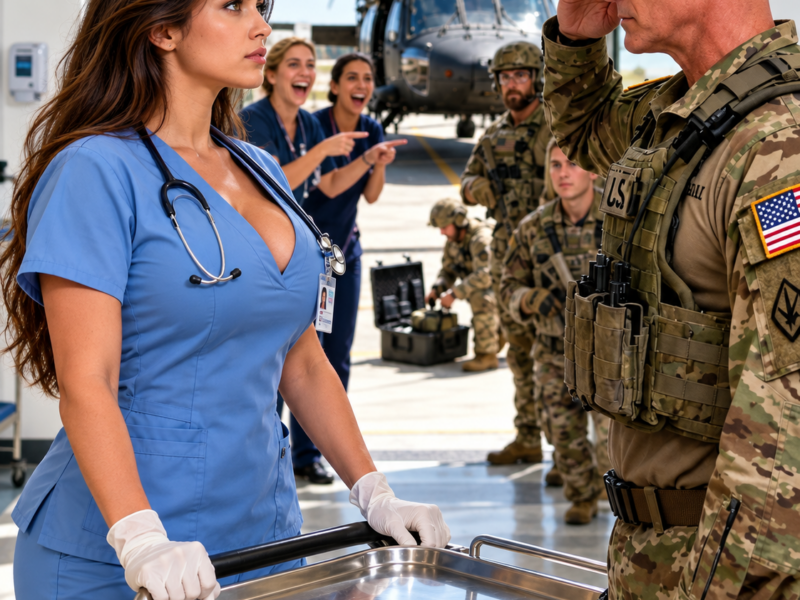
“I was standing in the emergency room at Harbor Point Medical Center when the attending physician laughed at my warning, told security to escort me out
I looked from the black medical case to Dr. Collins, waiting for him to explain why a man who had spent the last ten minutes treating me like an inconvenience was suddenly afraid to look away from a piece of luggage.
“Nobody touches that case,” Commander Whitaker said through the speaker.
Collins recovered first.
“Commander, with all due respect, you cannot dictate how we manage a patient’s personal belongings.”
“I’m not dictating anything about his belongings. I’m telling you that the case may contain material relevant to a classified medical incident, and I need your staff to preserve it until the appropriate personnel arrive.”
“Classified?” Collins gave a short, disbelieving laugh. “This is an emergency room, not a military installation.”
“Then perhaps you should have no objection to waiting five minutes before opening it.”
Collins looked toward the trauma bay.
The resident had stopped preparing the medication. Megan stood beside the phone, her hand hovering over the speaker button, while the two security officers who had escorted me out exchanged uneasy glances.
I had seen people become defensive when they were embarrassed.
This was different.
Collins wasn’t angry that the commander had challenged his authority. He looked as though he was calculating how much time he had left.
“Elena,” Megan whispered, “what do we do?”
I didn’t answer immediately.
Daniel Mercer’s monitor had begun sounding an alarm, and I could see his chest rising in shallow, irregular movements.
Whatever was inside that case, we couldn’t let it distract us from the man dying ten feet away.
“Get the rapid response team,” I told her. “And ask the physician on duty to reassess him now.”
Collins turned sharply.
“I haven’t released you to resume patient care.”
“I didn’t ask you to.”
The words came out before I could soften them.
For the first time that night, I didn’t lower my eyes.
The resident stepped back from the medication tray.
“Dr. Collins, his pressure is dropping again.”
Collins hesitated.
It lasted perhaps two seconds, but in an emergency room, two seconds can feel like a decision everyone will remember.
“Hold the medication,” he finally ordered.
The resident put the syringe down.
I moved toward the trauma bay, but Collins stepped into my path.
“You are not assigned to that patient.”
“Then assign someone who will listen to what he’s telling us.”
His jaw tightened.
Before he could respond, the commander’s voice cut through the speaker.
“Dr. Collins, I need you to listen carefully. The medication you were preparing may be dangerous for this patient because of a documented adverse reaction. We transmitted that alert to your hospital before the ambulance arrived.”
Collins stared at the phone.
“I never received it.”
“Your hospital’s receiving system acknowledged it.”
“Then the system failed to route it to me.”
“That is something your administration can investigate. Right now, you need to ensure the patient’s care team has the information.”
The words were measured, but I could hear the anger beneath them.
Collins stepped away from the doorway and motioned for me to enter.
It wasn’t an apology.
It was an admission that, at least for the next few minutes, he needed me.
I returned to Daniel’s bedside.
His skin had grown paler, and the bruising along his neck was more pronounced beneath the harsh fluorescent lights. I checked his identification band, reviewed the available records, and gave the incoming physician a concise report of everything I’d observed.
The new attending, Dr. Priya Shah, arrived within minutes.
She listened without interrupting, examined Daniel herself, and immediately ordered further assessment while the team worked to stabilize him.
“Elena, stay with me,” she said. “Tell me exactly what he said when he came in.”
I repeated his warning about the blue medication.
“And he said nothing else?”
I hesitated.
“He gripped my wrist and looked toward Dr. Collins before he spoke. He seemed afraid that someone might hear him.”
Dr. Shah glanced toward the black case.
“Then we should find out why.”
Commander Whitaker instructed us not to open it until his designated representative arrived, but he also agreed that the medical team could document its location and condition.
A hospital administrator appeared with a security supervisor and asked everyone to preserve the scene around the case.
Collins stood near the foot of the bed, silent now.
I noticed he had stopped looking at me altogether.
About fifteen minutes later, Daniel’s breathing became more regular, though he remained unconscious. Dr. Shah continued working through the possible causes of his condition, and the team prepared for additional testing.
I stayed beside him, watching the monitor and trying to make sense of the commander’s words.
A sailor had died.
My name had appeared in the report.
And somehow, the man in front of me had brought a case that made the chief of emergency medicine look as though he had just heard a sentence he had been dreading for years.
I had never served in the military.
I’d never worked in a military hospital.
So why did Commander Whitaker know my name?
The answer began four years earlier, in a hospital in North Carolina.
Back then, I was working at a regional medical center outside Jacksonville, where I had taken a temporary position after my younger brother, Mateo, died.
Mateo had been twenty-seven.
He was a Navy corpsman attached to a training unit, a careful young man who labeled everything, checked every dosage twice, and called me on Sunday evenings to complain about the terrible coffee on base.
He had been the person who taught me that the smallest details often mattered most.
He was also the person who had convinced me to become a nurse.
When he died during a military training exercise, the official explanation was a sudden medical crisis complicated by an unexpected reaction to medication.
The investigation found no evidence of misconduct.
The report described the event as tragic but unavoidable.
I remembered sitting at my kitchen table with the report open in front of me, reading the same three pages until the words blurred.
There was one detail I couldn’t accept.
Mateo had called me the night before he died.
He had sounded exhausted, but not sick.
“Elena, if something happens at work, promise me you’ll read the paperwork yourself.”
I had laughed because I thought he was being dramatic.
“What paperwork?”
“Just promise me.”
I promised.
The next morning, a Navy officer knocked on my apartment door.
By the time I received the report, I had already been told that Mateo’s death was a medical tragedy and that no one could have predicted it.
I spent months trying to reconcile that explanation with the brother I knew.
Then, during the final weeks of the investigation, I was asked to review a set of medical records because I had nursing experience.
I noticed a discrepancy between the medication listed in the official summary and the medication recorded in the treatment notes.
It wasn’t enough to prove what had happened, but it was enough to warrant another look.
I flagged it.
The discrepancy disappeared from the revised summary.
When I questioned the change, I was told the original notation had been a clerical error.
I couldn’t prove otherwise.
I didn’t know who had changed it or why.
Eventually, I stopped asking questions because every answer led to another closed door.
I returned to work, moved north, and tried to build a life that wasn’t organized around the last phone call I’d ever had with my brother.
I never forgot the discrepancy.
I never told anyone at Harbor Point about it.
Now Commander Whitaker was telling me my name had appeared in another report.
And Daniel Mercer had arrived carrying a black case.
“Elena?”
Dr. Shah’s voice brought me back to the trauma bay.
“His identification confirms the name, but there’s another alert coming through.”
She showed me the screen.
The medical record contained a reference to a documented reaction during a previous military medical incident. The underlying details were restricted, but the alert matched the warning Daniel had given us.
“That explains why he was concerned,” she said. “It doesn’t explain why the information didn’t reach our team.”
Before I could respond, the hospital administrator approached with a man in a dark suit and a woman carrying a secured document pouch.
The man introduced himself as a representative of the Navy’s medical investigation office.
“I’m here to take custody of the case and coordinate with the hospital,” he said. “Commander Whitaker asked that Nurse Vasquez remain available.”
Collins immediately stepped forward.
“I’ll be handling the hospital’s side of this.”
The representative looked at him.
“Of course, Doctor. We’ll need the names of everyone who accessed the patient’s electronic record before arrival.”
Collins’s expression barely changed.
“That information will need to come through administration.”
“It will.”
The representative turned to me.
“Ms. Vasquez, did you see anyone handle the case after the patient arrived?”
“No.”
“Did you open it?”
“No.”
“Did you notice anything unusual about its condition?”
I thought about the open zipper.
“It was partially open when I first noticed it. I can’t say whether it arrived that way.”
He wrote something down.
Then he looked at the administrator.
“We’ll need a secure room and a documented chain of custody.”
The case was photographed, sealed, and transferred to a secure hospital office.
I expected the matter to end there, at least until the Navy completed its review.
I was wrong.
Less than an hour later, Commander Whitaker arrived in person.
He was in his early fifties, with silver beginning to show at his temples and the tired expression of someone who had spent too many years delivering news people didn’t want to hear.
He introduced himself to Dr. Shah and the hospital administrator, then turned to me.
“Nurse Vasquez, thank you for recognizing the warning.”
“I didn’t do anything special. I listened to the patient.”
“That is precisely what made the difference.”
He glanced toward the closed office where the case had been secured.
“Before we discuss what’s inside, I need to explain why I requested you.”
I folded my arms, partly to keep my hands from shaking.
“You said my name was in a report about a sailor who died.”
“Yes.”
“Was it my brother?”
His face changed.
Not dramatically. He simply stopped speaking for a moment, as if he had hoped to approach the truth from another direction.
“Mateo Vasquez,” he said quietly.
The hallway seemed to narrow around me.
“You knew him?”
“I worked with the team that reviewed his death.”
“Then why did the report say the medication reaction was unavoidable?”
“Because that was the conclusion reached by the original investigation.”
“Was it wrong?”
Whitaker glanced at the people standing nearby.
“Some of its findings were incomplete.”
I took one step toward him.
“That isn’t an answer.”
“No,” he said. “It isn’t.”
For a moment, I hated him for the restraint in his voice.
I had spent four years hearing polished explanations from people who wanted me to accept that my brother’s death was simply a terrible thing that happened.
I didn’t want another official telling me to be patient.
“I flagged a discrepancy in his medical records,” I said. “Someone changed the summary afterward. Did you know that?”
Whitaker looked directly at me.
“I learned about the discrepancy during a subsequent review. I did not know the extent of your involvement until tonight.”
“Who changed it?”
“We’re still establishing that.”
“And the medication?”
“That is part of what we need to investigate.”
I felt the old frustration rising, hot and familiar.
“You’re asking me to trust another investigation when the last one couldn’t even preserve the original records.”
“I’m asking you to look at the evidence before deciding what it means.”
It was a fair request.
I hated that it was fair.
He led us into a small conference room away from the emergency department. Dr. Shah remained with Daniel, while the administrator arranged for the hospital’s legal and compliance teams to join us.
The sealed case was placed on the table.
Whitaker examined the seal, confirmed the documentation, and waited while the representative recorded the time and everyone present.
Then the case was opened.
Inside were several labeled medication containers, a compact medical device, a folded paper envelope, and a small digital recorder.
The labels had been partly worn away, but one of the containers bore a handwritten warning.
I leaned forward.
The lettering was familiar.
I had seen Mateo’s handwriting on birthday cards, grocery lists, and notes he’d left on my refrigerator when he visited.
This looked like his.
I stared at the label.
“Where did this come from?”
Whitaker didn’t answer immediately.
The representative photographed the container and placed it in a clear evidence sleeve.
“We’ll need to authenticate the writing and determine the item’s history.”
I barely heard him.
My fingers had gone cold.
“Commander, why does this have my brother’s handwriting on it?”
Whitaker sat down across from me.
“Daniel Mercer was assigned to a medical safety review after Mateo’s death. He believed the original investigation had overlooked a problem with how certain medications were stored, identified, and administered.”
I looked at the containers.
“You’re saying my brother found a problem before he died?”
“We believe he raised concerns about a medication protocol. We have records showing he requested a review.”
“Why wasn’t that in the report?”
“That is one of the questions we’re trying to answer.”
The room went quiet.
For years, I had imagined my brother’s final days as a sequence of ordinary moments interrupted by an inexplicable medical emergency.
Now I was being told that, before he died, he might have been trying to warn someone.
And someone might have failed to listen.
“Why did Daniel bring this here?” I asked.
Whitaker opened the document pouch and removed a printed timeline.
“Daniel had been helping investigators reconstruct the chain of events. He was scheduled to meet with us tonight, but he never arrived. His vehicle was found off the highway.”
“Was it an accident?”
“We don’t know yet.”
The words landed harder than I expected.
I thought of Daniel gripping my wrist, pleading with me not to give him the blue medication.
“Did someone try to hurt him?”
“We have no evidence of that at this point. I don’t want you drawing conclusions before the facts are established.”
I nodded, but my eyes had returned to the recorder.
“What’s on that?”
“We haven’t reviewed it yet.”
“Can we?”
Whitaker looked at the representative, who explained that the recorder would need to be examined and documented before its contents could be used as evidence.
I understood the reason.
I also understood that every minute mattered to someone who had spent years waiting for answers.
Then the recorder’s display lit up.
A small red indicator blinked beside a number.
The representative frowned.
“That’s unexpected.”
He checked the device without pressing any buttons.
“It may have been recording when it was packed.”
Whitaker asked everyone to step back while the device was photographed and its condition documented.
After the initial checks, the representative connected it to an isolated workstation and opened the first available file.
The audio began with a rustle of paper and the distant hum of machinery.
Then a man’s voice spoke.
“I’ve reviewed the medication records again. The discrepancy is not a clerical error.”
I recognized the voice before the next sentence.
Mateo.
My brother sounded tired, but unmistakably himself.
“If anyone finds this, the original records should still exist in the archived system. The revised summary leaves out the warning, and it changes the sequence of events.”
I pressed my fingertips against my mouth.
The recording continued.
“I’ve sent copies to the people responsible for reviewing this. If the records are corrected, the patient safety issue can still be addressed. I don’t want anyone else getting hurt.”
There was a pause.
Then another voice, too faint to identify, said something about the review being closed.
Mateo answered, “Then I want my objection attached to the final report.”
The file ended.
Nobody spoke for several seconds.
I could hear the air conditioner clicking on above us.
Whitaker finally broke the silence.
“That recording is one reason Daniel continued the review.”
“How did he get it?”
“We don’t know yet.”
“How long have you had it?”
“We didn’t have this recording before tonight.”
I looked at him sharply.
“Then how did you know to ask for the case?”
“Daniel sent an encrypted message before he disappeared. He said he had evidence related to the original investigation and instructed us to look for a black medical case if he was incapacitated.”
“And he mentioned me?”
“He asked that you be contacted if he could not explain the material himself. He believed you might recognize the handwriting and understand why the warning mattered.”
I looked down at the container sealed in plastic.
Four years of questions had led me to a handwritten label and a voice I had not heard since before my brother died.
But the recording did not prove that anyone had deliberately harmed Mateo.
It did not identify the person who had altered the summary.
It did not explain why Daniel had arrived injured and frightened.
It was evidence of a problem, not yet proof of a crime.
I needed to remember that distinction.
“Who had access to the original records?” I asked.
Whitaker slid the timeline toward me.
“We’re building that list now.”
The hospital administrator, who had remained quiet for most of the meeting, cleared his throat.
“There’s something else you should know.”
We turned toward him.
“Our electronic audit system shows that someone accessed Daniel Mercer’s record shortly before his ambulance arrived.”
Whitaker leaned forward.
“Who?”
“The access log is being reviewed. We have not yet confirmed whether the account was used by its assigned employee.”
“Can you tell us which department?”
The administrator hesitated.
“Emergency medicine.”
My gaze moved toward the door.
Dr. Collins.
I remembered the way he’d reacted when the commander mentioned the alert.
His insistence that he had never received the information.
His eyes fixed on the black case.
But suspicion was not evidence.
“Could that access have been routine?” I asked.
“Possibly,” the administrator said. “We need to establish exactly what was opened and when.”
Whitaker nodded.
“Then we establish it.”
He turned back to me.
“Ms. Vasquez, I understand that this is personal. I also need you to understand that any allegation must be supported by evidence. If someone altered records or interfered with the investigation, we will pursue it. But we cannot decide who is responsible based on a reaction in a hallway.”
I appreciated that he said it plainly.
I also knew he was right.
When I returned to the emergency department, Dr. Shah told me Daniel had been transferred for further evaluation and was stable enough that the immediate crisis had passed.
I stood beside his bed for a moment.
His eyes were open.
“Mr. Mercer?”
He turned his head toward me.
“You’re Vasquez,” he whispered.
“Elena Vasquez. Yes.”
He tried to sit up, then winced.
“Did you find it?”
“We found the case.”
His eyes closed briefly.
“Good.”
“Daniel, I need to ask you about my brother.”
He looked at me again.
“Mateo?”
I nodded.
He swallowed.
“He told me you listened.”
I pulled a chair closer to the bed.
“What happened to him?”
Daniel stared at the ceiling.
“I can’t tell you everything. Not yet. I need to make sure the records are safe first.”
“Are you afraid someone will destroy them?”
“I’m afraid people will decide what they mean before they read them.”
I sat quietly.
He was asking for the same thing Whitaker had asked of me.
Evidence first.
Conclusions afterward.
“Did someone hurt you tonight?” I asked.
Daniel turned toward the door.
“I don’t know.”
It was the first honest answer I’d heard all night.
He explained that he had been driving to meet Whitaker when another vehicle appeared behind him. He remembered headlights, a sudden movement near an exit, and the impact that sent his car off the road.
He couldn’t say whether the other driver had deliberately forced him off the highway or whether it had been an accident.
He remembered the black case beside him.
He remembered calling for help.
And he remembered telling the paramedics not to give him the medication he’d reacted to during an earlier treatment.
“Why were you so afraid?” I asked.
“Because I knew what was in the case, and I didn’t know who could be trusted with it.”
He looked at me with exhausted eyes.
“Then I saw the doctor’s badge.”
“Dr. Collins?”
Daniel didn’t answer directly.
“I’d seen his name before.”
My stomach tightened.
“Where?”
“On the review paperwork.”
I leaned closer.
“Was he involved in my brother’s death?”
Daniel took a slow breath.
“I don’t know what he did. But his name was on a document connected to the medication review.”
That was all he could tell me before the nurse asked me to give him time to rest.
I left the room with the weight of his words pressing against me.
A name on a document was not proof of guilt.
But it was enough to make the audit trail urgent.
The hospital administrator and compliance team worked through the night to preserve the electronic records, while Whitaker’s office coordinated with investigators handling the original military review.
By morning, the first findings were available.
The account that accessed Daniel’s record had been assigned to Dr. Collins, but the log alone could not establish who had been sitting at the computer.
The system showed that the military alert had reached the hospital’s receiving platform.
It also showed that the alert had been opened, then marked as reviewed before the patient arrived.
Collins insisted he had not seen it.
The hospital suspended his access to the record system while an independent review determined whether the account had been used by someone else.
He was furious.
“This is an administrative failure being turned into a personal accusation,” he told the hospital director.
No one accused him of a crime that morning.
No one cleared him, either.
For the first time, his confidence was not enough to end the conversation.
Two days later, Daniel was well enough to give a formal statement.
He confirmed that Mateo had raised concerns about a medication protocol and that he had helped collect records for a subsequent safety review.
He also confirmed that the black case contained copies of documents that might establish how the original report had been changed.
Investigators found that the original record and the revised summary did not match.
A medication warning appeared in the original documentation but was absent from the final summary.
The sequence of events had also been changed.
Those differences warranted a formal investigation, but they still did not establish who had made the changes or why.
The inquiry took months.
I returned to work, though I found myself checking every alert twice and asking questions even when the room grew uncomfortable.
Some colleagues supported me.
Others thought I’d become too cautious.
I stopped trying to convince them.
I had learned that speaking up was not the same as being right about every suspicion.
It meant refusing to ignore evidence simply because the truth might inconvenience someone important.
In the third month of the investigation, I received a call from Commander Whitaker.
“We’ve identified the person who revised the report,” he said.
I gripped the edge of my desk.
“Who?”
“A records contractor working under the original review team. The contractor removed the medication warning from the final summary after receiving a request to standardize the document.”
“Who requested it?”
“We’re still investigating whether that request was authorized and whether anyone understood the significance of the change.”
I closed my eyes.
“Was it Dr. Collins?”
“We have no evidence that he personally altered your brother’s report. His name appears in related correspondence, but we are not going to treat that as proof of wrongdoing.”
I let out a breath I hadn’t realized I was holding.
I had wanted a clear villain for four years.
Someone to blame.
Someone whose punishment would make the years of uncertainty feel less cruel.
Instead, the truth was unfolding through a series of decisions, missing safeguards, and people who had treated a warning as paperwork rather than a reason to stop and look again.
That did not make the consequences smaller.
It made them harder to explain away.
The investigation ultimately found that the original review had been inadequate and that the report’s revisions had concealed a material safety concern, whether through negligence or an improper attempt to close the matter quickly.
The evidence did not establish that Mateo had been deliberately harmed.
It did establish that his warning deserved a fuller investigation than it received.
The military reopened the case, corrected the record, and introduced new procedures for documenting medication alerts and preserving objections in medical reviews.
Daniel testified about the documents he had recovered.
The vehicle incident remained under investigation, and authorities could not determine whether the crash had been deliberate.
I never received an answer to every question.
But I received something I had stopped believing was possible.
A corrected report bearing my brother’s name.
The revised findings acknowledged that Mateo had raised a legitimate safety concern and that his concerns had not been adequately addressed.
When I read the document, I did not cry immediately.
I sat at my kitchen table with both hands around a mug of coffee that had gone cold, looking at the page where his name appeared.
Then I remembered his Sunday calls, his terrible jokes, and the way he used to label leftovers in my refrigerator because he claimed I couldn’t be trusted to identify anything in a plastic container.
A laugh escaped me before the tears came.
For years, I’d remembered him mainly through the way he died.
That morning, I finally remembered how he had lived.
Dr. Collins eventually returned to clinical duties after the hospital’s review found insufficient evidence to conclude that he had knowingly ignored the alert or intentionally endangered Daniel. He received additional training and remained subject to oversight while the hospital revised its emergency notification procedures.
He never became the man who apologized dramatically in front of the entire staff.
His apology came quietly, several weeks later, in an empty corridor outside the emergency department.
“I should have listened to you,” he said.
I waited.
“I was convinced I knew what I was looking at, and I treated your concern like a challenge to my authority.”
He looked down at his hands.
“That was wrong.”
I could have told him that he had humiliated me, threatened my career, and nearly convinced me that speaking up was pointless.
Instead, I said, “The next nurse who questions you might be the only person in the room who has noticed something important.”
“I know.”
I studied his face, trying to decide whether the apology changed anything.
It didn’t erase what had happened.
But I believed he understood the danger of repeating it.
“Then prove it when it matters,” I said.
He nodded and walked away.
Months later, Daniel sent me a short letter thanking me for listening when he could barely speak.
He included a copy of the final safety findings and a photograph of Mateo from a training day, smiling beside a group of sailors.
I framed the photograph and placed it on a shelf beside my nursing license.
Not because I wanted to turn my brother’s death into a lesson for strangers.
Because I wanted to remember that the person behind every chart had a life that could never be reduced to a diagnosis, a medication order, or a line in a report.
I still work at Harbor Point.
I still respect the physicians who make difficult decisions under pressure, and I still know that a nurse’s concern can be mistaken.
But when a patient says, “Please don’t give me that,” I no longer hear an obstacle to treatment.
I hear a person asking to be understood.
And whenever someone in a white coat looks irritated because I have asked one more question, I remember Daniel’s hand closing around my wrist, the black case beside his bed, and the voice of a Navy commander filling a crowded nurses’ station.
The night I was removed from that trauma bay, I thought the worst thing I could lose was my reputation.
I was wrong.
The worst thing would have been learning to stay silent just to keep it.
The end.









