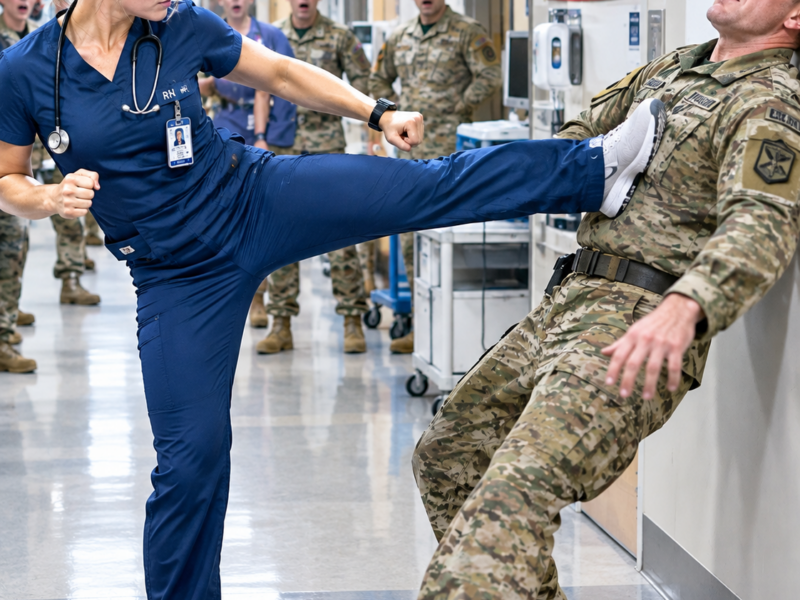
“I was standing in front of 700 Marines at Camp Pendleton when the combat instructor shoved me hard enough to send me stumbling across the gravel
I kept my eyes on Daniel Rourke while I folded the photograph and slipped it into my pocket.
“Everyone else can return to training,” I said. “Corporal Reed stays here until I’ve examined his ankle.”
Rourke’s jaw shifted.
“You don’t give orders to my instructors.”
“No,” I replied. “I give medical instructions concerning injured personnel. If you’d like to challenge that authority, we can do it in front of the commanding officer.”
For several seconds, neither of us moved.
Then he turned sharply and walked toward the administrative building.
I watched him go before kneeling beside Mason.
“Corporal, I need you to tell me what happened during that exercise.”
He stared at the ground.
“I twisted my ankle, ma’am.”
“I know that part. I’m asking about the photograph.”
His face drained of color.
I hadn’t shown it to him, yet he knew exactly what I meant.
“Who gave you that envelope?” he asked.
“I was hoping you could tell me.”
Mason shook his head. His hands were clasped so tightly that his knuckles had turned white.
“Please don’t put my name in anything.”
“Why?”
“Because I have a wife and a little girl. I’m supposed to be home next month. If I get flagged for insubordination, that could change.”
I sat back on my heels.
There it was. Not cowardice, as some people might have called it, but a young father calculating how much truth his family could afford.
“I’m not going to promise you that speaking up will be easy,” I told him. “I can promise you that I won’t put words in your mouth or ask you to lie.”
He studied my face.
“Chief Cole said you’d say something like that.”
The name struck harder than I expected.
“Nathan spoke to you?”
Mason looked toward the administrative building.
“He told me if anything happened to him, I should find the nurse who wouldn’t leave a patient behind.”
Before I could ask another question, two corpsmen arrived with a stretcher.
I helped them move Mason to the medical station, examined his ankle, and ordered imaging through the base medical facility. It was a significant sprain, possibly involving a fracture. He would not be returning to training that day.
While the corpsmen prepared him for transport, I stepped into the tent and called the number I had memorized years ago.
It went straight to voicemail.
Nathan Cole had once answered every call with a joke, even when he was exhausted or standing watch in miserable weather. After his career collapsed, he’d stopped answering mine.
I tried again.
Nothing.
I left a message.
“Nathan, it’s Claire. I received a photograph from the exercise eight months ago. Rourke is in it. I need to know what happened.”
I hesitated before ending the call.
Then I added, “If you were trying to warn me, I’m listening.”
When I stepped outside, the petty officer who had delivered the envelope was waiting beside the tent.
He looked even more uncomfortable than before.
“Commander, there’s something else.”
“Go ahead.”
“The person who gave me that envelope told me not to let Staff Sergeant Rourke see it.”
“Did you see who it was?”
“No, ma’am. He wore a hood, and he kept his face turned away. But he knew my name, my unit, and exactly where I’d be standing.”
“Man or woman?”
“Man, I think.”
“What else did he say?”
The petty officer swallowed.
“He said, ‘If Bennett gets the picture, the clock has started.'”
I looked at him carefully.
“Did he explain what that meant?”
“No, ma’am.”
I thanked him and sent him back to his duties.
For the next hour, I examined the medical records available to me, cross-checked the exercise schedules, and documented my interaction with Rourke. I didn’t need to prove misconduct yet. I needed to establish a reliable timeline.
The first discrepancy appeared in the incident summaries.
Eight months earlier, a Marine named Lance Corporal Evan Brooks had been injured during a vehicle-extraction drill. The official report described a routine fall, no equipment failure, and no evidence of instructor misconduct.
The second report concerned Nathan Cole.
According to the record, Nathan had failed to follow an established casualty-evacuation protocol, resulting in an injury that could have been prevented.
His assignment had been terminated shortly afterward.
But the photograph told a different story.
In the image, the training vehicle was overturned at an angle that made no sense for a routine fall. A section of its restraint assembly appeared to be detached. Rourke stood beside it, holding a clipboard, while Nathan knelt near the injured Marine.
Nathan wasn’t walking away from the casualty.
He was treating him.
I enlarged the photograph on my secure workstation and examined the background. The vehicle’s identification number was partly obscured by dust, but enough remained to identify the training unit.
I wrote the number down.
Then I noticed something else.
Rourke was wearing a red instructor’s armband.
According to the training schedule, he had not been assigned to that exercise.
I checked the schedule twice.
His name appeared on a separate medical-readiness evaluation that had taken place at another facility that same morning.
Either the schedule was wrong, or someone had placed him at two locations at once.
At 11:40 a.m., I submitted a formal request for the original incident file, including the equipment inspection logs and witness statements.
At 11:47, the request was denied.
The reason given was administrative restriction.
At 11:51, my access to the training database was suspended pending authorization from the exercise director.
I leaned back in my chair.
That was fast.
I had been careful to use the appropriate channels. I hadn’t distributed the photograph or accused anyone of falsifying records. I’d simply requested the documentation necessary to perform my assigned evaluation.
Someone had been watching.
My phone rang.
An unfamiliar number appeared on the screen.
“Commander Bennett?”
“Speaking.”
“This is Major Thomas Hale, executive officer for the training group. I need you to report to the administrative building immediately.”
“Is this about my records request?”
“It’s about your conduct this morning.”
“Understood. I’ll be there shortly.”
He ended the call without another word.
I saved my notes, locked my workstation, and walked across the compound.
The administrative building smelled of floor polish and stale coffee. A television in the reception area played a muted news broadcast, while a junior officer sat behind the desk, pretending not to watch me.
Major Hale was waiting in a conference room.
Rourke sat beside him.
A third man, Colonel Michael Vance, commanded the training group. I’d met him briefly on my first day. He had seemed professional, though distant, and had spent most of the introduction discussing readiness metrics and operational schedules.
Now he sat at the head of the table with his hands folded.
“Commander,” Vance began, “we understand you had an unfortunate interaction with Staff Sergeant Rourke.”
“An injured Marine required medical attention. Staff Sergeant Rourke attempted to prevent my assessment, then made physical contact with me.”
Rourke let out a quiet laugh.
“She stumbled. I was directing personnel through a crowded training area.”
I looked at him.
“You placed both hands against my shoulders and pushed.”
“That’s your interpretation.”
“No. That’s what happened.”
Colonel Vance raised a hand.
“Let’s keep this professional.”
“I agree, sir.”
He slid a document across the table.
“This is a preliminary statement prepared by Staff Sergeant Rourke. It says you entered an active training lane without authorization, interfered with the exercise, and became confrontational when redirected.”
I read the page.
It was written carefully enough to sound reasonable to someone who hadn’t been present.
There was no mention of Mason’s condition. No mention of my request to examine him. No mention of the shove.
“Who witnessed the incident?” I asked.
“Several personnel,” Hale answered.
“Then their statements should establish what occurred.”
“That’s why we’re asking you to submit your account.”
“I will. But I would also like to ensure that the statements are collected independently.”
Rourke leaned forward.
“You’re making this much bigger than it needs to be.”
I turned to him.
“You made it bigger when you chose to put your hands on me instead of allowing me to examine an injured Marine.”
His chair scraped against the floor.
Colonel Vance’s voice hardened.
“Staff Sergeant, sit back.”
Rourke obeyed, but his eyes remained on me.
I placed my own written statement on the table.
“I also have concerns regarding discrepancies in previous medical incident reports.”
The room went quiet.
Major Hale looked at Vance.
Vance didn’t look at him. He looked at me.
“What reports?”
“The incident involving Chief Petty Officer Nathan Cole and Lance Corporal Evan Brooks, approximately eight months ago.”
Rourke’s expression became unreadable.
Vance slowly unfolded his hands.
“That matter was investigated and closed.”
“Then the original documentation should support the findings.”
“It does.”
“May I review it?”
“No.”
“Why not?”
“Because this isn’t your investigation.”
“Then who is conducting it?”
Vance’s eyes narrowed.
“Commander, you’re here to assess medical readiness, not reopen personnel matters that have already been resolved.”
“I understand my assignment, sir. But if the medical records are inaccurate, they directly affect readiness.”
“That’s enough.”
His tone ended the discussion, at least on the surface.
He dismissed me with instructions to submit any further concerns through the chain of command.
As I stood, he added, “I’d strongly recommend that you focus on your actual duties. Reputations are easily damaged when people make assumptions without the full facts.”
I met his gaze.
“I agree, sir. That’s why I’m asking for the facts.”
For a moment, I thought he might order me to sit back down.
Instead, he nodded toward the door.
I walked out without another word.
Outside, I stopped beneath the building’s narrow awning and took a slow breath.
My hands were steady, but my thoughts were moving quickly.
Rourke had expected me to react emotionally after the shove. He’d wanted me to argue, raise my voice, or make a statement he could use against me.
When that failed, the request for records had been blocked.
Now the colonel himself had warned me away from an incident involving an injured Marine and a dismissed chief petty officer.
That wasn’t proof of a cover-up.
But it was enough to make me question who had benefited from closing the investigation.
My phone vibrated.
A message had arrived from an unknown number.
Stop looking at the photograph. Look at the inspection log.
A second message followed.
Bay Four. 1900. Come alone.
I stared at the screen.
The training facility had several equipment bays, but Bay Four was part of the older vehicle-maintenance area. It was rarely used during active exercises.
I didn’t reply.
Instead, I took screenshots of the messages, recorded the time, and forwarded the information through the appropriate secure reporting channel. Then I called the base security office and requested guidance regarding an anonymous message directing me to an isolated facility.
The officer who answered took the details and advised me not to go alone.
That evening, I arrived at Bay Four with a security investigator positioned nearby and another officer monitoring the surrounding access road.
I had no intention of walking into a trap simply because someone had learned how to type an ominous text.
The bay doors were partly open.
Inside, a single work light illuminated a maintenance bench. Dust covered the unused equipment, and the air smelled of old rubber and machine oil.
A man stood beside the bench with his back to me.
He turned when he heard my footsteps.
Nathan Cole looked older than he had eight months earlier. His hair had grown longer, and a pale scar ran from his left temple toward his ear. He was wearing civilian clothes, but his posture remained unmistakably military.
For a moment, neither of us spoke.
Then he looked past me toward the open doors.
“You brought security.”
“I brought people who know where I am.”
A faint, tired smile crossed his face.
“Still the same Claire.”
“You’re the one who sent the photograph?”
“Yes.”
“Why didn’t you call me?”
He glanced down at his hands.
“Because I didn’t know who was listening.”
I took the photograph from my pocket and held it up.
“Start here.”
Nathan studied the image as though it belonged to someone he had once known.
“That morning, Brooks was supposed to run a standard extraction drill. The vehicle’s restraint assembly had failed its inspection two days earlier. I flagged it.”
“Where’s the inspection report?”
“That’s what I spent months trying to find.”
He explained that the vehicle had been removed from the active equipment list after the inspection, then returned to service under a different maintenance classification.
The replacement entry carried the authorization of a senior training official.
“Did you see who signed it?”
“I saw the copy. The signature was supposed to be Colonel Vance’s.”
“Supposed to be?”
Nathan nodded.
“The digital record and the printed copy didn’t match. I raised the issue before the exercise.”
“And Rourke?”
“He told me the equipment had been cleared. When I refused to let the drill proceed, he said I was undermining the training program.”
Nathan rubbed his thumb against the side of his hand.
“Then someone else took responsibility for the final safety check. The exercise went ahead.”
The vehicle rolled during the extraction.
Brooks was thrown against the interior frame and suffered serious injuries. Nathan reached him first and stabilized his neck while the other personnel secured the scene.
He did what his training required.
But when the incident report was completed, the equipment failure had disappeared.
The report said Nathan had ordered an unsafe maneuver and failed to follow the evacuation protocol.
“Why would they blame you?” I asked.
“Because I had documented the original defect. If the equipment had been used after I reported it, the next question would have been who authorized it.”
He looked at me.
“They couldn’t make the defect disappear without explaining why I had raised it. So they made me the problem.”
“Did you appeal?”
“For months. I submitted copies, requested a formal review, and contacted people who should have been able to help.”
“What happened?”
“Every request came back with the same explanation. The findings had been reviewed. The matter was closed.”
“Did you have evidence?”
“I had enough to know something was wrong. Not enough to prove who changed the records.”
He reached into a canvas bag and removed a clear plastic folder.
Inside were copies of maintenance entries, a partial inspection checklist, and a printed email chain.
I read the documents slowly.
The first entry recorded a failed restraint assembly. The next listed the equipment as removed from service.
Three days later, a second entry changed its classification and returned it to the training inventory.
The authorizing signature appeared on the last page.
It looked like Colonel Vance’s.
But Nathan pointed to the timestamp.
“The printed version says 16:20. The electronic export says the authorization was entered at 18:06. The original inspection system was supposed to lock the record after the day’s final review.”
“Could the discrepancy be a routine correction?”
“It could. That’s what I thought at first. But the correction was entered under a maintenance account that had been disabled two weeks earlier.”
I examined the page again.
That was a concrete discrepancy, not proof of criminal conduct, but a lead that could be independently verified.
“Why didn’t you give this to investigators?”
“I did. They said the documents couldn’t be authenticated.”
“Then we need the original system records.”
Nathan nodded.
“There’s more.”
He removed a small envelope from the folder.
Inside was a handwritten statement from Lance Corporal Evan Brooks.
The young Marine described reporting an unusual noise from the vehicle before the drill. He also wrote that an instructor had told the team to proceed because the equipment had already been cleared.
At the bottom of the statement, Brooks had written a sentence that made me read it twice.
Chief Cole told them the vehicle was unsafe, but they said the order had already come from above.
I looked up.
“Why hasn’t this statement been included in the official file?”
“Brooks submitted it before he was transferred to a rehabilitation unit. Later, he told me he’d been asked to withdraw it because he had misunderstood what he saw.”
“Who asked him?”
“He wouldn’t tell me. He was afraid of losing his place in the unit.”
I understood that fear. I had heard it in Mason’s voice that morning.
“Where is Brooks now?”
“He’s still on active duty, but he doesn’t trust the system anymore.”
“Does he know you’re here?”
“No.”
I slid the documents back into the folder.
“We can’t use these to accuse anyone without verifying them. If we submit them through the same chain that blocked my request, we risk losing the originals.”
Nathan nodded.
“I know.”
“I’ll contact an independent investigative authority and request preservation of the relevant records. You should make a formal statement and keep copies of everything.”
He looked at me with a mixture of relief and exhaustion.
“I didn’t bring you here to ask you to fix my career.”
“Good. Because I can’t promise that.”
“I brought you here because Rourke is still training people.”
His voice tightened.
“And the same equipment is still in use.”
That changed the urgency of everything.
“Do you know which vehicles?”
“Not the exact current inventory. But I saw the same model in the yard yesterday.”
I immediately contacted the security investigator waiting outside and reported the possible continuing safety risk. I also requested that the relevant vehicles be secured pending inspection.
The investigator told me that any operational restriction would need to be approved through the appropriate command and safety authorities, but he could initiate an urgent review.
For the first time that evening, Nathan seemed to breathe more easily.
Then he said, “There’s one thing I haven’t told you.”
I waited.
“The person who gave you the photograph wasn’t me.”
I looked at the envelope in my hand.
“Then who was it?”
“I don’t know. Someone has access to the same records. Someone who knew the photograph would reach you before I had decided whether to contact you.”
“Could it have been Brooks?”
“Possibly.”
He hesitated.
“Or someone who was there that morning.”
Before I could ask more, the security investigator appeared at the bay entrance.
“Commander, we need you to come with us.”
His expression was controlled, but his urgency was unmistakable.
“What’s happened?”
“Staff Sergeant Rourke has filed a formal complaint alleging that you’ve obtained restricted records and contacted a former service member about a closed investigation.”
Nathan closed his eyes briefly.
“He’s moving faster than I expected.”
The investigator glanced at him.
“Mr. Cole, we’ll need your account as well.”
Nathan nodded.
I handed over copies of the documents and explained how I’d received them. The investigator recorded the chain of custody and instructed us not to alter, annotate, or circulate the originals.
It wasn’t dramatic. No one shouted or drew a weapon.
But by the time I returned to my quarters, I knew the dispute had moved beyond a hostile instructor and an injured Marine.
Someone had changed records, someone had prevented those records from being examined, and now someone was trying to make the people asking questions look like the problem.
The next morning, I arrived at the training ground before sunrise.
The Marines were assembling for the day’s readiness exercise. Their boots crunched across the gravel, and the air carried the familiar smell of coffee, damp earth, and diesel fuel.
Rourke stood beside the primary training vehicle, speaking to a group of instructors.
When he saw me, he stopped.
I walked directly toward him.
“Staff Sergeant, until the vehicle inspection is completed, I recommend that no further extraction drills use this equipment.”
He gave a thin smile.
“You don’t control the training schedule.”
“I’ve reported a potential equipment-safety issue. The appropriate authorities are reviewing it.”
“Based on what? A photograph?”
“Based on documentation that requires verification.”
He stepped closer, lowering his voice.
“You’re risking your career over a disgruntled former chief and an incident that was settled months ago.”
“I’m not the one who decided to falsify a medical report.”
His expression hardened.
“You’d better be able to prove that.”
“I’m trying to establish what happened. You seem unusually concerned about preventing that.”
A few instructors had turned toward us.
Rourke noticed and stepped back, putting on his familiar public expression of confidence.
“Everyone to the briefing area,” he called. “We have a schedule to keep.”
I watched the Marines move away.
Then a young lieutenant approached me.
“Commander Bennett? I’m Lieutenant Sarah Mitchell. I was assigned to the training group when the Brooks incident occurred.”
I recognized the name from the personnel roster.
“Do you have something to report?”
She looked toward Rourke before answering.
“I saw the inspection checklist before the vehicle was returned to service.”
“Did you sign it?”
“No, ma’am. I was a junior watch officer. I saw it on the maintenance desk, and I remember the defect because the restraint assembly was marked in red.”
“Did you see who approved the return to service?”
She hesitated.
“I saw Staff Sergeant Rourke carry the paperwork into Colonel Vance’s office.”
“Did you see what happened inside?”
“No. But when he came out, he told the maintenance team the colonel had approved the release.”
“Did you report what you saw?”
“I wrote it in my notes. When I asked about the discrepancy later, my notes were collected during a routine records review.”
“Who collected them?”
“Major Hale.”
I kept my voice calm.
“Lieutenant, I need you to understand that any formal statement must be accurate and voluntary. Don’t guess about anything you didn’t personally observe.”
“I understand.”
She swallowed.
“I’ve wanted to say something for months. I just didn’t know whether anyone would listen.”
“I’ll make sure your statement reaches the appropriate investigators.”
She nodded, then walked away before anyone could notice us speaking.
At 8:15 a.m., the training group assembled for a scheduled readiness demonstration.
Seven hundred troops filled the training area, standing in formation beneath the California sun. Senior officers occupied a raised platform near the front, and instructors positioned themselves along the marked lanes.
Colonel Vance stepped to the microphone.
“Today’s exercise will proceed according to the approved training plan.”
He spoke about discipline, accountability, and maintaining operational standards.
I stood near the medical station, watching the personnel and equipment.
The vehicle implicated in the previous incident was parked behind a safety barrier. An inspection team had arrived, but its review was not yet complete.
Rourke stood at the front of the formation.
He looked completely at ease.
Then Colonel Vance called my name.
“Lieutenant Commander Bennett, please join us.”
The crowd shifted as I crossed the training ground.
I hadn’t been told I would address the formation, and I had no prepared speech. I glanced toward the inspection team, then at the officers on the platform.
Vance handed me the microphone.
“Commander Bennett has raised concerns about the safety and documentation of previous exercises,” he announced. “She’ll briefly explain her position.”
It was a calculated move.
He was placing me in front of hundreds of people without giving me the time or resources to present the evidence properly. If I made an unsupported accusation, I would damage my credibility. If I backed down, the existing narrative would remain unchallenged.
I looked across the formation.
Some Marines had witnessed Rourke shove me. Others had heard rumors about the previous incident. Most knew nothing beyond what their instructors had told them.
I wasn’t going to ask them to believe me simply because I wore an officer’s uniform.
“My concern is straightforward,” I began. “When a Marine is injured during training, the medical record must accurately reflect what happened. When equipment is reported unsafe, its status must be verified before it returns to service.”
The formation remained silent.
“These are not personal preferences. They’re essential safeguards. They protect the people who train here, the people who supervise them, and the integrity of the decisions made afterward.”
Rourke crossed his arms.
I continued.
“An incident report from eight months ago contains discrepancies between an equipment inspection record and the final findings. Those discrepancies are being reviewed through the appropriate channels.”
Colonel Vance shifted beside me.
I kept my attention on the Marines.
“I am not asking anyone to reach a conclusion before the evidence is examined. I’m asking that the evidence be preserved and that anyone with firsthand knowledge be allowed to report what they saw without intimidation.”
For the first time that morning, several faces in the formation changed.
A corporal near the front glanced at the Marine beside him.
An instructor at the back lowered his eyes.
I handed the microphone back to Vance.
He accepted it with a rigid smile.
“Thank you, Commander. That will be all.”
But before he could resume, a voice came from the formation.
“Sir, may I make a statement?”
Everyone turned.
Lieutenant Mitchell stood at attention.
Vance’s expression tightened.
“Not at this time, Lieutenant.”
“Sir, I witnessed part of the equipment-release process before the Brooks incident. I have information relevant to the review.”
The silence that followed was heavier than anything I had experienced during a medical emergency.
Vance looked toward Major Hale.
Hale looked down at his clipboard.
Rourke took one step forward.
“Lieutenant, you are out of order.”
Mitchell didn’t move.
“Respectfully, Staff Sergeant, I’m reporting what I witnessed.”
I saw the fear in her face. She was standing in front of hundreds of troops, challenging a senior instructor whose influence had shaped her daily working life.
But she didn’t withdraw her statement.
Then another voice came from the formation.
“Sir, I was on the extraction team that morning.”
A corporal raised his hand.
“I remember the vehicle being pulled from service before the drill.”
Another Marine spoke.
“I heard Chief Cole warn the instructors about the restraint assembly.”
The voices didn’t erupt into a chorus. They came one at a time, hesitant and uneven, each person weighing the consequences before speaking.
That made them more powerful, not less.
Rourke looked toward Vance.
“Sir, this is becoming a circus.”
“No,” Vance replied sharply. “It is becoming a command issue.”
He ordered the formation to remain in place while the senior officers conferred.
I stepped away from the microphone.
My pulse was steady, but my throat felt dry.
The Marines weren’t proving the entire case. They were providing witnesses whose accounts could be independently checked against the records.
That was what we needed.
Then the inspection officer approached the platform carrying a sealed evidence bag.
“Colonel, we have completed the preliminary examination of the vehicle’s restraint assembly.”
Vance turned.
“And?”
“The component currently installed does not match the replacement part listed in the maintenance entry. We also found evidence that the assembly had been removed and reattached using hardware that doesn’t meet the approved specification.”
A murmur passed through the formation.
The officer continued.
“We cannot yet determine who performed the work or when. The vehicle has been secured, and a full technical examination is underway.”
Vance’s face had gone still.
Rourke’s confidence finally faltered.
“That proves nothing about the incident eight months ago,” he said.
The inspection officer looked at him.
“No, Staff Sergeant. It doesn’t. But it raises a serious question about the accuracy of the maintenance records.”
Colonel Vance ordered the exercise suspended and directed that the relevant equipment and records be preserved.
He also instructed that all personnel with firsthand knowledge be interviewed independently.
For the first time since I’d arrived at Camp Pendleton, no one told me to stay in my lane.
But I knew better than to mistake a procedural step for justice.
The investigation continued for several weeks.
The original maintenance database was preserved and examined by personnel outside the training group. Investigators compared the electronic entries with archived backups, access logs, inspection forms, and witness statements.
Lieutenant Mitchell provided her notes and described what she’d seen.
Several Marines confirmed that Nathan had raised concerns about the vehicle before the drill.
Mason Reed, after receiving treatment for his ankle, gave a statement about the injuries he had witnessed during more recent exercises and the pressure he felt not to report them.
His testimony didn’t prove that every injury had been concealed. It did establish a pattern of discouraging medical scrutiny that investigators needed to examine.
I submitted my own statement about the shove and the subsequent restrictions placed on my access to records.
Rourke denied deliberately interfering with medical care.
He claimed that he had been maintaining order during a demanding training exercise and that his contact with me had been incidental.
The witnesses told a different story.
The evidence regarding the earlier vehicle incident was more complicated.
Investigators established that the restraint assembly had failed inspection, had been removed from the active inventory, and had later been returned to service through a maintenance entry that contained irregularities.
The electronic access logs showed that the entry had been made using credentials associated with a maintenance account that should no longer have been active.
That did not, by itself, establish who had used those credentials.
But the archived correspondence revealed that Rourke had received an email warning him that the vehicle was not cleared for use.
His reply was brief.
The release has been approved. Proceed as scheduled.
The message did not prove that Rourke had altered the records himself, but it contradicted his claim that he had been unaware of the unresolved safety concern.
More importantly, investigators recovered an earlier version of the incident report.
It documented Nathan’s warning about the restraint assembly and noted that he had begun treating Brooks immediately after the rollover.
The final report omitted both details.
The revision history showed that the document had been edited after the initial submission. Several paragraphs concerning the equipment defect had been deleted, and the account of Nathan’s actions had been changed to suggest that he had delayed the evacuation.
The edits had been made through an administrative account used within the training group’s command office.
Investigators traced the account to a workstation assigned to Major Hale.
When confronted with the revision history, Hale initially said he had been preparing a summary based on information provided by the instructors.
He insisted he hadn’t intended to falsify anything.
But his explanation changed when investigators produced the archived emails.
He admitted that Vance had asked him to make the final report “consistent with the command’s findings.”
Hale said he believed the equipment issue had already been resolved and that the changes were intended to prevent confusion.
He also admitted that he had collected Lieutenant Mitchell’s notes during the later records review, though he claimed he had done so under routine administrative authority.
The investigation did not accept his explanation without scrutiny.
The evidence showed that he had altered the report and failed to preserve material witness information. Whether he had acted under pressure or out of loyalty to his superiors did not erase the consequences.
Colonel Vance denied directing anyone to conceal an equipment defect.
He said he had approved the exercise based on the information available to him and had relied on the instructors and maintenance personnel to verify the equipment.
But the archived email chain contained a message from Vance asking whether the vehicle could be returned to service before a scheduled demonstration.
The reply warned that the restraint assembly remained unresolved.
Vance’s response was only one line.
I need the schedule maintained. Find a compliant path forward.
Investigators could not determine from that sentence alone what he intended. In context, however, it undermined his claim that he had known nothing about the unresolved issue.
The final findings were not as simple as one villain and one innocent man.
A maintenance supervisor had improperly reused credentials to enter a return-to-service record. Hale had altered the incident report and withheld witness notes. Rourke had proceeded with an exercise after receiving a written warning about the equipment. Vance had pressured subordinates to maintain the schedule despite unresolved safety concerns.
Each action had contributed to a system in which protecting the training program’s reputation had become more important than recording what had happened to the people inside it.
Rourke was removed from instructor duties while the command reviewed the findings. He later faced formal administrative action for his role in the unsafe training decision and for his conduct toward me.
Hale was relieved of his administrative responsibilities and referred for further proceedings.
Vance was removed from command pending the completion of the broader review.
The maintenance supervisor’s role was investigated separately, and the affected equipment remained out of service until it could be inspected and cleared.
Nathan’s record was reopened.
When the review board finally met, he sat across from me in a plain conference room, wearing a clean uniform that seemed unfamiliar on him after so many months away from duty.
He had been offered the opportunity to submit a written statement, but he chose to attend in person.
“I don’t want anyone to tell me I was right because they feel sorry for me,” he said before the proceedings began. “I want them to look at the record and tell me what actually happened.”
That was the same Nathan I remembered.
The board examined the original inspection checklist, the recovered report versions, the email chain, and the witness statements. It also considered the fact that Nathan had raised the safety concern before the exercise and had provided immediate medical assistance when Brooks was injured.
The finding was clear.
The allegations that Nathan had knowingly disregarded the evacuation protocol were unsupported by the evidence. His warning about the equipment had been documented before the incident, and the final report had materially misrepresented his actions.
The board recommended that the adverse findings against him be removed and his service record corrected.
When the chair announced the recommendation, Nathan lowered his head.
He didn’t smile.
He simply pressed his fingertips against the edge of the table and took a long breath.
Afterward, I found him outside beneath a row of eucalyptus trees.
“How do you feel?” I asked.
He considered the question.
“Like I spent eight months trying to prove I wasn’t the person they said I was.”
He looked across the parking lot.
“And now I have to figure out who I am when I don’t have to prove it anymore.”
I stood beside him.
“You don’t have to decide today.”
He gave a small nod.
“Brooks called me last night.”
“What did he say?”
“He apologized for not speaking sooner.”
Nathan looked down at his hands.
“I told him he didn’t owe me an apology for being afraid. I just wish someone had made it easier for him to tell the truth.”
I thought about Mason, about Mitchell, and about the Marines who had hesitated before raising their hands in front of the formation.
“They’re going to remember what happened here,” I said.
“Some of them will. Others will remember the embarrassment, the investigation, the disruption.”
“That doesn’t make the truth less important.”
“No,” he said. “But it makes it harder to get there.”
For several seconds, we watched the wind move through the trees.
Then Nathan turned toward me.
“Thank you for listening.”
“I didn’t do it alone.”
“I know.”
He held out his hand.
I took it, and for the first time in months, the silence between us felt like the end of a difficult conversation rather than the beginning of another one.
The following week, I returned to the training ground to complete my medical-readiness assessment.
The atmosphere had changed, but not in the dramatic way people might have expected.
There were no speeches about courage or public apologies delivered over loudspeakers. The Marines still had early formations, long training days, and equipment inspections that took more time than anyone wanted them to.
But the injury-reporting procedure had been revised.
Medical personnel were given direct access to the documentation necessary to assess training injuries. Equipment discrepancies had to be recorded and resolved before affected drills could proceed. Witness statements relating to serious incidents were to be preserved independently of the initial command report.
The changes would not make every leader honest.
They would make it harder for one person’s authority to erase what another person had seen.
Mason returned to light duty after his ankle healed. When I saw him near the medical station, he approached me with a careful smile.
“Commander, I wanted to thank you.”
“You don’t owe me anything, Corporal.”
“I know. But I wanted to say it anyway.”
He glanced toward the training lanes.
“I used to think keeping my head down was the best way to protect my family.”
“And now?”
“Now I think I’d have to explain it to my daughter if I watched something happen and pretended I hadn’t seen it.”
He looked embarrassed by his own honesty.
I gave him a small nod.
“That’s a difficult thing to learn.”
“Yes, ma’am.”
He started to leave, then turned back.
“Do you think the other guys will trust us if we report things?”
“Some will. Some won’t. Trust takes longer to repair than a procedure.”
He considered that, then headed toward his unit.
Later that afternoon, I stood beside the same training lane where Rourke had shoved me.
The gravel had been smoothed by passing boots and vehicle tires. There was no mark left to show where I’d stumbled, and the formation area looked exactly as it had that morning.
A new instructor was briefing a group of Marines on casualty extraction.
He paused to ask the medical team whether the route was clear.
It was a small question, ordinary enough that nobody else seemed to notice.
I did.
I had come to Camp Pendleton expecting to evaluate medical readiness. I hadn’t expected to uncover a chain of decisions that had cost a good officer his reputation and allowed an unsafe practice to continue.
I hadn’t exposed the truth through rank, force, or a perfect speech in front of seven hundred troops.
I had done it by refusing to accept an explanation that didn’t match the evidence, by documenting what I saw, and by making room for people who had been afraid to speak.
The photograph had brought me to the right question.
The records had helped answer it.
But the people who finally changed the outcome were the ones who decided that silence was no longer the safest choice.
As I walked back toward the medical station, I passed the spot where I’d caught myself after the shove.
I remembered the laughter, Rourke’s dismissive smile, and the way the Marines had watched me brush the gravel from my hands.
For a moment, I had wondered whether remaining silent would have been easier.
It probably would have.
But later, when I thought about Nathan sitting across from the review board, Mason speaking honestly about his fear, and Lieutenant Mitchell standing in front of hundreds of troops, I knew the important moment hadn’t been when I stood up after being shoved.
It had been when I chose not to let humiliation decide what I did next.
I adjusted the strap of my medical bag and continued toward the station, where the next injured Marine would need someone to listen before anyone decided his pain was inconvenient.
THe end









