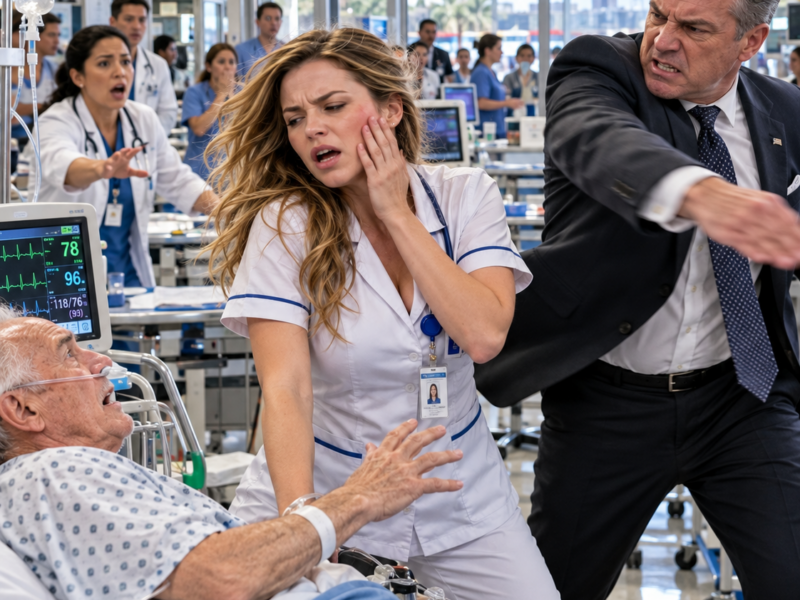
“I was standing beside a dying veteran’s hospital bed when the CEO slapped me across the face in front of six witnesses and ordered security to throw me out
The officer waited for my answer, but I could only stare at him.
“Yes,” I finally whispered. “I’m Daniel Carter’s daughter.”
He gave a small nod, as though he’d just confirmed something he’d spent years hoping was true.
“My name is Commander James Walker. I served with your father.”
Behind him, the two people carrying the document case remained silent.
Richard Vaughn let out a short, irritated laugh.
“This is a private medical facility. Whatever business you have here, you’ll need to schedule an appointment through my office.”
Commander Walker turned toward him.
“Mr. Vaughn, I don’t believe you understand why we’re here.”
“I’m the CEO of this hospital. I understand perfectly well how my facility operates.”
“Then you should understand that striking a member of your nursing staff in front of witnesses is a serious matter.”
Vaughn’s face reddened.
“She was being insubordinate. I was removing an employee who had repeatedly interfered with hospital operations.”
“Interfered?” I asked.
My voice sounded unfamiliar, thinner than I wanted it to be.
“I was trying to get a medication discrepancy checked before a patient received another dose.”
Walker looked at the tablet on the floor.
“Which patient?”
“Chief Petty Officer Thomas Reed. Retired Navy.”
At the sound of his name, Walker’s expression changed.
He crossed the room in three quick steps and approached the bed.
“Chief Reed?”
Thomas managed a faint smile.
“You’re late, Commander.”
Walker exhaled, and for the first time since entering, his composure slipped.
“Traffic was difficult.”
Thomas gave a weak chuckle that turned into a cough.
Walker immediately called for medical assistance.
Vaughn stepped forward.
“Doctor Harris is overseeing this patient’s care. You cannot simply enter a room and begin issuing orders.”
“Then call Doctor Harris,” Walker replied. “And call the hospital’s chief medical officer. We need this patient’s medication history preserved, and we need an independent medical evaluation immediately.”
He turned to the two people behind him.
“Please secure the documents.”
One of them placed the case on a small table.
The other quietly began photographing the medication record on the floor.
Vaughn’s eyes narrowed.
“You will not remove confidential patient information from this facility.”
“We haven’t removed anything,” Walker said. “We’re documenting what is already here.”
The officer then looked at me again.
“Ms. Carter, I need to ask you something about your father. But first, are you hurt?”
My cheek still burned.
I could feel the shape of the slap every time I moved my jaw.
“I’m fine.”
He glanced at the nurse standing in the doorway.
She shook her head.
“She needs to be examined,” the nurse said. “He hit her hard enough to knock her tablet out of her hand.”
Vaughn snapped his fingers toward security.
“Get everyone out of this room. This has become a circus.”
Neither officer moved.
One of them looked at Vaughn with an expression that suggested he’d just watched a man make a very expensive mistake.
Commander Walker reached inside his uniform jacket and produced an identification card.
“Mr. Vaughn, you are not in a position to direct this operation.”
Vaughn examined the card without taking it.
“Operation?”
Walker put it away.
“We’ll discuss the details with the appropriate authorities.”
For the first time, Vaughn looked genuinely uncertain.
Then Thomas grabbed Walker’s sleeve.
“James.”
Walker bent close to him.
“Yes, Chief?”
“Don’t let them move the records.”
“I won’t.”
Thomas glanced toward me.
“And don’t let them tell her this is just about a medication.”
My stomach tightened.
“What does that mean?” I asked.
Thomas looked as though he wanted to answer, but his breathing had become more labored.
Walker pressed the call button again.
“Chief, save your strength. We’ll talk when the doctor gets here.”
Thomas shook his head.
“No. She’s waited long enough.”
He turned toward me.
“Emily, your father didn’t die knowing the whole truth.”
The room seemed to contract around those words.
I took a step toward the bed.
“What truth?”
Thomas’s eyes moved to Vaughn.
The CEO had gone very still.
And that was the first moment I realized his anger might not have been about my nursing report at all.
It might have been about what Thomas was about to tell me.
Before he could continue, two physicians and a rapid-response team rushed into the room.
The next several minutes became a blur of urgent instructions, moving equipment, and the sharp smell of antiseptic.
I instinctively stepped forward to help.
Dr. Harris looked at me, then at Vaughn.
“She’s been fired,” Vaughn said. “She’s no longer assigned to this patient.”
Dr. Harris hesitated.
Thomas reached out and caught the doctor’s sleeve.
“Let her stay.”
Nobody answered immediately.
Then the chief medical officer arrived, took one look at Thomas’s condition, and began directing the team.
“Ms. Carter, if you know this patient’s baseline and recent symptoms, I want you to brief the team.”
I didn’t look at Vaughn.
I didn’t need his permission anymore.
I explained the falling blood pressure, the worsening chest pain, the timing of the medication, and the discrepancy between the original order and the administration record.
The pharmacist arrived moments later with the original dispensing documentation.
She held it up beside the electronic chart.
“They don’t match,” she said.
The chief medical officer took both documents.
“How long has this been going on?”
“That’s what I was trying to determine,” I replied.
He ordered an immediate review of the medication history while the team stabilized Thomas.
For the next twenty minutes, every person in the room focused on one thing: keeping him alive.
I stood near the foot of the bed, my hands clasped so tightly that my knuckles ached.
Finally, Thomas’s breathing began to settle.
A physician ordered further testing and transferred him to intensive care for close monitoring.
As the team wheeled him out, Thomas reached for my hand.
“Don’t go home yet,” he whispered.
“I won’t.”
He held my fingers for another second before they moved him through the doorway.
Commander Walker watched him leave.
Then he turned toward the sealed case.
“Now,” he said quietly, “we need to talk about Daniel Carter.”
We moved to a small conference room overlooking the hospital’s emergency entrance.
The helicopter was still on the landing pad.
Beyond the glass, a few staff members had gathered near the doors, trying to understand why uniformed officers had arrived without warning.
Vaughn insisted on joining us.
“I’m the hospital’s chief executive,” he said. “I will not be excluded from a discussion involving my own institution.”
Walker studied him.
“You may remain while we establish the basic facts. However, some of the information in this case is restricted.”
“Restricted by whom?”
“The people who authorized this visit.”
Vaughn sat down hard.
I remained standing.
Walker opened the case and removed a thick folder, a small digital recorder, and a photograph sealed in a clear protective sleeve.
He placed the photograph in front of me.
My hands began to tremble before I even picked it up.
It showed my father in his Navy uniform, standing beside three other men near a ship’s gangway.
He looked younger than I remembered him, with dark hair, broad shoulders, and the crooked smile he always wore when someone told him to stand still for a picture.
Thomas Reed stood beside him.
And on the other side was a man I recognized immediately.
Richard Vaughn.
I looked up.
“How did you get this?”
Walker folded his hands.
“Your father and Chief Reed served together during a Navy logistics investigation almost nine years ago. At the time, your father was responsible for reviewing a series of discrepancies involving medical supplies and emergency equipment.”
“Medical supplies?”
“Supplies intended for military medical facilities, including equipment that was later transferred through civilian contractors.”
I glanced at Vaughn.
He was staring at the photograph.
“That doesn’t establish anything,” he said. “I attended several Navy medical logistics meetings as a private-sector consultant. There’s nothing unusual about that.”
Walker nodded.
“You’re correct. The photograph alone establishes nothing.”
He opened the folder.
“But it isn’t the only evidence.”
Inside were copies of shipping manifests, invoices, and inventory reports.
Some entries had been highlighted.
Others carried handwritten notes in my father’s unmistakable block lettering.
I recognized the way he crossed his sevens.
I recognized the small upward slant of his signature.
I’d seen both thousands of times on birthday cards, school forms, and the notes he’d left on the kitchen counter when he was working late.
My throat tightened.
“Where did you get these?”
“Your father made copies before his death,” Walker said. “He gave them to Chief Reed, who preserved them because he believed the investigation had been compromised.”
“Compromised how?”
Walker looked at Vaughn.
“Several shipments of medical supplies were recorded as delivered to their intended destinations. The records indicated that the equipment had been received and paid for. But inspections later found shortages.”
Vaughn shook his head.
“Those contracts were audited. Any irregularities were addressed years ago.”
“Some were,” Walker replied. “Others were closed before the auditors received all the supporting documents.”
I studied the papers.
One invoice listed emergency respiratory equipment that had supposedly been delivered to a military clinic.
Another showed the same equipment being sold to a private medical distributor several weeks later.
The dates overlapped.
“Someone billed the government for equipment they sold twice,” I said.
“That was one possibility your father was investigating,” Walker replied.
“Was my father accusing Mr. Vaughn?”
“Your father was trying to establish who approved the transactions, who altered the records, and where the equipment ultimately went.”
Vaughn leaned back.
“This is absurd. I had no authority over those shipments.”
Walker slid another page across the table.
“Your signature appears on an authorization form connected to one of the contractors.”
Vaughn looked down.
For a brief second, his face betrayed something more than annoyance.
Then he recovered.
“That signature was obtained during a routine administrative process. I approved hundreds of documents. If someone misused my authorization, that’s not evidence I committed a crime.”
It was a plausible answer.
And that was what made the whole thing more disturbing.
There was no dramatic confession, no obvious villain admitting everything.
There were simply records, conflicting explanations, and people who had spent years protecting their own version of events.
I looked at Walker.
“What does any of this have to do with my father’s death?”
He didn’t answer immediately.
Instead, he took a folded document from the folder and placed it beside the photograph.
It was a copy of a letter dated three weeks before my father died.
The signature at the bottom was his.
My eyes blurred as I read the first line.
James, if anything happens to me before I finish this review, make sure Emily knows that I did not abandon the investigation.
I had to read it twice.
Then a third time.
My father had died on a Tuesday evening.
I’d been twenty-nine, living in a small apartment outside Norfolk, working nights at another hospital.
I remembered the phone call from my mother.
I remembered driving home through the rain, my hands shaking on the steering wheel.
I remembered the funeral, the uniform folded over the casket, and the way everyone told me my father had worked hard and deserved his rest.
The official explanation was a sudden cardiac event.
There had been no evidence of foul play.
No reason for me to question anything.
But the letter suggested my father had been afraid something would happen before he finished his work.
“Why didn’t anyone show me this three years ago?” I asked.
Walker’s expression softened.
“Because we couldn’t locate the original file, and we didn’t have enough evidence to establish whether the letter was authentic or whether the investigation had been compromised. Chief Reed recently contacted us with information that changed that.”
“What information?”
Walker tapped the sealed case.
“Evidence that records connected to your father’s investigation may have been altered after his death. Chief Reed also reported discrepancies in the medical records at this hospital.”
My skin prickled.
“The same discrepancies I reported?”
“Yes.”
I stared at the documents.
“You’re saying the problems here might be connected to what my father was investigating nine years ago?”
“We’re not yet saying that. We’re investigating whether there is a connection.”
Vaughn stood.
“This meeting is over. I will not sit here while you speculate about my hospital based on documents that may be incomplete or stolen.”
Walker didn’t raise his voice.
“Sit down, Mr. Vaughn.”
Vaughn remained standing for a moment.
Then he slowly returned to his chair.
I looked at the hospital logo embossed on the folder.
St. Matthew’s Medical Center had built an entire wing in the last five years.
The CEO’s name appeared on fundraising brochures, gala invitations, and plaques near the main entrance.
I’d once watched him give a speech about the hospital’s commitment to patient safety.
I’d applauded along with everyone else.
Now I was beginning to understand why my report had been treated like a personal attack.
But I still didn’t know what had happened to my father.
And I wasn’t willing to let the answer remain buried in a folder.
An hour later, I was sitting in the employee health office with an ice pack against my cheek.
The slap had left a red mark and tenderness along my jaw.
A security officer had taken statements from the nurses and administrators who witnessed the incident.
The hospital’s legal department had arrived.
So had two investigators who requested copies of the original medication records.
Vaughn had left the conference room accompanied by his attorney.
Before he walked away, he’d paused beside me.
“You have no idea what you’ve stepped into,” he said quietly.
I lowered the ice pack.
“Then explain it.”
He looked toward the investigators.
“You’re making a serious mistake.”
“That’s what you told me when I asked for the medication records.”
His mouth tightened.
For a moment, I thought he might say something useful.
Instead, he turned and walked away.
A few minutes later, Dr. Harris entered the room.
He closed the door behind him and stood with his hands in his coat pockets.
“I owe you an apology,” he said.
I looked at him carefully.
“For what?”
“For dismissing your concerns about Thomas.”
He rubbed his forehead.
“I saw the initial results and assumed the discrepancy was a documentation problem. I should have reviewed the original order instead of telling you to follow the existing plan.”
“Why didn’t you?”
He sat down.
“Because Vaughn’s office had been asking questions about staffing costs, medication utilization, and delays in treatment. I was told the hospital needed to reduce unnecessary interventions.”
“Was that why you didn’t want to reevaluate Thomas?”
“Partly. I thought I was being practical.”
He looked ashamed, but shame didn’t undo the risk Thomas had faced.
“Did you know about the altered medication records?”
“No.”
He paused.
“At least, I didn’t know anyone was deliberately altering them.”
That distinction stayed with me.
I could see the moment he realized how it sounded.
“Emily, I wasn’t trying to hurt a patient.”
“I believe you didn’t want to hurt him,” I said. “But you were willing to ignore what I was telling you because it was easier than challenging someone above you.”
He looked down.
“I know.”
I didn’t forgive him.
Not then.
But I let him sit in the silence instead of rescuing him from it.
Before he left, he told me the chief medical officer had suspended the disputed medication protocol pending review and ordered a full audit of the relevant records.
Thomas remained in intensive care.
The doctors believed he had suffered a serious cardiac complication, but they weren’t yet certain how much the medication discrepancy had contributed.
He was stable.
That was enough for me to breathe again.
For the first time that day, I allowed myself to think about my father without immediately pushing the thought away.
I called my mother.
She answered on the fourth ring.
“Emily? Is everything all right?”
I looked at the photograph Walker had left with me.
“Mom, did Dad ever tell you he was investigating something before he died?”
There was a long silence.
Then I heard her set something down.
“Why are you asking me that?”
“Because I found a letter he wrote to a Navy officer three weeks before he died.”
Another silence followed.
Longer this time.
“Oh, Emily.”
Those three words carried more weight than any answer could have.
“Mom, what do you know?”
She took a breath that trembled at the end.
“Your father was worried about something. He didn’t tell me the details, but he said people were pressuring him to sign off on reports he didn’t believe were accurate.”
“Did he mention Richard Vaughn?”
“No. He never told me that name.”
“Did you know he thought he might be in danger?”
“He didn’t say that exactly. He said the investigation had become difficult and that he wanted to make sure the evidence was safe.”
My grip tightened around the phone.
“What happened to his files?”
“He brought a box home one night. He put it in the hall closet and told me never to throw it away.”
I stood up so quickly that the ice pack fell from my lap.
“Where is it?”
“At the house. I kept it after he died. I couldn’t bring myself to open it.”
“Mom, don’t touch anything inside it. I’ll come over.”
She agreed, and I ended the call.
Before leaving the hospital, I asked Commander Walker whether the box could be relevant.
He didn’t hesitate.
“It could be. Don’t examine it alone, and don’t alter anything. I’ll arrange for an investigator to meet you there.”
I looked toward the intensive care unit.
“I need to see Thomas first.”
Walker nodded.
“Of course.”
Thomas was awake when I entered his room that evening.
His face looked pale beneath the hospital lights, and a monitor tracked his heartbeat beside the bed.
He gave me a weak smile.
“You look terrible.”
I pulled a chair beside him.
“You should see the other guy.”
He chuckled, then winced.
“Easy. I’m the one with the heart trouble.”
For a few seconds, we were simply a nurse and her patient, sharing a small joke after a frightening day.
Then I placed the photograph on his bedside table.
“Why did you ask me about my father?”
Thomas studied the picture.
“Because I knew who you were the first time I saw your name on the chart.”
“You could have told me.”
“I could have. But I didn’t know how much of the old investigation was still safe to discuss. I wasn’t even sure whether the records I kept would be enough to prove anything.”
“Why did you wait until now?”
He turned his head toward the window.
“Because I started recognizing things.”
“What things?”
“Medication records that didn’t match the original orders. Inventory numbers that appeared in two places. Supplies billed as delivered when staff couldn’t find them.”
He swallowed.
“I thought it was incompetence at first. Then I saw a name in a procurement file that I hadn’t seen in years.”
“Richard Vaughn.”
Thomas nodded.
“I didn’t know whether he was responsible. I still don’t know everything he did. But I knew your father’s investigation had involved some of the same contractors.”
I leaned forward.
“Did Dad die because of that investigation?”
Thomas closed his eyes.
“I can’t tell you that.”
“Did someone threaten him?”
“He told me he was being pressured. He never said anyone had threatened to kill him.”
I felt a dull ache beneath my ribs.
“Why did you say he didn’t know the whole truth?”
Thomas opened his eyes again.
“Because he trusted the wrong people with part of the evidence. He believed an internal review would expose the problem. He didn’t know that some of the people responsible for reviewing it might have their own reasons to make it disappear.”
“And you kept the rest?”
“Copies. Not everything.”
He looked at me with an expression I couldn’t quite read.
“Your father asked me to make sure the evidence survived if the official investigation went nowhere. I promised him I would.”
I thought of the letter in the sealed case.
“Did he ever say anything about me?”
Thomas smiled faintly.
“He said you were stubborn, just like him.”
A tear slipped down my cheek before I could stop it.
“He always said that was a compliment.”
“It was.”
I wiped my face.
“Why didn’t you contact me?”
Thomas looked away.
“Because I was ashamed. I spent years telling myself I was protecting you by staying silent. The truth was, I was afraid I’d bring trouble to your door without having enough proof to do anything about it.”
He paused.
“When I got sick, I realized I might die with the evidence still hidden. I couldn’t let that happen.”
I reached for his hand.
“I don’t know whether I can forgive you for keeping this from me.”
“You don’t owe me forgiveness.”
His answer came without hesitation.
That made it harder, not easier.
I stayed with him until his eyes grew heavy.
Before I left, he caught my hand again.
“Emily?”
“Yes?”
“Your father wasn’t a perfect man. He made mistakes. But when he found something that could hurt people, he couldn’t pretend he hadn’t seen it.”
I looked at the photograph on his bedside table.
“I know.”
Thomas squeezed my fingers.
“I hope you do.”
The box was waiting in my mother’s hall closet when I arrived the next morning.
It was a plain cardboard container with a faded shipping label and a strip of yellow tape across the lid.
My mother stood beside it, twisting a dish towel between her hands.
“I thought about opening it after the funeral,” she said. “But every time I tried, I felt like I was invading something he hadn’t meant for me to see.”
I touched the lid.
“He left it for a reason.”
An investigator named Laura Bennett arrived ten minutes later with a second investigator.
She photographed the box before cutting the tape.
Inside were old folders, printed emails, a small notebook, and a sealed envelope bearing my name.
My mother’s hand flew to her mouth.
“I’ve never seen that envelope.”
Neither had I.
The paper was yellowed at the edges, but my name was written in my father’s handwriting.
I waited while Bennett documented the contents and gave me permission to open the envelope.
Inside was a letter and a small brass key.
The letter began with the words I had heard my father say countless times when I was growing up.
Kiddo, if you’re reading this, something kept me from finishing what I started.
I pressed the paper against the table to steady my hands.
He wrote that he had discovered irregularities in several supply contracts and had initially believed they were the result of poor accounting.
As he investigated, he found evidence that some deliveries had been falsely recorded and that equipment intended for emergency medical use had been diverted to private buyers.
He had also found evidence that a small group of officials and contractors had tried to prevent an independent review.
He did not name Vaughn as the mastermind.
In fact, he warned me not to assume that every person whose signature appeared on a document understood what they were approving.
Paper can tell you who signed something. It cannot always tell you who knew what they were signing.
I read that sentence twice.
Then I continued.
My father explained that he had hidden copies of the original records in a secure storage locker.
The brass key belonged to that locker.
He had intended to retrieve the records after an upcoming review, but he had become concerned that the investigation was being compromised.
He asked me to give the key and the documents to an independent investigator if his work was never completed.
At the bottom of the letter, he’d added one final sentence.
Whatever you discover, don’t let anger make you careless. The truth deserves better than that.
I lowered the page.
My mother was crying silently.
I wanted to ask why she’d never told me about the box, but I understood the answer before the question reached my lips.
She’d been grieving.
I’d been grieving.
We had both been trying to survive the absence of the same man.
Investigator Bennett sealed the key in a protective evidence pouch.
“We’ll need to establish the locker location and coordinate with the appropriate authorities before opening it.”
“Can you tell me what’s inside?”
“Not yet.”
I nodded.
For once, waiting felt different.
I wasn’t being silenced.
I was allowing the evidence to speak in the right order.
The storage locker was in a private facility outside Norfolk, tucked between a row of small business units and a fenced vehicle lot.
My father had rented it under his own name.
The manager produced the original rental records, and Bennett documented every step before the door was unlocked.
Inside were two metal cases, a stack of sealed folders, and an old portable hard drive.
Nothing looked dramatic.
There were no hidden weapons or mysterious photographs covering the walls.
Just paperwork.
The kind of paperwork people rarely notice until it changes the course of their lives.
The first case contained duplicate shipping records and correspondence between contractors.
The second contained handwritten notes, including dates when my father had requested independent inspections.
Several inspection requests had been canceled without explanation.
Others had been marked completed even though the corresponding reports were missing.
The investigators worked through the records for hours.
I sat at a folding table near the door, reading the copies Bennett allowed me to review.
Then she stopped at a page and called her colleague over.
The document showed that a contractor had billed for specialized medical equipment, marked it as delivered, and then transferred the same inventory to a private distributor.
A second document connected the distributor to a company that had supplied equipment to St. Matthew’s Medical Center.
The dates matched the period when the hospital had begun expanding its emergency and critical-care services.
I stared at the paperwork.
“Is this proof that the hospital received equipment that had been improperly obtained?”
“Not by itself,” Bennett said. “We need to establish where the equipment went, who knew about the original transaction, and whether the invoices were knowingly falsified.”
She pointed to another page.
“But it gives us a clear trail to follow.”
For the next several days, the investigation moved slowly and methodically.
The Navy reviewed the historical contracts.
Civilian investigators examined the hospital’s procurement records.
The hospital’s independent board ordered an audit of medication administration, supply purchases, and internal safety reports.
The findings were troubling.
Several medication discrepancies had been recorded in the electronic system without corresponding amendments to the original orders.
A handful involved the same limited group of employees.
Some changes appeared to have been made under shared administrative credentials.
Other entries were tied to accounts with legitimate access but lacked the required documentation.
The evidence did not establish that every discrepancy had been deliberate.
It did establish that the hospital’s recordkeeping controls had failed in ways that could endanger patients.
More importantly, investigators discovered that complaints about missing supplies and altered documentation had repeatedly been classified as routine administrative errors.
In several cases, the people who submitted those complaints had later been reassigned or removed from projects.
My own report was among them.
I read the audit summary in the board’s conference room, my hands resting flat on the table.
I remembered the shifts I’d lost.
The training program I’d been removed from.
The quiet conversations that stopped whenever I entered the break room.
None of those things had seemed significant on their own.
Together, they formed a pattern.
Still, the investigators were careful not to turn a pattern into an accusation before they had evidence.
Richard Vaughn’s signature appeared on several procurement authorizations, but the records did not establish that he knew the equipment had been diverted.
His office had also received summaries of internal safety complaints, including mine.
That raised serious questions about what he’d been told, what he’d chosen to investigate, and why he’d ordered me dismissed before my report was reviewed.
Then the hard drive yielded something the paper records couldn’t explain.
A series of archived emails showed that a contractor had warned hospital administrators about inconsistencies in the supply chain months before the first medication discrepancies I reported.
One message had been forwarded to Vaughn’s office.
The response was brief.
Resolve this internally. We cannot afford another external review.
The message didn’t prove he had directed anyone to falsify a medical record.
But it contradicted his claim that he had never been informed of a possible problem.
When investigators asked him about it, he said he’d meant to prevent unnecessary disruption while the contractor corrected its paperwork.
That explanation was possible.
It was also something the evidence would have to test.
The investigation continued.
And then, on the ninth day, Commander Walker called me.
“We’ve found the document your father was looking for,” he said.
“What document?”
“A signed acknowledgment from the contractor confirming that certain equipment had been transferred to a private buyer after the original invoice had been paid.”
I sat down on the edge of my bed.
“Does it prove who was responsible?”
“It establishes that the transfer happened. We’re still working to establish who authorized it and who knew about it.”
I closed my eyes.
For three years, I’d carried a thousand questions about my father.
Now I finally had evidence that his work hadn’t been meaningless.
But evidence wasn’t the same as justice.
And justice wasn’t the same as getting him back.
Thomas was moved out of intensive care eleven days after the helicopter arrived.
When I visited him, he was sitting upright in a chair, complaining about the hospital food.
“I’ve survived the Navy, two heart procedures, and your cooking suggestions,” he said. “I refuse to be defeated by oatmeal.”
“I never cooked for you.”
“Exactly. That’s why I’m still alive.”
I laughed, and the sound surprised me.
For the first time in weeks, I felt something other than exhaustion.
Thomas watched me carefully.
“How’s the investigation?”
“Moving forward. They found records my father kept. The auditors are still tracing the transactions.”
“Good.”
He looked down at his hands.
“Emily, I need to tell you something.”
I waited.
“Your father and I argued before he died.”
I felt my shoulders stiffen.
“About what?”
“He wanted to take the evidence to an outside investigator immediately. I thought he should wait until he had a complete picture. I was afraid that if we moved too early, the people involved would destroy the rest.”
“Did you convince him to wait?”
“Partly.”
Thomas’s eyes filled with regret.
“I told myself I was being careful. But I also wanted to believe the system would work if we gave it enough time.”
I thought about my father’s letter.
The truth deserves better than anger.
“What happened after that?”
“He continued gathering evidence. We spoke twice more. Then he died, and I didn’t know whether to trust anyone with what I had.”
He swallowed.
“I’ve spent three years wondering whether waiting made it easier for people to bury his work.”
I sat beside him.
“You can’t know what would have happened if you’d done something differently.”
“No. But I can decide what I do now.”
I looked at the man who’d carried my father’s unfinished promise for years, then nearly carried it to his grave.
“I wish you’d told me sooner.”
“So do I.”
There was no perfect apology that could restore the lost years.
No sentence that could undo his fear or my father’s absence.
But Thomas wasn’t asking me to make his regret disappear.
He was finally admitting it belonged to him.
“I can’t promise I’ll never be angry with you,” I said.
“I wouldn’t believe you if you did.”
“But I don’t want the rest of our lives to be spent hiding from what happened.”
He nodded.
“Neither do I.”
I reached for his hand.
This time, when he held mine, neither of us pretended that the past could be fixed.
We simply agreed not to keep repeating it.
Three weeks after Vaughn slapped me, the hospital’s independent board held a public briefing.
The chief medical officer announced that the medication discrepancies were under formal review and that all affected protocols had been suspended until the audit was complete.
The board also confirmed that my dismissal had been overturned.
I was offered my job back, with back pay and a written apology.
I read the letter in my kitchen.
My first reaction was relief.
My second was anger.
The letter described the incident as an “inappropriate interaction” and referred to “management decisions made under stressful circumstances.”
It never used the word slap.
It never said that I had been fired while trying to protect a patient.
I called the hospital’s attorney.
“I won’t sign this.”
“We’re offering reinstatement and compensation,” she said. “The board wants to resolve the matter.”
“Then the board can describe what happened honestly.”
She paused.
“What language would you like changed?”
“All of it. I want the record to state that Mr. Vaughn struck me and terminated my employment after I raised a patient safety concern. I want the witness statements preserved. And I want a written assurance that the investigation into my report won’t be handled by the people I reported.”
There was another pause.
“I’ll take that back to the board.”
I hung up.
For the first time since the incident, I didn’t feel as though I had to persuade someone that my dignity mattered.
I was simply refusing to sign a version of events that erased it.
Two days later, the board issued a revised statement.
It acknowledged that Vaughn had struck me, that his conduct had violated hospital policy, and that my dismissal was unjustified.
It also announced that he had been placed on administrative leave pending the outcome of the investigations.
The statement didn’t settle the procurement inquiry.
It didn’t answer every question about my father’s death.
But it established one thing in writing.
I hadn’t been fired for doing my job badly.
I’d been fired because my questions had become inconvenient.
The hospital’s review continued for months.
Investigators ultimately traced several improper equipment transfers to a contractor network that had concealed shortages and submitted misleading invoices.
Some employees had knowingly helped conceal the transactions.
Others had signed documents without understanding what they represented.
The evidence established that Vaughn had received warnings about the irregularities and had repeatedly chosen to contain them internally rather than seek an independent review.
It did not establish that he had personally directed every falsified record or that he had caused my father’s death.
That distinction mattered.
Vaughn resigned before the board could vote on his permanent removal.
The authorities continued examining whether his actions and those of other administrators violated the law.
The contractor’s executives faced separate proceedings related to the false invoices and diverted equipment.
Several hospital employees were disciplined, and two were referred for further investigation after evidence showed they had deliberately altered records.
The hospital’s board also created an independent patient safety office with authority to investigate complaints without approval from the executive team.
None of those steps could erase what had happened to Thomas.
His doctors determined that his condition had been worsened by several factors, and they couldn’t attribute every complication to the medication discrepancy alone.
But the investigation confirmed that his care had been placed at unnecessary risk by failures in documentation and oversight.
He was discharged to a rehabilitation program six weeks after his admission.
On the morning he left, he handed me a small envelope.
Inside was a copy of the photograph of him and my father.
On the back, he’d written a date and a sentence.
We tried to do the right thing. Now someone else knows why it mattered.
I slipped it into my pocket.
“You’re not getting rid of me that easily,” Thomas said.
“I work here. You’re the one who’s supposed to be leaving.”
“Then I’ll visit.”
“You’d better.”
He smiled.
For a moment, he looked like the stubborn sailor in the photograph, the man who’d survived decades of difficult work and still believed a promise was something you had to keep.
I returned to St. Matthew’s the following Monday.
The lobby looked exactly as it had before.
The polished floors reflected the ceiling lights.
The reception desk stood beneath the same framed mission statement.
Near the elevators, a plaque bearing Vaughn’s name had been removed, leaving a slightly lighter rectangle on the wall.
I stopped beside it.
For months, I’d imagined that finding the truth about my father would feel like opening a door and finally stepping into a room where everything made sense.
Instead, it felt like standing in a familiar place and noticing how much I’d failed to see.
The hospital had never been one person.
It was the respiratory therapist who stayed late because a patient was frightened.
It was the nursing assistant who brought an extra blanket without being asked.
It was the pharmacist who checked an order because I called her, even though she was busy.
It was also the administrator who ignored a complaint, the physician who chose convenience over a second look, and the executive who believed authority could silence a question.
Institutions were made of people.
Their failures were made of choices.
So were their chances to do better.
My new supervisor met me outside the nurses’ station.
“We’re glad you’re back, Emily.”
I nodded.
“I am, too.”
She looked as though she wanted to say more.
Finally, she said, “I should have supported you when you filed the report.”
“Yes,” I replied.
She swallowed.
“I was afraid I’d lose my position.”
I understood the fear.
I’d felt it myself.
But understanding wasn’t the same as pretending it hadn’t hurt.
“I hope you’ll make a different choice next time,” I said.
“I will.”
I couldn’t know whether she meant it.
That was something she’d have to prove through her actions.
I tied my hair back, checked my assignment, and began my shift.
There were patients waiting.
There were medications to verify, questions to ask, and people who needed someone to notice when their condition changed.
I wasn’t returning because the hospital had apologized.
I was returning because the work still mattered.
And because I finally understood that protecting patients sometimes meant refusing to make powerful people comfortable.
Several months later, I visited my father’s grave with my mother.
The afternoon was cool, and a light breeze moved through the trees surrounding the cemetery.
I placed fresh flowers beside his headstone.
My mother stood quietly beside me, her hands tucked into her coat pockets.
“Do you think he’d be proud of you?” she asked.
I looked at the engraved letters of his name.
“I think he’d tell me I asked too many questions.”
She smiled through her tears.
“That sounds like him.”
I took the photograph from my pocket.
The corners had softened from being handled, but the faces remained clear.
My father stood beside Thomas, both of them younger than I could remember them, looking toward a future they believed they could influence.
For years, I’d thought the worst part of losing Dad was that I hadn’t been there when he needed me.
Now I understood that there were things he hadn’t been able to tell me, things he’d tried to protect me from, and things he had left unfinished because he believed someone else might finish them.
I couldn’t change his final weeks.
I couldn’t know whether the investigation had contributed to his death.
And I wasn’t going to invent an answer simply because uncertainty hurt.
But I could carry forward what he had actually taught me.
Pay attention.
Ask the next question.
Don’t confuse someone’s confidence with proof that they’re right.
And never mistake silence for peace.
I put the photograph away and rested my hand on the cold stone.
“I found the records, Dad,” I whispered. “People are finally looking at them.”
The wind moved through the trees.
There was no answer, of course.
There didn’t need to be.
When I stood, my mother slipped her arm through mine, and we walked back toward the car.
I thought about the morning Vaughn had struck me, the moment when I believed I’d lost my job, my reputation, and any chance of being heard.
I had imagined that the Navy helicopter would bring someone powerful enough to make everything right.
It hadn’t.
The officers had brought evidence, questions, and a reason to look again.
The rest had depended on people willing to tell the truth, even when the truth was inconvenient.
My father had started that work.
Thomas had preserved it.
And I had been given the chance to finish my part.
I couldn’t promise that every patient would be safe or that every powerful person would face consequences.
I could promise something smaller, something I could actually control.
The next time a patient told me something wasn’t right, I would listen.
And if the record didn’t match what I saw with my own eyes, I would ask why.
Because the most important thing my father left me wasn’t the key to a storage locker or a collection of documents.
It was the knowledge that doing the right thing doesn’t always protect you from being hurt.
Sometimes it simply gives you a reason to stand back up.
The end.









