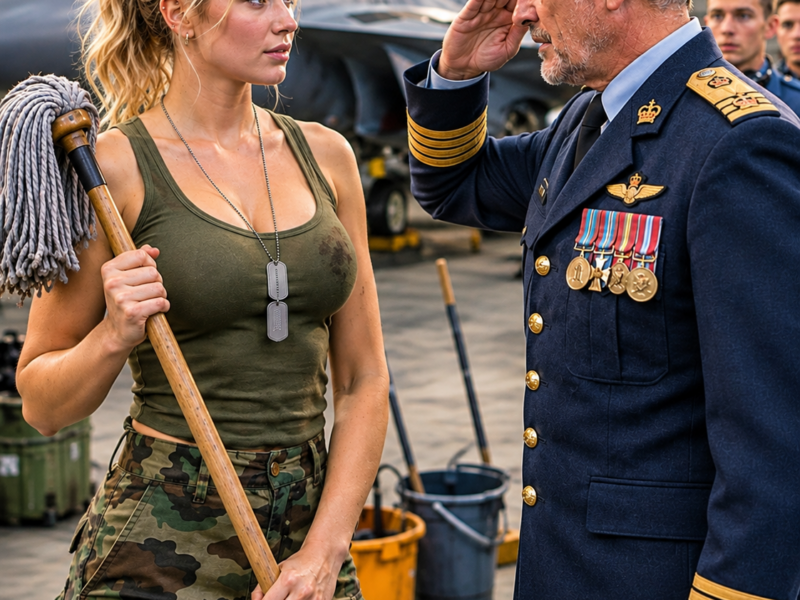
“I was scrubbing an oil stain off the hangar floor when a group of decorated pilots started laughing at my expense
The silver identification tag lay inside the evidence envelope, its scratched surface catching the fluorescent light above us.
I knew every mark on it.
I had held that tag in my hands eleven years earlier, standing beside a military chaplain while rain soaked through my dress uniform.
The name engraved on it belonged to Lieutenant Nathan Cole.
My closest friend.
My wingman.
And the man I had watched disappear from the sky during the final minutes of the Blackbird mission.
“That isn’t possible,” I whispered.
Colonel Hayes pulled the hangar doors closed behind him.
“That’s what I said when the security team brought me the report.”
“Who accessed my file?”
“An encrypted terminal at the command building. The request was submitted using Cole’s old credentials.”
I looked at him.
“Those credentials were supposed to have been deactivated.”
“They were.”
“Then somebody brought them back.”
Hayes nodded.
Behind him, Captain Mitchell and the other pilots were pretending not to listen.
I noticed Ryan staring at the photograph on my cleaning cart.
He looked less amused now.
“Colonel,” I said quietly, “I need to speak with you somewhere private.”
“Of course.”
He turned toward the pilots.
“Captain Mitchell, take your team to the briefing room. Nobody leaves the base until I say otherwise.”
Ryan hesitated.
“Sir, is there a security concern?”
Hayes looked at him.
“That’s not your concern right now.”
The captain collected his coffee and walked away.
As he passed me, he muttered something under his breath.
I didn’t catch every word.
But I heard “crazy janitor.”
Hayes heard it too.
He said nothing.
He simply waited until the pilots were gone.
Then he picked up the photograph and placed it inside his jacket.
“Come with me, Vesper.”
I hadn’t heard anyone use that callsign in eleven years.
It sounded strange coming from someone who hadn’t been there when everything fell apart.
I followed him across the hangar.
For the first time since taking this job, I left my cleaning cart unattended.
And for some reason, that small detail made me feel as though I was crossing a line I could never step back over.
The commander’s office smelled of coffee, leather, and freshly printed paperwork.
Hayes closed the door and motioned toward a chair.
I remained standing.
“Before we discuss anything, I want to know why you waited eleven years.”
He removed his service cap.
“Because I wasn’t in command eleven years ago.”
“That doesn’t answer my question.”
“No. It doesn’t.”
He walked to his desk, opened a drawer, and removed a thick folder.
The label read BLACKBIRD INCIDENT — RESTRICTED.
I recognized the classification markings.
My stomach tightened.
“Where did you get that?”
“It was transferred to me when I assumed command.”
“That file was supposed to be sealed permanently.”
“It was.”
He opened it.
Inside were photographs, flight logs, communications transcripts, and pages of official findings.
Some of the documents had handwritten annotations.
One name appeared repeatedly.
Colonel Thomas Rourke.
I stared at it.
Rourke had been our operations commander.
He was the man who approved our mission.
He was also the man who stood beside the flag-draped coffins at the memorial service and told our families that we had died serving our country.
“What does Rourke have to do with this?”
Hayes watched my face.
“He’s been retired for six years.”
“I know.”
“Three weeks ago, an anonymous source submitted a request to reopen the Blackbird investigation. The request included evidence that the original flight logs had been altered.”
I sat down slowly.
“What evidence?”
He slid a document toward me.
It was a communications transcript.
I recognized the date.
October 17.
The night we lost Nathan.
My eyes moved down the page.
The transcript showed a transmission from my aircraft at 22:41.
Then another at 22:43.
But the words were not what I remembered.
“That’s not what I said.”
Hayes leaned forward.
“What did you say?”
I touched the page.
“At 22:41, I reported an unidentified aircraft approaching our formation from the west. At 22:43, I requested permission to change course.”
“According to this transcript, you reported no unidentified aircraft.”
“Because somebody changed it.”
Hayes didn’t interrupt.
I looked at the next page.
A line had been highlighted in yellow.
VESPER REQUESTS IMMEDIATE RETURN TO BASE.
That was impossible.
I had never requested permission to return.
I had requested permission to pursue the unidentified aircraft because it had locked onto Nathan’s position.
The difference was everything.
Under the original report, I had abandoned my formation.
Under the truth, I had tried to save my wingman.
“Who signed this?” I asked.
Hayes pointed to the bottom.
Colonel Thomas Rourke.
My hands went cold.
“Rourke said I disobeyed a direct order,” I whispered. “He told the investigation board that I broke formation and caused Nathan’s aircraft to go down.”
“Yes.”
“He said I panicked.”
“Yes.”
“He said I abandoned the others.”
Hayes looked down.
“Yes.”
I pushed the document away.
For eleven years, I had carried that accusation like a stone in my chest.
I had never told anyone what happened during those final minutes.
Not my family.
Not the doctors.
Not even the people who had tried to help me afterward.
Because the official investigation had made its decision.
And because I had believed there was no point fighting a story that powerful people had already decided to tell.
Hayes opened another folder.
“There’s something else.”
He placed a photograph on the desk.
It showed a military transport aircraft parked beside a hangar.
A man stood near the rear landing gear.
He was older than I remembered, with gray at his temples.
But I recognized him immediately.
Nathan Cole.
Alive.
I covered my mouth.
The photograph had been taken at a private airfield in Nevada two months earlier.
“Where is he?”
“We don’t know.”
“Then why haven’t you found him?”
“Because whoever helped him disappear has been protecting him. Every time our investigators get close, the trail goes cold.”
I looked at the photograph again.
“Does he know I’m alive?”
Hayes paused.
“Emily, he specifically asked whether Vesper was still at Falcon Ridge.”
I stared at him.
That was when the real fear began.
Nathan hadn’t merely survived.
He had been looking for me.
I didn’t sleep that night.
I returned to the small apartment I rented outside the base and sat at my kitchen table until the coffee in my mug turned cold.
At 2:13 a.m., I opened the old laptop I had kept in a closet for years.
I hadn’t touched it since leaving the service.
The screen flickered.
A folder appeared.
BLACKBIRD.
Inside were files I had copied before the investigation closed.
I had kept them because I knew something was wrong, even though I hadn’t been brave enough to understand what it meant.
Most of the files were corrupted.
One wasn’t.
It was an audio recording from the night of the mission.
I put on my headphones.
Static filled my ears.
Then I heard my younger voice.
“Vesper to command. Unidentified contact at our nine o’clock. No transponder response.”
A second voice answered.
“Maintain course. Continue mission.”
I knew that voice.
Rourke.
The recording continued.
“Blackbird Two, do you copy?”
Nathan answered.
“Copy. I’ve got something on my scope.”
Another burst of static.
Then Rourke again.
“Blackbird Two, disengage. Return to assigned coordinates.”
Nathan’s response came immediately.
“Negative. I’ve got a radar lock. Something’s following us.”
I leaned closer to the laptop.
A third voice interrupted.
“Blackbird One, this is Vesper. I’m moving to cover Two.”
That was me.
Then came a sound I remembered too well.
A warning alarm.
Nathan’s voice broke through the static.
“Vesper, don’t follow me. It’s not a hostile aircraft.”
I stopped breathing.
The recording had never contained that sentence in the official transcript.
I played it again.
“Vesper, don’t follow me. It’s not a hostile aircraft.”
Then another voice came through.
A man I couldn’t identify.
“Blackbird Two, you are clear to proceed. Package is secure.”
Package.
I removed the headphones.
The word echoed in my kitchen.
We had been told the mission was a routine reconnaissance operation.
There had been no mention of a package.
No mention of a second aircraft.
No mention of any cargo.
I returned to the recording.
The final transmission was barely audible.
“Vesper, if they ask, you never saw the second aircraft.”
Then the signal disappeared.
I stared at the laptop.
For the first time, I understood why Nathan had warned me not to follow him.
He hadn’t been trying to escape an enemy.
He had been trying to keep me away from something our own command had arranged.
My phone rang.
The number was blocked.
I almost let it go to voicemail.
Then I answered.
“Hello?”
Silence.
“Emily.”
My fingers tightened around the phone.
I knew that voice.
Eleven years hadn’t erased it.
“Nathan?”
A long pause.
“You’re not supposed to be listening to that recording.”
I stood so quickly that my chair scraped across the kitchen floor.
“Where are you?”
“That doesn’t matter.”
“You’re alive.”
“I know.”
“Do you have any idea what I’ve been through?”
His breathing changed.
“Every day.”
I pressed my hand against the table.
“Why did you let them bury you?”
“Because if they knew I was alive, they’d have killed you before you ever got home.”
“Who?”
“Rourke wasn’t working alone.”
I looked toward the dark window.
“Then tell me who was.”
Nathan hesitated.
“Do you remember the second aircraft?”
“Yes.”
“It wasn’t carrying weapons.”
“What was it carrying?”
“Evidence.”
I closed my eyes.
“Evidence of what?”
“An illegal surveillance operation. They were using military aircraft to intercept communications and move classified intelligence without authorization. The mission that night was supposed to retrieve a storage device containing the records.”
I thought of the altered flight logs.
The missing aircraft.
The false report.
“Did you get it?”
“Yes.”
“Where is it?”
Nathan exhaled.
“With the person who helped me disappear.”
“Who?”
Before he could answer, a sharp knock sounded at my apartment door.
Three slow knocks.
Nathan heard it.
“Emily, listen carefully. Do not open that door.”
I stared at the entrance.
“How do you know someone is here?”
“Because I made the same mistake eleven years ago.”
The call ended.
I stood in the middle of my kitchen, holding the phone.
Then I heard a familiar voice from the hallway.
“Emily Carter? Federal security. We need to speak with you.”
I didn’t move.
The voice continued.
“We have authorization to enter.”
I looked at the laptop.
The recording was still open.
Then I noticed something I hadn’t seen before.
The file’s creation date was October 18, eleven years earlier.
But its last modification date was yesterday.
Someone had accessed it.
Someone had known I still had it.
I reached for the small kitchen drawer where I kept my spare keys.
Not because I had a weapon.
Because I remembered that the back stairwell door sometimes stuck, and I might need to leave quickly.
The knocking came again.
“Ms. Carter, open the door.”
I picked up the laptop.
And went out through the back.
Colonel Hayes was waiting outside the command building when I arrived at Falcon Ridge just after dawn.
He looked as though he hadn’t slept either.
“You received a visit.”
I nodded.
“Two men claiming to be federal security.”
“Did you see their identification?”
“No.”
“Good. They weren’t authorized.”
I handed him the laptop.
“Someone accessed my old recording yesterday.”
He examined the screen.
“Have you listened to it?”
“Yes.”
“All of it?”
“Yes.”
I watched his expression.
“Colonel, what was the second aircraft carrying?”
Hayes didn’t answer immediately.
Instead, he locked the laptop in his office safe.
“Come with me.”
He led me downstairs to a secure conference room.
A woman in civilian clothes was waiting inside.
She appeared to be in her early fifties, with short silver hair and a leather folder resting on the table.
“Emily Carter,” she said, standing. “I’m Special Agent Laura Bennett, Office of Special Investigations.”
I shook her hand.
She studied me carefully.
“I’ve read your original statement.”
“Then you know what they said I did.”
“I also know that your statement was altered before it reached the review board.”
My eyes moved to Hayes.
He remained silent.
Agent Bennett opened her folder.
“We’ve been investigating unauthorized intelligence transfers involving retired military officers, private defense contractors, and several individuals who held senior command positions.”
She placed three photographs on the table.
One showed Colonel Rourke.
Another showed a civilian aircraft.
The third showed Nathan.
“Your former commander was arranging the transfer of classified intelligence to a private contractor. The second aircraft was carrying a storage device with records of those transfers.”
“Why was my flight involved?”
“Because your aircraft had the equipment needed to identify the electronic signature of the target. You were the only pilot who could confirm the location.”
I shook my head.
“Nobody told me that.”
“We know.”
Agent Bennett turned a page.
“Your mission briefing was deliberately incomplete. The operation was designed to make you believe you were conducting routine surveillance.”
I remembered Rourke’s voice.
Maintain course.
Continue mission.
Then Nathan’s warning.
If they ask, you never saw the second aircraft.
“Why did Nathan disappear?”
“Because he recovered the storage device before the operation could be completed. He believed that turning it over through official channels would expose him to the same people who had organized the transfer.”
“And he was right?”
Bennett looked at me.
“Unfortunately.”
She opened another photograph.
It showed a younger version of Agent Bennett standing beside Nathan.
I stared.
“You knew him?”
“I was assigned to an internal investigation shortly before the Blackbird mission. Nathan contacted me privately after he discovered the operation.”
“Why didn’t you protect him?”
Her eyes lowered.
“Because I didn’t know who inside the investigation was compromised. He disappeared before I could arrange a secure extraction.”
I leaned back.
“So he spent eleven years hiding.”
“Yes.”
“And I spent eleven years believing I had caused his death.”
Nobody spoke.
Agent Bennett closed the folder.
“Emily, I need you to understand something. The evidence Nathan recovered could expose several people. But the original storage device is still missing.”
I looked at the photograph of him.
“Where is he now?”
“He’s willing to meet.”
My throat tightened.
“When?”
“Tonight.”
We met at a small diner outside town.
The kind of place with cracked red booths, old country music, and a waitress who called everyone sweetheart.
Hayes waited in an unmarked vehicle across the road.
Agent Bennett sat at another table.
I was alone in the booth.
At 8:17 p.m., the door opened.
A man walked inside wearing a faded baseball cap and a dark jacket.
He had more gray hair than the man in the photograph.
His face was thinner.
There was a scar near his right eyebrow that hadn’t been there before.
But his eyes were exactly the same.
Nathan stopped when he saw me.
For a moment, neither of us spoke.
Then he walked toward the booth.
“Hi, Vesper.”
I stared at him.
“Don’t call me that.”
He nodded and sat down.
“Fair enough.”
I looked at his hands.
They were shaking slightly.
“You’re alive.”
“Yes.”
“You let me attend your memorial.”
“I know.”
“You let me listen to people tell me that I had killed you.”
He looked down at the table.
“I know.”
I wanted to shout.
I wanted to ask a hundred questions.
Instead, I asked the one that had followed me for eleven years.
“Did you ever intend to come back?”
Nathan swallowed.
“Every day.”
“Then why didn’t you?”
“Because Rourke knew where your family lived. He knew your parents’ address. He knew your younger brother was attending college. He told me that if I surfaced, you would be charged with treason and your family would be investigated.”
I stared at him.
“You believed him?”
“I had already seen what he could do.”
Nathan reached inside his jacket.
He removed a small photograph.
It showed a house with a broken porch light.
I recognized it immediately.
My parents’ old home in Ohio.
On the back was a date.
Three days after Nathan’s disappearance.
“Someone had been watching them,” he said. “I couldn’t risk bringing danger to your door.”
I picked up the photograph.
My mother had passed away six years earlier.
She had spent her final years believing her daughter had abandoned the military after a tragic accident.
I had never told her the truth.
I had been too ashamed.
“Did you know my mother died?”
Nathan nodded.
“I heard.”
“Did you come to the funeral?”
He looked away.
“No.”
I placed the photograph back on the table.
“Then you don’t know what eleven years feels like.”
He didn’t defend himself.
That was somehow worse.
The waitress approached with a pot of coffee.
“Y’all need anything?”
“Just coffee,” Nathan said.
When she walked away, he reached into his bag and placed a small black storage device on the table.
“This is what I recovered.”
I looked at it.
“Is everything on there?”
“Original communications, financial records, flight authorization logs, and recordings of conversations between Rourke and the contractor.”
“Why didn’t you give it to Bennett?”
“I wanted to make sure she wasn’t compromised.”
Nathan glanced toward the window.
“There’s one more reason I came back.”
I waited.
“The night of the mission, I received a transmission that didn’t come from Rourke.”
My stomach tightened.
“What transmission?”
Nathan looked directly at me.
“Someone ordered me to destroy the storage device and eliminate the witness.”
I stared at him.
“Who was the witness?”
“You.”
The diner suddenly seemed too quiet.
Nathan continued.
“They knew you had identified the second aircraft. They knew you had recorded the signal. They wanted you removed before the investigation began.”
I looked down at my hands.
“So when you told me not to follow you…”
“I was trying to keep you alive.”
I leaned back.
“Why didn’t you tell me that before?”
“Because the recording wasn’t enough. I needed proof of who issued the order.”
“Did you find it?”
Nathan nodded.
He turned the storage device toward me.
“Listen to the final recording.”
Agent Bennett transferred the files into a secure forensic system the following morning.
We gathered in the same conference room where she had first shown me the photographs.
Hayes stood behind me.
Nathan sat across the table, his hands clasped together.
The first recordings contained conversations between Rourke and representatives of a private contractor.
They discussed payments, flight schedules, and the movement of intelligence materials.
Then came a recording dated October 17.
The night of our mission.
A familiar voice filled the room.
“Blackbird Two has the device.”
Rourke answered.
“Then make sure it never reaches the review board.”
Another voice spoke.
“What about Vesper?”
A pause.
Then Rourke said, “She’ll be handled.”
I gripped the edge of the table.
The next voice was quieter.
“She’s already transmitted the aircraft identification.”
“Then alter the transcript.”
“And the pilot?”
“Make it look like a flight error. The board won’t question a dead man, and they’ll have no reason to believe a disgraced woman.”
My eyes filled with tears.
For eleven years, I had believed I had failed Nathan.
Now I understood that someone had deliberately built a story in which I was the villain.
The recording continued.
Then another voice spoke.
“Sir, authorization is required from the oversight office.”
I leaned closer.
I recognized that voice too.
It belonged to General Marcus Whitmore.
At the time of the mission, Whitmore had been the senior officer responsible for intelligence oversight.
He had attended the memorial.
He had stood in front of our families and praised our sacrifice.
And now his voice was on the recording.
“Proceed,” he said. “No one can be allowed to connect the transfer to us.”
The room remained silent after the audio ended.
Agent Bennett closed her laptop.
“That is enough to reopen the investigation.”
“Is it enough to arrest them?” I asked.
“It is enough to obtain warrants. The financial records will establish the chain of responsibility.”
Hayes looked at the evidence.
“Rourke is still alive.”
“So is Whitmore,” Bennett replied.
Nathan rubbed his forehead.
“I knew Rourke was involved. I didn’t know about Whitmore.”
I looked at him.
“Now you do.”
For the first time in eleven years, I felt something other than guilt when I thought about that night.
It wasn’t relief.
Not yet.
It was anger.
Quiet, focused anger.
And for once, I wasn’t going to swallow it.
The arrests began four days later.
Colonel Thomas Rourke was taken into custody at his home in Virginia.
General Whitmore was arrested at a private airport while preparing to board a flight.
Several executives from the defense contractor were also charged.
The investigation uncovered years of unauthorized surveillance and illegal intelligence transfers.
The original Blackbird report had been altered to conceal the operation and protect those responsible.
My flight recordings, which had been dismissed as unreliable, were restored from archived backups.
The evidence established that I had not abandoned my formation.
I had followed the correct emergency procedure.
And I had been deliberately misrepresented.
The Air Force issued a formal statement acknowledging that the original investigation had been compromised.
My record was corrected.
The charges that had followed me were officially withdrawn.
But no document could give me back the eleven years I had spent believing I was responsible for Nathan’s death.
Three weeks after the arrests, I received a letter from the Department of the Air Force.
It contained a corrected service record, an apology, and an invitation to a formal recognition ceremony at Falcon Ridge.
I almost threw it away.
I had no interest in standing in front of a room full of people while someone read my name from a piece of paper.
Then Hayes called.
“Emily, I think you should come.”
“Why?”
“Because the people who wrote the old report made sure you never got to tell your story. You deserve to stand in that room as yourself.”
I looked at the letter.
“I don’t know if I can.”
“You don’t have to decide today.”
He paused.
“But I hope you do.”
The ceremony took place on a clear Friday morning.
The hangar was full.
Pilots, mechanics, maintenance crews, officers, civilian employees, and several families of the original Blackbird flight had gathered near the front.
I wore a simple dark blue dress.
No medals.
No uniform.
No special insignia.
Just my name.
Emily Carter.
When I entered, conversations quieted.
Captain Mitchell stood near the back.
He looked uncomfortable.
I hadn’t seen him since the morning Hayes recognized my callsign.
He approached carefully.
“Ma’am?”
I turned.
“Captain.”
He looked down at the floor.
“I owe you an apology.”
I waited.
“I treated you like you were less important because of your job. I made jokes about things I didn’t understand.”
He swallowed.
“I heard what happened. I read the corrected report.”
I nodded.
“Thank you for saying that.”
He looked as though he wanted to say more.
Instead, he offered a small, awkward nod and stepped aside.
I didn’t need him to become my friend.
I only needed him to understand that the person cleaning the floor might have lived through something he couldn’t imagine.
Colonel Hayes approached the podium.
He spoke about the investigation, the pilots who had disappeared, and the importance of protecting the truth even when doing so was uncomfortable.
Then he invited me forward.
I walked to the center of the hangar.
The concrete floor had been polished.
The same floor I had scrubbed every morning for months.
Hayes opened a folder.
“Eleven years ago, Captain Emily Carter was officially recorded as responsible for the loss of Blackbird Two. That finding was based on falsified evidence and deliberately altered communications.”
He looked at me.
“Today, that record has been corrected.”
The room was silent.
“Her service, judgment, and actions during the mission have been fully recognized.”
He paused.
“Her callsign was Vesper.”
I heard someone in the back whisper the name.
Hayes continued.
“She was never the failure described in the original report. She was a pilot who followed her training, protected her formation, and refused to let the truth disappear.”
He handed me a small presentation case.
Inside was my old flight insignia.
The metal was scratched.
The edges were worn.
I ran my thumb over it.
For eleven years, I had believed I no longer had the right to wear it.
Now it was sitting in my palm again.
Hayes stepped away from the podium.
“Emily, would you like to say something?”
I looked across the room.
At the pilots.
At the mechanics.
At the civilian workers.
At Nathan, standing near the back with his hands folded in front of him.
I walked toward the microphone.
For a moment, I couldn’t find the words.
Then I looked down at the polished concrete beneath my shoes.
“I spent a long time thinking that if I stayed quiet, eventually the worst part of that night would fade.”
My voice trembled.
“It didn’t.”
I took a breath.
“I thought I had lost my friend. I thought I had failed my team. And I believed the people who told me what happened because I couldn’t imagine that someone wearing the same uniform would deliberately lie about it.”
I looked at Nathan.
“But the truth matters, even when it arrives late.”
The room remained still.
“I don’t need anyone to pretend those eleven years didn’t happen. They did. People I loved died believing things that weren’t true. I can’t change that.”
I closed the presentation case.
“But I can stop carrying someone else’s lie.”
I stepped away from the microphone.
Nobody applauded immediately.
Then an older woman near the front stood.
She was Nathan’s mother.
I recognized her from the memorial service.
She walked toward me slowly, holding a folded handkerchief.
“Emily?”
I nodded.
She took both my hands.
“I owe you an apology.”
I shook my head.
“No, ma’am.”
“Yes,” she said softly. “I believed the report. I thought you had left my son behind.”
Her eyes filled.
“I should have listened to you.”
I couldn’t speak.
She squeezed my hands.
“Thank you for trying to bring him home.”
That was the moment I finally cried.
Not when the report was corrected.
Not when Rourke was arrested.
Not when my callsign was spoken aloud again.
But when the mother of the man I thought I had failed told me she no longer blamed me.
After the ceremony, Nathan found me outside the hangar.
The afternoon sun stretched across the runway.
Aircraft moved in the distance, their engines rising and falling like distant thunder.
He stood beside me without speaking.
For several minutes, we watched a maintenance crew prepare an aircraft for departure.
Then he said, “I don’t expect you to forgive me.”
I looked at him.
“Good.”
He nodded.
“I should have found a way to tell you.”
“Yes.”
“I thought I was protecting you.”
“You were protecting me from one danger and leaving me with another.”
He looked down.
“I know.”
I studied his face.
The anger was still there.
It might always be there.
But underneath it, something else had begun to settle.
“You were my wingman, Nathan.”
“I remember.”
“That meant I trusted you with my life.”
His eyes reddened.
“I know.”
“And you let me spend eleven years thinking you were dead.”
He didn’t look away this time.
“I’m sorry.”
I nodded slowly.
“I believe you.”
His shoulders lowered.
“But believing you doesn’t mean everything goes back to how it was.”
“I wouldn’t ask that.”
We stood quietly.
Then he reached into his jacket and removed a small envelope.
“I found this while I was putting the old records together.”
He handed it to me.
Inside was a photograph.
It showed the four of us beside our aircraft before the Blackbird mission.
Nathan stood on my left.
Two other pilots, Daniel Brooks and Michael Reeves, stood behind us.
We were laughing at something outside the frame.
On the back, in my own handwriting, were the words:
No one flies alone.
I stared at the photograph.
I remembered writing that sentence after a difficult training exercise.
At the time, it had seemed like a simple joke.
Now it felt like a promise I had spent eleven years trying to understand.
“Where did you get this?”
“It was in the storage device case.”
I turned the photograph over again.
“Why did you keep it?”
Nathan looked toward the runway.
“Because I couldn’t remember who I was before that night. That picture reminded me.”
I slipped it into my purse.
“I need time.”
He nodded.
“I understand.”
And for the first time since we had met again, I believed he meant it.
I returned to Falcon Ridge the following Monday.
Not as a pilot.
Not as a decorated veteran.
Not as Vesper.
I returned because the maintenance supervisor had offered me a position coordinating civilian aircraft support operations.
It wasn’t glamorous.
It involved schedules, inspections, equipment records, and plenty of paperwork.
But it meant I could work around aircraft without pretending I had never loved them.
My yellow cleaning cart was still parked in Hangar 12.
I stopped beside it for a moment.
The handle was worn.
One wheel squeaked.
Someone had left a new bottle of floor cleaner on the lower shelf.
I smiled.
Then I pushed it toward the storage room for the last time.
Captain Mitchell was standing near the entrance.
He watched me put the cart away.
“Leaving us, Ms. Carter?”
“Not exactly.”
I showed him the new identification badge clipped to my jacket.
He read it.
“Operations coordinator.”
“That’s the plan.”
He smiled awkwardly.
“Well, I guess I’ll have to find someone else to make fun of.”
I looked at him.
“Maybe try making fun of your own flying first, Captain. I’ve heard your landing reports.”
He laughed.
It was the first time we had shared a laugh that didn’t leave one of us humiliated.
As I walked back into the hangar, the morning sun spilled through the open doors.
A fighter jet sat near the center of the floor.
A young maintenance technician was kneeling beside one of its landing wheels, trying to remove a stubborn panel.
He looked up when I approached.
“Ma’am, do you know where I can find the replacement tool for this?”
I pointed toward the equipment cabinet.
“Second drawer, left side.”
He nodded.
“Thanks.”
Then he noticed the old insignia attached to my bag.
“Is that yours?”
I looked at the scratched silver wings.
“Yes.”
“Did you fly?”
I considered the question.
For years, I had answered no.
Not because it was true.
Because it was easier.
This time, I smiled.
“I did.”
He glanced toward the aircraft.
“That’s pretty incredible.”
I shook my head.
“It was mostly hard work and a lot of people looking out for each other.”
He returned to his task.
I continued walking.
At the far end of the hangar, Colonel Hayes stood near the open doors.
He raised a hand.
I raised mine in return.
Then the loudspeaker crackled.
A routine flight announcement filled the building.
A pilot requested clearance for departure.
The familiar rhythm of radio communication washed over me.
I stopped for a moment and listened.
Once, that sound had been the beginning of the worst night of my life.
Now it was simply the sound of people doing their jobs.
My phone vibrated.
A message from Nathan appeared.
I found a flight school outside Dayton. I’m thinking about volunteering with their veterans’ program. No pressure to answer. Just wanted you to know.
I read it twice.
Then I typed:
I hope you do. Just remember, earning someone’s trust back takes more than one good landing.
His reply came a minute later.
Understood, Vesper.
I looked at the screen.
For a moment, I considered telling him not to use that name.
But I didn’t.
Not because I was ready to forget.
Because the callsign no longer belonged to the night that had nearly destroyed me.
It belonged to the woman who had survived it.
I put my phone away and walked toward the sunlight.
Behind me, the hangar doors remained open.
And for the first time in eleven years, I no longer felt the need to disappear.
The end.









