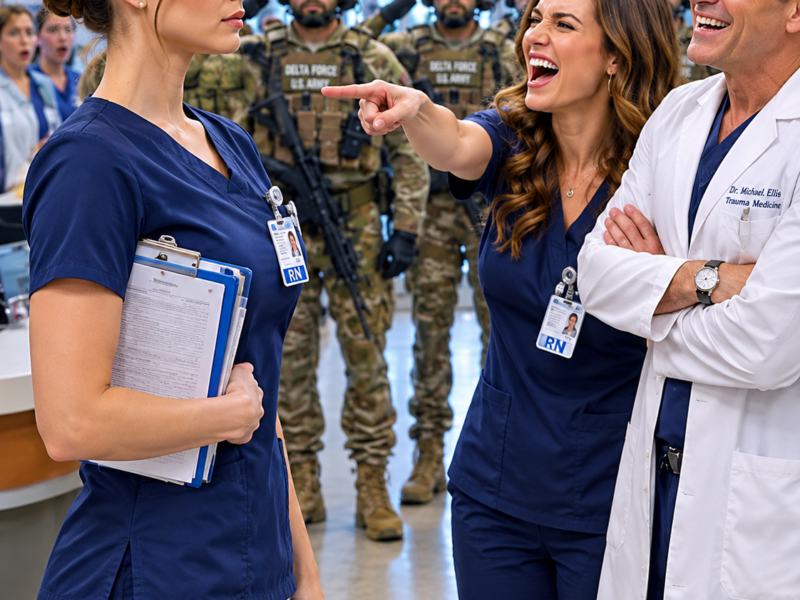
“I was restocking medical supplies when a surgeon laughed at the scars running down my arms and asked whether I’d lost a fight with a kitchen knife
The colonel did not move his hand from the envelope.
Neither did I.
For a moment, the emergency department seemed to fall silent around us. Monitors continued beeping. A nurse called for a portable X-ray. Somewhere behind the double doors, a child was crying. But all I could hear was the sound of my own pulse.
“Who wrote that?” I asked.
Colonel Harris glanced down at the envelope.
“General Adrian Voss.”
The name struck me harder than I expected.
I had not heard it spoken aloud in six years, but I remembered the voice that came with it. Calm. Controlled. Almost gentle. The kind of voice that could order men into a deadly situation and make it sound like an ordinary adjustment to a schedule.
“He’s still in command?” I asked.
“He retired from active duty last year,” Harris said. “He now serves as a senior adviser at the Joint Operations Center.”
I stared at the handwriting.
The letters leaned slightly to the right. The capital A had a long, sharp stroke. I remembered seeing that exact signature on the final operational order before we entered the mountains.
“Why would he send me a letter?”
“Because he knows we found you.”
I looked at Major Reeves, who was lying in the treatment bay with an oxygen mask over his face. His eyes were open now. He had been watching us.
“Daniel,” I said. “What did you tell them?”
He tried to sit up.
“Don’t,” I warned.
“I told them what happened.”
“You told them I was alive?”
“I told them you saved us.”
His voice was weak, but there was no uncertainty in it.
I looked back at Colonel Harris.
“I’m not sure I want to read that.”
“You don’t have to,” he said. “But I think you deserve to know why it was delivered.”
He placed the envelope on the counter.
I did not touch it.
Dr. Nathan Brooks cleared his throat behind me.
“Colonel, I think there’s been some kind of misunderstanding. This is a hospital. Whatever military matter you’re dealing with, it doesn’t belong in the emergency department.”
Harris turned toward him.
“Doctor, I agree that this is a hospital. That’s why I’m going to ask you to step away from Sergeant Carter.”
Brooks gave a short, disbelieving laugh.
“Sergeant?”
“Yes.”
“She is a nurse here. She’s been working under my supervision for months.”
“Then you should know her name.”
“I do.”
“Apparently, you don’t know much else.”
Brooks’s jaw tightened.
I wanted to tell him to stop. I wanted the entire room to return to the ordinary rhythm of medicine, where a person’s injuries mattered more than the story behind them.
But there was no returning to ordinary now.
Patricia, the charge nurse, appeared at the entrance to the treatment area. Her eyes moved from the colonel to the five men standing behind him, then to me.
“Emily? Are you all right?”
I nodded, though I wasn’t sure it was true.
“Can you take over the next two rooms?” I asked her. “I need a few minutes.”
“Of course.”
She looked at the envelope.
“Do you want me to stay?”
That simple question almost broke me.
“No,” I said. “But thank you.”
Patricia squeezed my shoulder before leaving.
Colonel Harris waited until she was gone.
“Sergeant Carter, we should speak somewhere private.”
“I’m not going anywhere until my patients are stable.”
“Understood.”
I pointed toward Reeves.
“Then tell me what happened to him.”
Harris glanced at the major.
“He was injured during a training exercise outside Nashville. A vehicle rolled during a nighttime maneuver. Six operators were involved. Their team requested medical assistance and transport.”
“That’s what I was told.”
“That’s all the hospital needs to know.”
“Then why are you here?”
“Because when Reeves regained consciousness in the ambulance, he asked whether the nurse with the scars was working at this hospital.”
My throat tightened.
“And you believed him?”
“I believed him enough to check.”
“Check what?”
“Whether the woman we buried six years ago was actually dead.”
I looked down at my hands.
Six years ago, I had stopped correcting people when they called me dead. It had been easier than explaining how a person could walk out of a war and still feel as if she had left the most important part of herself behind.
“I’m not Sergeant Carter anymore,” I said.
Harris’s expression softened.
“You don’t have to be anything you don’t want to be.”
“Then don’t call me that.”
He nodded.
“Emily.”
I looked at the envelope again.
“Tell me what happened in Black Ridge.”
He drew a slow breath.
“Not here.”
“Then open the envelope.”
He hesitated.
“It’s addressed to you.”
I picked it up.
My fingers felt strangely numb as I broke the seal. Inside was a single folded sheet of paper and a small photograph.
The photograph showed a mountain ridge beneath a gray sky. A narrow trail cut across the rock face. I recognized the place immediately.
The eastern approach.
The route we had been ordered to take.
I turned the photograph over.
Written on the back were six words.
YOU WERE NEVER SUPPOSED TO COME BACK.
I read them twice.
Then I unfolded the letter.
Emily,
If this letter has reached you, then Daniel Reeves has found you. I assume he has told you that your team was never abandoned by accident.
I have spent six years living with the knowledge that my orders sent good men into a situation they were never meant to survive.
I did what I believed was necessary at the time. I told myself the mission was larger than any one soldier. I told myself that the information we had could not be allowed to fall into enemy hands.
But I also know that I allowed a false report to stand.
I know that you were listed as killed before anyone confirmed your identity.
I know that the extraction record was altered.
And I know who made those changes.
You deserve the truth.
General Adrian Voss
I lowered the page.
The room seemed to tilt.
“What does he mean?” I asked.
Harris did not answer immediately.
“Colonel.”
“The original mission order was changed after your team entered the valley.”
“Changed by whom?”
“Voss authorized the route. Someone else altered the extraction coordinates and the timing of the air support.”
“Who?”
“Lieutenant Colonel Marcus Rourke.”
The name brought back another memory.
A man standing beside a field operations table. A silver watch. A smile that never reached his eyes. A man who had told us the eastern route was clear.
“He was our operations officer,” I whispered.
“He was.”
“Where is he now?”
“Still serving. He’s currently assigned to a strategic planning office.”
I felt the old coldness spreading through my chest.
“He knew.”
“We believe he knew.”
“He knew the route was compromised?”
Harris held my gaze.
“We believe he had information that the route was compromised before your team was sent in.”
I folded the letter carefully.
“Then why did we go?”
“That’s what the investigation needs to establish.”
I laughed once, without humor.
“An investigation. Six years later.”
“Some of the original records were classified. Others disappeared. The men who tried to raise questions were reassigned or told there wasn’t enough evidence.”
“And now?”
“Now we have a witness who survived.”
I looked at Reeves.
He had removed his oxygen mask.
“Daniel,” I said. “You should be resting.”
“I’ve rested enough.”
“You lost blood.”
“I know.”
“You could have a concussion.”
“I know that too.”
“Then stop making my job harder.”
A faint smile appeared on his face.
For a moment, he looked like the young captain I remembered, standing in the dust with a radio pressed against his ear and a split lip he refused to acknowledge.
Then his expression changed.
“Emily, I should have come sooner.”
I stared at him.
“Why didn’t you?”
“Because I couldn’t find you.”
“You knew I was alive?”
“Not at first.”
“When did you find out?”
“About three years ago, I heard a rumor from a medic who had been stationed in Germany. She said a woman with a scar across her shoulder had been working in a rehabilitation clinic. She thought it might be you.”
“Why didn’t you come?”
“I sent inquiries. The answers went nowhere. Your records had been sealed. Your identity had been changed. Every lead disappeared.”
I looked at Harris.
“Was that your doing?”
“No,” he said. “I was trying to find you too.”
“Then who changed my records?”
Harris glanced at the letter.
“Rourke had access to the casualty reports. We believe he used that access to make sure no one could connect you to the operation.”
“Why?”
“Because you saw something.”
I closed my eyes.
The mountain came back in pieces.
Rain on black rock.
The crackle of a radio.
A medic screaming for pressure.
The smell of fuel and wet earth.
A red warning light blinking on the communications panel.
And a voice telling me to ignore the coordinates.
I opened my eyes.
“I saw the extraction order,” I said.
Harris leaned forward.
“What do you remember?”
“Before the first strike, I was in the communications shelter. The radio operator had received a new set of coordinates. They didn’t match the original plan.”
“Who transmitted them?”
“I couldn’t see the sender. The message came through an encrypted channel.”
“Did you copy it?”
“I wrote the coordinates on a field card.”
“Do you still have it?”
I shook my head.
“I thought I lost it when the shelter collapsed.”
Reeves shifted in his bed.
“You didn’t lose it.”
I turned toward him.
“What?”
“You gave it to me.”
The words landed slowly.
“I did?”
“You shoved it into my vest before the second blast. You told me to keep it dry.”
I stared at him, searching his face.
“I don’t remember.”
“You were bleeding. Your left arm was injured. You told me the coordinates were wrong and that we needed proof.”
“Where is it?”
“I don’t know.”
“Daniel.”
“I had it when we reached the ravine. Then the extraction helicopter came under fire. I was pulled aboard. I remember handing my vest to a medic when we landed. I never saw it again.”
Harris looked at the men behind him.
“Who handled the equipment after evacuation?”
One of them stepped forward.
“Sergeant Lewis. He was the medic attached to the recovery unit.”
“Is he alive?”
“He’s in Colorado. Retired.”
Harris nodded.
“We’ll contact him.”
I looked at the photograph again.
YOU WERE NEVER SUPPOSED TO COME BACK.
“Why would Rourke want me dead?” I asked.
“Because you could have exposed the altered coordinates,” Harris said. “And because the report he submitted claimed the entire team had been killed before the extraction request was received.”
I felt sick.
“Daniel was alive.”
“Yes.”
“Three other men were alive.”
“Yes.”
“And the report said we were all dead?”
“That’s what the final record stated.”
I looked at Reeves.
“How many of us made it out?”
“Four,” he said quietly.
“Four?”
He nodded.
“Six went in. Four came back.”
I knew the number, but hearing it from him made it real again.
“Who didn’t?”
“Sergeant Miller and Corporal James.”
I remembered both of them.
Miller had laughed too loudly and carried a photograph of his daughter inside his helmet. James had been twenty-two, with a habit of tapping his fingers whenever he was nervous.
“Were they killed in the first strike?”
Reeves swallowed.
“James was. Miller made it to the lower ridge. He was wounded. We couldn’t get to him.”
I felt the old guilt rise.
“I should have—”
“No,” Reeves interrupted.
“I left him.”
“You were ordered to get the survivors out.”
“I heard him calling.”
“And you went back for him.”
“I couldn’t reach him.”
“You tried.”
The words did not comfort me.
They never had.
I folded the letter and placed it beside the photograph.
“Colonel, I want to see the original mission file.”
“We’ll arrange that.”
“No. I want to see it before anyone has time to change anything else.”
Harris considered me.
“You aren’t under orders.”
“I know.”
“You’re a civilian now.”
“I know that too.”
“Then why are you asking?”
I looked at the six men in the room, at the scars on my hands, at the photograph of the mountain.
“Because two men never came home. Because Daniel spent six years trying to find me. Because someone decided my name should disappear. And because I am tired of letting other people tell the story of what happened.”
Harris gave a small nod.
“Then we’ll do it properly.”
Before he could say anything else, Dr. Brooks stepped forward.
“This is getting ridiculous.”
Everyone turned.
Brooks had regained some of his confidence.
“You’re all discussing classified military matters in a patient-care area. I don’t know what kind of arrangement you have with this nurse, but I won’t have this department disrupted.”
Harris looked at him.
“Doctor, this conversation is ending.”
“Good.”
“And I suggest you stop speaking about Sergeant Carter as if she has no right to be here.”
Brooks’s face reddened.
“She works for me.”
I stepped between them.
“No, Dr. Brooks. I work with you.”
He stared at me.
“You’ve been hiding this?”
“I have been living my life.”
“You let us believe you were some ordinary nurse with a dramatic past.”
I looked at him for a long moment.
“I never asked you to believe anything about me.”
His eyes moved toward the scars on my neck.
“You could have told us.”
“Why? So you could make more jokes?”
He opened his mouth.
Nothing came out.
Patricia returned with a clipboard.
“Emily, Room Four needs you.”
I took it from her.
“Thank you.”
Then I turned to Harris.
“I have patients.”
He nodded.
“Take care of them. We’ll wait.”
I returned to work.
For the next two hours, I did what I had always done. I checked blood pressure, changed dressings, helped a frightened teenager through a panic attack, and held a man’s hand while a physician explained that his wife was being taken into surgery.
The world did not pause because my past had found me.
A patient still needed a blanket.
A mother still needed someone to explain the monitor.
A little boy still wanted to know whether the needle would hurt.
And for those two hours, that was enough.
But every time I passed the nurses’ station, I saw the colonel waiting.
The five men remained with him. They did not crowd the department or interfere with the staff. They simply stood near the wall, quiet and watchful.
Dr. Brooks avoided me.
At 7:40 p.m., Patricia approached me with a cup of coffee.
“You haven’t sat down once.”
“I’ve been busy.”
“You’ve been running.”
I looked at her.
She lowered her voice.
“Do you want to tell me what’s happening?”
“Not yet.”
“Okay.”
She placed the coffee beside my chart.
“But when you’re ready, I’m listening.”
I felt a tightness in my throat.
“Thank you.”
She glanced toward the men.
“Are they here because of you?”
“Yes.”
“Are you in trouble?”
“I don’t think so.”
She studied my face.
“That’s not the same as no.”
I managed a small smile.
“No. It isn’t.”
At 8:15, Reeves was cleared for transfer to a monitored room. His condition had stabilized, and the attending physician agreed that his injuries were serious but not immediately life-threatening.
Before the transport team moved him, he caught my wrist.
“Emily.”
“What?”
“There’s something else.”
I leaned closer.
“What is it?”
“The night we got out, I heard Rourke on the radio.”
My stomach tightened.
“What did he say?”
“He asked whether the evidence had been recovered.”
“Which evidence?”
“The field card. The coordinates.”
I stared at him.
“What did you tell him?”
“I said I didn’t know what he meant.”
“Did he believe you?”
“I don’t think so.”
“Why didn’t you tell me?”
“Because I didn’t remember it clearly until recently. The medication, the injuries, everything was a blur. But when I saw you today, I remembered the radio call.”
“Did you record it?”
He shook his head.
“No. But I remember the words.”
“What exactly did he say?”
Reeves looked toward the colonel.
“He said, ‘If Carter is alive, make sure she never gets another chance to speak.’”
For a moment, I could not breathe.
Harris had heard him.
His face changed.
“Major, are you certain?”
“As certain as I can be.”
“Did you tell anyone?”
“No.”
“Why?”
Reeves looked at me.
“Because I thought she was dead. And because I was afraid the people who had covered it up were still watching.”
The transport team moved his bed toward the elevator.
I followed for a few steps.
“Daniel?”
He turned his head.
“You don’t have to carry this alone anymore.”
He gave a tired nod.
“Neither do you.”
Then the doors closed.
Colonel Harris waited until Reeves was gone.
“We need to move quickly.”
“Where?”
“To a secure office. We can review what remains of the record.”
“Tonight?”
“If you’re willing.”
I looked at the clock.
My shift ended in forty-five minutes.
I thought about going home, locking the door, and pretending the letter had never arrived.
But I knew what would happen if I did.
I would lie awake hearing the radio again.
I would see the mountain every time I closed my eyes.
And tomorrow, I would still be the woman who had survived without knowing why she had been allowed to.
“Give me twenty minutes,” I said.
Harris nodded.
“I’ll arrange it.”
I went to the staff room and changed out of my scrubs.
When I returned, Brooks was standing near the lockers.
He looked uncomfortable.
“Emily.”
I stopped.
“What?”
He glanced toward the hallway.
“I owe you an apology.”
I waited.
He seemed to struggle with the words.
“The comments I made about your scars were inappropriate.”
“They were cruel.”
“Yes.”
“You made them in front of other people.”
“I know.”
“You made me feel like I had to hide something that wasn’t yours to judge.”
His face tightened.
“I understand.”
“No,” I said quietly. “You understand that a colonel and five soldiers walked in and saluted me. That’s not the same thing.”
He looked down.
I continued.
“My scars were there yesterday. They were there last week. They were there every time you saw me. You didn’t need a military officer to tell you they deserved respect.”
He nodded.
“You’re right.”
I didn’t forgive him. Not then.
But I didn’t need to punish him either.
“I hope you remember that the next time you see someone who looks different from you.”
“I will.”
I walked away.
Outside, rain had begun to fall over the hospital parking lot.
Colonel Harris was waiting beside a dark vehicle. The five men stood nearby.
One of them opened the passenger door.
I stopped before getting in.
“I need to ask something.”
“Of course,” Harris said.
“Why did you bring six men?”
He looked at the group.
“Because there were six people who went into that valley.”
“Two didn’t come back.”
“No.”
“And the others?”
“Three of us were attached to the recovery operation. The remaining men are members of Reeves’s current unit.”
I studied their faces.
“Did you know me?”
The oldest of them stepped forward.
“Not personally,” he said. “But we knew the story.”
“What story?”
“The story of the medic who went back into the fire for a wounded operator. The story of the sergeant who refused to leave until every survivor had been counted.”
I looked away.
“Stories become distorted.”
“Sometimes,” he said. “But not all of them.”
I got into the vehicle.
We drove to a federal operations building outside the city. It was not a dramatic place. No flags lined the driveway. No armed guards stood at every entrance. It looked like an office complex that could have belonged to an insurance company.
Inside, a woman in a charcoal suit met us near the security desk.
“Colonel Harris?”
“Agent Mitchell.”
She glanced at me.
“Sergeant Carter?”
“Emily.”
“Of course. I’m Laura Mitchell. I’m leading the review.”
She shook my hand.
Her grip was firm, her expression serious.
“We’ve been trying to reconstruct the Black Ridge operation for almost a year. Your arrival changes what we can do.”
“Why did the review start?”
“An anonymous complaint.”
“From whom?”
“We don’t know yet.”
She led us into a conference room.
A large screen covered one wall. Several folders lay on the table.
“Before we begin,” Mitchell said, “I want to make one thing clear. You’re not being asked to prove that you deserved to survive. You’re being asked to tell us what you remember. If you don’t remember something, say so. If you’re uncertain, say so. Do not fill in gaps.”
I appreciated that.
For six years, people had filled in the gaps for me.
She opened the first folder.
“This is the official timeline.”
A map appeared on the screen.
I recognized the valley.
Mitchell pointed to the eastern approach.
“Your team entered at 0210 local time. At 0247, a communications update was recorded. At 0312, the first engagement occurred. At 0340, the extraction request was logged.”
“That isn’t right,” I said.
She turned toward me.
“What part?”
“The extraction request was made before the first engagement.”
“Do you remember the time?”
“Approximately 0300. We had already received fire from the lower ridge, but the main strike happened later.”
Mitchell wrote something down.
“The official record shows 0340.”
“Then the official record is wrong.”
She moved to the next page.
“According to the final report, the team was declared lost at 0415.”
I stared at the screen.
“That’s impossible.”
“Why?”
“Because Daniel was still transmitting after 0415. I was beside him.”
Harris leaned forward.
“Can you identify the transmission?”
“It was a status update. He reported four survivors and requested immediate extraction.”
“Was it acknowledged?”
“I heard a response.”
“From whom?”
“I don’t know. The voice was distorted.”
Mitchell displayed a transcript.
“This is the recorded exchange.”
I read the words.
The transcript said the transmission had been received at 0448.
“That isn’t what I heard.”
“What time do you remember?”
“Closer to 0430.”
“Could the time difference be due to the damaged equipment?”
“Possibly. But there is another problem.”
I pointed at the transcript.
“This response says, ‘No personnel located. Mission terminated.’”
“Yes.”
“That isn’t what they said.”
“What did they say?”
I closed my eyes.
The radio hissed in my memory.
A burst of static.
Then a man’s voice.
“Hold position. Recovery is being coordinated.”
I opened my eyes.
“They said to hold position. They did not terminate the mission.”
Mitchell exchanged a glance with Harris.
“That’s significant.”
“Why?”
“Because the record shows that the command center believed your team had been killed before the extraction request was made. If the command center was still communicating with survivors, the final report was knowingly false.”
I looked at the map.
“Who entered the final report?”
Mitchell changed the screen.
“Lieutenant Colonel Marcus Rourke.”
The name seemed to darken the room.
“Can I see his signature?”
She displayed it.
I recognized it immediately.
“He signed the mission amendment too.”
“You’re certain?”
“Yes.”
“Did you see him sign it?”
“I saw his name on the paper copy. I didn’t watch him sign.”
Mitchell nodded.
“That’s an important distinction.”
She brought up another document.
“This is the amended route authorization. The original coordinates are on the left. The revised coordinates are on the right.”
I leaned closer.
The two sets were almost identical.
Almost.
The revised route led directly into the narrow section of the valley where the first strike had occurred.
“That’s where we were hit,” I said.
“Yes.”
“Why would anyone send us there?”
“That’s what we’re trying to establish.”
I pointed at the timestamp.
“This amendment was issued after we had already passed the first checkpoint.”
Mitchell nodded.
“Correct.”
“We never received a proper briefing.”
“The transmission was logged as received.”
“It wasn’t.”
“Could it have been transmitted to the team leader?”
“I was the communications officer. If the team had received an amended route, I would have known.”
“Could the message have been missed?”
“Not unless the entire communications system failed.”
“Did it?”
“No.”
She studied me.
“Then someone recorded a transmission that never occurred.”
I looked at Harris.
He was watching the screen with a grim expression.
“What happens now?” I asked.
Mitchell closed the folder.
“Now we locate the original transmission logs, verify the chain of custody, and interview everyone who handled the mission records.”
“And Rourke?”
“We’ll request an interview.”
“Request?”
“He is still a serving officer. We need to follow the proper process.”
I leaned back.
“Proper process is what allowed him to keep serving.”
Mitchell didn’t argue.
“I know.”
She brought up another image.
It was a photograph of a small field card.
My breath caught.
“Where did you get that?”
“From a storage archive in Germany. It was found inside a medical equipment case that had been returned after the operation.”
I stared at the faded writing.
The coordinates.
My handwriting.
A small arrow.
And beneath it, three words.
ROUTE NOT CLEARED.
I reached toward the screen.
“That’s mine.”
“We thought it might be.”
“Where is the original?”
“Secure evidence storage.”
“Does it still exist?”
“Yes.”
I covered my mouth.
For six years, I had believed the card was lost.
But someone had kept it.
Someone had placed it inside a case and allowed it to disappear into storage rather than destroy it.
“Who found it?”
“A records technician. He was reviewing old equipment inventories after the anonymous complaint.”
“Who was the technician?”
Mitchell hesitated.
“Peter Lawson.”
I looked at Harris.
“Do you know him?”
He shook his head.
Mitchell continued.
“Lawson is retired now. He worked in logistics records. He has agreed to speak with us.”
“Did he know what the card meant?”
“He says he didn’t at first. But he recognized the handwriting from a scanned report.”
“Which report?”
“The casualty summary.”
My stomach tightened.
“Show me.”
She displayed the summary.
My name appeared near the bottom.
SERGEANT EMILY CARTER — KILLED IN ACTION.
I stared at the words.
There was no description of my injuries. No identification number. No confirmation from a medical officer.
Just a line.
A sentence that had ended my life on paper.
Below it was another entry.
UNIDENTIFIED FEMALE REMAINS — RECOVERED FROM EASTERN RIDGE.
I felt the room become very still.
“That wasn’t me.”
“We know.”
“Then whose remains were those?”
Mitchell looked down at the folder.
“We believe they belonged to a local civilian who had been caught in the strike zone. The identification was never completed.”
I closed my eyes.
A civilian.
Someone whose name had never made it into the report.
Someone who had become a substitute for mine.
“Did her family ever find out?”
“Not yet. We’re trying to establish her identity.”
I opened my eyes.
“Then that has to be part of this.”
“It will be.”
I looked at the casualty summary again.
“Why did Rourke use my name?”
“We believe he needed the operation to appear fully lost. If you were listed as killed, there would be no surviving communications officer to challenge the route amendment.”
“But Daniel survived.”
“Yes.”
“And the others.”
“Yes.”
“Why wasn’t he listed as dead?”
“He was. His record was changed later after the recovery unit confirmed his identity.”
I stared at the screen.
“So he was dead on paper too.”
“For several days.”
I looked toward Harris.
“Was everyone who came back treated that way?”
“Two survivors were recorded as missing for nearly a week. One was listed as deceased for a month.”
I felt anger rising, but beneath it was something colder.
This had not been one mistake.
It had been a system of decisions.
A chain of people choosing silence because the truth was inconvenient.
“Can I speak to Peter Lawson?” I asked.
Mitchell nodded.
“We’ve scheduled a call for tomorrow morning.”
“I want to be there.”
“That’s possible.”
“And I want to see the field card.”
“We’ll arrange that as well.”
The meeting continued for another hour.
We reviewed the timeline, the route changes, the casualty report, and the gaps in the radio logs. I answered what I could and refused to guess when I couldn’t.
By the time we finished, my hands were trembling.
Harris offered to have someone drive me home.
I declined.
“I can manage.”
“Emily, you don’t have to prove that.”
“I know.”
But I needed to drive myself.
I needed to feel the steering wheel beneath my hands and decide where I was going.
Before I left, Mitchell handed me a card.
“My direct number,” she said. “If you remember anything else, even something that seems unimportant, call me.”
I took it.
“Do you think Rourke did it?”
“I think the evidence deserves a complete examination.”
“That isn’t an answer.”
“No,” she said. “It isn’t.”
I drove home through the rain.
For the first time in six years, I did not turn on the radio.
I didn’t want to hear anyone else’s voice.
I wanted silence.
But when I reached my apartment, I found myself standing in the kitchen with the lights off, staring at the small wooden box on the shelf.
Inside it were the few things I had kept from my military years.
A faded photograph.
A folded flag.
A medal I had never displayed.
And a dog tag that did not belong to me.
It belonged to Corporal James.
I had found it beside him after the first strike. I had carried it out because I could not leave him with nothing.
I took the tag from the box.
His name was engraved on the front.
JAMES.
On the back was a date and a small number.
I had never known what the number meant.
I turned it over in my hand.
Then I remembered something.
James had used the number as a shorthand for a storage locker. He had told me once that he kept letters from home there whenever he was deployed.
I had forgotten about it.
I sat down.
For six years, I had believed I had no evidence left.
But I had carried one piece of the past with me all along.
The next morning, I called Agent Mitchell.
“There’s something else,” I said.
“What is it?”
“I have Corporal James’s dog tag. He mentioned a storage locker before the mission.”
“Do you know where?”
“Not yet. But I think it could be connected to the field card.”
“Don’t touch anything else until we speak.”
“I haven’t.”
“Good. Bring the tag to the office. We’ll see what we can establish.”
I arrived at the operations building at 9:30.
Mitchell examined the tag and made a call.
Within an hour, she had found a reference to a personal effects locker in a military storage facility in Virginia.
The locker had been sealed after James was declared dead.
No one had opened it.
The facility manager agreed to let investigators examine it.
We drove there that afternoon.
The building was plain, with rows of gray metal doors and a faint smell of dust and machine oil.
A records officer met us at the entrance.
“Locker 214,” he said. “It has remained sealed since 2014.”
Mitchell showed him the authorization.
He checked the number twice before unlocking it.
Inside were three cardboard boxes.
The first contained clothing.
The second held a few personal photographs, a notebook, and several letters.
The third was smaller.
Inside it was a plastic bag containing a folded map and a portable digital recorder.
I stared at the recorder.
“That’s not personal equipment,” I said.
The records officer looked at Mitchell.
She nodded.
“Document everything.”
The recorder was placed into an evidence bag.
The map was unfolded on a table.
It showed the valley.
There were markings in blue ink.
A line crossed the eastern approach.
Beside it, in James’s handwriting, were the words:
SECOND TEAM NEVER ARRIVED.
I felt my stomach turn.
“What second team?” Mitchell asked.
I looked at the map.
“I don’t know.”
Harris, who had joined us, leaned over.
“There was supposed to be a support unit positioned on the western ridge.”
“Were they ever deployed?”
“According to the report, yes.”
I pointed to the words.
“James didn’t believe they arrived.”
Mitchell examined the recorder.
“Could this contain a recording?”
“Possibly,” the records officer said. “We need a digital examiner to assess it.”
“Can we do that today?”
“We can start the process.”
I looked at the map again.
The second team.
The altered coordinates.
The missing radio response.
The false casualty report.
It was beginning to look as if the eastern route had not simply been dangerous.
It had been deliberately isolated.
The recorder was transferred to a secure lab.
We waited several hours while technicians examined the device and created a forensic copy.
At 6:20 p.m., Mitchell called us into a small review room.
“The device contains three audio files,” she said.
“Are they intact?”
“Two are damaged. One is clear enough to review.”
She placed a headset on the table.
“Before we play it, I need you to understand that this may be difficult.”
I nodded.
Harris sat beside me.
Mitchell pressed play.
Static filled the room.
Then I heard James’s voice.
“Carter, if you ever get this, I want you to know I didn’t imagine it.”
My breath caught.
The recording continued.
“Rourke sent the new coordinates before the support team was in place. I heard the radio traffic. They were told to hold back.”
A burst of static.
Then another voice.
I recognized it.
Marcus Rourke.
“Maintain position. Do not advance until further authorization.”
James’s voice came again.
“Sir, the forward team is already committed.”
Rourke answered.
“Then they will hold.”
The recording crackled.
James said something I couldn’t make out.
Then Rourke spoke again.
“Do not put anything else on the open channel. This is a command decision.”
The file ended.
No one moved.
Mitchell removed the headset.
“That’s significant evidence.”
I stared at the recorder.
“James knew.”
“Yes.”
“He was trying to document it.”
“Yes.”
“Why didn’t he tell us?”
“He may have been planning to.”
I looked at the map.
“He died before he could.”
Harris lowered his head.
For a moment, I saw the weight he had carried for years.
“Emily,” he said, “I should have questioned the original report.”
“You didn’t write it.”
“I was responsible for the recovery review. I accepted the summary.”
“You were given false information.”
“I still should have asked more questions.”
I looked at him.
“You can’t spend the rest of your life apologizing for someone else’s decision.”
He held my gaze.
“Neither should you.”
The next morning, Agent Mitchell informed us that the audio file had been authenticated to the extent possible. The recording device had been assigned to James, and the voice analysis was consistent with Rourke’s known voice samples.
It was enough to justify a formal inquiry.
But it wasn’t enough to establish everything.
Mitchell explained that the next step would be an interview with Peter Lawson, the retired records technician who had found the field card.
We met him in a quiet office.
He was a thin man in his late sixties, with silver hair and careful hands.
He looked at me for a long time.
“I’m sorry,” he said.
I sat across from him.
“For what?”
“For not speaking sooner.”
“Did you know what happened?”
“Not all of it. But I knew the report was wrong.”
“How?”
He folded his hands.
“In 2014, I was assigned to process the returned equipment. The casualty summary came through before the equipment inventory was complete. I noticed that the report listed your name as confirmed deceased, but there was no matching identification record.”
“Why didn’t you challenge it?”
“I did.”
“What happened?”
“My supervisor told me the casualty confirmation came directly from command. He said the paperwork would be corrected later.”
“Was it?”
“No.”
Lawson looked down.
“Months later, I found your field card inside a medical case. I recognized the handwriting because it matched a scanned communication note in the file.”
“What did you do?”
“I made a copy and put the original back.”
“Why?”
“Because I was afraid.”
His voice cracked.
“I had a wife. Two children. I thought if I reported it, I would lose everything. I told myself someone higher up would correct the record.”
“But no one did.”
“No.”
I let the silence sit between us.
Then I asked, “Why did you come forward now?”
He looked at Mitchell.
“Because I saw the anonymous complaint and realized the case was being reviewed again. I thought if I stayed quiet, I would be part of it forever.”
“Who made the complaint?”
“I don’t know.”
“Did anyone ask you to keep the field card hidden?”
Lawson hesitated.
“Yes.”
“Who?”
“Rourke’s administrative assistant.”
Mitchell leaned forward.
“What exactly did she say?”
“She called me after I reported the discrepancy. She said the field card was part of a classified investigation and should remain in storage until further notice.”
“Did she identify who gave the instruction?”
“She said it came from Lieutenant Colonel Rourke.”
“Did you document the call?”
“No. But I wrote down the date and time.”
He handed Mitchell a small notebook.
She photographed the page.
“Thank you,” she said.
Lawson looked at me.
“I should have done more.”
I thought of James.
Of the two men who had not come home.
Of the years I had spent trying to make my life small enough that no one would ask about the scars.
“Yes,” I said. “You should have.”
He nodded, accepting it.
“But you’re speaking now,” I continued. “That matters.”
For the next several weeks, the investigation moved quickly.
Rourke was placed on administrative leave pending review.
His office was searched under authorization.
Investigators recovered archived communications, deleted message fragments, and a handwritten note that referenced the eastern route.
The note contained a sentence that appeared again and again in the evidence:
DO NOT ALLOW THE TEAM TO REACH THE WESTERN RIDGE.
The second team had been ordered to hold position.
The support unit had never been allowed to reach us.
Rourke’s explanation changed three times.
First, he said the route amendment had been necessary because of new intelligence.
Then he claimed the support team had been delayed by weather.
Finally, he argued that he had believed our unit was already compromised and had acted to prevent a larger disaster.
But the recorded communications contradicted him.
The weather report showed clear conditions.
The intelligence update he cited had been entered into the system after the strike.
And the audio recording from James showed that Rourke knew our team was already committed when he ordered the support unit to hold.
General Voss agreed to give a formal statement.
He did not try to excuse himself.
He admitted that he had approved the original mission and failed to verify the amended route. He said he had accepted Rourke’s summary because the situation had been chaotic and because the command team believed the operation had been compromised.
But he also admitted something else.
He had received a message from Rourke two days after the operation.
The message said that all members of the forward team were presumed dead and that no further recovery effort was possible.
Voss had questioned the report.
Rourke told him the survivors had been exposed to enemy forces and that additional attempts would risk more lives.
Voss had accepted that explanation.
It was a decision he could never take back.
When Mitchell asked whether he had known that Emily Carter was alive, Voss said no.
When asked whether he had tried to verify the casualty list, he admitted that he had not done enough.
His letter to me had been his attempt to begin correcting that failure.
I read his statement alone.
I did not hate him.
I didn’t forgive him either.
I understood that a man could make a terrible decision without being the only person responsible for what followed.
But understanding was not the same as absolution.
The inquiry eventually established that Rourke had deliberately altered the route and withheld the support team. He had then falsified the timeline to make it appear that the mission had ended before the survivors’ extraction request was received.
His motive was not a simple one.
He had been trying to protect an intelligence source operating in the valley. The source had been exposed, and Rourke believed that allowing our team to reach the western ridge would reveal the source’s location.
Instead of informing command and changing the mission, he had made a decision on his own.
He had sacrificed our team to protect an operation he considered more important.
When the plan failed and survivors remained, he attempted to erase the evidence.
The inquiry found no proof that Rourke had personally ordered the deaths of Miller or James. But it did find that his decisions had knowingly placed the team in an untenable position and prevented the support unit from reaching them.
His false reports had delayed medical assistance.
His interference had caused a surviving soldier to be listed as dead.
And his actions had allowed an innocent civilian’s remains to be misidentified as mine.
The case was referred for military prosecution.
Rourke was charged with falsifying official records, obstruction, dereliction of duty, and making false statements during the investigation.
He was not allowed to quietly retire.
He had to answer in public.
The day I learned that the charges had been approved, I was in the hospital cafeteria with Patricia.
She was stirring sugar into her tea.
“Is it over?” she asked.
I looked at the notification on my phone.
“Not yet.”
“But it’s moving.”
“Yes.”
She nodded.
“That’s something.”
I put the phone away.
For a while, we sat without speaking.
Then Patricia asked, “Do you still want to work here?”
I looked around the cafeteria.
At the nurses passing with trays.
At the physician arguing gently with a patient about discharge instructions.
At the ordinary, unremarkable life I had built.
“Yes,” I said.
“Good.”
She smiled.
“Because I don’t know how we’d manage without you.”
I laughed.
It was the first real laugh I had managed in weeks.
A few days later, the hospital’s director called me into his office.
He apologized for the way Brooks had treated me and confirmed that the department would review its conduct policies.
He also offered to transfer me to a different unit if I wanted distance from the attention.
I declined.
“I don’t want to move because other people have learned something about my past.”
He nodded.
“Then you won’t have to.”
Dr. Brooks was required to attend a professional conduct review. He apologized again, this time in front of the department leadership.
His apology was more careful than his first.
It did not erase what he had said.
But he did not make excuses.
Afterward, he approached me outside the conference room.
“I’ve been thinking about what you said,” he told me.
“Which part?”
“That your scars were there before I knew your history.”
I nodded.
“I should have treated you with respect without needing an explanation.”
“Yes.”
“I understand that now.”
I looked at him.
“Then make sure the next person doesn’t have to earn your respect by proving they survived something.”
He nodded.
“I will.”
That was the end of our conversation.
I did not need him to become my friend.
I needed him to become a better doctor.
Sometimes that was enough.
Three months after the investigation began, I traveled to Arlington for the formal memorial review.
The families of Sergeant Miller and Corporal James were invited.
So were the surviving members of the team.
I had not seen Miller’s daughter since she was a little girl in the photograph he carried inside his helmet.
She was grown now.
Her name was Hannah.
She approached me after the ceremony.
“My father talked about you,” she said.
I swallowed.
“He did?”
“He said you were the person who always remembered where everyone was.”
I looked down.
“I tried.”
“He said you never let anyone get left behind.”
I felt tears gathering.
“I couldn’t get him out.”
Hannah shook her head.
“You went back for him.”
“I couldn’t reach him.”
“You tried. That’s what he told us.”
She took my hands.
“He said if anything happened to him, we should remember that he was with people who cared.”
I couldn’t speak.
She hugged me.
I held her for a long time.
Later, I met James’s mother.
She was a small woman with silver hair and a steady gaze.
She held the dog tag I had returned to her.
“I wondered where this had gone,” she said.
“I’m sorry I kept it so long.”
She shook her head.
“You brought it home. That’s more than I could have asked.”
I told her about the recorder.
About the map.
About the words James had left behind.
She listened without interrupting.
When I finished, she pressed the tag against her palm.
“He always wanted people to know the truth,” she said.
“He did.”
“Then I’m glad he left something behind.”
I nodded.
For the first time, I understood that the evidence was not only about proving what Rourke had done.
It was also about restoring the voices of people who had been reduced to a line in a report.
Miller had been a father.
James had been a son.
They had been friends, soldiers, and men with plans for a future.
They deserved to be remembered as more than casualties.
After the ceremony, Reeves found me near the memorial wall.
He was walking without assistance now, though he still moved carefully.
“You look better,” I said.
“So do you.”
“I’m not sure that’s true.”
“It’s true enough.”
We stood together for a while.
The names on the wall were carved in neat rows.
I found Miller’s first.
Then James’s.
Reeves followed my gaze.
“I used to think about that night every day,” he said.
“So did I.”
“I kept replaying the decision to leave the lower ridge.”
“I kept replaying the decision to go back.”
He looked at me.
“Do you still think it was your fault?”
I took a breath.
“Some days.”
“Why?”
“Because I was the one who heard the call. I was the one who knew the route was wrong. I was the one who couldn’t get everyone out.”
“You were also the one who kept us alive.”
“I didn’t save everyone.”
“No one could.”
I looked at the names.
“That’s what I have to learn.”
He nodded.
“Me too.”
Then he reached into his jacket and handed me a small envelope.
“What is this?”
“Something I should have given you years ago.”
Inside was a photograph.
It showed four exhausted soldiers beside a medical helicopter. The sky was pale with early morning light. One man was sitting on the ground with a bandage around his head. Another had his arm around a medic.
And there I was.
My hair was covered in dust. My uniform was torn. A dark bandage crossed my shoulder.
But I was standing.
Alive.
I stared at the photograph.
“I didn’t know anyone took this.”
“I did.”
“Why didn’t you send it?”
“I tried. The address I had was returned. Then your records disappeared.”
I turned the photograph over.
On the back, Reeves had written:
WE MADE IT BECAUSE YOU REFUSED TO GIVE UP.
I held it carefully.
“Thank you.”
He nodded.
“I should have found you.”
“You did find me.”
“Six years later.”
“Still counts.”
He smiled.
We walked away from the memorial together.
For the first time, I did not feel as if I were leaving something behind.
I felt as if I were carrying the truth with me.
The military proceedings lasted several more months.
Rourke was eventually convicted of falsifying official records and obstructing the investigation. He was dismissed from service and sentenced under military law.
The court found that his decisions had directly contributed to the failure of the operation and the delay in recovering the wounded.
The civilian casualty was also identified.
Her name was Mariam Haddad.
She had been a teacher in a small village near the valley. Her family had spent years searching for information about her disappearance.
The investigators contacted them through the appropriate channels.
I read her name in the final report and felt a different kind of grief.
She had not been part of our team.
She had not chosen the mission.
She had simply been living her life when the violence reached her.
I asked Mitchell whether the family would receive an apology.
“They will,” she said. “And the record will be corrected.”
“Will they know what happened?”
“They’ll be told what we can establish.”
I nodded.
“Good.”
A week later, I received a letter from Mariam’s daughter.
It was short.
She thanked me for helping establish her mother’s identity.
She said her family had spent six years wondering whether Mariam had died alone.
Now they had a name, a date, and a place to remember her.
I placed the letter beside the photograph Reeves had given me.
Two pieces of paper.
Two lives.
Both of them reminding me that the truth could arrive late and still matter.
By then, the scars on my shoulder had begun to fade slightly at the edges.
The one near my collarbone remained visible.
I stopped covering it with a scarf.
Not because I wanted people to ask.
Because I was tired of arranging my clothes around someone else’s comfort.
One afternoon, a young nurse named Olivia approached me during a quiet moment in the department.
She was new to the hospital and had been assigned to shadow me for the week.
“Can I ask you something?” she said.
“Of course.”
She glanced at my shoulder.
“Does it hurt?”
I knew what she meant.
“Sometimes.”
“Do you mind if I ask how you got it?”
I considered the question.
“Not today.”
She nodded quickly.
“I’m sorry. I shouldn’t have asked.”
“You don’t need to apologize. You asked respectfully.”
She looked relieved.
I returned to the medication chart.
After a moment, she said, “I think I would be scared if I had to go through something like that.”
“So would I.”
“But you still work in emergency medicine.”
I looked at her.
“Being afraid doesn’t mean you can’t do something important.”
She considered that.
Then she nodded.
I saw something change in her expression.
Not admiration.
Understanding.
And I realized that was what I wanted to leave behind.
Not a story about being brave.
A reminder that people could carry painful things and still choose to help someone else.
Months passed.
The investigation became a closed case.
The records were corrected.
The surviving members of the team were formally cleared of the accusations that had followed them.
The families received updated reports.
And the name Emily Carter was restored to the military record as a surviving member of the Black Ridge operation.
I received a copy of the correction in a plain envelope.
It was only two pages.
No dramatic language.
No grand declaration.
Just the facts.
I read it once.
Then I put it away.
I had spent years wanting someone to acknowledge what happened.
When the acknowledgment finally came, I discovered it did not erase the memories.
It did not make the mountain disappear.
It did not return the men we had lost.
But it did take away one burden.
I no longer had to wonder whether the truth would ever be written down.
It was.
On the anniversary of the operation, I took a day off work.
I drove to a quiet park outside Nashville and sat beside a lake.
The sky was clear.
The wind moved gently through the trees.
I brought the photograph Reeves had given me and the small copy of the corrected report.
I placed them beside me.
For a long time, I did nothing.
Then I took out my phone and called Daniel.
He answered after two rings.
“Emily?”
“Hi.”
“Everything okay?”
“Yes.”
He was quiet.
“That’s good.”
“I wanted to tell you something.”
“Go ahead.”
“I don’t think about that night every minute anymore.”
He exhaled.
“That’s good.”
“I still remember it. I still have bad nights. But it isn’t the only thing I remember now.”
“What else do you remember?”
I looked at the photograph.
“I remember Miller making terrible jokes. James pretending he wasn’t afraid of the dark. I remember you arguing with the radio operator about the temperature of the coffee.”
He laughed softly.
“That coffee was terrible.”
“It was.”
“And?”
“I remember getting out. I remember the first morning after. I remember the people who helped us.”
“That’s a better collection of memories.”
“Yes.”
There was a pause.
Then he asked, “Are you coming to the reunion next month?”
“I haven’t decided.”
“You should.”
“I don’t know if I’m ready.”
“You don’t have to be ready for everything.”
I smiled.
“You sound like a therapist.”
“Don’t tell anyone.”
We both laughed.
When the call ended, I stayed by the lake a little longer.
I thought about the six men who had walked into my emergency department.
I thought about the way they had stood at attention.
At first, I had believed they were saluting the uniform I used to wear.
But I understood now that they had been honoring something else.
They were honoring the person who had refused to let their story disappear.
I had spent six years trying to become someone who could live without remembering.
I had thought the only way to heal was to leave the past behind.
But the past was not a place I had to return to every day.
It was a part of me.
And I could decide what to do with it.
The following month, I attended the reunion.
There were fewer people than I expected.
Some had moved away.
Some could not travel.
Some were no longer alive.
But the people who came stood together beneath a row of trees, sharing food and stories.
Hannah Miller brought her daughter.
James’s mother brought a photograph of him as a teenager.
Reeves arrived with a cane he insisted he no longer needed.
Colonel Harris came without his uniform.
Agent Mitchell stopped by briefly to say hello.
And General Voss sent a letter acknowledging his responsibility for failing to challenge the original report.
I read it.
Then I folded it and placed it in my bag.
No one asked me to forgive him.
No one asked me to forget.
For once, that was enough.
Near the end of the afternoon, Reeves stood beside me.
“Do you ever regret coming back to the hospital that day?” he asked.
I looked at him.
“Which day?”
“The day we walked in.”
I thought about the envelope.
The letter.
The photograph.
The old fear that had returned so suddenly.
“No,” I said.
“Not even when you saw us?”
“Especially then.”
He smiled.
“Why?”
“Because I thought I had lost the people who knew what really happened. Then you walked through the door.”
He looked toward the others.
“We all thought we had lost you.”
“I know.”
“And now?”
I watched Hannah laughing with James’s mother.
I watched Harris listening to a story from one of the younger operators.
I watched the afternoon sunlight move across the grass.
“Now I think we found each other again.”
Reeves nodded.
He didn’t say anything else.
He didn’t need to.
That evening, I returned home and placed the photograph on the shelf above my desk.
Beside it, I set the corrected report.
The wooden box remained where it had always been.
But I no longer needed to keep every memory locked inside it.
The next morning, I went to work.
Patricia was at the nurses’ station, reviewing the schedule.
“Morning, Emily.”
“Morning.”
She looked up.
“Ready for another day?”
I tied my hair back and checked the board.
“Let’s see what comes through the doors.”
A few minutes later, the ambulance entrance opened.
A paramedic hurried in with a patient.
The department moved into action.
I stepped forward.
“Tell me what we’ve got.”
And just like that, the work began.
Not because the past had vanished.
Not because I had become fearless.
But because there were people in front of me who needed help, and I knew how to give it.
The scars were still there.
The memories were still there.
But they no longer had the final word.
For six years, I had believed my life after Black Ridge was only an afterlife, a quiet existence built around the things I could no longer talk about.
I was wrong.
It was a life.
It was mine.
And I was finally ready to live it.
The end.









