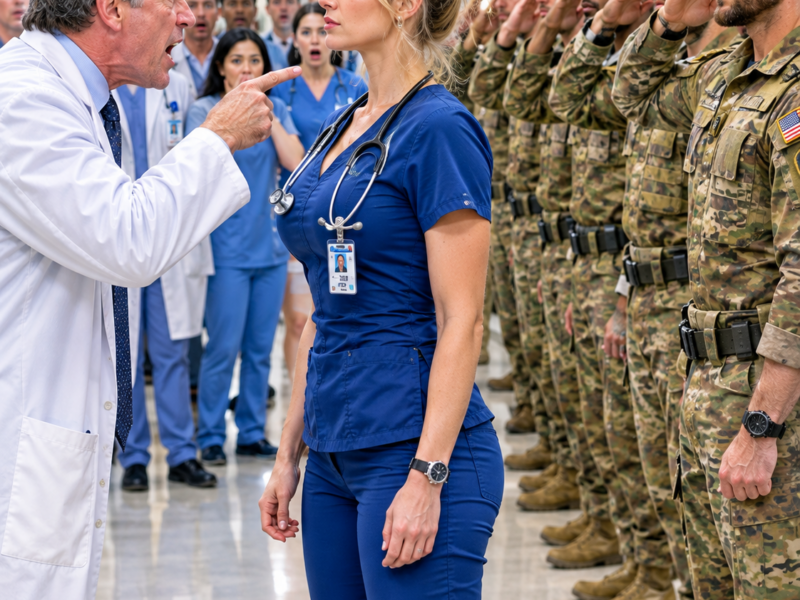
“I was ordered to step away from the operating table in front of eight Navy SEALs—until their commander suddenly stood at attention
The man standing outside the trauma bay hadn’t changed much.
His hair was shorter, his face a little thinner, and there were new lines around his eyes. But I recognized the way he held his shoulders. I recognized the slight tilt of his head when he watched a room, calculating every person and every possible exit.
Colonel Andrew Mercer.
Four years ago, he had been the senior officer responsible for coordinating Operation Black Harbor.
Four years ago, I had watched him walk away while six men were carried out of a ruined building.
And four years ago, he had signed the report that declared me missing and presumed dead.
I couldn’t breathe.
“Commander,” I whispered, “why is he here?”
Commander Hayes followed my gaze.
His expression hardened.
“He came with the transport team. Said he was coordinating the medical transfer.”
“He has no authority to be here.”
“I know.”
Dr. Lawson stepped forward, visibly irritated.
“Can somebody explain why we’re holding up emergency treatment for a reunion?”
Hayes finally turned toward him.
“Doctor, I suggest you step away from Nurse Brooks.”
Lawson laughed without humor.
“I’m the director of emergency surgery. I decide who works in my trauma bay.”
“Then perhaps you should start by listening to the people who just saved your patient.”
Before Lawson could respond, Patricia, the senior nurse, approached with a tablet.
“Doctor, the patient in Bed Three is deteriorating again. His oxygen saturation is dropping.”
I moved immediately.
“Get me a portable ultrasound.”
Lawson raised his voice.
“You are not touching that patient.”
Patricia looked at him.
“She’s the only person in this room who recognized the problem before he arrested.”
For a moment, Lawson seemed ready to argue.
Then the monitor sounded.
He stepped aside.
I went to the bedside.
The injured SEAL was conscious but struggling. I checked his breathing, watched the monitor, and guided the respiratory therapist through the next steps while the attending trauma surgeon arrived.
My hands remembered what my mind was trying to forget.
I had spent years telling myself I was no longer that person.
But the truth was that I had never stopped being her.
The patient stabilized after the team intervened. I stepped back, allowing the physician to take over.
When I turned around, Commander Hayes was watching me.
“You haven’t lost it,” he said.
I didn’t smile.
“I never wanted to need it again.”
He nodded.
“I understand.”
“No,” I said quietly. “You don’t.”
His expression changed.
I looked past him toward the hallway.
“Not yet.”
Four years earlier, Operation Black Harbor had been described as a straightforward recovery mission.
A small team would enter an abandoned coastal communications facility, retrieve a captured intelligence analyst, and evacuate before sunrise.
I had been a Navy medical officer assigned to the joint special operations unit.
My job was to keep the team alive.
I wasn’t a SEAL. I wasn’t a combat commander. But I had spent years training alongside men who trusted me with their lives, and I had earned a place in their unit.
The team called me Doc.
The mission had gone wrong before we reached the facility.
Our extraction route changed at the last minute. The new coordinates came through an authenticated command channel. I questioned the change, but the authorization appeared legitimate.
Then the building exploded.
The first blast threw me against a concrete wall. The second brought part of the ceiling down.
I remembered smoke, broken glass, and someone shouting my name.
I remembered crawling toward a wounded teammate.
I remembered the radio going silent.
And I remembered seeing Colonel Mercer through the dust, standing near the entrance with two armed men.
He had looked directly at me.
Then he had turned away.
I never understood why.
When I regained consciousness, I was in a military hospital under a temporary identity. My records had been restricted. I was told that the remaining team members had been evacuated, that an investigation was underway, and that I was not to contact anyone connected to the mission.
A few weeks later, I learned that six men had been declared dead.
The official report said the team had entered the facility despite intelligence indicating an imminent threat.
It said I had been killed in the explosion.
I knew that wasn’t true.
But the medical command officer handling my recovery told me that my survival had been classified for operational reasons. He said revealing my identity could endanger the surviving members.
I believed him.
I signed the paperwork.
I left the military.
And eventually, I became Hannah Brooks, a nurse who hoped that helping people in a civilian hospital would be enough to make the past stay buried.
For four years, it had.
Until eight SEALs arrived at my hospital.
Commander Hayes waited until the trauma team had stabilized the remaining patients before approaching me.
“Can we talk somewhere private?”
I looked at the patients.
“I can’t leave until they’re settled.”
“We’ll wait.”
Dr. Lawson stepped into our path.
“Commander, I need to make something clear. Nurse Brooks is under my supervision. If you want to discuss her military background, you can do that after my department has finished dealing with this emergency.”
Hayes looked at him.
“Your department?”
“That’s right.”
“Then perhaps you can explain why your medical records show that one of our men was given a medication he has a documented allergy to.”
Lawson’s face tightened.
“What?”
Hayes held out a folded medical printout.
“Patient Daniel Reeves. Severe allergy to the medication listed here. The electronic record was altered shortly before the helicopter arrived.”
Lawson glanced at the page.
“That isn’t possible.”
Patricia came over.
“I saw the original allergy alert. It was in the chart when the patient was registered.”
Lawson turned sharply.
“Patricia, go back to your station.”
She didn’t move.
“I also saw someone access the chart from an administrative terminal.”
“Who?”
“I don’t know. But the login belonged to your office.”
The silence that followed was immediate.
Lawson took the printout from Hayes.
“This is a serious accusation.”
“Then I suggest you take it seriously.”
I looked at the document.
The medication entry had been changed at 8:42 p.m.
The helicopter had landed at 8:51.
Someone had modified the record just nine minutes before the patients arrived.
“Commander,” I said, “who had access to the patient manifest?”
Hayes looked at me.
“Hospital administration, military medical coordination, and the transport liaison.”
“Who was the liaison?”
He didn’t answer immediately.
Then he glanced toward the hallway.
“Colonel Mercer.”
My stomach tightened.
I looked at the printout again.
The medication change wasn’t a random mistake.
It was a warning.
Someone had known which patients were coming, what their medical histories contained, and how to alter the records before the emergency team could react.
I turned toward Patricia.
“Preserve the original chart. Don’t let anyone overwrite it.”
She nodded.
“Already requested an audit lock.”
Hayes gave her a grateful look.
Then he turned to Lawson.
“Until this is investigated, nobody changes those records.”
Lawson’s face flushed.
“You cannot issue orders in my hospital.”
“No,” Hayes said. “But federal investigators can.”
We met in a small conference room near the intensive care unit.
Commander Hayes came with me. Patricia joined us after handing over the trauma bay to another senior nurse.
Colonel Mercer was already waiting.
He stood beside the window with his hands folded behind his back.
“Commander,” he said smoothly. “I was wondering when you’d arrive.”
Hayes closed the door.
“You shouldn’t be here.”
Mercer smiled.
“I was assigned to coordinate the medical transfer.”
“You were removed from operational command years ago.”
“Administrative reassignment isn’t the same as removal.”
I stood near the door.
Mercer glanced at me.
For a moment, his expression was unreadable.
Then he smiled.
“Hannah Brooks. I heard you were working here.”
“You knew I survived.”
His smile disappeared.
“That’s a serious accusation.”
“You signed the report that declared me dead.”
“Based on the information available at the time.”
“You saw me after the explosion.”
He said nothing.
I took one step closer.
“I remember you standing in that doorway. I remember looking straight at you.”
Mercer exhaled.
“You were badly injured. You may not remember events accurately.”
“I remember enough.”
Hayes moved beside me.
“Colonel, the hospital records have been altered. We have reason to believe someone used the medical transfer process to target members of the original team.”
Mercer raised an eyebrow.
“That’s quite a leap.”
“Then you won’t mind answering a few questions.”
“I’ve already given my statement.”
“Not about the records.”
Mercer looked at me again.
“You should be careful, Hannah. People who revisit old operations sometimes discover that their memories aren’t as reliable as they think.”
I felt my hands begin to shake.
Not from fear.
From the effort of keeping them still.
“Is that supposed to scare me?”
“No. It’s advice.”
“Then here’s mine. Don’t confuse my silence with forgetting.”
His expression hardened.
Before he could respond, someone knocked.
Patricia opened the door.
“Commander, there’s someone here from the Naval Criminal Investigative Service. She says she needs to speak with Nurse Brooks.”
A woman in a dark blazer entered.
“I’m Special Agent Elena Ward. I understand there’s been a possible compromise of military medical records.”
Hayes nodded.
“We have an altered patient chart and a connection to a classified operation.”
Ward looked at Mercer.
“Colonel, I’d like you to remain available for questioning.”
He straightened.
“Agent, I have no obligation to answer questions based on an unverified hospital complaint.”
Ward held up her identification.
“I’m not asking you to answer anything yet. I’m telling you not to leave the premises.”
Mercer looked at the badge, then at me.
For the first time, I saw something in his eyes that wasn’t confidence.
It was calculation.
He was deciding what to do next.
Agent Ward interviewed me for nearly two hours.
She asked about the explosion, the revised extraction route, the original team roster, and the months following my recovery.
I told her everything I remembered.
When I described Mercer standing near the entrance, she asked me to repeat it.
“Did you see him before or after the second explosion?”
“After.”
“Could you see his face clearly?”
“Yes.”
“Were there other people with him?”
“Two men. One wore a dark tactical vest. The other carried a radio.”
“Did you recognize them?”
“No.”
She wrote something down.
“Why didn’t you report seeing Colonel Mercer?”
“I tried.”
“To whom?”
“A medical command officer. Captain Ellis. He told me my survival was classified and that I couldn’t discuss the mission.”
“Did he give you that instruction in writing?”
I shook my head.
“Not that I remember.”
Ward closed her notebook.
“Captain Ellis is one of the people we’re looking into.”
I stared at her.
“Why?”
“Because he approved the changes to your identity record. And because he signed the document that classified you as deceased.”
I felt a chill move through me.
“I thought the operation’s investigation was closed.”
“It was officially closed. That doesn’t mean it was properly investigated.”
She slid a folder across the table.
Inside was a copy of the original mission report.
The document said the team had received a warning about hostile activity but proceeded anyway.
It also stated that I had been instructed to remain at the medical staging point.
I looked up.
“That’s false.”
Ward nodded.
“We know.”
She showed me another page.
The original extraction coordinates were listed in a separate appendix. Someone had crossed them out and replaced them with a new route.
The authorization code belonged to a senior command office.
I recognized the final four digits.
They belonged to Mercer’s command terminal.
I looked at Ward.
“Can you prove he entered it?”
“We’re working on that.”
“Then what do you need from me?”
“Anything you remember about the final briefing.”
I closed my eyes.
There had been a briefing room.
A printed map.
A radio operator standing beside the door.
And a man carrying a black folder.
I opened my eyes.
“Someone brought a folder into the briefing.”
“Who?”
“I don’t know his name. He wasn’t wearing a uniform. He had a contractor badge.”
Ward leaned forward.
“Can you describe him?”
“Tall. Dark hair. A small scar near his chin. He had a silver ring on his right hand.”
She wrote it down.
“Did he speak to you?”
“Yes. He asked me to sign a medical equipment receipt.”
“What was wrong with it?”
“The inventory didn’t match the equipment we were supposed to receive. I refused.”
Ward stopped writing.
“Do you remember the company?”
I thought for a moment.
“Something with the word Atlantic. Atlantic Defense, maybe.”
Ward looked at Hayes.
He had gone very still.
“What?” I asked.
Hayes pulled out his phone and showed me a photograph.
The man in the picture had dark hair, a scar near his chin, and a silver ring.
I recognized him immediately.
“That’s him.”
Hayes lowered the phone.
“His name is Peter Shaw. He was a logistics contractor attached to the operation.”
Ward’s expression changed.
“Shaw was questioned during the original investigation. He claimed he had never entered the briefing room.”
I looked at the picture again.
“He lied.”
Ward nodded.
“And now we may be able to prove it.”
The next morning, the hospital felt different.
The eight SEALs were spread across intensive care and the surgical recovery unit. Some were stable. Others remained in critical condition.
I visited each of them when my shift allowed.
Chief Daniel Reeves was the first to speak.
“You still make people nervous, Doc.”
I smiled faintly.
“You’re supposed to be resting.”
“I’m resting. I’m also talking.”
His voice was weak, but his eyes were clear.
“I remember Black Harbor.”
I pulled a chair beside his bed.
“So do I.”
He stared at the ceiling.
“I was on the second team. We were supposed to secure the southern entrance. When the explosion happened, the radio went dead. We were told you didn’t make it.”
“I know.”
“We searched the wreckage.”
I looked down at my hands.
“Did you find anything?”
“Your medical bag. Your identification tag. A lot of blood.”
He turned his head toward me.
“But no body.”
I swallowed.
“Why did the report say I was dead?”
“Mercer told us the recovery team had confirmed it.”
“Did you believe him?”
“For a while.”
He paused.
“Then one of the guys found a message on an old operations channel. It said the extraction route had been changed without approval from the field commander.”
I leaned forward.
“Who sent it?”
“Unknown. The message disappeared before we could save it.”
“Did anyone else see it?”
“Three of us.”
I wrote down their names.
“Daniel, why didn’t you tell investigators?”
He gave a bitter laugh.
“We did. They said the message was fabricated.”
I sat quietly.
Four years of unanswered questions were beginning to connect.
“There’s something else,” he said.
“What?”
“Before the mission, Shaw came to our staging area. He asked the team leader about the cargo list. Said some equipment had been substituted.”
“Did anyone challenge him?”
“Yourself, apparently.”
He smiled weakly.
“You were the only one who refused to sign.”
I stared at him.
That receipt.
That small, seemingly insignificant piece of paperwork.
It might have been the reason someone had decided I could never tell the truth.
By the afternoon, Agent Ward had obtained a warrant for the contractor’s records.
Peter Shaw’s company, Atlantic Defense Logistics, had received a series of payments from a shell corporation shortly before Operation Black Harbor.
The payments were approved through a consulting account connected to Colonel Mercer.
The same company had later paid for a private medical evacuation service that transported me after the explosion.
That detail made my skin crawl.
“Why would they pay for my evacuation?” I asked.
Ward explained carefully.
“We believe they needed you alive, but out of contact.”
I looked at her.
“Why?”
“Because you were a witness. You had seen the contractor’s equipment substitution and questioned the route change. If you were officially dead, your testimony couldn’t reopen the operation.”
I felt sick.
“They didn’t kill me because they thought I was useful?”
“That’s one possibility.”
Hayes stood beside the table.
“And when the original team started asking questions, someone decided to deal with them too.”
Ward nodded.
“We’re investigating whether the recent medical record alteration was intended to harm the surviving SEALs or create confusion around their treatment.”
“Who changed the chart?” I asked.
“We have a login trail leading to an administrative workstation assigned to Dr. Lawson.”
I thought of Lawson’s expression when the allergy record was brought up.
“Was he involved?”
“We don’t know yet. But his access credentials were used.”
Hayes folded his arms.
“Then bring him in.”
Ward shook her head.
“Not until we know whether someone used his account without permission.”
She turned to me.
“There’s another issue. Your military separation record was altered. It shows that you voluntarily resigned after a psychological evaluation.”
I stared at her.
“I never had that evaluation.”
“I know. The appointment record was fabricated.”
“Who signed it?”
Ward hesitated.
“Captain Ellis.”
I closed my eyes.
Captain Ellis had been the man who told me to keep quiet. The man who said my survival was classified. The man who promised that my service record would be protected.
He had helped erase me.
Dr. Lawson appeared outside the nurses’ station shortly after six.
He looked exhausted and angry.
“Brooks. My office. Now.”
I didn’t move.
“If you have something to say, you can say it here.”
He lowered his voice.
“You have created a serious problem for this hospital.”
“Someone altered a patient’s allergy record.”
“I am aware.”
“And your credentials were used.”
“My credentials are used by half the administrative staff.”
“Then we should find out who had access.”
He glanced toward the hallway.
“Not everything needs to become a federal investigation.”
I stared at him.
“Eight injured men were brought here. Someone changed their records before they arrived. One of them could have died.”
“And he didn’t.”
“Because I caught it.”
Lawson’s jaw tightened.
“You seem to have forgotten that you’re a nurse, not an investigator.”
“No. I remember exactly what I am.”
He leaned closer.
“Then act like it. Stay out of this investigation and let the appropriate people handle it.”
I looked past him.
Agent Ward was standing near the elevator.
She had heard enough.
“Dr. Lawson,” she said, approaching. “I’d like you to come with me.”
His expression shifted.
“On what grounds?”
“Your credentials were used to access and alter a protected medical record. We need to determine whether you authorized the access.”
“I did not.”
“Then you can explain that in a formal interview.”
Lawson looked at me.
“This is because of you.”
“No,” I said. “It’s because someone put a patient’s life at risk.”
He walked away with Ward.
For the first time since the SEALs had arrived, I felt that the hospital might finally be choosing the right side.
Two days later, I learned what had happened to the eight SEALs.
All eight were alive.
Three had undergone surgery. Two were still receiving intensive care. The others were expected to recover.
I stood in the corridor outside the ICU when Commander Hayes approached.
“Good news,” he said.
I looked at him.
“Which part?”
“Reeves is off the ventilator. The others are stable.”
I let out a breath I hadn’t realized I was holding.
“Thank God.”
Hayes studied me.
“You should be proud.”
“I didn’t save them alone.”
“No. But you saw something the rest of us missed.”
He paused.
“There’s something I need to tell you about Black Harbor.”
I turned toward him.
“What?”
“The original team leader survived.”
My heart stopped.
“Who?”
“Lieutenant Marcus Bell.”
I remembered Marcus.
He had been the one who insisted on checking every piece of equipment before deployment. He had been the first person to call me Doc.
“I thought he was dead.”
“So did we. He was listed among the casualties, but he was evacuated separately and placed in a long-term rehabilitation facility under a different administrative designation.”
“Why wasn’t I told?”
“His identity was restricted while investigators reviewed his testimony.”
“Does he remember what happened?”
Hayes nodded.
“He remembers Mercer giving the order to change the route. He also remembers Shaw entering the command vehicle shortly before the team moved out.”
I closed my eyes.
“Then we can prove it.”
“We can prove more than that.”
He handed me a small envelope.
Inside was a photograph of the original team.
Marcus stood in the center, smiling. I was beside him, holding a medical kit. Daniel Reeves was behind us, making a ridiculous face at the camera.
I touched the edge of the photograph.
“Where did you get this?”
“Reeves had it in his personal effects. He asked me to give it to you.”
I couldn’t speak.
Hayes waited.
Then he said, “There’s a message on the back.”
I turned it over.
In faded handwriting were six words.
We never stopped looking for you.
My eyes filled.
I pressed the photograph against my chest.
For four years, I had believed everyone had moved on.
That the men I served beside had accepted the official story.
That I had become a name on a casualty list.
But they had kept looking.
Even when the system told them not to.
The investigation moved quickly after Marcus Bell agreed to testify.
He identified Mercer as the officer who ordered the unauthorized route change. He confirmed that Peter Shaw had delivered the substituted equipment and that Captain Ellis had later instructed the surviving personnel to keep the incident confidential.
Financial records connected the contractor to the shell corporation.
Communications logs showed that the route change had been transmitted through a command channel using Mercer’s credentials.
The original mission report had been altered hours after the explosion.
The medical evacuation records had also been modified to conceal my survival.
When confronted with the evidence, Captain Ellis admitted that he had been instructed to classify my identity and suppress the original equipment discrepancy.
He claimed he had believed the order came from a higher authority.
That did not excuse what he had done.
But it explained how a single lie had spread through so many official records.
Peter Shaw was arrested after investigators found evidence that he had knowingly supplied defective equipment and passed operational information to an unauthorized recipient.
Colonel Mercer was taken into custody on charges connected to conspiracy, falsification of official records, and obstruction of the investigation.
Dr. Lawson was not charged with involvement in the military conspiracy. Investigators determined that his credentials had been used by an administrative employee acting under instructions from an outside contractor. Lawson was placed on administrative leave while the hospital reviewed his handling of the incident and his response to the altered chart.
The hospital also changed its access procedures.
Every medical record connected to the SEALs was preserved, audited, and reviewed by an independent team.
And for the first time in four years, the truth about Operation Black Harbor became part of the official record.
I wasn’t responsible for the deaths.
I hadn’t disobeyed the mission order.
I hadn’t abandoned my team.
I had questioned a suspicious change, refused to sign a false equipment receipt, and tried to save the men beside me.
The official correction arrived in a plain envelope.
I read it alone in the hospital break room.
My name was restored to the original mission roster.
My service record was corrected.
The false declaration of death was withdrawn.
The final paragraph acknowledged that my actions during the operation had been consistent with my training and responsibilities.
I read it twice.
Then I folded the pages and sat quietly.
I had imagined this moment many times.
I thought I would feel triumphant.
Instead, I felt tired.
Not defeated.
Just tired of carrying something that had never belonged to me.
Three weeks later, the eight SEALs were well enough to gather in the hospital’s rehabilitation courtyard.
Some still used crutches. One had a brace around his shoulder. Reeves walked slowly, with a nurse nearby.
But all eight were there.
I came out carrying a tray of coffee.
“You’re not supposed to be walking around,” I told Reeves.
He grinned.
“I’m not walking around. I’m standing in one place.”
“That’s not how medical instructions work.”
“That’s why I don’t write them.”
The others laughed.
For a moment, the courtyard felt like an ordinary place.
A group of friends teasing one another after a difficult week.
Then Commander Hayes approached with Marcus Bell.
I hadn’t seen Marcus since the operation.
He looked older, thinner, and moved with a slight limp. But his eyes were the same.
“Doc,” he said.
My throat tightened.
“Marcus.”
He opened his arms.
I stepped into the embrace.
For a few seconds, neither of us spoke.
Then he whispered, “I’m sorry we couldn’t find you.”
I shook my head.
“You were told I was dead.”
“We should have questioned it harder.”
“You did what you could.”
He pulled back and looked at me.
“Are you coming back?”
I frowned.
“Back where?”
“To the service. There’s a position being discussed. Medical training, operational support. They want someone who understands what happened.”
I looked at the eight men.
Then at the hospital windows.
“I don’t know.”
Marcus nodded.
“You don’t have to decide today.”
That was the first time anyone had said that to me.
Not that I should return.
Not that I owed the team something.
Not that I needed to prove I was still the person they remembered.
Just that I didn’t have to decide today.
A month later, the hospital held a small ceremony for the medical team who had treated the eight SEALs.
There were no television cameras.
No grand speeches.
Just a few hospital administrators, the trauma staff, and the men who had recovered.
Dr. Lawson was absent. His administrative review was still ongoing, and he had issued a written apology to the staff for dismissing my concerns during the emergency.
I accepted the apology.
Not because it erased what happened, but because I no longer wanted to carry his judgment around with me.
Patricia stood beside me as the commander began speaking.
He talked about the speed of the response, the teamwork, and the importance of listening to every member of a medical team.
Then he looked directly at me.
“Some people believe courage is always loud. That it looks like giving orders or standing in front of danger. But sometimes courage is quieter. Sometimes it’s a person who notices what everyone else overlooks. Someone who speaks up when speaking up costs something.”
He paused.
“Four years ago, Nurse Brooks was written out of the history of our unit. Last month, she walked into a trauma bay and saved members of that same team. We owe her more than a salute.”
The eight SEALs stood.
Some moved carefully. Some needed help.
But every one of them raised a hand.
I felt tears gathering.
This time, I didn’t try to hide them.
I raised my hand in return.
Not as a soldier.
Not as a nurse.
Just as someone who had finally been seen.
After the ceremony, I found myself alone near the hospital entrance.
The automatic doors opened and closed as people came and went.
A child held his father’s hand. A woman carried flowers. An exhausted resident leaned against the wall, drinking coffee from a paper cup.
Ordinary life.
I looked down at my hospital badge.
HANNAH BROOKS — REGISTERED NURSE.
For a long time, I had thought of those words as a new identity.
A way to escape the old one.
But I understood now that I hadn’t needed to escape anything.
The nurse and the officer were both me.
The woman who had crawled through smoke to reach a wounded teammate was the same woman who had stood beside a hospital bed and refused to let a patient receive the wrong medication.
I had never stopped being capable.
I had only stopped believing that my past was something I could survive.
Commander Hayes approached from behind.
“Thinking about the offer?”
I smiled faintly.
“A little.”
“You don’t have to return to active duty to remain part of the team.”
“I know.”
He nodded toward the courtyard.
“Those men are going to remember you for the rest of their lives.”
I watched Reeves laughing with Marcus.
“I’m going to remember them, too.”
Hayes reached into his jacket and handed me a small folded note.
“Reeves wanted you to have this.”
I opened it.
It was written in uneven handwriting.
You once told me that saving one person was worth the entire mission. I didn’t understand it then. I do now. Thank you for not giving up on us.
I folded the note carefully.
“Tell him he doesn’t owe me anything.”
Hayes smiled.
“I think he knows.”
The hospital doors opened again.
A new ambulance was arriving.
Somewhere inside, another patient needed help.
I straightened my badge and turned toward the trauma entrance.
“Looks like I’m needed.”
Hayes stepped aside.
“Yes, ma’am.”
I stopped and looked at him.
He gave me a small, respectful smile.
I shook my head.
“Just Hannah.”
Then I walked back into the hospital.
Behind me were eight men who had once believed I was gone.
Ahead of me was a room full of people who needed someone to notice the details, ask the difficult questions, and refuse to stand back when a life was at stake.
For the first time in four years, I wasn’t walking away from my past.
I was walking forward with it.
And I finally understood that surviving wasn’t the end of my story.
It was the reason I still had one.
The end.









