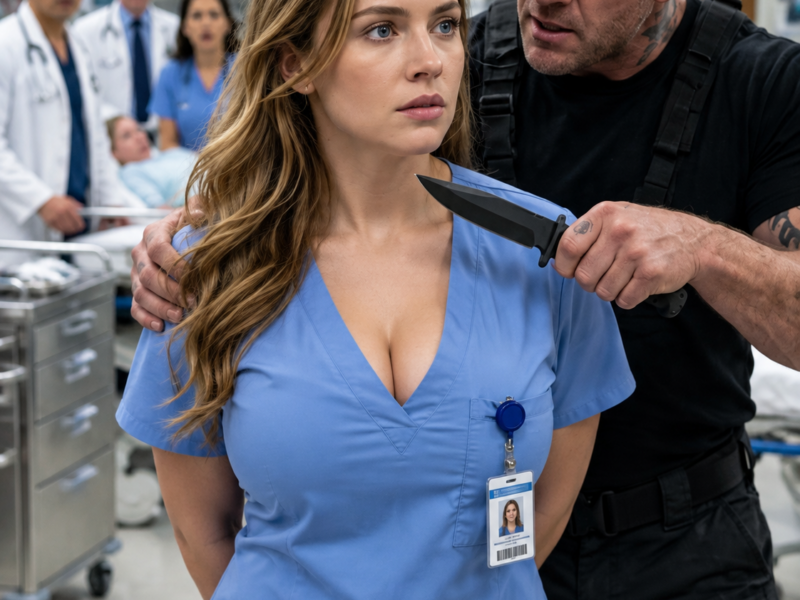
“I was halfway through my first night shift at St. Vincent’s Hospital in Dallas when an armed man dragged a bleeding security guard through the emergency room doors
I couldn’t take my eyes off the photograph.
The man beside me was Daniel Reed, my former team leader, the person who had pulled me out of a burning vehicle in Kandahar and carried me nearly half a mile while shrapnel tore through his own shoulder.
I had watched a military chaplain read his name at a memorial service.
I had stood beside his empty coffin with my hands clenched so tightly that my fingernails left crescents in my palms.
And now his face was staring up at me from a bloodstained photograph on a hospital floor.
“Where did you get this?” I asked.
The gunman tilted his head.
“That’s your first question?”
“It’s the only one you’re getting.”
For the first time since he had entered the emergency department, he looked almost amused.
“Still the same, Carter.”
“Don’t call me that.”
His expression hardened, and the rifle shifted toward the floor.
Behind him, the second armed man glanced toward the corridor, then at a small digital watch on his wrist.
“We don’t have time for this, Mason.”
Mason.
The name stirred something in my memory, but the years had buried it beneath too many other things.
I searched his face for the young soldier I remembered, the one who had once laughed over burnt coffee and played terrible country music during long drives between bases.
Then I recognized his eyes.
Ethan Mason.
He had been a communications specialist attached to our unit during the final months of our deployment.
He wasn’t supposed to have been in Kandahar the night Daniel died.
“What are you doing here, Ethan?” I asked.
His jaw tightened.
“Trying to keep you alive.”
A nervous laugh escaped someone behind the nurses’ station.
It stopped almost immediately.
“Then put the gun down,” I said.
“You don’t understand what’s happening.”
“You’re holding a hospital full of people at gunpoint. I understand that part perfectly.”
For a moment, neither of us spoke.
Then the security guard on the floor groaned, and my attention shifted to the blood spreading beneath him.
His name tag read HENDERSON.
He was conscious, but his breaths were shallow, and his fingers kept slipping against the wound in his abdomen.
I looked at Mason.
“He’s losing blood. Let me treat him.”
“Stay where you are.”
“He’s going to die if nobody helps him.”
Mason glanced at the guard.
Something flickered across his face, perhaps regret, perhaps calculation.
“Do it,” he said. “Slowly.”
I moved toward Henderson with my hands visible.
Every instinct told me to study the room, identify the second man’s position, and find a way to get everyone out.
But Henderson was a patient now, and the blood soaking his uniform wasn’t a military problem or an intelligence puzzle.
It was a medical emergency.
I pressed a trauma dressing against his wound and instructed a nearby nurse to bring the emergency kit.
“Keep pressure here,” I told her. “Don’t lift the dressing to check it.”
She was shaking so badly that the package nearly slipped from her fingers.
I covered her hand with mine for a second.
“Look at me. You’re doing fine.”
She nodded, swallowed, and followed my instructions.
That was when Mason noticed the tattoo on my wrist.
A small black compass, barely visible beneath my sleeve.
His face changed.
“You kept it.”
I pulled my cuff down.
“Not another word.”
“Daniel said you would.”
I looked up so sharply that the nurse beside me flinched.
“What did you say?”
Mason opened his mouth.
The second man seized his arm.
“Enough. We came for the drive, not a reunion.”
The drive.
There it was, the first concrete piece of information that didn’t belong to the story they were telling.
They hadn’t come to kill me immediately.
They were looking for something.
And whatever it was, they believed I knew where to find it.
I finished securing the dressing and looked toward Denise.
She was crouched behind the counter, keeping two frightened patients low to the ground.
Her eyes met mine.
I gave her the smallest shake of my head.
Don’t move.
Don’t challenge them.
Wait.
The hospital’s alarm continued to sound, but somewhere in the distance, I could hear sirens approaching.
The second man heard them too.
“We have six minutes, maybe less.”
Mason finally lowered his rifle a few inches.
“Where is it, Emily?”
“I don’t know what you’re talking about.”
“The drive Daniel gave you.”
“Daniel never gave me anything.”
“Then why did he spend his last thirty seconds asking us to find you?”
The room seemed to narrow around those words.
I remembered the final night in Kandahar with a clarity I had spent six years trying to lose.
The heat.
The smell of burning fuel.
The radio screaming with overlapping voices.
Daniel’s hand gripping my shoulder as he pushed me toward the extraction point.
And his last words.
If anything happens, don’t trust the report.
I had assumed the blast had scrambled my memory.
For months, those words had returned in nightmares, always incomplete, always swallowed by the sound of the explosion.
Now Mason was telling me Daniel had been looking for me before he died.
“You’re lying,” I whispered.
“I wish I were.”
The second man stepped forward.
He was taller than Mason, with close-cropped hair and a pale scar running from his jaw to his collar.
He carried no visible military insignia.
“Miss Carter, I’m going to give you one opportunity to cooperate.”
“Then you should start by explaining why you’re threatening hospital staff.”
His eyes narrowed.
“You’ve spent six years pretending to be someone else. Don’t make the mistake of thinking this place protects you.”
Before I could answer, a phone began ringing inside the black duffel bag at his feet.
He looked down.
For the first time, his composure cracked.
Mason saw it.
So did I.
The second man reached for the bag, but Mason raised his rifle toward him.
“Don’t.”
The word was quiet.
The effect was immediate.
The two men stared at each other across the bloodstained floor.
And in that instant, I understood something important.
They were not working together because they trusted each other.
They were working together because each believed he needed the other.
The phone stopped ringing.
A message chimed from inside the bag.
Mason looked at me.
“Whatever happens next, don’t let him take you upstairs.”
Then the lights went out.
For half a second, the emergency department disappeared into darkness.
A patient screamed.
Someone knocked over a chair.
The backup lighting flickered on, casting the room in a dim red glow.
Mason was no longer standing where he had been.
Neither was the second man.
I heard a struggle in the corridor, followed by a crash and a sharp command.
Then a gunshot cracked through the hospital.
The sound was so violent that several patients began screaming at once.
Denise shouted my name.
I was already moving toward Henderson, who had begun to slip into unconsciousness.
I pressed harder against his wound and called for the trauma team.
The gunshot had come from somewhere beyond the emergency department doors.
A moment later, a figure stumbled back into view.
It was the second man.
His left arm hung at an awkward angle, and his expression had lost every trace of confidence.
Mason followed him, breathing hard, his rifle still raised.
“Everyone stays down!” Mason shouted.
Then he looked directly at me.
“Emily, the drive is upstairs. Records storage, fourth floor. You need to get to it before he does.”
I stared at him.
“You expect me to walk upstairs while you’re pointing a gun at people?”
“I expect you to decide whether Daniel died for nothing.”
The words landed with deliberate cruelty.
I hated him for using Daniel’s name.
I hated myself more for feeling the old instinct to obey.
But I had learned something during six years of trying to become ordinary.
The past could explain why I was afraid.
It did not get to make every decision for me.
“I’m not leaving these patients,” I said.
Mason looked at Henderson, then at the frightened nurse kneeling beside him.
For a second, he seemed to understand exactly what I meant.
He turned toward the other man.
“Get the bag.”
The scarred man lunged for it.
Mason swung the rifle toward him, and both men disappeared into the corridor again.
I heard footsteps racing toward the stairwell.
Then Denise grabbed my wrist.
“Emily, tell me what is happening.”
I looked at her.
There was no way to explain six years of military secrets while a bleeding security guard lay between us.
“Call the police when you can do it safely,” I said. “Tell them there are at least two armed men, one injured. Don’t let anyone follow me.”
Her fingers tightened around my wrist.
“You’re a nurse.”
“I know.”
“Then act like one and stay with your patients.”
Her voice broke on the last word.
For the first time that night, I saw how frightened she was.
Not for herself.
For me.
I glanced at Henderson, then at the nurse holding pressure on his wound.
She met my eyes and nodded.
“I’ve got him,” she said.
I wanted to believe that was enough.
Then the overhead speaker crackled.
A man’s voice announced that the hospital was entering a security lockdown.
The fourth floor would be sealed within minutes.
If the drive was really there, the men would either retrieve it or destroy whatever evidence it contained.
And if Daniel had somehow survived, if there was even a chance that the truth about his death had been buried, I could not let that chance disappear.
I took the stairs.
I didn’t carry a weapon.
I carried a flashlight from the emergency cabinet and a trauma shears clipped to my pocket.
My hands were steady by the time I reached the second-floor landing.
The third-floor corridor smelled of disinfectant and overheated electrical equipment.
At the fourth-floor stairwell, I found a trail of blood leading toward a restricted records area.
The door stood slightly open.
I stopped outside it and listened.
A drawer slammed.
A man’s voice muttered a curse.
Then silence.
I pushed the door inward.
The room was lined with filing cabinets, archive boxes, and shelves holding old patient records that had not yet been transferred to the hospital’s digital system.
The scarred man stood at the far end, searching through a metal cabinet.
He turned when he heard me.
“You should have stayed downstairs.”
“I get that a lot.”
His gaze moved to the trauma shears in my pocket.
He smiled without warmth.
“You think those will help you?”
“No. But they make me feel better.”
He took a step toward me.
I moved backward, keeping a heavy table between us.
He was injured, but not enough to make him harmless.
His right hand disappeared beneath his jacket.
I didn’t wait to find out what he was reaching for.
I shoved the table sideways.
It crashed into his legs, knocking him off balance.
I ran for the door.
He caught the back of my scrub top and pulled me hard enough to tear the fabric at the shoulder.
I twisted free, struck the wall, and felt pain shoot down my arm.
He grabbed for me again.
This time, I used the momentum of his movement to drive him into the cabinet.
The metal doors rattled.
He stumbled, swore, and reached for my throat.
I struck his injured arm.
He cried out and released me.
I slipped through the doorway and slammed it shut behind me.
His weight hit the other side a second later.
The door shook in its frame.
I ran down the corridor until I reached a small office marked ARCHIVE ADMINISTRATION.
Inside, a desk lamp illuminated a stack of folders and an old desktop computer.
A black flash drive lay beside the keyboard.
For a moment, I could only stare at it.
It was ordinary.
No military insignia.
No identifying label.
Just a small piece of plastic that could have held someone’s vacation photographs.
A folded note rested beneath it.
My name was written on the outside in Daniel’s handwriting.
I knew the sharp angle of his capital E, the way he crossed his sevens, the small ink blot he always made when he wrote too quickly.
My fingers began to tremble.
I unfolded the note.
Emily, if you’re reading this, Mason found you before I could explain.
I’m sorry.
The official report was built on a lie. Your father knew about the operation before it happened, and he tried to stop it.
I read the last sentence twice.
My father had been an Army intelligence analyst before he retired.
He had died of a heart attack when I was eighteen, long before my deployment.
I had grown up believing he had left the military quietly, worn out by years of service and the things he had seen.
He had never spoken about Kandahar.
He had never mentioned Daniel.
And I had never told anyone in my unit that my father had worked in intelligence.
The note continued.
The drive contains the original mission logs and the communications records that disappeared after the extraction. Do not trust anyone who tells you the files prove the whole story. Some of the evidence was altered before it was copied.
At the bottom, Daniel had written one final sentence.
If you want to know what happened to your father, look at the recording marked HOME.
A noise sounded in the corridor.
Footsteps.
I slipped the drive into my pocket and folded the note.
The office door opened.
Mason stood there, his rifle lowered, his face pale with exhaustion.
He saw the paper in my hand.
For the first time since the attack began, he looked afraid.
“Did you read it?”
“Enough.”
His eyes dropped to my pocket.
“Give me the drive.”
“Why?”
“Because if the wrong people get those files, more people will die.”
“That’s what everyone says when they want you to stop asking questions.”
He flinched as if I had struck him.
“You think I came here because I wanted to scare a hospital full of people?”
“You brought a gun into an emergency department.”
“I know what I did.”
“Then explain it.”
He looked toward the corridor.
“We don’t have much time.”
“Then talk faster.”
Mason dragged a hand across his face.
“The operation in Kandahar wasn’t supposed to be a rescue. It was supposed to recover a source and destroy the records connecting him to an intelligence contractor.”
“What source?”
“Your father.”
I took a step back.
“No.”
“Emily—”
“My father had been dead for eleven years.”
Mason stopped.
The silence that followed was worse than an argument.
“Eleven years?” he repeated.
I nodded.
He looked as if something inside him had just collapsed.
“That’s not what Daniel told me.”
I wanted to dismiss him as a liar, but the shock in his face was too immediate.
“What did Daniel tell you?”
“That your father had disappeared after exposing a covert program called Black Harbor. That he’d been presumed dead, but no one had ever recovered a body.”
I felt the floor shift beneath my feet.
My father had been buried in a small cemetery outside Austin.
I had attended the funeral.
I remembered the casket.
I remembered my mother’s trembling hand in mine.
I remembered the cold rain on the back of my neck.
“You have the wrong man,” I said.
Mason didn’t argue.
Instead, he took a small photograph from his jacket and held it out to me.
It showed a gray-haired man standing beside a woman outside a diner.
The picture was grainy, taken from a distance, but the man’s profile was unmistakable.
My father’s nose.
His narrow shoulders.
The scar above his left eyebrow from a car accident when I was twelve.
I reached for the photograph.
Mason pulled it back.
“Not yet.”
I stared at him.
“Are you insane?”
“If that man is your father, I need to know something before you see the rest.”
“What?”
“Did he ever tell you about a woman named Rachel?”
I searched my memory.
My father had known hundreds of people.
But Rachel wasn’t a name I associated with his military years.
Then I remembered a Christmas when I was sixteen.
My father had received a phone call after midnight.
He had stepped onto the porch, spoken quietly for several minutes, and returned looking older than he had before the phone rang.
When I asked who it was, he said it was an old colleague.
A week later, a Christmas card arrived without a return address.
He burned it in the kitchen sink.
At the time, I thought it was a private family matter.
Now I wondered what had been written inside.
“No,” I said. “He never told me about Rachel.”
Mason nodded slowly.
“Then the recording might explain why.”
A heavy thud sounded from the stairwell.
The scarred man was coming.
Mason turned toward the door.
“There’s a maintenance passage behind those shelves. It leads to the service elevator. Take the drive and go.”
“I’m not leaving until you tell me who sent you.”
He hesitated.
Then he lowered his rifle completely.
“Colonel Robert Vance.”
The name brought back another memory.
Vance had overseen the final review of our mission.
He had been the man who told me Daniel’s death was unavoidable, that the extraction had gone wrong, and that I should be grateful to have survived.
He had looked me in the eyes and said there was nothing more to investigate.
“You work for Vance?”
“I did.”
“And now?”
“Now I know he lied.”
The office door shuddered.
The scarred man slammed his shoulder against it.
Mason moved to the shelves and pushed aside a row of archive boxes, revealing a narrow maintenance door.
“Go.”
I didn’t move.
“What happened to Daniel?”
Mason’s face tightened.
“He survived the blast.”
For six years, I had carried Daniel’s death like a stone inside my chest.
Now Mason was telling me that the man I had mourned might have lived.
“Then why did you let us believe he was dead?”
“I didn’t know he survived until three months ago.”
The door slammed again.
A crack appeared near the lock.
Mason reached into his pocket and pulled out a small, folded photograph.
It was a picture of him and Daniel standing beside a battered truck.
On the back, Daniel had written a date from two years earlier.
I stared at it.
“Where is he?”
Mason looked at me with something close to shame.
“I don’t know. The last message he sent said he was going to find you.”
The door burst open.
The scarred man entered with a pistol in his good hand.
Mason raised his rifle, but the man fired first.
The shot struck Mason high in the shoulder.
He fell against the desk, knocking the lamp to the floor.
I ducked behind the shelves as another shot punched through a cabinet.
The scarred man advanced.
“Give me the drive, Emily.”
I pressed my hand against my pocket.
“You first.”
He laughed.
“You have no idea what you’re holding.”
“Then explain it.”
“It’s evidence of an operation that was shut down years ago. The people responsible are gone. The people who remain are trying to keep it buried.”
“Who are you?”
He stopped several feet away.
“Someone who knows that your father didn’t die in Texas.”
I felt sick.
“You’re lying.”
“Then watch the recording.”
He pointed at the desk.
The old computer monitor had flickered on during the struggle.
A video file was open on the screen.
HOME.
The scarred man glanced toward Mason, who was trying to press a hand against his bleeding shoulder.
“You have two choices,” he said. “You can leave with a dead man’s apology, or you can learn why your father abandoned you.”
I looked at the screen.
Then at Mason.
He was pale, but conscious.
“Emily,” he whispered. “Don’t let him decide what you deserve to know.”
I moved to the computer.
The scarred man raised his pistol.
“Play it.”
I clicked the file.
Static filled the screen.
Then a room appeared, dimly lit, with a plain white wall behind a wooden table.
A man sat facing the camera.
His hair was gray.
His shoulders were thinner than I remembered.
But when he looked up, I saw the familiar crease between his eyebrows.
My father.
For several seconds, I couldn’t breathe.
He looked directly into the camera.
“My name is Thomas Carter,” he said. “If Emily is watching this, then Black Harbor has failed to keep the truth from her.”
My knees nearly gave way.
He continued, his voice steady but tired.
“Emily, I am sorry. I know you were told I died in 2015. I know you buried a man whose name was mine. And I know that nothing I say can undo what that did to you.”
Tears blurred the screen.
The scarred man stood behind me, silent now.
My father leaned closer to the camera.
“I did not arrange the operation in Kandahar. I tried to stop it because the people directing it had identified our source as expendable. Daniel Reed discovered the plan and attempted to get the team out.”
He paused.
“The explosion was not an accident.”
The room seemed to tilt.
“Someone changed the extraction coordinates. Someone sent your unit into the wrong compound. And after the blast, they falsified the communications logs to make it appear that Daniel had disobeyed orders.”
My hands tightened against the desk.
I remembered the report.
The formal inquiry.
The cold language that blamed Daniel for abandoning the designated extraction point.
I remembered how I had spent months wondering whether I had missed something, whether I could have done more, whether Daniel’s death had been the consequence of a decision he regretted.
My father looked down, then back into the camera.
“I was already investigating Black Harbor when the operation was authorized. I discovered that a private intelligence contractor had been selling access to classified surveillance systems. When I tried to report it, the evidence disappeared, and my family was placed under observation.”
He swallowed.
“I was told that if I continued, Emily would be used to silence me.”
The scarred man shifted behind me.
My father continued.
“I made a terrible choice. I disappeared and allowed you to believe I was dead because I thought distance would keep you safe. I convinced myself that protecting you meant letting you grieve a lie.”
He closed his eyes briefly.
“I was wrong.”
The words were almost too quiet to hear.
“I should have trusted you with the truth. I should have found another way.”
I pressed a hand over my mouth.
For years, I had wondered why my father had seemed so distant in the final months before his death.
I had blamed work, stress, and the slow exhaustion that came with a career spent around secrets.
Now I understood that he had been afraid.
But fear did not erase what he had done.
The video continued.
“Daniel survived the explosion. He was badly injured and taken into custody by people working for the contractor. I don’t know where he is now. The files on this drive contain the original mission logs, but they also contain the names of people who helped cover up the operation.”
My father leaned forward.
“One of those names belongs to Colonel Robert Vance.”
Mason made a low sound behind me.
The scarred man swore.
My father looked directly into the camera again.
“Emily, if you have the drive, do not hand it to anyone simply because they claim to be on your side. The files were copied more than once. Some versions have been altered, and some contain planted evidence.”
He took a breath.
“Look for the original transmission from the night of the extraction. The timestamp is 02:14. That is where the lie began.”
The screen went black.
For several seconds, nobody spoke.
Then the scarred man reached toward the computer.
I moved between him and the desk.
“Don’t touch it.”
His expression hardened.
“You’ve seen enough.”
“No. I’ve seen the beginning.”
“You don’t understand what those files can do.”
“Then tell me.”
He lowered the pistol slightly.
“My name is Grant Mercer. I was hired to recover the drive before it reached federal investigators. Vance told me it contained fabricated intelligence that would destroy innocent people.”
“And you believed him?”
“I believed the contract.”
The honesty of the answer surprised me.
He wasn’t a fanatic.
He was a man who had taken a job, accepted the version of events that made the job easier, and kept going until the evidence began contradicting his instructions.
“You shot Mason,” I said.
“He tried to stop me.”
“Because he changed his mind.”
Mercer looked at Mason.
“Because he discovered who was paying him.”
Mason grimaced, pressing his hand against his shoulder.
“He’s right about one thing,” he said. “Vance hired me to find the drive. I thought it was evidence that could clear Daniel’s name. I didn’t know the hospital would be targeted.”
“You still brought a gun into a hospital,” I said.
“I know.”
There was no excuse in his voice.
Just exhaustion.
Then the office computer chimed.
A new file had appeared in the folder.
TRANSMISSION_0214.
I opened it.
The recording was audio only.
A burst of static.
Then a voice I recognized immediately.
Colonel Vance.
“Proceed with the revised coordinates. The team cannot be allowed to reach the source.”
A second voice answered.
“Sir, Carter’s unit is already moving.”
Vance’s reply was quiet.
“Then make sure the report reflects a failure of field leadership.”
I stopped the recording.
The scarred man had gone pale.
Mason stared at the screen.
The voice was unmistakable.
Vance had not merely hidden what happened.
He had ordered the conditions that made the disaster possible and prepared the explanation before the bodies were recovered.
But one question remained.
Why had the hospital been attacked tonight?
I opened the file properties.
The drive had been accessed remotely less than an hour earlier.
Someone had known the recording was there.
Someone had known I was at St. Vincent’s.
And someone had sent armed men to retrieve it before I could hear it.
I turned toward Mercer.
“Who told you I would be here?”
He didn’t answer.
Mason did.
“Vance has people inside the hospital system. He knew your employment history before you were hired.”
My stomach tightened.
“That doesn’t explain why he waited three weeks.”
“Maybe he didn’t know where the drive was until tonight,” Mason said. “Or maybe he was waiting for someone to confirm you had it.”
I thought of the text message in my locker.
You shouldn’t be working at St. Vincent’s.
The sender hadn’t threatened me.
They had warned me.
Perhaps the person who sent it had known what was coming.
Perhaps they had been watching me for weeks, waiting to see whether I would recognize the danger.
A new sound rose from the stairwell.
Voices.
Several people moving quickly.
Mercer stepped toward the door.
“If that’s Vance’s team, we’re out of time.”
“How do I know you’re not leading them here?” I asked.
“You don’t.”
He glanced at the drive in my hand.
“But if I wanted it badly enough to kill you, I wouldn’t still be standing here talking.”
It was not a comforting argument.
It was, however, the first honest one he had offered.
I looked at Mason.
“Can you walk?”
“Probably.”
“That’s not the same as yes.”
“It’s the best I’ve got.”
I helped him to his feet and guided him toward the maintenance passage.
Mercer followed, keeping his pistol lowered but ready.
We emerged near the service elevator just as the first police officers reached the fourth-floor corridor.
I stepped into the open with my hands raised.
“I’m a nurse. There’s an injured man behind me, and there are armed suspects inside the records area.”
The officers ordered everyone to the floor.
Mercer dropped his pistol immediately.
Mason did the same, wincing as he lowered himself to his knees.
I placed the flash drive on the floor and pushed it toward the nearest officer.
“That contains evidence related to a federal crime. It needs to be secured and independently examined.”
One officer looked at the drive, then at me.
“Are you Emily Carter?”
I hesitated.
“Yes.”
He exchanged a glance with his partner.
“There’s someone downstairs asking for you.”
“Who?”
He didn’t answer immediately.
Instead, he reached into his vest and pulled out a small photograph.
It was the same image Mason had shown me.
My father outside the diner.
Only this time, there was writing on the back.
A location.
And a date from three days earlier.
The officer spoke carefully.
“An elderly man arrived at the hospital about twenty minutes before the attack. He asked for you by name, then left when the security alarm went off.”
I stared at the photograph.
“Did he say where he was going?”
“He left a message.”
The officer handed me a folded piece of paper.
My fingers felt clumsy as I opened it.
Emily, if you’re ready to hear the truth, come alone to the place where your mother taught you to swim.
I knew the location.
A public pool in Austin that had closed years ago.
My mother had taken me there every summer until I was twelve.
The message was signed with two words.
I’m sorry.
For the first time that night, I had something more dangerous than a mystery.
I had hope.
And hope, I was learning, could make a person reckless in ways fear never could.
I wanted to leave immediately.
I wanted to drive to Austin and find my father and demand to know why he had let me bury him.
I wanted to ask whether he had ever thought about the years I had spent believing he was gone.
I wanted answers so badly that I could almost feel them in my hands.
But Denise was still downstairs.
Henderson was still fighting for his life.
And three armed men had turned a hospital into a crime scene because someone believed the truth could be contained by fear.
I could not walk away from that.
I returned to the emergency department.
Denise saw the torn shoulder of my scrub top and rushed toward me.
“Emily!”
She wrapped her arms around me before I could speak.
For several seconds, I let myself lean against her.
Then I pulled back.
“How’s Henderson?”
“He’s in surgery. The trauma team thinks he’ll make it.”
I closed my eyes briefly.
“Good.”
Denise studied my face.
“You’re not going to tell me this was a normal night shift, are you?”
A tired laugh escaped me.
“No.”
She looked toward the police officers gathering near the entrance.
“Are you safe?”
I thought about my father, Daniel, Mason, Mercer, and Colonel Vance.
“No,” I said. “But I know more than I did an hour ago.”
She didn’t ask me to explain.
Instead, she squeezed my hand.
“Then make sure knowing more doesn’t cost you everything.”
I kept those words with me through the hours that followed.
The hospital was searched from the basement to the roof.
The surviving patients were moved to secure areas, statements were taken, and the emergency department slowly returned to its familiar rhythm of alarms, footsteps, and whispered updates.
Mason was taken into custody after surgery on his shoulder.
Mercer was arrested without further resistance.
The flash drive was transferred to federal investigators, who confirmed that the original transmission and the altered mission logs were consistent with evidence they had been quietly collecting for months.
Colonel Vance was placed under investigation.
Two days later, he was arrested at his home.
The charges included conspiracy, evidence tampering, and obstruction of a federal investigation.
His lawyers called the recordings fabricated.
The investigators had the original transmission timestamps, independent copies of the mission logs, and testimony from people who had been ordered to remain silent.
For the first time in six years, Daniel’s name was no longer officially attached to the failure of the Kandahar operation.
The investigation did not repair the lives damaged by the truth.
It did not bring back the three members of my unit whose faces had been crossed out in red.
It did not give their families back the years they had spent believing their loved ones had died because Daniel had abandoned them.
But it gave those families something they had never been allowed to have.
The truth.
Mason eventually agreed to cooperate with investigators.
He admitted that Vance had hired him to recover the drive and promised him protection if he delivered it without questions.
He also admitted that he had known enough about the operation to suspect Daniel’s death had been misrepresented, but not enough to understand the full conspiracy.
His cooperation helped investigators locate additional records and identify the contractor that had helped bury the original evidence.
He did not ask me to forgive him.
I respected him more for that.
Three weeks after the attack, I drove to Austin.
The public pool was closed, its blue paint peeling and weeds growing through cracks in the surrounding pavement.
A faded sign warned that the facility was awaiting renovation.
I parked beside the chain-link fence and stood there for a long time.
I had spent most of my adult life believing that the dead stayed where you left them.
I had learned to build my days around that certainty.
Now I was standing outside a place from my childhood, waiting to meet a man who had been dead for eleven years.
At 4:12 p.m., a gray sedan pulled into the lot.
The driver sat behind the wheel for several seconds before getting out.
He was older than the man in the recording.
His hair had thinned, his shoulders had narrowed, and he leaned slightly on his right leg.
But when he looked at me, his eyebrows rose in the same familiar way they always had when I came home late as a teenager.
“Emily.”
I couldn’t move.
He took one step toward me, then stopped.
“I don’t expect you to forgive me.”
I stared at him.
“You don’t get to start with forgiveness.”
He nodded.
“You’re right.”
“Do you know what it was like to bury you?”
His mouth tightened.
“Yes.”
“No, you don’t.”
He lowered his eyes.
I had imagined this moment so many times that I had prepared a dozen speeches.
I had imagined shouting, crying, demanding explanations until he had no choice but to answer every question.
Instead, I found myself staring at the small scar above his eyebrow, the one I used to touch when I was little because he told me it was proof that he had once been a very brave boy.
I hated that I remembered that.
I hated that part of me still wanted to run into his arms.
“You let me believe you were dead,” I said.
“I did.”
“You let Mom grieve you.”
His face crumpled.
“I know.”
“Did you ever think about coming home?”
“Every day.”
“Then why didn’t you?”
He took a slow breath.
“Because the first time I tried, I learned that the people watching me had begun watching you. I thought I could keep them away by staying gone.”
“You could have told me.”
“I should have.”
“You could have trusted me.”
“I should have done that too.”
His answers offered no defense, no clever explanation that could turn his betrayal into a sacrifice I was supposed to admire.
For that, I was grateful.
He reached into his coat and pulled out a small envelope.
“I brought something.”
I didn’t take it.
“What is it?”
“Your mother’s last letter to me.”
The words caught in my throat.
My mother had died four years after the funeral.
Cancer.
A long, exhausting illness that had reduced our world to hospital rooms, medication schedules, and the sound of rain against her bedroom window.
I had held her hand when she died.
I had believed she was grieving my father until the very end.
“She knew?” I asked.
He nodded.
“She found out two years after the funeral. I told her I was alive because I thought she deserved to know.”
“And she kept it from me?”
“She was afraid. But she also told me that she would never forgive me if I used her to keep you obedient.”
He looked down at the envelope.
“She wrote this before she died. She asked me to give it to you only if you ever learned the truth.”
I took the envelope.
Inside was a single sheet of paper, folded into thirds.
My mother’s handwriting was smaller than I remembered, but the loops in her letters were unmistakable.
My darling Emily,
If you’re reading this, then your father has finally stopped hiding behind the word protection.
I don’t know whether you’ll ever forgive him. I don’t know whether I would, if I were you.
But I want you to understand something. Fear can make good people do terrible things while convincing themselves they’re being brave.
Your father loved you. That part was never a lie.
But love doesn’t excuse the choices we make in its name.
You are allowed to love him and still be angry. You are allowed to miss him and still tell him he hurt you. You don’t owe anyone an easy forgiveness just because they are sorry.
Whatever you decide, make sure the decision belongs to you.
I read the letter twice.
Then I folded it carefully and placed it back inside the envelope.
My father stood several feet away, waiting.
For the first time since I had seen him, he looked less like a mystery and more like the man who had taught me to ride a bicycle, helped me with algebra, and once spent an entire Saturday building a treehouse that leaned so badly we had to reinforce it with scrap wood.
He was not a monster.
He was not a hero.
He was a man who had made a terrible choice and lived long enough to understand what it had cost.
“I don’t know how to do this,” I said.
He nodded.
“Neither do I.”
“I can’t pretend those eleven years didn’t happen.”
“I wouldn’t ask you to.”
“And I can’t promise I’ll forgive you.”
“I understand.”
I looked toward the empty pool.
When I was seven, I had slipped into the deep end before I could swim properly.
My mother had been the first to reach me, pulling me from the water while my father stood frozen on the deck, too far away to help.
Afterward, he had sat beside my bed and told me he would never let anything happen to me.
He had meant it.
But meaning something and making it true were not the same thing.
“Tell me everything,” I said.
“All of it. No edited reports. No decisions made for my own good. If you want any chance of having a relationship with me, you start by telling the truth.”
He nodded, and this time, he didn’t look away.
“I will.”
We sat on the cracked concrete beside the pool as the sun lowered behind the buildings.
He told me about Black Harbor, the contractor, the surveillance program, and the evidence he had tried to expose.
He told me how Daniel had discovered the altered extraction coordinates and tried to warn the unit.
He told me that the body buried under his name belonged to a man whose identity had never been publicly confirmed.
He told me how he had spent years moving between safe houses, waiting for a chance to expose Vance without placing me in greater danger.
Some of his answers were incomplete.
Some required verification.
Some hurt more than I expected.
I didn’t hug him.
I didn’t tell him everything was forgiven.
When he finished, we sat in silence until the evening air grew cold.
Then I stood.
“I have a shift tomorrow.”
He looked up, startled by the ordinary words.
“You’re going back to work?”
“Yes.”
“After everything that’s happened?”
I tucked my mother’s letter into my bag.
“Especially after everything that’s happened.”
He rose slowly.
“Can I see you again?”
I considered the question.
A few weeks earlier, I might have answered immediately.
Now I understood that a promise could be another kind of hiding place, a way to make uncertainty feel less frightening.
“You can call me,” I said. “I’ll decide when I’m ready to meet again.”
He nodded.
“That’s fair.”
I walked to my car without looking back.
Halfway across the parking lot, I heard him say my name.
I turned.
“I am sorry, Emily.”
For a moment, I saw the father I had lost, the one who used to wait on the porch when I came home from school.
Then I saw the man who had chosen to let me bury him.
“I believe you,” I said.
It was not forgiveness.
But it was the first honest thing I had been able to give him.
I returned to Dallas and to St. Vincent’s.
The first night back, Denise handed me a cup of coffee and looked at the fresh badge clipped to my scrubs.
“You look different.”
“I feel different.”
“Good different?”
I thought about the question.
“I think so.”
She nodded toward the emergency department.
“Room six needs a nurse.”
I picked up the chart and went to work.
The hospital still smelled of disinfectant and coffee.
Monitors still beeped.
Families still waited for news they were afraid to hear.
And every time the emergency doors opened, I felt a brief tightening in my chest before reminding myself that the present was not the past.
Daniel’s fate remained uncertain.
The last verified message from him was still the one Mason had received, saying he intended to find me.
Investigators continued searching for him, and I refused to mistake a lack of answers for proof that he was gone.
I had already mourned him once.
I would not bury him a second time without evidence.
Months later, when I was asked why I had stayed at St. Vincent’s after the attack, I gave the simplest answer I could.
“Because people needed help.”
It was true.
It just wasn’t the whole truth.
I stayed because I wanted a life in which my hands could be used to heal instead of fight, where a frightened stranger could trust me without knowing my history, and where I could make decisions based on the person I had become rather than the woman I had once been.
I still carried the compass tattoo on my wrist.
I had considered covering it, but eventually decided it belonged to a part of my life I no longer needed to deny.
A compass didn’t tell you where you had been.
It only gave you a direction.
I couldn’t change the years my father had stolen from us.
I couldn’t restore Daniel’s lost time or undo the choices Mason had made.
I couldn’t make the families of my fallen teammates ungrieve their losses.
But I could decide what happened next.
And for the first time in six years, that decision belonged entirely to me.
The end.









