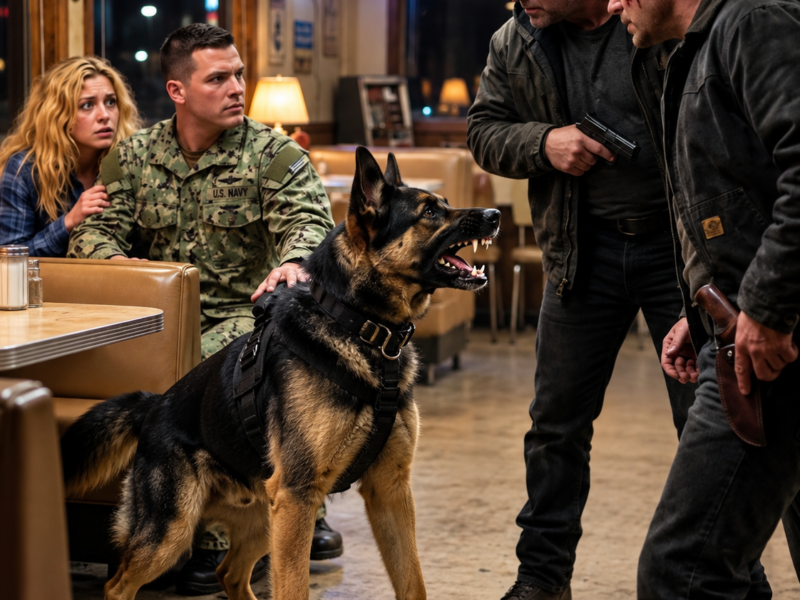
“I was halfway through my coffee at a roadside diner outside Jacksonville when a trembling little girl grabbed my Navy SEAL uniform and whispered, “Please, sir, don’t let them take me home,”
I stared at Emily, unable to speak.
The rain tapped against the diner windows, and somewhere behind me, a coffee mug clattered against a saucer.
I barely heard it.
Six years earlier, I’d signed a report stating that Lieutenant Michael Hayes had died during a classified operation overseas.
I’d stood beside his flag-draped coffin.
I’d watched his wife, Sarah, lower her head while a military chaplain spoke words about sacrifice and courage.
And now an eight-year-old girl was sitting in front of me, carrying a photograph with my name on the back and a key marked 214.
“Emily,” I said carefully, “I need you to tell me something. Did your mother ever say the name Michael Hayes?”
Her eyes widened.
She nodded.
“She said he was my real daddy.”
The chair beneath me suddenly felt too small.
Michael hadn’t been just another officer.
He’d been my closest friend, the man who had pulled me out of a burning vehicle during a mission that had gone catastrophically wrong. We’d served together for years, shared terrible coffee in worse places, and made promises about what we’d do when we finally came home.
One of those promises had been simple.
If either of us ever failed to make it back, the other would look after his family.
I had believed I’d kept that promise by honoring his death.
Now I wondered whether I’d helped bury something far more important than a friend.
“Where’s your mother now?” I asked.
Emily looked down at her hands.
“I don’t know.”
“When did you last see her?”
“Monday morning. She woke me up before school and told me to pack my backpack. She said we were going on a trip.”
Her lower lip trembled.
“But then the man came to our house. Mommy told me to hide in the laundry room. I heard them arguing.”
“What were they saying?”
Emily rubbed the edge of the towel Carol had wrapped around her.
“He said she had run out of time. Mommy told him he’d never get the papers.”
I kept my expression steady, though my thoughts were moving faster than I could organize them.
“What happened after that?”
“I heard something fall. Then Mommy yelled at me to run out the back door.”
She swallowed.
“She said to find a soldier and show him the picture.”
“Did you see her leave?”
Emily shook her head.
“I waited behind a shed until it got dark. Then I walked until I found a gas station. A lady let me use her phone, but I didn’t know anybody’s number.”
She looked up at me.
“I remembered the diner because Mommy said soldiers sometimes came here after work.”
That last detail was wrong in a way I couldn’t immediately explain.
Sarah had never known where I ate.
At least, she hadn’t six years ago.
I looked at the photograph again.
The date on the back was from three weeks earlier.
Someone had written my name on it recently.
That meant Sarah had either found a way to contact me or had deliberately prepared Emily to seek me out.
And someone else had known enough to follow the girl.
“Carol,” I said, “could you bring Emily something warm to drink? Hot chocolate, if you’ve got it.”
“Of course.”
I waited until Carol had moved away before reaching for my phone.
I didn’t call my old unit.
I called the one person I trusted to tell me the truth even if it destroyed everything I thought I knew.
Mason Reed answered on the second ring.
“Mason.”
“It’s Daniel.”
There was a pause.
“Mercer? You all right?”
“I need you to do something for me. Quietly.”
His voice changed immediately.
“What’s going on?”
“I need a welfare check on a woman named Sarah Hayes and an address I’m about to send you. I also need you to find out whether any recent missing-person report exists for a little girl named Emily Hayes.”
“Why quietly?”
I looked at Emily, who was warming her hands around the mug Carol had brought her.
“Because someone has been following her, and she believes the police can’t be trusted.”
Mason didn’t ask me to explain.
“Send me what you have. I’ll start with the official channels and see what’s there.”
I sent him Sarah’s name and a few details from the photograph.
Then I slipped the silver key into my pocket.
“Emily, do you know where this key belongs?”
She shook her head.
“Mommy said not to give it to anybody except you.”
“Did she tell you why?”
“She said you’d know.”
I didn’t.
But I had a suspicion.
During our last deployment together, Michael had given me a small metal box to hold while he went into a briefing. He’d told me it contained personal documents he couldn’t risk carrying, then asked me to keep it safe.
The next morning, the box was gone.
Michael had accused me of losing it, but we’d been interrupted before we could discuss it properly.
Three days later, our mission began.
Michael never came back.
For six years, I’d assumed the box had been misplaced during the chaos that followed his death.
Now I wondered if the key in my pocket belonged to it.
“Carol,” I called, “do you have a phone charger?”
She brought one over.
While Emily drank her hot chocolate, I plugged in my phone and searched my old messages for the last address Michael had ever sent me.
It took nearly ten minutes to find it.
A storage facility on the west side of Jacksonville.
I remembered the place. Michael had rented a unit there before our deployment, telling me he needed somewhere to store furniture while he moved between apartments.
I’d forgotten about it until now.
I showed Emily the address.
She stared at it for a moment, then nodded slowly.
“Mommy took me there once.”
My pulse quickened.
“When?”
“Last month. She said we were going to visit somebody, but nobody came out. We just stood outside a door.”
“Do you remember the number?”
She closed her eyes, concentrating.
“Two hundred fourteen.”
The key in my pocket suddenly felt heavier.
I stood and approached Carol.
“Can you stay with Emily for a few minutes?”
“Where are you going?”
“To find out what this key opens.”
She looked at the little girl, then back at me.
“Daniel, you should call someone.”
“I have.”
It wasn’t the whole truth, but it was enough to reassure her.
Before leaving, I crouched in front of Emily.
“I’m going to find out where your mother is. You stay here with Carol, and don’t leave with anybody unless I come back or a uniformed officer you can verify through dispatch arrives.”
She gripped my hand.
“Are you going to bring Mommy home?”
I wanted to say yes.
Instead, I told her the only thing I could promise.
“I’m going to do everything I can to find her.”
Ranger came with me.
I didn’t have to call him twice.
The storage facility was fifteen minutes away, tucked between a tire shop and an abandoned furniture warehouse.
The rain had eased into a cold mist by the time I arrived.
Most of the units were dark, their metal doors streaked with rust and dirt.
Unit 214 sat at the end of the second row.
I inserted the key.
It turned smoothly.
Inside was a narrow storage room containing three plastic bins, a folding chair, and a gray metal box that looked almost exactly like the one Michael had shown me six years earlier.
Dust covered the floor, but the box itself was clean.
Someone had been here recently.
Ranger moved past me, sniffing the corners before returning to my side.
I knelt in front of the box.
The lock opened with a soft click.
Inside were a stack of documents, two old cell phones, a folded map, and a sealed envelope bearing my name.
My hands felt clumsy as I opened it.
Daniel,
If you’re reading this, then Sarah has decided she can’t keep hiding anymore.
I need you to know that I didn’t die overseas.
I read the sentence twice.
Then a third time.
The words didn’t change.
Michael was alive.
Or he’d been alive when he wrote the letter.
I forced myself to continue.
The official report was created to protect a mission that went wrong for reasons nobody wanted investigated. The people responsible made sure I disappeared before I could testify.
Sarah knows where the original evidence is.
Emily knows nothing about the operation, and that’s how it must stay.
If something happens to Sarah, find the black ledger. It contains the names of everyone who arranged the cover-up.
Don’t trust anyone who tells you the case was closed for your protection.
I read the last line in silence.
I had signed that report.
I’d spent six years believing I was honoring my friend.
If Michael had been alive, then the funeral, the sealed records, and the statements we’d been given had all been part of a lie.
I lowered the letter.
For the first time in years, I wondered whether my signature had helped protect the people who had destroyed his life.
A sound came from behind the storage units.
Footsteps.
I folded the letter and slipped it into my jacket.
Ranger turned toward the entrance, his posture stiffening.
“Who’s there?” I called.
No answer.
Then my phone vibrated.
A message from Mason appeared on the screen.
I found Sarah Hayes. Her car was abandoned near a medical clinic. No confirmed sighting since Monday. Also, there’s something you need to know about Michael’s death report.
Before I could respond, another message arrived.
The officer who certified the identity of the body was transferred out of the country six months later. His personnel file is sealed.
A cold pressure settled in my chest.
I typed back.
What else?
Mason’s response came almost immediately.
Someone accessed the archived case file yesterday using credentials belonging to a retired senior officer.
Then I heard a car door slam outside.
I moved toward the entrance, keeping Ranger close.
A man stood in the mist beside a black sedan.
He was tall, dressed in a charcoal coat, and old enough to have gray at his temples.
I recognized him before he spoke.
Colonel Richard Vance.
He had commanded our unit during the operation in which Michael supposedly died.
He’d also been the man who told me that asking further questions would endanger the families of everyone involved.
His expression was calm, almost disappointed.
“Daniel,” he said. “You’ve always had trouble leaving the past alone.”
I stepped outside but stayed close enough to the storage room to retreat if necessary.
“Where’s Sarah?”
Vance glanced at the building behind me.
“I don’t know.”
“Then why are you here?”
“Because you’ve opened something that should have remained closed.”
I watched his hands.
He wasn’t carrying anything visible, but his arrival at the exact moment I’d opened Michael’s box was too convenient to dismiss.
“Did you know Michael was alive?”
Vance exhaled through his nose.
“You’re not ready for the answer to that question.”
“Try me.”
For the first time, his composure faltered.
“Michael was involved in something bigger than you understood. He made decisions that put people at risk. We had to contain the damage.”
“By declaring him dead?”
“By preventing a national security disaster.”
“Did Sarah know?”
He looked away.
That was answer enough.
I took a step closer.
“Where is she?”
“I came here to offer you a way out, Daniel. You can return that box, walk away, and let the authorities handle the matter.”
“What authorities? The ones who let a little girl spend three days running from the man who took her mother?”
Vance’s jaw tightened.
“I don’t know anything about a child.”
“Then you won’t mind explaining why someone has been following her.”
He stared at me for a long moment.
Then he said something I hadn’t expected.
“Because Sarah stole the ledger.”
I felt the pieces shift, but they didn’t fit together yet.
“What ledger?”
“The black ledger Michael kept. It contains payments, names, dates, and records of an operation that was never supposed to exist.”
“And you want it.”
“I want it out of the hands of people who will use it to destroy lives without understanding what they’re looking at.”
“That sounds convenient.”
“Daniel, there are people in that ledger who can bring down entire institutions. Some are guilty. Some aren’t. If the wrong names are exposed without context, innocent families will suffer.”
For a moment, I saw something that looked like genuine fear in his face.
Not fear for himself alone.
That made the situation more complicated, not less.
“Why didn’t you tell me the truth six years ago?”
“Because you were young, grieving, and loyal to Michael. You would’ve gone after him without knowing who was watching.”
“Maybe I should have.”
“Maybe,” he said quietly. “But you didn’t.”
He reached into his coat and withdrew a business card.
“Call me when you’ve decided whether you want answers or revenge.”
He placed the card on the hood of his car.
Then he drove away.
I stood in the mist until his taillights disappeared.
Ranger nudged my hand.
I looked down at the letter in my jacket.
For six years, I’d thought my grief had been the price of doing my duty.
Now I had to consider the possibility that my duty had been manipulated from the beginning.
I returned to the diner and found Emily sitting beside Carol, her hands wrapped around another cup of hot chocolate.
When she saw me, she slid out of the booth.
“Did you find Mommy?”
“Not yet.”
Her face fell, but she didn’t cry.
I hated that she seemed to have already learned how to expect disappointment.
“I found something your mother wanted me to see,” I told her. “And I think it may help us find her.”
I showed her the photograph again.
“Do you remember anyone else who visited your house?”
Emily thought for a moment.
“A man came once when Mommy was asleep. He had a shiny watch and smelled like peppermint.”
I looked at her.
“Did you see his face?”
“Not really. But he had a little scar on his chin.”
Vance had no scar on his chin.
I didn’t know whether that was reassuring or not.
“Did he talk to your mother?”
Emily nodded.
“He said she had to give back the book. Mommy said it wasn’t a book. It was proof.”
The black ledger.
“Did he say anything else?”
Emily’s gaze drifted toward the window.
“He said my daddy was a coward for running away.”
I crouched beside her.
“What did your mother say?”
Emily’s voice became so soft I had to lean closer.
“She said my daddy was trying to come home.”
I looked away for a moment.
That sentence was enough to change the way I read Michael’s letter.
He hadn’t simply been hiding.
He’d been trying to return.
And someone had made sure that his family believed he’d abandoned them.
Mason called before I could ask another question.
“I have an address,” he said. “Sarah’s car was found near a clinic in a neighborhood off Atlantic Boulevard. The clinic manager remembers a woman matching her description asking for help on Monday.”
“Was she injured?”
“Possibly. There was blood on the driver’s seat. Not much, but enough to suggest something happened.”
“Did she leave with anyone?”
“An employee remembers a man in a dark coat waiting outside. No name, no plate.”
I looked at Emily.
“Send me the location.”
“Daniel,” Mason said, “there’s another issue. The retired officer whose credentials were used to access the case file died two years ago.”
I closed my eyes briefly.
“Someone stole his credentials.”
“Or someone still has access to them.”
“Keep looking. And Mason?”
“Yeah?”
“If anything happens to me, don’t let this turn into another sealed report.”
He was silent for a beat.
“Understood.”
The clinic was small, wedged between a pharmacy and a laundromat.
I arranged for Carol to remain with Emily while I went inside, and I asked Mason to send an officer to the diner to establish a proper welfare check.
This time, I wasn’t going to let a child’s safety depend entirely on my promises.
A nurse at the clinic remembered Sarah.
She’d arrived pale and exhausted, with a cut above her eyebrow and a deep bruise on her wrist.
She’d refused an ambulance.
Before leaving, she’d asked the nurse to pass along a message if anyone named Daniel Mercer came looking.
The nurse handed me a folded piece of paper.
It contained an address and a sentence.
THE HOUSE WHERE MICHAEL LEARNED TO LIE.
I knew the address immediately.
It was the small white house in the photograph.
Michael had bought it before our deployment, intending to move Sarah and Emily there when he returned.
He’d never told me he’d purchased it.
That was the first time I’d understood how much of his life he’d kept hidden from me.
The house stood at the end of a quiet street lined with live oaks.
The porch light was on.
I parked across the road and approached on foot, Ranger beside me.
The front door was unlocked.
Inside, the living room looked almost untouched. A child’s drawing hung on the refrigerator, and a pair of small pink rain boots sat beside the stairs.
A half-finished cup of tea stood on the kitchen counter.
Sarah had been there recently.
“Sarah?” I called.
A floorboard creaked upstairs.
I moved toward the staircase.
“Sarah, it’s Daniel. Emily is safe.”
Silence.
Then a voice came from the back of the house.
“Don’t come any closer.”
I stopped.
Sarah stepped into the doorway holding a small pistol with both hands.
She looked older than she had in the photograph, and the scar near her eyebrow was fresh.
For several seconds, neither of us moved.
Then her eyes settled on my uniform.
“You came,” she whispered.
“I came.”
Her hands shook as she lowered the gun.
“Where’s Emily?”
“With someone I trust. She’s warm, she’s safe, and she wants to see you.”
Sarah covered her mouth.
The sound that escaped her was not quite a sob.
I gave her a moment before speaking again.
“I found Michael’s box.”
She looked at me sharply.
“Did you read the letter?”
“Yes.”
“Then you know he didn’t die.”
“I know he may still be alive.”
She closed her eyes.
“He is.”
The certainty in her voice made me take a step forward.
“Where is he?”
“I don’t know where he is now. The last time I heard from him was four days ago.”
“Why didn’t you contact me sooner?”
Sarah laughed once, bitterly.
“Because the last time I trusted someone in uniform, I watched my husband disappear.”
I had no defense against that.
She led me into the kitchen and pulled a chair away from the table.
“Michael discovered that people in our own command were diverting equipment and money through contractors operating overseas. Some of it was being used to fund operations that weren’t on any official record.”
“The ledger?”
She nodded.
“He copied everything he could find. He thought if he gathered enough evidence, he could force an investigation.”
“What happened?”
“Someone found out. Michael was given a choice: cooperate with the people involved or become the person they blamed for the entire operation.”
I remembered the sealed report I’d signed.
“What did he choose?”
“He refused to cooperate. Then they told him his family would be in danger if he tried to expose them.”
Sarah stared at the tabletop.
“He disappeared because he thought he could protect us by staying away. At first, he sent messages through people he trusted. Then the messages stopped.”
“Why did you let Emily believe he was dead?”
“Because she was four years old when the funeral happened. I couldn’t explain a conspiracy to a child. And because I didn’t know whether he was alive anymore.”
Her voice broke.
“Every birthday, she asked why her father didn’t come home. I told her he loved her. I told her he hadn’t forgotten her. Those were the only truths I had left.”
I sat down opposite her.
For years, I’d carried Michael’s death like a debt I could never repay.
Sarah had carried his absence while raising a child who thought her father had chosen to leave.
Neither of us had understood the full cost.
“Why bring Emily to me now?”
“Because I finally found the original ledger. And because the people hunting it found me.”
She stood and went to a cupboard above the refrigerator.
From behind a stack of plates, she retrieved a black notebook wrapped in a dish towel.
“This is what they want.”
She placed it on the table.
I didn’t open it immediately.
“Why not take it to the FBI?”
“I tried.”
She pulled a folded sheet of paper from her pocket and pushed it toward me.
It was a copy of an email sent from an anonymous account.
The message contained photographs of Emily leaving school and walking home.
Beneath them were six words.
GIVE US THE LEDGER OR SHE DISAPPEARS.
I felt a surge of anger so sharp that I had to unclench my hands.
Sarah watched me.
“I went to a local detective. He promised to help, then someone called my house that night and repeated things I’d told him in confidence.”
“So you ran.”
“I hid the ledger and sent Emily to find you. I thought if anyone could recognize what it was, it would be you.”
She looked down at my hands.
“Michael trusted you more than anyone.”
I wanted to tell her that Michael had trusted me too much.
I’d signed the report that declared him dead without asking to see the body.
I’d accepted the explanation because the people giving it were men I’d served beside.
And I’d told myself that refusing to question them was loyalty.
“Sarah,” I said, “I need to know something. Did you ever see the body they identified as Michael?”
She shook her head.
“They told me the remains were too badly damaged. They said I should remember him as he was.”
I felt sick.
“Who told you?”
“Colonel Vance.”
I looked at the ledger.
Vance had known where the evidence was.
He’d arrived at the storage facility before I could leave.
And he’d admitted he wanted the ledger returned.
But he’d also seemed genuinely afraid of what it contained.
I couldn’t yet tell whether that fear came from guilt or from knowing how far the people behind the operation would go.
Before I could ask another question, Sarah’s phone buzzed on the table.
A message appeared from an unknown number.
I’M OUTSIDE.
Sarah went white.
Ranger stood.
I moved toward the window and looked through the curtains.
A silver sedan sat at the curb.
The driver’s face was hidden by the reflection on the windshield.
Then the passenger door opened.
A man stepped out.
He wore a dark coat and carried a small paper bag.
He looked up at the house.
Even from the window, I could see the faint scar on his chin.
Emily’s visitor.
“Get away from the window,” I whispered.
Sarah grabbed the ledger.
“What do we do?”
I called Mason.
He answered immediately.
“I need you to send officers to the address I’m about to text. Possible armed suspect, possible kidnapping connection. Do not use the local department as the sole response.”
“What’s happening?”
“Someone who threatened a child is outside this house.”
I sent the address.
The man approached the front door.
Instead of knocking, he took a key from his pocket.
Sarah’s face drained of color.
“He has a key.”
I guided her toward the rear hallway.
“Go through the kitchen and take the back door. Stay out of sight.”
“I’m not leaving without the ledger.”
“You’re not leaving without yourself, either.”
She stared at me, then slipped the notebook into her coat.
The front lock turned.
I moved behind the wall beside the entrance, keeping Ranger close and my hands visible.
The door opened.
The man stepped inside.
“Sarah?” he called pleasantly. “We don’t have to make this difficult.”
I recognized his voice from the storage facility only because I’d heard Emily repeat his words.
He wasn’t Vance.
He was someone else.
“Put the bag down,” I said.
He stopped.
For the first time, I saw his face clearly.
“Daniel Mercer,” he said. “I was hoping you’d stay out of this.”
“That’s unfortunate.”
His eyes moved toward Ranger, then back to me.
“I’m here to collect property that doesn’t belong to you.”
“Then you should have brought a warrant.”
He smiled without warmth.
“You’re making a serious mistake.”
“Maybe. But you came to a house where a child lives, and you threatened her. That’s a mistake I’m not willing to ignore.”
He reached inside his coat.
Ranger lunged forward, barking sharply.
The man stumbled backward, his hand emerging empty.
I stepped into the open, keeping my distance.
“Don’t.”
For a long moment, we stared at each other.
Then he slowly withdrew his hand.
It held a phone.
He tapped the screen and turned it toward me.
A photograph appeared.
Michael stood in front of a concrete building, thinner than I remembered, with gray beginning at his temples.
He was alive.
The date beneath the photograph was from the previous day.
“He’s waiting for you,” the man said. “And if you want him to survive the week, you’ll bring the ledger to the old naval air station tomorrow night.”
“Who are you?”
He pocketed the phone.
“Someone who doesn’t want another family destroyed.”
Then he walked back outside.
I followed him to the porch but didn’t pursue him into the street.
A moment later, his sedan disappeared around the corner.
Sarah came out of the kitchen.
She had seen the photograph on the phone.
For several seconds, she couldn’t speak.
Then she whispered, “He’s alive.”
I nodded.
“And he wants the ledger.”
“No,” she said, clutching the notebook against her chest. “He wants us to bring it to him.”
I looked at her.
“What difference does that make?”
She swallowed.
“Because Michael would never ask me to risk Emily’s life for a book.”
The distinction mattered.
It mattered more than I wanted to admit.
The next morning, Mason arrived at the house with two federal investigators.
One was a woman named Agent Laura Bennett, who had spent years investigating fraud involving military contracts.
She listened to our account without interrupting, then examined the ledger under a portable document scanner.
After twenty minutes, she looked up.
“This is real,” she said. “At least some of these entries match financial records we’ve been trying to obtain for years.”
“Can you protect Sarah and Emily?” I asked.
“We can place them in protective custody while we establish the chain of evidence. But I need you to understand something, Chief Mercer. If this ledger is genuine, there are people with enough influence to interfere with an investigation.”
“Then we make it impossible for them to bury.”
Agent Bennett nodded.
“That’s the idea.”
She arranged for Emily to be reunited with Sarah in a secure location, with a counselor available to help the girl understand what was happening.
I watched from the doorway as Emily ran into her mother’s arms.
Sarah dropped to her knees and held her daughter so tightly that Emily’s rain-damp hair pressed against her cheek.
“You’re here,” Emily whispered.
“I’m here, baby.”
“You didn’t leave me?”
Sarah pulled back just enough to look into her face.
“Never because I wanted to.”
Emily’s chin trembled.
“Then why didn’t you come back?”
Sarah’s eyes filled.
“Because I was trying to make sure you could grow up without being afraid.”
Emily considered that, then wrapped her arms around her mother’s neck again.
I turned away to give them privacy.
I had spent six years trying to honor a dead man’s memory.
Now I was watching a living mother apologize for a disappearance she had never wanted.
It made me realize how little any of us understood about what survival could cost.
That afternoon, Agent Bennett showed me a second set of records recovered from the ledger.
Several names matched individuals connected to the operation that had supposedly killed Michael.
One belonged to a defense contractor who had received millions in payments after the mission.
Another belonged to a senior officer who had since retired.
The third was Colonel Vance.
I stared at the page.
“Does this prove he ordered Michael’s disappearance?”
“Not by itself,” Bennett replied. “But it establishes a financial connection that deserves investigation.”
“What about the man with the scar?”
“We’re working on an identification.”
She tapped another page.
“There’s something else. The ledger records payments to a private medical facility outside the country. Several entries continue for years after Michael was declared dead.”
I looked at the dates.
The payments had begun three weeks after the funeral.
They’d continued every month for almost six years.
The amounts varied, but the final payment was made only four days earlier.
Michael hadn’t just survived.
Someone had been paying to keep him hidden.
“Can we trace the account?”
“We’re trying.”
I looked at the photograph of Michael on the man’s phone.
If he had been held somewhere against his will, I needed to know.
If he’d chosen to stay hidden, I needed to understand why.
And if he had sent that message, I needed to hear the truth from him.
Agent Bennett closed the folder.
“We’re not going to send you into an unverified meeting alone.”
“I wasn’t planning to.”
“Good. Because the old air station is federal property, and we’ll be coordinating with the appropriate authorities. No improvising, no private confrontation.”
I agreed.
For once, I wanted the truth more than I wanted the satisfaction of confronting the people who’d lied to me.
The meeting was scheduled for nine that night.
We arrived early and established a discreet perimeter around the abandoned hangar identified in the message.
The air smelled of wet concrete and salt.
Ranger stayed close to my left leg, his attention fixed on the wide doorway.
At 8:57, headlights appeared on the access road.
A dark SUV rolled toward the hangar and stopped.
The driver’s door opened.
A man stepped out.
He was leaner than the man I’d remembered, his shoulders slightly hunched, his hair grayer.
But I knew the way he moved.
I knew the scar on his right hand, the one he’d gotten while repairing a broken radio during our first deployment together.
Michael Hayes looked directly at me.
For several seconds, neither of us moved.
Then he said, “You got my letter.”
My throat tightened.
“Six years late.”
He lowered his gaze.
“I know.”
I wanted to cross the space between us.
I wanted to punch him.
I wanted to ask him how he could let Sarah bury a husband who was still alive and let Emily grow up believing her father was gone.
Instead, I stood where I was.
“Why?”
Michael looked at Ranger, then back at me.
“Because I thought if you knew, you’d come looking.”
“I would have.”
“Exactly.”
His answer was so quiet that it hurt more than an argument would have.
He rubbed his face.
“The operation went wrong. Men died. The people responsible needed someone to blame, and I had the evidence that could expose them. They offered me a deal: disappear, keep quiet, and Sarah and Emily would be left alone.”
“So you agreed.”
“I thought I was buying them time.”
“You let your daughter grow up without you.”
His eyes shone.
“I know.”
“You let Sarah believe you were dead.”
“I know.”
“Do you?”
My voice had risen, and I forced it back down.
“Do you know what it did to her? To me?”
Michael looked at the concrete floor.
“I’ve spent six years knowing what I did. There isn’t a day I haven’t thought about it.”
“Then why come back now?”
“Because the people who were paying to keep me hidden stopped paying. And because Sarah found the ledger before they could destroy it.”
He glanced toward the shadows beyond the hangar.
“I didn’t know where she was. I didn’t know if Emily was safe. I sent someone to find the ledger, and he told me he’d seen you.”
“The man with the scar?”
Michael nodded.
“His name is Peter Sloan. He used to work security for the contractor. He’s been helping me survive.”
“By threatening a child?”
Michael’s face changed.
“He did what?”
I told him about the message, the photograph, and the man entering Sarah’s house.
Michael closed his eyes.
“I never asked him to do that.”
“Then you should be careful who you trust.”
He nodded slowly.
“I’ve learned that lesson.”
Agent Bennett stepped out from the shadows and identified herself.
Michael looked startled, then seemed to sag with relief.
She explained that the ledger had been secured, copied, and placed under federal investigation.
For the first time since arriving, Michael appeared uncertain of what to do with his hands.
“So it’s over?” he asked.
“No,” Bennett replied. “It’s beginning. We’ll need your testimony, your records, and a complete account of the operation. If you cooperate, we can discuss protection for you and your family.”
Michael swallowed.
“I’ll tell you everything.”
“Good. Then let’s start with the body.”
He looked at her.
“What body?”
“The one identified as yours.”
Michael’s expression went blank.
Then he shook his head.
“There was no body.”
Bennett waited.
“I was told the report would state that I had died overseas. I didn’t know they’d produced remains or held a funeral until Peter told me years later.”
I stared at him.
The funeral I’d attended.
The coffin I’d stood beside.
The report I’d signed.
All of it had been built on evidence nobody had allowed me to examine.
Agent Bennett made a note.
“Then we have another person to identify.”
Michael nodded.
“I can give you the names of the people who arranged my disappearance. But I need to see Sarah and Emily first.”
“You will,” Bennett said. “After we finish taking your statement and confirm the immediate threat has been contained.”
Michael looked at me.
“How is Emily?”
“She’s safe.”
His eyes filled.
“Does she hate me?”
I thought about the little girl in the diner, holding a photograph and asking a stranger in uniform to protect her.
“I don’t think she knows you well enough to hate you.”
He flinched.
“But she knows you weren’t there,” I added. “And you can’t undo that by showing up once.”
“I know.”
“Then don’t ask her to make you feel better about it.”
He nodded.
“I won’t.”
For the next several hours, Michael gave a recorded statement.
He named the officers who had pressured him, the contractors who had handled the payments, and the intermediaries who had kept him hidden.
Some details matched the ledger.
Others led investigators to records they hadn’t known existed.
At dawn, Agent Bennett told us that Colonel Vance had been taken in for questioning.
Peter Sloan had also been located.
He’d agreed to cooperate after learning that the ledger had already been secured.
The investigation would take months, perhaps years.
There would be hearings, sealed documents, and lawyers trying to discredit every witness.
But for the first time, the evidence was in the hands of people who had a legal obligation to pursue it.
And Michael was no longer a ghost.
Two days later, he met Sarah and Emily in a quiet room at a federal facility.
I stayed outside the door.
I could hear almost nothing through the walls, only occasional muffled voices and the scrape of a chair.
After twenty minutes, the door opened.
Sarah stepped into the hallway.
Her eyes were red.
“How did it go?” I asked.
She took a long breath.
“Emily asked him why he didn’t come home.”
I waited.
“He told her the truth. Not all the classified details, but the truth about his choices. He said he was afraid and made a decision he thought would protect us.”
“How did she take it?”
Sarah looked through the small window in the door.
“She told him she was angry.”
I nodded.
“That’s fair.”
“Then she asked whether he’d come to her school concert if she invited him.”
I looked at Sarah.
“What did he say?”
“He said he’d be there if she wanted him to be, and he’d keep showing up after that, even when she was angry.”
Sarah wiped her cheek.
“She hasn’t forgiven him. Not yet.”
“She doesn’t have to.”
“No,” Sarah said. “She doesn’t.”
She leaned against the wall beside me.
“For six years, I thought I had to protect Emily from the truth. Then I thought I had to protect her from the people who wanted the ledger. I never stopped to consider that she might need the truth in order to decide what kind of relationship she wanted with her father.”
I glanced at the closed door.
“You’re allowed to be angry with him, too.”
A small, tired smile crossed her face.
“I am.”
We stood there for a while without speaking.
Then Sarah looked at me.
“Do you blame yourself?”
The question caught me off guard.
“For signing the report?”
“For believing it.”
I considered giving her the easy answer.
Instead, I told her the truth.
“Yes. I should have asked more questions. I should have insisted on seeing the evidence. But I trusted the people who told me he was gone, and I let my grief become an excuse not to look any closer.”
Sarah nodded.
“I don’t think you could have saved us from everything.”
“Maybe not.”
“But you came when Emily asked for help.”
I looked down at my hands.
“I almost sent her to the police without listening.”
“But you listened.”
She touched my arm.
“That matters.”
It didn’t erase my part in what had happened.
It didn’t make the years Michael had lost to fear any less real, or give Sarah back the nights she’d spent wondering how to answer her daughter’s questions.
But it gave me something I hadn’t expected to find in the middle of all that damage.
A reason to stop punishing myself long enough to do something useful.
Three months later, I attended Emily’s school concert.
The investigation had already led to several arrests, including a former defense contractor and two officers accused of falsifying records and obstructing the inquiry.
Vance had been charged in connection with the financial scheme, though his lawyers continued to challenge the evidence.
Michael was cooperating with prosecutors and living under protective supervision.
He and Sarah were not back together.
They were learning how to speak honestly without pretending that honesty could erase what had happened.
Emily had decided she wanted him in her life, but she was setting the pace.
That evening, I sat near the back of the school auditorium with Ranger curled beneath my chair.
Parents filled the rows, holding phones and whispering over programs.
When the lights dimmed, a line of children walked onto the stage carrying paper stars.
Emily stood near the center.
She scanned the audience until she found Sarah.
Then she spotted Michael sitting several seats away from her mother.
For a second, her expression was difficult to read.
Michael didn’t wave.
He didn’t call out.
He simply sat still and let her decide what to do.
Emily turned back toward the stage.
When the music began, she sang.
Her voice was small, sometimes unsteady, but she never stopped.
At the end, the audience applauded.
Emily ran offstage and found Sarah first.
Then she crossed the aisle toward Michael.
She didn’t throw her arms around him.
She didn’t tell him everything was forgiven.
She held out a folded piece of paper.
Michael accepted it with both hands.
“What is it?” he asked.
“A picture I made.”
He unfolded it carefully.
It showed three people standing in front of a white house, with a small black dog beside them.
Above their heads, Emily had written, FAMILY, in uneven blue letters.
Michael’s face crumpled.
“Thank you, sweetheart.”
Emily studied him.
“You’re still in trouble.”
He gave a shaky laugh.
“I know.”
“And you have to come next time, too.”
“I will.”
She looked at him for another moment, then took his hand.
It wasn’t a complete reconciliation.
It wasn’t a promise that the hurt would disappear.
It was a beginning, and for that evening, a beginning was enough.
As I watched them leave the auditorium with Sarah walking beside them, I thought about the photograph Emily had carried into Millie’s Diner.
Four words on the back had brought us together, but they hadn’t told the whole story.
They hadn’t explained Michael’s choices, Sarah’s fear, or my own failure to question what I’d been told.
They had only pointed us toward the truth.
Later, I drove back to the diner with Ranger in the passenger seat.
Carol recognized us immediately and brought over a cheeseburger, a cup of coffee, and a bowl of water without asking.
I sat in the same booth where Emily had grabbed my sleeve months earlier.
Outside, rain slid down the windows, blurring the headlights passing along the road.
For a moment, I could almost see her standing in the doorway again, soaked to the skin, terrified of the people who were supposed to know where she belonged.
I reached down and scratched Ranger behind the ears.
He rested his head against my knee.
I had spent years believing that protecting someone meant standing between them and danger, taking the hit, keeping the secret, carrying the burden alone.
But Emily had taught me something I hadn’t learned in all my time in uniform.
Sometimes protection means listening when the story doesn’t make sense.
Sometimes it means admitting that the people you trust have lied to you.
And sometimes it means allowing the truth to hurt, because the lie is hurting someone even more.
I finished my coffee and looked toward the door.
I couldn’t give Michael back the six years he’d lost.
I couldn’t give Sarah back the nights she’d spent waiting for a husband she thought was dead.
And I couldn’t promise Emily that the people she loved would never disappoint her again.
But I could make sure that when she needed someone to listen, she wouldn’t have to beg a stranger twice.
That night, when I finally drove home, Ranger rested his head against my arm, and for the first time in years, the silence in the car didn’t feel like something I had to survive.
The end.









