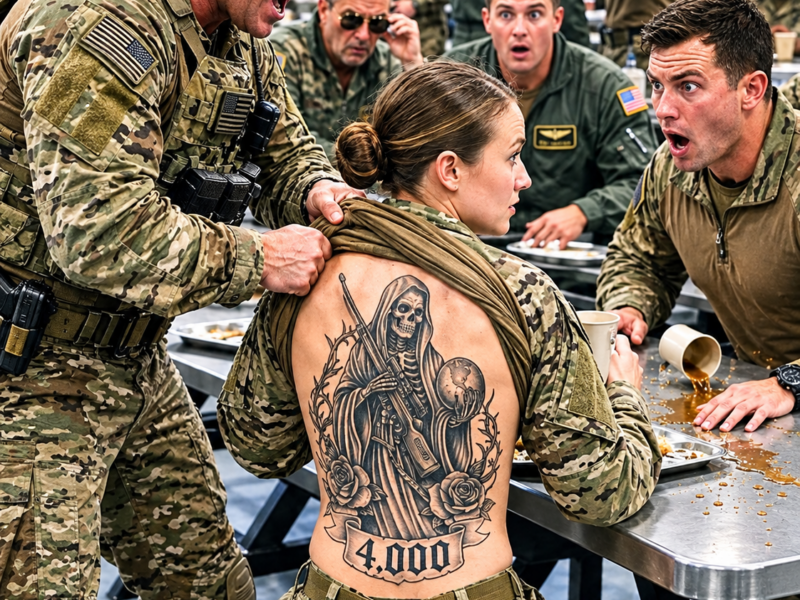
“I was halfway through lunch in the military mess hall at Fort Liberty when a senior sergeant pointed at the faded tattoo on my forearm and laughed
I stared at the document, reading the sentence for a third time, hoping the words might rearrange themselves into something that made sense.
They didn’t.
Harlan stood behind his desk with both hands planted on the wood, watching me as if he expected me to confess.
“That isn’t what happened,” I said.
“Then explain what did.”
I looked at the photograph again. Captain Daniel Reeves stood in the center, his face turned toward the camera, one hand resting on the shoulder of a young operator whose face was hidden by shadow.
The black cord around that man’s wrist was unmistakable.
I’d braided it from paracord during a long night aboard a transport vessel, when Reeves had admitted he was afraid he wouldn’t make it home to his daughter.
He’d laughed when I handed it to him.
“Something to remind me that somebody’s waiting,” he’d said.
I had never seen that cord again after September 18, 2019.
Until now.
“Where did you get this?” I asked.
“From the review team.”
“Which review team?”
Harlan’s eyes narrowed. “You’re not in a position to interrogate me.”
“Then you’re not in a position to demand answers about a classified operation you apparently know very little about.”
The words came out colder than I intended.
For several seconds, neither of us moved.
Then Harlan pulled out the chair opposite him.
“Sit down, Bennett.”
This time, I did.
He opened the folder to another page, revealing a transcript with several lines blacked out. My name appeared beside a timestamp of 0217.
“At 0217, your radio transmission directed Reeves and his team toward the eastern access road,” Harlan said. “At 0234, the team came under fire. Reeves was killed, and two others were seriously wounded.”
“I know the timeline.”
“Then you know why the report says your decision contributed to his death.”
I looked at the page.
The transcript recorded my voice giving a grid coordinate, followed by a confirmation from Reeves. The next entry was a transmission from another operator, but the line had been redacted.
I leaned closer.
“Where’s the rest of this transmission?”
“That’s the complete version I received.”
“No, it isn’t.”
I pointed to the timestamp. “The radio log uses synchronized time. There are forty-three seconds missing between these entries. Nobody simply forgets forty-three seconds in an operational transcript.”
Harlan’s expression shifted.
It was the first time he looked less like a man in charge and more like someone who had stumbled into a situation he didn’t understand.
“How can you be sure?”
“Because I was there.”
My voice cracked on the last word.
I hated that he heard it.
For six years, I had carried the memory of that night without discussing it outside the people who had been authorized to know. I’d left the Navy, transferred into the Army under a specialized interservice arrangement, and rebuilt my life around work that didn’t require me to explain the things I couldn’t talk about.
I’d learned how to sleep through most nights.
I’d learned how to stop checking my phone every time a helicopter passed overhead.
I’d even learned how to visit the memorial wall without looking at Reeves’s name for too long.
But I’d never learned how to hear someone suggest that I had sent him to his death.
“I want the original recording,” I said.
Harlan closed the folder.
“That’s not something I can authorize.”
“Then contact someone who can.”
He studied me for a long moment.
“Why didn’t you challenge the report when it was first filed?”
The question landed harder than it should have.
I looked down at my hands.
“Because the report wasn’t the only thing that came out of that operation.”
I remembered the hospital room at Naval Medical Center Portsmouth, the antiseptic smell, the plastic chair beside my bed, and the doctor explaining that the damage to my shoulder might end my operational career.
I remembered the formal interview three days later.
I remembered being asked the same questions repeatedly until the night seemed to dissolve into disconnected fragments.
And I remembered the last instruction I’d received from the officer handling the review.
Don’t discuss the operation outside authorized channels.
I had obeyed.
Then the Navy informed me that my operational assignment was ending. The transfer paperwork arrived weeks later, and my life moved forward whether I wanted it to or not.
“Someone told me the investigation was complete,” I said. “I was ordered not to discuss the details. I believed the people handling it were doing their jobs.”
“And now?”
“Now I have a document with forty-three seconds missing from a transmission that could explain what happened.”
Harlan glanced at the photograph.
“There’s something else.”
He turned to the final page.
A short memorandum stated that an additional witness had recently submitted a request to reopen the review.
The witness’s name had been covered with a black rectangle.
“Who filed this?” I asked.
“I don’t know. The request came through official channels this morning.”
“Then why am I seeing it?”
“Because the request specifically identifies you as someone who may possess information relevant to the original investigation.”
I looked up sharply.
“I haven’t spoken to anyone about that night in years.”
“I didn’t say you had.”
A knock sounded at the office door.
Harlan looked toward it, visibly irritated.
“Come in.”
A young lieutenant stepped inside, holding a sealed envelope.
“Sergeant First Class Harlan? This was delivered to the training command office for Staff Sergeant Bennett. The sender requested that it be handed to her directly.”
He gave the envelope to me and left.
My name was printed across the front in block letters.
No return address.
No explanation.
Just my name and a date.
September 18, 2019.
For a moment, the office seemed to tilt around me.
Harlan moved closer.
“Open it.”
I turned the envelope over.
The seal had been pressed firmly shut, but there was no official stamp or security marking. Whoever had sent it had wanted it to look ordinary.
That made me trust it less.
I slipped a finger beneath the flap and pulled out a single sheet of paper.
Three lines were typed across the center.
You were right about the eastern road.
Reeves knew the coordinates had been compromised.
Ask who authorized the change at 0209.
I read the message twice.
Then a third time.
Harlan took a step toward me. “What does it mean?”
I folded the paper carefully.
“It means somebody knows what happened that night.”
“Who?”
“I don’t know.”
But I had a suspicion.
At 0209, someone had changed our extraction route. I’d received the revised coordinates through command channels, verified the transmission, and relayed the information to Reeves.
At the time, I believed the change had come from the operations center.
The report had later described the route change as my recommendation.
I had spent six years wondering whether I’d misheard the original order.
Now someone was telling me the coordinates had been compromised before I ever transmitted them.
“Sergeant,” I said, “I need access to the original radio logs, the route authorization, and every amendment made to the mission plan that night.”
Harlan’s mouth tightened.
“That would require approval from the joint command.”
“Then request it.”
“And if they refuse?”
I slipped the note into my pocket.
“Then we find out why.”
He stared at me for several seconds before reaching for his desk phone.
For the first time since he’d mocked me in the mess hall, he wasn’t trying to win an argument.
He was trying to understand what had happened.
And that was the moment I realized I might not be the only person in that building who had spent six years living with the wrong version of the truth.
The following morning, I arrived at the joint training headquarters before sunrise.
The parking lot lights reflected off the wet pavement, and a thin mist hung over the rows of vehicles. I hadn’t slept more than two hours.
Every time I closed my eyes, I saw the same image: Reeves turning toward me in the darkness, his radio pressed to his mouth, asking me to confirm the coordinates.
I’d confirmed them.
That was the part I couldn’t escape.
I entered the building and went directly to Harlan’s office.
He was already there, wearing the same uniform he’d had the day before. Two cups of coffee sat on his desk, one untouched.
“You look terrible,” he said.
“So do you.”
He almost smiled.
“I made the request. Command approved a preliminary review, but they won’t release the original audio without an authorized investigator.”
“Who is the investigator?”
“Major Evelyn Shaw. She’s scheduled to arrive at nine.”
I recognized the name.
Shaw had been a Navy lieutenant commander when I was still on active duty. She had worked in operational oversight, reviewing mission records and coordinating with intelligence personnel.
I remembered her as precise, reserved, and difficult to impress.
“Does she know I’m here?”
“She’s the one who requested the meeting.”
That stopped me.
“She requested it?”
Harlan nodded.
“Apparently, your name came up in a separate inquiry. She wants to hear your account before reviewing the new evidence.”
I sat across from him.
“Did you tell her about the envelope?”
“Not yet. I thought you should decide whether to share it.”
I studied him, looking for the man who had publicly ridiculed me less than a day earlier.
He looked uncomfortable.
“I’m not asking you to forgive how I handled yesterday,” he said. “I was out of line.”
The apology was awkward, but it sounded genuine.
“I appreciate you saying that.”
“I made assumptions.”
“Yes, you did.”
He nodded, accepting the answer without defending himself.
Then he looked at my forearm.
“That tattoo. The date and coordinates. You put them there because of Reeves?”
I rolled my sleeve down.
“I put them there because I didn’t want to forget.”
“Forget what?”
I looked toward the window.
“That the people who give the orders don’t always have to live with the consequences.”
Harlan didn’t respond.
At nine, Major Shaw arrived carrying a slim briefcase and a thick file. She shook Harlan’s hand, then turned to me.
“Staff Sergeant Bennett.”
“Major.”
Her eyes moved briefly to my tattoo before returning to my face.
“I understand you’ve received some correspondence.”
I felt the muscles in my shoulders tighten.
“Who told you?”
“No one. I was informed that an unidentified source might contact you. I didn’t know whether the source had done so.”
She placed the file on the desk.
“Before we proceed, I want to make something clear. This is an initial fact-finding review. I am not here to assign blame. I am here to establish what the available evidence actually supports.”
“Then I want the original audio.”
“You’ll hear it.”
She opened the briefcase and removed a small encrypted playback device.
Harlan closed the office door.
Shaw connected the device to a speaker and entered an access code. A moment later, static filled the room.
Then came the familiar sounds of the operations channel.
Short confirmations.
Grid references.
The clipped voices of people working under pressure.
I knew the voices before the first full transmission ended.
Then I heard mine.
“Reeves, confirm your position.”
His reply came through the static.
“Position confirmed. We’re holding at the western approach.”
A second voice interrupted.
“Team, updated coordinates follow. Eastern access road is clear. Repeat, eastern access road is clear.”
My stomach tightened.
The voice was male, calm, and unmistakably senior.
It was not Reeves.
It was not me.
And it was not the voice I’d remembered hearing during the operation.
Shaw paused the recording.
“Do you recognize the speaker?”
I stared at the device.
“I recognize the transmission. I need to hear the next part.”
She pressed play.
The recording continued.
“Updated coordinates received,” I heard myself say.
Then Reeves’s voice came through.
“Negative. Our ground intelligence indicates movement on the eastern road. Request confirmation from command.”
A pause followed.
The silence lasted only a few seconds, but I remembered it as much longer.
Then the same senior voice returned.
“Your intelligence is outdated. Proceed as directed.”
Reeves answered immediately.
“With respect, sir, we have visual confirmation of armed personnel along that approach.”
“Proceed as directed, Captain.”
Shaw stopped the recording.
Harlan leaned forward.
“Why wasn’t that in the transcript?”
“Because the transcript we were given began after the disputed transmission,” Shaw said. “Someone provided a partial extract rather than the complete recording.”
I felt my pulse beating against my throat.
“Play the rest.”
Shaw hesitated.
“The next section contains information that has not been authenticated for this review.”
“Then authenticate it.”
She looked at me for a long moment before restarting the audio.
The static rose and fell.
Then I heard Reeves again, his voice lower now.
“Command, we are not moving east until we receive independent confirmation.”
A burst of interference followed.
The senior voice came back, sharper than before.
“Captain Reeves, failure to comply will be recorded as refusal of a lawful order.”
I gripped the edge of the desk.
Reeves had been a careful officer. He wasn’t reckless, and he wasn’t interested in proving anything to anyone.
If he had refused an order, he had a reason.
The recording continued.
Then came my own voice.
“Reeves, stand by. I’m checking the coordinates against the original mission plan.”
I remembered saying those words.
I remembered pulling up the earlier route data and noticing that the eastern approach had been marked as a restricted corridor.
I remembered the sudden pressure in my headset as the senior voice ordered me to relay the new coordinates.
And I remembered making a choice.
“Command, the revised grid conflicts with the original route authorization,” my recorded voice said. “Request verification from the operations officer.”
The reply came almost immediately.
“Verification complete. Relay the revised grid.”
Shaw paused the recording.
I looked at her.
“That’s not how I remember it.”
“What do you remember?”
“I remember being told the verification came directly from the operations officer. I asked for confirmation because the new route didn’t match the plan. I was told the change had already been approved.”
“Did you see the authorization yourself?”
“No.”
The answer felt like a stone in my mouth.
I’d believed the voice.
I’d believed the person speaking had the authority to make the change.
I’d passed the coordinates to Reeves because I thought I was relaying an authenticated order.
Shaw folded her hands.
“That distinction matters. But it doesn’t establish who altered the route, or why.”
“What happens next?”
“We trace the authorization. We identify who entered the change, who approved it, and who transmitted it.”
“And if those records are gone?”
“Then we determine why.”
She turned another page in her file.
“There’s one more issue. The original investigation concluded that the coordinates were relayed by you without independent verification. The report also stated that Reeves had accepted the route change without objection.”
I stared at her.
“He objected repeatedly.”
“I can hear that.”
“Then why did the report say otherwise?”
Shaw didn’t answer immediately.
Instead, she removed a second document from her briefcase.
It was a personnel record, with the name partially obscured by a black bar.
“Someone with access to the original operation files requested that the recording be archived under a restricted classification. That request was approved three days after the incident.”
“By whom?”
She turned the document around.
At the bottom was an authorization signature.
I recognized the name.
Colonel Thomas Voss.
Six years earlier, Voss had been the senior officer overseeing our mission coordination. He had also signed the initial review that cleared the command staff of wrongdoing and placed the central responsibility on the person who relayed the coordinates.
Me.
I looked at the signature until the letters blurred.
“Where is he now?”
“Retired,” Shaw said. “He left active service two years ago.”
“Does he know this review has been reopened?”
“We haven’t contacted him yet.”
“Then somebody else might have.”
Shaw’s eyes narrowed.
“Why do you say that?”
I took the envelope from my pocket and placed it beside the file.
She read the note without speaking.
When she reached the final line, she looked up.
“Ask who authorized the change at 0209,” she said quietly.
“Yes.”
“Did you know about the change before that time?”
“No. I received the revised coordinates shortly afterward.”
“Who else had access to the mission plan?”
I thought of the operations center, the intelligence analysts, the communications personnel, and the handful of officers who could modify the route authorization.
There were dozens of possibilities.
But only a few people could have known the exact time the change had been entered.
“I can give you the names of the personnel on duty,” I said. “The original roster should still exist.”
Shaw closed the file.
“Then that’s where we begin.”
For the next three days, we worked through the records.
The process was slower than I’d expected. Some files had been transferred to a different archive. Others required approvals from offices that no longer existed under their original names.
The mission roster was incomplete, and two digital logs had been migrated without their original audit metadata.
Every missing piece created another question.
Harlan stayed involved, handling the local administrative requests and arranging secure access to the training command’s facilities. He never asked me to tell him what had happened in the operation beyond what the review required.
That restraint earned more of my trust than another apology would have.
On the fourth morning, Shaw called me into the conference room.
She had placed three printed pages on the table.
“We found the route modification,” she said.
I sat down.
“Who entered it?”
“An operations coordinator named Daniel Mercer. At the time, he was a civilian contractor assigned to mission support.”
I searched my memory.
The name meant nothing.
“Who approved it?”
Shaw slid the second page toward me.
The approval had been entered under a command-level credential belonging to Colonel Voss.
“Was it actually him?”
“We can’t establish that yet. The system recorded his credentials, not a biometric confirmation.”
“Could someone else have used them?”
“Yes. But the access log shows the approval originated from a terminal inside the command coordination office.”
I looked at the timestamp.
0209.
The time printed on the anonymous note.
“What happened to Mercer?”
“He left the contract six months after the operation. His employment record says he relocated to Colorado.”
“Have you contacted him?”
“Not yet. We wanted to verify the audit trail first.”
I rubbed my forehead.
“Then contact him.”
Shaw nodded.
Before she could close the file, I noticed another entry at the bottom of the page.
A second modification had been attempted at 0211.
It had been rejected.
“What’s this?”
Shaw leaned over the table.
“An attempt to restore the original route.”
“By whom?”
The field was blank.
I looked at the access log again.
The entry had been made from a communications terminal.
My terminal.
I felt the room become very still.
“I didn’t submit that change.”
“Are you certain?”
“I remember trying to verify the route, but I never had authorization to modify it. I wouldn’t have attempted to overwrite a command-level order without notifying the operations officer.”
Shaw studied the record.
“Someone used your access credentials?”
“Or the system attributed the request to me because it came through my workstation.”
She tapped the page.
“The request was rejected because the original authorization remained active.”
I stared at the timestamp.
Two minutes after Voss’s credentials had approved the eastern route, someone had tried to restore the original plan.
Someone had known the new route was dangerous.
Someone had tried to stop it.
And the system had recorded the attempt under my name.
“Can you recover the request details?” I asked.
“We’re working on it.”
“Then keep working.”
For the first time, I wasn’t thinking about proving I had done nothing wrong.
I was thinking about the person who had tried to help us and whose attempt had disappeared into a report that blamed me.
That afternoon, Shaw received a call from the review office.
Mercer had been located.
He agreed to speak with investigators, but he had one condition: he wanted confirmation that the inquiry was formally authorized before providing any records he had retained.
Shaw arranged the interview for the following week.
I spent the weekend at home, trying to live a normal life.
I bought groceries. I washed my clothes. I answered two emails about training schedules.
On Sunday evening, I took the old photograph of Reeves from the folder I’d been allowed to keep for reference and placed it on my kitchen table.
He was smiling in the picture.
Not the professional smile he used for official photographs, but the crooked, tired one that appeared whenever someone made a joke he didn’t want to admit was funny.
I’d once asked him why he stayed in the service when he could have left for a safer career.
He’d shrugged.
“Because the people beside me deserve somebody who won’t stop asking questions just because the answers get uncomfortable.”
At the time, I’d thought he was talking about leadership.
Now I wondered whether he’d known how uncomfortable those answers might become.
On Monday morning, Mercer joined the review by secure video.
He appeared older than I expected, with thinning hair and a gray shirt buttoned to the collar. He looked at Shaw first, then at me.
When his eyes settled on my face, his expression changed.
“Staff Sergeant Bennett,” he said.
“Mr. Mercer.”
He swallowed.
“I’ve wanted to talk to someone about that night for a long time.”
“Then tell us what happened.”
He glanced away from the camera.
“I was the one who entered the revised coordinates.”
The room went silent.
“Why?” Shaw asked.
“Because I received a change request through the approved command channel. It carried Colonel Voss’s credentials, and I was told it had already been verified.”
“Who told you that?”
Mercer rubbed his hands together.
“I don’t know if I can identify the voice with certainty. It came over the internal line. The person said the intelligence assessment had changed and the eastern road was clear.”
“Did you question the request?”
“Yes. The original plan identified the eastern approach as compromised. I asked for written confirmation.”
“And?”
“I was told the confirmation would follow. It never did.”
I leaned toward the screen.
“Did you know Reeves’s team was already near the western approach?”
“Yes. I could see their position on the operations display.”
“Then why did you enter the change?”
His face tightened.
“Because I was told the team would miss the extraction window if the route wasn’t updated. I believed the authorization was legitimate.”
He looked directly at me.
“I didn’t know they’d be sent into an ambush.”
No one spoke for several seconds.
Shaw asked him to continue.
Mercer explained that shortly after entering the revised coordinates, he noticed a discrepancy in the authorization trail. The change had been approved under Voss’s credentials, but the confirmation field was missing.
He attempted to contact the operations officer.
The line was busy.
Then a second request appeared, attempting to restore the original route.
“Did you enter that request?” I asked.
“No.”
“Did you know who did?”
“I thought it might have been you. Your terminal was the one listed on the log.”
“I didn’t submit it.”
Mercer nodded slowly.
“I believe you.”
Those three words should have comforted me.
Instead, they reminded me how long it had taken for anyone to consider that I might be telling the truth.
“Why didn’t you report the missing authorization?” Shaw asked.
“I did. I filed a discrepancy report the following morning.”
“Where is it?”
“I don’t know. My supervisor told me it had been resolved. A few weeks later, I was informed that the route change had been properly authorized and that the incident was under review.”
“Did you keep a copy?”
Mercer hesitated.
Then he reached offscreen and returned with a thin folder.
“I kept the original discrepancy report.”
Shaw’s posture changed.
“Can you show us the document?”
He held it toward the camera, then uploaded a scanned copy through the secure channel.
The report included the original route modification request, the missing confirmation field, and a note indicating that Mercer had asked for the authorization to be independently verified.
At the bottom was a handwritten instruction.
Hold further inquiry pending command review.
The signature belonged to Voss.
It wasn’t proof that Voss had personally entered the change.
But it was proof that he had known the authorization was disputed and had ordered the inquiry stopped.
Shaw thanked Mercer and ended the session.
For several minutes, I sat without moving.
I had spent six years believing that the worst thing about that night was the decision I’d made.
Now I understood that someone had made it possible for that decision to happen, and someone else had worked to make sure nobody examined it too closely.
“Does this clear me?” I asked.
Shaw looked at the documents.
“It establishes that the original report omitted material evidence and that the route authorization requires further investigation. It does not yet tell us who gave the order or why.”
“I didn’t ask whether it tells you why.”
She met my eyes.
“Then yes. The evidence we have now directly contradicts the claim that you independently selected the eastern route without questioning it.”
I let out a breath I hadn’t realized I was holding.
It wasn’t vindication.
Not yet.
But for the first time in six years, the official record no longer stood unchallenged.
That afternoon, Shaw contacted Voss through his attorney.
He agreed to an interview two days later.
I wasn’t required to attend.
I asked to be there anyway.
Voss appeared in person at a secure conference facility on Thursday morning. He was in his late sixties, neatly dressed, and still carried himself with the polished confidence of someone accustomed to having his decisions accepted.
He shook Shaw’s hand.
He acknowledged Harlan, who had been asked to attend as the training command’s representative.
Then he looked at me.
“Staff Sergeant Bennett,” he said. “It’s been a long time.”
“Yes, sir.”
His gaze dropped briefly to my forearm, where the trident was visible beneath my rolled sleeve.
“I see you still have that.”
“I do.”
He sat down.
Shaw began with the route modification, presenting the records Mercer had provided.
Voss listened without interrupting.
When she asked whether he had personally authorized the change, he leaned back.
“I authorized numerous adjustments that evening. The situation was evolving rapidly, and I relied on my staff to verify the details.”
“Did you know the eastern road had been identified as compromised?”
“I don’t recall receiving that specific warning.”
Shaw placed the original intelligence summary in front of him.
His signature appeared at the bottom of the page, acknowledging receipt.
Voss looked at it.
“That document would have been among many I reviewed.”
“Did you order the original route to be changed?”
“I may have approved the change based on information available at the time.”
“Did you personally verify that the eastern road was clear?”
“No.”
“Did you know Captain Reeves had objected to the revised coordinates?”
Voss paused.
“I was informed that there had been disagreement over the route.”
“Did you investigate the discrepancy?”
“The incident was reviewed by the appropriate authorities.”
“That wasn’t my question.”
His jaw tightened.
“No. I did not personally investigate it.”
Shaw let the silence sit between them.
Then she produced the discrepancy report.
Voss’s expression barely changed, but his fingers stopped moving.
“Did you receive this report from Mr. Mercer?” she asked.
“I don’t recall.”
“The document carries your handwritten instruction to suspend further inquiry pending command review.”
“That was standard procedure.”
“Why was the report later described as having found no authorization discrepancy?”
“I can’t speak to how every document was summarized.”
I watched him carefully.
He wasn’t panicking.
He wasn’t even particularly angry.
He was choosing his words the way someone might choose where to place furniture in a room, leaving as little space as possible for anyone to move.
Then Shaw placed the audio transcript beside the report.
“There’s one final issue,” she said. “The official transcript omitted Captain Reeves’s objections and Staff Sergeant Bennett’s request for verification. Who authorized that omission?”
Voss looked at the transcript.
“I wasn’t responsible for preparing the transcript.”
“Who was?”
“I don’t remember.”
Shaw closed her notebook.
“Then we’ll continue the review through the appropriate records channels.”
Voss stood, ending the interview as soon as the procedure allowed.
As he passed me, he stopped.
“You’ve built a career since then, Bennett. Don’t let an old tragedy consume the life you’ve managed to make.”
I looked at him.
“Captain Reeves’s life was cut short. Mine wasn’t. That’s not the same thing as being able to forget what happened.”
His expression hardened.
“Be careful about accusing people when you don’t have the full picture.”
“I’m not accusing you, sir. I’m asking what happened.”
He held my gaze for another second before leaving.
I remained seated long after the door closed.
Shaw gathered the documents.
“We have enough to reopen the original findings,” she said. “But we still need to establish who issued the verbal instruction and whether the route change was based on false intelligence or a deliberate decision.”
“Can we prove the recording was edited?”
“We can prove the transcript was incomplete. We cannot yet establish who removed the missing material from the official file.”
I nodded.
It was not the answer I wanted.
It was the answer I needed to hear.
Over the following weeks, the inquiry expanded. Former operations personnel were interviewed, additional logs were recovered, and the original intelligence assessment was compared with the information available to command that night.
The evidence established that the eastern route had been flagged as compromised before the change was authorized. No verified intelligence update had cleared it.
The review also established that Reeves had repeatedly objected, that I had requested confirmation, and that Mercer had documented the missing authorization.
The original finding against me was formally withdrawn.
A corrected report was issued.
It stated that I had relayed coordinates in reliance on an order represented to me as authorized, and that the evidence did not support the conclusion that I had independently directed Reeves’s team into the compromised route.
The report did not identify a single person as responsible for every failure that night.
It did, however, acknowledge that the command review had been inadequate and that material evidence had been omitted from the original investigation.
When Shaw called to tell me the findings had been corrected, I thanked her.
Then I went to my car and sat behind the steering wheel.
I thought I’d feel triumphant.
Instead, I cried so hard I had to put my forehead against the steering wheel and wait until I could breathe normally.
For six years, I’d carried a sentence that wasn’t mine alone.
Now the record finally said so.
Reeves was still gone.
Nothing on paper could change that.
A month later, I visited the memorial wall at the edge of the base.
The afternoon was cold, and the wind moved through the trees behind the stone monument. I carried a small photograph of Reeves and a copy of the corrected findings in a plain folder.
I placed the photograph beside his name.
For a while, I simply stood there.
Then I took out the folder and read the final paragraph one more time.
It didn’t call me a hero.
It didn’t make Reeves’s death meaningful.
It didn’t erase the mistakes made by people who should have known better.
It only told the truth about what the evidence showed.
For the first time, that was enough to let me breathe.
Footsteps approached from behind.
I turned and found Harlan standing a few feet away, holding two cups of coffee.
“I figured you might be here,” he said.
He offered me one.
I accepted it.
We stood side by side, looking at the names carved into the stone.
After a while, he said, “I owe you another apology.”
“You already gave me one.”
“That one was for what I said in the mess hall. This one’s for thinking I knew who you were before I knew anything about you.”
I looked at him.
“Most people do that sometimes.”
“Doesn’t make it right.”
“No,” I said. “It doesn’t.”
He glanced at the folder in my hand.
“Are you going to keep the tattoo?”
I looked down at the faded trident.
For years, I’d thought of it as a marker of the life I’d lost, the team I’d left behind, and the night I couldn’t undo.
Now I saw something else in it, too.
Not proof that I’d been right about everything.
Not proof that I had never made a mistake.
Just a reminder that the truth could survive even when the official version failed it.
“Yes,” I said. “I’m keeping it.”
Harlan nodded.
We finished our coffee in silence.
Before leaving, I touched two fingers to the stone beneath Reeves’s name.
“I tried to get it right, Danny,” I whispered.
The wind carried the words away, leaving only the cold surface beneath my hand.
I couldn’t bring him home.
I couldn’t give his daughter the years she should have had with him.
But I could stop letting someone else’s incomplete report define the last thing I remembered about my friend.
When I finally walked away from the memorial, the tattoo on my forearm was still faded, the coordinates still difficult to read, and September 18 was still a date I would never forget.
For the first time, though, I wasn’t carrying the accusation with me.
I was carrying the truth we had managed to recover—and the knowledge that honoring a fallen friend sometimes meant refusing to let the people who survived him settle for an easy answer.
ThE End.









