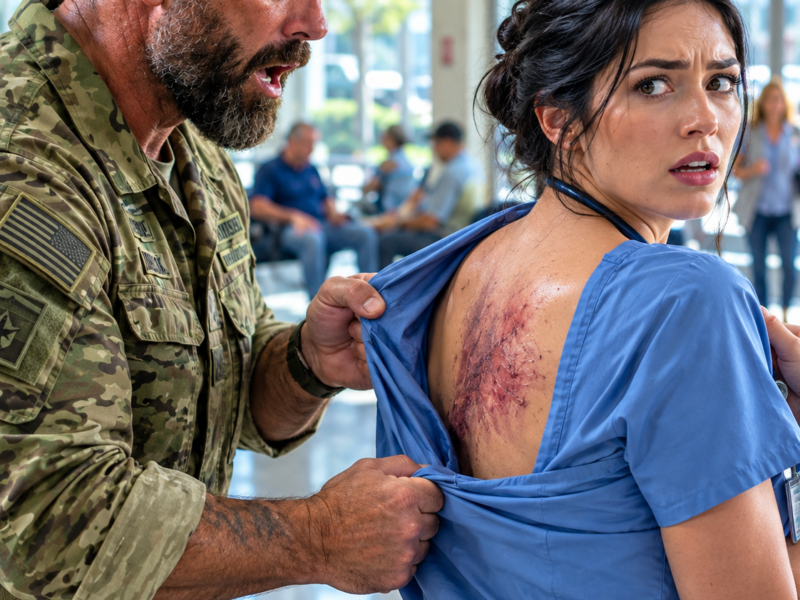
“I was halfway through changing a wounded Marine’s dressing at a VA hospital in Virginia when a Navy SEAL caught sight of the burn scars on my arm
I looked at the photograph again, forcing myself to study the faces instead of the words.
The woman beside the helicopter was undoubtedly me, seven years younger, with my hair pulled into a tight bun and a smile I barely recognized.
The young soldier beside me had his face scratched out so aggressively that the paper had nearly torn.
“Who is he?” I asked.
Daniel Brooks stared at the photograph as though it were something dangerous.
“I don’t know what you think you remember,” he said quietly, “but you need to stop asking questions about that night.”
Mason took a step toward him.
“That’s your answer? After all these years?”
Daniel’s jaw tightened. “Not here.”
“Then where, Daniel? Because I’ve spent seven years waking up to the sound of that aircraft breaking apart, and I just found out the woman we buried in our memories is standing right in front of us.”
The word buried made my stomach turn.
I placed the photograph on the counter.
“Nobody is leaving this room until somebody tells me why my face is in a picture from a mission I supposedly never survived.”
Daniel looked at me, and for the first time I saw something worse than fear in his expression.
Shame.
He reached for the photograph, but I covered it with my hand.
“Please,” he said.
That single word stopped me more effectively than a command would have.
He looked exhausted suddenly, as if he’d been carrying something too heavy for too long.
“I can’t explain all of it here.”
“Then start with one thing. Why is your name on the back?”
He glanced at the inscription.
If I don’t come back, ask Daniel.
His throat moved as he swallowed.
“Because you trusted me.”
“Did I?”
He closed his eyes.
“More than you should have.”
Mason let out a bitter laugh.
“She’s entitled to know what happened.”
“And you think telling her everything at once is going to help her?” Daniel snapped.
“I think lying to her for seven years has done enough damage.”
The room fell silent.
I looked at Mason.
“What do you mean, lying?”
He rubbed a hand across his face. The anger had drained from him, leaving behind a man who looked as if he hadn’t slept properly in years.
“I don’t know what Daniel has told you, but the official story was never the whole story. Raven Two was supposed to extract a medical team and several personnel from a temporary field site. The aircraft never made it back to the designated landing zone.”
“I know that much.”
“No,” he said. “You know what they put in the report.”
He pulled a chair away from the wall and sat down, his eyes fixed on the photograph.
“That night, I was part of the security team on the ground. We were waiting for your helicopter when we lost contact. Then we heard the distress call. There was an explosion, followed by a mayday transmission that cut in and out.”
I gripped the counter.
“What did the voice say?”
Mason hesitated.
“First, the pilot called out a position. Then someone said the medical team was still inside. We moved toward the crash site, but the fire was spreading, and the fuel was going up.”
He paused.
“I heard you on the radio.”
The room seemed to grow colder.
“What did I say?”
His eyes lifted to mine.
“You asked us not to leave the others.”
A fragment surfaced in my mind: orange light against the cockpit window, the smell of burning insulation, someone coughing through a mask.
I pressed my palm against my temple.
“There were people inside,” I whispered.
“Yes.”
“How many?”
Mason looked at Daniel before answering.
“Four on the aircraft. Three listed as crew, one listed as medical support.”
“Four?” I repeated. “There were more people on that mission.”
“Not according to the flight manifest.”
I stared at him.
The words on the photograph seemed to sharpen in my mind.
If I don’t come back, ask Daniel.
“Who was the soldier beside me?”
Neither man answered.
Then the door opened, and a physician stepped inside to check on Daniel’s shoulder.
“Everything all right in here?”
Daniel immediately slipped the photograph into his jacket.
“Fine, Doctor.”
The physician glanced at Mason’s coffee-soaked hand, then at my face.
“Emily, can I speak with you for a moment?”
I didn’t move.
“I need another minute.”
He studied me, evidently recognizing that look nurses sometimes get when a patient has just told them something that changes the entire course of an ordinary shift.
“All right. But don’t forget your other patients.”
When he left, Daniel pushed himself upright.
“I’m going home.”
“You’re not going anywhere,” I said.
He looked startled.
“You have a shoulder injury, a head wound, and you nearly passed out when Mason mentioned the crash. You can either tell me the truth here, or I’ll arrange to have someone evaluate you before you leave.”
For the first time, Mason almost smiled.
“She’s always been stubborn, hasn’t she?”
Daniel’s eyes snapped toward him.
“You remember her?”
Mason’s smile disappeared.
“Of course I remember her.”
He turned to me.
“You saved one of my men that night. He was bleeding badly, and you refused to leave him when the aircraft was taking fire. You kept him alive long enough for us to get him out.”
My eyes filled before I could stop them.
“I don’t remember.”
“I know.”
He said it gently, without pity.
“And that’s what made the official report so hard to accept. They said you were dead. But I never saw your body.”
Daniel stood abruptly.
“Enough.”
His voice carried an authority that made both of us look at him.
Then he reached into his jacket and withdrew the photograph again.
“I’ll tell you what I can,” he said. “But you need to understand something first. If we start this, there may be people who won’t want you digging any further.”
“Who?”
He looked toward the hallway.
“People who still have a lot to lose.”
I felt a strange calm settle over me.
“Then they should have thought about that before leaving me with seven years of missing memories.”
Daniel sat back down.
“The man in the photograph was named Ethan Cole.”
The name struck a chord I couldn’t quite place.
I repeated it under my breath.
“Ethan.”
“He was a combat medic assigned temporarily to your team,” Daniel continued. “He wasn’t supposed to be on Raven Two that night. He’d been moved to another unit two days before the mission.”
“Then why was he standing beside me?”
“Because he came back.”
Mason leaned forward.
“Daniel.”
“She deserves to know.”
He turned to me again.
“Ethan discovered that somebody had altered the mission’s evacuation list. There were names on the original roster that didn’t appear on the final one. He believed the changes were deliberate.”
“Why would anyone alter a flight manifest?”
“To make it appear certain people were never there.”
I thought of the scratched-out face.
“Was Ethan one of them?”
Daniel nodded.
“He was trying to bring evidence to someone he trusted. You were helping him.”
My mouth had gone dry.
“What evidence?”
“That’s what I don’t know.”
Mason shook his head. “You know more than that.”
Daniel’s expression hardened.
“I know what I was told.”
“That’s not the same thing.”
I looked between them, feeling the familiar pressure building behind my eyes.
“Stop talking around me. What happened to Ethan?”
Daniel’s shoulders sagged.
“He was listed as missing after the crash. Later, the military amended the report to say he’d never boarded the aircraft.”
“But you just told me he was there.”
“I saw him before the mission. I saw him with you. I know he was supposed to be on that helicopter.”
“And after?”
Daniel looked down at his hands.
“After, I was told to sign a statement saying I couldn’t confirm his presence.”
The silence that followed seemed to swallow the sound of the rain.
“You signed it?”
His eyes filled with tears.
“Yes.”
I stepped away from the counter.
“Why?”
“Because I was twenty-six years old, Emily. Because my commanding officer told me the investigation was classified and that signing the statement would protect the surviving personnel. Because I believed him.”
“And did it?”
“No.”
He shook his head.
“It protected the people who wanted that report buried.”
I wanted to hate him. It would have been easier than standing there, looking at a man who had apparently spent seven years regretting a decision he couldn’t undo.
But regret wasn’t the same as innocence.
“You knew I was alive?” I asked.
“No. I knew you might have been.”
“That’s not what I asked.”
He stared at the floor.
“I heard a rumor, about eighteen months after the crash, that a woman with severe burns had been found at a remote medical station. There was no name attached to it. I tried to get more information, but the request was denied.”
“And you stopped looking?”
“I didn’t stop.”
“Did you try to find me?”
He hesitated.
“I tried to get the file reopened. I wrote letters. I spoke to people who wouldn’t return my calls. Then I was transferred, and my father got sick, and I—”
He stopped.
I waited.
“Eventually, I told myself that if you were alive, you’d come back when you were ready.”
“That was convenient.”
He nodded, accepting the accusation.
“Yes. It was.”
Mason stood and walked to the window.
“I spent years thinking I’d left her behind in that fire,” he said. “When I finally got access to the incident report, I found a reference to a radio transmission that wasn’t included in the public summary.”
“What transmission?”
He turned around.
“The woman said, ‘Tell Daniel I kept my promise.'”
I looked at the photograph again.
“That was me?”
“I believe so.”
“Then what promise was I talking about?”
Daniel’s face crumpled.
“I think you were promising to protect Ethan’s evidence.”
A sudden memory flashed through my mind.
A narrow corridor.
A red emergency light.
A man’s voice saying, “If anything happens, don’t give it to them.”
My hand flew to my mouth.
There was more.
I could almost feel the weight of something pressed into my palm, small and hard, while smoke crawled beneath a door.
I heard myself whisper, “I have it.”
Mason took a step toward me.
“Have what?”
I couldn’t answer.
The memory vanished as quickly as it had come, leaving me trembling.
Daniel reached out, but I moved away.
“Don’t touch me.”
He lowered his hand.
“I need to go home,” I said.
“Emily—”
“I need to think.”
Mason nodded.
“I’ll give you my number. If anything comes back to you, even something that seems meaningless, call me.”
He took a card from his wallet and placed it on the counter.
I slipped it into my pocket.
Daniel remained seated, staring at the photograph.
Before I left, he spoke one last time.
“If you find anything, don’t take it straight to the people who investigated the crash.”
I turned toward him.
“Why not?”
He looked at me with an expression I would remember for a long time.
“Because the person who signed the report is still in a position to make sure nobody reads it.”
That afternoon, I finished my shift on autopilot.
I changed dressings, checked medication orders, and helped an elderly veteran call his daughter. I answered questions with the same steady voice I’d used for years.
But all the while, I kept hearing Daniel’s words.
You trusted me.
More than you should have.
At six, I drove home through the rain to my small apartment in Chesapeake. I left the lights off and stood in the kitchen, watching headlights slide across the ceiling.
I had no photograph of my old team, no letters from the military, no personal belongings from the crash. Whatever had survived the fire had been taken during my initial treatment, and the paperwork said my possessions had been destroyed.
I’d accepted that explanation because there had been nothing else to accept.
Now I wasn’t sure I believed any of it.
I opened my laptop and searched for Ethan Cole.
There were dozens of results, most unrelated. A former high school football player. A real estate agent in Ohio. A musician who had released an album three years earlier.
Then I found a military memorial page.
Ethan James Cole.
Born in 1989.
Listed as missing in action on October 17, seven years earlier.
The photograph was grainy, but I recognized the eyes.
He had a crooked smile and a small scar near his chin.
I stared at his face until the laptop dimmed.
Then I searched for the crash report.
The public document was short, formal, and almost completely useless. It listed the aircraft’s loss, the location, the weather conditions, and the names of those presumed killed.
My own name wasn’t there.
Neither was Ethan’s.
Instead, the medical support position was marked vacant.
I read the page three times, trying to understand how an entire person could be erased with a single word.
Then I noticed a reference number at the bottom.
An appendix was mentioned, but the link led to an access-denied page.
I wrote down the number.
It was nearly midnight when I finally went to bed.
I dreamed of the helicopter again.
This time, I wasn’t outside it.
I was inside the cabin, strapped against the wall while a red light blinked above the door. Someone was shouting that we had to move. My hands were covered in blood, but I couldn’t tell whose.
A man crouched beside me.
His face was hidden by smoke.
He pressed something into my palm.
“Don’t let them have it,” he said.
Then the aircraft lurched, and I woke with a cry.
For several seconds, I couldn’t breathe.
My bedroom was dark and quiet. Rain whispered against the windows.
I switched on the bedside lamp and looked down at my hands.
My fingers were clenched around the blanket.
Slowly, I opened them.
There was nothing there.
But the words remained.
Don’t let them have it.
I spent the next two days trying to find a connection between Ethan Cole and the altered manifest.
I searched archived news reports, military announcements, and court records. Most of the results led nowhere.
Then, on Thursday afternoon, I received a call from an unknown number.
“Emily Carter?”
The man sounded older, with a careful, measured voice.
“Who’s asking?”
“My name is Colonel Richard Hayes. I was involved in the administrative review following the Raven Two incident.”
I sat down at my kitchen table.
“How did you get my number?”
“Your name came up in a records request. I understand you’ve been speaking with former personnel.”
I thought of Mason.
“I’ve spoken to two people who were there.”
“Then you understand why it’s important not to draw conclusions based on incomplete memories.”
I looked at the notebook beside my laptop.
“What exactly are you asking me to do?”
“Nothing unreasonable. I’d simply like to meet with you and explain the limits of what we know.”
“Why now?”
A pause.
“Because I understand you may have recovered some memories.”
I had told nobody about the dream.
My grip tightened around the phone.
“Who told you that?”
“I’d rather discuss it in person.”
“Then send me the information in writing.”
“Emily, I don’t think you appreciate how complicated this matter is.”
“You’re right. I don’t. That’s why I want the records.”
His tone cooled.
“Some records remain restricted for legitimate reasons.”
“Then why call me?”
He was silent long enough for me to hear a faint click on his end.
“Because I believe you deserve closure.”
I thought of Daniel’s shame and Mason’s crushed coffee cup.
“Closure isn’t the same as the truth.”
“No,” he said quietly. “It isn’t.”
Then he gave me an office address in Norfolk and asked me to meet him the following morning.
I said I’d consider it.
After we hung up, I sat at the table for a long time.
Something about the call bothered me more than his warning. He hadn’t asked whether I was recovering. He’d spoken as if he already knew what I remembered.
I called Mason.
He answered on the second ring.
“Emily?”
“Colonel Richard Hayes just called me.”
The silence on the other end was immediate.
“What did he say?”
“He wants to meet.”
“Don’t go alone.”
“Do you know him?”
“Yes.”
“Was he involved in the investigation?”
“He supervised the administrative review.”
“Daniel told me the person who signed the report was still in a position to keep it buried.”
Mason exhaled slowly.
“Hayes wasn’t the only person who signed it.”
“Who else?”
“I don’t know all the names. But if he wants to see you, there’s probably a reason he doesn’t want to put in writing.”
I glanced at the number I’d written beside the appendix reference.
“What if I want to know what he’s hiding?”
“Then we go together.”
The next morning, Mason met me outside a diner near the waterfront.
He’d brought a folder containing copies of documents he’d gathered over the years. The pages were worn, with handwritten notes in the margins.
We sat in a booth near the window while he explained what he’d discovered.
“After the crash, the initial incident log mentioned a second ground team,” he said. “That team was never included in the final report.”
“How do you know?”
He slid a photocopy across the table.
A single line had been underlined in blue ink: Additional personnel accounted for separately pending review.
“That could mean anything,” I said.
“Exactly. But the final report removed the entire reference.”
I studied the page.
“Who made the change?”
“The copy I obtained doesn’t show the editor’s name. The revision number matches the version approved by Hayes.”
I looked up.
“You’re telling me the colonel removed evidence of a second team?”
“I’m telling you the record was changed under his authority. I don’t know why.”
It wasn’t enough to accuse anyone of a crime.
But it was enough to know the official version had been edited.
Mason tapped the folder.
“There’s another thing. The aircraft’s transponder went dark before the crash was reported. The official explanation was electrical failure.”
“Was that possible?”
“Yes. But the maintenance log says the system had been inspected two days earlier and passed.”
“Could it have failed anyway?”
“Of course.”
He watched me carefully.
“That’s the problem with this case. Every detail has an innocent explanation when you look at it alone.”
“And together?”
“Together, they look like somebody wanted to make sure nobody could reconstruct the night.”
We went to the colonel’s office at ten.
Hayes was in his late fifties, with silver hair, a crisp shirt, and a desk so orderly it looked unused. He stood when we entered and shook my hand.
His grip was firm.
“Ms. Carter. I’m glad you came.”
His eyes shifted to Mason.
“Mr. Reed. I wasn’t expecting you.”
“Makes two of us,” Mason said.
Hayes gestured toward the chairs.
“I understand you’ve both been reviewing old records.”
“We have questions,” I said.
“Of course.”
He opened a folder on his desk.
“I want to begin by acknowledging the difficulty of what you experienced. Recovering from a traumatic event can be complicated, and memory is not always a reliable guide to specific details.”
“I know what memory loss feels like,” I replied. “I’ve lived with it for seven years.”
“I’m sure you have.”
“Then please don’t use it to dismiss what I tell you.”
His expression tightened slightly.
“That isn’t my intention.”
I placed my copy of the incident log on the desk.
“Why was the reference to the second ground team removed from the final report?”
He studied the page.
“That document was part of a preliminary review. Some information was excluded from the final report because it had not been verified.”
“Who was on that team?”
“I don’t recall the names.”
“Was Ethan Cole on it?”
For the first time, Hayes looked genuinely surprised.
Then the expression disappeared.
“Ethan Cole was listed as missing during the incident. His status was never conclusively established.”
“He was standing beside me in a photograph taken before the flight.”
“Photographs can be difficult to date and authenticate.”
“It was in a wounded Marine’s possession.”
Hayes folded his hands.
“Ms. Carter, I understand why you want answers, but I cannot responsibly validate a theory based on an old photograph and fragments of recollection.”
“Then show me the records.”
“Some of those records are still restricted.”
“Why?”
“Operational security.”
“Seven years later?”
“Restrictions don’t necessarily expire because time has passed.”
Mason leaned forward.
“Did you know she was alive?”
Hayes looked at him.
“I learned that Ms. Carter had survived after the medical recovery process identified her.”
“Then why wasn’t she informed about the investigation?”
“She was receiving treatment. Decisions about what information to provide were made by the appropriate medical and administrative authorities.”
“That’s not an answer,” I said.
“No,” Hayes replied. “It’s the answer I can give you.”
I stood.
“I don’t think we’re going to get anywhere today.”
“Emily, please.”
His voice softened, but his eyes remained alert.
“There is one thing you should understand. People sometimes search for a single person to blame because the alternative—that a terrible event occurred through a series of failures—is difficult to accept.”
“Maybe,” I said. “But failures don’t usually require someone to erase names.”
For a moment, his composure slipped.
It was brief, but I saw it.
Then he closed the folder.
“If you recover additional information, I strongly recommend you consult the appropriate authorities before making it public.”
We left without shaking his hand.
Outside, Mason walked beside me in silence until we reached the parking lot.
“He knows something,” I said.
“Maybe.”
“You saw his face when I mentioned Ethan.”
“I did.”
“Why won’t he tell us?”
Mason stopped beside his truck.
“Because we haven’t found the thing that makes telling the truth safer than keeping quiet.”
I looked at him.
“Then we find it.”
That evening, I returned to my apartment and emptied the small storage box where I kept the few documents from my early rehabilitation.
I had searched it years earlier, looking for any clue about my identity. There were hospital forms, discharge instructions, and a copy of the first identification card issued to me after my recovery.
Nothing about the crash.
Nothing about my team.
At the bottom, beneath a folded hospital gown, I found an envelope I didn’t remember seeing before.
My name was written on the front.
The handwriting was mine.
Inside was a single sheet of paper, folded twice.
The ink had faded, but I could still read the words.
If I forget, start with the blue door. Ask for the room where they kept the radios.
I sat very still.
I didn’t remember writing it.
But I recognized the shape of every letter.
On the bottom corner was a date.
October 16.
The day before the crash.
I called Mason.
He arrived within twenty minutes, still wearing the same jacket he’d had that morning.
When I showed him the note, he read it twice.
“Do you know what the blue door means?” I asked.
He shook his head.
“Not yet.”
“Do you know where they kept the radios?”
“At the temporary field site, there was a communications room. The door was painted blue.”
I looked at the date again.
“Then that’s where we need to go.”
Mason hesitated.
“The site is no longer active. The buildings may not even be there.”
“Can you find out?”
“I can try.”
He took a photograph of the note and slipped his phone back into his pocket.
“I need to make a few calls.”
Before he left, he turned toward me.
“Emily, I want you to understand something. If this leads where I think it might, you may find out things about yourself that you don’t like.”
I looked down at my scarred arms.
“I’ve spent seven years not knowing who I was. I’m not sure there’s much left to protect.”
He didn’t argue.
Three days later, Mason called with an address and a name.
The old field site had been converted into a restricted training and logistics facility. The communications building was still standing, though it had been renovated.
He’d also learned that a retired civilian contractor named Paul Mercer had worked there during the period before the crash.
Mercer had left the country shortly after the investigation.
He had recently returned to Virginia.
Mason arranged to meet him at a storage facility outside Norfolk.
When we arrived, Mercer was waiting beside a row of metal doors. He was in his sixties, with thinning white hair and a cane he leaned against as he studied us.
“I wondered when somebody would come asking about Raven Two,” he said.
I stepped forward.
“My name is Emily Carter.”
His eyes widened.
Then he looked at my arms.
“You’re alive.”
The words came out as a whisper.
“You knew me?”
“I knew you were on that aircraft. I was the communications technician at the field site.”
“Did you know Ethan Cole?”
Mercer glanced toward the parking lot.
“I knew him.”
“Why was his name removed from the flight manifest?”
He tightened his grip on the cane.
“Because he wasn’t supposed to be on the helicopter.”
“Then why was he there?”
Mercer took a slow breath.
“Because he had evidence that someone was using the evacuation system to move people who weren’t on the official manifests.”
Mason’s face hardened.
“People?”
“Sometimes personnel. Sometimes civilians. The paperwork was changed afterward, and the movements were classified under unrelated operations.”
“Was it illegal?” I asked.
Mercer looked at me for a long moment.
“I don’t know everything they were doing. But I know the records were falsified.”
“What did Ethan discover?”
“He found a discrepancy between the radio logs and the final evacuation reports. He believed the discrepancy could prove that people had been moved without proper authorization.”
“Did he give me the evidence?”
Mercer nodded slowly.
“He told me you were the only person he trusted to carry it out of the site.”
I felt the floor shift beneath me.
“What evidence?”
Mercer looked from me to Mason.
“A recording. A copy of the original communications log. And a list of the names that had been removed from the manifests.”
“Where is it now?”
“I don’t know.”
“You’re telling me you helped him prepare it, and you don’t know where it went?”
“I helped him make a backup. The original was supposed to leave with him. I thought it did.”
He reached into his coat and withdrew a small key.
“This opens a locker in the old communications building. Ethan rented it under a false name. I kept the key because he asked me to hold it until someone came looking.”
I stared at the key.
“Why didn’t you come forward?”
Mercer’s face crumpled.
“Because after the crash, somebody visited me. They knew where my children went to school. They knew my wife’s work schedule. They told me that if I spoke about the missing records, my family would pay for it.”
His voice broke.
“I was a coward. I told myself I was protecting them.”
I thought of Daniel, of the statement he’d signed, of all the people who had convinced themselves that silence was the safest choice.
I took the key.
“Thank you for telling us.”
Mercer nodded, tears shining in his eyes.
“There’s something else. Before the crash, Ethan told me the evidence wasn’t just about missing names. He said it could expose the person who had ordered the changes.”
“Who?”
He looked toward the road.
“I never knew for certain.”
The communications building stood behind a security fence on the edge of the facility.
We couldn’t simply walk in, and Mason refused to take the key anywhere without permission. He contacted a former colleague who still worked with the facility’s administrative office and explained that we had reason to believe a personal storage locker contained property connected to a missing service member.
Two days later, we were granted supervised access.
The room smelled of dust, old wiring, and damp concrete. The blue door had been repainted gray, but the faded outline was still visible beneath the new coat.
My hands began to tremble.
“I’ve been here,” I whispered.
Mason stood beside me.
“Do you remember?”
“Not exactly.”
I touched the doorframe.
For an instant, I saw a flash of sunlight, heard a radio crackling, and felt someone pressing a small metal object into my palm.
Then it was gone.
A facility officer led us to the storage lockers and watched while I fitted the key into the lock.
It turned.
Inside was a small metal case, a sealed envelope, and a digital recorder wrapped in a plastic bag.
The envelope had my name on it.
I opened it with shaking fingers.
The letter was written by Ethan.
Emily, if you’re reading this, the original records may not have reached the people who can act on them. I don’t know who we can trust. Keep the copy safe. If anything happens to me, remember that the names matter more than the operation. Those people existed, and somebody decided they shouldn’t.
I had to stop reading.
The words seemed to reach through seven years and take hold of something deep inside me.
Mason placed a hand on the edge of the locker.
“Take your time.”
I continued.
If you have to choose, protect the living. The evidence can wait. People cannot.
At the bottom was a short line.
Daniel knows where the backup belongs.
I looked up.
“Daniel.”
Mason nodded slowly.
“We need to find him.”
The digital recorder was old but intact. The facility officer arranged for it to be transferred to an authorized forensic technician, who made a verified copy and documented its condition.
The metal case contained several pages of handwritten notes and a small memory card.
The notes listed dates, flight numbers, and names that did not appear in the final reports.
Some entries were marked with a red line.
Others had been crossed out entirely.
The list included the names of several civilians who had been reported missing from the area during the weeks before the crash.
There were no details about where they had gone.
Only dates and destinations.
It was evidence of falsified records, but not proof of what had happened to every person listed.
That distinction mattered.
I didn’t want another story built out of assumptions.
I wanted the truth.
When we finally reached Daniel, he was sitting on the back steps of his house, watching his young daughter draw with sidewalk chalk.
He stood when he saw us.
His face changed when he noticed the metal case in my hands.
“You found it,” he said.
“You knew it was there?”
He looked at his daughter, then called her inside to get a glass of water.
When the door closed behind her, he sat down heavily.
“I knew Ethan had made a backup. I didn’t know where he’d hidden it.”
“His letter says you knew where the backup belonged.”
Daniel stared at the case.
“He meant the original investigation office. The place where the records were supposed to be submitted.”
“Why didn’t he take it there?”
“Because he believed the office was compromised.”
“By whom?”
Daniel rubbed his face.
“He never told me a name. He said he had proof that the evacuation logs were being altered, but he was afraid that if he submitted it through official channels, the evidence would disappear.”
“Then why did he trust you?”
“Because I helped him compare the original radio traffic with the final reports. I saw the discrepancies myself.”
I sat beside him.
“What happened the night of the crash?”
Daniel’s voice grew quieter.
“Ethan was supposed to leave the site before the operation. At the last minute, he discovered that the backup copy had been accessed. He thought someone was looking for it. He came to you because you were assigned to the medical flight and could get the evidence out.”
“And I agreed?”
“You told him you’d protect it.”
I looked down at my hands.
“Then why was I on the helicopter?”
“Because the mission was real. There were wounded personnel who needed evacuation. Nobody knew the aircraft would go down.”
“Was Ethan supposed to be on board?”
Daniel shook his head.
“He boarded at the last minute. I saw him go up the ramp. I should have reported it.”
“Why didn’t you?”
“Because he told me that if anyone asked, I should say he’d left the site earlier. He thought that would protect the evidence if the aircraft was searched.”
“And after the crash?”
Daniel’s eyes filled.
“I heard the radio transmission. I heard you say you’d kept your promise. I knew you’d gotten the evidence out, or at least that you believed you had.”
“But you didn’t know I survived.”
“No.”
He looked at me.
“I spent years wondering whether you had died protecting something that never even made it to safety.”
I felt anger rise, but beneath it was a grief I couldn’t name.
“You could have told the truth.”
“Yes.”
“You could have refused to sign that statement.”
“Yes.”
“You could have kept looking for me.”
He lowered his head.
“Yes.”
His willingness to accept every accusation left me with nowhere to put the anger.
I stood and walked to the edge of the yard.
His daughter had left a chalk drawing on the sidewalk: a yellow sun, a blue house, and three stick figures holding hands.
I thought about the people whose names had been removed from the records. Their families had probably spent years searching, waiting for a phone call that never came.
I thought about Ethan, whose face had been scratched from a photograph and whose presence had been erased from a report.
And I thought about the woman I had been before the crash, the one who had believed that keeping a promise was enough to protect the people she loved.
“Did you know who altered the records?” I asked.
Daniel came to stand beside me.
“No. I suspected Hayes had approved the changes, but I never saw proof that he ordered them.”
“Then we don’t accuse him without evidence.”
Daniel nodded.
“What do you want to do?”
I looked at the case.
“We make sure the records can’t disappear again.”
Mason helped us contact an attorney who specialized in military records and a former federal investigator who agreed to review the material.
We made verified copies of every document and recording. The originals were secured, and the chain of custody was documented.
The audio took several weeks to process.
When the investigator finally called us in to listen, I sat between Mason and Daniel in a small conference room.
The recording began with static and the distant rumble of aircraft engines.
Then a man’s voice came through.
“Raven Two, confirm passenger count.”
A second voice answered with a number that didn’t match the final manifest.
Another voice interrupted.
“That’s not the approved list.”
There was a burst of static.
Then a man said, “Proceed. The paperwork will be corrected afterward.”
The investigator paused the recording.
“Can you identify the speaker?”
Mason shook his head.
“Not from that fragment.”
We listened again.
The voice sounded familiar, but not familiar enough to identify.
The recording continued, revealing more discrepancies between the instructions given over the radio and the reports filed afterward. It did not prove that every missing person had been transported illegally, nor did it establish who had ordered the changes.
But it proved the final report was not an accurate account of the operation.
That was enough to reopen the investigation.
Colonel Hayes denied deliberately falsifying records. He said the revisions had been made during a chaotic administrative review and that he had relied on information supplied by other personnel.
The investigator found evidence that Hayes had approved changes without adequate verification, but the material did not establish that he had personally ordered a cover-up.
He was removed from the review process while the inquiry continued.
Several other officials were interviewed.
The original flight records were restored to the investigation file, and the missing names were formally acknowledged.
It wasn’t the dramatic confession I’d once imagined justice would require.
There was no single villain standing before a room of reporters, admitting everything.
There were interviews, disputed recollections, records requests, and long stretches of silence while people in offices decided what could be proven.
But for the first time in seven years, the official record no longer claimed that the missing names had never existed.
The investigator also confirmed that the medical station where I had been found had reported an unidentified woman with severe burns. The report had been filed under a temporary case number and had never been connected to the Raven Two investigation.
The failure to connect those records was not, by itself, proof of deliberate concealment.
It was another mistake that had cost me years.
When I received the corrected documentation, I sat at my kitchen table and read my own name beside the words surviving medical personnel.
I expected relief.
Instead, I cried.
Not because the paperwork could give me back the years I’d lost, but because it finally acknowledged that I had been there.
That I had existed before the fire.
That the woman with the scars was not a mystery to be solved or a rumor to be dismissed.
She was a person who had survived something terrible.
And she had been trying to come home ever since.
The inquiry into Ethan’s disappearance remained open. The recovered records established that he had been present before the mission and that his name had been removed from the final manifest, but they did not establish what had happened to him after the crash.
His remains were never found.
His family received the corrected records and the letter he’d written to me. They asked whether I remembered his last moments.
I told them the truth.
I remembered a voice.
A hand pressing something into mine.
A promise.
I didn’t remember whether I’d seen him after the aircraft went down, and I wouldn’t pretend otherwise just to give them a more comforting answer.
Ethan’s sister, Sarah, met me at a small café in Richmond three months later.
She brought the same photograph Daniel had shown me, only hers had not been scratched.
Ethan stood beside me beneath the helicopter blades, smiling at something outside the frame.
“You were friends?” she asked.
“I think we were becoming friends.”
She ran her thumb along the edge of the photograph.
“He talked about you in his letters. He said you were the kind of person who’d argue with a commanding officer and then stay late to make sure everyone had clean bandages.”
A small laugh escaped me.
“That sounds like me.”
“He also said you were afraid of flying.”
I stared at her.
“I was?”
“Terrified, apparently. He said you always pretended you weren’t.”
For a moment, I could almost hear Ethan laughing.
It wasn’t a recovered memory exactly. It was something better in its own way: a piece of the person I’d been, offered by someone who had known him.
Sarah gave me a copy of one of his letters.
In it, he’d written about wanting to return home, about his mother’s cooking, and about a promise he’d made to himself to stop letting fear decide what kind of man he would become.
There was no grand revelation hidden in the pages.
Just a young man trying to do the right thing in a situation he didn’t fully understand.
I folded the letter carefully and placed it in my bag.
“I’m sorry we couldn’t bring him home,” I said.
Sarah looked at me.
“You helped bring his name home.”
I didn’t know what to say.
She reached across the table and squeezed my hand.
“That matters.”
The following spring, Mason invited me to a small memorial ceremony for the crew and medical personnel connected to Raven Two.
It wasn’t a large event. There were no television cameras, and no speeches about heroism that tried to turn grief into something simple.
A few former service members stood beside the memorial wall, their hands folded against the wind.
Daniel came with his daughter.
He approached me after the ceremony, holding a small envelope.
“I thought you should have this.”
Inside was a photograph of the crew before the mission.
The same one I’d seen in the hospital, but this copy had been preserved carefully.
Ethan’s face was intact.
I looked at the young woman beside him.
She was smiling, one hand resting on his shoulder, completely unaware of the years that lay ahead.
“I don’t expect you to forgive me,” Daniel said.
I studied him.
For months, I’d imagined what I would say if he ever apologized without making excuses.
Now that he stood before me, I realized there was no sentence that could undo what had happened.
“I believe you’re sorry,” I said.
His eyes lowered.
“But I need you to understand that your silence wasn’t harmless. I spent years believing there was nothing left to find because people who knew the truth decided I couldn’t handle it.”
He nodded.
“I understand.”
“I hope you do.”
I slipped the photograph into my bag.
“I can’t promise that things will go back to the way they were.”
“I’m not asking you to.”
He looked toward his daughter, who was standing beside Mason and showing him a drawing she’d made of the memorial wall.
“I just wanted you to know that I’m done keeping quiet.”
That was something, at least.
I didn’t offer him a hug, and he didn’t ask for one.
We stood together for a moment, sharing the silence that had once been used to hide the truth and was now simply the silence of two people who had run out of words.
Then I walked toward Mason.
He was waiting near the parking lot, his hands tucked into his jacket pockets.
“How are you doing?” he asked.
I considered the question.
For years, I’d treated healing as if it meant getting back to the person I’d been before the crash. I had imagined that if I could recover every memory, identify every face, and reconstruct every missing hour, the scars would finally make sense.
But the scars weren’t a puzzle.
They were part of what had happened to me.
Some memories returned in fragments over the following months. Others never came back. I still woke occasionally to the smell of smoke that wasn’t there, and certain sounds could send me back into the dark cabin before I had time to remind myself where I was.
I learned to live with those moments without demanding that each one explain itself.
“I’m getting there,” I told Mason.
He nodded.
“That’s a good answer.”
We walked toward the parking lot together.
At my car, I took the old photograph from my bag and looked at Ethan’s face one more time.
For seven years, I’d believed the worst thing I’d lost in the crash was my memory.
Now I understood that the silence afterward had taken something from me, too: the chance to grieve honestly, to ask questions while the people who knew the answers were still close enough to ask, and to know that my life before the fire had mattered.
I couldn’t recover those years.
I couldn’t bring Ethan home.
And I couldn’t make every person who had failed us admit what they’d done.
But I could keep the names from disappearing again.
I placed the photograph in the glove compartment, started the engine, and watched the morning light spread across the windshield.
The scars on my arms caught the sunlight as I reached for the gearshift.
For the first time, I didn’t pull my sleeves down.
The End.









