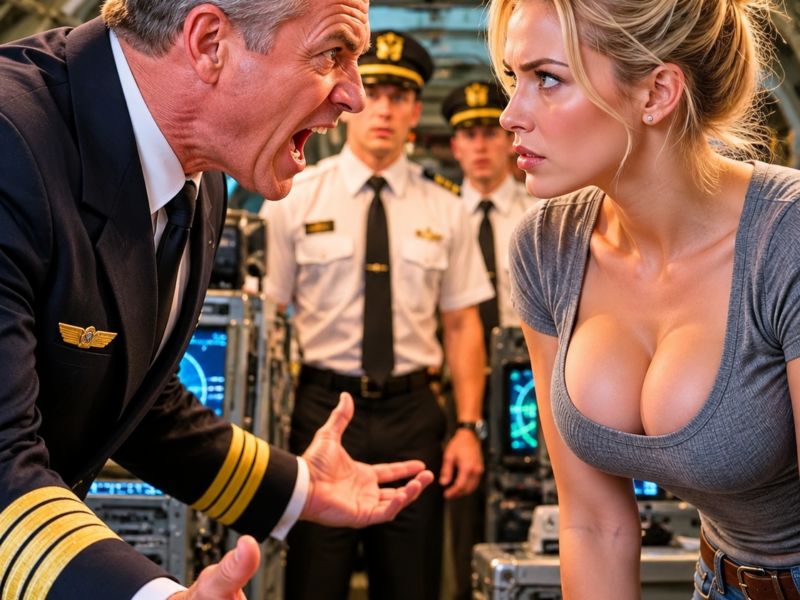
“I was halfway through boarding my first-class seat when a flight attendant blocked my path, pointed at my worn leather jacket
Captain Hayes didn’t wait for me to answer.
He glanced toward Vanessa, then at the passengers watching us from their seats.
“Mr. Mason, secure the forward cabin. I want everyone seated until we understand what’s happening.”
Vanessa stepped forward.
“Captain, I really think there’s been a misunderstanding. I was only trying to—”
Hayes raised one hand.
“Not now.”
He turned toward me.
“Claire, we need to talk. Somewhere private.”
I looked at the photograph on his phone again.
Ethan Cole.
The name seemed to pull eleven years of memories into the narrow aisle.
“Before I go anywhere,” I said, “I want to know why a dead man is sending messages.”
Mason exchanged a glance with Hayes.
Then he said something I hadn’t expected.
“Because we received a second message. And this one was addressed to you personally.”
He handed me his phone.
The message contained an address in San Diego and a time: 11:45 p.m.
Below it was a sentence.
You were right about the fuel readings. I should have listened.
My knees almost gave way.
I knew exactly what those words meant.
Eleven years earlier, during the rescue mission off the Syrian coast, I had warned Ethan that the fuel readings on our aircraft were inconsistent.
He had dismissed my concerns.
Not rudely.
Not carelessly.
He had simply trusted the maintenance report more than my instincts.
Less than an hour later, our helicopter went down.
I remembered the smell of burning insulation.
The vibration beneath my boots.
The warning lights flashing across the instrument panel.
And Ethan’s voice telling me to get out while there was still time.
I had survived.
He hadn’t.
Or so I had believed.
“Who sent this?” I asked.
“We don’t know,” Mason replied. “The message came through an encrypted channel connected to an old military communications network.”
“Then why are you showing it to me?”
“Because whoever sent it knew about the fuel readings.”
I looked at Hayes.
“Did you know?”
His face hardened.
“I knew the original investigation was incomplete.”
“That’s not an answer.”
“No,” he admitted. “It isn’t.”
I handed the phone back.
“Then I want the complete story.”
Hayes nodded toward the cockpit.
“That’s why we’re here.”
I followed them through the cockpit door.
The familiar smell of electronics, coffee, and aviation equipment brought back memories I had spent years trying to keep buried.
The aircraft was parked at the gate, its engines still silent.
The first officer remained in his seat while Hayes closed the cockpit door.
Mason stood near the navigation display.
I looked at him.
“You’re flying this aircraft?”
“Not today. I’m traveling as a passenger.”
“Then why were you in the forward galley?”
He hesitated.
“I’m assigned to a special operations aviation unit. I was meeting Hayes in San Diego.”
I studied him.
“And you recognized me immediately.”
“I recognized your voice before I recognized your face.”
I frowned.
“What?”
“On the morning briefing recording. Eleven years ago. You were the last person to communicate with Ethan before the helicopter disappeared.”
I sat in the empty jump seat.
“How long have you known?”
“About three years.”
I looked at Hayes.
“Three years?”
He nodded.
“An independent review began after several inconsistencies appeared in the original accident report.”
“And nobody contacted me?”
“We tried.”
I laughed once, without humor.
“Where?”
“Your last known military address. Then your former employer.”
“That was six years ago. I moved twice after leaving the Navy.”
Hayes lowered his eyes.
“Someone made sure our attempts never reached you.”
The sentence settled between us.
“Who?”
He opened a folder stored beneath the cockpit console.
Inside were copies of official correspondence.
Several requests for my interview had been marked received.
Others had been stamped closed.
I recognized the signature on the final document.
Admiral Richard Vaughn.
At the time of the rescue mission, Vaughn had been the senior officer responsible for the regional aviation command.
He had personally approved the operation.
He had also attended the memorial service where Ethan was declared dead.
I stared at the signature.
“Why would he block an investigation?”
Mason answered quietly.
“Because he approved the aircraft maintenance contractor.”
I looked up.
Hayes continued.
“The helicopter’s fuel system had been inspected forty-eight hours before the mission. The maintenance contractor certified it as fully operational.”
“And it wasn’t.”
“We believe the fuel readings were deliberately falsified.”
I remembered the warning.
The numbers on the panel had never made sense.
I had reported them twice before takeoff.
The second time, Ethan had looked directly at me and said, “The inspection is complete, Claire. We have a mission.”
I had trusted him.
And he had trusted the report.
“What happened to the maintenance contractor?”
Hayes slid another document across the console.
The company had been dissolved.
Its principal owner had died in a car accident two years later.
But its financial records showed several payments to an offshore account connected to Vaughn’s former aide.
I looked at the paperwork.
“So the helicopter didn’t crash because of bad luck.”
“No,” Hayes said. “And we’re beginning to believe the mission itself was arranged to destroy evidence.”
I stared at him.
“What evidence?”
He opened the final page.
A photograph showed a small black data recorder recovered from the aircraft wreckage.
The recorder had never appeared in the official investigation.
I looked at the serial number.
It was familiar.
“That belonged to Ethan.”
Hayes nodded.
“He had requested permission to carry it on the mission.”
“Why?”
“That’s what we’re trying to establish.”
I leaned back.
Then I noticed something.
A small handwritten note was attached to the photograph.
Recovered from aircraft wreckage, but not logged into official inventory.
I read it twice.
“Where is it now?”
Hayes looked at Mason.
Mason shook his head.
“Missing.”
I stared at them.
“So the only person who knows where it is is Ethan.”
“Possibly,” Hayes said.
I looked through the cockpit window at the airport terminal.
The passengers were still seated.
Some were checking their phones.
Others were watching the crew.
I had boarded a plane expecting four hours of peace.
Now I was sitting beside two military officers discussing a dead commanding officer and a missing flight recorder.
“Captain,” I said, “I need to know one more thing.”
“Go ahead.”
“Why did Ethan ask for me?”
Hayes closed the folder.
“Because he believes you’re the only person who can identify the original recording.”
We landed in San Diego a little after 6:00 p.m.
The flight attendant never apologized.
Vanessa avoided looking at me as I stepped into the terminal.
I didn’t expect her to.
There were larger things occupying my mind.
Still, as I passed her, she quietly said, “Ma’am.”
I stopped.
She looked uncomfortable.
“I was wrong about your ticket.”
I studied her face.
“Yes, you were.”
“I’m sorry.”
I nodded once.
“Thank you.”
Then I continued walking.
I wasn’t interested in humiliating her.
I had spent enough years being judged by people who didn’t know me.
I had no intention of becoming one of them.
Outside, Mason was waiting beside a dark SUV.
Hayes joined us a moment later.
We drove away from the airport and headed toward a military installation near the coast.
The sun was beginning to set.
For several miles, nobody spoke.
Finally, Mason broke the silence.
“There’s something I haven’t told you.”
I turned toward him.
“What?”
“The message wasn’t sent from the United States.”
I looked at Hayes.
“Where did it come from?”
“An offshore relay station near Cyprus.”
I felt my throat tighten.
That was close to where Ethan’s aircraft had disappeared.
“Was it traced?”
“Not completely. But the message contained a code phrase from the original rescue operation.”
“Which one?”
Mason glanced at Hayes.
Then he said it.
“Blue Lantern.”
I closed my eyes.
That phrase had been used only once.
During the final moments before the helicopter went down.
Ethan had transmitted it over the emergency frequency.
At the time, we believed it was a request for immediate extraction.
Later, investigators said the transmission had been corrupted.
But I remembered the exact words that followed.
Blue Lantern. Do not recover the aircraft. Recover the passenger.
I opened my eyes.
“What passenger?”
Hayes didn’t answer.
Mason reached into the center console and pulled out a photograph.
It showed a young woman sitting inside a military transport aircraft.
She was wearing a plain white shirt and had a bandage around her left wrist.
I recognized her face.
Not because I had met her.
Because I had seen her in a classified briefing before the mission.
Her name was Dr. Nadia Rahman.
A civilian engineer who had been working with a defense contractor on advanced aircraft navigation systems.
Three days before the rescue mission, she had disappeared.
The official explanation was that she had been evacuated from the region.
But I remembered hearing Ethan argue with Vaughn about her disappearance.
I took the photograph.
“She was the reason we went out there.”
Hayes nodded.
“Yes.”
“Why didn’t anyone tell us?”
“Because the mission was classified above your operational clearance.”
I stared at him.
“Then why was I assigned to the flight?”
“Because you were responsible for navigation and electronic surveillance.”
I looked at the photograph again.
The woman had been carrying something.
A small metal case resting on her lap.
“What was in the case?”
“We believe it contained original engineering records proving that a private contractor had deliberately altered the aircraft’s navigation and fuel systems.”
I remembered the unexplained readings.
The missing inspection records.
Ethan’s insistence that we continue.
Suddenly, the mission looked different.
We hadn’t been sent to rescue a missing engineer.
We had been sent to recover evidence.
And someone had decided that evidence was worth more than the lives of everyone on board.
At 10:30 p.m., we arrived at a small government facility near the waterfront.
It was not the kind of place that appeared on tourist maps.
A security guard checked our identification and opened a metal gate.
Inside, a single building stood behind a row of warehouses.
Mason parked near the entrance.
Hayes turned toward me.
“Before we go inside, I need you to understand something.”
I waited.
“We don’t know whether Ethan is working with us or against us.”
I looked at him.
“Then why are we here?”
“Because the message came with a warning.”
“What warning?”
Hayes took out his phone.
The second message was displayed on the screen.
Come alone, or the remaining evidence disappears.
I read it twice.
“That doesn’t sound like a man asking for help.”
“No,” Mason said. “It sounds like someone who expects to be followed.”
I looked at the building.
“Then we’re not going alone.”
Hayes gave a small nod.
“Agent Bennett’s team is already nearby.”
He had mentioned her earlier during the flight.
She was an investigator attached to a federal military oversight unit.
I hadn’t met her yet.
Mason checked the security system.
Then the three of us entered.
The corridor smelled of dust and cold metal.
At the end was a room with a single table and two chairs.
Someone was sitting with his back to the door.
His hair was gray.
His shoulders were thinner than I remembered.
But when he turned, I knew him.
Ethan Cole.
For eleven years, I had imagined this moment.
Sometimes I pictured him apologizing.
Sometimes I imagined myself shouting.
Sometimes I imagined that I would simply walk away.
None of those possibilities prepared me for the sight of him breathing.
He stood slowly.
“Claire.”
I couldn’t speak.
He took one step toward me.
Then stopped.
“I wasn’t sure you’d come.”
I stared at him.
“You sent a message saying you remembered everything.”
“I do.”
“You let me believe you were dead.”
His face tightened.
“I know.”
“You let your family bury an empty coffin.”
He lowered his eyes.
“I know.”
I felt the anger rise.
“Do you know what it was like to stand in front of your photograph and listen to people call you a hero while I was being investigated for failing to save you?”
He didn’t answer.
I stepped closer.
“You were my commanding officer. You were responsible for bringing us home.”
“I was.”
“And you disappeared.”
He looked at me.
“I thought I was keeping you alive.”
I laughed bitterly.
“Everybody seems to have a different excuse for abandoning me.”
Ethan flinched.
For several seconds, the room was silent.
Then he reached into his jacket and placed a small metal object on the table.
It was a flight recorder.
The serial number matched the photograph Hayes had shown me.
My eyes moved to Ethan’s face.
“You had it.”
“Yes.”
“All these years?”
“Most of them.”
“Why?”
“Because it contains the original mission recording. The recording that proves the aircraft was sabotaged before we ever left the ground.”
I looked at the device.
“Then why didn’t you send it to investigators?”
“I tried.”
He opened a folder.
Inside were copies of three letters.
Each had been addressed to different oversight offices.
All had been returned or marked undeliverable.
“Someone had access to the internal investigation system,” he said. “Every time I tried to release the evidence, the trail led back to the same people.”
I looked at Hayes.
He nodded slowly.
“We’ve confirmed that.”
I turned back to Ethan.
“Then why now?”
Ethan took a breath.
“Because Nadia is alive.”
The room went still.
I looked at the photograph Mason had shown me.
“Where is she?”
“She’s been in protective custody for the last two years.”
“Why didn’t she come forward?”
“Because she has a family. And because the people responsible have spent eleven years making sure anyone who knows the truth stays silent.”
I studied his face.
“How did you survive the crash?”
Ethan looked down at his hands.
“The helicopter didn’t explode immediately. We went down in shallow water. I got out through the side door.”
“And the others?”
His jaw tightened.
“One crew member died during the impact. Another was recovered by a local fishing vessel. The third…”
He stopped.
I waited.
“The third was taken by the people who arranged the operation.”
I felt cold.
“Taken?”
“Yes.”
“Who?”
Ethan looked directly at me.
“Dr. Nadia Rahman.”
I shook my head.
“The official report said she had been evacuated.”
“It was a lie. She was on the aircraft. She had the case. When we went down, she was pulled from the water by a second team.”
I looked at Hayes.
He seemed just as stunned as I was.
“Why didn’t you tell us?” I asked.
“Because the second team wasn’t military.”
Ethan pushed another photograph toward me.
It showed a private security vessel near the coastline.
The name on its side was blurred.
But I could make out the company logo.
It was the same contractor that had inspected our helicopter.
The same company whose financial records had been linked to Admiral Vaughn.
My hands began to shake.
“They were there before we even took off.”
Ethan nodded.
“They knew where we’d be.”
I looked at the recorder.
“Then this is the evidence.”
“Yes.”
He pushed it toward me.
“But there’s one thing I need you to do.”
I didn’t touch it.
“What?”
“Listen to the final transmission.”
Hayes connected the recorder to a secure playback system.
A moment later, static filled the room.
Then I heard my own voice.
“Flight control, this is Bennett. Fuel pressure is dropping on the left engine. Requesting immediate return.”
Ethan answered.
“Maintain altitude. I’m checking the auxiliary system.”
Another voice interrupted.
It was Admiral Vaughn.
“Continue mission. The aircraft is cleared for the operation.”
I leaned closer.
“Sir, our readings are unstable.”
“Your maintenance inspection was completed. Continue.”
I remembered the frustration in my younger voice.
“With respect, Admiral, the numbers don’t match the inspection report.”
There was a pause.
Then Vaughn said something I had never heard before.
“Captain Cole, you were briefed on the consequences of abandoning this mission.”
Ethan’s voice came through.
“Yes, sir.”
“Then do your job.”
The recording continued.
The aircraft began to shake.
A warning alarm sounded.
Then Ethan spoke.
“Claire, prepare for emergency descent.”
I heard myself respond.
“Copy.”
A few seconds passed.
Then another transmission came through.
A voice I didn’t recognize.
“Package secured. Proceed with secondary extraction.”
Ethan answered.
“Negative. We have personnel in the water.”
The unknown voice replied.
“Leave them.”
I pressed my hand against my mouth.
Ethan’s voice became louder.
“Repeat that order.”
“Leave them. The package is priority.”
Then came the sentence that had haunted my dreams for eleven years.
“Blue Lantern. Do not recover the aircraft. Recover the passenger.”
But this time, I heard something underneath the static.
A second voice.
A woman.
“Captain, please. They have my brother.”
I looked at Ethan.
He nodded.
“Nadia.”
The recording continued.
Ethan was shouting.
“Claire, get out! That’s an order!”
Then another voice came through.
“Vesper, do you copy?”
I stopped breathing.
Vesper.
My old callsign.
I had never heard anyone use it during that mission.
The voice continued.
“Claire, if you can hear me, don’t let them take the recorder.”
I turned toward Hayes.
“Who is that?”
He stared at the playback screen.
The voice came again.
“Vesper, it’s Daniel. I know what they did.”
Daniel Brooks.
My former flight engineer.
The man officially listed as killed during the crash.
I gripped the table.
“Daniel was alive?”
Ethan looked at me.
“Yes.”
“Where is he?”
Ethan lowered his head.
“That’s the part I couldn’t tell you until I had the recorder.”
The room seemed to shrink.
“Tell me.”
He looked at Hayes.
Then at me.
“Daniel was the person who falsified the original maintenance readings.”
I stared.
“No.”
“He was working with the contractor.”
I shook my head.
“No. Daniel was on our crew.”
“I know.”
“He was my friend.”
“I know.”
I stepped away from the table.
For eleven years, I had mourned three people.
Now one had returned from the dead, one was alive in hiding, and one had apparently betrayed us before the mission even began.
“Why would he do that?”
Ethan’s voice was quiet.
“Because they had his daughter.”
I looked at him.
“What?”
“Daniel’s daughter had a serious medical condition. The contractor offered to pay for experimental treatment. Then they used that debt to control him.”
I remembered Daniel sitting in the crew lounge, showing me a photograph of his little girl.
He had called her his reason for getting up every morning.
I remembered him laughing when I complained about the maintenance paperwork.
He had told me not to worry.
He said everything was under control.
I closed my eyes.
“Where is he now?”
Ethan looked toward the door.
“He’s outside.”
A knock sounded.
Hayes moved toward the entrance.
Mason stepped in front of him.
“Wait.”
He checked the corridor camera.
A man stood outside.
His hair was gray.
His face was older.
But the shape of his shoulders was unmistakable.
Daniel Brooks.
I had spent eleven years believing he was dead.
Now he was standing ten feet away.
Hayes opened the door.
Daniel stepped inside.
He looked at me first.
“Claire.”
I didn’t move.
He swallowed.
“I know you hate me.”
I stared at him.
“You falsified the inspection.”
He nodded.
“Yes.”
“You knew the aircraft wasn’t safe.”
“I knew there were problems.”
“You knew.”
His eyes filled.
“I knew enough.”
I walked toward him.
“Then why did you let us take off?”
He looked down.
“Because they threatened my daughter.”
I felt the anger return.
“You could have told us.”
“They said they’d hurt her. They knew where she went to school. They had photographs of her outside the hospital.”
“You could have warned Ethan.”
“I tried.”
Ethan shook his head.
“You never said anything.”
Daniel’s voice cracked.
“Because they were listening.”
He reached into his pocket and removed a small photograph.
A little girl stood beside a hospital bed.
She was smiling.
On the back was a date from eleven years earlier.
“Her name is Lily,” he said. “She was seven then. She needed a transplant. The contractor promised to cover the costs.”
I looked at the photograph.
I remembered Daniel’s daughter.
I remembered him telling us that she was getting better.
“What happened to her?”
Daniel’s eyes lowered.
“She survived. She’s twenty now.”
I looked at him.
“Does she know what you did?”
“No.”
He swallowed.
“She knows I was gone. She knows I made mistakes. But she doesn’t know the full story.”
I turned away.
For a moment, I couldn’t decide whether I wanted to strike him or sit beside him.
He had helped sabotage an aircraft carrying people who trusted him.
But he had also been a frightened father trying to save his child.
That didn’t erase what he had done.
It made the truth harder to carry.
Agent Bennett entered the room with two investigators.
She had been listening from the adjacent security office.
“Daniel Brooks?”
He nodded.
“You’re under arrest pending charges related to the falsification of military maintenance records and conspiracy.”
Daniel didn’t resist.
Before the investigators escorted him out, he turned toward me.
“Claire, I never stopped thinking about that night.”
I looked at him.
“Neither did I.”
Then he was gone.
The investigation took eight months.
The recorder provided the evidence needed to reopen the rescue mission case.
Nadia Rahman eventually testified.
She explained how the contractor had used her engineering work to conceal modifications made to military aircraft.
The illegal modifications were designed to allow certain aircraft to operate with altered tracking signatures and hidden communications equipment.
The contractor had planned to sell the technology to foreign buyers.
Admiral Vaughn had approved the operation.
Colonel Hayes had been right about the falsified maintenance reports.
The helicopter had been deliberately cleared for a mission despite known fuel system defects.
The original objective had been to recover Nadia and the evidence she carried.
When the aircraft went down, the private security team had been instructed to recover her and abandon the crew.
Ethan had refused.
He had managed to get Nadia to safety, but he had been badly injured.
A local fisherman found him several hours later.
By the time he recovered, the official report had already declared him dead.
A contact within the intelligence network helped him disappear.
He had spent years moving between safe locations, trying to preserve the evidence.
Daniel had been arrested and charged.
He cooperated with investigators and pleaded guilty to his role in the conspiracy.
His testimony helped establish how the contractor had pressured him.
But the court did not excuse his actions.
Neither did I.
Admiral Vaughn was convicted of conspiracy, obstruction, and multiple violations involving classified military operations.
Several executives from the contractor were also convicted.
The families of the crew received formal apologies and corrected records.
The government acknowledged that the original rescue operation had been compromised.
But none of those findings could return the years we had lost.
Ethan and I met again after the investigation concluded.
This time, there were no officers, no recorders, and no classified folders.
Just two cups of coffee in a quiet restaurant near the coast.
He looked older than the man I remembered.
So did I.
“I’ve been thinking about what you said,” he began.
“Which part?”
“That I let you believe you failed.”
I stirred my coffee.
“You did.”
He nodded.
“I should have found a way to contact you.”
“Yes.”
“I thought staying dead would protect everyone.”
I looked at him.
“And did it?”
He considered the question.
“No.”
For a while, we watched people walking along the sidewalk outside.
Then he said, “I don’t expect you to forgive me.”
I put down my spoon.
“I don’t know if I can.”
He nodded.
“But I want you to know something.”
I waited.
“On that night, when the aircraft started going down, you did everything right.”
My throat tightened.
“I know that now.”
“You kept the crew calm. You identified the engine failure. You got the emergency transmission out.”
I looked at him.
“Then why did you order me to leave?”
“Because I knew the aircraft wasn’t going to hold together. I wanted at least one of us to make it.”
I looked down at my hands.
“I spent eleven years thinking I should have stayed.”
Ethan shook his head.
“You did stay. Longer than anyone should have.”
I didn’t answer.
There was no perfect apology that could undo what had happened.
But there was something honest in his voice that hadn’t been there before.
“I missed you, Claire,” he said.
I looked at him.
“I missed who we were before that night.”
He nodded.
“Me too.”
We didn’t promise to become close again.
We didn’t pretend that the past had disappeared.
We simply finished our coffee.
Sometimes that was the most honest beginning two people could manage.
A month later, I received an invitation to speak at a naval aviation safety conference.
At first, I declined.
I had spent years avoiding microphones, briefing rooms, and questions about the accident.
But the invitation included a note from a young flight officer named Sarah Mitchell.
She had written that she was struggling to report maintenance concerns because senior personnel kept telling her to trust the inspection paperwork.
She had read the summary of my case.
She wanted to know how I had found the courage to speak up.
I read her message three times.
Then I called the conference organizer.
I accepted.
On the morning of the event, I stood in front of a room filled with pilots, engineers, mechanics, and safety officers.
The lights were bright.
The microphone was cold in my hand.
I looked at the faces in the audience.
Some were young enough to be my children.
Others had spent decades in aviation.
I began with the fuel readings.
I explained what I had noticed, what I had reported, and how quickly a reasonable concern had been dismissed.
I didn’t make the story sound heroic.
I talked about fear.
About trusting people.
About the pressure to follow an order even when the evidence in front of you suggested that something was wrong.
Then I told them about Daniel.
About the contractor.
About Ethan.
And about the official report that had blamed the wrong person.
When I finished, Sarah Mitchell approached me.
“Ma’am?”
I turned.
“Yes?”
She looked nervous.
“How do you know when to keep questioning something after everyone tells you to stop?”
I thought about it.
Then I answered honestly.
“You don’t always know. Sometimes you question it because the numbers don’t make sense. Sometimes you question it because someone you trust is asking you to ignore what you can see.”
I paused.
“And sometimes the hardest part isn’t speaking up. It’s accepting that you might lose people you care about when you do.”
She nodded slowly.
“Thank you.”
I smiled.
“Keep your reports. Keep your notes. And never let anyone convince you that asking a safety question makes you difficult.”
She thanked me again and walked away.
I watched her join a group of young officers near the exit.
For the first time, I understood that what happened to us might still prevent something similar from happening to someone else.
Six months after the conference, I received a letter from Daniel.
It was handwritten.
He told me that Lily had graduated from nursing school.
He had pleaded guilty, accepted his sentence, and was trying to rebuild what remained of his relationship with her.
He didn’t ask me to forgive him.
He didn’t ask me to write back.
At the end, he included one sentence.
I hope one day she can understand that I loved her enough to make a terrible decision, but not enough to make the right one.
I folded the letter and placed it in a drawer.
I didn’t know whether I would ever forgive him.
Perhaps I didn’t need to decide that yet.
A week later, I met Lily at a small coffee shop.
She had contacted me after finding my name in the court documents.
She wanted to know what kind of person her father had been before everything happened.
I told her about the man who carried her photograph everywhere.
The man who made terrible jokes during long flights.
The man who once stayed awake all night helping a new mechanic prepare for a certification exam.
I also told her the truth about the mission.
I didn’t hide his betrayal.
She listened without interrupting.
When I finished, she looked down at her hands.
“Do you think he loved me?”
I took a moment.
“Yes.”
She looked up.
“Then why did he do it?”
I thought about the aircraft.
The warning lights.
The emergency transmission.
The people who had been forced to choose between fear and responsibility.
“Because love doesn’t always make people brave,” I said. “Sometimes it makes them afraid. And sometimes they let that fear hurt people who never deserved it.”
Lily wiped her eyes.
“Do you hate him?”
I looked out the window.
“I hate what he did. I don’t know if that means I have to hate every part of who he is.”
She nodded.
We talked for another hour.
When she left, she hugged me.
It wasn’t forgiveness.
It wasn’t a promise.
It was simply two people trying to understand how a decision made eleven years earlier had changed both their lives.
The following spring, I returned to Jacksonville for a short visit.
I walked along the waterfront one evening and watched the sun settle behind the harbor.
The wind smelled of salt and warm pavement.
My phone vibrated.
A message from Ethan.
I’m teaching young pilots now. They ask too many questions, which I consider a good sign.
I smiled.
Then another message arrived.
I still think about that night. I hope you’re doing better.
I typed:
I’m learning to.
I put the phone away.
For eleven years, I had thought the rescue mission was the moment my life had ended.
It wasn’t.
It was the moment someone else’s decisions had changed the direction of my life.
I had lost friends.
I had lost trust.
I had lost years I could never recover.
But I had also learned that survival did not require me to carry the blame for everyone else’s choices.
I couldn’t change the mission.
I couldn’t bring back the people who had died.
I couldn’t make Ethan’s silence disappear or Daniel’s betrayal harmless.
But I could decide what I did with the truth once I finally had it.
As I walked back toward the parking lot, an aircraft passed high above the coastline.
I stopped and watched until it disappeared into the evening clouds.
I no longer wondered whether I should have stayed in that helicopter.
I had stayed long enough.
And I had finally learned that coming home didn’t mean forgetting what happened.
It meant allowing myself to live after it.
The End.









