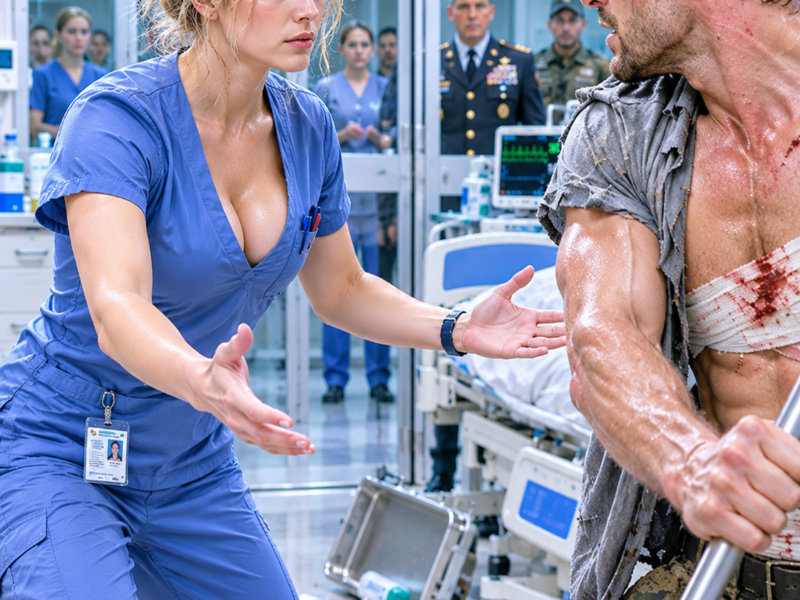
“I was halfway across the psychiatric ward at Fort Liberty when the biggest, most unpredictable patient in the building slammed his fist against the reinforced glass
Colonel Whitaker held the envelope between us.
I didn’t take it.
“What’s in there?” I asked.
He glanced toward Daniel’s room, then back at me.
“Not here.”
“Then where?”
“Somewhere we can speak privately.”
I looked down at the photograph in my hand.
The little girl beside the Christmas tree couldn’t have been more than six years old. She had dark curls, a missing front tooth, and a red sweater with a reindeer stitched across the front.
On the back, beneath the message addressed to me, was a second line in smaller handwriting.
You said you would bring him home.
I looked at the colonel.
“Who wrote this?”
He didn’t answer.
“Was it my brother?”
His jaw tightened.
“Yes.”
I felt the hallway tilt slightly beneath my feet.
My brother, Michael Bennett, had been a staff sergeant in the Army. He had served in Afghanistan and returned home with a collection of injuries he rarely discussed.
He had died four years earlier in a single-vehicle accident on a rural road outside Fayetteville.
At least, that was what our family had been told.
The Army had informed us that Michael was driving home after visiting a former colleague when his truck left the road during heavy rain.
There had been no investigation that we knew of beyond the official report.
No suspicious circumstances.
No unanswered questions.
Just a folded flag, a funeral, and a mother who never quite recovered.
I looked at the colonel again.
“What does Daniel have to do with my brother?”
Before he could answer, Dr. Harris stepped between us.
“Colonel, this is a medical facility. Whatever military matter you’re discussing can wait until the patient is stable.”
Whitaker nodded.
“You’re right, Doctor.”
Then he turned toward me.
“But if you want to understand why that man recognized your name, you need to hear the truth.”
I glanced through the observation window.
Daniel was sitting on the floor again.
His face had gone pale.
He was watching us.
“Rachel,” he called.
I approached the door.
He lifted one hand, holding it against the glass.
“Don’t let him tell you the whole story.”
Colonel Whitaker closed his eyes briefly.
That small reaction told me more than his words had.
I turned to Daniel.
“What story should I hear?”
He looked down at the photograph.
“Start with Michael.”
My brother’s name sounded strange coming from a man I had never met.
I wanted to ask a hundred questions, but the security officer was already asking me to step away from the door.
I followed Colonel Whitaker into a small administrative conference room.
He placed the envelope on the table.
I remained standing.
“Before you open that,” he said, “I need you to understand that your brother was not the man described in the accident report.”
“Then what was he?”
Whitaker pulled out a chair but didn’t sit.
“He was the only person who tried to report what happened during Operation Cedar.”
The name meant nothing to me.
I shook my head.
“Michael never mentioned an operation by that name.”
“He wasn’t supposed to.”
“That’s convenient.”
The colonel accepted the accusation without defending himself.
“Three years before his death, your brother served in a joint field unit in Afghanistan. Sergeant Mercer was part of that unit.”
I looked at the photograph again.
“Emily?”
Whitaker nodded.
“Emily was a civilian child your brother encountered during the operation.”
“Why was her photograph addressed to me?”
“Because Michael told her about you.”
I sat down slowly.
Whitaker continued.
“Your brother had a reputation for looking after civilians. He carried extra food, medicine, and supplies whenever he could. During one operation, he found a family living near a damaged road outside a small village.”
“Was Emily part of that family?”
“Yes. Her father had been killed, and her mother was missing. Daniel became protective of her.”
I studied the colonel’s face.
“Why would an American soldier be responsible for a little girl in Afghanistan?”
“He wasn’t supposed to be responsible for her. But she had no one else.”
He paused.
“Michael became involved, too.”
I looked at the date.
December 18.
“Why did my brother promise to bring her home?”
Whitaker finally sat down.
“Because he believed she was in danger.”
He opened the envelope and removed several pages.
The first was a photocopy of a handwritten statement.
The second was a photograph of a military vehicle.
The third was a report with multiple sections blacked out.
I recognized Michael’s signature at the bottom of the handwritten page.
My throat tightened.
“What am I looking at?”
“A statement your brother submitted after the operation.”
I began reading.
The words were difficult to make sense of at first.
There were references to missing medical supplies, an unauthorized convoy, and a civilian evacuation that had never appeared in the official record.
Then I saw a sentence underlined in blue ink.
The child was present when the second vehicle arrived.
I looked up.
“What second vehicle?”
Whitaker rubbed his forehead.
“That’s where things became complicated.”
He explained that during the operation, a convoy had been assigned to transport civilians away from an area considered unsafe.
Daniel had been tasked with escorting the group.
Michael was responsible for coordinating the movement of supplies.
But the convoy never reached its destination.
One vehicle was found abandoned.
Another returned without its passengers.
The official report stated that the civilians had been transferred to a local aid organization.
Daniel claimed that wasn’t true.
He insisted the children had been taken somewhere else.
“Emily was one of them,” I said.
“Yes.”
“And my brother knew?”
“He was the first person to challenge the report.”
I looked at the statement again.
“Did he find her?”
Whitaker didn’t respond immediately.
Instead, he turned to the last page.
It was a photograph of Michael standing beside Daniel.
They were younger, both wearing dusty uniforms.
Michael had one arm around Daniel’s shoulders.
Between them stood Emily.
She was holding a small stuffed rabbit.
I recognized the red sweater.
It was the same one in the Christmas photograph.
I touched the edge of the paper.
“Why was this never given to our family?”
“Because the investigation was closed before your brother died.”
“That doesn’t answer my question.”
He looked at me.
“Because people in positions of authority believed reopening the matter would damage several careers.”
I stared at him.
“You’re telling me my brother’s death was covered up?”
“No. I’m telling you his report was buried. Those are two different things.”
“How convenient that you know the difference.”
Whitaker lowered his eyes.
For the first time, he looked less like a commanding officer and more like a man who had been carrying something heavy for years.
“I signed the original report,” he said.
I couldn’t speak.
He continued.
“I was Daniel’s commander. I was responsible for the operation. When Michael raised concerns, I believed he was exhausted and struggling with what he’d seen.”
“Did you investigate?”
“Not properly.”
“Did you listen to him?”
He looked at the table.
“No.”
The answer was so quiet that I almost missed it.
I stood.
“Then why are you here?”
“Because Daniel requested that I come.”
“Why?”
“Because he has been trying to tell someone what happened for three years, and he finally recognized your name.”
I picked up the photograph.
“How did he know me?”
“Michael showed him a picture of you.”
I remembered the photograph on my brother’s refrigerator.
It had been taken during my nursing school graduation.
I was wearing a white coat, holding a cheap bouquet from a grocery store, and smiling so hard my cheeks hurt.
Michael had been proud of me.
He used to tell people I could calm a room without raising my voice.
I had assumed he was exaggerating.
Now I wondered how many times he had talked about me to the people he served with.
A knock interrupted my thoughts.
Dr. Harris entered.
“Rachel, I need to speak with you.”
I turned.
“What’s happened?”
“Sergeant Mercer has requested that you return.”
“Is he agitated?”
“No.”
Dr. Harris hesitated.
“He’s asking for you by name.”
I looked at Whitaker.
He nodded toward the door.
“Go.”
I returned to Room 214.
Daniel was standing near the observation window.
His breathing was steadier than before.
When he saw me, he moved back toward the chair.
“Did he give you the envelope?”
“Yes.”
“Did he tell you about the convoy?”
“Some of it.”
Daniel rubbed both hands over his face.
“Then you know your brother didn’t abandon us.”
I pulled a chair closer but left a comfortable distance between us.
“Why did you say that?”
“Because that’s what they told everyone.”
“Who?”
“The people who wrote the report.”
He sat down.
“After the convoy stopped, we were told to leave the area. Michael refused. He said there were still civilians missing.”
“Was Emily missing?”
“Yes.”
“What happened?”
Daniel stared at the floor.
For several seconds, I thought he might refuse to answer.
Then he began.
“We found the second vehicle outside a warehouse. It wasn’t on the route we’d been given. There were children inside.”
His voice trembled.
“Emily was one of them.”
I waited.
“Michael wanted to take them out. I wanted to call it in first. We argued because we didn’t know who we could trust.”
“Why?”
“Because someone had changed the destination orders.”
He looked at me.
“The convoy wasn’t taking those families to safety. Someone had arranged for them to be moved somewhere else.”
“Who arranged it?”
“I don’t know. I never saw the paperwork with the final authorization.”
“Then how did my brother know?”
Daniel swallowed.
“Because he saw the signature.”
He leaned forward.
“He told me it belonged to an officer he had worked with before.”
I glanced toward the hallway.
“Colonel Whitaker?”
Daniel shook his head.
“No. Someone higher.”
A chill settled in my stomach.
“What happened to the children?”
“We got them out.”
He paused.
“Most of them.”
I looked at him carefully.
“What do you mean, most?”
His eyes filled.
“There were seven children in that warehouse. We found six.”
I felt my fingers curl around the edge of the chair.
“Where was Emily?”
Daniel looked at the photograph.
“She was hiding under a truck. Michael found her.”
He took a shaky breath.
“He carried her all the way back to the road.”
I could picture my brother doing that.
He had always been the one who stopped when everyone else kept walking.
Daniel continued.
“We got the six children to a local aid worker. Michael stayed behind to look for the seventh.”
“And you?”
“I went with the children.”
“Why?”
“Because Emily wouldn’t let go of me.”
His voice cracked.
“She was terrified. She kept asking where her mother was.”
I didn’t interrupt.
“Michael told me to take her somewhere safe. He said he’d catch up.”
Daniel looked down at his hands.
“He never did.”
I waited until he looked at me again.
“What happened to my brother?”
Daniel shook his head.
“I don’t know.”
“Then why did you tell me to ask my brother?”
“Because before he disappeared, he left me a message.”
“What message?”
Daniel looked toward Colonel Whitaker, who had quietly entered the hallway.
“He told me that if anything happened to him, I should find Rachel Bennett.”
My mouth went dry.
“What exactly did he say?”
Daniel closed his eyes.
“He said, ‘She’ll know what to do when she sees the photograph.'”
I looked at the little girl in the red sweater.
I was beginning to understand why Michael had written my name on it.
But I still didn’t know what he expected me to do.
“Daniel, where is Emily now?”
He opened his eyes.
“I don’t know.”
“Is she alive?”
He looked at me for a long time.
“I hope so.”
That answer stayed with me long after I left the room.
Over the next several days, I found myself reading everything I could about Operation Cedar.
I wasn’t supposed to access military records.
I knew that.
But the documents Colonel Whitaker had brought to the medical center contained enough references to suggest that an official review had been opened and then quietly abandoned.
I asked the hospital’s legal office to help me obtain the records that could lawfully be released to my family.
They told me the request could take months.
I almost accepted that.
Then I found something tucked inside the back of the photograph’s envelope.
A narrow strip of paper.
It had been folded so many times that the creases were almost white.
I unfolded it carefully.
There was a phone number and a name.
Martha Ellis.
I recognized the name from Daniel’s account.
She was the local aid worker who had taken the children after the warehouse rescue.
I showed the note to Colonel Whitaker.
He stared at it for several seconds.
“Where did you find this?”
“It was inside the envelope.”
He took a breath.
“Martha was interviewed during the original investigation.”
“Did you speak to her?”
“Yes.”
“What did she say?”
“She confirmed that six children were brought to her.”
“And Emily?”
He didn’t answer.
“Colonel?”
“She said Emily had been taken to a medical facility before the others arrived.”
“Which facility?”
“I don’t know.”
I folded the paper.
“Then let’s find out.”
He looked at me carefully.
“Rachel, this may be harder than you think.”
“I’ve already spent four years believing my brother died without leaving anything behind. I’m done accepting incomplete answers.”
For a moment, he said nothing.
Then he nodded.
He helped me arrange a call through the appropriate military channels.
It took two days to locate Martha Ellis.
She was living in Virginia now, working with a nonprofit that helped families of displaced children.
When I called, I introduced myself and explained that I was Michael Bennett’s sister.
There was a long silence.
Then she said something I will never forget.
“I wondered when one of you would come looking.”
My hands tightened around the phone.
“One of us?”
“Daniel and Michael. They both told me someone would eventually ask about that little girl.”
I swallowed.
“Do you know where Emily is?”
“I know where she was taken.”
“Can you tell me?”
Martha hesitated.
“I can tell you what I remember. But first, you need to understand something. Emily wasn’t the only child your brother was trying to protect.”
I closed my eyes.
“How many?”
“Seven.”
I looked at the photograph.
“Daniel said they found six.”
“They did.”
“Then where was the seventh?”
Martha’s voice softened.
“That little girl was Emily.”
I stood up.
“That doesn’t make sense.”
“She was the seventh child on the original list. The six others were taken to me. Emily was transferred separately because she was injured.”
“Who transferred her?”
“I never saw the paperwork. A medical team arrived after the convoy left.”
“Where did they take her?”
“To a field hospital first. Then she was moved again.”
“Why?”
“Her mother had been found.”
I gripped the phone.
“Her mother was alive?”
“Yes.”
I looked at Colonel Whitaker.
He had stopped writing.
“Why didn’t Daniel know?”
“Because he was separated from the group. Your brother asked me not to tell anyone where the family was being moved until he could verify who had authority over the transfer.”
I sat back down.
“Did Michael find them?”
Martha was quiet.
Then she answered.
“He came to see me two days later.”
My breath caught.
“Two days later?”
“Yes. He looked exhausted. He had a cut above his eyebrow and his uniform was filthy. But he was alive.”
I pressed my hand against my mouth.
The official report said he had died years later in North Carolina.
This was still consistent with that timeline.
But it meant he had continued searching after the warehouse rescue.
“What did he say?”
“He asked me to keep a letter for his sister.”
My knees weakened.
“A letter?”
“Yes. He said if he couldn’t explain things himself, I should make sure you received it.”
“Do you still have it?”
“I do.”
I began crying before I could stop myself.
“Could you send it to me?”
“I think you should come get it.”
I booked a flight to Virginia that evening.
Colonel Whitaker offered to accompany me, but I refused.
I needed to do this alone.
When I arrived at Martha’s office the next morning, she was waiting by the front door.
She was in her sixties, with silver hair and kind eyes.
She hugged me before I could say anything.
“I am so sorry about Michael.”
I nodded, unable to find the right words.
She led me to a small office and brought out a wooden box.
Inside were several documents, two old photographs, and a sealed envelope bearing my name.
The handwriting was unmistakable.
My brother’s.
I held the envelope for a long time.
Then I opened it.
Rachel,
If you’re reading this, I probably failed to explain what happened.
I know you will be angry. You have every right to be.
I need you to understand that I never wanted you involved in any of this.
The day I met Emily, she reminded me of you when you were little. Not because you looked alike, but because you both had the same way of asking questions nobody wanted to answer.
I laughed through my tears.
That sounded exactly like Michael.
I continued reading.
The operation went wrong because someone changed the orders. We found children being moved through a warehouse that wasn’t on our route. I don’t know who authorized it, but I know the paperwork was altered.
Daniel thinks I abandoned him. I haven’t. I told him to protect Emily while I followed the second vehicle.
I found her mother. She was alive.
I got them to a safe medical station, and I thought the worst was over.
But someone found out I had copied the records.
My hands began shaking.
If anything happens to me, don’t let anyone turn Daniel into the story’s villain. He did what I asked him to do. He kept Emily alive.
I stopped reading.
The room felt too small.
Martha quietly placed a glass of water beside me.
I took a breath and continued.
There is one more thing.
I didn’t tell you because I wanted you to have a normal life.
Emily’s mother asked me to keep a photograph of her daughter. She wanted Emily to remember the people who helped her when she was lost.
I told her about you. I told her you were a nurse and that you would understand why some people need someone to sit beside them before they can speak.
I looked at the photograph.
If you ever meet Daniel again, tell him I kept my promise.
The letter ended there.
No explanation of the accident.
No final confession.
Just my brother’s signature.
I sat in Martha’s office for nearly an hour.
Then I asked the question that had been pressing against my mind.
“Did Michael ever tell you why he left the Army?”
Martha looked toward the window.
“He didn’t leave because he wanted to.”
My head lifted.
“What do you mean?”
“He was preparing to submit evidence about the altered orders. A few weeks after he returned home, he told me he was being watched.”
“By whom?”
“I don’t know. He never gave me a name.”
“Did he tell you he was afraid?”
She nodded.
“He said he wasn’t afraid for himself. He was afraid that the truth would disappear if he stayed quiet.”
I stared at the letter.
My brother had carried that fear alone.
And I had spent four years thinking he had simply moved on from the military and never wanted to talk about his service.
I had never asked enough questions.
Martha reached into the wooden box again.
“There is something else.”
She handed me a second photograph.
It showed a woman standing outside a small house with a young girl beside her.
The girl had grown older.
She was wearing a blue jacket and holding the same stuffed rabbit from the photograph in Daniel’s room.
On the back was a handwritten note.
Emily and her mother. Three years after the rescue.
I stared at it.
“She’s alive.”
Martha nodded.
“Yes.”
“Does she know about Michael?”
“Her mother told her everything she could.”
I touched the photograph.
“Can I meet her?”
Martha hesitated.
“That depends on whether her mother is ready.”
I understood.
This wasn’t a mystery to solve at the expense of a family that had already endured too much.
I asked Martha to contact them.
Then I returned to North Carolina.
Daniel was waiting for me when I entered the medical center.
He had been moved to a quieter unit and was attending counseling regularly.
He looked healthier.
His beard had been trimmed, and his hands weren’t shaking as badly.
When he saw the photograph, he stood.
“Where did you get that?”
“From Martha.”
I handed it to him.
He stared at the image of Emily and her mother.
For a long time, he didn’t speak.
Then he pressed the photograph against his forehead.
“She’s alive.”
“Yes.”
His shoulders began to shake.
I sat beside him.
He cried without trying to hide it.
I didn’t tell him everything was going to be okay.
I knew better than to make promises I couldn’t guarantee.
I simply stayed.
After several minutes, he looked at me.
“Michael kept his promise.”
“He did.”
Daniel wiped his face.
“I thought he was gone because of me.”
I shook my head.
“Why?”
“Because I left him.”
“You followed his orders. You protected the children.”
“But he never came back.”
“That doesn’t mean he abandoned you.”
Daniel looked down.
“I should have known.”
I thought about my brother’s letter.
“He knew you were carrying that guilt. He wrote specifically that you weren’t to blame.”
Daniel closed his eyes.
For the first time since I had met him, the room felt peaceful.
The following weeks brought changes that none of us had expected.
The military review reopened after Martha provided her records and the documents Michael had left behind.
Colonel Whitaker submitted a formal statement admitting that he had failed to investigate the altered convoy orders properly.
It cost him his position.
He didn’t ask for sympathy.
When I saw him for the last time before his reassignment, he stood outside the medical center.
“I should have listened to your brother,” he said.
“Yes.”
He nodded.
“I know.”
I looked at him.
“Why did you come here that morning?”
He took a long breath.
“Because Daniel told me he was ready to speak, but only if you were there. He said Michael trusted you more than anyone.”
I thought about the first morning.
The reinforced glass.
The security officers.
The people who had labeled Daniel dangerous before anyone asked him what he was afraid of.
“Why didn’t you tell me the truth immediately?”
“Because I was afraid of what the records would reveal.”
I studied him.
“At least you’re not afraid anymore.”
He looked down.
“I wish I could say that was enough.”
It wasn’t.
Nothing could return the years Daniel had spent believing he had abandoned a child.
Nothing could give Michael another chance to explain himself.
But the truth had finally been allowed into the room.
Three months later, Daniel was discharged from inpatient care and moved into a supervised recovery program near Fayetteville.
He still had difficult days.
Sometimes loud noises sent him back into memories he couldn’t control.
Sometimes he woke from nightmares and called the medical center because he didn’t want to be alone.
But he was learning to ask for help before the fear became unbearable.
He also began writing letters to Emily.
He didn’t expect her to answer.
He simply wanted her to know that he had never forgotten her.
One afternoon, I received a message from Martha.
Emily and her mother wanted to meet us.
I read it several times before calling Daniel.
When I told him, he became very quiet.
“Are you sure?”
“Yes. Her mother agreed.”
“What if she doesn’t recognize me?”
“Then you’ll introduce yourself.”
He gave a small, nervous laugh.
“That’s easier said than done.”
“I know.”
The meeting was arranged at a community center in Virginia.
I arrived early with Daniel.
He wore a clean shirt and dark jeans.
He had shaved that morning and kept smoothing his sleeves.
“You look fine,” I told him.
“I feel like I’m going to be sick.”
“That’s normal.”
We waited near the entrance.
Then a woman walked through the doors holding the hand of a young girl.
The girl was about nine now.
Her dark curls fell over her shoulders.
She looked at Daniel.
He stood so slowly that I could hear his chair scrape against the floor.
The girl studied his face.
Then she looked at the photograph in her mother’s hand.
“Are you Daniel?”
His lips parted.
“Yes.”
She took a small step forward.
“My mom says you carried me when I was scared.”
Daniel lowered himself to one knee.
“I did.”
“Did you know I kept the rabbit?”
She lifted a small stuffed animal from her bag.
Its ears were worn, and one button eye had been replaced with a different one.
Daniel began to cry.
“I wondered if you still had it.”
Emily looked at him for a moment.
Then she stepped forward and wrapped her arms around his neck.
He held her gently, as if he were afraid the moment might disappear.
Her mother stood nearby, wiping her eyes.
I looked away to give them privacy.
When I finally glanced back, Emily was asking Daniel questions about my brother.
“Was Michael funny?”
Daniel smiled through his tears.
“Very.”
“Did he like Christmas?”
“More than anybody I knew.”
“Did he really want me to be safe?”
Daniel looked at her.
“He did everything he could.”
Emily nodded.
Then she turned toward me.
“Are you Rachel?”
I smiled.
“Yes.”
She reached into her bag and pulled out a folded piece of paper.
“My mom said I should give you this.”
I opened it.
It was a drawing of a Christmas tree.
Beneath it were three people holding hands.
One had dark hair and a blue shirt.
One wore a uniform.
The third was a little girl with a red sweater.
At the bottom, Emily had written:
Thank you for helping Daniel find his family again.
I had to look away for a moment.
I had spent years believing my brother’s story ended on a wet road outside Fayetteville.
I thought his last chapter was a police report and a funeral.
But he had left something behind.
Not money.
Not medals.
Not even a complete explanation.
He had left a promise.
And somehow, that promise had found its way to me through a frightened soldier, an old photograph, and a little girl who remembered being carried to safety.
A few months later, I visited Michael’s grave.
I brought the original Christmas photograph and placed a copy beneath the flowers.
The afternoon was quiet.
A light breeze moved through the trees, and somewhere beyond the cemetery fence, a lawn mower hummed.
I sat beside his headstone.
“She kept the rabbit, Michael,” I whispered.
For a long time, I said nothing else.
Then I took out the letter he had written me and folded it carefully along its original creases.
I finally understood why he had trusted me with the truth.
He hadn’t expected me to save anyone.
He had only hoped I would listen when someone was ready to speak.
And when I stood to leave, I realized that the promise my brother had made on December 18 had never really been about bringing one little girl home.
It had been about making sure that nobody who loved her would ever have to wonder whether she had been forgotten.
The end.









