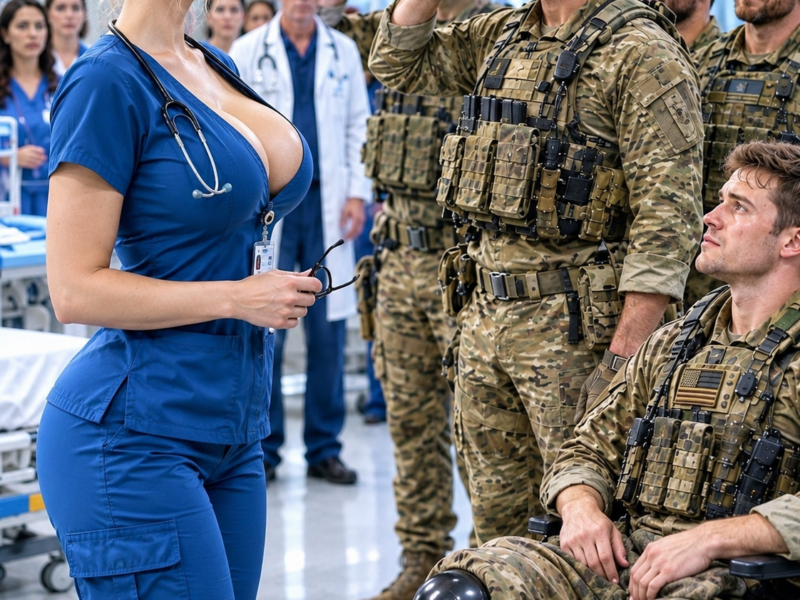
“I spent three years making sure nobody at the hospital knew I had once treated soldiers under enemy fire
The man in the dark suit stopped beneath the emergency department sign.
He didn’t look like a military investigator.
His shoes were too polished, his tie too perfect, and his expression too calm for someone arriving in the middle of a medical emergency.
He glanced at the five soldiers, then at me.
“Emily Carter?”
I didn’t answer.
Tyler moved closer to my side.
“Don’t talk to him.”
The man smiled faintly.
“I’m here to resolve a misunderstanding.”
“Then you can start by identifying yourself,” I said.
He reached inside his jacket.
Every muscle in my body tightened.
“Don’t,” Tyler warned.
The man’s hand paused.
Then he slowly withdrew a leather identification wallet and opened it.
“Graham Cole. Office of Military Personnel Review.”
I examined the card without touching it.
“Which agency?”
“I’m authorized to handle sensitive military matters.”
“That isn’t an answer.”
His smile disappeared.
Behind me, Sergeant Brooks was helping the wounded corporal breathe while another nurse prepared a second stretcher. The emergency department was still functioning, but I could feel everyone’s attention shifting toward the confrontation.
I hated that.
I had spent eleven months building a quiet life where nobody looked at me as though I were someone important.
Now five soldiers had walked through the doors, and the past was standing in front of me.
Cole glanced at Tyler.
“Private Grant. You’ve caused enough trouble.”
Tyler’s jaw tightened.
“You told us Captain Reed was dead.”
“I said he was unavailable.”
“You said he couldn’t be contacted.”
Cole sighed.
“This is not the place.”
“Then why did you come here?”
Cole looked at me again.
“Because Nurse Carter has information that belongs to the military, and we need to recover it.”
I felt my stomach tighten.
“I have no military property.”
“Not according to our records.”
“What records?”
“Your deployment medical logs.”
For a moment, the hospital seemed to grow very quiet.
I hadn’t seen those logs in seven years.
They had been sealed after the incident in Afghanistan. I had been ordered to surrender every copy before leaving the service.
I had done exactly that.
Or so I had believed.
Cole took a step toward me.
“I suggest we speak privately.”
“No,” Tyler said.
Cole turned sharply.
“You don’t get to give orders anymore.”
Tyler didn’t move.
“Neither do you.”
I looked between them.
“Tyler, tell me what’s happening.”
He glanced at the injured corporal.
“Not here.”
“Then stop speaking in riddles.”
His expression softened.
“Emily, the accident wasn’t an accident. Someone tried to kill us before we could reach you.”
I looked at the five soldiers.
“Why?”
Sergeant Brooks answered from behind the stretcher.
“Because we found the original mission file.”
My heartbeat quickened.
“What original mission file?”
“The one from your final deployment.”
I stared at him.
He continued.
“Captain Reed recovered it before he disappeared. It contains the real orders from the night your unit was attacked.”
I felt a familiar pressure behind my ribs.
The night my career ended.
The night I lost someone.
The night I had been told I was responsible for a death.
I turned to Cole.
“Is that why you’re here?”
He didn’t answer.
His silence told me enough.
“Security,” I called.
Cole’s expression hardened.
“You’re making a mistake.”
“I’m asking you to leave until your credentials are verified.”
“You don’t understand what this file contains.”
“Then explain it.”
He leaned closer.
“Some things are better left buried.”
The words struck me harder than they should have.
I had heard them before.
Seven years ago, after the mission review, Captain Reed had stood outside the medical tent and told me that the truth would come out eventually.
I had asked him what truth.
He had looked over his shoulder and said, “Some things are better left buried.”
But his eyes had told a different story.
He had been warning me.
Before I could speak, two hospital security officers entered the department.
“Sir, we need you to come with us,” one said.
Cole raised his identification.
“This is a federal matter.”
“Then you can verify your credentials with hospital administration.”
Cole looked at me one final time.
“You have no idea how many people will suffer if you keep this going.”
I held his gaze.
“Then maybe you should have thought about that before you came after wounded soldiers.”
He was escorted toward the administrative corridor.
The moment he disappeared, Tyler grabbed my wrist.
“Emily, we need to get out of here.”
I pulled free.
“Absolutely not. There are injured men here. I’m not abandoning them.”
“I’m not asking you to abandon them.”
“Then explain.”
He took a breath.
“Captain Reed is alive.”
My hands went cold.
I stared at him.
“That’s impossible.”
“That’s what they wanted everyone to believe.”
“Where is he?”
Tyler looked toward the entrance.
“He was supposed to meet us here.”
“Supposed to?”
“He never arrived.”
I looked at the five soldiers again.
“Why did you come looking for me?”
Sergeant Brooks stepped closer.
“Because the file has your name on it.”
I felt the room tilt.
“What does that mean?”
He lowered his voice.
“It means the official report says you abandoned a wounded soldier and disobeyed a direct order. The original file proves you did the opposite.”
I couldn’t speak.
For seven years, I had carried that accusation like a stone in my chest.
The military had investigated me, questioned me, and eventually removed me from my assignment. I had been allowed to resign, but my record remained stained.
I had never told anyone at Mercy General.
Not even Melissa.
I had simply started over.
Now a stranger was telling me that the one thing I had spent years trying to forget might finally be corrected.
“Who was the wounded soldier?” I asked.
Tyler looked down.
“Corporal Matthew Hayes.”
The name cut through me.
Matthew had been twenty-four. He had been shot during the attack and trapped beneath part of a damaged vehicle.
I had reached him first.
I remembered his blood on my gloves.
I remembered the radio call ordering me to withdraw.
And I remembered refusing.
I had stayed with him until the evacuation team arrived.
The report later claimed that I had disobeyed orders and endangered the entire unit.
It also claimed Matthew had died before extraction.
But I had never believed that part.
I had felt a pulse.
I had heard him speak.
I had watched the evacuation team carry him away.
I looked at Tyler.
“Did Matthew survive?”
Tyler nodded.
“He’s alive.”
For a moment, I couldn’t feel my legs.
“Where is he?”
“He’s one of us.”
I looked toward the soldier with the facial injury.
He had been sitting quietly near the wall, his injured wrist supported by a nurse.
He slowly raised his eyes.
“Hello, Emily.”
I stared at him.
The years had changed his face, but not his eyes.
“Matthew?”
He nodded.
I covered my mouth.
“You were alive.”
“I was.”
“Why didn’t anyone tell me?”
His expression became painful.
“Because the people who wrote the report didn’t want you to know.”
I moved toward him.
He stood carefully, wincing as he did.
I reached for his uninjured arm.
“I thought you died.”
“I know.”
“I saw them take you away.”
“I know.”
“Why didn’t you contact me?”
He looked down.
“Because they told me you were responsible for the attack.”
I stepped back.
“What?”
“They showed me a report saying you had ignored the evacuation order. They said you had caused the delay that led to the ambush.”
“That isn’t true.”
“I know that now.”
His voice broke.
“But for years, I believed it.”
The room seemed to close around us.
I remembered the final night in Afghanistan.
The smoke.
The radio.
The desperate attempt to keep Matthew alive.
I remembered Captain Reed ordering me to leave him.
I remembered refusing.
And I remembered the last thing Matthew had whispered before the evacuation team reached us.
“Tell my brother I tried.”
I had never met his brother.
I had never been able to tell him anything.
Now Matthew was standing in front of me.
“I never forgot you,” I whispered.
He nodded.
“Neither did I.”
Before I could say more, the trauma physician called my name.
“Emily, I need you.”
The wounded corporal’s blood pressure was dropping.
I turned immediately.
“I’m coming.”
For the next forty minutes, there was no past.
There was only the patient.
I helped the physician stabilize his condition, monitored the other injuries, and coordinated with the nursing team as the emergency department filled with activity.
The five soldiers were no longer a mystery.
They were patients.
And they needed us.
When the physician finally confirmed that the corporal was stable enough for further treatment, I stepped into the corridor and leaned against the wall.
My hands were shaking.
Melissa approached with two cups of water.
“You okay?”
I stared at the cup.
“I don’t know.”
She stood beside me.
“You don’t have to explain everything tonight.”
I looked at her.
“I’m sorry I never told you.”
“About what?”
“Who I used to be.”
Melissa gave a small smile.
“Emily, I don’t care what you used to be. I care that you showed up every night and took care of people.”
I looked down.
She continued.
“But I do think you should tell someone what happened. You don’t have to carry it alone.”
Before I could answer, Tyler appeared at the corridor entrance.
“Emily.”
I straightened.
“What?”
“There’s something else.”
I followed him into an empty consultation room.
Sergeant Brooks was waiting there with a small black case.
He placed it on the table.
“This is the original mission file.”
I stared at it.
“Where did you get it?”
“Captain Reed left it with us.”
“What’s inside?”
“Orders, communications, medical records, and a recording from the command vehicle.”
I looked at the case.
“Why didn’t you give it to investigators?”
“We tried.”
He opened the case.
A small encrypted storage device sat inside.
“Two weeks ago, we submitted a copy through the proper channels. Three days later, our vehicle was forced off the road.”
I felt a chill.
“Cole?”
“We believe he arranged it.”
“Why?”
“Because the recording identifies the person who changed our extraction coordinates.”
He pressed a button on the device.
A crackling voice filled the room.
At first, it was difficult to understand.
Then I heard a familiar command.
“Leave the medic. The objective takes priority.”
My blood turned cold.
It was Captain Reed’s voice.
But something was wrong.
The recording continued.
“Repeat, leave the medic. Do not delay extraction.”
I stared at the device.
“That isn’t what happened.”
Sergeant Brooks nodded.
“We know.”
He opened another file.
“This is the full recording.”
A second voice came through.
“Captain, the medic is still with Hayes. We can bring both out.”
Then another voice.
“Negative. We have orders to leave them.”
The recording went silent for a moment.
Then Captain Reed spoke again.
“Those are not my orders. Who authorized this?”
A different man answered.
“Major Cole. Command has approved the revised extraction.”
I felt the air leave my lungs.
The recording continued with the sound of an argument.
Reed demanded confirmation.
The other man refused.
Then came the sound of gunfire.
The recording ended.
I stared at the screen.
“Graham Cole.”
Sergeant Brooks nodded.
“He was a major at the time. He had access to the operation’s communications network.”
“Why would he change the extraction order?”
“Because the mission wasn’t what we were told.”
He explained that the unit had been sent to retrieve an intelligence officer who had discovered illegal weapons transfers involving a private military contractor. The contractor had been moving equipment through a network of unofficial channels.
The intelligence officer had collected evidence.
The mission was supposed to bring him out.
But someone had changed the plan.
The attack had been arranged to destroy the evidence and eliminate the people who knew about it.
Matthew, Tyler, and the others had survived.
Captain Reed had recovered the original communications file.
And I had been blamed because I had refused to abandon Matthew.
“Why did they need my medical logs?” I asked.
Sergeant Brooks looked uncomfortable.
“Because your notes recorded Matthew’s condition when the extraction team arrived.”
I understood immediately.
My medical record proved that Matthew had been alive when I handed him over.
It also proved that I had followed the correct medical procedures and had not delayed the evacuation.
“They changed the report,” I whispered.
“Yes.”
“And Captain Reed?”
“He disappeared after trying to expose it.”
I looked toward the door.
“Where is he now?”
Sergeant Brooks shook his head.
“We don’t know.”
A phone vibrated on the table.
Tyler checked it.
His face changed.
“What is it?” I asked.
He turned the screen toward me.
There was a message from an unknown number.
The original file is only half the evidence. Ask Emily what happened to the second radio.
I stared at the words.
“What second radio?”
Matthew, who had entered quietly, looked at me.
“Do you remember the radio you carried during the evacuation?”
I nodded slowly.
“It was damaged.”
“No,” he said. “It was working.”
I looked at him.
“What?”
“You used it to call for the extraction team. You gave the radio to the officer who arrived.”
I tried to remember.
The chaos.
The shouting.
The blood.
The helicopter.
I remembered handing the radio to someone in a dark uniform.
But I couldn’t remember his face.
“Why does that matter?”
Matthew swallowed.
“Because the second radio recorded the conversation between you and the command center.”
I stared at him.
“Where is it?”
He looked toward the door.
“Captain Reed has it.”
A knock interrupted us.
Melissa opened the consultation room door.
“Emily, there’s someone at the front entrance asking for you.”
My chest tightened.
“Who?”
She hesitated.
“He says his name is Jonathan Reed.”
I was already moving before she finished.
I reached the lobby and stopped.
A man stood near the entrance, leaning on a cane.
His hair was mostly gray. His face was thinner than I remembered. One side of his neck was marked by an old burn scar.
But I recognized him.
Captain Jonathan Reed.
He looked at me for a long moment.
“Emily.”
I couldn’t move.
“You’re alive.”
He gave a tired smile.
“Apparently, I’m getting very good at that.”
I approached slowly.
“Why didn’t you contact me?”
“Because I thought you were being watched.”
“You let me believe I had ruined my career.”
His expression fell.
“I know.”
“You let me believe I had failed Matthew.”
“I know.”
“You let me spend seven years thinking I had done something wrong.”
He lowered his head.
“I am sorry.”
I shook my head.
“That’s not enough.”
“No,” he said quietly. “It isn’t.”
He reached into his jacket and removed a small handheld radio.
The casing was cracked, and the antenna was bent.
“This is the second radio.”
I stared at it.
“The recording is intact?”
“Every word.”
He handed it to me.
I didn’t take it immediately.
“Why now?”
“Because Cole found out the soldiers had the mission file. He knew they were coming here. I realized he would try to destroy the last evidence.”
“Why didn’t you go to the authorities?”
“I did. But the first investigator assigned to the case was connected to Cole. The second disappeared. I needed an independent investigation.”
“Then why bring it here?”
Reed looked at Tyler and Matthew.
“Because these men trusted you.”
I felt anger rising.
“You don’t get to use my trust as a strategy.”
He nodded.
“I know.”
For a moment, I thought I might walk away.
Then I remembered the recording.
I remembered Matthew beneath the wreckage.
I remembered the accusation that had followed me for seven years.
I took the radio.
“Then we’re doing this properly.”
Reed nodded.
“Agreed.”
The hospital administrator contacted the authorities through the independent federal investigation office. Agent Laura Bennett arrived less than an hour later with two investigators.
She examined the mission file and the radio.
Then she listened to the recordings.
Her expression became increasingly serious.
“This is significant,” she said. “But we need to verify the source and preserve the original.”
Reed handed over a signed statement and explained where he had kept the device.
Agent Bennett asked each soldier to provide a separate account.
When she reached me, I told her everything.
I described the original attack, the evacuation order, the condition of Matthew, and the moment I refused to leave him.
I explained how I had handed him to the extraction team and recorded his vital signs.
I described the investigation that followed, the accusations, and my decision to leave the Army.
For the first time in seven years, I told the story without apologizing.
Agent Bennett listened carefully.
When I finished, she closed her notebook.
“Ms. Carter, based on what we’ve heard tonight, your actions appear consistent with your medical responsibilities. The evidence suggests the original report was deliberately altered.”
I swallowed.
“Can you prove it?”
“We’ll need a full investigation. But yes, we now have a credible path to establishing what happened.”
She looked toward the radio.
“And we have evidence identifying the person who issued the false extraction order.”
“Major Cole?”
“Mr. Cole is being detained pending verification of his credentials and the evidence. We also have reason to believe he used his position to interfere with previous investigations.”
I looked toward the emergency department.
“Will the soldiers be safe?”
“We’re arranging protection and secure transportation. Nobody will remove them from this hospital without verified authorization.”
That was the first moment I allowed myself to breathe.
The next morning, the story began to unravel.
Investigators confirmed the recordings were authentic. The transmission logs matched the original mission records. Medical documentation showed that Matthew had been alive when I transferred him to the evacuation team.
They also found evidence that Cole had altered the after-action report and pressured witnesses to support the false version.
His identification at the hospital had been misleading. He had no authority to retrieve the soldiers or seize the evidence.
He was arrested before noon.
The private contractor connected to the weapons transfers was investigated. Several former officials were questioned, and additional evidence was recovered from a storage facility overseas.
Captain Reed’s disappearance was officially reclassified as an attempt to evade a coordinated threat, not an unexplained absence.
And my military record was reopened.
But the most important moment came three days later.
Matthew was preparing to leave the hospital when I walked into his room.
He was dressed in civilian clothes, his wrist supported by a brace.
“You’re leaving?”
“Doctor says I can continue treatment as an outpatient.”
I smiled.
“That’s good.”
He studied me.
“Emily, I need to tell you something.”
I sat beside him.
“Go ahead.”
“After the mission, when I woke up in the military hospital, I asked about you.”
I looked down.
“They told me you had been removed from the unit.”
“They said you were under investigation,” he continued. “They told me not to contact you because it might interfere with the case.”
I nodded slowly.
“I was afraid you’d believe them.”
“I did.”
He looked ashamed.
“I’m sorry.”
I reached for his hand.
“You were injured. You were confused. They lied to both of us.”
He swallowed.
“I also wanted to tell you something about my brother.”
I looked up.
“Your brother?”
“He was the person I asked you to tell that I tried.”
I remembered the words.
“He’s been asking about you,” Matthew said. “He wants to meet the medic who stayed with me.”
My eyes filled.
“I’d like that.”
Matthew smiled.
“Then I’ll arrange it.”
A week later, I met his brother in the hospital cafeteria.
He shook my hand with both of his and thanked me.
I tried to tell him I had only done my job.
He shook his head.
“You did more than your job. You stayed when you could have walked away.”
I didn’t know how to answer.
So I simply nodded.
The investigation took several more months.
The official report was corrected. The false accusations against me were withdrawn, and my military record was formally cleared.
I received a letter from the Army acknowledging the misconduct that had damaged my career.
I read it twice.
Then I placed it in a drawer.
I didn’t need a ceremony.
I didn’t need a medal.
I only needed the truth to stop following me like a shadow.
Captain Reed visited me once before returning to testify in the investigation.
He stood outside the hospital, looking at the rain.
“I should have fought harder for you,” he said.
“Yes,” I answered.
He nodded.
“I can’t change what happened.”
“No.”
“But I can tell the truth now.”
I looked at him.
“Then do that. For everyone who didn’t get the chance.”
He gave a quiet nod.
We shook hands, and he left.
Tyler and the other soldiers sent me a photograph several weeks later.
All five of them stood together outside their rehabilitation center.
Matthew was smiling.
Sergeant Brooks had his arm around Tyler.
The corporal who had nearly died in our emergency department was standing in the middle, looking healthier than I had thought possible.
On the back, they had written:
You saved us twice. Once overseas, and once by refusing to let the truth disappear.
I kept the photograph in my locker.
Life at Mercy General eventually returned to normal.
I still worked the night shift.
I still arrived early.
I still checked medication charts, adjusted blankets, and sat beside frightened patients who needed someone to explain what was happening.
But my coworkers knew more about me now.
Melissa never treated me differently. She simply started bringing an extra coffee when the nights got difficult.
One evening, she found me looking at the photograph.
“Your friends?”
I smiled.
“Something like that.”
She leaned against the counter.
“Do you miss the Army?”
I thought about the question.
I missed the people.
I missed the moments when a team could understand one another without speaking.
I did not miss the fear, the loss, or the feeling that every mistake could cost someone their life.
“Sometimes,” I said. “But I’m where I need to be.”
Near the end of that shift, an ambulance brought in a young soldier who had been injured during training.
He was frightened and kept asking whether he would be okay.
I pulled a chair beside his bed.
“My name is Emily. I’m going to take care of you tonight.”
He looked at my badge.
“Were you ever in the Army?”
I paused.
For eleven months, I would have avoided the question.
This time, I smiled.
“Yes. I was a combat medic.”
His eyes widened.
“Really?”
“Really.”
“Were you scared?”
I considered lying.
Instead, I told him the truth.
“Every time.”
He looked confused.
“Then how did you do it?”
I adjusted his blanket.
“You learn that being brave doesn’t mean you aren’t afraid. It means you keep helping the person in front of you.”
He nodded slowly.
I stayed until his breathing settled.
Later, when the corridor was quiet, I stepped outside into the cool night air.
My phone buzzed.
A message from Tyler appeared.
We heard your record was officially cleared. Took them long enough.
I laughed and typed back.
Take care of your shoulder. And do your exercises.
His reply came immediately.
Yes, ma’am.
I put the phone away and looked up at the hospital windows.
For seven years, I had believed that one terrible night had taken away the person I used to be.
I had thought leaving the Army meant leaving that part of myself behind.
But I finally understood something.
I had never stopped being a medic.
I had simply changed where I stood when someone needed help.
And this time, when the past came looking for me, I didn’t hide.
I faced it.
I told the truth.
And I finally let myself come home.
The end.









