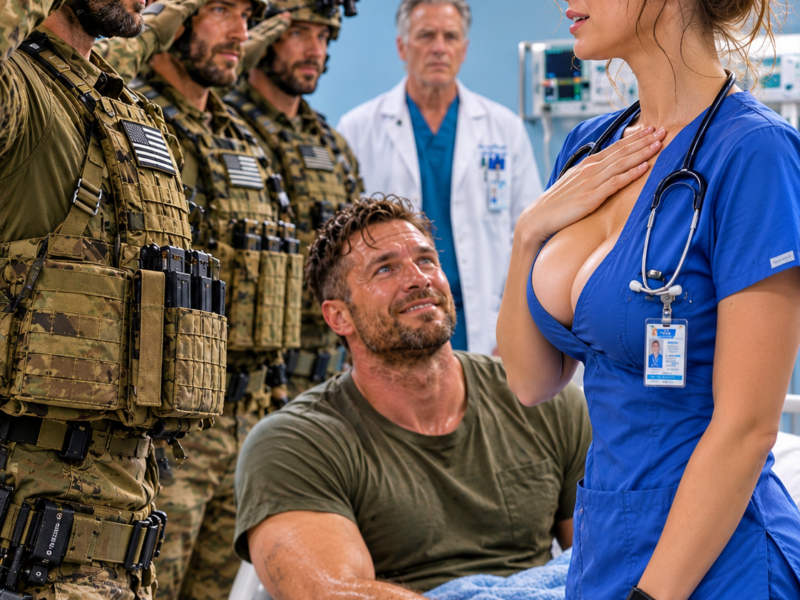
“I donated my rare blood to a dying stranger because the hospital said he had almost no chance of surviving without it
The commander didn’t answer me immediately.
He turned the photograph over again, running his thumb across the handwriting as if he had spent years trying to understand it.
“Your mother’s name was Margaret Bennett,” he said.
I felt the floor shift beneath me.
“Yes.”
“Did she ever tell you about a man named Daniel Brooks?”
I looked through the glass panel toward the hospital room. Daniel was still unconscious, surrounded by monitors and IV lines.
“No. I’ve never heard his name before tonight.”
The commander nodded slowly, but his expression told me he had expected that answer.
“My name is Colonel James Walker,” he said. “And six years ago, your mother gave my team something that saved our lives.”
I stared at him.
“My mother died eleven years ago.”
“I know.”
His voice was quiet, almost apologetic.
“That’s why this is difficult to explain.”
Behind him, the soldiers had stopped talking. Their presence had filled the corridor when they arrived, but now every one of them seemed to be waiting for something.
Colonel Walker gestured toward the empty family consultation room.
“Could we speak somewhere private?”
I glanced at Daniel’s chart, then at the nurse covering his room.
“I’m not leaving him for long.”
“You won’t have to.”
I followed him.
Inside the consultation room, he placed the photograph on the table between us.
There were six men in it, all younger, standing beside a dusty military vehicle. Daniel was near the center, one arm around a soldier whose face had been crossed out with a thick black marker.
I recognized Daniel from the hospital bed, though the man in the photograph looked stronger and considerably younger.
“Who is the man they crossed out?” I asked.
Walker sat down.
“Sergeant First Class Aaron Pike. He was the only member of our team who didn’t make it home.”
I looked again at the photograph.
“I’m sorry.”
“So are we.”
Walker folded his hands.
“Six years ago, our convoy was hit during an operation overseas. We were separated, communications were down, and two of our men were badly wounded. Daniel was our medic. He kept working long after he should have been treated himself.”
“Why would my mother be involved?”
“Because Daniel had a second source of help. Someone outside the military who could get information to him when our own channels failed.”
I shook my head.
“My mother worked in a public library.”
“She did. Before that, she worked as a civilian medical records specialist. She had a talent for finding mistakes people wanted buried.”
I felt a chill travel up my arms.
My mother had always been private about her earlier jobs. When I was younger, she told me she had spent several years working with government contractors, but she never gave details.
After she died, I found a box of old employment papers. Most of them were routine. A few had been marked confidential. I assumed they were outdated paperwork and left them untouched.
Walker continued.
“During the operation, Daniel discovered that the medical supply manifest had been altered. The team had been sent with equipment that didn’t match the mission requirements. The wrong blood products had been listed, the emergency extraction coordinates were outdated, and a request for additional medical supplies had been marked as fulfilled when nothing had arrived.”
“That sounds like an administrative failure.”
“It could have been. Except the same mistakes appeared in several missions. People were getting hurt, and the paperwork kept saying the right supplies had been delivered.”
I thought of the photograph again.
“Daniel found out?”
“He suspected it. He needed someone who could trace the records without alerting the people responsible. Your mother had worked on a contract reviewing medical logistics. She recognized the pattern.”
I stared at him.
“How did he know her?”
Walker took a breath.
“Your mother had helped Daniel before. Years earlier, when he was still a young corpsman, he had been assigned to a medical unit that treated civilians after a roadside explosion. One of the injured children needed a rare blood match. Your mother was working with a civilian donor registry at the time. She helped locate a donor before the child ran out of time.”
“That still doesn’t explain why her name was on the photograph.”
“No. Not yet.”
He opened a thin folder and removed a sealed envelope.
The paper had yellowed around the edges. My name was written across the front in my mother’s handwriting.
Claire.
I knew that handwriting better than my own.
The tall C. The narrow loop in the final e. The small upward slant of the letters.
My hands began to tremble.
“Where did you get this?”
“Daniel gave it to me before the operation. He asked me to keep it safe and find you if he ever failed to return.”
I looked at the date.
Six years ago.
My mother had been dead for five years by then.
I couldn’t make sense of it.
“Why would he have a letter addressed to me?”
“Because your mother wrote it before she died. Daniel was carrying it when we were deployed.”
I touched the envelope but didn’t open it.
“What does it say?”
“I don’t know. Daniel never let me read it.”
I looked up sharply.
“You carried this for six years and never opened it?”
“He made me promise.”
The answer came without hesitation.
I picked up the envelope. It was sealed with a strip of old tape, and the paper beneath it had softened with age.
For a moment, I couldn’t move.
Then I slid my finger beneath the flap.
Inside was a single folded sheet.
My mother’s handwriting filled both sides.
Claire,
If you’re reading this, something has happened that I hoped you would never have to face.
I stopped.
The room seemed to narrow around me.
I read the next line.
There are things I kept from you because I believed keeping you out of them was the only way to keep you safe.
My eyes blurred.
I forced myself to continue.
You know I loved you more than anything. You also know I was not always honest about where I worked or why I left certain jobs. I need you to understand that those decisions were never because I trusted you less.
I turned the page over.
Years ago, I found evidence that someone was changing medical supply records to conceal the diversion of emergency blood products and other lifesaving materials. I reported what I found through the proper channels. Instead of investigating, someone warned me to stop.
I had no idea how far it went until Daniel came to me.
I looked at Walker.
“He knew my mother?”
“He knew what she had discovered.”
I returned to the letter.
Daniel was one of the few people who believed me. He understood what it meant when a unit of blood was missing from a hospital shelf or a medical request was marked complete when it had never been filled. He also understood that the people responsible were not making harmless mistakes.
My mother had underlined the next sentence.
They were choosing who would receive help and who would be left waiting.
I swallowed hard.
The letter continued.
I tried to turn over everything I had. I copied the records I could access and gave Daniel a list of people who might still have original documents. I did not know whether he could use it, but I knew he would not ignore it.
Then came a paragraph that made me put the page down.
There is one thing I need you to know about your blood.
I read it again.
I looked toward the hospital room.
My blood.
The rare donor profile that had brought me into Daniel’s life tonight.
I lifted the page.
When you were born, the doctors discovered that your blood carried an unusual combination of inherited markers. It was rare, but it was not a disease. I was told you might one day be able to help people who had very few compatible donors.
I had always known my blood type was uncommon. I had joined the donor registry during college after a hospital blood drive coordinator explained that my donations could be useful to patients with rare compatibility needs.
But my mother had known more than I did.
She wrote:
I never wanted you to feel that your value came from something inside your body. You are not a resource. You are not a solution to someone else’s problem. You are my daughter, and you have the right to decide what you give and to whom.
I pressed the letter against the table.
For the first time since the soldiers arrived, I understood why Walker had looked at me with such concern.
He wasn’t thanking me only for donating blood.
He was looking at the daughter of a woman who had spent years trying to expose something dangerous.
“Why did Daniel need my name?” I asked.
Walker leaned forward.
“Because the evidence your mother collected disappeared. Daniel believed she had kept a second copy somewhere. He thought you might know where.”
“I don’t.”
“That’s what he told me you might say.”
I looked at the envelope again.
At the bottom of the letter was a sentence I hadn’t noticed.
If Daniel ever comes to you, ask him about the blue ledger. Don’t trust anyone who says it was destroyed.
I read it aloud.
Walker went very still.
“The blue ledger,” he repeated.
“You know what that is?”
“I’ve heard Daniel mention it.”
“What is it?”
“A record of the original shipments. Names, dates, quantities, authorizations. If it still exists, it could show exactly who altered the supply records.”
“Where is it?”
“We don’t know.”
I stared at him.
“Then why would my mother tell me to ask Daniel?”
“Because he may be the only person who knows where she left it.”
A faint alarm sounded from the corridor.
I stood so quickly that my chair scraped the floor.
A nurse appeared in the doorway.
“Claire, he’s awake.”
I hurried back to Daniel’s room.
His eyes were open, but his face was pale and strained. The oxygen tubing shifted slightly as he turned his head.
“Easy,” I said, moving to his bedside. “You’re in the hospital. You’re safe.”
His gaze settled on me.
For a second, he looked confused.
Then his eyes moved to the necklace around my neck.
It was a small silver pendant my mother had given me when I turned eighteen. I wore it every day, rarely thinking about it.
Daniel’s expression changed.
“Claire,” he whispered.
I froze.
“You know me?”
He tried to speak again, but the words caught in his throat.
“Your mother…”
I leaned closer.
“She left me a letter.”
His eyes closed briefly.
“Then she kept her promise.”
“What promise?”
He looked toward the door.
Colonel Walker had followed us into the room. Daniel saw him and gave the smallest nod.
“Tell her,” Daniel whispered.
Walker approached the bed.
“Daniel, you need to rest.”
“No.” Daniel’s voice was weak, but there was determination beneath it. “Not this time.”
I took his hand.
“What happened to my mother?”
Daniel looked at me for a long moment.
“Nothing happened to her because of the records,” he said. “She died before they knew how much she had kept.”
The answer didn’t comfort me.
“Then why did you carry my name for six years?”
He swallowed.
“Because she asked me to find you if the ledger ever became important again.”
“What does that mean?”
Daniel’s eyes shifted to the monitor.
“Someone started looking for it.”
Walker glanced toward the soldiers outside.
“When?”
“Three months ago,” Daniel said. “First they asked about the old contractor files. Then they started contacting people who had worked on the medical supply program.”
“Who?”
Daniel shook his head.
“I don’t know all the names. But I know they found out about the second copy.”
My fingers tightened around his.
“Where is it?”
He looked directly at me.
“Your mother’s house.”
I felt the air leave my lungs.
“My mother’s house was sold years ago.”
“I know.”
“Someone else lives there.”
Daniel’s face tightened.
“Then we need to get there before they do.”
Walker stepped between us.
“Absolutely not. You’re in critical condition.”
Daniel tried to lift his head, then winced.
“I’ve been trying to get that ledger back for six years.”
“And you nearly died getting here,” Walker replied.
Daniel looked at me again.
“Claire, listen carefully. The people who changed those records didn’t just steal supplies. They built a system around making the shortages look legitimate. They made money from contracts, but the worst part was what happened to the people waiting for treatment.”
I thought about the patients I had cared for over the years. The frightened families. The phone calls asking whether a shipment had arrived. The doctors trying to stretch what little they had.
“How many people were hurt?”
Daniel didn’t answer.
He didn’t need to.
A nurse entered to check his blood pressure. Walker stepped aside, but his attention remained fixed on Daniel.
I looked at the letter in my hand.
My mother had known something was wrong. She had tried to stop it. And now, six years after Daniel promised to find me, the secret had come back to the hospital where I worked.
I was still trying to process it when my phone vibrated.
An unknown number.
I almost ignored it.
Then another message appeared.
WE KNOW YOU HAVE THE LETTER.
My stomach dropped.
A second message followed.
DO NOT GO TO YOUR MOTHER’S HOUSE.
I looked at the screen, then at Walker.
He saw my expression.
“What is it?”
I handed him the phone.
He read the messages without speaking.
Daniel tried to turn toward us.
“Did they contact her?”
Walker nodded.
Daniel closed his eyes.
“They’re closer than I thought.”
Walker immediately called one of his men and ordered the hospital security team to be notified. He asked another soldier to stay outside Daniel’s room.
I felt suddenly exposed, as if the walls around us were made of glass.
“Who has my number?” I asked.
“We’ll find out,” Walker said.
But his voice had changed.
He no longer sounded like a commander offering reassurance. He sounded like a man who had just realized the danger was already inside the building.
A hospital administrator arrived minutes later, accompanied by two security officers.
Mark Ellis was responsible for operations at St. Vincent. He was usually calm, polished, and careful with his words.
Tonight, he looked angry.
“Colonel Walker,” he said, “I understand you have military personnel occupying a hospital corridor. I need an explanation.”
Walker didn’t move.
“We’re protecting a patient and a member of the hospital staff.”
“From whom?”
“That’s what we’re trying to establish.”
Ellis looked at me.
“Claire, are you involved in this?”
“I don’t know what you mean.”
His eyes dropped to the letter in my hand.
“Is that what this is about?”
I felt my pulse jump.
Walker noticed it too.
“How do you know about the letter?” he asked.
Ellis gave a thin smile.
“Because I was informed that a member of your team had been asking questions about old medical records.”
“That wasn’t my question.”
The administrator’s expression hardened.
“This hospital has no obligation to cooperate with an unofficial investigation.”
Walker took one step closer.
“No one asked you to.”
Ellis turned toward the security officers.
“I want these men escorted out.”
Neither officer moved.
One of them looked toward the corridor, where the soldiers stood silently.
Then a voice came from behind us.
“Don’t do that.”
It was Daniel.
He had pushed himself upright against the pillows, his breathing shallow.
Ellis stared at him.
For the first time, his confidence disappeared.
“You,” Daniel whispered.
Walker moved toward the bed.
“Stay down.”
Daniel ignored him.
“I remember your name.”
Ellis’s jaw tightened.
“You’re confused.”
“No,” Daniel said. “I remember the authorization stamp on the shipment that never arrived. I remember the report you signed saying the hospital had received it.”
The administrator’s face drained of color.
I looked from one man to the other.
“You know each other?”
Daniel nodded.
“Mark Ellis was a regional logistics coordinator six years ago. He approved the final medical supply report after the convoy was attacked.”
Ellis shook his head.
“That report was reviewed by three departments.”
“And every one of them used the numbers you provided.”
Walker took out his phone.
“I’m recording this conversation.”
Ellis turned toward the door.
“I’m leaving.”
One of the security officers stepped aside, but Walker’s soldier appeared in the doorway.
“Please remain here,” Walker said.
Ellis looked at me again.
“You have no idea what your mother was involved in.”
The words struck harder than I expected.
I stepped forward.
“Then explain it.”
He gave me a cold look.
“Your mother was not the innocent person you think she was.”
For a moment, I couldn’t speak.
Then Daniel said, “Don’t listen to him.”
Ellis reached into his jacket.
Every soldier in the corridor reacted at once.
“Hands where I can see them,” Walker ordered.
Ellis froze.
He slowly withdrew a phone and placed it on the counter.
“I was reaching for my phone.”
Walker took it.
“Then you won’t mind us checking it.”
The administrator’s face tightened.
“You can’t do that.”
“No,” Walker said. “But the authorities can.”
He handed the phone to one of his men and called the hospital’s legal department, asking them to contact federal investigators.
Ellis was escorted to a separate office.
He didn’t resist.
But as he passed me, he leaned close enough for only me to hear.
“Your mother should have left the past alone.”
I watched him disappear around the corner.
For the first time that night, I was afraid not just of what had happened to my mother, but of what she had known about the people around her.
By morning, federal investigators had arrived.
They interviewed Walker, Daniel, the hospital staff, and me. They photographed the letter and made a secure copy of the messages on my phone.
The original remained with me after they documented it.
Daniel was too weak to give a full statement, but he confirmed the basic timeline.
The investigators also found that Ellis had attempted to access Daniel’s patient file shortly after his arrival. His access credentials had been used from a terminal in the administration wing.
He claimed he was checking a transfer request.
The system showed no such request.
By late morning, the hospital had placed him on administrative leave, pending investigation.
I was asked to go home with an escort.
I refused.
“I want to see my mother’s house,” I said.
Walker studied me.
“It’s not safe to go there without a plan.”
“Then make a plan.”
He looked as if he wanted to argue, but Daniel spoke first.
“Let her go.”
Walker turned.
“You’re not in charge here.”
“No,” Daniel said. “But she is the only one who can recognize what her mother left behind.”
I looked at him.
“You’re coming?”
Daniel shook his head.
“I can barely sit up.”
For the first time, he smiled.
“I’m not asking you to carry me. I’m asking you to take the letter.”
Walker arranged for two investigators and a security team to accompany me.
My mother’s old house stood on a quiet street lined with maple trees. It had been sold eight years earlier to a young couple who had renovated the kitchen and painted the front door blue.
I hadn’t been inside since the week after the funeral.
The current owners, a woman named Rebecca and her husband, had been told that investigators needed to inspect a possible storage space. They were understandably confused, but they agreed to cooperate.
Inside, the house smelled faintly of fresh paint and coffee.
I stood in the hallway, staring at the place where my mother used to hang her coat.
I could almost hear her calling me down for dinner.
Rebecca showed us the basement.
“There’s an old storage cabinet behind the furnace,” she said. “We never use it. It came with the house.”
The cabinet was narrow and built into the wall. Its metal door was rusted around the hinges.
I ran my fingers along the frame.
My mother had once told me that the house was full of places where old things could hide. I thought she meant childhood memories.
I looked at the letter again.
The blue ledger.
“Can you open this?” I asked one of the investigators.
He examined the lock and brought over a small tool kit.
A few minutes later, the cabinet door swung open.
Inside were paint cans, old electrical supplies, and a small blue metal box.
My heart began to pound.
The box had no lock.
I lifted the lid.
Inside was a ledger wrapped in a plastic sleeve, a flash drive, and a photograph of my mother standing beside Daniel.
They were both smiling.
Daniel looked barely twenty-five.
My mother looked younger than I remembered her, with her hair pulled back and her sleeves rolled up.
On the back of the photograph, she had written:
For the people who were never counted.
I sat down on the basement steps.
The ledger was real.
The investigator carefully photographed everything before placing the items into evidence bags.
The pages contained shipment numbers, dates, quantities, and handwritten corrections. Some entries had initials beside them. Others had short notes identifying the hospitals and military units affected.
Near the back, one page had been folded over.
I opened it carefully.
There were three names.
Mark Ellis.
A senior procurement officer named Richard Harlan.
And a hospital executive whose name I recognized immediately.
St. Vincent’s chief financial officer, Peter Lang.
I felt sick.
Lang had been one of the people who welcomed me when I started working at the hospital. He had spoken at staff events about patient care and the importance of putting people first.
I looked at the investigator.
“Is this enough?”
“It’s a significant lead,” he said. “But we’ll need to verify the records.”
The flash drive was sent to a secure digital forensics team.
By evening, the first results came back.
The files included scanned invoices, internal emails, and audio recordings. Some documents showed that emergency blood products had been diverted to private distributors, then resold through companies connected to the procurement officer.
Other records showed that the shortages had been concealed by changing delivery confirmations and backdating approvals.
The names in the ledger were not merely mistakes.
They were part of a system.
One email, dated three days before the convoy attack, contained a warning about Daniel’s questions.
Another referred to my mother by name.
The final line read:
If she has retained copies, locate them before Brooks can retrieve anything.
I read it twice.
My mother had known they were looking for her records.
She had hidden the ledger in a place no one would think to search.
And Daniel had carried my name because he believed the people responsible might eventually come looking for it.
The investigation moved quickly after that.
Federal agents searched Ellis’s office and the procurement officer’s home. They recovered additional records, including a deleted email chain that connected Lang to the diversion scheme.
Ellis was arrested two days later.
Harlan was taken into custody the following week.
Lang resigned before investigators could reach his office, but he was stopped at the airport while attempting to board an international flight.
Daniel remained in the hospital.
His recovery was slow. The injuries from the crash were serious, and the blood loss had taken a toll. I visited after every shift, sometimes sitting beside his bed without speaking.
On the fourth day, he asked me to bring the photograph from the blue box.
I placed it on his bedside table.
He studied my mother’s face.
“She was braver than she knew,” he said.
“Why didn’t she tell me?”
Daniel looked at the photograph for a long time.
“She wanted you to have a normal life.”
“She could have trusted me.”
“Maybe. But she was your mother. She thought protecting you meant carrying the fear herself.”
I sat down.
“Did she know she was dying?”
Daniel’s expression changed.
“She knew she was sick. She didn’t know how quickly things would happen.”
I had never understood why my mother had seemed so tired in her final year. She told me it was stress, then blamed the medication, then changed the subject whenever I asked whether she needed help.
Daniel continued.
“She gave me the letter shortly before she died. She asked me to find you only if the evidence became important again. I hoped it never would.”
I looked down at the photograph.
“Did she ever say anything about me?”
He smiled faintly.
“All the time.”
I looked up.
“She said you were stubborn. That you hated being told what to do. That you once tried to fix a broken bird feeder with medical tape.”
I laughed before I could stop myself.
“I was nine.”
“She said you were the kind of person who would keep helping even when nobody was watching.”
My throat tightened.
“That sounds like her.”
Daniel reached for the photograph.
“She was proud of you.”
I turned toward the window because I didn’t want him to see me cry.
A week later, Daniel was strong enough to sit in a wheelchair and attend a formal interview with federal investigators. His testimony confirmed the records and connected the ledger to the altered reports.
The investigation eventually revealed that the diversion scheme had affected more than one hospital and several military medical supply programs. Some shipments had been rerouted for profit. Others had been recorded as delivered when they had never left the warehouse.
The full number of affected patients was still being established.
No one could undo the delays or the suffering.
But the records made it impossible to pretend the shortages had been random.
The case continued for months.
Ellis and Harlan eventually entered guilty pleas. Lang was convicted after investigators recovered messages showing that he had approved payments tied to the false delivery reports.
The court ordered restitution and imposed prison sentences. The hospital also began an independent review of its procurement system.
St. Vincent’s replaced its tracking procedures, expanded its emergency donor coordination, and created a process that allowed clinical staff to report supply discrepancies without going through the administrators responsible for those contracts.
I was asked to participate in the review.
At first, I hesitated.
I was a nurse, not an investigator.
But I remembered the patients who had waited for supplies that never arrived. I remembered how often the staff had been told to make do.
So I agreed.
I also stayed on the donor registry.
The donation that brought Daniel through the worst of his injuries was not a miracle. It was one person helping another because the opportunity was there.
I didn’t want the investigation to turn that simple act into something it wasn’t.
Three months after Daniel arrived at St. Vincent’s, he was discharged.
Before he left, the soldiers returned.
This time, there were no urgent footsteps or anxious faces. They came in civilian clothes, carrying a framed photograph.
It was the same photograph I had seen that first morning.
But the black marker had been removed from Sergeant Aaron Pike’s face.
His name was printed beneath him.
The frame included a small inscription:
For those who brought us home, and those who never stopped looking.
Colonel Walker handed it to me.
“We wanted you to have a copy.”
I looked at the six men.
Daniel stood in the center, smiling.
Aaron Pike stood beside him.
“Thank you,” I said.
Walker shook his head.
“Your mother started this. Daniel kept it alive. You helped bring it into the light.”
Daniel approached slowly, still using a cane.
He held out a small envelope.
“I found this in my personal effects after the crash. I was going to give it to you when I could explain everything.”
Inside was another note from my mother.
It was shorter than the first.
Claire,
If Daniel has found you, it means he kept his promise. I hope you never have to understand why I made him one.
Don’t let what happened to me make you afraid of the world. There are people who take advantage of others, but there are also people who show up when it matters. Be one of those people, but remember you are allowed to let others help you, too.
I love you.
Mom.
I read the note twice.
Then I folded it carefully and placed it in my pocket.
For a long moment, no one spoke.
Finally, Daniel said, “She would have liked seeing you here.”
I looked at him.
“I wish she could have.”
“So do I.”
We stood together near the hospital entrance while the soldiers gathered around us.
I thought about the night Daniel had been wheeled through the emergency doors, pale and barely conscious. I thought about the unit of blood I had given, the photograph, the letter, and the blue ledger hidden behind a furnace in a house I no longer owned.
I had spent years believing my mother had left behind unanswered questions.
Now I understood that she had left behind something else.
A choice.
She had chosen to speak when silence would have been easier. Daniel had chosen to protect the evidence when giving up would have been safer. And when a stranger arrived at my hospital with almost no chance of surviving the night, I had made the choice I knew how to make.
I had helped.
I still don’t know whether my mother imagined that one day her secret would lead me to Daniel. Maybe she only hoped that the truth would matter to someone, someday.
But I keep her letter beside my nursing license now.
Not because I need a reminder of the danger she faced.
Because I need a reminder that even when the people who do the right thing are gone, what they leave behind can still save someone.
THE end.









