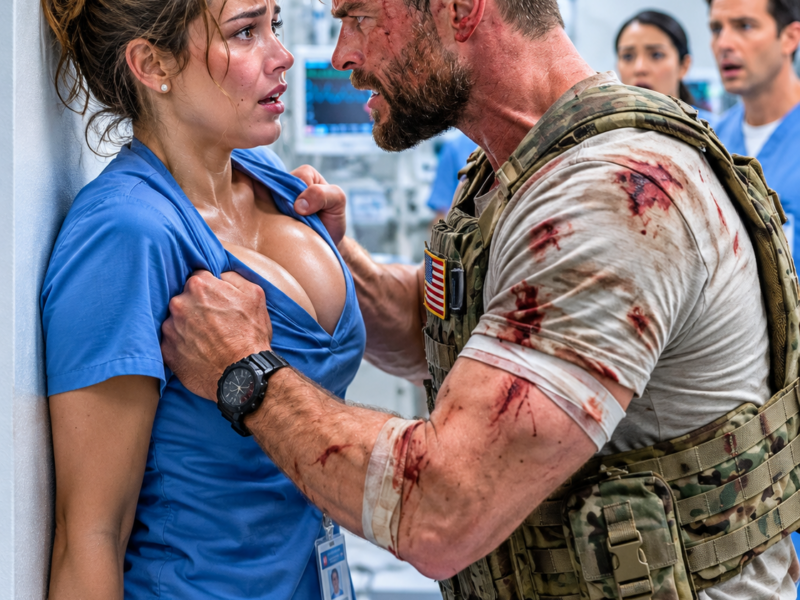
“He called me a filthy sl*t in front of an entire emergency ward, then grabbed my throat hard enough to leave fingerprints
“Emily?”
The voice came from the emergency ward.
It was weak, strained, and unmistakably desperate.
Commander Reed turned toward the open doorway. The two sailors carrying the evidence case stopped behind him.
“He’s awake, sir,” one of them said. “But he’s refusing to let the doctors near him.”
Reed looked at me.
“Stay here until I explain what’s happening.”
I touched the silver necklace beneath my collar.
“Not until you tell me why that man recognized it.”
For several seconds, the commander said nothing.
Then he glanced at Collins and the risk-management officer.
“Because the man who gave you that necklace saved Chief Cole’s life six years ago.”
I stared at him.
“My brother died six years ago.”
“I know.”
The answer came too quickly.
I felt my throat tighten.
“My brother was Petty Officer Daniel Carter. He was a Navy corpsman. He died during a deployment. That’s all my family was ever told.”
Reed’s expression softened.
“Then your family wasn’t told enough.”
He turned to the sailors.
“Take the evidence case to the conference room. Nobody opens it without me.”
Collins stood abruptly.
“Commander, this is a private hospital matter. You cannot simply—”
“Your hospital has already altered a medical record involving an active-duty service member,” Reed interrupted. “I suggest you stop describing this as private.”
Collins’s face lost some color.
Reed looked back at me.
“Come with me. I’ll explain what I can, but first, I need you to see someone.”
I followed him into the hallway.
As we passed the nurses’ station, Denise caught my arm gently.
“Emily, are you sure?”
I looked at the treatment room.
The patient who had called me a slur and put his hand around my throat was lying behind that door.
I wasn’t sure I wanted to see him.
But I needed to understand why my brother’s necklace had frightened him.
“Yes,” I whispered.
Inside the room, Ryan Cole was sitting upright against the raised bed.
His left arm was immobilized. A bandage covered his ribs, and a monitor traced his heartbeat beside him.
Two nurses stood near the medication cart.
When he saw me, his face changed.
Not anger this time.
Recognition.
And something that looked painfully close to shame.
“Emily,” he said.
I stopped several feet from the bed.
“Don’t come any closer.”
He lowered his eyes.
“Okay.”
Commander Reed moved beside him.
“Chief, tell her what you told me.”
Ryan swallowed.
“Your brother’s name was Daniel Carter.”
“Don’t say his name like you knew him.”
“I knew him.”
“Then why didn’t you say that when I first came into the room?”
Ryan looked down at his bandaged arm.
“Because when I saw the necklace, I thought I was back there.”
“Back where?”
He closed his eyes.
“On the deck of a ship that wasn’t supposed to be there.”
Commander Reed pulled a chair toward me.
“Emily, six years ago, a Navy team was operating aboard a support vessel in the North Atlantic. Their assignment was classified, but a rescue operation went wrong.”
I remained standing.
“What does that have to do with Daniel?”
“Your brother was assigned as the team’s corpsman. Ryan was one of the operators.”
Ryan’s voice was barely audible.
“Daniel treated me after an explosion. He stayed with me when the rest of the team was ordered to evacuate.”
I looked at him.
“Why?”
“Because I was bleeding, and he wouldn’t leave.”
“Was he injured?”
Ryan nodded.
“He had a wound in his side. He kept telling everyone it was nothing.”
My fingers curled around the necklace.
That sounded like Daniel.
He had always been the person who said he was fine when everyone else was falling apart.
“What happened to him?”
Neither man answered immediately.
Then Reed said, “The official report stated that your brother died during an equipment transfer after the operation.”
I stared at him.
“That’s what we were told.”
“The report was incomplete.”
Ryan shifted painfully.
“Daniel didn’t die during the transfer.”
I felt the floor seem to move beneath me.
“Then when?”
He looked directly at me.
“He died trying to get us out.”
A nurse stepped closer to check his monitor, but Ryan raised one hand.
“Please. Let me finish.”
Commander Reed nodded.
Ryan took a shallow breath.
“The operation was supposed to be a short extraction. We had a local informant who was helping us identify a weapons shipment. Someone leaked our position. The vessel came under fire before we could move the informant and the team.”
“Why wasn’t that in the report?”
“Because the mission was classified.”
“That doesn’t explain why my family was told he died in an accident.”
Ryan looked at Reed.
The commander answered.
“Because someone wanted the incident recorded as an equipment failure rather than an operational compromise.”
The room became very quiet.
I looked at my brother’s necklace.
“Who?”
Reed didn’t answer.
Instead, he opened the conference-room evidence case that had been brought into the room.
Inside were several sealed envelopes, a small digital storage device, and a photograph.
He removed the photograph first.
It showed three men standing on the deck of a ship.
One was Ryan, younger and thinner.
The second was my brother, wearing a corpsman’s uniform and smiling at the camera.
The third was a man in a Navy officer’s uniform.
I recognized him.
He had been standing beside Commander Reed in the hallway.
“That’s Captain Michael Voss,” Reed said. “He was the officer in charge of the operation.”
I looked from the photograph to the commander.
“Where is he now?”
“Retired.”
“Does he know we’re talking about this?”
Reed’s expression hardened.
“He’s the reason I brought that evidence case here.”
Ryan shifted again.
“Emily, I need you to understand something. When I saw your necklace, I remembered what Daniel told me before he died.”
“What did he say?”
Ryan looked at the small silver pendant.
“He said if anything happened to him, I had to find his sister.”
My eyes burned.
“Why?”
“Because he thought someone might come looking for you.”
I stepped back.
“Looking for me? I was a teenager.”
“I know.”
“Why would anyone care about me?”
Ryan didn’t have an answer.
Commander Reed opened one of the envelopes.
Inside was a folded letter, its edges worn from handling.
He held it out to me.
“Your brother wrote this shortly before the operation.”
I stared at the handwriting.
I knew every curve of those letters.
Daniel had written birthday cards in the same careful script, even when he was exhausted.
My hands began to shake.
I unfolded the page.
The first line read:
Emily, if you’re reading this, something happened that I couldn’t prevent.
I pressed my lips together and continued.
He wrote about ordinary things first.
He reminded me to call our mother more often. He apologized for missing my graduation. He joked that I still owed him money for the concert tickets he’d bought years earlier.
Then the tone changed.
He wrote that he had discovered inconsistencies in the mission orders.
A medical evacuation had been delayed despite an available transport.
The delay had placed several people in danger.
Daniel believed the delay had been deliberate.
He had copied part of the communications log and hidden it somewhere safe.
He didn’t name the person responsible.
But near the bottom, he wrote:
If anyone tells you the operation was simple, don’t believe them. Ryan knows what happened. And if Ryan ever finds you, listen to him before you trust anyone wearing my uniform.
I read the sentence twice.
Then I looked at the wounded man in the bed.
“You knew about this letter?”
Ryan nodded.
“Daniel gave me a copy of the first page. He told me there was another piece of evidence, but he never told me where he put it.”
“Why didn’t you come to us?”
“I tried.”
His voice broke.
“After the operation, I was questioned. My statement was changed. I was told the original records were classified, and I was warned not to contact your family.”
“By whom?”
Ryan looked at the photograph.
“Captain Voss.”
Commander Reed placed a second document on the bed.
“This is why the evidence case matters.”
It was a copy of the original mission log.
Several entries had been highlighted.
One showed that an evacuation request had been received at 0214 hours.
Another showed that authorization had been withheld for nearly forty minutes.
The final entry recorded Daniel’s request for immediate medical extraction.
It had been marked DENIED.
I looked up.
“Who denied it?”
Reed pointed to the signature at the bottom.
Michael Voss.
My stomach tightened.
“You’re saying he left my brother there?”
“I’m saying the record raises serious questions about why the evacuation was delayed,” Reed replied. “We need the original communications file before we can establish the full sequence.”
Ryan stared at his hands.
“Daniel could have left me. He had a chance.”
“Why didn’t he?”
“Because he was a corpsman. He believed nobody should be abandoned.”
I remembered Daniel’s last phone call.
He had been home for three days before deployment, sitting at our kitchen table with a cup of coffee.
He’d asked whether I was still thinking about nursing school.
When I told him I wasn’t sure I could handle seeing people suffer every day, he’d smiled.
“You don’t have to be fearless, Em. You just have to care enough to stay.”
I had thought he was talking about school.
Now I wondered if he had been talking about himself.
A sharp knock interrupted my thoughts.
A hospital security supervisor entered with two officers.
“Commander Reed, administration has requested that all military personnel leave the treatment area.”
Reed didn’t move.
“On whose authority?”
“Mr. Collins.”
I looked toward the doorway.
Collins stood behind the security supervisor.
His expression was no longer merely irritated.
He looked frightened.
“Emily, we need you to come with us,” he said. “There are concerns about your access to restricted patient information.”
I stared at him.
“You mean the information someone entered under my credentials?”
“We’re reviewing that.”
“You suspended me before reviewing anything.”
Collins looked at Reed.
“Commander, this is becoming disruptive.”
Reed stepped between us.
“Then perhaps you should explain why a false statement appeared in her medical record minutes after she was assaulted.”
Collins’s jaw tightened.
“I don’t know anything about a false statement.”
“Good. Then you’ll have no objection to an independent audit.”
The commander turned to one of the sailors.
“Call the base legal office. Tell them we need an immediate preservation order for every record associated with Chief Cole’s admission.”
Collins took a step forward.
“You cannot seize hospital records.”
“We’re not seizing anything. We’re preserving evidence.”
The security supervisor glanced uneasily at the officers.
I noticed something then.
Collins wasn’t looking at Commander Reed.
He was looking at the evidence case.
More specifically, at the small digital device inside it.
When Reed closed the lid, Collins’s eyes followed the movement.
I remembered the access warning on the computer.
RESTRICTED MILITARY CASE.
ACCESS LOGGED.
And I remembered that my false report had appeared under my credentials.
Someone had known exactly where to find the record.
“Mr. Collins,” I said.
He turned toward me.
“Why did you know my login had been used before I reported it?”
His face tightened.
“I didn’t.”
“You told me the record was submitted through my credentials. I hadn’t even told you that was the issue.”
For the first time, he looked directly at me.
Then he glanced at the security supervisor.
“Take her to the administrative office.”
Commander Reed raised his hand.
“Nobody touches her.”
The supervisor stopped.
Collins exhaled sharply.
“This is a hospital, not a military installation.”
“No,” Reed replied. “It’s a hospital where an injured service member was assaulted, a nurse was falsely accused, and evidence connected to a classified operation may have been compromised.”
He opened the case again.
“That makes this more than an internal personnel matter.”
The room fell silent.
Then Ryan spoke.
“Emily.”
I turned.
He was looking at Collins.
“Don’t let him take the necklace.”
My hand went to my collar.
Collins’s eyes flickered.
It was a small reaction.
But Reed saw it.
So did I.
“Why would he want my necklace?” I asked.
Ryan struggled to sit higher.
“Because Daniel put something inside it.”
I looked down at the pendant.
It was a simple silver circle with a tiny anchor engraved on the front.
Daniel had given it to me when I graduated high school.
He’d told me it was a reminder that no matter how far I went, I always had a place to come home to.
I’d worn it almost every day for six years.
I turned it over.
There was a narrow seam along the edge.
I’d never noticed it before.
Commander Reed held out his hand.
“May I?”
I hesitated.
Then I unclasped the necklace and placed it in his palm.
He examined the pendant under the overhead light.
“There’s a recessed latch.”
He used a small tool from his uniform pocket and pressed the edge.
A tiny section of silver shifted.
Inside was a micro-storage chip.
I covered my mouth.
Daniel had hidden evidence inside the necklace.
The object I’d worn through nursing school, my first job, and every difficult day since his death had carried a secret I hadn’t known existed.
Collins moved suddenly.
He reached toward the pendant.
One of the sailors stepped between them.
“Don’t,” Reed said.
Collins stopped.
His face had gone pale.
“That device may contain classified information.”
“Which is why it will be handled under proper chain of custody,” Reed replied.
The commander placed the pendant into a clear evidence pouch.
Then he looked at Collins.
“How did you know it contained anything?”
Collins said nothing.
The answer came from Ryan.
“Because Voss told him.”
Everyone turned toward the bed.
Ryan’s breathing had become shallow, but he continued.
“Voss knew Daniel had copied the communications log. He didn’t know where the copy was. After Daniel died, he told us the evidence had been destroyed.”
Ryan swallowed.
“But Daniel had already told me he was leaving something with his sister.”
Collins shook his head.
“That’s ridiculous.”
“Then why did you try to get the necklace?” I asked.
He looked at me, and for the first time I saw anger beneath his fear.
“You have no idea what you’re involved in.”
“Then explain it.”
He didn’t.
Commander Reed handed the evidence pouch to the sailor.
“Secure it. No one opens it until the legal team arrives.”
Collins took another step backward.
The security supervisor looked between him and Reed.
“Sir, should I contact the police?”
“Yes,” Reed said. “And tell them we may have evidence of record tampering and attempted evidence theft.”
Collins turned toward the hallway.
One of the officers moved to block the door.
“Mr. Collins, please remain here.”
His shoulders dropped.
For a moment, he looked less like a powerful hospital administrator and more like a man who had run out of places to hide.
But there was still one question.
“Where is Captain Voss?” I asked.
Reed’s expression changed.
“We don’t know.”
“Does he know you found the chip?”
The commander looked toward the sailor holding the evidence pouch.
“Now he might.”
A few minutes later, the hospital’s security system was locked down.
The false report was preserved. The access logs were copied. Collins was escorted to a separate office while investigators were contacted.
Dr. Hayes, the attending physician who had treated Ryan, arrived with a medical chart in his hands.
He looked exhausted.
“I need to speak with Commander Reed.”
Reed turned.
“About what?”
Hayes glanced at Ryan, then at me.
“I found an unusual medication order in the chart. It was entered under Emily’s credentials, but the dosage was not appropriate for the patient’s condition.”
My stomach tightened.
“What medication?”
Hayes named it.
I recognized it immediately.
The order could have dangerously lowered Ryan’s blood pressure.
“Did anyone administer it?”
“No,” Hayes said. “I questioned it before it reached the bedside.”
Reed looked toward Collins’s office.
“Preserve that order and every associated access record.”
Hayes nodded.
“I’ve already called the hospital’s compliance officer.”
Ryan closed his eyes.
“Voss doesn’t want the records found.”
I stepped closer to the bed.
“Why would he risk hurting you now?”
Ryan opened his eyes.
“Because I was supposed to die before I remembered.”
The words settled over the room.
I looked at the bruises on his face and the bandages covering his ribs.
For the first time, I understood that the man who had attacked me might also have been terrified of what would happen if he survived.
That didn’t excuse what he’d done.
It didn’t erase the fear I’d felt when his hand closed around my throat.
But it changed the shape of the question I had been asking.
Ryan wasn’t simply a violent patient.
He was a wounded man carrying six years of fear, guilt, and a secret my brother had trusted him to protect.
And now that secret had been found.
The next morning, I was asked to meet with the Navy’s legal representative.
The microchip inside Daniel’s pendant contained a short encrypted file.
It wasn’t the full communications log, but it included timestamps, radio traffic, and a recording of the evacuation request.
The recording was enough to confirm that the mission’s official timeline had been altered.
It also revealed something none of us had expected.
Daniel had been alive for nearly twenty minutes after the first evacuation request was denied.
During those minutes, he repeatedly asked for transport for the wounded.
His final transmission was calm.
He gave the location of the injured men, confirmed their condition, and asked that the team be brought home.
Then the recording ended.
I listened to it twice.
The second time, I couldn’t keep my hands still.
He sounded exactly as I remembered.
Steady. Patient. More concerned about everyone else than himself.
The legal representative explained that the file would be authenticated and compared with the original military records.
There would be no instant public confession, no dramatic arrest in the hospital corridor.
The investigation would take time.
But the evidence could no longer be quietly erased.
Commander Reed found me sitting alone near the hospital chapel.
He sat in the chair across from mine.
“Your brother was a good man,” he said.
I looked at him.
“Why didn’t anyone tell us?”
He lowered his eyes.
“Some people were afraid of what the truth would cost them. Others believed silence was the safest way to protect the people who survived.”
“Did you know?”
“I knew there were inconsistencies. I didn’t know Daniel had left evidence with you.”
I studied his face.
“Did you try to find out?”
“Yes. I requested the original logs more than once. Each request was denied.”
“Then why come here now?”
“Because Ryan remembered your name. And because I finally received information that the original file might still exist.”
He paused.
“I should have found your family sooner.”
I didn’t know what to say.
An apology couldn’t return six years.
But I could see that he meant it.
“What happens to Ryan?”
“His injuries will take time to heal. After that, he’ll be interviewed again, with legal counsel and medical support.”
“Will he be punished for what he did to me?”
Reed didn’t hesitate.
“He will be held accountable for assaulting you. His service record doesn’t excuse it.”
I nodded.
That answer mattered more than I expected.
I didn’t want anyone pretending that Ryan’s suffering made mine irrelevant.
Later that afternoon, I returned to the treatment room.
Ryan was awake, and the medication had helped control his pain.
He watched me approach.
“I heard you’re being cleared,” he said.
“The investigation is still ongoing.”
“But the report against you?”
“Preserved. They’re reviewing who entered it.”
He looked down.
“I’m sorry.”
I pulled a chair beside the bed.
“Do you know what scared me most?”
He shook his head.
“It wasn’t the insult. It wasn’t even when you grabbed me. It was the moment afterward, when I realized everyone was discussing what you said about me instead of what you had done.”
His eyes filled.
“I know.”
“No, I don’t think you do. I was standing there with your fingerprints on my neck, wondering whether I’d lose the job I worked seven years to keep.”
He swallowed.
“I don’t have an excuse.”
“Good. Because I didn’t come here for one.”
I touched the small bandage where the pendant had rested against my skin.
“I came because I want to know what my brother was trying to protect.”
Ryan nodded slowly.
“Then I’ll tell you everything I remember.”
For the next hour, he spoke about Daniel.
Not the mission report version.
The real person.
The man who complained about terrible coffee, kept extra socks in his medical bag, and made everyone sit down when they were injured, even if they insisted they were fine.
He told me Daniel had once spent an entire night repairing a damaged medical kit because he didn’t want the next team to go without supplies.
He told me my brother had laughed when Ryan asked whether he ever got scared.
“Of course I get scared,” Daniel had said. “I just don’t want fear making my decisions for me.”
I looked down at my hands.
I had spent six years remembering Daniel as the person who had died.
Ryan was giving me back the person who had lived.
Before I left, he asked me something.
“Do you think you can forgive me?”
I didn’t answer immediately.
“I don’t know.”
He nodded.
“That’s fair.”
“But I can tell you this. If you want to make things right, tell the truth when they ask you. All of it. Even the parts that make you look bad.”
“I will.”
“And don’t ever put your hands on another nurse.”
He looked directly at me.
“I won’t.”
The following weeks were difficult.
The hospital reinstated me after the initial review found no evidence supporting the accusation against me. The forged report was removed from my personnel file, and the access logs were transferred to investigators.
Collins was placed on administrative leave.
The hospital issued a formal apology, though the words felt small beside what had happened.
I returned to work with a faint mark still visible beneath my jaw.
Denise hugged me when I walked through the emergency department doors.
“You don’t have to prove anything by coming back so soon,” she said.
“I know.”
“Then why are you here?”
I looked toward the ambulance entrance.
“Because this is still where I’m supposed to be.”
She squeezed my hand.
The Navy investigation continued.
The recovered recording was compared with archived communications, and the discrepancies were confirmed. Investigators found that Captain Voss had authorized the delay and later approved changes to the official timeline.
The evidence also showed that he had pressured witnesses to describe the incident as an equipment failure.
Collins’s connection was still being examined, but investigators discovered that he had accessed restricted patient information before Ryan’s arrival and had communicated with a private security contractor linked to Voss.
The medication order entered under my credentials had been created from a terminal in the administrative wing.
It was not an accident.
Ryan gave a formal statement.
He described the mission, Daniel’s actions, and the pressure he’d faced afterward. He also acknowledged his behavior in the emergency room without minimizing it.
His recovery was slow.
Some days he could barely sit up. Other days he argued with physical therapists because he wanted to walk before his body was ready.
When I saw him during one of my shifts, he apologized again.
This time, I believed he understood what the apology was for.
I didn’t become his friend overnight.
Trust doesn’t return just because someone has finally told the truth.
But I stopped seeing him only as the man who had hurt me.
I began to see the person my brother had refused to abandon.
Three months after that Thursday night, Commander Reed called me.
The investigation had reached a formal turning point.
Captain Voss had been relieved of his remaining advisory duties and referred for further military proceedings. The altered mission report was officially corrected, and Daniel’s role in protecting the wounded team was entered into the record.
The Navy also confirmed that Daniel’s family had never received the complete account of his final hours.
Reed asked whether I would attend a small ceremony at the naval station.
I almost said no.
I had spent years avoiding anything that reminded me of the deployment that took my brother away.
But then I remembered the letter.
Emily, if you’re reading this, something happened that I couldn’t prevent.
I told Reed I’d be there.
The ceremony was held in a quiet hall overlooking the harbor.
There were no cameras, no large audience, and no speeches designed to impress anyone.
Just a few officers, the surviving members of the team, and a framed photograph of Daniel in uniform.
Ryan stood near the front.
He was walking with a cane, his left arm still stiff from the injury.
When he saw me, he nodded.
I nodded back.
Commander Reed read the corrected account of the operation.
He described Daniel’s actions, the delayed evacuation, and the evidence that had finally allowed the record to be amended.
Then he presented me with a small folder.
Inside was a copy of the corrected report and a letter acknowledging Daniel’s service.
I ran my fingers over his name.
For six years, his final day had been reduced to a sentence on a piece of paper.
Now the record finally told the truth.
After the ceremony, Ryan approached me.
“I brought something,” he said.
He handed me a small envelope.
Inside was a photograph.
Daniel stood on the deck of the ship, one arm around Ryan’s shoulder, laughing at something outside the frame.
On the back, Daniel had written:
Take care of my people.
I held the photograph against my chest.
“Why did you keep this?”
“Because I couldn’t forget him.”
I looked at Ryan.
“Neither could I.”
He glanced at the necklace.
“Did you have it repaired?”
I nodded.
The jeweler had restored the tiny compartment but left it empty.
I had decided not to hide anything inside it again.
Ryan took a breath.
“I know forgiveness isn’t something I can ask for on a schedule.”
“No,” I said. “It isn’t.”
“But I hope someday you can remember me without remembering that room.”
I looked at the photograph once more.
“Maybe someday. But you’ll have to earn that.”
He nodded.
“I will.”
A year later, I was still working at Harbor Point.
The hospital had changed its procedures for restricted military cases. Staff credentials required additional verification, and any attempt to alter an incident report triggered an independent review.
My brother’s name was no longer buried beneath an incomplete account.
The Navy had begun the process of formally recognizing his actions, and our mother finally received the full record of what happened.
She cried when she read it.
Then she placed Daniel’s photograph beside the one from his high school graduation.
For the first time in years, she spoke about his last deployment without lowering her voice.
Ryan sent a letter every few months.
He never asked me to forget what happened in the emergency room. He wrote about his rehabilitation, the men from his team, and the ways he was trying to live differently.
I answered once.
I told him I hoped he was healing.
That was all I could promise.
I still wear Daniel’s necklace.
Not because it contains a secret anymore, but because it reminds me of the person behind the uniform.
Sometimes, when a patient arrives angry or frightened, I remember that night.
I remember the insult, the hand around my throat, and the silence that followed.
I also remember what happened afterward: a commander who refused to let a false report stand, a wounded man who finally told the truth, and a brother whose last act was to make sure the people he loved would not be forgotten.
I used to think Daniel had left me only a necklace and six years of unanswered questions.
Now I know he left me something harder to carry, and far more important: the truth.
And every time I walk into that emergency room, I carry it with me.
THe End.









