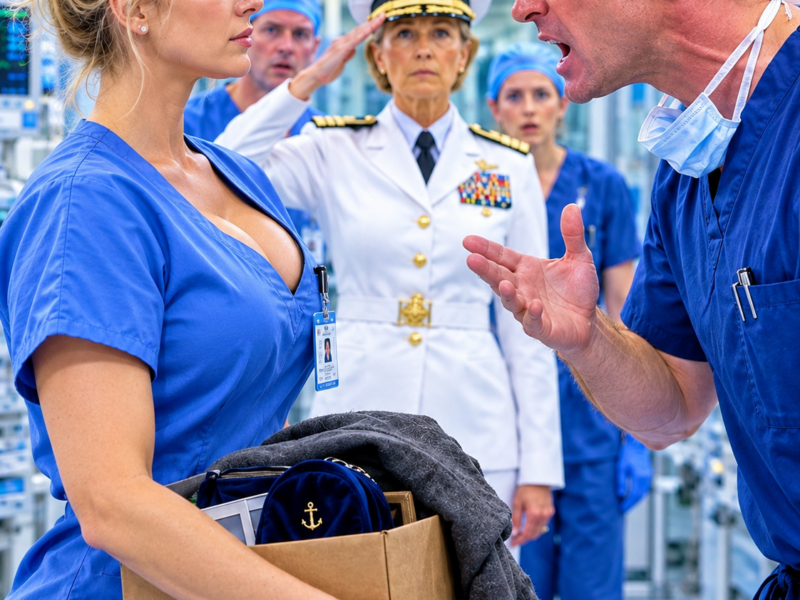
“Get this scrub tech out of my operating room!” Dr. Harrison shouted, ripping the instrument tray from my hands. “You don’t belong here, and I don’t care what story you tell people about your past.”
The first thing I did when I heard Major Daniel Cross’s name was step backward.
For six years, I had trained myself not to react when someone mentioned Operation Iron Harbor. I had learned to keep my expression calm, my voice steady, and my hands busy.
But that name could still bring me to my knees.
“Where is he?” I asked.
Admiral Thomas Bennett glanced toward the intensive care unit.
“Room 412. He’s awake, but his condition is fragile.”
“Does he know I’m here?”
“He asked for you before he would agree to speak to anyone.”
I looked at the hospital badge in the admiral’s hand. Dr. Harrison had taken it from me only minutes earlier.
“I’ve been suspended.”
“I know.”
“Then I shouldn’t be anywhere near the operating rooms.”
The admiral’s expression hardened.
“Rebecca, six years ago, you walked into a burning medical station to retrieve seventeen wounded Marines after your evacuation aircraft was destroyed. You stayed until every living person had been moved. You were awarded the Medal of Honor for that mission, and you nearly died doing it. I don’t care what some arrogant doctor thinks your job title means.”
I looked down.
“I wasn’t trying to be a hero.”
“I know. That’s why I came to find you.”
Before I could answer, Dr. Harrison approached us.
“Admiral, I assure you this is an internal personnel matter. Ms. Hayes has been removed from duty because she interfered with a surgeon.”
Bennett turned slowly.
“Was the Marine alive when she left the operating room?”
Harrison hesitated.
“He was unstable.”
“That’s not what I asked.”
“Yes.”
“Then she may have been the only person in that room who remembered what mattered.”
Harrison’s face reddened.
“With respect, Admiral, this hospital cannot allow technicians to question medical authority.”
“Nor should it allow doctors to confuse authority with infallibility.”
The hallway fell silent.
Bennett handed my badge to a nurse.
“Restore her access while we review the incident. No one is asking her to perform outside her credentials. But she is not to be treated like a criminal for raising a concern.”
Harrison opened his mouth.
The admiral raised one hand.
“Not another word, Doctor.”
Then he looked at me.
“Come with me. There’s something you need to hear.”
I followed him to Room 412.
Major Daniel Cross lay beneath a white blanket. His face was thinner than I remembered, and a long scar ran from his left temple toward his jaw. A monitor tracked his heartbeat.
For a moment, I couldn’t make myself move.
Six years earlier, Daniel had been my commanding officer, my closest friend, and the man who had made me promise that I would never leave a wounded Marine behind.
He had also been the last person I saw before the medical station exploded.
“Rebecca?”
His voice was barely audible.
I approached the bed.
“I’m here.”
He studied my face.
“You cut your hair.”
I let out a small, broken laugh.
“That’s what you noticed?”
“It’s been a long time.”
I pulled a chair closer.
“I thought you were dead.”
“I know.”
“I attended your memorial.”
“I know that too.”
My throat tightened.
“Why didn’t you come back?”
Daniel looked toward the window.
“Because someone made sure I couldn’t.”
The admiral closed the door.
“Major, tell her what you told me.”
Daniel took a slow breath.
“Operation Iron Harbor wasn’t supposed to be an evacuation mission. It was a recovery operation. We were sent to retrieve a communications officer who had discovered that military supply shipments were being diverted through a private contractor.”
I remembered the briefing.
We had been told the officer was carrying classified intelligence and needed immediate medical extraction.
“We were told the area was secure,” I said.
“It wasn’t.”
Daniel nodded.
“The coordinates were changed after our team was already moving. The enemy knew exactly where we would be.”
I stared at him.
“Who changed them?”
“We never had proof at the time. But I found the original transmission after the explosion.”
He looked toward the admiral.
“Tell her about the file.”
Bennett stepped forward.
“Three weeks ago, a military intelligence team recovered a damaged field recorder from a storage facility in Virginia. It contained part of the original mission communication.”
“Why wasn’t I told?”
“Because the recording included a name that changed everything.”
Daniel reached beneath his pillow and pulled out a folded piece of paper.
He handed it to me.
I unfolded it.
The name was written in block letters.
ADMIRAL EDWARD VANCE.
I stared at the page.
Vance had been the senior officer responsible for coordinating the mission. He had attended Daniel’s memorial and personally delivered a commendation to our unit.
He had looked me in the eyes and said that our sacrifice would never be forgotten.
“You’re saying he sent us into that ambush?”
Daniel nodded.
“He authorized the altered coordinates.”
I looked at Bennett.
“Then why is he still serving?”
“Because the original recording was incomplete. It established that someone had ordered the change, but it didn’t prove who had given the final instruction. Vance denied everything.”
“And now?”
“Now we have you.”
I frowned.
“Me?”
Daniel shifted painfully.
“You were wearing a body camera during the evacuation.”
I felt the room tilt.
“No. That camera was destroyed.”
“Your camera was damaged, not destroyed. I recovered its storage module before the medical station collapsed.”
I stared at him.
“You had it all this time?”
“I hid it because I knew what was on it.”
“What was on it?”
Daniel looked directly at me.
“The order to leave us behind.”
For six years, I had believed the worst moment of my life was watching the medical station burn.
Now I understood there had been another moment—one I had never seen.
A moment someone had deliberately kept from me.
“Where is the module?”
Daniel’s eyes moved to the admiral.
“It’s not here.”
Bennett nodded.
“We believe it was taken from the secure evidence room at the naval base last night.”
“By whom?”
“We’re investigating.”
I stood.
“Then we need to find it.”
Daniel reached for my wrist.
“Rebecca, wait.”
I looked down at him.
“There’s something else.”
His voice became quieter.
“The man who took it knew where it was hidden because someone from this hospital told him.”
I thought of Dr. Harrison.
His sudden anger. His insistence that I leave the operating room. The way he had watched me after the admiral arrived.
“Who?”
Daniel swallowed.
“Dr. Harrison.”
I couldn’t speak.
The admiral’s expression hardened.
“We’ve been looking into him since this morning. His credentials were used to access a restricted medical file connected to the original mission.”
“Why would a hospital doctor be involved in a military operation?”
“Because Harrison wasn’t always a hospital doctor,” Bennett replied. “Before he joined St. Matthew’s, he worked as a medical consultant for the contractor involved in Iron Harbor.”
I remembered Harrison’s face when I mentioned the patient’s condition.
He hadn’t simply been annoyed.
He had been afraid.
“Where is he now?” I asked.
The admiral checked his phone.
“Security says he left the building twelve minutes ago.”
I looked toward the door.
“Then he has the evidence.”
Bennett shook his head.
“Not necessarily. We have agents following him.”
Daniel tightened his grip on my wrist.
“Don’t go after him alone.”
“I won’t.”
“Promise me.”
I hesitated.
Then I nodded.
“I promise.”
But I knew one thing.
I was not going to let another person disappear because someone powerful had decided their life was inconvenient.
The admiral arranged for me to speak with a federal investigator, Special Agent Laura Mitchell. She arrived at the hospital less than half an hour later, carrying a folder and a small recording device.
She listened while I explained what Daniel had told me.
When I finished, she asked a question I hadn’t expected.
“Ms. Hayes, do you remember the last words spoken over your team’s radio before the explosion?”
I closed my eyes.
The memory came back in pieces.
A warning.
A burst of static.
Then a voice.
“Medical team is expendable. Complete the recovery.”
I opened my eyes.
“I remember.”
Agent Mitchell wrote something down.
“Was that General Vance’s voice?”
“I couldn’t tell. The transmission was distorted.”
She nodded.
“We believe the missing camera module contains a clearer recording.”
“Then what are we waiting for?”
“We need to find Harrison first.”
She turned the folder around.
Inside was a photograph of Dr. Harrison entering a parking garage. A man in a dark jacket was waiting beside a black vehicle.
“Who is that?” I asked.
“His name is Peter Lang. He worked for the private contractor that managed the Iron Harbor supply operation.”
I recognized him.
He had been in the background of our original mission briefing.
I had never known his name.
“Why would Harrison meet him?”
“Because Lang has been moving money through several companies linked to the contractor. We believe Harrison has been helping him obtain medical records and military patient information.”
My stomach tightened.
“Was the Marine I operated on involved?”
“Sergeant Torres?”
I nodded.
“He was carrying a storage device when he was wounded. We believe Lang’s men were trying to recover it.”
The black envelope.
The date.
The name Daniel had given me.
Everything was connected.
Agent Mitchell stood.
“We’re going to Lang’s last known location. I want you to remain here.”
I shook my head.
“Daniel told me Harrison knows where the camera module is.”
“And we’ll question him.”
“He won’t tell you anything unless he believes he can control the situation.”
Agent Mitchell looked at me carefully.
“You’re not a law enforcement officer.”
“No. I’m a nurse.”
“And a decorated service member.”
“That’s not why I’m asking to come.”
“Then why?”
I glanced toward Room 412.
“Because Daniel has waited six years to tell me the truth. I’m not going to let someone silence him again.”
She considered my answer.
“Fine. You can accompany us to the facility, but you will stay with the agents. No weapons, no independent action.”
“Understood.”
The address led us to a private medical storage center on the outskirts of Arlington.
It was a plain building with tinted windows and a security gate. The sign outside advertised medical records management and equipment storage.
Two federal vehicles parked near the entrance.
Agent Mitchell approached the security desk with her credentials.
I followed her inside.
A receptionist looked up.
“Can I help you?”
“Peter Lang,” Mitchell said. “We need to know whether he is on the premises.”
The receptionist glanced at the computer.
“I can’t disclose client information.”
Mitchell showed her the warrant.
The receptionist’s expression changed.
“He’s in the lower storage area.”
We took the elevator down.
The doors opened onto a corridor lined with numbered metal units.
At the far end, Dr. Harrison stood beside a rolling cart.
He looked up.
For a second, his face showed pure surprise.
Then anger.
“You shouldn’t be here, Rebecca.”
Agent Mitchell stepped forward.
“Dr. Harrison, you’re being questioned in connection with the theft of classified evidence and the unauthorized access of military medical records.”
Harrison laughed nervously.
“This is ridiculous.”
“Where is Peter Lang?”
“I don’t know.”
A door opened behind him.
Lang stepped out holding a small black case.
He looked at the agents, then at me.
“That’s her,” he said.
Harrison turned.
“What?”
“The woman from Iron Harbor.”
I felt every muscle in my body tighten.
Lang opened the case.
Inside was a small metal storage module.
My camera module.
For six years, I had believed it was lost in the fire.
Now it was sitting in front of me.
“Give it to the agents,” I said.
Lang smiled.
“You have no idea what’s on here.”
“I know enough.”
“No, you don’t. You think this is about one bad order? It was about protecting a national security operation.”
“By abandoning wounded Marines?”
“By preventing a much larger disaster.”
Agent Mitchell stepped closer.
“Put the case down.”
Lang looked at Harrison.
The doctor shook his head.
“Don’t.”
For a moment, I thought Lang might surrender.
Then he grabbed the cart and shoved it toward the agents.
Metal equipment crashed across the floor.
The agents moved in.
Harrison tried to run toward the elevator, but an officer caught him before he reached the doors.
Lang dropped the case and raised his hands.
“Don’t shoot!”
Mitchell secured the module.
“It’s over.”
I stared at the small device.
It was scratched and burned, but intact.
“Is it working?” I asked.
“We’ll find out.”
Lang looked at me.
“You should have stayed a scrub tech.”
I stepped closer.
“I was doing my job.”
He gave a bitter smile.
“You don’t know what your job cost.”
I thought about the seventeen wounded Marines.
The ones who had survived because we refused to leave them behind.
I thought about the families who had spent years believing their loved ones were dead.
Then I looked at him.
“I know exactly what it cost.”
The module was taken to a federal laboratory for recovery.
We waited several hours while technicians extracted the files.
By midnight, Agent Mitchell called me into a secure conference room.
The admiral was there.
Daniel had been transported from the hospital under medical supervision, and he sat in a wheelchair near the wall.
On the screen was a video file.
My body camera.
I couldn’t look away.
The footage showed the medical station under attack. Smoke drifted through the corridor. A Marine was being carried toward the evacuation point.
Then the radio crackled.
“Medical team, prepare for extraction.”
A second voice interrupted.
“Negative. No extraction. The recovery objective takes priority.”
The camera shifted.
A man stood near the communications table, speaking into a handset.
General Edward Vance.
His voice was clear.
“Leave the medical team in place. If they survive, they will compromise the operation.”
I felt my hands go cold.
The footage continued.
Daniel stepped into the frame.
“Sir, there are wounded personnel here. We cannot leave them.”
Vance turned toward him.
“That’s an order, Major.”
Daniel looked toward the camera.
Then he said something I had never forgotten.
“Then I refuse.”
The video ended with a burst of static.
No one spoke.
I stared at the screen.
Daniel lowered his head.
“I should have told you sooner.”
I turned toward him.
“You were injured. You were hiding. You had no way of knowing who you could trust.”
“I still left you with the guilt.”
“You didn’t leave me anything. They did.”
Agent Mitchell closed the file.
“This recording establishes direct authorization. We have enough to proceed.”
The admiral stood.
“Then we proceed.”
The next morning, General Vance was arrested at his residence.
The investigation uncovered a network of falsified supply records, diverted medical equipment, and payments to private contractors. The original mission had been designed to recover evidence of the operation. When the medical team discovered what was happening, Vance had ordered them abandoned.
Harrison had later joined the hospital to gain access to military medical records and identify anyone who might still possess evidence.
He had recognized me months earlier.
He had not fired me because I was incompetent.
He had tried to remove me because I was a witness.
The hospital opened its own investigation. Dr. Harrison was dismissed and later charged for his role in the cover-up.
The Marine I had treated, Sergeant Torres, survived his surgery. His recovery was slow, but he was eventually able to walk again.
When I visited him, he held out a small envelope.
“What’s this?” I asked.
“Something I was told to give you.”
Inside was a photograph.
It showed the seventeen Marines from Iron Harbor standing together in front of a transport aircraft.
Daniel was in the center.
I stood beside him, younger and smiling, wearing my old uniform.
On the back, someone had written:
WE CAME HOME BECAUSE YOU DIDN’T LEAVE.
I read it twice.
Then I sat beside Torres.
“Thank you,” I whispered.
He shook his head.
“No, ma’am. Thank you.”
Three months later, the military held a formal ceremony at the base.
The surviving members of Iron Harbor were invited. Families came from across the country. Some had waited six years for confirmation that their loved ones had survived.
Admiral Bennett stood at the podium.
He spoke about courage, duty, and the responsibility leaders carried when others placed their lives in their hands.
Then he called my name.
“Rebecca Hayes.”
I walked onto the stage.
The admiral held out a small case.
Inside was my Medal of Honor.
I had not worn it since the ceremony six years earlier. I had kept it locked away because every time I looked at it, I remembered the people who hadn’t made it home.
Bennett pinned it to my jacket.
“You earned this,” he said quietly.
I looked at the medal.
“I didn’t do it alone.”
“I know.”
He turned toward the audience.
“Ladies and gentlemen, this woman saved seventeen wounded Marines during Operation Iron Harbor. She did so after receiving an order that would have left them behind. She chose the lives in front of her over the comfort of obedience.”
The audience stood.
I heard applause, but I barely registered it.
I was looking at Daniel.
He was standing beside the front row, supported by a cane.
When our eyes met, he smiled.
For the first time in six years, I smiled back without feeling the weight of the explosion.
After the ceremony, Daniel found me outside.
“You still hate these events?” he asked.
“More than ever.”
He laughed.
Then he looked at the medal.
“You should wear it.”
“I don’t want people to think I’m asking for attention.”
“Then don’t wear it for them.”
He nodded toward the medal.
“Wear it for the seventeen people who came home.”
I looked at the photograph in my hand.
The faces were older in my memory now. Some had scars. Some had gray hair. But they were alive.
“I spent six years thinking I had failed you,” I said.
Daniel shook his head.
“You didn’t fail us, Rebecca. We failed you by letting you carry that guilt alone.”
I looked toward the ceremony hall.
“Do you think I’ll ever stop remembering?”
“No,” he said. “But maybe one day you’ll remember the people who survived before you remember the ones you lost.”
I thought about that for a long time.
Then I touched the medal.
“Maybe.”
The following Monday, I returned to Arlington Military Medical Center.
My suspension had been officially withdrawn. The hospital had issued a written apology and changed its emergency review procedures so that staff could raise immediate patient-safety concerns without fear of retaliation.
At the nurses’ station, Olivia handed me a fresh badge.
“Welcome back, Becky.”
I smiled.
“Thank you.”
Then I walked toward the operating rooms.
Dr. Harrison’s name had been removed from the schedule. A new attending surgeon was leading the trauma team.
A Marine was being prepared for surgery.
I washed my hands, checked the instrument trays, and took my place beside the operating table.
The surgeon looked at me.
“Ready?”
I nodded.
“Ready.”
The monitor beeped steadily.
The patient was alive.
And that was what mattered.
I no longer needed everyone in the hospital to know who I had been. I didn’t need a salute or a medal to remind me why I had chosen this work.
I was Rebecca Hayes.
A nurse.
A scrub tech.
A woman who had once been a commander.
And I had learned that titles could change, uniforms could disappear, and medals could spend years locked in a box.
But the promise behind them never had to.
No one would be left behind.
THE end.









