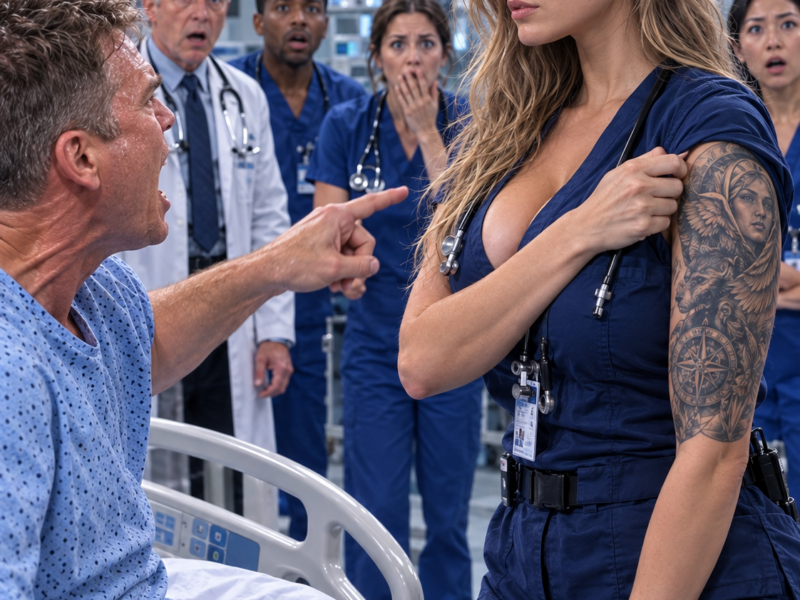
“‘GET SOMEONE ELSE!’ the wounded Marine screamed, ripping the oxygen mask from his face as three doctors failed to calm him
For twelve years, I had carried my brother’s death like a locked room inside my chest. I knew the date he died, the last words he said to me, and the name of the operation that took him away. What I had never known was why the man lying in front of me looked at my brother’s name as if it were a sentence he had been serving every day since.
Sergeant First Class Daniel Brooks sat rigidly against the raised hospital bed, his hands trembling beneath the thin blanket. The monitors beside him continued their steady rhythm, but his breathing came in short, uneven bursts. His eyes were fixed on the faded blue flower tattoo on my wrist.
“Tell me,” I whispered. “What happened to Michael?”
Brooks swallowed. For a moment, I thought he would refuse to speak. Then he closed his eyes.
“We were supposed to bring seven men home.”
The words struck me harder than I expected.
Michael had been twenty-four when he died. He had enlisted young, convinced that serving meant protecting people who had no one else to protect them. When he called me before his final deployment, he joked about the food, complained about his boots, and promised he would be home in time for my birthday.
He never made it.
The official report said his unit had come under heavy enemy fire during a recovery mission. Michael had been killed while attempting to move a wounded teammate to cover. His death had been classified as a combat loss, and the surviving personnel had been commended for their actions.
For years, I had tried to be grateful that someone had survived.
Now one of those survivors was looking at me as though gratitude was the one thing he could no longer bear.
“Seven men,” I repeated. “What do you mean?”
Brooks rubbed his palms against the blanket.
“There were seven of us in the patrol. Michael was the youngest. He was our medic, and he was better at his job than men twice his age. He remembered everybody’s allergies, everybody’s family names. He carried extra letters for guys who couldn’t write home without getting angry.”
A painful smile touched his mouth.
“He used to say that if he could get a man breathing again, he could give him enough time to figure out the rest of his life.”
My throat tightened. That sounded exactly like Michael.
“He talked about you all the time,” Brooks continued. “His big sister. The nurse. He said you were the reason he joined up.”
I looked away.
I had never wanted Michael to follow me into military medicine. I had wanted him to finish college, fall in love, buy a house with a crooked fence, and complain about ordinary things. But when he told me he had enlisted, I knew I couldn’t ask him to abandon the person he wanted to become.
“What happened that day?” I asked.
Brooks’s jaw tightened.
“We were moving through a village when the first blast hit. The vehicle behind us went up. We lost communications, and two men were injured immediately. Michael was treating one of them when the second attack came.”
His fingers curled into the blanket.
“I got hit by debris. My leg was badly damaged. I couldn’t stand, but I could still move enough to get behind a wall. Michael came back for me.”
“Was he injured?”
“Yes. Shrapnel in his side. He should have been the one getting treated. Instead, he dragged me across the road while rounds were hitting the buildings around us.”
I forced myself to breathe.
“Why wasn’t he evacuated?”
“He tried to call for extraction. The radio was damaged, and our backup unit was pinned down. We had a narrow window to get the wounded out before the enemy closed the road.”
Brooks stopped and looked at me.
“I was the senior man still able to make decisions. I gave the order to move the others toward the pickup point. Michael refused to leave me.”
“Of course he did,” I said, my voice barely audible.
“He told me he wasn’t leaving another brother behind.”
The room seemed to shrink around us.
Brooks looked down at his hands as if he could still see the dust and blood beneath his fingernails.
“I told him to go. I told him that was an order. He looked straight at me and said, ‘Then write me up when we get home.’”
A broken laugh escaped him, then disappeared.
“That was Michael. He could be scared out of his mind and still find a way to make somebody else smile.”
I pressed my lips together to keep them from trembling.
“What happened next?”
“The road was blocked. We had to take cover inside a damaged building. One of the men had a chest wound, and Michael was working on him. I was losing blood. I remember him pressing a dressing against my leg and telling me to keep talking to him.”
Brooks’s gaze became distant.
“Then the building took another hit.”
He flinched so violently that the monitor beside him registered the change.
I instinctively stepped closer, but stopped when he raised one hand.
“Please,” he whispered. “Give me a second.”
I stayed where I was.
He took several shallow breaths before continuing.
“When the dust settled, part of the ceiling had collapsed. Michael was trapped beneath a support beam. He was conscious, but he couldn’t get free. I tried to move the beam. I tried until my hands were bleeding.”
His voice cracked.
“He kept telling me to stop because I was making my own injury worse. Can you imagine that? He was pinned beneath half a building, and he was worried about me.”
Tears blurred my vision.
“What did he say?”
Brooks stared at the wall.
“He asked me to tell you something.”
My heart seemed to stop.
“What?”
“He said, ‘Tell Rebecca I kept my promise.’”
I gripped the edge of the bedside table.
“What promise?”
Brooks looked at my wrist again.
“The tattoo. The flower and the seven dots.”
I could no longer feel my fingers.
Michael and I had designed those tattoos when we were teenagers. The forget-me-not was our reminder that distance did not erase love. The seven dots represented the seven people we had promised never to abandon, a pact we had made with our closest friends after one of them nearly died in a car accident.
Over the years, life scattered us. Some joined the military. Some moved away. One died in an accident. But Michael had kept the tattoo, and so had I.
I had never known he had shown it to his squad.
“He told us about the promise before we deployed,” Brooks said. “He made every one of us touch the tattoo on his wrist and swear that we would get each other home.”
His eyes filled again.
“We joked about it. Called it the stupidest oath we’d ever heard. But we made the promise.”
“And you couldn’t keep it,” I whispered.
Brooks absorbed the words without flinching.
“No,” he said. “I couldn’t.”
For a moment, anger rose inside me, hot and sharp. Twelve years of unanswered questions seemed to gather in that single space between us.
“You were the senior man. You gave the orders. You came home.”
“Yes.”
“And my brother didn’t.”
“No.”
“Why?”
The question came out harsher than I intended, but I couldn’t take it back.
Brooks did not defend himself.
“Because Michael made a choice, and I let him make it.”
I stared at him.
“He chose to stay behind?”
“He chose to keep treating a wounded soldier when he should have been moving toward the extraction point. He chose to come back for me. He chose to stay with the others when we had a chance to move.”
Brooks’s voice grew quieter.
“And when the beam trapped him, he ordered me to leave.”
I shook my head.
“Then why are you blaming yourself?”
“Because I was the one who left.”
He said it so plainly that I had no answer.
“I couldn’t move the beam. My leg was useless. The building was still coming apart, and the enemy was closing in. Michael knew we had seconds before the exit was cut off. He made me promise to take the others out.”
Brooks wiped his face with the back of his hand.
“He said if I stayed, two men would die instead of one. He told me to look after the rest of the team. Then he said, ‘Go home, Sergeant. Tell my sister I wasn’t afraid.’”
I covered my mouth.
“I fought him,” Brooks continued. “I told him we would get him out. He looked at me and said, ‘You don’t get to promise what you can’t control.’”
The words settled between us, heavy with the weight of twelve years.
“I left him there,” Brooks whispered. “I carried two men to the pickup point. I came back with the recovery team when it was safe, but the building had collapsed completely. We found him beneath the rubble.”
He closed his eyes.
“He was still holding his medical bag.”
A sob escaped me before I could stop it.
I had imagined Michael’s last moments a thousand times. I had imagined him alone, frightened, calling for someone who never came. I had imagined that he might have felt abandoned.
I had never imagined him spending his final minutes trying to make sure other people survived.
“Why didn’t anyone tell us?” I asked.
Brooks opened his eyes.
“The report said he died while treating the wounded. That part was true. The rest was buried in the operational review. There were questions about the extraction decision, about the radio failure, about whether the patrol had been sent into a situation it couldn’t safely manage.”
He took a breath.
“I was interviewed for weeks. I told them exactly what happened. I told them Michael had ordered me to leave. I told them I had done everything I could to get him out.”
“Then why did you say you couldn’t save him?”
“Because I survived.”
He looked at me, and for the first time I understood the depth of his shame.
“I kept thinking that if I had been stronger, faster, less injured, I could have moved that beam. If I had made a different call, maybe we could have reached the road sooner. Maybe I could have found another way.”
He swallowed hard.
“I know what the report says. I know what the investigators concluded. But every night, I hear him telling me to go. And every night, I wonder whether I left too soon.”
I wanted to hate him. A part of me still did. It was easier to imagine that someone had failed Michael than to accept that sometimes a person could do everything possible and still lose the person he was trying to save.
But I also saw the man in the bed before me.
His body had been injured again, but the terror that had made him scream at the doctors was not only physical. The sound of equipment, the pressure of hands trying to hold him still, the sudden commands from strangers—each had dragged him back to the building where he had left my brother.
He had not been refusing help because he wanted to die.
He had been afraid that accepting help meant he was abandoning Michael all over again.
“Is that why you wouldn’t let the doctors touch you?” I asked.
Brooks nodded.
“When they held my shoulders down to examine the wound, I couldn’t breathe. I could hear the building coming down. I could feel the dust in my mouth. I knew I was in a hospital, but I couldn’t make myself believe it.”
His eyes lowered.
“I thought if I closed my eyes, I’d see him again. And if I saw him, I’d have to leave him again.”
I moved a chair beside the bed.
“Daniel, look at me.”
He did, reluctantly.
“You are not back in that building. You’re in a hospital. You’re injured, and people are trying to help you. Nobody is asking you to leave Michael behind.”
His expression crumpled.
“I don’t know how to stop feeling like I did.”
“I don’t know if you can stop feeling it all at once,” I said honestly. “But you don’t have to keep punishing yourself to prove you loved him.”
He stared at me for a long time.
“Can you forgive me?”
The question hurt more than I expected.
I thought of Michael’s last letter, folded inside a box in my apartment. I thought of the way he signed every message with the same ridiculous joke. I thought of the empty chair at family dinners, the birthdays when I could barely speak, and the years I had spent wondering whether someone had failed him.
“I can’t give you an answer just because you need one,” I said.
Brooks nodded, tears running down his cheeks.
“I understand.”
“But I can tell you this,” I continued. “Michael’s last choice wasn’t about leaving you. It was about giving you a chance to live. If I turn that into a reason to hate you, I make his choice smaller than it was.”
Brooks pressed both hands over his face.
For the first time since I had entered the room, he cried without trying to hide it.
I stayed beside him.
When his breathing steadied, I called the attending physician and explained what had happened. We agreed that any necessary procedures would be explained to Brooks before they began, and that no one would restrain him unless there was an immediate medical necessity. A trauma specialist was contacted to help him manage the memories that kept pulling him back into the past.
I could care for his injuries. I could listen. I could help him feel safe enough to accept treatment.
But I couldn’t heal twelve years of guilt in one night.
And I couldn’t pretend that learning the truth had erased my grief.
Before I left the room, Brooks called my name.
“Rebecca?”
I turned.
“There was something else Michael asked me to tell you.”
I felt my chest tighten again.
“What?”
“He said he was sorry about your last phone call.”
The room went silent.
I had never told anyone how our last conversation ended.
Michael had called me two nights before his death. I was exhausted after a long shift, frustrated with the world, and angry that my little brother had once again tried to reassure me instead of admitting he was scared. I told him I was tired of pretending everything was fine. I told him he had chosen this life, and I couldn’t keep worrying about him every day.
He went quiet.
Then he said, “I know, Becca. I’ll call you when I get back.”
I told him I had to go.
I never got to call him back.
For twelve years, that conversation had been the one memory I couldn’t forgive myself for.
“How would you know that?” I whispered.
Brooks shook his head.
“Michael told us about it that night. He said he thought you’d been angry with him. We told him you were his sister and that you were allowed to be angry. He said he knew, but he wanted to hear your voice one more time.”
I gripped the chair so hard my fingers hurt.
“He wasn’t angry with you,” Brooks said. “He told me that before the building came down. He said he knew you loved him. He said he was sorry he hadn’t made it easier for you to love him from a distance.”
My knees weakened, and I sat down.
For years, I had believed that the last thing Michael carried from me was disappointment. Now I was hearing that he had carried my love with him, even when I had been too tired and frightened to say it properly.
I bent forward and cried into my hands.
Brooks didn’t try to comfort me. He simply sat with me in the silence, allowing the grief to exist without asking either of us to make it smaller.
When I finally looked up, he said, “I kept his last letter.”
I stared at him.
“What letter?”
“He wrote one to you. He gave it to me before we went out on the mission. He said if anything happened to him, I had to make sure it reached you.”
My heart began pounding.
“Did you send it?”
Brooks shook his head.
“I tried. After I came home, I couldn’t bring myself to open it. I was afraid there would be something in it that would prove I had failed him. I told myself I would send it when I was ready.”
His face tightened with shame.
“Then one month became a year. A year became five. I kept carrying it from one place to another. I told myself I was protecting you from more pain, but the truth is, I was protecting myself.”
I looked at him for a long time.
“Where is it now?”
“In my personal effects. My bag came with me from the scene. It’s in the locker beside my room.”
I rose from the chair.
“I’ll get it.”
“Rebecca, you don’t have to.”
“I know.”
I paused at the door.
“But Michael asked you to make sure it reached me. It’s time.”
A hospital administrator helped retrieve Brooks’s belongings. The envelope was old and creased, its edges softened by years of being carried. My name was written across the front in Michael’s unmistakable handwriting.
Rebecca Hayes.
Not Becca, the name he used when he was teasing me. Not Sis, the name he used when he wanted a favor.
My full name, written carefully, as if he wanted to make sure the letter found the right person.
I returned to Brooks’s room and sat by the window. For a few minutes, I couldn’t bring myself to open it.
Then I slipped my finger beneath the flap.
Inside was a single sheet of paper.
Becca,
If you’re reading this, Sergeant Brooks probably broke his promise and waited too long to give you this letter. Don’t be too hard on him. He’s a good man, even when he thinks he has to carry the whole world on his shoulders.
I laughed through my tears.
I know you’re worried about me. I know you wish I had chosen a safer life. Sometimes I wish that too. But I want you to understand that I’m not here because I don’t know what I could lose. I’m here because I do.
I know what it feels like to be scared. I get scared all the time. I just don’t want fear to make every decision for me.
You taught me that when we were kids. You were the one who stood between me and every terrible thing in the world, even when you were barely old enough to understand it yourself.
I used to think being brave meant never needing anybody. Now I think it means knowing what matters enough to ask for help.
So here’s what I want you to remember: you don’t have to protect me from every bad thing that could happen. You just have to keep being my sister.
I love you, Becca. Even when we’re angry. Even when we’re far apart. Even when we don’t know what to say.
And if I don’t make it home, don’t turn the rest of your life into a punishment. Live it. Laugh when something is funny. Take the trip you’ve been putting off. Let somebody love you, even when you think you don’t deserve it.
I want you to have a life bigger than the day you lose me.
Your little brother,
Michael
I read the letter once.
Then again.
By the third time, I was no longer trying to keep my tears from falling.
I had spent twelve years believing I needed to solve Michael’s death before I could begin living around it. I had thought that if I could identify the mistake, the missed signal, the person who had made the wrong choice, then the pain would finally have a place to go.
But Michael had left me something else.
Permission to live.
I folded the letter carefully and held it against my chest.
Across the room, Brooks watched me in silence.
“I should have sent it,” he said.
“Yes,” I answered.
He lowered his eyes.
“I am sorry.”
“I believe you.”
It wasn’t the same as saying everything was forgiven. We both knew that. But for the first time, his apology did not feel like a demand that I make his guilt disappear.
It was simply the truth.
I placed the letter inside its envelope.
“Daniel, I can’t promise that I’ll never feel angry about what happened. I can’t promise that hearing your name won’t bring back the worst day of my life.”
He nodded.
“But I won’t ask you to carry my grief as proof that you loved him. Michael made his choice. You made yours. And neither of us gets to rewrite that day.”
Brooks looked at me, his face wet with tears.
“What do I do now?”
“You let people help you.”
He almost smiled.
“You make it sound easy.”
“It isn’t.”
I pulled the chair closer to his bed.
“But you can start by letting the doctor treat your injuries. Then you can talk to someone who knows how to help you live with what happened. And when you’re ready, you can tell Michael’s story without making yourself the villain in every version of it.”
His shoulders trembled.
“I don’t know if I deserve that.”
“Deserving isn’t the point. You’re alive. That means there is still something you can do with the life he helped you keep.”
The next morning, Brooks agreed to treatment.
He asked the doctors to explain each step before they touched him. When fear rose in his eyes, I reminded him where he was. Sometimes he needed me to repeat it several times. Sometimes the sound of a metal tray was enough to send him back into the past, and we had to pause until he could hear my voice again.
But he kept trying.
Over the following days, his physical condition stabilized. A trauma counselor began working with him, and Brooks slowly learned to recognize the difference between remembering the attack and being trapped inside it. His recovery was uneven. There were nights when he woke shouting Michael’s name, and mornings when he could barely meet my eyes.
I did not promise him that everything would be fine.
I promised only that he would not have to face the truth alone.
Before he was discharged, Brooks asked whether I would visit him when he returned for follow-up care.
“I think that would help,” he said. “But I understand if you don’t want to.”
I considered the question carefully.
“I’ll be here when I’m scheduled to be here,” I told him. “And if we talk, we’ll talk honestly. No more carrying letters for twelve years.”
A faint, embarrassed smile crossed his face.
“No more letters.”
At the door, I turned back.
“Daniel?”
“Yes?”
“Thank you for telling me what happened.”
He swallowed.
“I should have told you sooner.”
“Yes,” I said. “You should have.”
Then I let the silence stand between us, not as a punishment, but as a reminder that honesty mattered even when it came late.
Months passed.
I returned to my shifts, to the endless rhythm of medication rounds, emergencies, charting, and the quiet moments when a frightened patient needed someone to sit beside them. I still missed Michael. I still had days when his absence hit me so suddenly that I had to stop and breathe.
But I began taking the trips I had postponed. I started calling friends I had lost touch with. I even agreed to attend a family gathering without inventing an excuse to leave early.
The letter stayed in the top drawer of my bedside table.
Sometimes I read it before going to sleep. Sometimes I left it untouched for weeks. I no longer needed to read every line to prove I remembered him.
On the anniversary of Michael’s death, I drove to the cemetery with a small bouquet of forget-me-nots.
I stood before his headstone, the wind moving softly through the trees, and placed the flowers beside his name.
For a long time, I said nothing.
Then I rolled up my sleeve and looked at the faded tattoo on my wrist.
Seven tiny dots. One blue flower.
“I got your letter,” I whispered.
The words sounded strange in the open air, but saying them made something inside me loosen.
“I know you kept your promise. I know you weren’t alone in the way I imagined. And I know you loved me, even when I didn’t know how to say what I needed to say.”
I wiped my cheeks.
“I miss you, little brother. I always will.”
For the first time in twelve years, I let myself leave the cemetery without feeling that walking away meant abandoning him.
As I reached my car, my phone vibrated. A message from Brooks appeared on the screen.
I went to my first group session today. I told them about Michael. I told them what he did, and what he said. For the first time, I didn’t end the story by saying I failed him.
A second message followed.
I said he saved my life. I think I’m finally learning how to live it.
I read the words twice, then looked back toward Michael’s grave.
The pain had not disappeared. It probably never would. But it had changed shape. It was no longer only a locked room, sealed by questions no one could answer. It was also a letter, a promise, and the memory of a young man who had chosen to help others even when he was afraid.
I typed a reply.
He would be proud of you for telling the truth. Keep going.
Then I put my phone away and walked toward the car.
The sun was breaking through the clouds, spreading a thin band of gold across the road. I thought of Michael’s last request—that I have a life bigger than the day I lost him.
For twelve years, I had mistaken grief for loyalty. I had believed that if I stopped hurting, I would somehow be leaving him behind.
Now I understood that remembering him did not require me to remain broken.
I could carry his love without carrying the weight of every unanswered question. I could honor his courage without pretending he had never been afraid. And I could forgive a man who had done his best without pretending the loss had not changed us both.
The flower on my wrist had faded, but the seven dots were still there.
I touched them once before starting the engine.
Then I drove home.
The END.









