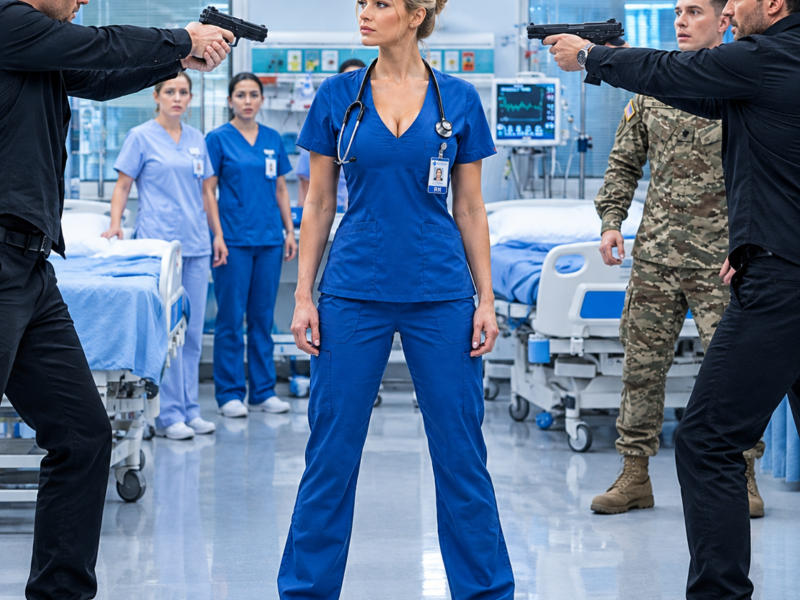
“Get down!” the first gunshot shattered the hospital windows, and everyone in the emergency room dropped to the floor
The gunman recognized me.
“Hayes?” he whispered.
And just before he pulled the trigger, he said a name I had buried with the rest of my past.
“Ghost Team is here for you.”
For half a second, the emergency room disappeared.
I wasn’t Rebecca Hayes, the night-shift nurse at St. Catherine’s Medical Center.
I was Lieutenant Commander Rebecca Hayes, former Navy SEAL, callsign Ghost.
And the man standing in front of me had just confirmed that the people hunting Daniel Brooks knew exactly who I was.
The rifle came up.
I moved.
I knocked the barrel sideways as the shot exploded into the wall behind me. Glass rained from a cabinet. I drove my elbow into the attacker’s arm, forced him off balance, and sent him crashing against the medication cart.
He recovered faster than I expected.
He was trained.
Very trained.
He swung the rifle toward my head.
I ducked, caught the weapon, and twisted until his grip broke. The rifle hit the floor.
“Stay down!” I shouted.
He didn’t.
He reached for a knife.
Before he could draw it, a security guard slammed into him from behind. Both men hit the floor.
“Rebecca!” someone screamed.
It was Dr. Miller, the emergency department attending.
He was crouched behind the nurses’ station with blood running down his forehead.
“Get everyone into the trauma rooms!”
“Already moving!”
I turned toward the treatment bay.
The second gunman had Daniel by the shoulder and was trying to pull him out of bed.
Daniel cried out in pain.
“Stop!” I shouted.
The attacker looked over his shoulder.
“You should have stayed retired, Ghost.”
He raised his weapon.
Then the hospital’s overhead lights went dark.
Emergency power kicked in a second later, bathing the room in dim red light.
In that brief darkness, someone screamed.
A gunshot followed.
When the lights returned, the second attacker was on the floor, clutching his leg.
Daniel was still in bed.
And standing beside him was a man in a hospital security uniform.
He held a pistol in a steady two-handed grip.
“That’s enough,” he said.
I recognized his voice before I recognized his face.
“Marcus?”
He lowered the weapon slightly.
“Long time, Rebecca.”
Marcus Cole.
My former teammate.
The man I had believed was dead.
***
There were too many questions and not enough time.
I checked the wounded attacker, kicked his rifle out of reach, and helped the security guard secure him.
“Who else is inside?” I asked Marcus.
“Two at the ambulance entrance. One outside the east stairwell. I don’t know if there are more.”
“Police?”
“Dispatch says units are responding, but someone jammed the first emergency call.”
I looked toward Daniel.
“Why is Ghost Team hunting him?”
Marcus glanced at the injured man.
“Because Daniel has something they need.”
“What?”
“Evidence.”
Daniel struggled to sit up.
“Don’t let them take the case.”
I moved to his bedside.
“Where is it?”
He looked at the IV line, then toward the blood-soaked bandage on his ribs.
“Not in the case.”
Marcus frowned.
“What does that mean?”
Daniel swallowed.
“The case is bait.”
I stared at him.
“You’re telling me they attacked a hospital for something that isn’t even here?”
“They think it is.”
“Then where is it?”
Daniel’s eyes met mine.
“Inside the hospital.”
My stomach tightened.
He pointed weakly toward the trauma bay.
“Room six.”
I looked at Marcus.
He shook his head.
“That’s where they came from. We need to move him.”
“No,” Daniel said.
His voice was stronger now, but pain cut through every word.
“If you move me, they’ll know.”
“Who?”
He looked at Marcus.
“Your commander.”
Marcus went still.
“What commander?”
Daniel closed his eyes.
“Bennett.”
The name landed like a punch.
Commander Thomas Bennett had led our unit during my final deployment. He had been respected, decorated, and trusted with the lives of every person under his command.
He had also been declared dead after an operation in Syria six years earlier.
I had watched his name added to the memorial wall.
I had stood at his funeral.
And now Daniel was telling me Bennett was alive.
“That’s impossible,” I said.
Daniel shook his head.
“It’s the reason they came.”
***
The hospital’s public address system crackled.
A man’s voice filled the emergency department.
“Attention, medical staff. This is a security lockdown. All personnel are to remain in their current locations.”
Marcus looked up.
“That isn’t hospital security.”
The voice continued.
“Rebecca Hayes, we know you’re there. You have one minute to surrender Daniel Brooks and the evidence. Nobody else needs to get hurt.”
My hands went cold.
I recognized the voice.
Not because I had heard it recently.
Because I had spent six years trying to forget it.
Thomas Bennett.
Marcus moved closer.
“Don’t answer him.”
“He knows I’m here.”
“He wants you to panic.”
“He knows my name. He knows my history. He knows Daniel.”
“He wants you to believe he controls the room.”
I looked around.
A frightened resident was holding pressure on a patient’s wound. A nurse was trying to calm a child beneath a desk. The security guard was keeping one attacker pinned to the floor.
There were innocent people everywhere.
Bennett knew that.
He was using them as leverage.
I pressed my radio.
“This is Rebecca Hayes in the emergency department. We have armed intruders, multiple injured people, and a possible hostage situation. We need law enforcement and tactical support immediately.”
Static answered.
Then Bennett’s voice returned.
“Still giving orders, Rebecca? You never did know when to stop.”
I looked at Marcus.
“Can you get everyone into the inner treatment area?”
He nodded.
“What are you planning?”
“To keep them alive.”
“That’s not a plan.”
“It will have to do.”
***
We moved the patients in stages.
The staff worked with remarkable courage. Dr. Miller took charge of the trauma bays. Two nurses escorted patients through the rear corridor. The security guard helped move the injured resident.
I stayed near Daniel.
He was losing blood.
His pulse was fast, and his skin had turned clammy.
“Dr. Miller,” I called. “He needs another assessment.”
The doctor checked the dressing.
“Possible internal bleeding. We need imaging and a surgical team.”
Daniel grabbed my wrist.
“No imaging.”
“You may be bleeding internally.”
“They’ll find the implant.”
I stared at him.
“What implant?”
He looked at Marcus.
Marcus’s expression changed.
“You have it?”
Daniel nodded.
“Not the evidence. The key.”
I leaned closer.
“Daniel, I need you to explain.”
He took a shallow breath.
“Six years ago, Ghost Team was sent to recover a data drive from an abandoned facility. We were told it contained intelligence on a weapons network.”
“I remember.”
“You were told the mission was compromised by enemy forces.”
“Yes.”
“It wasn’t.”
He looked directly at me.
“Our own command sold the operation.”
The room seemed to tilt.
“What?”
“Bennett was working with a private defense contractor. They were selling weapons and targeting information. The drive contained the records.”
I felt the old memories returning in sharp fragments.
The explosion.
The radio silence.
The missing extraction helicopter.
The bodies we never recovered.
My team.
My friends.
“Why wasn’t this reported?”
“Because the people who reported it disappeared.”
Daniel shifted in pain.
“I was an intelligence analyst attached to the investigation. I found the original transactions and the mission logs. Bennett’s people tried to kill me before I could deliver them.”
“And the case?”
“An empty shell. They think the evidence is inside.”
Marcus looked at him.
“Where is it?”
Daniel pointed to his chest.
“Encrypted data is stored on a medical-grade device beneath my skin. The case contains the reader.”
I stared at him.
“You had a device implanted?”
“Before I came here.”
“Why?”
“Because I couldn’t trust anyone with the original files.”
The public address system crackled again.
“Two minutes, Rebecca.”
Bennett sounded almost amused.
“You know what happened to your team. You know what happened to me. Don’t make the same mistake twice.”
I looked at Daniel.
“Can the device be removed?”
“Not safely.”
“Can it be read without removing it?”
He nodded.
“If we have the reader.”
“Where is the reader?”
Daniel’s eyes moved toward Room Six.
“The case.”
***
Marcus and I reached Room Six through the connecting corridor.
The room was empty except for a portable imaging cart and a metal cabinet.
A black medical case sat beneath the cart.
It looked ordinary.
Too ordinary.
Marcus crouched beside it.
“That’s the one?”
I nodded.
He opened the outer compartment.
Inside was a small device, a cable, and a folded sheet of paper.
No data drive.
No weapons.
Just the reader.
I took the paper.
There were three words written across it in Daniel’s handwriting.
**TRUST NO COMMAND.**
Beneath them was a series of numbers.
Marcus studied the device.
“Can you use it?”
“Not without Daniel.”
“We need to get him here.”
I shook my head.
“Bennett is waiting for us to move him.”
Marcus looked toward the corridor.
“Then we bring the reader to him.”
I picked up the case.
A metallic click sounded behind us.
Marcus shoved me down.
A bullet struck the cabinet where my head had been.
A figure appeared in the doorway.
Black tactical clothing.
Rifle raised.
I recognized the insignia on his shoulder.
Ghost Team.
But it wasn’t one of my old teammates.
It was a counterfeit patch.
The man advanced.
“Put the case down.”
Marcus raised his pistol.
“Come get it.”
The attacker fired.
Marcus returned fire, forcing him behind the doorframe.
I moved toward the opposite side of the room and pulled the imaging cart over as cover.
The attacker rushed in.
Marcus shouted my name.
I didn’t hesitate.
I drove the cart into the man’s legs, knocking him off balance. His rifle struck the floor.
Marcus moved in and restrained him.
The man struggled, but he was alone now.
I pulled the patch from his shoulder.
Underneath it was another insignia.
A private security company.
The same contractor Daniel had named.
I looked at Marcus.
“Bennett brought private soldiers into a hospital.”
Marcus checked the hallway.
“Then we stop treating this like a military operation.”
He looked at me.
“We treat it like a rescue.”
***
When we returned to the emergency department, Dr. Miller was waiting.
“Police are outside,” he said. “They can’t get through the east entrance. Someone has blocked the access road.”
“Can they reach us through the ambulance bay?”
“Not safely.”
Marcus looked at me.
“Bennett wants the evidence before the police get inside.”
I placed the case on the counter.
“Then we give him something else to worry about.”
Daniel was awake.
His face was pale, but his eyes were focused.
I showed him the reader.
“Can you connect this?”
He nodded.
“There’s a port beneath the dressing. But don’t remove the device.”
Dr. Miller examined him.
“I can expose the connector. I will not perform anything unnecessary.”
Daniel agreed.
The doctor worked carefully while I held the reader.
A small connector appeared beneath the edge of the bandage.
I plugged in the cable.
The screen flickered.
A string of encrypted characters appeared.
Then a message:
**AUTHENTICATION REQUIRED.**
Daniel whispered a sequence of numbers.
I entered them.
The screen changed.
A file directory opened.
There were mission logs, payment records, operational orders, and audio recordings.
One folder was marked:
**GHOST TEAM — FINAL OPERATION.**
I opened it.
A video began playing.
The image was grainy, but the voice was clear.
Bennett.
“Proceed with the extraction delay. The team must remain in the facility until the transfer is complete.”
Another voice asked, “What about the personnel?”
Bennett answered without hesitation.
“They’re expendable.”
I couldn’t breathe.
I watched the timestamp.
The recording had been made minutes before the explosion that killed my teammates.
Marcus stood beside me.
His face was pale.
“Rebecca.”
I looked at him.
“You knew?”
“No.”
“Then why did you disappear?”
His jaw tightened.
“I was captured. They held me for months. I escaped, but by then the official report said I was dead. When I tried to contact you, someone sent me a photograph of your apartment.”
He swallowed.
“There was a message. If I came near you, they’d kill you.”
I stared at him.
“So you let me believe you were dead.”
“I thought it was the only way to keep you safe.”
I wanted to be angry.
I was angry.
But there were patients behind us, and Bennett was still outside.
The monitor beeped.
Daniel’s blood pressure was falling.
Dr. Miller looked at me.
“We need to move him to surgery.”
I nodded.
“Do it.”
Then the public address system came alive again.
“Rebecca. I know you’ve opened the files.”
Bennett’s voice sounded closer.
“Now we can stop pretending.”
***
The emergency department doors opened.
Bennett walked in without a weapon raised.
He wore a dark suit beneath a tactical vest, his hair silver at the temples.
He looked older.
But not different.
Not enough.
“Rebecca,” he said.
I stood between him and the patients.
“Commander.”
He smiled.
“Still formal.”
“You don’t deserve anything else.”
His eyes moved to the reader on the counter.
“You have something that belongs to me.”
“You mean evidence of murder?”
“I mean information that could destabilize national security.”
“You killed my team.”
“I made a decision.”
“They trusted you.”
“And I made sure their sacrifice served a larger purpose.”
I felt something inside me break.
Not fear.
Not grief.
Something colder.
“You left them there.”
Bennett’s expression hardened.
“They were soldiers. They understood the risks.”
“They were my family.”
He looked almost bored.
“Your family is gone, Rebecca. You should have stayed retired.”
I glanced at the people behind me.
The resident.
The nurses.
The patients.
A child clutching his mother’s hand.
I understood then what Bennett had never understood.
He believed courage meant controlling people.
He believed power meant making others afraid.
But courage was the nurse who kept pressure on a stranger’s wound while bullets struck the walls.
It was the resident who stood between a patient and a rifle.
It was Marcus returning to a fight he had already survived once.
And it was me refusing to abandon people because someone with a weapon told me to.
“You’re not getting the files,” I said.
Bennett sighed.
“I was hoping you would be reasonable.”
He raised his hand.
Two armed men appeared behind him.
I heard a sharp command from the ambulance entrance.
“Federal agents! Drop your weapons!”
For one brief moment, Bennett looked genuinely surprised.
Marcus stepped forward.
“It’s over.”
Bennett looked at him.
“Cole.”
“Hello, Thomas.”
The two men behind Bennett raised their rifles.
Then the emergency department filled with the sound of commands and boots.
Federal agents entered from both sides.
The attackers hesitated.
That hesitation was enough.
One dropped his weapon.
The other tried to run and was tackled before he reached the corridor.
Bennett slowly lowered his hand.
His eyes stayed on me.
“You think this changes anything?”
I held his gaze.
“It changes what happens next.”
He was handcuffed and escorted out.
As he passed, he leaned toward me.
“You’ll never get your old life back.”
I looked at the patients behind me.
“I wasn’t trying to.”
***
The next hour was a blur of surgery, interviews, and statements.
Daniel survived.
The surgeon repaired the internal damage, and the device remained in place until the medical team could safely remove it under controlled conditions.
The files were copied, verified, and delivered to federal investigators.
The recordings confirmed the conspiracy.
The payment records connected Bennett to the contractor.
The mission logs showed that the extraction delay had been deliberate.
And the names of the people who had died were finally attached to the truth.
My teammates had not been lost because of bad luck.
They had been betrayed.
The investigation lasted months.
Bennett and several members of the contractor’s leadership were charged with murder, conspiracy, and multiple federal offenses. Others involved in the weapons network were arrested as investigators followed the records.
Marcus testified.
So did Daniel.
And I did too.
For the first time in six years, I told the full story of what happened on that mission.
I spoke about the people I had lost.
I spoke about the orders we had followed.
I spoke about the moment I realized the mission had been designed to sacrifice us.
It hurt.
But the truth no longer belonged to Bennett.
***
Three months later, I returned to St. Catherine’s.
The hospital had repaired the windows and replaced the damaged equipment. The emergency department looked almost exactly as it had before.
Almost.
The staff knew who I was now.
Some were curious.
Some were uncomfortable.
A few called me a hero.
I asked them not to.
I had done what I could in a terrible situation.
The real heroes were the people who had kept caring for patients while the world around them fell apart.
Dr. Miller met me near the nurses’ station.
“Good to have you back.”
“Good to be back.”
He handed me a small envelope.
“Someone left this for you.”
Inside was a photograph.
It showed six people standing in front of a military transport plane.
I recognized every face.
My team.
All of them.
On the back, someone had written:
**WE DESERVED THE TRUTH. THANK YOU FOR BRINGING US HOME.**
I sat down.
For six years, I had believed I was the only one left carrying their memory.
Now I knew their names would be remembered for what they had done, not for the lie someone had told about them.
I folded the photograph and put it in my pocket.
Then I went back to work.
***
Daniel returned to the hospital a few weeks later for a follow-up appointment.
He walked slowly, still recovering from surgery, but he was alive.
He found me in the staff lounge.
“Thought I’d see if you were still here.”
I smiled.
“Someone has to keep the place running.”
He sat across from me.
“Federal investigators wanted me to tell you something.”
“What?”
“They found a second recording.”
My smile faded.
“What recording?”
Daniel took a folded paper from his jacket.
“Bennett wasn’t the only officer involved. The original operation was authorized by someone much higher.”
I stared at him.
“Who?”
He hesitated.
“The order came from an office that was supposed to be protecting us.”
I felt the old coldness return.
“Do they have a name?”
“Not yet. They’re still tracing the authorization.”
He placed the paper on the table.
“There’s something else.”
I unfolded it.
It was a short list of names.
At the bottom was mine.
Beside it were the words:
**STATUS: ACTIVE.**
I looked up.
“What does this mean?”
Daniel’s expression was serious.
“It means someone still thinks you’re part of the operation.”
I folded the paper.
For a moment, I considered calling the investigators.
Then I looked through the lounge window at the emergency department.
A child was laughing beside his mother.
A nurse was helping an elderly patient into a wheelchair.
A doctor was explaining test results to a worried family.
This was the life I had chosen.
Not because I was afraid of my past.
Because I had finally decided what I wanted my future to be.
I stood and put on my coat.
“Then they’ll have to come find me.”
Daniel watched me.
“You’re not worried?”
I thought about the men who had entered the emergency room.
The patients who had trusted me.
The team I had lost.
The truth we had recovered.
I shook my head.
“I’ve spent enough years running from people who think they own my life.”
I walked back toward the nurses’ station.
The monitors were beeping.
The phones were ringing.
Somewhere down the hall, a patient needed help.
And for now, that was where I belonged.
I had once been a soldier who knew how to survive a battlefield.
Now I was a nurse who knew how to protect people when the battlefield came to them.
They could call me Ghost.
They could call me a target.
They could call me whatever they wanted.
But when the next frightened patient reached for my hand, I would be there.
And I would never again mistake silence for peace.
The end.









