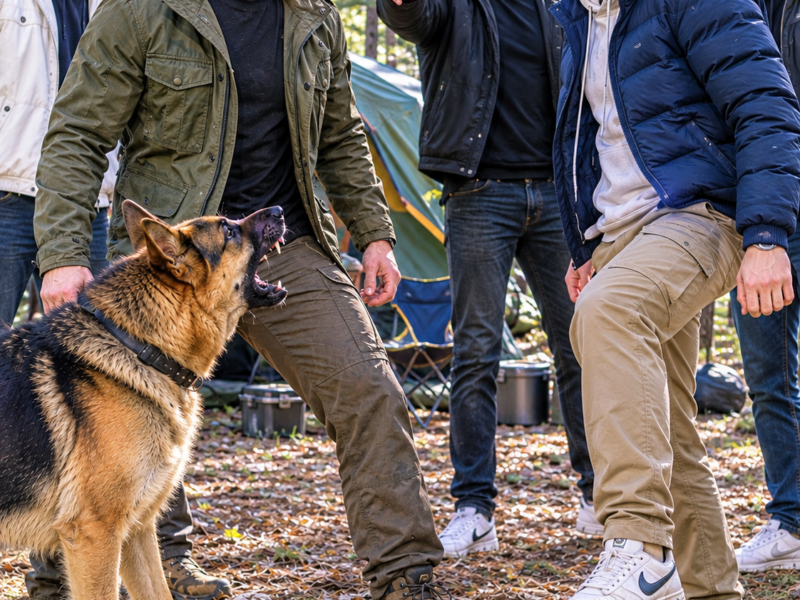
“Four wealthy young men surrounded a lone camper deep in the forest, kicked over his supplies, and laughed as his German Shepherd stood between them and his tent
I stared at the message on my phone until the screen dimmed.
“Leave the bag alone if you want to live.”
Atlas stood beside me, his ears pointed toward the dark trees. He wasn’t barking, but I knew that posture. Seven years together had taught me the difference between a dog who was curious and a dog who sensed danger.
This was the second kind.
I slipped the phone into my pocket and looked toward the old service road.
Someone had been watching my campsite.
Someone had photographed me without my knowledge.
And someone was desperate enough to threaten a stranger over a duffel bag.
I had spent years in places where the difference between a warning and a trap could be measured in seconds. I wasn’t about to ignore either possibility.
“Come on, buddy,” I whispered.
Atlas moved at my side as I approached the bag.
I didn’t touch it immediately. I studied the ground around it first. The dark stain near the pine needles looked old in some places and fresh in others. The orange tape on the handle had been wrapped around it twice, carefully enough that it didn’t resemble ordinary luggage marking.
The bag itself was expensive, waterproof, and badly scratched.
Someone had dragged it through the woods.
I took a few photographs from different angles, then backed away and called the county sheriff’s office.
A dispatcher answered after two rings.
I explained that I had found a suspicious bag in a remote camping area and had received a threat on my phone. I gave her my coordinates and described the tire tracks leading toward the service road.
She told me to remain at a safe distance and wait for a deputy.
I agreed.
But I didn’t return to my tent.
The boys had destroyed half my campsite, and I had no intention of pretending that the night was ordinary. I moved to a rocky rise where I could see the clearing and most of the road without standing in the open.
Atlas settled beside me.
For almost twenty minutes, nothing moved.
Then headlights appeared between the trees.
A dark pickup crawled along the service road with its lights dimmed. It stopped near the clearing, and the engine continued to idle.
Two men stepped out.
Neither wore hunting gear. One had a gray jacket and a knit cap. The other was taller, dressed in a black coat that looked far too clean for the forest.
The man in the black coat walked directly toward the duffel bag.
He didn’t search for it.
He knew exactly where it was.
I took another photograph.
The man in gray scanned the trees while his companion crouched beside the bag. He pulled a small tool from his pocket and cut through the orange tape.
Then he froze.
Even from the rise, I could see his shoulders stiffen.
He turned toward the man in gray and said something I couldn’t hear.
The taller man answered sharply.
They began arguing.
The man in gray pointed toward the road, clearly urging the other to leave. But the man in black ignored him. He opened the bag a few inches, looked inside, and slammed it shut.
He glanced around the clearing.
For one brief moment, his gaze traveled toward my position.
I stayed motionless.
He couldn’t see me in the darkness, but I knew he had sensed something.
He pulled out his phone.
A second later, mine vibrated.
**You were told to leave it alone.**
I looked from the screen to the men below.
They were no longer arguing.
Both were staring at the trees.
I didn’t wait for them to come looking.
I moved along the ridge, keeping the rock between us, until I reached a narrow trail that led toward the public campground. Atlas followed silently.
I had no desire to turn a suspicious discovery into a gunfight in the woods. My priority was getting the evidence to the authorities and staying alive long enough to explain what I had seen.
At the campground, I found a patch of light near the ranger station and called the sheriff again.
This time, I told the dispatcher that two men had arrived in a dark pickup and were tampering with the bag.
She told me a deputy was on the way.
I gave her the license plate number I had photographed when the truck turned around.
The deputy arrived twelve minutes later.
His name was Cole Bennett. He was in his early forties, with a weathered face and the cautious expression of someone who had spent years dealing with people who didn’t always tell the truth.
He listened without interrupting.
When I showed him the photographs, his expression changed.
“Did you recognize either man?”
“No.”
“What about the four young men who were here earlier?”
I told him about Blake Morrison and his friends. I described their expensive clothes, the way they had treated my campsite like a private playground, and their sudden fear when they heard something near the service road.
Bennett studied one of the photographs.
“Blake Morrison,” he said quietly.
“You know him?”
“I know his father. Owns Morrison Ridge Development. He’s been buying land all over this county.”
“That doesn’t explain why his son was threatening a camper.”
“No,” Bennett said. “It doesn’t.”
He asked me to show him the message again.
I handed him my phone.
He read it twice, then photographed the screen with his own device.
“I’m going to need you to come with me,” he said. “But first, tell me something. Did you touch that bag?”
“No.”
“Good. Don’t go near it again.”
He called for another unit and reported the location. Then he drove me toward the county road, where we waited for backup.
Before we left, I looked back toward the forest.
A pair of headlights flickered between the trees.
The dark pickup was moving again.
This time, it was coming toward us.
Bennett saw it too.
He reached for his radio and identified the vehicle. The pickup slowed when it reached the main road, then accelerated hard in the opposite direction.
A second patrol car turned onto the road and followed it.
Bennett watched the taillights disappear.
“Looks like someone doesn’t want us finding out what’s in that bag,” he said.
I thought of the four boys and the way their laughter had vanished the instant they heard that metallic crash.
“Maybe they already know.”
Bennett didn’t answer.
He took me to the sheriff’s station, where another deputy photographed my damaged tent and recorded my statement. I was offered a spare room at a nearby motel while investigators secured the campsite.
I declined the room and stayed in the station lobby until morning.
Atlas rested at my feet, but I barely slept.
Every time a door opened, I looked up.
At 6:20 a.m., Bennett came out of the back office carrying a folder.
“We found the bag,” he said.
“And?”
“It’s not camping equipment.”
He sat across from me and opened the folder.
Inside were photographs of the duffel bag, the orange tape, and its contents. I saw several bundles of cash, a small digital recorder, a black notebook, and a sealed plastic pouch containing a memory card.
There was also a second phone, its screen cracked.
Bennett turned one photograph toward me.
The notebook contained names, dates, dollar amounts, and parcel numbers. Some entries had been crossed out. Others had been marked with small black stars.
“Do you recognize any of these names?” he asked.
I studied the page.
One name appeared repeatedly.
**Blake Morrison.**
Another belonged to a local contractor who had disappeared from town six weeks earlier.
“What’s this about?” I asked.
“We don’t know everything yet,” Bennett replied. “But we have reason to believe it connects to a missing-person investigation and a series of suspicious property transactions.”
He closed the folder.
“The contractor was named Peter Lawson. He worked for Morrison Ridge Development. His truck was found abandoned near a logging road last month. No body, no confirmed sighting, no explanation.”
“And you think the bag belongs to him?”
“We think he may have hidden it.”
Bennett leaned forward.
“There’s one more thing. The memory card contains audio files. One of our investigators has started reviewing them.”
“What’s on them?”
“A conversation recorded two nights ago. We heard Blake Morrison’s voice.”
My stomach tightened.
“Then the boys weren’t just trespassing.”
“No,” Bennett said. “They were looking for something.”
He paused.
“And now they know someone else found it.”
By midmorning, I was allowed to leave the station, but Bennett asked me to remain reachable. I gave him the photographs from my phone and agreed to provide a formal statement.
Before I left, he made one thing clear.
“If anyone approaches you about the bag, don’t try to handle it yourself. Call us.”
“I understand.”
I meant it.
I had no intention of hunting four spoiled young men through Montana’s wilderness.
But I also knew that people who believed money could erase consequences rarely stopped because someone asked them politely.
I checked into a small motel near town. Atlas drank from a metal bowl beside the bed, then curled up near the door.
I was halfway through a cup of coffee when someone knocked.
Three measured taps.
I looked through the peephole.
Blake Morrison stood in the hallway.
He was alone, wearing a dark jacket and sunglasses. The arrogance from the campsite was gone. His face looked pale, and he kept glancing toward the stairwell.
I didn’t open the door.
“What do you want?” I called.
“We need to talk.”
“Talk from there.”
He swallowed.
“You found the bag.”
I said nothing.
“Listen, I know how this looks. We shouldn’t have messed with your campsite. We were out of line.”
“That isn’t why you’re here.”
He looked down the hallway.
“No. It isn’t.”
Atlas rose and gave a low warning growl.
Blake heard him.
“Please,” he said. “I need you to understand something. My friends and I didn’t put that bag there. We were told it had been moved into the woods, and we were supposed to find it before anyone else did.”
“Who told you?”
“My father.”
The answer came so quickly that I knew he had rehearsed it.
“Why?”
“Because Peter Lawson stole documents from the company. My father said Lawson was blackmailing him. He told us to retrieve the bag before the police got involved.”
“And you believed him?”
“I didn’t know what else to believe.”
I waited.
Blake removed his sunglasses. His eyes were red, and there was a faint bruise along his jaw.
“Last night, after we left you, I went back to the road. I saw the men in the pickup. One of them works for my father. The other one…” He shook his head. “I don’t know who he is.”
“You came to warn me?”
“I came because my father knows you have the bag. He knows you spoke to the sheriff. And he’s going to do whatever it takes to get those files back.”
“Why would he tell you that?”
Blake’s jaw tightened.
“Because he told me to help him get rid of you.”
For a moment, neither of us spoke.
Then I asked, “And what did you say?”
“I told him I wouldn’t.”
He looked at Atlas again.
“I know you have every reason not to trust me. I acted like a jerk in the woods. I thought we could do whatever we wanted because nobody would make us pay for it.”
“That’s a useful thing to learn.”
“I deserve that.”
He reached into his jacket slowly and removed a folded sheet of paper.
I told him to put it on the floor and step back.
He did.
Then he retreated several feet.
I opened the door just enough to retrieve the paper while keeping Atlas behind me.
It was a printed photograph of Peter Lawson standing beside a pickup truck. On the back, someone had written a date and a set of coordinates.
Below them were four words:
**THE SECOND CACHE IS REAL.**
I looked up.
“Where did you get this?”
“It was in my father’s office. I took it this morning.”
“What’s the second cache?”
“I don’t know. But I heard my father talking about it. He said the first bag was a decoy and that Lawson had hidden the real records somewhere else.”
“Then why was your father so desperate to recover the first bag?”
“Because it wasn’t a decoy to him. It had enough evidence to ruin him. But he thinks the second cache contains something worse.”
I folded the paper.
“You need to give this to Deputy Bennett.”
“I will. But there’s something else.”
Blake’s voice dropped.
“My father knows where you camped. He knows your name. And he knows you used to be in the military.”
That explained the message.
Someone had looked me up.
Someone had decided I was an obstacle.
“Go to the sheriff’s station,” I told him. “Tell them everything. Don’t contact your father again.”
He nodded, but didn’t move.
“Will you help me?”
“No.”
The answer seemed to hit him harder than he expected.
“I can’t fix what I did,” he said.
“No. You can’t. But you can stop making it worse.”
He stared at me for a long moment, then turned and walked toward the stairs.
I watched until he disappeared.
Then I called Bennett.
He arrived twenty minutes later with another investigator. I gave him the photograph and repeated Blake’s statement. Bennett listened carefully, his expression growing darker with every detail.
“Did he say where the second cache might be?”
“He didn’t know. The coordinates on this paper may be a starting point.”
Bennett passed the photograph to his colleague.
“We’ll verify the location and get a warrant if we need one.”
“What if Morrison gets there first?”
“We’ll move quickly.”
I studied his face.
“That’s not a guarantee.”
“No,” he admitted. “It isn’t.”
He left with the photograph, promising to update me as soon as he could.
For the next several hours, I tried to rest.
I failed.
At 1:40 p.m., my phone rang.
It was Bennett.
“We found the location,” he said. “It’s an abandoned survey cabin about four miles east of your campsite.”
“Have you searched it?”
“We’re preparing to.”
“Then I’m staying out of your way.”
“Good. I wanted to hear you say that.”
There was a pause.
“Daniel, I need to tell you something. The audio files are worse than we expected.”
I sat upright.
“What did you hear?”
“Peter Lawson confronted Morrison about illegal dumping, fraudulent land records, and payments made to county officials. Morrison threatened him. In a later recording, someone asks whether Lawson is still alive.”
“And the answer?”
“An unidentified man says, ‘Not if he kept the originals.’”
I looked at Atlas.
“Do you have evidence that Morrison ordered his death?”
“Not enough to charge him with murder. Not yet. But the recordings give us probable cause to investigate the disappearance and the financial crimes.”
“Then find the originals.”
“We intend to.”
He ended the call.
I paced the room for several minutes before forcing myself to stop.
I had spent years training to move toward danger when other people needed help. Learning when not to move had been a harder lesson.
This time, the investigation belonged to Bennett.
I wasn’t going to interfere.
At 4:15 p.m., he called again.
“We found the second cache.”
I let out a breath.
“What was in it?”
“Documents, hard drives, and a handwritten statement from Lawson. He apparently expected someone to find it if he disappeared.”
“Was he alive when he wrote it?”
“The statement is dated three days before he went missing.”
“Does it name Morrison?”
“Yes. It also names two subcontractors and a county inspector who allegedly accepted payments to overlook illegal dumping on protected land.”
“Anything about the disappearance?”
“Not directly. But the hard drives contain messages arranging a meeting with Morrison the night Lawson vanished.”
Bennett paused.
“We’re bringing Morrison in for questioning.”
“Will he come willingly?”
“He’s already on his way to the station.”
That surprised me.
“Why?”
“Because he thinks he can explain everything away.”
I almost laughed.
Men like Morrison often believed that a room full of evidence was simply another negotiation.
But I knew the truth would depend on more than a notebook and a recording. It would depend on witnesses, verified records, and people willing to tell investigators what they had seen.
The next morning, I learned how quickly the situation could change.
A local news alert appeared on my phone.
**DEVELOPER UNDER INVESTIGATION AFTER EVIDENCE FOUND IN MONTANA FOREST.**
The article identified Morrison Ridge Development and reported that authorities were investigating allegations of fraud, illegal dumping, witness intimidation, and the disappearance of Peter Lawson.
It did not name me.
I was grateful for that.
By noon, Blake had given a formal statement. Two of his friends followed him. The fourth, a young man named Tyler Grant, initially refused to cooperate, but changed his mind when investigators showed him a photograph of the truck near the service road.
The boys admitted they had gone into the forest because Blake’s father promised them money if they recovered the bag. They had been told not to involve the police and to scare off anyone who might have found it.
They had not been told to hurt anyone.
That didn’t excuse their behavior, but it explained their sudden panic when the men in the pickup appeared.
They had thought they were playing a dangerous game for easy money.
Then they realized someone else was willing to cross a line they hadn’t expected.
The driver of the pickup was identified as Grant Keller, a former security contractor employed by Morrison Ridge. He was arrested after investigators found messages between him and Morrison arranging the recovery of the bag.
The second man was identified as Victor Shaw, a private investigator who had been hired to locate Lawson’s missing records. He denied knowing anything about the disappearance, but his phone contained messages instructing Keller to retrieve the evidence and destroy any device found with it.
Neither man was charged with murder immediately. Investigators were careful not to claim more than the evidence supported.
But the case was growing.
The recovered hard drives revealed years of payments routed through shell companies. Environmental inspectors had been bribed to overlook contaminated soil. Property records had been altered to conceal the dumping of industrial waste on land scheduled for development.
And the recordings captured Morrison threatening Lawson when he refused to cooperate.
The most important breakthrough came from a small detail in the audio.
A metallic crash.
The same sound I had heard from the forest the night Blake and his friends fled my campsite.
Investigators compared the timing with the recordings and with vehicle data recovered from Keller’s truck. The sound came from a steel storage container being dropped onto a flatbed near the service road.
That container had been used to move equipment from the survey cabin.
Inside it, investigators found traces of blood.
DNA testing later matched the blood to Peter Lawson.
It was not enough on its own to prove how he died, but it placed him at the site where Morrison’s men had been working after his disappearance.
Then a witness came forward.
A mechanic named Luis Ortega had repaired Keller’s truck the morning after Lawson vanished. He told investigators that Keller had arrived with a damaged tailgate and a large stain on the bed. Keller had paid in cash and ordered him not to record the repair.
Luis had stayed silent for weeks because he feared losing his job and worried about his family.
When he learned that authorities had recovered the recordings, he decided he could no longer keep quiet.
His testimony, combined with the forensic evidence and the digital records, gave investigators a much stronger case.
Three weeks after I found the bag, Morrison was arrested on charges related to fraud, bribery, evidence tampering, and witness intimidation. Keller and Shaw faced additional charges connected to the destruction of evidence and their roles in the attempted recovery.
The investigation into Lawson’s death continued.
For a while, I thought that was where my part in the story ended.
I had given my statement, handed over my photographs, and returned to the ordinary business of living.
Then Deputy Bennett called me one evening.
“They found Peter Lawson,” he said.
I sat down slowly.
“Alive?”
“No.”
His voice softened.
“Search teams located his remains on land owned by a company linked to Morrison Ridge. The medical examiner is still working through the details, but the evidence points to homicide.”
I closed my eyes.
For weeks, Lawson had been a name in a notebook, a voice on a recording, and a man whose disappearance had frightened powerful people.
Now he was a person whose family could finally begin to understand what had happened.
“Does his family know?”
“They’ve been informed. His wife and daughter have been waiting for answers since he disappeared.”
I looked toward Atlas, who lay asleep on the rug.
“I’m glad they found him.”
“So are we,” Bennett said. “It doesn’t undo what happened. But they deserve the truth.”
After the call, I took Atlas outside.
The evening air was cold, and the sky over Montana was turning the color of steel. I walked until the motel lights were behind us and the noise of the road faded.
Atlas stopped beside me and leaned his shoulder against my leg.
I rested a hand on his head.
“Good work, buddy.”
He wagged his tail once.
I thought about the campsite, the overturned supplies, and the four boys who had laughed because they believed a lone camper was an easy target.
They had mistaken quiet for weakness.
They had mistaken solitude for helplessness.
And they had mistaken money for power without limits.
Blake eventually sent me a letter through Deputy Bennett. He apologized for the way he and his friends had treated me and admitted that he had spent most of his life believing consequences were things that happened to other people.
I didn’t write back.
An apology could be sincere and still not erase what someone had done. If Blake wanted to change, he would have to prove it through the choices he made after the attention faded.
Months later, I heard that he had cooperated fully with investigators and testified about his father’s instructions. His testimony helped establish how the evidence-recovery scheme had operated. He also agreed to work with investigators to identify other properties where illegal dumping had occurred.
His three friends received penalties appropriate to their involvement, including fines, community service, and probation. Their records reflected the fact that they had participated in intimidation, even though they had not been responsible for Lawson’s death.
Morrison’s case took longer.
His lawyers challenged the recordings and questioned the reliability of the witnesses. Investigators answered with authenticated digital records, financial documents, forensic findings, and testimony from people who had once been too frightened to speak.
In the end, Morrison was convicted of multiple fraud and corruption offenses, along with witness intimidation and evidence tampering. Keller and Shaw were also convicted for their roles in the conspiracy. The case concerning Lawson’s killing was resolved through additional evidence connecting the men involved to the events surrounding his disappearance.
The court ordered restitution for environmental cleanup and imposed prison sentences on the men responsible.
The contaminated land would take years to restore.
No sentence could give Peter Lawson back to his family.
But the truth was no longer buried in the forest.
A year after that first night, I returned to the same region for another camping trip.
I chose a different clearing, far from the old service road. I pitched my tent beside a stream and watched Atlas investigate the pine needles with the serious concentration of a detective inspecting a crime scene.
The woods were quiet.
For the first time in a long while, the quiet felt peaceful.
I thought about how easily that trip could have ended differently. If I’d ignored the bag, the evidence might have disappeared. If I’d confronted the men in the pickup, I might have given them exactly the opportunity they wanted. If Deputy Bennett hadn’t listened carefully, the truth might have taken much longer to surface.
Being a SEAL had taught me how to act under pressure.
Life after the military had taught me something just as important: courage didn’t always mean moving toward the threat. Sometimes it meant staying calm, recognizing what you didn’t know, and trusting the right people to do their jobs.
Atlas came over and sat beside me.
I scratched behind his ears.
“You know,” I told him, “we came out here for peace and quiet.”
He tilted his head.
“And somehow we ended up helping solve a murder.”
His tail thumped against the ground.
I laughed for the first time in days.
The memory of those boys still bothered me, but not because they had damaged my tent or ruined my supplies. It bothered me because they had looked at another human being and seen someone they could humiliate without consequence.
I hoped they had learned something lasting from what followed.
Not fear.
Not resentment.
Responsibility.
The forest had given up its secret because someone finally chose not to look away. The men who thought they could bury the truth had learned that evidence could survive intimidation, that witnesses could find their courage, and that money could not purchase an escape from every consequence.
As the sun sank behind the trees, I packed away the last of my equipment and secured the tent.
Atlas waited by the trail, ready to go.
I checked the clearing one final time, then followed him toward the road.
We had come to the mountains looking for a few quiet days.
We left with a reminder I would carry for the rest of my life:
You don’t have to be looking for trouble to stand in its path.
But when trouble finds you, what matters most is what you choose to do next.
THE END.









