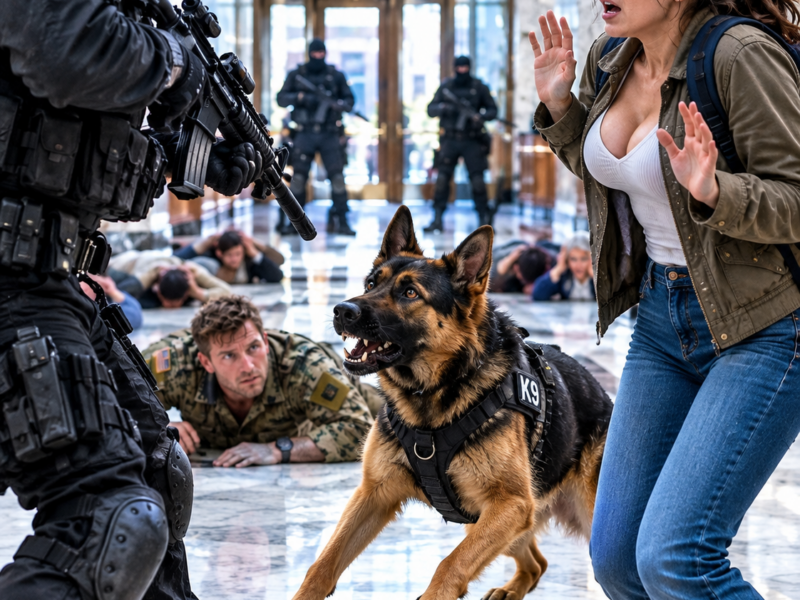
“Four armed men stormed the First National Bank in downtown Charleston, forcing me and thirty-seven other people to our knees
The screen began counting down from sixty seconds.
Jack stared at his own name glowing on the wall, then at the second authorization line beneath it.
“Daniel,” he said through the steel door, “if that’s really you, tell me something only you would know.”
For several seconds, there was nothing but the faint hum of the ventilation system.
Then the voice answered.
“You still owe me twenty dollars from that poker game in Virginia Beach.”
Jack’s mouth tightened.
“That was eight years ago.”
“You said you’d pay me when we got home.”
Jack lowered his head, and for the first time since the gunmen entered the bank, the man who had faced four armed robbers without flinching looked like someone who had just heard a ghost speak.
Behind me, Madison’s mother whispered a prayer.
I wanted to believe the voice meant Daniel was alive, but the countdown kept moving, and the words on the screen gave us no time to understand what was happening.
Fifty-two seconds.
Arthur Harris leaned toward the panel.
“There’s a manual release inside the archive,” he said. “If Voss reached it, he could erase the entire database.”
“Then we stop him,” Jack replied.
“You don’t understand. The archive contains more than records. It contains the control system for the secure room. If he destroys it, the door may never open again.”
Jack looked at the screen.
“Can you override it?”
Harris swallowed.
“I designed the original system. But Voss changed the authorization protocols.”
“Can you override it or not?”
“Yes,” Harris admitted. “If I can reach the service terminal.”
“Where is it?”
“Inside the bank manager’s office.”
Jack glanced toward the office door, where the gunfire had left a jagged hole in the wall.
Voss was somewhere beyond the steel door, and the police were still outside.
The countdown showed forty-three seconds.
Jack turned toward the hostages.
“My name is Jack Reynolds,” he said, raising his voice just enough to carry across the bank. “The police are about to enter. Stay low, keep your hands visible, and follow their instructions. If anyone is injured, tell the first officer you see.”
He looked at me.
“Emily, can you keep everyone together?”
I nodded, though my knees were shaking.
“I can try.”
“That’s all I’m asking.”
He turned to Ranger and touched two fingers to the dog’s harness.
“Stay with Emily.”
Ranger looked up at him.
For a moment, I thought the dog would refuse to leave his side. Instead, he walked toward me, stopped beside Madison, and sat between us and the hallway.
Jack watched him settle.
“Good boy.”
Then he turned to Harris.
“Show me the service terminal.”
The manager pointed toward the damaged office.
They moved together, keeping close to the wall.
I wanted to follow them. I wanted to know what was behind that door, what Daniel Mercer had to do with Jack, and why a bank in downtown Charleston had a secret archive that someone was willing to kill for.
But Madison was trembling against me, and the older man beside us was struggling to breathe.
I had to stay.
The countdown reached thirty seconds.
Then the lights flickered again.
A sharp mechanical bang came from the secure hallway.
Harris stopped.
“He’s cutting power to the archive.”
Jack looked at the panel.
“Can he still erase the records?”
“Yes.”
“How long?”
Harris stared at the screen.
“Twenty seconds.”
Jack’s expression hardened.
“Then we don’t have time to argue.”
They disappeared into the manager’s office.
I heard drawers opening, metal scraping against metal, and Harris muttering under his breath.
The countdown reached fifteen seconds.
Then ten.
I held Madison close and stared at the red digits.
Five.
Four.
Three.
The screen went black.
For one awful second, I thought we had lost everything.
Then a new message appeared.
ERASURE INTERRUPTED. MANUAL AUTHORIZATION REQUIRED.
A second later, the steel door unlocked.
Jack emerged from the office, holding a small black access device.
Harris followed him, his face pale and damp with sweat.
“Tell me you stopped it,” Jack said.
“I stopped the automatic purge,” Harris replied. “But Voss still has physical access to the archive.”
“Then we get to him before he can finish.”
Jack started toward the hallway.
I caught his sleeve as he passed.
“Jack.”
He stopped.
“Is Daniel really alive?”
He looked at me, and I saw the conflict in his eyes.
“I don’t know yet.”
“But you recognized his voice.”
“I recognized a memory.”
He gently freed his sleeve from my fingers.
“Stay with Ranger.”
Then he disappeared through the steel doorway.
I watched until the darkness swallowed him.
Only then did I realize my hands were shaking.
I pressed them against Madison’s backpack and tried to breathe.
Outside, a heavy crash shook the bank’s front entrance.
Police officers poured into the lobby, shouting for everyone to remain on the ground.
I raised both hands.
“We’re hostages!” I called. “There are injured people near the teller counter!”
An officer approached, checked my hands, and helped Madison’s mother to her feet.
Another officer moved toward the wounded robber behind the counter.
Within seconds, paramedics were being directed inside.
I should have felt safe.
Instead, my eyes kept returning to the secure hallway.
Jack had gone in alone.
And the last person he expected to find there might be the one person he had spent eight years trying to mourn.
The archive smelled of hot wiring and dust.
Jack followed Harris down a narrow corridor lined with steel cabinets. Emergency lights cast long shadows across the floor, and somewhere behind the walls, a generator rattled unevenly.
At the end of the corridor, a glass partition separated the archive from a small control room.
Dr. Voss stood beside a computer terminal, a pistol in one hand and a metal case in the other.
He looked up as Jack entered.
“You’re late.”
Jack stopped several feet away.
“Put the gun down.”
Voss glanced at the case.
“You have no idea what you’re asking me to surrender.”
“I know you shot an unarmed man in front of thirty-eight people.”
“The man was expendable.”
“Is that what you told Daniel?”
For the first time, Voss’s composure slipped.
“You have no idea what happened to Daniel.”
“Then tell me.”
Voss laughed softly.
“You were always the sentimental one. That was your weakness.”
Jack’s hands remained at his sides, but every muscle in his body was ready.
“You used our unit.”
“I used a program the government authorized.”
“You sent us into a facility that wasn’t on our mission briefing.”
“Because the official briefing would have compromised the operation.”
“You told us the building was empty.”
“It was supposed to be.”
Jack’s jaw tightened.
“Daniel was in that building.”
“Daniel was where he was ordered to be.”
“He wasn’t on the roster.”
“No,” Voss replied. “He wasn’t.”
The words landed harder than any admission Jack had expected.
Voss watched him absorb them.
“Your team was sent to retrieve a storage device from a black-site communications facility. You believed it contained intelligence on a foreign arms network. The truth was that it held the identities of American operatives whose missions were never officially acknowledged.”
“And Daniel?”
“Daniel was the systems engineer who maintained the archive. He had discovered that the records were being sold.”
Jack stared at him.
“Sold to whom?”
“People with money. People with power. People who wanted access to identities that should never have been exposed.”
Voss placed the metal case on the table.
“Your mission was designed to retrieve the evidence and destroy the facility. Daniel was supposed to be dead before your team arrived.”
Jack’s face went still.
“You knew he was there.”
“I knew someone was there.”
“You sent us in anyway.”
“Your team was expendable if the operation failed.”
For a moment, the only sound was the generator.
Jack remembered the mission in fragments: rain against concrete, a corridor filled with smoke, a radio that went silent, and the last time he had heard Daniel’s voice.
He remembered Daniel shouting that the eastern stairwell was blocked.
He remembered turning back.
He remembered an explosion that threw him against a wall.
And he remembered waking in a military hospital with a doctor telling him Daniel Mercer had died during the operation.
Jack had carried that sentence for eight years.
He had never been given a body to bury.
“Where is he?” Jack asked.
Voss nodded toward the inner chamber.
“Behind that partition.”
Jack looked through the glass.
A man sat in a chair beside the central server rack, his wrists secured by restraints. His hair had grown longer, and his face was thinner than Jack remembered, but the scar near his eyebrow was unmistakable.
Daniel.
Jack took a step toward the glass.
Daniel lifted his head.
For a moment, neither man moved.
Then Daniel whispered, “You got old.”
Jack let out a breath that sounded almost like a laugh.
“You look terrible.”
“Eight years in a locked room will do that.”
Jack moved toward the door, but Voss raised his pistol.
“Not yet.”
Jack stopped.
“Let him go.”
“I need the archive.”
“You need the evidence destroyed.”
“I need to survive.”
Voss gestured toward the metal case.
“Those records contain enough information to destroy governments, intelligence agencies, and people who have never even heard my name. If they reach the wrong hands, thousands of lives could be endangered.”
“Then why did you try to erase them?”
“Because the system is compromised.”
“By you.”
Voss’s expression hardened.
“You still believe the world divides neatly into good men and bad men. It doesn’t. Sometimes people have to make choices that look unforgivable from the outside.”
“You chose to kill your own people.”
“I chose to preserve an operation that kept this country safe.”
“By selling identities?”
“By controlling who knew what.”
Jack looked at Daniel through the glass.
“Is that true?”
Daniel shook his head.
“Some of it. Not the part about protecting anyone.”
Voss turned toward him.
“Be quiet.”
Daniel ignored him.
“The archive was never just a list of names, Jack. It contained mission logs, payment records, orders, and evidence of unauthorized operations. Voss used it to blackmail people. When someone refused to cooperate, he threatened to expose their identities.”
“Why didn’t you tell anyone?”
“I tried.”
Daniel’s eyes dropped.
“I sent a copy of the records to an oversight office. Voss found out before the transmission finished.”
Jack understood the rest without being told.
The failed mission.
The explosion.
The official report.
Daniel’s disappearance.
Voss had used Jack’s unit to cover the destruction of the facility, then told the military that Daniel had died in the blast.
Jack had spent eight years believing he had left a friend behind.
Instead, his friend had been hidden behind a steel door while the man responsible built a life around the lie.
“Open the chamber,” Jack said.
Voss shook his head.
“Not until I have the archive.”
“You have it.”
“I have the physical case. I need the master key.”
Jack held up the access device he had taken from the manager’s office.
“This?”
Voss’s eyes flicked toward it.
“Yes.”
Jack looked at the device, then at the computer terminal.
“You can have it after Daniel walks out.”
Voss laughed.
“You’re not in a position to negotiate.”
“No,” Jack said. “But you are.”
He nodded toward the corridor.
“Police are inside the bank. Your men are either in custody or injured. The entire building is surrounded. You have nowhere to go.”
Voss glanced at the monitor.
For the first time, Jack saw fear beneath the doctor’s arrogance.
“You think they’ll arrest me?” Voss asked. “They’ll bury this. They’ll deny the archive ever existed. And anyone who tries to expose it will be discredited.”
“Maybe.”
Jack took a slow breath.
“But you won’t get to decide that alone anymore.”
Voss lifted his gun.
Jack moved.
The shot struck the glass partition, sending cracks across its surface. Jack slammed into Voss before he could fire again, driving the weapon toward the ceiling.
They collided with the control table.
The metal case hit the floor and slid beneath a cabinet.
Voss struck Jack across the face, then tried to bring the gun around.
Jack caught his wrist.
They struggled in the narrow room, knocking equipment from the shelves.
Through the cracked glass, Daniel shouted, “Jack, the emergency release!”
Jack heard him but couldn’t see the control panel.
Voss drove an elbow into Jack’s ribs and broke free.
The gun came up.
Before Voss could aim, Ranger’s sharp bark echoed through the corridor.
Voss glanced toward the doorway.
That fraction of a second was enough.
Jack struck his wrist, sending the pistol skidding across the floor. Voss lunged for it, but Jack tackled him and pinned him against the wall.
“It’s over,” Jack said.
Voss struggled, breathing hard.
“You have no idea what you’ve just done.”
Jack secured Voss’s wrists with the restraints that had been hanging from the control table.
“I know exactly what I did.”
He pulled Voss away from the wall and looked toward the cracked partition.
“Daniel!”
“Left side of the door!” Daniel shouted. “There’s a manual release behind the panel!”
Jack found it beneath a metal cover and pulled the lever.
The chamber door unlocked.
Daniel stepped out unsteadily, rubbing his wrists.
For a moment, the two men stood facing each other, separated by eight years of grief, deception, and all the words they had never been allowed to say.
Jack tried to speak.
Nothing came.
Daniel looked at him.
“I thought you were dead.”
Jack swallowed.
“I thought you were.”
Daniel gave a tired, almost apologetic smile.
“Guess we were both wrong.”
Jack reached for him, then hesitated, unsure whether to embrace him or check him for injuries.
Daniel solved the problem by grabbing him in a fierce hug.
Jack held on.
For several seconds, neither man spoke.
Then Daniel whispered, “You came back.”
Jack closed his eyes.
“I should’ve found you sooner.”
“You were told I was dead.”
“I should’ve questioned it.”
Daniel pulled away enough to look at him.
“You were grieving. They used that.”
Jack’s eyes filled, and he didn’t try to hide it.
“I buried you without a body.”
Daniel’s expression softened.
“I know.”
Jack stared at him.
“How?”
“Voss kept records of everything. He showed me the reports. He wanted me to believe no one was looking for me.”
Jack shook his head.
“I never stopped thinking about you.”
Daniel looked down.
“I know that now.”
A siren wailed somewhere above them.
Jack glanced toward Voss, who sat restrained against the wall, his face twisted with contempt.
“We need to get you out of here.”
Daniel nodded toward the computer terminal.
“Not yet. The archive.”
Jack retrieved the metal case from beneath the cabinet and set it on the table.
Daniel opened it with a code.
Inside lay a small encrypted drive, several sealed folders, and a stack of printed documents bound with a rubber band.
“Everything is here,” Daniel said. “The original mission records. The payment trails. The names of the people who authorized the program.”
“Can we prove it?”
Daniel looked at the server rack.
“If the logs survived the attempted purge, yes.”
Jack glanced toward Harris, who had appeared at the doorway.
“They survived,” the manager said. “I interrupted the deletion before it reached the master files.”
Daniel turned toward him.
“Arthur?”
Harris nodded slowly.
“I’m sorry.”
Daniel looked at the man for a long time.
“You knew I was alive.”
Harris lowered his eyes.
“I knew Voss had you. I was told that if I spoke, my daughter would be killed.”
Daniel’s expression hardened.
“So you stayed quiet.”
“Yes.”
“You let me spend eight years in that room.”
Harris flinched.
“I did.”
For a moment, I thought Daniel might strike him.
Instead, he turned away.
“Then you can tell the police everything.”
Harris nodded.
“I will.”
Jack looked at the documents.
“We need to preserve the records before anyone can destroy them again.”
Daniel connected the drive to the terminal.
The monitor filled with rows of files, dates, names, and transaction numbers.
Then a warning appeared.
REMOTE ACCESS DETECTED.
Daniel went pale.
“No.”
Jack moved beside him.
“What is it?”
“Voss wasn’t the only one who could access the archive.”
The computer began displaying connection requests from an external network.
Daniel typed rapidly, opening one log after another.
“Someone has been watching this system. They know the purge failed.”
Voss laughed from the wall.
“You thought I was working alone?”
Jack turned toward him.
“Who else?”
Voss said nothing.
Daniel pulled up a list of recent access attempts.
One name appeared repeatedly beside the connection records.
MERCER, DANIEL — AUTHORIZATION OVERRIDE.
Daniel stared at the screen.
“That’s impossible.”
Jack looked at him.
“What?”
“Someone has been using my credentials for eight years. The archive accepted commands in my name, including orders to delete records.”
Voss smiled faintly.
“They needed a dead man to take the blame.”
Daniel’s hands tightened over the keyboard.
“They made it look like I authorized the operations.”
“And when the records were exposed,” Voss said, “the world would believe a rogue engineer had sold identities and betrayed his country.”
Jack looked at the stack of documents.
“They built the entire cover-up around you.”
Daniel nodded slowly.
“And now they’ll try to finish it.”
The remote connection count rose.
Daniel disconnected the terminal from the external network, but the warning remained.
“They may already have copied some of the files,” he said. “We need independent witnesses and a verified copy before we leave this room.”
Jack looked toward Harris.
“Can you do that?”
Harris nodded.
“There is an offline backup system in the next cabinet. I can authenticate the original records.”
“Then do it.”
Harris began working.
Jack moved to the doorway and called for the police officers waiting in the corridor.
“Officer! We have an armed suspect in custody, a rescued hostage, and evidence of a criminal operation. We need federal investigators and an independent evidence team. Nobody touches these computers until they’re documented.”
A police officer appeared, weapon raised.
“Step away from the suspect and show me your hands!”
Jack complied immediately.
“I’m a Navy SEAL. My identification is in my left pocket. There’s a weapon on the floor, and the suspect is restrained.”
The officer approached cautiously, secured Voss, and called for additional support.
Jack showed his identification and explained the immediate situation without attempting to control the police response.
Within minutes, more officers entered the archive.
Voss was taken into custody.
He said nothing as they led him away, but just before he disappeared around the corner, he looked back at Daniel.
“You think this ends here?”
Daniel met his gaze.
“No,” he said. “I think it finally starts here.”
When Jack and Daniel emerged from the secure hallway, I was sitting on a folding chair near the bank’s front windows.
Madison had been reunited with her father, who had arrived after hearing about the hostage situation on the news. The little girl was asleep in his arms, her pink backpack tucked beneath his elbow.
The elderly man I had helped was receiving treatment from a paramedic.
Ranger lay at Jack’s feet, his head resting on his paws.
When he saw his handler, he stood immediately.
Jack crouched and pressed his forehead briefly against the dog’s.
“Good work, buddy.”
Ranger wagged his tail once.
Then Jack turned toward Daniel.
I could see the resemblance between the two men now. Not in their faces, but in the way they stood beside each other, alert to the same sounds, understanding each other’s movements without needing words.
Eight years had separated them.
But the connection had survived.
An officer approached Jack.
“We need statements from both of you. Federal investigators are on their way.”
Jack nodded.
“Understood.”
The officer glanced toward Daniel.
“Sir, we’ll need to get you checked by medical personnel.”
Daniel looked at the open doors, the flashing police lights, and the ordinary city street beyond them.
“I’m not going anywhere,” he said.
Jack placed a hand on his shoulder.
“No one’s asking you to.”
As they guided Daniel toward the paramedics, I stepped closer.
“Jack?”
He turned.
I struggled to find the right words.
“I don’t know how you stayed so calm.”
He looked down at Ranger.
“I wasn’t calm.”
“You seemed calm.”
“That was different.”
He glanced toward Daniel, who was speaking with a medic.
“Sometimes you have to keep your fear from making decisions for you.”
I thought about the moment Jack had stood in front of Voss with a gun pointed at his chest. I thought about the little girl hiding beneath my arm, and the bank manager who had spent years living with a secret he couldn’t bear to reveal.
“Were you afraid he was going to kill you?” I asked.
Jack considered the question.
“Yes.”
He didn’t pretend otherwise.
“But I was more afraid of what would happen if I let him decide what everyone else deserved to know.”
Before I could answer, Daniel called his name.
Jack turned toward him.
For the first time that morning, Daniel was smiling.
Not because the past had been repaired. It hadn’t. Eight years of captivity could not be undone by a single reunion, and the people whose identities had been stolen would not recover their lives overnight.
But the door was open.
The truth was no longer locked away.
And the two men who had been made to believe they had lost each other were standing in the same room again.
The investigation lasted nearly a year.
The evidence recovered from the archive was copied, authenticated, and transferred to independent investigators. The records exposed a network of illegal surveillance, identity theft, unauthorized operations, and payments made through shell companies.
Several officials resigned before charges were filed.
Others were arrested.
Dr. Voss was charged with multiple crimes, including kidnapping, conspiracy, attempted murder, and the illegal handling of classified information. The case drew national attention, but many details remained sealed to protect people whose identities had been compromised.
Arthur Harris testified for the prosecution.
He admitted that he had helped maintain the archive and had stayed silent after discovering how it was being used. He also provided evidence that helped investigators trace the payments and identify the people who had ordered the cover-up.
His cooperation did not erase his responsibility.
But it helped prevent the same system from continuing under another name.
Daniel spent months in medical care and rehabilitation. He had to relearn how to live without expecting every locked door to close behind him.
Jack visited him whenever he could.
Sometimes they talked about the operation that had separated them. Sometimes they argued about football, old friends, or the twenty dollars Daniel still insisted Jack owed him.
They never solved everything in one conversation.
Some nights, Daniel woke from nightmares and called Jack without explaining why. Jack would answer, listen, and stay on the phone until the silence no longer frightened his friend.
Other nights, they sat together without speaking.
That was enough.
As for me, I returned to my classroom six weeks after the robbery.
The first morning back, Madison’s father brought her to the school office. She was carrying the same pink backpack, though she’d tied a small silver ribbon around one of its straps.
She walked into my classroom and handed me a drawing.
It showed a woman holding a little girl’s hand. Beside them stood a large black-and-tan dog, with a man in a blue shirt drawn behind him.
Above the picture, Madison had written, in uneven letters, THE PEOPLE WHO HELPED US.
I knelt beside her.
“This is beautiful.”
She smiled shyly.
“My dad helped me spell the long words.”
I looked at the drawing again.
“Would you like me to put it on the wall?”
She nodded.
I pinned it beside the classroom door, where every child who entered could see it.
Later that afternoon, a package arrived at the school.
Inside was a photograph of Jack and Daniel standing outside a rehabilitation center in Virginia. Ranger sat between them, wearing his working harness, his ears lifted and his tongue hanging out.
On the back, Jack had written a short note.
Thank you for looking after the people who couldn’t protect themselves that day. Ranger says you owe him a treat.
I laughed for the first time in weeks.
Then I put the photograph in my desk drawer, beside Madison’s drawing.
Months later, I learned that Jack had returned to service after the investigation, while Daniel had begun helping a team of independent auditors review the records recovered from the archive. They had found more names than anyone expected, including people who had spent years believing their families had abandoned them.
Not every case had a happy ending.
Some people were truly gone.
Some families would never receive the answers they wanted.
But the lies no longer belonged to the people who had created them.
And that mattered.
The following spring, I saw Jack and Daniel again at a small charity event in Charleston organized for families affected by the investigation.
Ranger was there, too, lying quietly beneath a table while children took turns asking if they could pet him.
Jack watched the dog with an expression I recognized now.
It wasn’t fearlessness.
It was trust.
Daniel stood beside him, holding two cups of coffee.
“You still owe me twenty dollars,” he said.
Jack accepted one of the cups.
“I saved your life.”
“You’re still bad at poker.”
“I thought you were dead.”
Daniel’s smile softened.
“I know.”
For a moment, they looked at each other without speaking.
Then Daniel bumped his shoulder against Jack’s.
“Buy me lunch, and we’ll call it even.”
Jack shook his head.
“Fine. But you’re paying for coffee next time.”
They walked toward the food tables, arguing quietly about who owed whom what.
Ranger followed, his tail brushing the legs of the chairs.
I watched them disappear into the crowd and thought about the locked door in the bank, the countdown on the screen, and the way Jack had stood between a frightened child and a man who believed he could control everyone in the room.
For years, Jack had carried the belief that he had failed his friend.
For years, Daniel had been kept alive by the belief that nobody was coming.
Neither man could get those years back.
But when the truth finally gave them a choice, they chose to face what had happened together.
And sometimes, I realized, rescue doesn’t begin when someone opens a locked door.
Sometimes it begins when the person on the other side finally hears a familiar voice and dares to answer.
The end.









