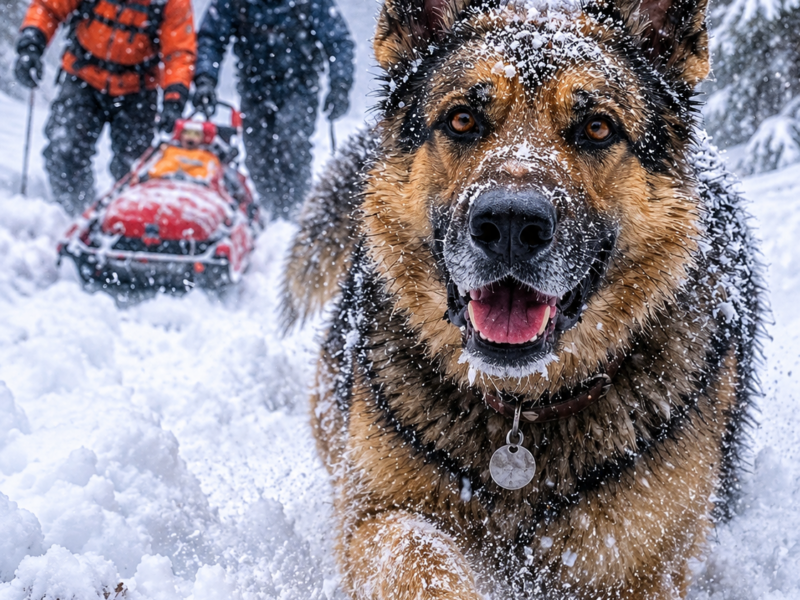
“During the worst blizzard our town had seen in decades, my dog Luke suddenly jumped in front of my pickup truck, refusing to let me pass
My father’s warning stayed with me all the way back to the farmhouse.
Before you call the police… you need to know who was here.
I kept one hand on his shoulder as the ambulance crew loaded him onto the stretcher. His face was pale beneath the frost, and his lips had turned almost blue. A paramedic wrapped another blanket around him while the other checked his pulse.
Luke stood beside the open ambulance doors, his golden fur covered in snow.
He wouldn’t leave my father.
Even when the paramedic tried to guide him back, Luke planted his paws and leaned against the stretcher.
“Let him come,” Dad whispered.
The paramedic looked at me.
I nodded.
“Luke stays with him.”
The dog climbed into the ambulance and settled beside my father’s legs. Only then did Dad close his eyes.
I wanted to ask a hundred questions.
Who had been at the house?
Why was the back door open?
And what had my father found that made him afraid to call the police?
But the ambulance doors were already closing.
“Michael,” Dad called weakly.
I stepped closer.
“Don’t trust the first story you hear.”
Then the doors shut.
I stood in the snow, watching the red lights disappear through the storm.
For several seconds, I couldn’t move.
My father had nearly frozen to death in a ditch, and the only reason he was alive was because his dog had stopped my truck.
Now he was telling me not to trust the police.
I looked toward the farmhouse.
Its porch light flickered through the blizzard.
Something was wrong in that house.
And I was going to find out what.
I climbed into my truck and drove the remaining half mile.
The snow had covered most of the tire tracks, but I could still see them near the driveway.
There were two sets.
One belonged to my father’s old pickup.
The other was wider, with deep grooves that looked like the tires on a heavy-duty truck.
They didn’t lead toward the road.
They led straight to the back of the house.
I parked near the barn and stepped out.
The wind hit me so hard it stole my breath.
Luke’s tracks were everywhere, circling the yard and crossing the path between the farmhouse and the road.
But there was something else.
A set of boot prints.
They began near the back porch, crossed the yard, and disappeared beneath the snow near the old woodpile.
I followed them with my flashlight.
The back door stood open by several inches.
A thin line of warm air escaped into the storm.
I pushed it with my gloved hand.
“Dad?”
No answer.
The kitchen looked exactly as I remembered it.
The same faded curtains.
The same wooden table with a coffee ring near the edge.
The same refrigerator covered in photographs held by cheap magnets.
One picture showed my mother, who had died eleven years earlier, standing between Dad and me on the porch.
I had forgotten how happy we looked.
A chair lay overturned near the table.
A mug had shattered against the floor.
Coffee had dried in a dark stain beside the pieces.
I moved carefully, avoiding the broken ceramic.
There was a muddy footprint near the refrigerator.
Then another near the hallway.
Someone had been inside.
I called my father’s name again.
Silence.
I checked the living room first.
The television was on, though the screen showed only a black reflection of the room.
Dad’s reading glasses lay on the couch.
A drawer in the side table had been pulled open.
The family photographs on the mantel were crooked.
One was missing.
It was a picture of Dad standing beside an old red tractor, taken shortly after he bought the farm.
I remembered it because he had always said that tractor was the first thing he ever owned without owing a bank money for it.
Why would someone steal that photograph?
I moved down the hallway.
The bedroom door was open.
The bed was made.
Dad’s slippers sat beside it.
His wallet was on the dresser.
His medication was lined up neatly beside a glass of water.
Nothing seemed missing.
Then I noticed the closet.
The door was open, and the boxes on the top shelf had been pulled down.
I stepped inside.
Most of them contained old tax records, family documents, and photographs.
But one space was empty.
A narrow wooden box had been removed from the shelf.
I knew that box.
My father had kept it locked for as long as I could remember.
When I was a child, I once asked what was inside.
He told me it held things that were better left in the past.
I had never asked again.
I returned to the kitchen and looked around.
The house didn’t feel like a place that had been robbed.
It felt like a place someone had searched for something specific.
And they had known exactly where to look.
My phone vibrated.
It was a message from an unfamiliar number.
Your father is safe. Leave the house alone.
I stared at the screen.
A second message arrived.
You don’t understand what you’re getting into.
I called the number.
It went straight to voicemail.
I didn’t leave a message.
Instead, I took a screenshot and sent it to my father.
The message showed as delivered.
A few minutes later, my phone rang.
It was Dad.
“Michael?”
His voice was weak, but clearer than before.
“I’m here. I’m at the house.”
“Did you find it?”
“Find what?”
There was a pause.
“The box.”
I looked toward the empty space in the closet.
“Someone took it.”
Dad breathed out slowly.
“I was afraid of that.”
“What’s in it?”
“Not over the phone.”
“Dad, someone was here. They turned the house upside down. I found boot prints outside. And I just got a message telling me to leave.”
Another pause.
Then he said something that made my stomach tighten.
“Did they take the photograph?”
“Which photograph?”
“The one with the tractor.”
I looked toward the empty space on the mantel.
“Yes.”
Dad didn’t speak for several seconds.
Then I heard him whisper, “They know.”
“Know what?”
“Listen to me. There’s a loose floorboard under the pantry shelves. Pull it up. You’ll find something I hid there years ago.”
“Dad, why didn’t you tell me this before?”
“Because I thought it was over.”
“What is?”
“Michael, I need you to listen. The man who came to the house tonight isn’t a stranger.”
My grip tightened around the phone.
“Who is he?”
Dad took a shaky breath.
“His name is Daniel Price.”
The name meant nothing to me.
“Who is Daniel Price?”
“He used to work for the county. He helped me after your mother died.”
“Why would he break into your house?”
“Because he knows what I kept.”
“What’s in the box?”
Dad’s voice dropped.
“Proof.”
“Proof of what?”
Before he could answer, a nurse spoke in the background.
“Sir, you need to rest.”
“Wait,” I said quickly. “Dad, tell me one thing. Why were you outside in the storm?”
He hesitated.
“Because I saw him leave.”
“Daniel?”
“Yes.”
“Did he hurt you?”
“I don’t know.”
“What do you mean you don’t know?”
“I remember the back door. I remember arguing. Then I remember being outside.”
My throat went dry.
“Did he push you?”
“I think so.”
“Dad—”
“There’s something else, Michael.”
I waited.
“Luke saved me before. Not just tonight.”
I glanced toward the back door.
“What are you talking about?”
“Your dog has been trying to tell me something for weeks.”
“Luke?”
“He kept going to the barn. Scratching at the floor. I thought he smelled a mouse or something.”
Dad coughed.
“Then yesterday, he brought me one of your mother’s old work gloves. The one I thought I’d lost years ago.”
I looked toward the hallway.
“What does that have to do with anything?”
“Everything.”
The call ended when the nurse took the phone from him.
I stood in the kitchen, listening to the wind batter the windows.
Then I heard a noise from the pantry.
A soft scrape.
I turned toward it.
The sound came again.
Scrape.
Scrape.
I lifted my flashlight.
The pantry shelves were old pine, built by my grandfather. Dad had never replaced them because he said they were stronger than anything made today.
I moved the cans and jars from the bottom shelf.
There it was.
A narrow board with a small metal ring set into one end.
I pulled.
The board lifted with a groan.
Beneath it was a shallow space.
Inside lay a small plastic container wrapped in a faded dish towel.
I carried it to the table and opened it.
There were three things inside.
A brass key.
A folded letter.
And a photograph.
The photograph showed my father standing beside a younger man in front of the farmhouse.
The younger man was wearing a county maintenance uniform.
I recognized him immediately from an old newspaper clipping Dad kept in a drawer.
Daniel Price.
But there was someone else in the photograph.
A little girl stood between them.
She looked about eight years old.
She had dark hair, a red coat, and a serious expression.
On the back of the photograph, Dad had written a date.
December 14.
And beneath it, four words.
The night everything changed.
I unfolded the letter.
The handwriting was my father’s.
Michael,
If you’re reading this, then I was wrong to believe the past would stay buried.
I kept quiet because I thought silence was the only way to protect you.
But I should have trusted you.
There is a reason Daniel keeps coming back.
There is a reason he wants the box.
And there is a reason Luke refuses to leave the barn alone.
The key opens the old feed room.
Look behind the north wall.
You will understand why I never told you.
I read the letter twice.
Then I looked toward the window.
The barn stood across the yard, its outline barely visible through the falling snow.
The north wall.
I remembered the old feed room.
It hadn’t been used in years.
The door was usually locked.
I took the key and slipped it into my pocket.
Before leaving, I checked the kitchen one more time.
The broken mug.
The overturned chair.
The missing photograph.
The strange message on my phone.
My father’s words kept circling in my head.
The man who came to the house tonight isn’t a stranger.
I stepped outside.
The wind had grown stronger.
Snow swept across the yard in thick white sheets.
I hurried toward the barn, holding my flashlight close to my chest.
The side door was half buried.
I pushed it open and stepped inside.
The familiar smell of hay, old wood, and engine oil surrounded me.
I had spent half my childhood in that barn.
Dad taught me how to repair fences there.
He taught me how to saddle a horse.
He taught me that if an animal trusted you, you had a responsibility to deserve it.
Luke had loved the barn.
When he was a puppy, he used to sleep beneath the workbench while Dad repaired equipment.
I called his name.
“Luke?”
No answer.
I moved toward the feed room.
The key turned with a reluctant click.
The door opened.
The room was dark and cold.
An old metal shelf stood against one wall.
Empty feed bags lay in a corner.
A broken rake leaned against the door.
I swept my flashlight over the north wall.
At first, I saw nothing unusual.
Then I noticed a section of wooden paneling that didn’t match the rest.
The boards were newer.
I pressed one.
It moved slightly.
I found a small gap near the floor and pulled.
The panel came away.
Behind it was a narrow compartment.
Inside sat a metal lockbox.
I used the brass key.
The lid opened.
There were documents inside, along with a small digital recorder and several envelopes.
The first document was a county property map.
The second was a maintenance report dated eighteen years earlier.
The third was a photograph of a collapsed bridge.
I recognized the location.
It was the old Miller Road crossing, about three miles from the farmhouse.
The bridge had been closed for years after a section collapsed during a storm.
I remembered the accident.
A vehicle had gone through the damaged barrier one winter night.
The driver died.
A little girl survived.
The newspaper had called it a tragic accident caused by dangerous weather and poor visibility.
I looked again at the photograph from the plastic container.
The girl in the red coat.
She was the survivor.
Her name was written on the back of one of the documents.
Sarah Price.
Daniel Price’s daughter.
I picked up the maintenance report.
It said the bridge had been inspected the day before the accident.
The report declared it safe.
But a handwritten note had been added in the margin.
North support compromised. Immediate closure required.
The note was signed by Richard Bennett.
My father.
I felt the blood drain from my face.
He had known the bridge was dangerous.
He had signed a warning.
Why had the official report said it was safe?
I turned the page.
There was another document.
A copy of an email from the county engineer to my father.
It said the bridge would remain open because closing it would delay a major construction contract.
There was a name at the bottom.
Daniel Price.
He had been the county maintenance supervisor.
I kept reading.
A week after the accident, Daniel had submitted a revised report claiming no warning had been received.
The original inspection record had disappeared.
My father’s signature was still on the handwritten note, but the county’s official records showed that he had approved the bridge for use.
I understood why someone would want those papers hidden.
But I didn’t understand why my father had kept them.
Or why Daniel was still searching for them after eighteen years.
I picked up the digital recorder.
A strip of masking tape had been stuck to it.
On the tape, Dad had written:
For Michael. Only if I can’t explain.
My hands were trembling.
I pressed play.
At first, there was only static.
Then my father’s voice filled the little room.
“December fifteenth. I have to put this somewhere safe.”
He sounded younger.
Angrier.
“Daniel came to the farm today. He says the county has decided to blame the accident on the driver. He says the report is gone. He says if I keep talking, I’ll lose my job.”
There was a long pause.
Then Dad continued.
“I told him I wouldn’t lie. I told him that bridge should have been closed.”
Another pause.
“He said his daughter would have a father if I had kept my mouth shut.”
The recording crackled.
“I don’t know what he means. I didn’t know the driver. I didn’t know the little girl. But I know what happened to that bridge, and I know who changed the report.”
I stopped the recording.
My heart was beating so hard I could feel it in my throat.
The girl in the photograph had survived.
But what had happened to her afterward?
I searched through the envelopes.
One contained old newspaper clippings.
Another held copies of letters from the county.
The last envelope was addressed to my father.
The handwriting was unfamiliar.
I opened it.
Inside was a short note.
Richard,
You promised you would tell the truth when the time was right.
My daughter still asks why her father let that happen.
I can’t keep protecting him.
You have until Friday.
D.P.
I looked at the date.
The letter had been written three days earlier.
Friday was today.
A noise came from outside.
A heavy thump.
I spun toward the door.
Someone was in the barn.
I switched off my flashlight.
Footsteps crossed the concrete floor.
Slow.
Deliberate.
A beam of light moved across the feed room door.
“Richard?”
A man’s voice.
“Are you in here?”
I recognized it from the voicemail greeting attached to the unknown number.
Daniel Price.
I crouched behind the metal shelf.
The footsteps came closer.
Then stopped.
“I know you found it,” Daniel said.
His voice was calm.
“There’s no point hiding.”
I held my breath.
The door creaked.
A silhouette appeared.
Daniel stepped inside.
He was in his late fifties, broad-shouldered, wearing a heavy winter coat and a wool cap.
He carried a flashlight in one hand.
In the other, he held a small metal object.
A pistol.
My stomach tightened.
He swept the light across the room.
Then he noticed the open lockbox.
His face changed.
“Damn it.”
He took one step forward.
I moved behind the shelf, trying not to disturb anything.
Then a low growl came from the darkness.
Daniel froze.
The growl grew louder.
A golden shape emerged from behind the old tractor.
Luke.
His fur was wet with snow, and one ear was folded back.
He stood between Daniel and me.
“Get back,” Daniel snapped.
Luke didn’t move.
“Luke,” I whispered.
The dog glanced at me for half a second, then returned his attention to Daniel.
Daniel lifted the pistol.
“Get that dog out of here.”
I stepped forward.
“Put it down.”
Daniel turned the flashlight toward my face.
“Michael.”
His voice sounded almost disappointed.
“Your father should have stayed out of this.”
“You broke into his house.”
“I came to collect something that belongs to me.”
“You mean evidence?”
Daniel laughed without humor.
“Evidence. That’s what he called it?”
“You falsified a report.”
“I didn’t cause that accident.”
“You signed the report saying the bridge was safe.”
“I signed what I was told to sign.”
“You were the maintenance supervisor.”
“And your father was the inspector. He could have stopped the whole thing.”
“He tried.”
“Not hard enough.”
Daniel’s eyes flickered toward the lockbox.
“Give me the recorder.”
“No.”
He raised the pistol slightly.
Luke barked.
The sound echoed through the barn.
Daniel flinched.
“Control your dog.”
“He’s doing a better job than you are.”
For a moment, neither of us moved.
Then Daniel lowered the flashlight.
“You don’t know what happened after the accident,” he said.
“Then tell me.”
His jaw tightened.
“My wife left. My daughter was in physical therapy for two years. She couldn’t walk properly. She had nightmares. Every time a truck passed outside, she woke up screaming.”
He looked toward the floor.
“I spent eighteen years trying to get someone to admit what happened.”
“Then why are you trying to destroy the evidence?”
“Because the evidence doesn’t tell the whole story.”
He took another step toward the lockbox.
“My daughter was in that car because I was driving. I had been drinking. I knew the weather was bad. I knew the bridge was closed in the county records, but I thought the temporary barrier had been moved.”
He swallowed.
“When the car went through, I told everyone the barrier hadn’t been there.”
I stared at him.
“You were the driver?”
Daniel nodded.
“I lied. I told myself I had no choice. I had a little girl in the back seat. I thought if they knew I’d been drinking, she’d lose her father.”
“And you let them blame the bridge.”
“I let them blame the county. I let them blame the weather. I let your father carry the guilt.”
His eyes shone in the flashlight beam.
“Then Sarah grew up and started asking questions. She found an old newspaper article. She found the inspection report. She wanted the truth.”
“Why did you come here?”
“Because Richard promised to tell her.”
I glanced at the letter.
“You gave him until today.”
“He promised eighteen years ago. He kept saying he needed more time.”
“So you broke into his house?”
“I wanted the box. I wanted the recorder. I wanted to make sure he couldn’t destroy everything before Sarah came.”
“You could have called him.”
Daniel looked at me.
“You think I haven’t?”
His voice cracked.
“He wouldn’t answer. Then I saw him outside tonight. I tried to stop him from going to the road, but he wouldn’t listen. He fell. I thought he was pretending to keep me away from the house.”
My hands curled into fists.
“You left him in the snow.”
Daniel looked away.
“I didn’t know how badly he was hurt.”
“You knew he was down.”
“I panicked.”
“You drove away.”
He said nothing.
Luke growled again.
Daniel’s eyes dropped to the dog.
“I never wanted any of this.”
“Then put the gun down.”
He looked at the pistol in his hand as if he had forgotten he was holding it.
For one brief second, I thought he might lower it.
Then he lunged toward the lockbox.
Luke moved first.
The dog sprang forward, barking, and Daniel stumbled backward.
The pistol hit the concrete.
I rushed toward it, but Daniel grabbed my coat and shoved me into the shelf.
Metal rattled.
The flashlight rolled across the floor.
Luke caught Daniel’s sleeve between his teeth.
“Let go!” Daniel shouted.
He swung his arm.
Luke yelped and fell sideways.
Something inside me broke.
I shoved Daniel away with both hands.
He lost his balance and crashed against the wall.
I kicked the pistol beneath the shelf.
Then I dropped beside Luke.
“Buddy. Hey. Look at me.”
Luke’s breathing was fast.
There was a small cut above his shoulder, but he was moving.
Daniel sat against the wall, holding his wrist.
Neither of us spoke.
Then the sound of sirens came through the storm.
Blue and red lights flashed against the barn windows.
I had called 911 before entering the barn.
I had told the dispatcher someone might be armed and had given the farmhouse address.
I hadn’t known whether the officers would arrive in time.
Now they were here.
Two deputies entered with their weapons drawn.
“Hands where we can see them!”
Daniel lifted his hands.
I pointed toward the pistol beneath the shelf.
The deputies secured him and called for medical assistance.
One officer approached me.
“Are you hurt?”
“No. The dog needs a vet.”
He looked at Luke.
“Is that your dog?”
“Yes.”
The officer crouched carefully.
“Good boy.”
Luke tried to stand.
I put a hand on his back.
“Easy. You’ve done enough.”
But he wasn’t finished.
He looked past me toward the barn door.
A woman was standing there.
She wore a dark winter coat and had a red scarf wrapped around her neck.
Her cheeks were wet.
“Dad?”
Daniel turned.
The color disappeared from his face.
“Sarah.”
The woman stepped inside.
For a moment, she looked at him as if she were seeing a stranger.
Then her eyes moved to the lockbox.
“You found it,” she said.
I nodded.
“Are you Sarah?”
She looked at me.
“Yes.”
I pointed toward Daniel.
“He says he came here because your grandfather promised to tell you the truth.”
Sarah’s face tightened.
“My grandfather?”
“Richard Bennett.”
She looked toward the ambulance lights outside.
“Is he alive?”
“He’s at the hospital. He’s stable, but he was badly exposed to the cold.”
She covered her mouth.
Then she looked at Daniel.
“You told me he wouldn’t talk because he was hiding something.”
Daniel lowered his head.
“He was.”
“What was he hiding?”
I held up the recorder.
“Everything.”
Sarah stared at it.
“Can I hear it?”
I hesitated.
The officers were still securing the scene.
One of them stepped closer.
“Let’s preserve that as evidence.”
Sarah nodded, but her eyes never left the recorder.
“I’ve waited eighteen years,” she whispered.
“I know,” I said.
“No. You don’t.”
Her voice was quiet, but there was something devastating in it.
“I grew up believing my father had been the victim of a terrible accident. Then I found out he had been drinking. Then I found out the county had blamed someone else. Every time I thought I knew the truth, another piece fell apart.”
She looked at Daniel.
“I don’t know what I’m supposed to believe anymore.”
Daniel’s eyes filled.
“I was trying to protect you.”
“You protected yourself.”
He had no answer.
The deputies took him outside.
Sarah remained in the feed room.
She looked at the photograph in my hand.
“That’s me,” she said.
“I figured.”
“I was eight.”
I nodded.
She touched the edge of the picture.
“I don’t remember the night very clearly. I remember the snow. I remember the headlights. I remember waking up in the hospital and asking where my father was.”
Her voice shook.
“He told me he’d been trying to save me.”
I didn’t know what to say.
Sometimes the truth doesn’t arrive like a revelation.
Sometimes it arrives like a door opening into a room you’ve spent your whole life trying not to enter.
I put the photograph back into the plastic container.
“Your father will have to explain the rest to you,” I said.
Sarah nodded.
Then she looked down at Luke.
“Is he all right?”
“He’ll be checked out.”
She crouched beside him.
Luke sniffed her glove.
For the first time that night, his tail moved.
Sarah smiled through her tears.
“Good boy.”
I wondered whether he knew who she was.
Perhaps he recognized the scent from the old photograph, or perhaps he simply understood that she was hurting.
Whatever the reason, he leaned his head against her knee.
She gently stroked his ears.
“Thank you,” she whispered.
The ambulance took Luke to the emergency veterinary clinic.
I followed in my truck after the deputies finished taking my statement.
The veterinarian examined his shoulder and found a shallow wound and a bruised leg.
Nothing was broken.
“He’s going to be sore,” she told me. “But he’s a tough old fellow.”
I sat beside him while she cleaned the cut.
Luke kept looking toward the door.
“He’s worried about my dad,” I said.
The veterinarian smiled.
“Then you’d better take him to see him as soon as we clear him.”
At the hospital, my father was in a warm room with an IV in his arm.
His color had improved.
A nurse said he had narrowly avoided severe hypothermia.
Luke walked slowly to the bed.
The moment Dad saw him, his face changed.
“There you are.”
Luke rested his head against the mattress.
Dad reached down and rubbed his ears.
“You stubborn old fool.”
Luke’s tail thumped against the floor.
I pulled a chair beside the bed.
“Dad, we found the box.”
His hand stopped moving.
“And Daniel?”
“The deputies have him.”
Dad closed his eyes.
“Did he tell you?”
“He told me he was driving the car that night. He had been drinking. He lied about the barrier and let the county take the blame.”
Dad stared at the ceiling.
“I knew he had been drinking,” he said.
I leaned forward.
“You knew?”
“I suspected. I found a receipt in the truck after the accident. He’d been at the tavern that evening.”
“Why didn’t you tell anyone?”
“I tried.”
“Dad, the report says you approved the bridge.”
“I didn’t.”
His voice became stronger.
“I signed the inspection warning. Daniel removed it from the official file. When I confronted him, he said the county would destroy my career if I accused him without proof.”
“You had the handwritten report.”
“They said it could have been written afterward. The original inspection records were missing.”
“Then why didn’t you take the documents to the state?”
“I was afraid.”
The admission seemed to cost him more than the cold had.
“I was afraid of losing the farm. I was afraid of losing my pension. I was afraid you’d think your father was a coward.”
I looked at him.
“Dad, I don’t think that.”
“You should.”
“No.”
He shook his head.
“I let an innocent man carry the blame for eighteen years.”
“You didn’t cause the accident.”
“But I could have done more to stop the lie.”
I had no easy answer.
My father had spent most of his life teaching me that doing the right thing mattered.
Now I understood how difficult it could be when the cost of doing it was everything you had.
“Sarah deserves the truth,” I said.
He nodded.
“I know.”
“She came to the barn.”
Dad’s eyes moved toward me.
“Sarah?”
“She was there when Daniel was arrested.”
He covered his face with one hand.
“Oh, God.”
“She wants answers.”
“I owe her those.”
“Then you’ll give them to her.”
Dad looked at Luke.
“I was supposed to tell her today.”
“What stopped you?”
“I saw Daniel’s truck outside. I went out to confront him. He wanted the box. We argued. I remember him grabbing my coat.”
He swallowed.
“Then I slipped near the road. I couldn’t get up.”
His hand found Luke’s head.
“I called for help. I don’t know how long I was out there.”
I looked at the dog.
“Luke found you.”
Dad smiled faintly.
“He didn’t find me. He knew.”
“What do you mean?”
“He’d been watching the road all evening. Every time a vehicle passed, he went to the window. I thought he was restless because of the storm.”
Dad scratched behind Luke’s ear.
“When I didn’t come back, he went looking.”
I remembered the way Luke had stood in front of my truck.
The way he had refused to move.
The way he had led me through the snow without hesitation.
He hadn’t been blocking my truck.
He had been bringing me to my father.
And when he saw me, he hadn’t wasted a second.
The following morning, the storm finally began to weaken.
Snow still covered the roads, but the emergency crews had cleared the main highway.
A deputy came to the hospital to take my father’s statement.
Sarah arrived an hour later.
She stood in the doorway for a long time before entering.
Dad looked up.
“Sarah.”
She approached the bed.
“Mr. Bennett.”
He looked at her as though the name had struck him.
“Please. Call me Richard.”
She pulled a chair closer.
“I heard the recording.”
Dad nodded.
“I figured you would.”
“I heard you say you warned them about the bridge.”
“I did.”
“Why didn’t you keep fighting?”
He looked down at his hands.
“I should have.”
“Did you know my father had been drinking?”
Dad closed his eyes.
“I suspected it. I didn’t have proof at the time.”
“But you knew he was lying.”
“Yes.”
Sarah stared at him.
“Then why did you wait eighteen years?”
Dad’s voice was barely above a whisper.
“Because I was afraid.”
She looked away.
For a moment, the room was filled only by the soft hum of the medical equipment.
Then she asked, “Did you know I survived?”
“I did.”
“Did you ever wonder what happened to me?”
“Every Christmas. Every birthday. Every time I drove past that bridge.”
Her eyes filled.
“I used to hate you.”
“I understand.”
“I thought you were the reason my father lost his job. I thought you were the reason he couldn’t look me in the eye.”
Dad nodded slowly.
“I can’t ask you to forgive me.”
“I don’t know if I can.”
“You don’t have to.”
Sarah looked at him.
“Why did you keep the evidence?”
“Because I couldn’t let the truth disappear.”
“Then why not give it to me?”
Dad looked toward Luke.
“I wanted to tell you in person. I wanted to look you in the eye and explain what happened.”
Sarah wiped her cheeks.
“I don’t need an explanation that makes you feel better.”
“I know.”
“I need the truth.”
Dad nodded.
“Then I’ll give you all of it.”
The investigation lasted several months.
The county reopened the old bridge case.
The original inspection records were found in a storage archive after investigators traced a series of missing document numbers to a retired records office.
The recorder, the letters, and the photographs supported my father’s account.
Daniel eventually admitted that he had been driving that night and had concealed his drinking.
He also admitted that he had altered the maintenance records after the accident.
He was charged with evidence tampering and making false statements.
The county’s role was investigated separately.
Several former officials were questioned.
The bridge had been allowed to remain open despite warnings, and the accident had been used to cover up a chain of decisions that should never have been made.
My father testified.
He did not try to make himself look better.
He told the investigators what he had done, what he had failed to do, and what he had been afraid to say.
Sarah attended the hearing.
She sat in the front row with her hands folded in her lap.
When Dad finished speaking, she approached him.
She didn’t hug him.
She didn’t forgive him.
But she thanked him for finally telling the truth.
For my father, that was enough to begin.
By early spring, the snow around the farmhouse had melted.
The yard was muddy, the creek was running again, and the first green shoots had appeared beside the old fence.
Luke was moving more slowly.
His shoulder had healed, but the veterinarian said his joints were showing their age.
Dad started sleeping downstairs so Luke wouldn’t have to climb the stairs.
I began visiting every weekend.
Sometimes I brought groceries.
Sometimes I repaired something around the house.
Mostly, I sat at the kitchen table while Dad told stories I’d heard a dozen times.
The difference was that now I listened.
One afternoon, I found him sitting on the porch with Luke beside him.
The dog had his head resting on Dad’s boot.
A warm breeze moved through the trees.
“Remember that storm?” Dad asked.
“How could I forget?”
He smiled.
“I thought I was going to die out there.”
I sat beside him.
“I know.”
“I wasn’t afraid of the cold.”
I looked at him.
“What were you afraid of?”
Dad watched Luke.
“That nobody would know what happened. That the truth would disappear with me.”
I nodded.
“But it didn’t.”
“No.”
He reached down and rubbed Luke’s head.
“Because this fellow wouldn’t let it.”
Luke opened one eye, then closed it again.
Dad laughed softly.
“He always knew more than I gave him credit for.”
I smiled.
“You used to say dogs only cared about food and a warm place to sleep.”
“I was wrong.”
We sat quietly for a while.
Then Dad said, “Sarah called yesterday.”
“What did she want?”
“She asked if I’d meet her at the bridge.”
I turned toward him.
“Did you go?”
He nodded.
“She wanted to see the place where it happened.”
“How was it?”
“Hard.”
He looked out toward the fields.
“She brought flowers. I brought the original inspection report. We stood there for almost an hour.”
“Did you talk?”
“Some.”
He rubbed his thumb across the armrest.
“She told me she doesn’t know if she’ll ever forgive her father. She said she doesn’t know if she’ll ever forgive me either.”
“What did you say?”
“I told her she didn’t owe either of us forgiveness.”
Dad took a slow breath.
“Then she asked if I would tell her what her father was like before the accident.”
I waited.
“I told her he could be funny. That he loved old country music. That he used to bring her flowers from the roadside because he couldn’t afford to buy them.”
Dad’s eyes grew wet.
“She said she wished she’d remembered more.”
I looked down at Luke.
“Maybe now she can remember the truth without carrying the lie.”
Dad nodded.
A few weeks later, Sarah came to the farmhouse.
She brought a small wooden box.
Inside were photographs of her childhood.
Her mother holding her in the hospital.
Her father teaching her to ride a bicycle.
A birthday cake with eight candles.
She placed one picture on the kitchen table.
It showed Daniel standing beside a little girl in a red coat.
“That’s the last picture I have from before the accident,” she said.
Dad looked at it.
“I remember that coat.”
Sarah smiled faintly.
“My mother bought it. I hated it because it scratched my neck.”
Luke approached her and sniffed the photograph.
Sarah laughed.
“He remembers me?”
“Maybe,” I said.
She knelt and rubbed his chest.
“He was there that night, wasn’t he?”
Dad nodded.
“Luke was outside when I fell. He must have seen Daniel’s truck. He kept barking at the back door.”
Sarah looked at the dog.
“You saved him.”
Luke wagged his tail.
Sarah stayed for dinner.
She and Dad talked about ordinary things.
The weather.
The farm.
The old bridge.
For the first time, the conversation wasn’t about blame.
It was about two people trying to understand how much of their lives had been shaped by one terrible night.
Daniel remained in custody while the case moved through the courts.
He wrote Sarah a letter.
She didn’t open it immediately.
When she finally did, she read it alone.
She told me later that he had apologized, but he had also explained how frightened he had been.
“I believe he was scared,” she said. “But he made choices. And I have to live with what those choices did.”
She didn’t say she hated him.
She didn’t say she forgave him.
She simply put the letter away.
Sometimes healing doesn’t look like reconciliation.
Sometimes it looks like finally being able to set a letter down without letting it control the rest of your day.
Summer came.
The farmhouse porch needed repainting, the barn roof needed repairs, and Dad complained that I was doing everything too slowly.
Luke followed us from one project to another, though he spent most afternoons sleeping in the shade.
One evening, I found Dad standing beside the old feed room.
He was holding the little metal lockbox.
“I thought I’d put this somewhere else,” he said.
“Why?”
“Because I don’t want to spend the rest of my life hiding things.”
He handed it to me.
“Keep the evidence somewhere safe. Not buried under a floorboard.”
I nodded.
“Are you sure?”
“Yes.”
He looked toward the barn door.
“There’s one more thing I want you to do.”
“What?”
“Fix that loose step on the porch. Sarah nearly tripped on it last time.”
I laughed.
“That’s what you’re worried about?”
“It’s a dangerous step.”
“Of course.”
He smiled.
Then he grew serious.
“Michael, I want you to know something.”
I waited.
“When you were a boy, I thought protecting you meant keeping the ugly parts of life away from you.”
He looked at the lockbox.
“I was wrong about that, too.”
I sat beside him on the porch.
“You don’t have to protect me from everything.”
“I know that now.”
He looked at Luke, who was lying beneath the maple tree.
“I think that dog knew it before either of us did.”
That night, Dad went to bed early.
I stayed outside with Luke.
The sky was clear.
The stars were bright over the fields, and the air smelled of fresh grass.
Luke lay beside my chair, his breathing slow and steady.
I reached down and rested my hand on his back.
“Good boy,” I whispered.
His tail moved once against the porch boards.
I thought about the blizzard.
About the headlights disappearing behind walls of snow.
About the strange golden figure standing in the middle of the road.
I had been angry when Luke blocked my truck.
I had honked.
I had shouted.
I had even considered driving around him.
If I had, I might never have found my father.
I might never have discovered the truth.
And Sarah might have spent the rest of her life believing a story that was never true.
Luke had understood something none of us had.
Sometimes the person who needs saving doesn’t know how to ask.
Sometimes the only way to reach them is to stand directly in front of the road and refuse to move.
A few days later, Dad and I took Luke for a slow walk along the fence line.
He stopped at the place where the driveway met the road.
For a moment, he stood still, looking toward the bend.
I wondered if he remembered that night.
Then he turned and walked back toward Dad.
My father reached down and scratched his ears.
“Come on, old friend,” he said. “Let’s go home.”
Luke followed him.
And I followed them both.
The farmhouse door was open, letting the summer air drift through the kitchen.
The old photographs were back on the mantel.
The missing picture of Dad beside the tractor had been returned.
The lockbox was no longer hidden.
And for the first time in eighteen years, my father didn’t have to wonder whether the truth would die with him.
I still think about that winter night.
I think about how close I came to driving past Luke.
I think about how a dog with aching joints and a graying muzzle stood against a blizzard because someone he loved needed help.
People often say dogs are loyal.
I used to think that meant they stayed beside us when life was easy.
Now I know it means something more.
Luke didn’t just stay beside my father.
He refused to let him disappear.
And when the storm was at its worst, when the road was nearly invisible and the world had turned white, that old golden dog became the one thing neither the cold nor the darkness could stop.
He brought me to my father.
He brought the truth into the open.
And he brought a broken family one step closer to finding its way home.
THE END









