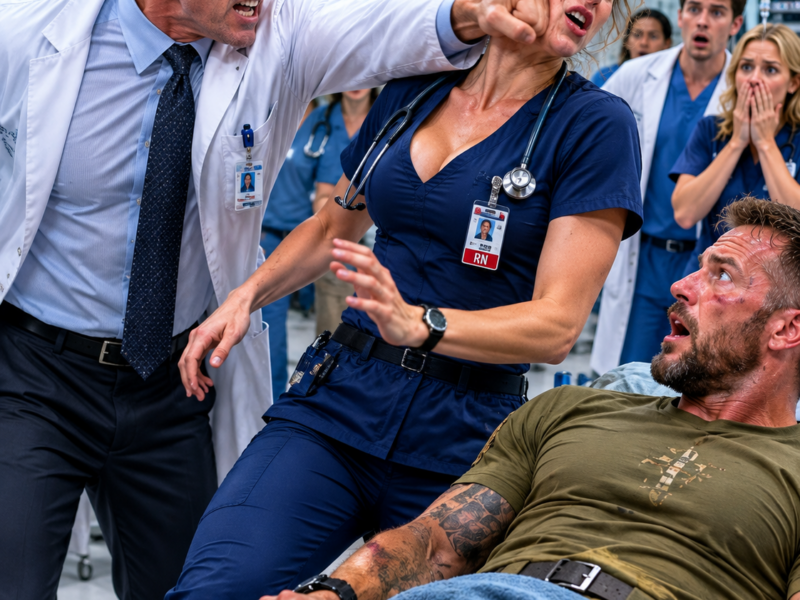
“Dr. Richard Coleman threatened to fire me in front of thirty patients at Harborview Medical Center after I made one decision he considered unforgivable
I stared at the photograph.
For a moment, the noise of the emergency department seemed to disappear.
There was the helicopter, the dusty landing zone, and six people standing shoulder to shoulder.
I recognized the woman immediately.
It was me.
Four years younger, with my hair pulled tightly beneath a military cap and a small American flag on my shoulder.
The scar on my left forearm was visible even in the faded photograph.
I reached for the edge of the table.
“Where did you get that?”
Frank Mitchell didn’t answer immediately.
He looked at Dr. Coleman, who was standing beside the bed with an expression of growing irritation.
“Doctor, I think we need a little privacy.”
Coleman folded his arms.
“This is my emergency department. I decide who stays in the room.”
Frank looked at him.
“Then perhaps you should start by listening to the people who work in it.”
Coleman’s jaw tightened.
“Mr. Mitchell, you’re injured and confused. Let us take care of you.”
“I’m injured. I’m not confused.”
I stepped between them.
“Mr. Mitchell, you need to sit down. Your shoulder hasn’t been examined yet.”
He looked at me again.
“You’re right. I’m sorry.”
Then he lowered his voice.
“But that photograph shouldn’t exist in a hospital.”
I swallowed.
“Why?”
Frank tapped the picture with one finger.
“Because the last time I saw the woman in it, I was told she hadn’t survived.”
My stomach tightened.
“That’s impossible.”
“Is it?”
I looked at the photograph again.
The woman standing beside the helicopter was wearing a uniform with a name patch.
CARTER.
My name.
But the man beside her was the person I hadn’t seen in four years.
Chief Petty Officer Daniel Hayes.
I remembered the dust in my mouth.
The heat against my skin.
The sound of a radio struggling to transmit through the mountains.
And the moment I had been pulled away from a burning vehicle.
“Where did you get this picture?” I asked again.
Frank sighed.
“From a man who died believing you were still alive.”
I looked at him.
“Who?”
“Chief Hayes.”
My knees felt weak.
Before I could ask another question, Dr. Coleman interrupted.
“That’s enough. Nurse Carter, return to your station.”
I turned toward him.
“Sir, I need to finish assessing Mr. Mitchell.”
“Another nurse can do that.”
Frank shook his head.
“I want her.”
Coleman gave a short laugh.
“You don’t get to choose your nurse.”
Frank looked directly at him.
“Actually, I do get to request one.”
Coleman turned toward the doorway.
“Security.”
I had never seen a patient request security to be called simply because he wanted to speak with a nurse.
But I also knew that something about Frank’s photograph had frightened him.
Not just surprised him.
Frightened him.
And I wanted to know why.
“Dr. Coleman,” I said, “I’ll finish the assessment, then I’ll return to my duties.”
He stared at me.
“You’re making a serious mistake.”
I checked Frank’s blood pressure and carefully examined his shoulder.
It was swollen, but there was no obvious deformity.
His forehead wound needed cleaning.
I arranged for imaging and pain management after confirming his medication history.
He watched me work.
When I finished, he spoke quietly.
“Still careful.”
I looked up.
“What?”
“You always checked everything twice.”
I lowered the blood pressure cuff.
“You knew me?”
Frank nodded.
“Not personally. But I knew your team.”
I pulled the curtain closed.
“Tell me what happened.”
He glanced toward the nurses’ station.
Then he reached for the photograph.
“Four years ago, I was part of a Navy support team assigned to a humanitarian evacuation operation overseas.”
I sat on the edge of the nearby chair.
“I remember.”
“Your team was responsible for getting civilians out before the fighting reached the valley.”
I nodded slowly.
“Yes.”
Frank continued.
“Your convoy was hit. The lead vehicle caught fire. Communications went down. Several people were injured.”
My throat tightened.
“How do you know all that?”
“Because I was on the recovery team.”
I looked at him.
The memories returned in pieces.
The explosion.
The windshield shattering.
Someone shouting my name.
My left arm trapped beneath a damaged section of the vehicle.
I remembered trying to pull another soldier free.
Then the second explosion.
Then nothing.
“I was told everyone had been evacuated,” I whispered.
Frank shook his head.
“Not everyone.”
I looked at him.
“Who didn’t make it?”
He closed his eyes.
“Two members of your team.”
I knew their names before he said them.
Sergeant Lucas Miller.
Corporal Ethan Brooks.
I had been their field medical officer.
I had promised both of them that we would get home.
I looked down at my scar.
“Why did you think I was dead?”
Frank took a breath.
“Because the initial report listed you as deceased after the recovery team found your identification tag near the vehicle.”
I stared at him.
“My tag?”
“Yes.”
“But I was evacuated.”
“That’s what I eventually learned.”
He rubbed his forehead.
“The records were inconsistent. One report said you had been transported to a military hospital. Another said your body hadn’t been recovered.”
I remembered waking up in a hospital room several days later.
My arm had been stitched, my ribs were bruised, and my head was wrapped in bandages.
I remembered a military doctor telling me that my unit had suffered casualties.
I remembered asking about Lucas and Ethan.
Nobody gave me a straight answer.
I had been transferred for rehabilitation shortly afterward.
By the time I was physically able to return to duty, the investigation was already underway.
And then I received a letter telling me my service was no longer required.
I had never understood why.
Frank looked at me.
“Emily, what happened after you were evacuated?”
I shook my head.
“I was treated, transferred, and eventually discharged. I tried to get information about the incident, but every request was delayed or denied.”
Frank leaned forward.
“Did anyone ever tell you that the investigation had been reopened?”
“No.”
He looked toward the doorway.
“Then someone made sure you never found out.”
Before I could respond, Dr. Coleman returned with a hospital security officer.
“Mr. Mitchell, you’re being transferred to another treatment room.”
Frank frowned.
“Why?”
“Because this conversation is interfering with patient care.”
I stood.
“He hasn’t finished his assessment.”
Coleman turned to me.
“You’re relieved of this patient.”
I felt every eye in the nearby area move toward us.
“Sir, with respect, I haven’t done anything inappropriate.”
He stepped closer.
“You have ignored a direct instruction twice tonight.”
“I have been treating a patient.”
“You’re a probationary nurse. I can end your employment before the end of this shift.”
The security officer looked uncomfortable.
Frank slowly reached for the photograph.
“Doctor, I wouldn’t do that.”
Coleman laughed.
“And why is that?”
Frank looked at him for several seconds.
“Because you don’t know who you’re threatening.”
Coleman rolled his eyes.
“I know exactly who she is. She’s a rookie nurse who thinks she knows more than the people running this hospital.”
Frank shook his head.
“No. You know her job title.”
Then he looked at me.
“And I think you deserve to know why I came here tonight.”
He reached into his pocket again and produced a small folded envelope.
My name was written across the front.
Emily Carter.
The handwriting was familiar.
I recognized it immediately.
My hands began to tremble.
“Where did you get that?”
Frank placed it beside the photograph.
“Daniel Hayes gave it to me.”
I picked it up carefully.
The envelope was old.
The edges were worn, and there was a faint brown stain near the bottom.
On the back, Daniel had written a date.
Four years earlier.
The same week I was discharged.
I looked at Frank.
“Why didn’t he send it to me?”
Frank’s expression softened.
“He tried.”
I opened the envelope.
Inside was a folded sheet of paper.
The first line was enough to make my eyes fill.
Emily, if you’re reading this, it means someone finally found a way to tell you what happened.
I couldn’t continue.
My vision blurred.
I sat down.
Frank waited.
Dr. Coleman looked increasingly impatient.
“Whatever this is, it can wait until after treatment.”
I looked up at him.
“No, Doctor. I think it has waited long enough.”
For the first time, he said nothing.
I unfolded the letter.
Daniel’s words were written in his familiar block handwriting.
He explained that after the evacuation, he had discovered discrepancies in the official casualty report.
The report stated that the convoy had entered the valley using an approved route.
But Daniel had seen the original route authorization.
It showed something else.
The evacuation path had been changed less than an hour before departure.
The change had been approved by someone who wasn’t supposed to have authority over the operation.
And the revised route had been sent to an outside contractor.
Daniel believed the information had been leaked.
He also believed the attack had not been random.
I stopped reading.
Frank watched me.
“Keep going.”
The next paragraph explained that Daniel had requested an investigation.
Instead of receiving answers, he had been ordered to turn over his communication logs.
He refused.
Three days later, his office was searched.
His laptop disappeared.
And the original recording from the operation was removed from the official archive.
The final paragraph was shorter.
There was someone inside our command structure who knew the route was compromised. Emily, you were never responsible for what happened to Lucas and Ethan. You were sent into a situation someone else had already prepared.
I covered my mouth.
For four years, I had replayed that day in my head.
I had wondered whether I should have chosen a different route.
Whether I should have ignored the order.
Whether I should have made the convoy wait.
Whether Lucas and Ethan might have survived if I had done one thing differently.
Now a man I trusted was telling me that someone had deliberately placed us in danger.
I looked at Frank.
“Who was it?”
He hesitated.
“Daniel never identified the person in the letter.”
“Why?”
“Because he didn’t have enough proof.”
Frank lowered his voice.
“But he believed the person had connections to this hospital.”
I looked at him.
“What?”
He nodded toward the nurses’ station.
“That’s why I asked for you.”
My eyes moved toward Dr. Coleman.
He was watching us.
His face had become unreadable.
I turned back to Frank.
“Are you saying someone here was involved?”
Frank nodded slowly.
“I don’t know how deep it goes. But I know Daniel was trying to find something before he died.”
I stared at him.
“Daniel is dead?”
Frank looked down.
“I’m sorry.”
The words landed harder than I expected.
I hadn’t known Daniel had died.
He had been one of the few people who had defended me when the investigation began.
He had told me not to blame myself.
I had never been able to thank him.
“When?”
“Eleven months ago.”
I closed my eyes.
“How?”
Frank hesitated.
“His car went off the road during a storm. The official report called it an accident.”
I looked at the letter again.
Something about the timing bothered me.
“Did he ever give you anything else?”
Frank reached into his pocket.
This time, he removed a small brass key.
It was attached to a metal tag.
The tag had three numbers engraved on it.
417.
“Daniel told me to keep this safe.”
I looked at the key.
“What does it open?”
“I don’t know.”
“Then why bring it here?”
Frank’s expression changed.
“Because someone followed me tonight.”
I stared at him.
“What?”
He glanced toward the corridor.
“I noticed the same black SUV behind me twice. When I parked outside the hospital, it pulled into the lot across the street.”
My mouth went dry.
“Did you call the police?”
“I planned to after I spoke with you.”
I stood.
“We need to tell hospital security.”
Frank nodded.
But before I could move, Dr. Coleman stepped forward.
“Give me the letter.”
I looked at him.
“Excuse me?”
“You heard me. This document contains information about a military operation. It doesn’t belong in a hospital.”
Frank stared at him.
“How do you know what’s in it?”
Coleman didn’t answer.
He reached for the paper.
I pulled it back.
“Don’t touch it.”
His face reddened.
“You’re out of line.”
“Then call the police.”
For several seconds, he simply stared at me.
Then he turned toward the security officer.
“Have her escorted out of the department.”
The officer hesitated.
“Doctor, she’s a staff nurse.”
“I am the department director.”
Frank slowly sat upright.
“Richard, I wouldn’t do that.”
Coleman’s face changed.
Not much.
Just enough for me to notice.
“You know my name?”
Frank nodded.
“I’ve seen you before.”
Coleman looked toward the door.
“That’s impossible.”
Frank studied him.
“Four years ago, you attended a briefing at Naval Station San Diego. You were there representing a medical logistics contractor.”
Coleman said nothing.
Frank continued.
“You asked several questions about the casualty reports. You wanted to know which soldiers had survived and which records were still being reviewed.”
The room seemed to lose its air.
I looked at Dr. Coleman.
“Why were you at that briefing?”
He straightened his jacket.
“I have no obligation to discuss my previous professional activities with a nurse.”
Frank’s voice hardened.
“You were standing beside the man who approved the route change.”
Coleman stepped back.
“That’s enough.”
I finally understood why he had been so determined to silence me.
It wasn’t because I was inexperienced.
It wasn’t because I had challenged his authority.
It was because he recognized something in the photograph.
Or perhaps he recognized the name on the envelope.
I picked up my phone.
“I’m calling hospital security and the police.”
Coleman reached for it.
I moved away.
“Don’t.”
His hand stopped.
For the first time since I had met him, he looked uncertain.
Then he did something I never expected.
He smiled.
“Emily, you’re making a mistake. You have no idea what you’re involved in.”
Frank looked at him.
“That’s exactly what someone says when they know the truth is coming.”
The security officer finally stepped between us.
“Doctor, I think we should wait for the administrator.”
Coleman turned sharply.
“Are you refusing a direct order?”
“I’m asking everyone to remain calm.”
He stared at the officer.
Then he walked out.
I watched him disappear down the corridor.
My hands were shaking.
Frank touched my arm gently.
“Now you understand why I needed to find you.”
I nodded.
But one question remained.
“Why did you come here tonight?”
Frank looked at the photograph.
“Because Daniel told me that if anything happened to him, I should find you.”
He paused.
“And because I think someone has been waiting for you to stop asking questions.”
The next morning, Harborview’s hospital administrator, Margaret Lewis, arrived earlier than usual.
She was a practical woman in her sixties who had spent twenty years running hospitals.
She listened to everything without interrupting.
Then she asked me to repeat the part about Dr. Coleman requesting the letter.
I did.
She wrote it down.
“Did he actually touch the document?”
“No. He tried to take it.”
Margaret nodded.
“All right. We’ll preserve the hallway footage and the incident records.”
She looked at Frank.
“Mr. Mitchell, I’m going to arrange for your care to continue with another physician. I also want hospital security to document your concerns.”
Frank nodded.
“Thank you.”
Margaret turned to me.
“Emily, I need to ask you something.”
“Yes?”
“Are you willing to give a formal statement?”
I looked at the envelope.
Then at Frank.
“Yes.”
She nodded.
“Then I’ll make sure you’re protected from retaliation while we investigate.”
For the first time in months, I felt someone in authority was actually listening.
The police arrived shortly afterward.
Frank gave a statement about the vehicle he had seen following him.
They also took photographs of the letter and the key.
The hospital preserved the original document.
I was asked to remain available while the investigators verified Daniel’s claims.
I spent the afternoon in a small conference room.
At 3:20 p.m., a federal investigator arrived.
Her name was Special Agent Laura Bennett.
She was in her forties, spoke quietly, and carried a thick folder.
She introduced herself and explained that an investigation into the original evacuation operation had recently been reopened after new information surfaced.
I looked at her.
“Why wasn’t I contacted?”
She glanced at the file.
“Because we didn’t know you were still in the country.”
I frowned.
“What does that mean?”
She explained that my military discharge records had been amended after the incident.
My last known address was listed as an overseas assignment.
Someone had apparently submitted a personnel update indicating that I had relocated.
I had never done that.
“Who submitted it?”
“We’re still investigating.”
She placed a document in front of me.
It was a copy of an access log.
My military personnel record had been accessed repeatedly over the previous year.
The last access had occurred three weeks earlier.
The user identification belonged to a contractor associated with Caldwell Medical Logistics.
I stared at the name.
“Is that connected to Dr. Coleman?”
Agent Bennett nodded.
“His previous employer.”
I felt my stomach tighten.
“Was he involved in the original operation?”
“We have reason to believe he assisted in the handling of medical records after the incident.”
I looked at her.
“Why would a hospital director be involved in military casualty records?”
“That’s what we’re trying to establish.”
She opened the folder.
“Emily, I need you to tell me exactly what you remember about the convoy.”
I took a breath.
Then I began.
I told her about the original route.
The last-minute change.
The radio transmission.
The explosion.
The way Lucas had tried to pull Ethan out of the vehicle.
I told her about the hospital.
The missing records.
The discharge letter.
And the years I had spent wondering whether my decisions had cost two men their lives.
Agent Bennett listened without interrupting.
When I finished, she asked one question.
“Did you ever see anyone outside your unit carrying the revised route?”
I thought carefully.
Then something came back to me.
A man in a white shirt standing beside the command vehicle.
He had a clipboard.
He wasn’t wearing a uniform.
I remembered him because he had asked me to sign a delivery receipt.
I had refused because the paperwork didn’t match the equipment list.
I had forgotten about that encounter completely.
“Yes,” I said.
Agent Bennett leaned forward.
“Can you describe him?”
“Average height. Dark hair. Maybe in his forties. He had a small scar near his chin.”
She turned a page.
Then she showed me a photograph.
My breath caught.
It was Richard Coleman.
He had been younger, but there was no mistaking him.
I looked at the photograph for a long time.
“He was there.”
Agent Bennett nodded.
“We suspected that.”
I felt sick.
“Why was he at the command center?”
“He was working as a medical logistics consultant for the contractor responsible for emergency evacuation supplies.”
I shook my head.
“He had access to the route?”
“Not officially.”
“Then how?”
Agent Bennett closed the folder.
“That’s part of the investigation.”
She stood.
“Emily, we have enough to question him. But we need to be careful. If he has been accessing records improperly, he may have retained information about witnesses.”
I looked at her.
“Are you saying he’s dangerous?”
“I’m saying we don’t yet know how far his involvement goes.”
That evening, I returned to the nurses’ station.
Rachel, another nurse who had trained me during my first weeks at Harborview, approached.
“Hey. Are you okay?”
I nodded.
“Just tired.”
She lowered her voice.
“I heard Coleman was removed from the schedule.”
I looked at her.
“What?”
“Margaret put him on administrative leave pending an investigation.”
I exhaled.
“Good.”
Rachel glanced toward the ICU.
“How’s Mr. Mitchell?”
“Stable. His shoulder is fractured, but he’s doing well.”
She nodded.
Then she looked at my arm.
“Can I ask something?”
I hesitated.
“Sure.”
“That scar. Was it from the military?”
I looked down.
For years, I had kept it hidden beneath long sleeves.
I had hated the way it reminded me of the worst day of my life.
“Yes.”
Rachel nodded.
“You don’t have to tell me anything.”
I appreciated that.
“Thank you.”
She smiled.
Then she handed me a fresh cup of coffee.
“On the house.”
I laughed quietly.
For the first time, I didn’t feel like I had to hide.
Two days later, Frank was cleared for discharge.
His shoulder was healing, and his forehead wound had been closed with several stitches.
Before leaving, he asked me to sit with him for a few minutes.
He handed me the photograph.
“Keep this.”
I looked at it.
“Are you sure?”
He nodded.
“Daniel wanted you to have it.”
I ran my thumb along the edge.
“Why didn’t he come find me himself?”
Frank looked out the window.
“Because he was afraid.”
I turned toward him.
“Of what?”
“That the people responsible for what happened would hurt you again.”
I looked down.
Frank continued.
“He told me you had a habit of taking responsibility for everything.”
I smiled sadly.
“That sounds like Daniel.”
“He also said you were the strongest person on the team.”
I shook my head.
“He shouldn’t have said that.”
Frank raised an eyebrow.
“Why not?”
“Because I wasn’t strong enough to save Lucas and Ethan.”
He leaned forward.
“Emily, I was there when your team was recovered. I saw what you did.”
I looked at him.
“You were unconscious when they found you. Your arm was badly injured, and you had been trying to get another soldier out of the vehicle.”
My eyes filled.
Frank continued.
“You didn’t leave them. You stayed until you couldn’t stay anymore.”
I covered my mouth.
For four years, I had remembered the explosion.
I had remembered the moment I lost consciousness.
But I had never known what happened in the minutes before the rescue team reached us.
“Daniel told me something else,” Frank said.
“What?”
“He said you were the reason he survived.”
I looked at him.
Frank smiled faintly.
“You pulled him out of the communications vehicle before the second explosion.”
I stared at the photograph.
A memory surfaced.
A hand gripping my uniform.
A voice shouting for help.
Smoke.
A damaged door.
I had remembered helping someone.
I had never known it was Daniel.
Frank stood carefully.
“Don’t spend another four years punishing yourself for something you couldn’t control.”
I nodded.
“I’ll try.”
He extended his good hand.
I shook it.
Then he looked at me with a seriousness I wouldn’t forget.
“That scar doesn’t tell the story of how you were injured, Emily.”
I glanced at my arm.
“It tells the story of the person who kept trying to save people even when she was hurt.”
I couldn’t find words.
He left the hospital shortly afterward.
But the investigation was far from over.
Three weeks later, Agent Bennett called me.
They had recovered additional communications from an archived military server.
The recordings showed that the original route had been changed by a senior officer after receiving information from an outside contractor.
The officer was Colonel Robert Vance.
Coleman had not issued the order, but he had helped process the altered medical evacuation records afterward.
More importantly, the investigators had found evidence that he had known the casualty report was incomplete.
He had also accessed my personnel file several times, apparently attempting to locate me.
When confronted, Coleman initially denied everything.
Then investigators showed him the original delivery receipt I had refused to sign.
It contained his signature.
He eventually admitted he had been present at the command center.
He claimed he had only been following instructions from the contractor.
But the financial records told a different story.
Payments had been made to a company he secretly controlled.
The money had passed through several accounts before reaching him.
He had helped conceal the route change and remove records that could expose the people responsible.
He also knew that Daniel had kept copies of the original communications.
The hospital had been a convenient place to keep me quiet.
Coleman had assumed I was an inexperienced nurse who would be too afraid to challenge him.
He had never considered that the scar he dismissed as an ugly old injury might connect him to the evidence that could destroy his carefully constructed career.
The day investigators arrested him, I was working the evening shift.
I heard the commotion near the main entrance.
Rachel came running over.
“Emily.”
I looked up.
“What happened?”
“They’re taking Coleman out.”
I walked toward the hallway.
Two federal agents were escorting him past the nurses’ station.
He looked older than I remembered.
His expensive jacket was gone.
His expression was tight.
When he saw me, he stopped.
“Emily.”
I said nothing.
He looked at my name badge.
“I hope you understand. I was following instructions.”
I stared at him.
“Lucas and Ethan followed instructions, too.”
His face changed.
I continued.
“And they never got the chance to go home.”
He looked away.
One of the agents guided him forward.
I didn’t feel victorious.
I didn’t feel powerful.
I simply felt tired.
The kind of tiredness that comes when something you’ve carried for years finally leaves your hands.
The legal process took several months.
Colonel Vance and the contractor involved in the route change faced separate proceedings.
Coleman was charged with conspiracy-related offenses, obstruction, and falsifying records connected to the investigation.
The evidence established that he had knowingly helped conceal information after the operation.
He eventually entered a plea agreement and agreed to cooperate with investigators.
The findings also formally cleared me of wrongdoing in the evacuation incident.
I received a copy of the amended report.
It stated that I had acted within my authority and had made reasonable decisions based on the information available at the time.
I read the sentence several times.
Then I placed the report beside the photograph.
I thought I would cry.
Instead, I sat quietly at my kitchen table and watched the afternoon sunlight move across the floor.
For four years, I had believed I had failed two men who trusted me.
Now I understood that I had been betrayed by people who were supposed to protect all of us.
It didn’t make the loss smaller.
But it finally allowed me to stop blaming myself for it.
A month later, Frank returned to Harborview for a follow-up appointment.
His shoulder had healed well.
He found me in the emergency department and held up his arm.
“Good as new.”
I smiled.
“That’s not what your X-ray said last time.”
He laughed.
“Doctors always exaggerate.”
I shook my head.
“You’re impossible.”
He looked around the department.
“How are things?”
“Busy. As usual.”
“Good.”
He hesitated.
Then he reached into his jacket and handed me a small envelope.
Inside was a photograph of Daniel standing beside a helicopter.
On the back, he had written a message.
To Emily Carter. The bravest people aren’t the ones who never get hurt. They’re the ones who keep showing up after they do.
I held it carefully.
“Frank…”
He shrugged.
“Daniel wanted you to know.”
I looked at the photograph.
“Thank you.”
Frank nodded.
Then he asked something I hadn’t expected.
“Are you still hiding that scar?”
I glanced at my forearm.
“No.”
He smiled.
“Good.”
That night, a young patient arrived with a badly injured hand.
His mother was crying, and he kept apologizing because he thought he had ruined their evening.
I pulled a chair beside his bed.
“Hey. You don’t have to apologize for being hurt.”
He looked at me.
“Are you sure?”
I nodded.
“I’m sure.”
As I reached for the bandage supplies, my sleeve moved back.
The scar was visible beneath the hospital lights.
For once, I didn’t pull the fabric down.
It was simply part of me.
I still worked as a nurse at Harborview.
I still made mistakes sometimes, asked questions, learned from more experienced colleagues, and drank coffee that tasted like it had been brewed in a parking lot.
But I no longer confused being new with being powerless.
And I never again allowed someone to convince me that protecting a patient was an act of disrespect.
Months later, the hospital held a small ceremony honoring the nurses and staff who had helped expose the misconduct.
I didn’t want to attend.
I wasn’t comfortable standing in front of a crowd.
But Rachel insisted.
When my name was called, I walked onto the stage in my navy-blue scrubs.
Margaret Lewis handed me a certificate.
Then Frank Mitchell, who had been invited as a guest, stood from the front row.
He didn’t salute.
He simply placed his hand over his heart.
I looked down at the scar on my arm.
For years, I had thought it was the part of my past that made me different from everyone else.
Now I understood that it was only one small piece of a much larger story.
The photograph, the letter, the missing records, and the men who had finally been held accountable would always be part of my life.
But they would no longer decide who I was.
When I stepped off the stage, Rachel was waiting.
She looked at my arm and smiled.
“Looks like you don’t have to hide it anymore.”
I shook my head.
“No. I don’t.”
And for the first time since that convoy entered the valley, I walked through the hospital doors without feeling that I was leaving part of myself behind.
THE ENd.









