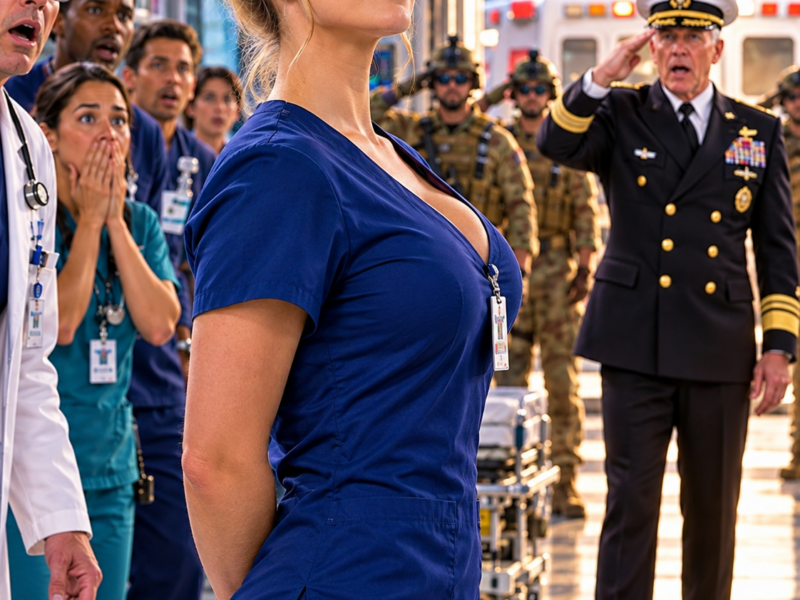
“Dr. Richard Caldwell laughed when the new nurse mispronounced a military abbreviation in front of the entire emergency department
The hangar had been abandoned for six years, but the lights were on when I arrived.
That was the first sign that someone had been expecting me.
The second was the black SUV parked beside the entrance.
I stopped at the edge of the runway, rain soaking through my jacket. Lucas Reed’s identification tag pressed against my palm. I had carried it all the way from the hospital, gripping it so tightly that its edges had left marks in my skin.
Six years ago, I had walked away from Blackwater Ridge believing Lucas was dead.
Now a four-star admiral had called me Angel Six, a doctor I barely knew had tried to silence me, and a photograph of my mother had connected all of them to a secret someone had spent years protecting.
I pushed open the hangar door.
“Emma.”
The voice came from the shadows.
Colonel Nathaniel Shaw stepped into the light.
He looked older than I remembered from the photographs in the classified reports, but his expression was unchanged. Calm. Controlled. The expression of a man who believed the world could be arranged according to his wishes.
Two armed men stood behind him.
I didn’t reach for the small pistol concealed beneath my jacket. I knew they had already seen it.
“You came alone,” Shaw said.
“You asked me to.”
“I wasn’t sure you would.”
“You’ve spent six years making sure I had no reason to trust anyone. Why should tonight be different?”
His eyes dropped to the chain around my neck.
“You found the tag.”
I closed my fingers around it.
“Tell me where Lucas is.”
Shaw smiled faintly.
“You always were impatient. Your mother had the same weakness.”
Hearing him speak about her made something cold settle inside me.
“Don’t say her name.”
“Angel Six,” he said. “A remarkable woman. More remarkable than you know.”
“My mother was a Navy nurse. She died when I was young.”
“That is what you were told.”
I took one step forward.
“What are you saying?”
Shaw gestured toward a metal table in the center of the hangar. On it sat an old laptop, a stack of folders, and a photograph sealed inside a plastic sleeve.
I recognized the photograph immediately.
My mother stood in front of a military transport aircraft, wearing a flight jacket. A younger Admiral Jonathan Pierce stood beside her. Between them was a little girl with dark hair and a crooked smile.
Me.
I had never seen the picture before.
“Your mother wasn’t simply a nurse,” Shaw said. “She was the original Angel Six. She led a medical extraction unit that recovered wounded personnel from locations where conventional teams couldn’t operate.”
I stared at the photograph.
“Why was that hidden from me?”
“Because she discovered what we were doing.”
“What were you doing?”
Shaw’s smile disappeared.
“Blackwater Ridge was supposed to be a routine recovery operation. A small team was sent to extract a source who had information about an illegal weapons network. The source was never the objective. The objective was the information he carried.”
“And the people who died?”
“Collateral.”
The word struck harder than a shout.
I remembered the smoke. The radio cutting in and out. The wounded soldiers calling for help while our extraction route disappeared beneath enemy fire.
I remembered Lucas dragging a man twice his size toward the helicopter.
I remembered turning around and seeing him run back into the burning building.
“Lucas wasn’t collateral,” I said.
“No. He was a problem.”
My throat tightened.
“You left him there.”
“We left a lot of people there.”
I moved toward the table, but one of the guards stepped into my path.
Shaw raised a hand, stopping him.
“Let her look.”
I opened the folder.
Inside were operation reports, medical records, photographs, and pages covered in blacked-out paragraphs. Several documents carried the same authorization code: E6-0417.
Lucas’s identification number.
Beneath them was a photograph of a man sitting in a hospital bed. His face was thinner, his hair longer, and a scar ran from his temple to his jaw.
But I knew his eyes.
Lucas.
Alive.
I couldn’t breathe.
“When?” I whispered.
“Three days after the operation,” Shaw replied. “He was recovered by a private team and transferred to a secure medical facility.”
“You knew he was alive.”
“Yes.”
“For six years?”
“Yes.”
The room seemed to tilt.
I had spent six years waking from nightmares, wondering whether I had abandoned him. I had replayed every decision, every order, every second when I might have done something differently.
And all that time, he had been alive.
“Where is he?”
“Safe.”
“Where?”
“That depends on what you intend to do with what you’ve learned.”
I slammed the folder onto the table.
“You don’t get to bargain with me.”
Shaw leaned closer.
“Your mother made the same mistake. She believed knowing the truth was enough to change things.”
“What happened to her?”
For the first time, his expression shifted.
“She found evidence that the Blackwater Ridge mission had been deliberately compromised. She intended to give it to Admiral Pierce. Before she could, her transport was involved in an accident.”
“An accident?”
“That’s the official report.”
“And the real report?”
Shaw said nothing.
I felt the old grief rise inside me, but this time it had somewhere to go.
“You killed her.”
“I didn’t pull the trigger.”
“That isn’t an answer.”
“No,” he said quietly. “It isn’t.”
A door opened behind me.
I turned.
Dr. Richard Caldwell walked into the hangar.
He wore no white coat now. His dark suit was soaked from the rain, and his face had lost the smug confidence he displayed at the hospital.
“You should have stayed in your ward,” he said.
I looked from him to Shaw.
“So that’s why you were there.”
Caldwell adjusted his cuffs.
“I was there to make sure Admiral Pierce didn’t say anything unnecessary.”
“He was injured.”
“He was inconvenient.”
“He trusted me.”
“He trusted your mother too. Look where that got her.”
I felt my hands curl into fists.
“You knew who I was.”
“Of course. Your employment file was flagged the moment you applied. We knew you had returned to military medicine, but we didn’t expect you to recognize the old call sign.”
“Then why humiliate me in front of the staff?”
“To see whether you would react. People who have nothing to hide don’t usually become defensive.”
“You were testing me.”
“And you failed to remain quiet.”
I looked at Shaw.
“Did you send him to the hospital?”
“Caldwell has been useful,” Shaw said. “He helped manage Admiral Pierce’s medical care and controlled who had access to him.”
“He tried to keep me away from the admiral.”
“Because Pierce was trying to reach you.”
I remembered the admiral’s trembling hand closing around mine.
Angel Six.
Only you.
I had thought he was confused from the pain medication. Now I understood he had been trying to warn me.
“Where is Admiral Pierce?”
Caldwell gave a small laugh.
“Being treated. Somewhere secure.”
“You kidnapped him?”
“We moved him for his protection.”
“From whom?”
“People who ask too many questions.”
I reached into my jacket and touched my phone.
Shaw noticed.
“Put it on the table.”
I didn’t move.
“Now, Emma.”
“You’re worried about a phone?”
“I’m worried about what you may have sent.”
I looked at the laptop.
Its screen was dark, but a small green light blinked beside the keyboard.
The laptop wasn’t waiting for me to open the files.
It was already connected to something.
A recording system.
My mother had been careful. I had seen the small device in her photograph, clipped inside the pocket of her flight jacket. At the time, I thought it was a medical radio.
Now I recognized the design.
It was a secure field recorder.
“Did she record you?” I asked.
Shaw’s eyes narrowed.
“Your mother was sentimental.”
“That’s not what I asked.”
He stepped toward me.
“Give me the phone.”
I slowly placed it on the table.
Then I pressed the side button twice.
A small red light appeared on the screen.
Caldwell lunged.
One of the guards grabbed my arm, but I twisted away and drove my elbow into his chest. He stumbled into the table, sending the folders scattering across the floor.
Shaw shouted something.
A gun came up.
Before anyone could fire, the hangar lights went out.
The darkness lasted only a second.
Then emergency lights flashed red along the walls.
A voice came through the overhead speakers.
“Colonel Shaw, this is Admiral Pierce. Stand down.”
Shaw froze.
I knew that voice.
“Your men are surrounded,” the admiral continued. “The FBI has the building secured. Do not attempt to leave.”
Caldwell backed toward the side door.
Shaw grabbed the nearest guard and shoved him toward me.
“Get her!”
The guard reached for my jacket.
I ducked beneath his arm and ran toward the far wall. A sharp crack split the air. Something struck the metal beam beside my head.
I dropped behind a stack of equipment cases.
Then I heard footsteps.
Not one pair.
Several.
“Federal agents! Drop your weapons!”
The guard beside the table lowered his gun.
Caldwell tried to run.
He made it three steps before two agents tackled him to the concrete.
Shaw didn’t move.
He stood beneath the red emergency lights, staring at the photograph of my mother that had fallen to the floor.
“You have no idea what you’ve done,” he said.
I stepped out from behind the cases.
“I know exactly what I’ve done.”
“You’ve exposed an operation that kept this country safe.”
“You buried soldiers.”
“I made decisions.”
“You erased my mother’s life. You let families believe their loved ones were dead. You turned a hospital into a place where wounded people couldn’t trust their own doctors.”
His jaw tightened.
“Your mother understood the stakes.”
“No. She understood the people paying them.”
An agent approached and ordered Shaw to turn around.
For a moment, he looked as though he might resist. Then he slowly raised his hands.
As the agents placed him in handcuffs, he turned toward me.
“Lucas will never forgive you.”
I stared at him.
“You don’t get to speak for Lucas anymore.”
The agents led him away.
I remained in the hangar, surrounded by scattered papers and the sound of rain striking the roof.
My knees finally weakened.
I sat on the concrete and pressed Lucas’s tag against my chest.
For six years, I had believed I had failed him.
Now I knew someone had stolen the chance for me to find him.
A woman in a dark coat approached and crouched beside me.
“Emma Bennett?”
I nodded.
“Special Agent Mara Collins. We’ve been investigating Shaw’s unit for fourteen months. Admiral Pierce gave us the location of this hangar before he was taken from the hospital.”
I looked up.
“Is he alive?”
“Admiral Pierce is stable. He’s at the medical center under federal protection.”
“And Lucas?”
Her expression softened.
“We found him.”
The words barely reached me.
“Where?”
“He’s at a rehabilitation facility outside Norfolk. He was transferred there after the original operation. He has been under a protected identity.”
I stood too quickly.
“Take me to him.”
“We will. But there’s something you should know.”
I stopped.
“Is he hurt?”
“His injuries were serious. He spent months in recovery and underwent several operations. He’s had difficulty walking, and his memory of the first weeks after Blackwater Ridge is incomplete.”
I swallowed.
“Does he know I’m alive?”
Agent Collins hesitated.
“He asked about you.”
The hangar seemed to disappear around me.
“What did you tell him?”
“That we were trying to locate you.”
I closed my eyes.
For six years, I had imagined the moment I would see Lucas again. Sometimes he was angry. Sometimes he was silent. Sometimes he turned away before I could explain why I had left him behind.
I had never imagined he might be waiting for me too.
“Please,” I said. “Take me to him.”
The drive to Norfolk felt longer than the six years that had come before it.
Agent Collins drove while I sat in the passenger seat, holding the tag in both hands. The rain faded into a thin mist. Streetlights passed over the windshield, one after another.
At the facility, a nurse led me down a quiet corridor.
“Mr. Reed knows someone is coming,” she said. “He asked for a few minutes alone before the visit.”
I nodded, unable to trust my voice.
She stopped outside a room.
“He’s had a difficult day. Please take your time.”
Then she opened the door.
Lucas sat beside the window in a wheelchair.
His hair was shorter than in the photograph. A pale scar crossed his jaw, and one leg rested on a support cushion. His hands looked thinner, but the small silver ring on his right thumb was still there.
He was looking outside.
“Lucas,” I whispered.
He turned.
For a moment, neither of us moved.
Then his eyes dropped to the tag in my hand.
“You kept it.”
My breath caught.
“I thought you were dead.”
“I thought you were.”
His voice was rough, quieter than I remembered.
I took one step into the room.
“I’m sorry.”
He looked at me for a long time.
“Don’t.”
“I left you there.”
“You followed the extraction order.”
“I heard you on the radio. I heard you calling for help.”
“And you came back.”
I shook my head.
“Not far enough.”
“You came back twice, Emma. The second time, the helicopter was already taking fire. I saw you trying to reach the ramp. I remember that.”
“I should have stayed.”
“And then we’d both have died.”
He looked down at his hands.
“I spent a long time being angry. Not at you. At everyone. At the people who sent us there, the people who left us, and the people who told our families we were gone.”
“I didn’t know you were alive.”
“I know.”
“I looked for you.”
“I know that too.”
I stepped closer.
“Then why didn’t you contact me?”
His eyes filled with something I couldn’t name.
“I tried. At first, I couldn’t speak properly. Later, they told me the operation was still under investigation and that contacting anyone could put them in danger. They said they’d find a way to reach you.”
“Who told you that?”
“Shaw’s people.”
I felt sick.
“They kept us apart.”
Lucas nodded.
“After a while, I stopped believing anyone was coming.”
I lowered myself into the chair beside him.
“I came back to military medicine because I couldn’t imagine doing anything else. I thought if I could save enough people, maybe I could stop hearing the ones I couldn’t save.”
Lucas looked at me.
“You saved people, Emma.”
“Not you.”
“I survived.”
The words were simple.
They were enough to break something open inside me.
I began to cry, silently at first, then with the kind of grief I had spent six years refusing to feel.
Lucas reached across the space between us.
His fingers touched mine.
“I wanted to see you,” he said. “I just didn’t know what I would say.”
“You don’t have to say anything.”
“I have one question.”
I looked at him.
“Why did you keep the call sign?”
I glanced down at the tag.
“Because it was the last thing I heard you say before the radio went silent.”
He closed his eyes.
“I remember.”
For a while, we sat without speaking.
There were things we would have to learn about each other again. There would be difficult conversations, physical therapy, investigations, and days when the past returned without warning.
But for the first time in six years, the future did not feel like a locked room.
The next morning, I returned to Harbor Point Military Medical Center.
The hospital looked exactly as it had before: polished floors, bright lights, nurses moving between rooms, and the steady rhythm of monitors behind closed doors.
But nothing felt the same.
Dr. Caldwell had been removed from duty. Investigators had seized his office and the records he had altered. Several members of the hospital administration were being questioned about the unauthorized restrictions placed on Admiral Pierce’s care.
The staff had heard rumors.
Some had seen the federal agents.
Others had watched Caldwell leave in handcuffs.
No one knew the full story yet.
I didn’t intend to tell it in a hallway.
I went directly to the intensive care unit.
Admiral Pierce was sitting upright in bed, a blanket across his lap. He looked exhausted, but his eyes were clear.
When he saw me, he smiled faintly.
“Angel Six.”
I pulled a chair beside his bed.
“You owe me an explanation, Admiral.”
“I owe you several.”
“Start with my mother.”
His smile faded.
“Your mother saved my life.”
I waited.
“During the operation at Blackwater Ridge, she was assigned to a medical extraction team. She discovered that Shaw had altered the mission orders. The team was sent into an area that had already been compromised. She warned me, but I didn’t act quickly enough.”
“Why?”
“Because I believed the intelligence was reliable. I believed the people giving me orders were telling the truth.”
“And after the operation?”
“Your mother collected the evidence. She had names, communications, and proof that the extraction had been deliberately delayed. She wanted to take it to an independent investigation.”
“Then she died.”
Pierce lowered his eyes.
“Her aircraft went down during a transfer. The investigation was controlled by Shaw’s office. I was told there was no evidence of sabotage.”
“You believed them?”
“I wanted to believe them. It was easier than admitting I had failed her.”
I looked at him.
“Did you know I was her daughter?”
“Yes.”
“From the beginning?”
“Yes.”
“Then why didn’t you contact me?”
“Because Shaw had access to your records. He knew where you lived, where you worked, and who you spoke to. I thought keeping you away from the investigation would protect you.”
“It didn’t protect me. It left me alone with the questions.”
He nodded slowly.
“You’re right.”
For the first time since I had met him, the admiral looked less like a man accustomed to giving orders and more like someone trying to accept the weight of a mistake.
“I kept a copy of your mother’s final recording,” he said. “I should have given it to you years ago.”
He reached toward the bedside drawer.
A nurse brought him a small evidence envelope that had been placed there by Agent Collins.
Inside was a memory card.
“Your mother recorded a message,” he said. “Not for me. For you.”
I stared at it.
“Have you listened to it?”
“No.”
“Why not?”
“Because it was addressed to her daughter.”
I took the envelope carefully.
The nurse brought a hospital tablet, and an agent helped me open the file. The screen flickered before my mother’s face appeared.
She was sitting inside a small room. Her hair was tied back, and there was a tiredness around her eyes I had never seen in the photographs at home.
But she was smiling.
“Hello, sweetheart.”
My hand flew to my mouth.
“I don’t know when you’ll see this,” she continued. “I hope it’s when you’re older. I hope I’m there to explain it myself, but if I’m not, I need you to know something.”
She paused and looked down.
“I chose my work because I wanted to help people come home. Sometimes that meant going places other people couldn’t go. Sometimes it meant standing between frightened people and the things they were afraid of.”
Her eyes returned to the camera.
“But none of that was more important than you. Not the uniform, not the mission, not the call sign. You were always my greatest reason to come home.”
I couldn’t stop crying.
“People may tell you that courage means never being afraid. That’s not true. Courage is being afraid and still choosing what is right. And being right doesn’t always mean being alone. Let people help you. Trust the ones who earn it. And never let anyone convince you that your life belongs to their mission.”
She leaned closer to the camera.
“I love you, Emma. Whatever happens, remember that.”
The recording ended.
For several seconds, I couldn’t move.
The admiral looked away, giving me privacy even though we were the only people in the room.
I held the tablet against my chest.
My mother had left me something better than an explanation.
She had left me permission to live.
The investigation lasted for months.
Agent Collins and her team uncovered financial records, falsified mission reports, and communications linking Shaw to the private contractors who had recovered Lucas. They found evidence that Caldwell had altered medical files and restricted access to Admiral Pierce in order to keep him from speaking.
The recording from the hangar, along with the documents recovered there, became central evidence.
Shaw was charged with conspiracy, obstruction of justice, and the deliberate concealment of military records. Caldwell faced charges related to the falsification of medical records and his role in the effort to silence Pierce.
Other officers were investigated. Some had knowingly followed illegal orders. Others had been misled, just as I had been.
The truth was complicated.
It was not a story in which every person was a villain or every decision had a simple answer.
But the evidence was clear about one thing: the people who had been abandoned deserved to have their names restored.
The families of the missing were finally contacted.
Some received answers they had waited years to hear. Others learned that their loved ones would never return.
I attended several of those meetings.
I didn’t pretend to know how to make grief easier. I simply sat with them, listened, and made sure no one had to hear the truth alone.
Lucas began physical therapy twice a week.
The first time I visited him after his session, he was furious because he couldn’t complete a set of exercises.
“I used to carry people twice my size,” he muttered.
“You still can,” I said.
“Not today.”
“Then today you work on standing.”
He looked at me, annoyed.
“You always were good at giving orders.”
“Only when people need them.”
He laughed, and the sound filled the room in a way I hadn’t realized I missed.
It took time.
Some days he made progress. Other days he struggled to get out of bed. I learned not to measure recovery by how far he walked, but by the small things: the first time he stood without help, the first time he slept through the night, the first time he talked about Blackwater Ridge without looking as though he were back there.
I also learned that I didn’t have to be his nurse.
I could simply be Emma.
One afternoon, several months after the hangar, Lucas asked me to walk with him along the garden path outside the rehabilitation center.
He used a cane.
We moved slowly.
At the end of the path, he stopped beside a bench.
“I’ve been thinking about what happens next,” he said.
“So have I.”
“I don’t want the rest of my life to be about that operation.”
“Neither do I.”
“I want to go somewhere with no military gates, no security badges, and no one calling me by a number.”
I smiled.
“That sounds reasonable.”
He looked at me.
“Would you come?”
I took his hand.
“Yes.”
We sat together as the afternoon sun slipped behind the trees.
For years, I had thought the call sign Angel Six was something I had to earn by being fearless. I had believed it meant running toward danger, carrying the wounded, and refusing to break.
Now I understood that it had belonged to my mother before it ever belonged to me.
It was not a command.
It was a promise.
To bring people home.
To tell the truth.
And, when the time came, to let yourself come home too.
A year after the night at the hangar, Harbor Point held a memorial for the service members whose names had been hidden or wrongly recorded after Blackwater Ridge.
Their families stood beneath a row of flags.
Admiral Pierce attended in uniform, walking slowly but without assistance. Lucas stood beside me, leaning lightly on his cane.
A new plaque had been placed near the entrance.
It carried the names of the people who had been abandoned, including those who had survived but had been erased from the official record.
At the bottom was one final line:
For those who brought them home.
I placed my mother’s old identification badge beneath the plaque.
For a moment, I thought I heard her voice in the quiet.
Not a command.
Not a warning.
Just the gentle voice from the recording, telling me that I had always been her greatest reason to come home.
Lucas slipped his hand into mine.
“Ready?”
I looked at the names one last time.
Then I looked at him.
“Yes.”
We walked away together.
And for the first time since Blackwater Ridge, when someone called my name, I didn’t turn around expecting another order.
I simply kept walking toward the life we had finally been given.
THE END.









