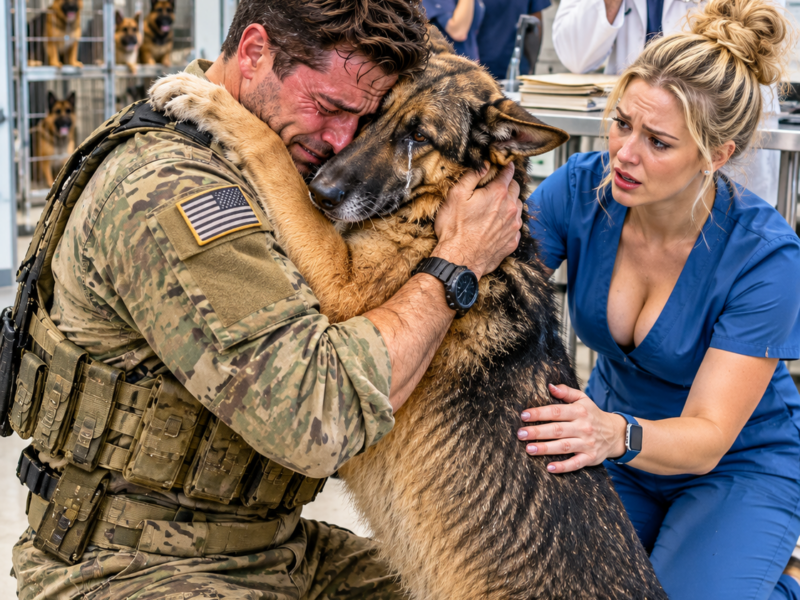
“Don’t Let Them Put My K9 Down—He Knows What Happened to the Other 45 Dogs”
The green light began flashing faster.
For three seconds, nobody moved.
Then Rook let out a sharp bark.
It was the first time he had barked since Daniel brought him into the facility.
Daniel immediately lowered himself beside him.
“Easy, buddy. What is it?”
Rook struggled to turn his head toward the harness. His breathing was shallow, and his legs trembled beneath him, but his eyes remained fixed on the little black device.
Commander Harris stepped forward.
“Remove that equipment immediately.”
Daniel looked up.
“Why?”
“Because it is classified military property.”
“Then explain why it’s attached to my dog’s harness.”
Harris didn’t answer.
Instead, he reached toward the device.
Daniel moved between them.
“Don’t touch him.”
The commander’s expression hardened.
“Petty Officer Brooks, you are interfering with an official military matter.”
“And you’re standing in a veterinary room trying to take something off a sick dog without explaining what it is.”
I had never heard Daniel speak to a superior officer like that.
But I understood why.
Rook wasn’t just an animal in that room.
He was Daniel’s partner. The one who had followed him through dangerous missions, slept beside him during deployments, and trusted him with his life.
And now someone wanted to take away the only thing Rook seemed desperate to show us.
Dr. Lewis stepped closer.
“Commander, the dog is medically unstable. Any unnecessary movement could cause further distress.”
Harris looked at her.
“Then sedate him.”
“No,” I said before I could stop myself.
Everyone turned toward me.
I swallowed.
“He’s already weak. We don’t know what that device is doing. We shouldn’t interfere with it until we understand why it’s attached.”
Harris stared at me for a long moment.
Then he made a phone call.
“I want security in treatment room three. Immediately.”
My stomach tightened.
This was no longer about a medical record.
Someone was afraid of what we might discover.
And I had a terrible feeling that Rook was the reason.
Within minutes, two military security officers arrived.
Harris ordered them to secure the harness.
Daniel refused to let them approach.
“You’re not taking it off him.”
One officer glanced at Rook, then at Daniel.
“Sir, we’ve been instructed to collect the equipment.”
“Then collect it after a veterinarian confirms it’s safe.”
Dr. Lewis nodded.
“I agree. We need to examine the device without removing the harness.”
Harris looked furious, but he couldn’t openly challenge the veterinarian’s medical authority in front of the officers.
He stepped into the hallway.
I watched him through the narrow window in the door.
He was speaking rapidly into his phone.
Then he looked directly at me.
I turned away.
“Emily,” Dr. Lewis whispered. “Take Rook’s current blood pressure and oxygen levels. I need to know how stable he is.”
I moved to the examination cart.
His numbers were concerning, but not as bad as I expected.
Something else was happening.
Rook’s neurological responses had been deteriorating for weeks. Yet whenever Daniel spoke, his eyes followed him. When I touched his left shoulder, he reacted. When I placed my hand near the harness, he became unusually alert.
I had an idea.
“Daniel, can you ask him to lie down?”
Daniel knelt.
“Down, buddy.”
Rook slowly lowered himself onto the blanket.
“Good boy.”
I carefully examined the device without touching its buttons.
There was a tiny seam around the outer casing. A manufacturer mark had been scratched away, but beneath it I could make out three letters.
VTX.
I had seen those letters before.
They appeared in several supply invoices attached to Project Sentinel.
A private defense contractor called Vortex Applied Systems.
I remembered the name because one of its invoices had been flagged for unusual medical equipment shipments.
The company had supplied portable detection containers used during the evaluation program.
I looked at Dr. Lewis.
“Do you remember the equipment vendor in the Sentinel records?”
She nodded slowly.
“Vortex.”
Daniel looked between us.
“What’s Vortex?”
“A private contractor,” I answered. “They supplied equipment for the program that involved the forty-six dogs.”
Daniel looked down at Rook.
“Was he exposed to something during those evaluations?”
Nobody answered.
He looked at me again.
“Emily, I need the truth.”
I wished I could give it to him.
But the truth was buried somewhere inside records we weren’t supposed to access.
And Rook was running out of time.
At 2:17 p.m., Dr. Lewis received a call from the laboratory.
She listened without speaking.
Then her expression changed.
“Repeat the test.”
A pause.
“Use the second sample.”
Another pause.
“Don’t release the result to the central system yet.”
She ended the call.
“What happened?” I asked.
She looked at Daniel.
“Rook’s blood contains traces of an industrial compound that shouldn’t be present in a military working dog.”
“What compound?” Daniel asked.
“We’re waiting for confirmation.”
“Was he poisoned?”
“I don’t know yet.”
Daniel clenched his jaw.
“Someone exposed my dog to something, and nobody told me?”
Dr. Lewis lowered her voice.
“I’m saying we need to investigate before making that conclusion.”
But I could see the fear in her eyes.
She had worked in military veterinary medicine longer than I had. She knew what unexplained organ damage looked like.
And she knew when a pattern was too consistent to ignore.
I checked the time.
The euthanasia appointment was scheduled for 3:00 p.m.
Daniel noticed me looking at the clock.
“Is it still happening?”
I looked at Rook.
He was lying beside Daniel, breathing slowly.
“No,” I said.
Daniel stared at me.
“Emily, I don’t want him to suffer.”
“I know. But we just found something that could change his diagnosis. We need more time.”
Dr. Lewis nodded.
“I am suspending the procedure until we complete the toxicology review.”
For the first time that day, Daniel seemed able to breathe.
He lowered his forehead against Rook’s.
“You hear that, buddy? You’re not going anywhere yet.”
Rook moved one paw and placed it over Daniel’s wrist.
I looked away again.
This time, I wasn’t crying because I thought we were losing him.
I was crying because I had just realized we might still have a chance.
That evening, I stayed after my shift.
I told myself it was because Rook needed monitoring.
That was partly true.
The other reason was that I couldn’t stop thinking about the forty-five other dogs.
I returned to the records office and opened the Project Sentinel folder.
Most of the files were restricted, but I had copied the handwritten note from Dr. Reed before Harris could take it.
I searched the old medical archive using the code S-46.
The system returned a list of forty-six case numbers.
Each dog had been assigned a different evaluation site.
Some were stationed in Virginia. Others had been transferred through facilities in North Carolina, California, and overseas.
The medical descriptions were disturbing.
One dog developed persistent coughing and unexplained fatigue.
Another experienced sudden tremors.
A third suffered kidney failure six months after a training exercise.
In several cases, the official diagnosis was listed as age-related organ deterioration.
But many of the dogs were only five or six years old.
Then I found a document titled:
SENTINEL — ENVIRONMENTAL EXPOSURE SUMMARY.
It contained a reference to an experimental industrial compound used to test the detection equipment.
The compound was supposed to remain sealed inside specialized containers.
The dogs were trained to identify changes in its chemical signature.
But the report included a sentence that made my blood run cold.
“Repeated seal integrity failures were observed during field evaluations. Personnel and animal exposure cannot be excluded.”
Someone had known the containers were leaking.
Someone had continued the trials anyway.
I opened the next document.
It was a list of incident reports submitted by handlers.
There were twenty-three reports.
Twenty-three separate warnings.
Several handlers had reported that their dogs refused to approach the containers. Others described vomiting, disorientation, and unusual exhaustion after training.
Every report had been closed.
The official explanation was almost identical.
“Behavioral response consistent with operational fatigue.”
I leaned back in my chair.
They hadn’t just ignored the warnings.
They had turned the dogs’ symptoms into evidence that the dogs were unreliable.
A new notification appeared on the screen.
ACCESS TERMINATED — PROJECT SENTINEL ARCHIVE.
I stared at it.
Someone had just revoked my access.
Then the office phone rang.
I answered.
“Veterinary records.”
A man’s voice came through.
“Emily Carter?”
“Yes.”
“This is Dr. Samuel Reed.”
I stood up.
“Dr. Reed?”
“I heard you accessed the Sentinel files.”
My heart began pounding.
“How did you know?”
“Because somebody just called me and asked whether I had ever spoken to you.”
I glanced at the office door.
“Dr. Reed, I found your note.”
Silence.
Then he spoke.
“Is Rook still alive?”
“Yes. He’s stable for now.”
“Good. Listen carefully. Do not let them remove that device from his harness.”
“Why? What is it?”
“It’s not just a tracker.”
I gripped the phone.
“What do you mean?”
“I helped review the original equipment logs. The devices were designed to record environmental exposure levels during the trials. If the one on Rook is still functioning, it may contain information that was never uploaded to the central system.”
I looked at the door again.
“Can it prove what happened?”
“It might.”
“Then why didn’t you report it?”
He let out a tired breath.
“I did. Three times. The reports disappeared. The fourth time, I was told that continuing the investigation would jeopardize the entire program.”
“Who told you?”
“I can’t say that over the phone.”
“Dr. Reed, we need your help.”
“I know.”
His voice dropped.
“There’s something else. Rook wasn’t supposed to be part of the final evaluation group.”
I frowned.
“What?”
“His handler reported a serious equipment failure during an exercise. Rook refused to enter one of the containers. Daniel requested that the dog be removed from the program.”
I remembered the expression on Daniel’s face when Harris had dismissed his questions.
“Was the request approved?”
“No. It was rejected.”
“Why?”
“Because the contractor needed another completed evaluation.”
My stomach turned.
“Are you saying they sent Rook back into the test?”
“Yes.”
I closed my eyes.
Then Dr. Reed said something that made the room feel suddenly colder.
“Emily, the device on Rook may contain the only record of what happened during that final exercise. And if Commander Harris knows it is still functioning, he will do everything possible to get it back.”
The line went dead.
The following morning, I told Daniel everything.
He listened without interrupting.
When I finished, he sat beside Rook’s kennel for a long time.
Finally, he spoke.
“I remember that exercise.”
I pulled a chair closer.
“What happened?”
“Rook was supposed to search a row of equipment containers. He was trained to detect chemical leaks and other hazardous materials. But when we reached the third container, he stopped.”
“Did he alert?”
“No. He backed away.”
Daniel rubbed his forehead.
“I thought maybe the scent profile was unfamiliar. I gave him the command again. He refused.”
“What did you do?”
“I checked the container. There was a warning light on the seal monitor, but the equipment team told me it was a faulty sensor.”
He looked at Rook.
“I should have trusted him.”
“Daniel, you reported it.”
“Not strongly enough.”
He swallowed.
“After the exercise, Rook started coughing. He was tired for days. I filed another report, but they said it was stress.”
I remembered the twenty-three closed incident reports.
“Other handlers reported the same thing.”
Daniel’s eyes hardened.
“How many?”
“Twenty-three documented warnings.”
He looked down at his hands.
“How many dogs died?”
I hesitated.
“Eleven before Rook’s case was opened.”
Daniel closed his eyes.
“And the others?”
“We don’t know yet. There are thirty-four dogs still listed as living or transferred.”
He looked at Rook.
“Then we find them.”
I wanted to tell him it wasn’t that simple.
But I knew he wouldn’t stop.
And I didn’t want him to.
At noon, a woman in civilian clothes arrived at the facility.
She introduced herself as Lieutenant Commander James Porter from military legal oversight.
Dr. Lewis had contacted him after the toxicology results came back.
Porter listened as we explained what we had found.
He didn’t look surprised when we mentioned Project Sentinel.
That worried me.
“How much evidence do you have?” he asked.
I showed him the copied note, the medical summaries, and the exposure report.
Daniel described the equipment failure during his final exercise with Rook.
Porter read everything carefully.
Then he asked one question.
“Where is the device?”
I pointed toward Rook’s harness.
“Still attached. We haven’t removed it.”
“Good.”
He turned to Dr. Lewis.
“I need you to preserve every medical sample, every test result, and every original record connected to this dog. No alterations. No summaries. No transfers without documented authorization.”
Dr. Lewis nodded.
Porter looked at me.
“Can you identify the contractor?”
“Vortex Applied Systems.”
He wrote the name down.
Then he made a call.
I couldn’t hear the conversation, but I noticed his expression change.
When he ended it, he looked at us.
“An independent investigative team will be here tomorrow morning.”
“Will Commander Harris know?” Daniel asked.
“Possibly.”
“Then we need to move quickly.”
Porter shook his head.
“No. We need to move correctly. If evidence disappears or procedures are violated, the people responsible will use that to discredit the investigation.”
He looked toward Rook.
“And we need to keep this dog alive long enough to tell us what happened.”
That afternoon, the second toxicology report arrived.
Dr. Lewis read it twice.
Then she called us into her office.
“The compound has been identified,” she said.
Daniel leaned forward.
“What is it?”
“An industrial solvent mixture used in specialized equipment testing. It can cause serious damage to the kidneys, liver, and nervous system after repeated exposure.”
“Can it be treated?” I asked.
“Some of the damage is reversible if exposure stops early enough. But Rook has significant organ injury.”
Daniel’s face tightened.
“Is he going to die?”
Dr. Lewis didn’t answer immediately.
“We cannot promise that he will recover. But his current condition is stable enough for us to attempt an intensive treatment plan.”
I looked at the results.
The report showed that Rook’s kidney function had deteriorated dramatically, but his heart and respiratory system remained relatively strong.
There was still a chance.
Not a guarantee.
A chance.
“What do we do?” Daniel asked.
Dr. Lewis began explaining the treatment plan.
Specialized fluids. Medication to support organ function. Careful monitoring. Nutritional support. And a transfer to a veterinary center equipped for advanced toxicological treatment.
Daniel nodded at every instruction.
Then he asked the question I knew he had been holding inside.
“Will he suffer?”
“We will manage his pain and distress as carefully as possible. If his condition worsens, we’ll reassess. But today, I believe he deserves a chance.”
Daniel looked at Rook.
“Then we give him one.”
He bent down and pressed his forehead against the dog’s.
“You hear that, buddy? We’re not done.”
Rook’s tail moved once against the blanket.
It was small.
Barely noticeable.
But Daniel saw it.
And for the first time since he had walked into our facility, he smiled.
The next morning, the investigative team arrived.
They secured the medical records and began interviewing staff.
Commander Harris arrived shortly afterward.
He was no longer calm.
“What is the meaning of this?” he demanded.
Porter met him in the hallway.
“An independent investigation into Project Sentinel.”
“That program was reviewed and closed.”
“Not according to the evidence.”
Harris looked toward the treatment room.
“Where is the equipment?”
“Preserved as evidence,” Porter replied.
“I have authorization to retrieve it.”
“Then you can provide that authorization to the investigative team.”
Harris stepped closer.
“You have no idea what you’re interfering with.”
Porter didn’t move.
“Actually, Commander, I believe we’re beginning to understand exactly what happened.”
Harris stared at him.
Then he turned toward Daniel.
“You should think carefully about what you’re doing. Your military record is involved in this matter.”
Daniel stood beside Rook’s kennel.
“My record doesn’t matter right now.”
“Your involvement could affect your future.”
Daniel looked at him.
“My dog is dying because someone ignored warnings. If telling the truth affects my future, then so be it.”
Harris had no answer.
He walked away.
But before he disappeared around the corner, he glanced once at the harness.
I noticed.
So did Porter.
The device was examined in a secure laboratory later that day.
The investigators found that it contained stored exposure readings from several training sessions.
More importantly, it held an incomplete audio recording from the final exercise.
The recording was damaged, but the team managed to recover part of it.
We listened in a small conference room.
First came the sound of equipment being moved.
Then Daniel’s voice.
“Rook, hold.”
A brief pause.
“That’s it. Stay.”
There was a metallic noise.
Then an unfamiliar voice.
“Seal pressure is dropping.”
Another voice answered.
“Keep the test running.”
Daniel spoke again.
“Something’s wrong with this container. I’m pulling the dog out.”
The second voice became sharper.
“Negative. Complete the evaluation.”
Then came a sound like a heavy object striking the floor.
Rook barked.
Daniel shouted.
“Get him out! Now!”
The recording ended.
Nobody in the room spoke.
Porter replayed the last few seconds.
“Keep the test running.”
Those four words changed everything.
The investigators matched the recording with the original equipment logs. They discovered that the container had experienced a seal failure during the exercise.
The exposure warning had been registered.
But the test had continued.
And the official report had later described the event as a routine equipment malfunction with no confirmed animal exposure.
Daniel stared at the screen.
“They knew.”
His voice was almost inaudible.
“They knew he was being exposed.”
Porter nodded.
“We’re investigating who gave the order and who altered the report.”
I looked at the recording.
Rook had refused to enter that container because he sensed something was wrong.
He had tried to protect his handler.
And when Daniel tried to remove him, someone had ordered the exercise to continue.
I thought about the way Rook had hugged Daniel in that treatment room.
Maybe he had been frightened.
Maybe he had simply wanted his person close.
But now I wondered whether he had been trying to tell Daniel something for months.
Something no one had listened to.
The investigation expanded over the next two weeks.
The team located the medical records of all forty-six dogs.
Eleven had died before Rook’s condition became the focus of the investigation.
Rook was the twelfth.
The remaining thirty-four were found across several military facilities and retirement placements.
Some had already been diagnosed with unexplained illnesses.
Others appeared healthy but showed signs of exposure in their bloodwork.
Every one of them received a full medical evaluation.
The investigators also discovered that Vortex Applied Systems had failed to report repeated equipment seal failures.
Several senior personnel had received internal warnings.
Some had approved continued testing.
Others had changed medical classifications to make the cases appear unrelated.
Commander Harris was removed from his administrative position pending the investigation.
The contractor’s military work was suspended.
And the original Project Sentinel records were placed under independent review.
But the most important news came from the veterinary center.
Rook was responding to treatment.
His kidney function was still poor, and his neurological symptoms had not disappeared.
He needed daily monitoring and specialized medication.
But he was eating small meals again.
He could stand for short periods.
And he had started recognizing familiar commands.
Daniel visited every day.
He brought Rook’s favorite blanket, a rubber training ball, and a small stuffed animal that belonged to his daughter, Emma.
The first time Rook saw the stuffed animal, he sniffed it carefully.
Then he rested his head on it.
Daniel laughed.
“That’s Emma’s favorite. Don’t let her find out you’re borrowing it.”
I watched from the doorway.
It was the first time I’d heard Daniel laugh without immediately looking worried afterward.
Three weeks after Rook arrived at the center, I found Daniel sitting beside his kennel.
He was holding a photograph.
It showed him in uniform, much younger, standing beside Rook after their first major training evaluation.
Rook looked proud.
Daniel looked exhausted.
“What are you thinking about?” I asked.
He handed me the picture.
“His first day with me.”
I smiled.
“He looks pretty serious.”
“He was. Wouldn’t take his eyes off me. I thought he was judging me.”
“Maybe he was.”
Daniel laughed softly.
Then his expression became serious.
“I keep thinking about the other dogs.”
“So do I.”
“What happens to them now?”
“The investigators are coordinating treatment and retirement plans. The ones who can recover will receive continued care. The others will be placed with specialized veterinary teams.”
“And the handlers?”
“They’re being interviewed. Some of them have been trying to get answers for years.”
Daniel looked down at Rook.
“I thought I was the only one who couldn’t understand why he got sick.”
He stroked the dog’s head.
“I blamed myself.”
I pulled a chair beside him.
“You reported the problem. You tried to remove him from the exercise. You brought him here when he became ill. You never abandoned him.”
Daniel’s eyes filled.
“I should have done more.”
I shook my head.
“Rook doesn’t need you to punish yourself. He needs you beside him.”
Daniel looked at the dog.
Rook opened one eye.
Then he slowly moved his paw toward Daniel’s hand.
Daniel took it.
“Still here, buddy.”
Rook closed his eyes again.
The following month, the independent review released its preliminary findings.
The report confirmed that Project Sentinel had continued despite documented equipment failures and repeated warnings about possible animal exposure.
It also confirmed that several medical records had been inaccurately classified.
The full investigation was still ongoing, but the evidence was enough to trigger major changes.
The military suspended all animal testing involving the affected equipment.
Every dog connected to the program was assigned an independent medical review.
Handlers were given access to their dogs’ complete medical histories.
And a new reporting system was established so that concerns about working dog health could not be closed without independent veterinary approval.
For Daniel, the report brought little comfort.
It could not undo what had happened to Rook.
It could not give the eleven dogs their lives back.
But it meant their suffering would no longer be hidden behind altered paperwork.
One afternoon, Dr. Lewis came to my office.
“Rook is being discharged next week.”
I looked up.
“Discharged?”
“His condition is stable enough for home care. He’ll need medication, regular blood tests, and follow-up appointments. He isn’t fully recovered, and we can’t guarantee that he will be.”
I smiled.
“But he’s going home?”
“Yes.”
I felt my eyes fill.
“Daniel knows?”
“He’s waiting outside.”
I walked into the hallway.
Daniel was standing near the entrance, holding Rook’s old leash.
When he saw me, he looked up.
“Is it true?”
I nodded.
“He’s going home.”
Daniel covered his face with one hand.
For a moment, he couldn’t speak.
Then he looked through the glass toward Rook’s room.
“Come on, buddy,” he whispered. “Let’s go home.”
Rook’s discharge day was bright and cool.
Daniel arrived early with Emma.
She was nine years old, with brown hair tied into a ponytail and a small drawing folded in her jacket pocket.
She had visited Rook only once during his hospitalization because Daniel wanted her to remember him as strong, not surrounded by machines.
When she saw him lying on the blanket, she approached slowly.
“Hi, Rook.”
The dog lifted his head.
His tail moved.
Emma smiled.
“I made you something.”
She unfolded the drawing.
It showed a German Shepherd wearing a blue collar beside a man in a uniform.
Above them, she had written:
MY DAD’S BEST FRIEND.
Daniel looked at the picture for a long moment.
Then he crouched beside her.
“That’s perfect.”
Emma gently placed the drawing near Rook.
“You’re coming home now, okay?”
Rook reached forward and sniffed her hand.
Then he leaned his head against her knee.
Emma began to cry.
Not because she was afraid anymore.
Because he was coming home.
I watched Daniel attach the leash to Rook’s collar.
He moved slowly, careful not to pull on the dog’s weakened body.
Rook stood.
His legs shook.
Daniel waited.
“Take your time.”
Rook took one step.
Then another.
It wasn’t the confident stride I remembered from the day he first arrived.
But it was enough.
He was walking out of the facility.
Alive.
And when they reached the doorway, Rook stopped.
He turned his head toward me.
For a moment, I thought he was simply looking around.
Then he walked back two steps and pressed his nose against my hand.
I crouched and rubbed his ears.
“You’re welcome, brave boy.”
Daniel smiled.
“He knows you helped him.”
I shook my head.
“He helped us, too.”
Rook gave a quiet bark.
Then he followed Daniel outside.
Several months later, I received a photograph from Daniel.
Rook was lying on a sunny porch beside Emma.
His coat looked healthier.
His eyes were brighter.
A blue bandage covered the area where his blood samples had been collected during his latest checkup.
Under the photograph, Daniel had written:
“Still on medication. Still has good days and bad days. But he’s home. And every morning, he waits by the door for me like nothing ever happened.”
I kept that photograph on my desk.
Rook was not magically cured.
His kidneys still required careful monitoring, and the damage from the exposure might affect him for the rest of his life.
But he was alive.
He could sleep in the sun, chase a ball for a few minutes, and rest his head on Emma’s lap.
He could hear Daniel’s footsteps coming down the hallway.
And he could do the one thing he had wanted all along.
Stay with his family.
The investigation into Project Sentinel continued. More officials were questioned, and the contractor faced serious consequences. The remaining dogs received medical care, and their handlers finally learned what had happened to their partners.
The number forty-six was no longer just a code in a restricted military folder.
It represented forty-six lives.
Forty-six loyal companions.
Forty-six dogs who had trusted the people responsible for protecting them.
And one of them, a German Shepherd named Rook, had refused to give up.
I sometimes think about that morning when Daniel carried him into our facility.
I remember the medical folder.
The euthanasia appointment.
The little metal tag.
And the moment Rook wrapped his paws around the man he loved.
At the time, I thought I was witnessing a goodbye.
I didn’t understand that I was witnessing the beginning of a fight.
A fight for the truth.
A fight for the dogs whose warnings had been ignored.
And a fight for a partner who still had a life waiting for him.
Today, Rook is still recovering.
He may never return to active duty, and he may always need special care.
But every morning, when Daniel opens the back door, Rook follows him into the sunlight.
Sometimes he walks slowly.
Sometimes he stops to rest.
And sometimes, when Daniel kneels beside him, Rook places both front paws against his chest.
Just like he did in that treatment room.
Only now, nobody is saying goodbye.
His name is Rook. He was a Navy SEAL’s partner, a survivor of Project Sentinel, and a reminder that loyalty deserves protection—not exploitation.
The end.









