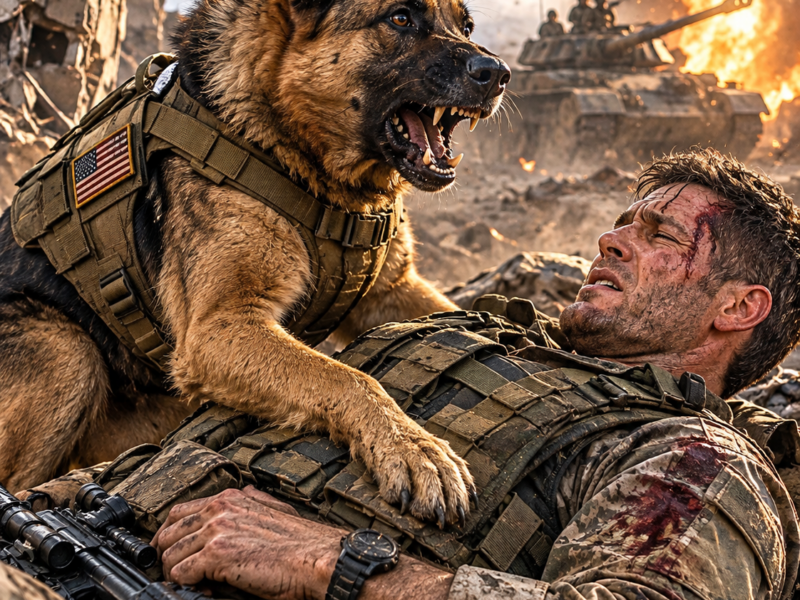
“Don’t leave him behind!” I screamed as the helicopter lifted through the smoke-filled sky
Three days after the explosion, I woke up to the sound of a heart monitor.
For several seconds, I couldn’t remember where I was. My chest felt as though someone had driven a steel rod through it. My throat was dry, my head was pounding, and every breath hurt.
Then I remembered.
The gunfire.
The collapsing building.
Ryan shouting my name.
And Max disappearing into the smoke.
I tried to sit up.
Pain immediately shot through my ribs.
A nurse rushed toward me.
“Sergeant Cole, please don’t move. You’re in the military hospital. You’ve been through major surgery.”
I grabbed her wrist.
“Max.”
She looked confused.
“My dog. Where’s Max?”
She glanced toward the doorway.
“Let me get your commanding officer.”
“No.” My voice cracked. “I need to know where he is.”
She didn’t answer.
And somehow, her silence frightened me more than anything I had experienced on the battlefield.
A few minutes later, Captain Brooks entered the room.
His uniform was wrinkled. There were dark circles beneath his eyes, and his face looked older than I remembered.
He pulled a chair beside my bed.
“How are you feeling, Cole?”
“Where’s Max?”
Captain Brooks looked down at his hands.
I had known that man for almost four years. I had seen him walk through gunfire without blinking. I had watched him deliver casualty reports with a steady voice, even when the names belonged to men he considered family.
But now, he couldn’t look me in the eyes.
“Your injuries were severe,” he began. “You had internal bleeding, several broken ribs, and a serious injury to your shoulder. The medical team wasn’t sure you would survive the first night.”
“I don’t care about that.”
“I know.”
“Captain, where is my dog?”
He took a slow breath.
“Max was recovered from the building.”
My heart started beating faster.
“Is he alive?”
Captain Brooks closed his eyes briefly.
“Son…”
“No. Don’t say it like that.”
He reached into his jacket and placed something on the blanket.
It was Max’s collar.
The black leather was torn. The metal identification tag was scratched, and one side of the harness buckle had melted from the heat.
I stared at it.
For a moment, I couldn’t understand what I was looking at.
Then I recognized the small silver star attached beside his name.
I had bought it for him after our first successful deployment.
My hands began to shake.
“Where is he?”
Captain Brooks finally looked at me.
“Max didn’t make it.”
The room became silent.
I heard the monitor beside my bed.
I heard the faint movement of a nurse outside the door.
But everything else seemed to disappear.
“No,” I whispered.
“I’m sorry, Ethan.”
“No. He was with me. He was right there.”
Captain Brooks lowered his head.
“The veterinary team worked on him for nearly forty minutes after he was recovered. He had suffered catastrophic injuries. They did everything they could.”
I picked up the collar.
It was still dusty.
There was a small patch of dried blood near the buckle.
I pressed it against my chest.
“He was supposed to come home,” I whispered.
Captain Brooks didn’t answer.
I began crying.
Not quietly.
Not like a soldier trying to maintain control.
I cried like someone who had just lost the only friend who had never once asked him to be strong.
For seven years, Max had followed me into danger.
He had slept beside my bunk, waited outside every briefing room, and greeted me after every mission as if I had been gone for a lifetime.
And now I was lying in a hospital bed, alive because of him.
But he would never see another sunrise.
He would never chase another tennis ball.
He would never rest his head on my knee while I ate dinner.
I looked at Captain Brooks.
“Did he suffer?”
The captain swallowed.
“He was conscious when they found him. But the medics believe he was trying to move toward the sound of another soldier.”
I closed my eyes.
Another soldier.
The faint voice we had heard inside the building.
The person Max had turned back to find.
“Did he save anyone else?”
Captain Brooks nodded slowly.
“Yes. And that’s something you need to know.”
He leaned forward.
“Before the second explosion, Max located a soldier trapped in a service corridor beneath the collapsed section. His barking helped our recovery team identify the location. We found Corporal Ryan Miller and another injured soldier nearby. Both were alive.”
I looked at him.
“Ryan?”
“He’s recovering. He has a broken arm and a concussion, but he’ll be all right.”
I couldn’t speak.
Max had gone back into that building for a reason.
He had heard someone calling for help.
And even after dragging me to safety, he had refused to leave another member of his team behind.
Captain Brooks placed a hand on my shoulder.
“He saved three lives that day, Ethan. Yours, Ryan’s, and the soldier trapped in the corridor.”
I looked down at the collar.
“Who saved him?”
The captain had no answer.
And that was when the truth finally broke through me.
My best friend had spent his entire life saving other people.
But when he needed saving, there was no one left who could bring him home.
The following morning, Ryan came to visit.
He entered my hospital room with his right arm in a sling. A bandage covered part of his forehead, and he walked slowly.
For a few seconds, neither of us spoke.
Then he saw Max’s collar on the bedside table.
His expression collapsed.
“Is that…”
I nodded.
Ryan pulled a chair closer.
He stared at the collar for a long time.
“I keep hearing him,” he whispered.
I looked at him.
“What?”
“That barking. During the explosion. I was behind the wall when I heard him. I thought he was trying to get you out.”
Ryan wiped his face.
“Then I heard him again, farther down the corridor. I followed the sound, but the ceiling started coming down. I couldn’t reach him.”
He looked at me.
“Ethan, I tried.”
I reached for his hand.
“I know.”
“I should have gone back.”
“No.”
“But he went back for us.”
I tightened my grip.
“That’s who Max was.”
Ryan lowered his head.
“He was the bravest soldier I ever knew.”
I looked toward the window.
Outside, the morning sun was shining over the hospital parking lot.
For the first time in seven years, I had woken up without Max beside me.
And the silence was unbearable.
A week later, the doctors finally allowed me to leave the hospital.
My recovery would take months. I still needed physical therapy, and the doctors warned me that I might never regain the full strength in my left shoulder.
But I was alive.
I could walk.
I could breathe without a machine.
And I could go home.
Captain Brooks drove me back to the base housing area.
Before we reached my house, he stopped at the small K9 facility where Max and I had spent so many mornings training.
I looked at him.
“Why are we stopping?”
He handed me a small envelope.
“There’s something you should see.”
Inside was a photograph.
It showed Max sitting beside me after a training exercise. His tongue was hanging out, his ears were raised, and I was laughing at something outside the frame.
On the back, someone had written:
Some heroes wear uniforms. Some wear collars. The bravest ones never leave their partners behind.
I stared at the words.
“Who wrote this?”
“Ryan.”
I smiled sadly.
Captain Brooks opened the vehicle door.
“I thought you might want to say goodbye to the place where you two started.”
I stepped out.
The training yard looked exactly the same.
The obstacle course.
The wooden barriers.
The small patch of grass where Max used to lie after long exercises.
I walked toward his favorite spot.
There was a tennis ball resting near the fence.
It was the old blue one he had carried around for almost two years.
I picked it up.
For a moment, I imagined hearing his paws behind me.
I imagined him rushing toward me, grabbing the ball, and refusing to give it back.
But there was only wind.
I placed the ball beside the fence and whispered:
“You did good, buddy.”
Then I turned away.
When I finally arrived home, Sarah was waiting at the front door.
My wife ran toward me and wrapped her arms around my shoulders.
She was crying before she even said hello.
“I thought I was going to lose you,” she whispered.
I held her tightly.
“I’m here.”
She pulled away and looked at my face.
“Where’s Max?”
I couldn’t answer immediately.
She already knew.
But she needed to hear it.
“He didn’t come back, Sarah.”
Her eyes filled with tears.
She covered her mouth and leaned against my chest.
We stood there for a long time.
Then I noticed something near the living room window.
Max’s bed.
His water bowl.
His favorite blanket.
Sarah had kept everything exactly where it had been before my deployment.
Even his old tennis ball was resting beside the bed.
And on the wall above it was a photograph of Max with our daughter, Lily.
I hadn’t seen that picture in months.
Lily was only eight years old when Max first came into our lives.
She had been afraid of him at first. He was bigger than most dogs she had ever seen, and his bark could shake the windows.
But Max had always been gentle with her.
He allowed her to put ribbons around his neck, place stuffed animals on his back, and read bedtime stories beside him.
Sometimes, when I came home late from training, I would find Lily asleep on the living room floor with her head resting against his side.
They had grown up together.
And now I had to tell her he wasn’t coming home.
“Where’s Lily?” I asked.
Sarah looked toward the stairs.
“She’s in her room. She has been waiting for you.”
I slowly climbed the steps.
When I opened the bedroom door, Lily was sitting on her bed holding Max’s old red collar.
She looked at me.
“Daddy?”
I sat beside her.
“Hey, sweetheart.”
She looked down at the collar.
“Mom said Max got hurt.”
I nodded.
“Yes, baby.”
“Is he coming home after he gets better?”
My throat tightened.
I reached for her hand.
“Lily, there’s something I need to tell you.”
She looked into my eyes.
“Max was very brave. He helped me and some other soldiers. But he got hurt very badly.”
Her lower lip began to tremble.
“Can the doctors fix him?”
I shook my head.
“No, sweetheart. They tried everything they could.”
She stared at me.
Then she asked the question I had been dreading.
“Does that mean Max is dead?”
I pulled her into my arms.
“Yes.”
She started crying.
Not loudly at first.
Just a few small sobs against my shirt.
Then she held me tighter.
“But he promised he’d come back.”
I closed my eyes.
“I know.”
“He always comes back.”
I kissed the top of her head.
“He did everything he could, sweetheart.”
Lily cried for several minutes.
Then she pulled away and looked at the collar in her hands.
“Can we keep his bed?”
I nodded.
“Of course.”
“And his bowl?”
“Yes.”
“And his blanket?”
I smiled through my tears.
“Everything, baby. We’re keeping everything.”
She leaned against me again.
That night, I slept beside my daughter because she didn’t want to be alone.
At some point after midnight, I woke up and heard her whispering.
She was talking to Max’s photograph.
“Goodnight, Sergeant Max. I love you.”
I turned my face toward the wall.
And cried until morning.
Two weeks later, Captain Brooks called me.
The military had scheduled a memorial ceremony for Max at the base.
He told me that several soldiers from our battalion would attend. The veterinary team, the K9 handlers, and even the soldiers Max had helped during his final mission would be there.
I hesitated.
I wasn’t sure I could stand in front of everyone and talk about him.
But Captain Brooks said something that changed my mind.
“Max deserves to have his story told by the person who knew him best.”
So I agreed.
The ceremony took place on a clear Friday morning.
A small platform had been built near the training grounds. Behind it stood a large American flag, and beside the platform was a framed photograph of Max wearing his working harness.
His name had been printed beneath it:
SERGEANT MAX
I arrived wearing my dress uniform.
My left arm was still weak, and I moved carefully.
Sarah walked beside me, holding Lily’s hand.
Ryan was already there.
He stood near the front with his arm out of the sling. When he saw me, he walked over.
“Good to see you, brother.”
I nodded.
“Good to see you too.”
He looked at Lily.
“Hey, little one.”
She gave him a small smile.
Ryan reached into his pocket and pulled out something wrapped in a piece of cloth.
“I brought something for you.”
Lily opened it.
Inside was Max’s old blue tennis ball.
She recognized it immediately.
“This is his favorite.”
Ryan nodded.
“I thought you should have it.”
She hugged the ball against her chest.
“Thank you.”
The ceremony began a few minutes later.
Captain Brooks stepped onto the platform.
He spoke about Max’s service record, his detection work, and the number of missions he had completed.
He mentioned the explosive device he had discovered during our first deployment.
He spoke about the lives Max had protected and the soldiers who had returned home because of him.
Then he paused.
“During his final mission, Sergeant Max faced a decision that no training manual could have prepared him for. He had already brought his wounded handler to safety. But when he heard another soldier calling for help, he returned to the danger.”
Captain Brooks looked toward Max’s photograph.
“He did not hesitate. He did not abandon his team. And he did not stop until he had given everything he had.”
He unfolded a document.
“Today, the United States Army recognizes Sergeant Max for extraordinary courage and devotion to duty. He is posthumously awarded the Medal of Military Valor.”
A soldier carried the medal forward.
It was placed beside Max’s photograph.
I stared at it.
The medal was beautiful.
It shone beneath the morning sunlight.
But all I could think about was how much Max would have preferred a tennis ball.
Captain Brooks then called my name.
“Sergeant Cole, would you please come forward?”
I walked toward the platform.
My legs felt heavy.
I looked at the soldiers standing in front of me.
Some were crying.
Some stood with their heads bowed.
Others looked at Max’s photograph.
I reached the microphone.
For a few seconds, I couldn’t speak.
Then I looked at the picture.
“People have asked me what made Max special.”
I swallowed.
“Some say it was his training. Some say it was his instincts. Others say it was his courage.”
I paused.
“But I think they are all missing something.”
I looked toward Lily.
“Max was special because he never understood the meaning of leaving someone behind.”
My voice began to shake.
“He didn’t care whether someone was strong or weak. He didn’t care whether the person was a soldier, a stranger, or a friend. If he heard someone calling for help, he went.”
I looked down at my hands.
“That day, he dragged me through a collapsing building. He saved my life. But he also went back for another soldier who couldn’t get out.”
I took a breath.
“I am standing here today because Max refused to let me die.”
The tears came before I could stop them.
“And I wish more than anything that I could have brought him home.”
The entire ceremony fell silent.
I turned toward Max’s photograph.
“You were my partner. My protector. My best friend.”
My voice broke.
“You brought me home, buddy. I just wish I could have brought you home too.”
I stepped away from the microphone.
Ryan lowered his head.
Captain Brooks wiped his eyes.
And Lily walked toward the photograph.
She placed the blue tennis ball at its base.
Then she whispered:
“Thank you for protecting my daddy.”
No one spoke for several seconds.
There was nothing left to say.
After the ceremony, I returned to the K9 facility.
Several handlers were waiting near the training yard.
One of them was Staff Sergeant Marcus Hill, a veteran handler who had been working with a young German Shepherd named Scout.
Marcus approached me.
“Sir, I wanted to ask you something.”
“Go ahead.”
He glanced at Scout.
“I’m taking him through advanced training next month. I’ve heard what happened to Max, and I want to make sure I understand something.”
I waited.
Marcus continued.
“How do you teach a dog to be that loyal?”
I looked at Scout.
The young dog was sitting quietly beside his handler, watching the world with curious eyes.
I smiled sadly.
“You don’t teach loyalty the way you teach a command.”
Marcus frowned slightly.
“Then how?”
“You build trust. Every day. You show him that you will protect him, and you give him a reason to believe you’ll always come back.”
I crouched and let Scout sniff my hand.
“Max trusted me with his life. And I trusted him with mine.”
I stood again.
“Never forget that your dog is not a tool. He’s your partner. Treat him like one.”
Marcus nodded.
“I will, sir.”
For the first time since the explosion, I felt that perhaps something good could come from losing Max.
His story might help another handler understand what their partner truly meant.
And perhaps another soldier would return home because of it.
Three months later, I was medically cleared to return to limited duty.
I couldn’t go back to frontline operations. My injuries made that impossible.
At first, I struggled with the idea.
For years, my identity had been tied to the field. I had been a soldier, a handler, and Max’s partner.
Without him, I didn’t know who I was supposed to become.
But Captain Brooks offered me a position as a K9 training instructor.
I accepted.
My first day back, I walked onto the training field carrying Max’s old collar in my hand.
The young handlers gathered around me.
Some had heard the story. Others had only seen the photograph in the memorial building.
I placed the collar on a small table.
“Before we start,” I said, “I want to tell you about a dog who taught me the most important lesson of my military career.”
I spoke about Max.
I told them about his first days at Fort Campbell, his stubborn personality, and the way he would refuse to eat if I wasn’t nearby.
I told them about Afghanistan.
And I told them about the final mission.
I didn’t hide the ending.
I wanted them to understand that courage did not mean a dog couldn’t feel fear.
It meant that even in the middle of fear, he could still choose to protect someone else.
When I finished, nobody spoke.
Then one of the youngest handlers raised his hand.
“Sergeant Cole?”
“Yes?”
“Do you think Max knew he was saving you?”
I looked at the collar.
“I don’t know exactly what he understood.”
I paused.
“But I know he understood that I was his person.”
The young soldier nodded.
“And I think that was enough.”
A year after Max’s final mission, Captain Brooks informed me that the unit wanted to establish an annual award in his honor.
It would be called the Sergeant Max Award for Courage and Loyalty.
Every year, the award would recognize a military working dog that demonstrated exceptional bravery, dedication, and service.
I was asked to help present the first medal.
The ceremony was held in the same training yard where Max and I had first worked together.
The first recipient was a German Shepherd named Scout.
During a training exercise several months earlier, Scout had detected an injured soldier hidden beneath a damaged vehicle when the rest of the team believed the search area was clear.
His alert had helped the rescue team locate the soldier before his condition became critical.
Marcus stood beside him as the award was presented.
I knelt and placed the medal around Scout’s harness.
“Good work, soldier.”
Scout wagged his tail.
For a moment, I imagined Max standing beside me.
I imagined his ears lifting when he heard the word “soldier.”
I imagined him nudging my hand, waiting for his reward.
I reached into my pocket and pulled out a small tennis ball.
It was a new one.
I gave it to Scout.
The young dog grabbed it happily.
Everyone laughed.
And for the first time, I could smile at a memory of Max without feeling as though my heart was breaking.
On the anniversary of his death, I took Sarah and Lily to a small memorial park near our home.
We had brought flowers, a framed photograph, and Max’s old collar.
The photograph showed him sitting beside me in Afghanistan.
His ears were raised, his tongue was hanging out, and his eyes were focused directly on the camera.
He looked happy.
He looked alive.
Lily placed a small pink ribbon beside the photograph.
“Why pink?” I asked.
She shrugged.
“Because Max liked when I put pink ribbons on him.”
I smiled.
“I remember.”
She knelt beside the memorial stone and carefully adjusted the ribbon.
Then she looked up at me.
“Daddy?”
“Yes, sweetheart?”
“Do you think Max knows we still miss him?”
I looked at the sky.
I didn’t know what to say.
So I told her what I believed.
“I think the love we gave him was something he carried with him every day. And I think that love stays with us, too.”
She nodded.
Then she touched the photograph.
“I wish he could have met my new teacher.”
I laughed softly.
“He would have liked her.”
“And I wish he could have chased balls with me again.”
“Me too.”
Lily stood and wrapped her arms around my waist.
“Do you still miss him?”
I looked at Max’s photograph.
“Every single day.”
She thought for a moment.
“Does it ever stop hurting?”
I knelt beside her.
“No, sweetheart. Not completely.”
I brushed a strand of hair away from her face.
“But one day, the memories start making you smile more than they make you cry.”
She looked at the photograph again.
Then she smiled.
“Max was a good dog.”
I nodded.
“He was the best.”
That evening, after Sarah and Lily had gone to bed, I sat alone in the living room.
Max’s bed was still near the window.
His water bowl was still beside it.
His blanket was folded exactly where Sarah had placed it.
I had considered putting everything away several times.
But every time I tried, I couldn’t do it.
Not because I believed Max would return.
I knew he wouldn’t.
I kept those things because they reminded me that he had been here.
That he had lived.
That he had loved us.
And that, for seven years, I had been lucky enough to walk beside him.
I opened the small wooden box on the table.
Inside were his collar, identification tag, photograph, and medal.
I lifted the collar carefully.
The leather had become worn and soft from years of use.
I ran my fingers over the metal tag.
MAX.
His name.
Only four letters.
But somehow, those four letters carried more memories than I could ever put into words.
I remembered the first time he refused to come near me.
I remembered our first successful mission.
I remembered him sleeping beside my bunk during a thunderstorm.
I remembered his paws running across the training field.
And I remembered the last time I saw him standing in the smoke.
I had spent months wondering whether I could have done something differently.
Could I have held on tighter?
Could I have followed him?
Could I have stopped him from going back?
The questions never completely disappeared.
But eventually, I understood something.
Max hadn’t returned to the darkness because he wanted to die.
He had returned because someone needed help.
He had done what he had always done.
He had protected his team.
And I couldn’t be angry with him for being exactly the dog I had loved.
I placed his collar back inside the box.
Then I looked toward the empty bed.
“Goodnight, Sergeant.”
The house was quiet.
No paws crossed the floor.
No familiar bark came from the hallway.
No warm body rested against my legs.
But I could still remember him.
And perhaps that was how I would carry him for the rest of my life.
The next morning, I returned to the training field.
A new group of handlers was waiting.
I stood in front of them and looked at each young soldier.
“Before you work with your dogs,” I said, “I want you to remember one thing.”
I paused.
“One day, your dog may save your life. You may think you’re the one teaching him how to be brave, but if you’re lucky, he’ll teach you something much greater.”
I looked toward the photograph of Max hanging above the entrance.
“Never take that kind of loyalty for granted.”
Then I began the training session.
For the first time, I didn’t feel as though I was leaving Max behind when I walked away from his memorial.
I felt as though I was carrying his lesson forward.
Because Sergeant Max had completed his final mission.
He had brought his handler home.
He had helped save two other soldiers.
And he had left behind a legacy that would live in every K9 team that trained on that field.
I still keep his collar beside my bed.
Sometimes, when the house is silent, I reach for it and remember the sound of his paws running toward me.
I remember the way he looked at me before every mission.
And I remember the promise I made to him in that hospital room.
That I would tell his story.
That I would never forget him.
That I would make sure the world knew he was more than a military dog.
He was a soldier.
He was my brother.
He was Sergeant Max.
And although he never walked through our front door again, he will always have a place in our home.
Because the bravest heroes don’t always come home. Sometimes, they give everything they have so someone else can.
And if I could speak to him one more time, I wouldn’t talk about medals, missions, or the lives he saved.
I would simply kneel beside him, put my hand on his head, and say the words I never got to say before that final explosion:
“Thank you for choosing me, buddy. I would choose you every single time.”
The End.









