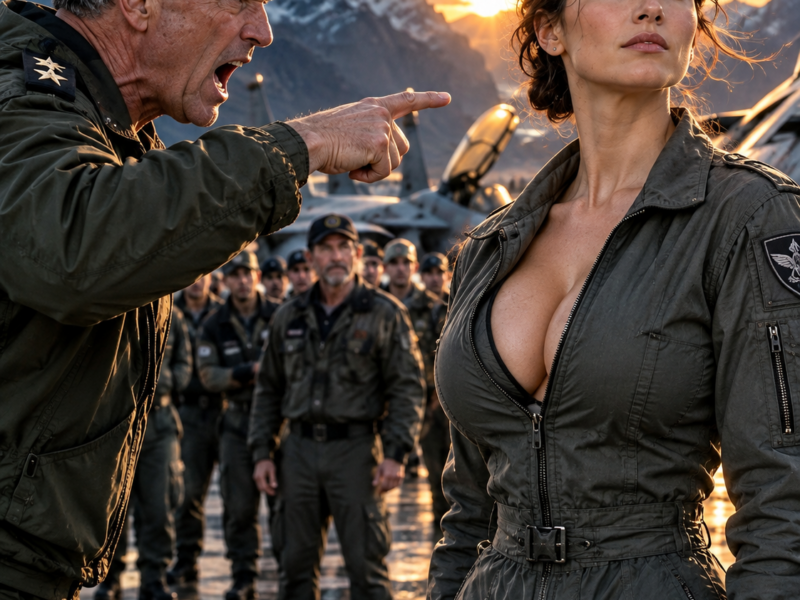
“Colonel Hayes ordered me off the runway in front of two dozen airmen, calling me a glorified mechanic who had no business near a fighter jet
“Ghost Hawk, do you copy?” the voice repeated through my headset.
I stood beside the F-35, watching Colonel Hayes speak urgently into his radio while the name echoed through my mind.
General Thomas Whitaker.
He had been the last senior officer to question me before my final mission three years earlier. He had signed the authorization that sent my flight into the Afghan mountains, and he had been the first person to tell my family that I hadn’t survived.
Now someone was telling me he might have been involved in the coordinates that nearly killed me.
I pressed the transmit button.
“Falcon Actual, this is Ghost Hawk. I copy. Identify the threat.”
A burst of static followed.
Then the voice answered, “The mission briefing has been compromised. The strike package includes an aircraft carrying a secondary targeting system that wasn’t in the approved configuration. Do not engage until you verify the target data.”
I glanced toward aircraft twelve.
The jet I had been inspecting for the past week.
The jet Colonel Hayes had ordered me to leave.
“Who is transmitting?” I asked.
“Your old wingman.”
My hand tightened around the radio.
“Ethan?”
“I’m here, Rebecca.”
For three years, I had imagined hearing Ethan Cole’s voice again. In some versions, he was angry that I had survived. In others, he was relieved. Sometimes I imagined we would meet in a quiet room and talk about the six minutes between the first missile warning and my aircraft hitting the ground.
I had never imagined hearing him warn me that our own mission was compromised.
“Where are you?” I asked.
“Approaching the designated staging area. I’m flying the second aircraft.”
“Your file said you were transferred to a training squadron.”
“It did.”
“Why?”
“Because somebody wanted us separated.”
Across the runway, Colonel Hayes lowered his radio and began walking toward the operations building.
I watched him go.
“Ethan, tell me exactly what you know.”
“I know the target coordinates were changed at 0400 this morning. I know the change came through an authorization channel linked to General Whitaker’s command. And I know the person who approved the alteration is on this base.”
“Hayes?”
“I don’t know yet.”
The transmission crackled.
Then Ethan added, “Rebecca, I also know they weren’t expecting Ghost Hawk to answer.”
That explained the colonel’s expression.
It didn’t explain why my callsign had been restored without my knowledge, or why someone had activated a mission I hadn’t agreed to lead.
“Who authorized my return to flight status?” I asked.
“Your medical clearance was approved six weeks ago.”
I stared at the tablet in my hand.
“I never received a medical clearance.”
“I know.”
“Then someone forged it.”
“That’s what I’m trying to tell you.”
I looked toward the operations building.
Colonel Hayes had disappeared inside.
Around me, ground crews continued preparing the aircraft. They had orders to meet a launch window, and none of them knew that the paperwork authorizing the mission might have been falsified.
I had spent three years trying to uncover the truth behind one compromised flight.
Now someone was asking me to lead another.
“Falcon Actual,” I said, “hold your position. Nobody launches until I confirm the target package.”
“Rebecca, we have less than ten minutes.”
“Then we have nine minutes to find out who’s lying.”
I ended the transmission and headed for the operations building.
The security guard at the entrance stepped into my path.
“Sorry, Sergeant. Colonel’s orders. Nobody enters without authorization.”
I looked at him.
“I’m not asking to enter as a sergeant.”
He hesitated.
Before he could respond, a voice came from behind me.
“Let her through.”
The man standing in the doorway wore a general’s uniform, his silver hair neatly combed, his expression composed.
General Thomas Whitaker.
He was older than I remembered, with deeper lines around his mouth, but he still had the same habit of holding his hands behind his back when he wanted a conversation to appear calm.
“Captain Morgan,” he said.
I hadn’t heard anyone call me that in three years.
“General.”
He glanced at the security guard.
“Leave us.”
The guard moved away.
Whitaker gestured toward the corridor.
“Walk with me.”
I followed him into a conference room overlooking the runway. Through the glass, I could see aircraft twelve being fueled while technicians checked its landing gear.
Whitaker closed the door.
“I understand there’s been some confusion regarding your assignment.”
“That’s one way to describe it.”
He accepted the remark without reacting.
“Your return to flight status was authorized through a restricted command process. The details were withheld because your previous identity was compromised.”
“By whom?”
“That’s what we’re investigating.”
“Then why is someone telling me that the person who altered my coordinates is part of today’s strike package?”
For the first time, Whitaker’s composure faltered.
“Who told you that?”
“Someone who apparently knows more about this mission than I do.”
“Captain, this is a sensitive operation. We cannot allow unverified information to derail it.”
“Then verify it.”
I placed my tablet on the table and showed him the discrepancy in aircraft twelve’s targeting configuration.
He studied the screen for several seconds.
“Where did you obtain this?”
“During my inspection.”
“You were ordered to stop inspecting that aircraft.”
“After I found the discrepancy.”
Whitaker looked up.
“Did Colonel Hayes tell you to stop?”
“Yes.”
He walked toward the window.
For a moment, he appeared to be weighing something he had carried for a long time.
“Rebecca, three years ago, I was given intelligence that your flight was approaching a compromised position. By the time the warning reached the command center, your aircraft had already disappeared from radar.”
“You told my mother I died.”
“I believed you had.”
“You signed the report before they recovered my aircraft.”
His shoulders stiffened.
“That report was based on the information available at the time.”
“No. It was based on a decision someone made before the wreckage was found.”
He turned.
“You don’t know what happened in that command center.”
“Then tell me.”
He was silent long enough for the hum of the air-conditioning to become noticeable.
Finally, he said, “The mission was intended to prevent an attack on an allied position. The target coordinates were changed through an authenticated command channel. We later discovered that the intelligence had been manipulated.”
“By whom?”
“We never established that conclusively.”
I leaned forward.
“Did you know the coordinates were wrong before we launched?”
His eyes met mine.
“No.”
It was the first answer he had given me without trying to control the conversation.
I wanted to believe him.
But I had learned that an honest answer to one question did not make a person trustworthy on every other subject.
“Why was my callsign activated today?”
“Because the people who falsified the original mission have resurfaced. Someone sent the command center evidence suggesting they are preparing another operation.”
“And the strike?”
“It’s intended to stop a weapons transfer.”
“Then why conceal the altered targeting system?”
Whitaker looked at the tablet again.
“I didn’t authorize that modification.”
The conference room door opened.
Colonel Hayes entered with two security officers.
“General, we need to suspend this discussion.”
Whitaker’s expression hardened.
“On whose authority?”
“Mine, pending a security review.”
“You don’t have authority to suspend a general’s briefing.”
Hayes looked at me instead.
“Captain Morgan has accessed restricted mission data without authorization. She should be detained until we establish the extent of the breach.”
I stood slowly.
“I’m happy to explain every inspection I performed. Are you willing to explain why you ordered me away from an aircraft whose targeting system had been altered?”
Hayes’s jaw tightened.
“I ordered you off the runway because you were interfering with an active operation.”
“After I found the discrepancy.”
“Enough.”
Whitaker stepped between us.
“Colonel, you will stand down.”
For a moment, I thought Hayes might refuse.
Then his radio chirped.
He listened, and his face changed.
“What do you mean the flight plan has been updated?”
He turned toward the window.
Outside, the ground crew was moving away from aircraft twelve.
A warning light flashed on the cockpit display.
The tower’s voice came over the building speakers.
“Redstone operations, be advised. Revised launch authorization received. Ghost Hawk and Falcon Actual are cleared for immediate departure.”
Whitaker snatched up the desk phone.
“Tower, this is General Whitaker. Hold all aircraft.”
The response came back almost immediately.
“Unable to comply, sir. Authorization is locked through command control.”
Whitaker went still.
I looked at Hayes.
He wasn’t surprised.
He was afraid.
And he was trying very hard not to let either of us see it.
I stepped toward him.
“Who sent the revised authorization?”
He backed away.
“I don’t know.”
“Then why do you look like you do?”
He glanced at the two security officers.
“Take Captain Morgan into custody.”
Neither moved.
Whitaker’s voice cut through the room.
“Colonel Hayes, you’re relieved of operational control pending investigation.”
Hayes looked from the general to me.
Then he reached into his jacket and pulled out a small access card.
“General, you have no idea what you’re doing.”
He swiped the card against the wall panel.
The conference room lights went dark.
A security alarm sounded throughout the building.
By the time the emergency lights came on, Hayes had disappeared into the corridor.
One of the security officers ran after him.
Whitaker grabbed the tablet from the table.
“Can you stop the launch?”
“Not from here.”
I reached for the radio clipped to my belt.
“Falcon Actual, this is Ghost Hawk. Abort departure. Repeat, abort departure.”
Ethan’s response came through at once.
“Ghost Hawk, my aircraft is already taxiing.”
“Stop the aircraft.”
“I’m trying. The flight-control system has accepted the revised route.”
“Switch to manual control.”
A pause.
“Rebecca, the targeting system is transmitting a new set of coordinates. They’re not the coordinates from our briefing.”
“Can you identify them?”
“Negative. The data is encrypted.”
I turned to Whitaker.
“Get me to the aircraft.”
He hesitated for only a second before nodding.
We ran.
The runway was a confusion of shouted orders and flashing lights. Ground crews were pulling equipment clear while the tower tried to establish control of the launch sequence.
Aircraft twelve had begun moving.
I reached the cockpit ladder and climbed fast, the cold metal vibrating beneath my boots.
The aircraft’s systems were active.
The targeting display showed a destination I recognized immediately.
The same mountain valley where my last mission had ended.
For a moment, the years between then and now collapsed into one impossible instant.
I could almost hear the warning tones from my damaged cockpit, the distorted voices over the radio, the desperate call from the crew behind me.
Then I saw the coordinates.
They were not merely similar to the old ones.
They were identical.
Someone was sending me back to the exact place where I had supposedly died.
I pulled up the mission data and compared the current flight plan with the original record I had memorized during the investigation.
The altered route was designed to bring our aircraft into range of a ground-based targeting system hidden near the valley.
It was the same system that had locked onto us three years earlier.
The mission hadn’t been compromised by accident.
Someone had rebuilt the trap.
“Falcon Actual,” I said, “I have the target coordinates. They’re a match for the original ambush site.”
Ethan answered immediately.
“Then we abort.”
“Not yet.”
“Rebecca, are you serious?”
“If we abort without identifying the source, they’ll change the plan and try again.”
“And if we continue, we may not come back.”
I looked through the cockpit glass at the runway ahead.
“I know.”
For a moment, neither of us spoke.
Then Ethan said, “You always did have a terrible habit of taking responsibility for things that weren’t yours.”
I almost smiled.
“And you always had a terrible habit of complaining while following my lead.”
“Some things don’t change.”
I checked the control panel.
The flight-control system was still accepting encrypted updates from the command network. If I launched with the current configuration, someone else could potentially redirect the aircraft.
I needed to isolate the unauthorized input before we left the ground.
“Tower, Ghost Hawk. Hold launch. I have an unverified targeting override.”
The response was immediate.
“Negative, Ghost Hawk. Launch authorization remains active.”
“I’m reporting a safety issue.”
“Authorization is locked.”
I looked toward the control tower.
Through the glass, I could see personnel moving between consoles. One operator was standing behind the others, speaking into a phone rather than a headset.
He wasn’t watching the runway.
He was watching me.
I recognized him.
Major Daniel Voss, a communications officer who had been transferred to Redstone shortly before Hayes arrived.
He had been present during my inspection of aircraft twelve, and he had been the one who told me the targeting system was functioning normally.
I keyed the radio.
“Falcon Actual, do you see Major Voss in the tower?”
“Affirmative.”
“Keep him in sight.”
I switched channels and contacted the base security desk.
“This is Captain Morgan. Restrict access to the command network and preserve all active authorization logs. No one is to erase or modify mission data without General Whitaker’s direct approval.”
A security officer responded, but the connection cut out before I could confirm the order had been received.
Then the aircraft’s display changed again.
A red warning appeared across the screen.
REMOTE TARGETING CONTROL ACTIVE.
I reached for the system isolation switch.
The control rejected the command.
Someone had locked me out.
I had seconds to decide whether to remain on the ground and allow the remote system to continue transmitting, or launch and risk being directed into the same trap that had nearly killed me.
Neither option was acceptable.
I contacted Ethan again.
“Falcon Actual, can you access the original flight data?”
“I have the archived mission record.”
“Compare the authorization signatures.”
There was a pause.
Then his voice sharpened.
“Rebecca, the revised authorization is signed with your credentials.”
I stared at the screen.
“My credentials were deactivated three years ago.”
“Someone reactivated them.”
“Can you identify the terminal?”
“I’m tracing it now.”
The display flashed.
A new message appeared beneath the targeting warning.
MISSION COMMAND TRANSFERRED TO GHOST HAWK.
I understood then why the launch authorization had been locked.
Someone had used my callsign and credentials to create the appearance that I had approved the operation.
If the mission failed, the records would show that I had ordered it.
If we survived, the same records could be used to blame me for whatever happened next.
I keyed the radio.
“General Whitaker, do not approve any further mission changes under my credentials. They have been compromised.”
His response came through with heavy interference.
“Understood. Security is attempting to isolate the command network.”
Then another voice interrupted.
“Ghost Hawk, this is command. You are cleared to launch. Failure to comply will be treated as a direct refusal of lawful orders.”
It wasn’t Whitaker.
It was Hayes.
I watched the runway lights stretch ahead of me.
“Colonel Hayes,” I said, “you are not authorized to issue mission commands under General Whitaker’s channel.”
“Your authorization is active, Captain. Launch.”
“I will not fly an aircraft with a compromised targeting system.”
“You will launch, or you will answer for every life lost because of your refusal.”
I thought of my crew in the Afghan mountains.
I thought of the official report that had declared me dead before anyone had confirmed what happened.
Then I thought of the people who had spent three years making sure no one asked why.
“Not this time,” I said.
I shut down the launch sequence.
The aircraft rolled to a stop.
For several seconds, the radio was silent.
Then Hayes’s voice returned, cold and controlled.
“Captain Morgan, you have just committed an act of insubordination. Security is on its way.”
I removed my headset and climbed down from the cockpit.
Two armed security officers approached from the edge of the runway.
Behind them, General Whitaker was walking toward me with a phone pressed to his ear.
“Rebecca, don’t move.”
I stopped.
He ended the call and looked at the security officers.
“Stand down.”
One of them hesitated.
“Sir, we’ve received orders to detain her.”
“From whom?”
The officer glanced toward the tower.
Whitaker held out his hand.
“Show me the order.”
The officer handed him a tablet.
Whitaker read the screen, then looked up.
“This order was issued using my credentials.”
“That’s what we were told, sir.”
Whitaker turned toward the tower.
“Then someone has compromised the command network at the highest level.”
He handed the tablet back.
“No one leaves this base until we establish who issued that order.”
For the first time since I’d arrived at Redstone, the general looked less like a man protecting an institution and more like a man realizing the institution had been used against him.
Then Ethan’s voice came through my radio.
“Rebecca, I found the source.”
I pressed the transmit button.
“Identify it.”
“The authorization originated from a terminal inside the command center.”
“Whose terminal?”
He paused.
“Colonel Hayes’s.”
The two security officers exchanged a look.
Whitaker immediately ordered them to secure the building.
But Ethan wasn’t finished.
“There is something else. The terminal contains a second authorization record from three years ago. The original mission wasn’t simply redirected. The route change was approved before your flight took off.”
My throat tightened.
“By whom?”
“I’m opening the signature file now.”
The seconds stretched.
I could hear Ethan typing, then the low murmur of another voice in the background.
Finally, he spoke.
“Rebecca, the authorization wasn’t signed by General Whitaker.”
I looked at the general.
He was watching me, waiting.
“Whose signature is it?”
Ethan exhaled.
“Colonel Richard Hayes.”
The runway seemed to fall silent around us.
Hayes had been on the base for less than a month when I arrived. He had spent every day treating me like an inconvenience, ordering me away from aircraft twelve, and insisting that discipline meant unquestioning obedience.
But he had been involved in my last mission long before he ever met me.
I turned toward the command building.
“Where is he now?”
Whitaker spoke into his radio, ordering a full security sweep.
Then a new transmission came through the speakers.
It was Hayes.
“Ghost Hawk, if you want to know why your crew died, come to the old hangar. Come alone.”
The transmission ended.
Whitaker grabbed my arm.
“Absolutely not.”
I looked at the hangar beyond the far taxiway.
Its doors had been sealed for years, and the building no longer appeared on the active maintenance schedule.
I knew that because I’d checked.
“What if he’s the only person who can tell us what happened?” I asked.
“Then we bring him in under guard.”
“He won’t talk if he thinks he’s already lost.”
Whitaker studied me.
“That’s not your responsibility.”
“No, sir. But finding out what happened to my crew is.”
I took a security detail with me despite Hayes’s demand that I come alone. Whitaker contacted the base commander, and the remaining aircraft were ordered to remain grounded while the command network was isolated.
When we reached the old hangar, the main doors stood open.
Inside, a single work light illuminated a table covered with folders, printed flight records, and photographs.
Hayes stood beside it without a weapon.
He looked exhausted.
For the first time, he didn’t seem interested in my rank or my uniform.
“You found the signature,” he said.
“Yes.”
He nodded slowly.
“I expected you would.”
“Why did you change our coordinates?”
He looked at the photographs.
“Because the original mission was never what you were told.”
I waited.
“Three years ago, intelligence indicated that a weapons transfer was taking place in the valley. The briefing said your team would secure the area while another unit intercepted the shipment.”
“That was the mission.”
“No. The real objective was to recover a data package from a field command post. The weapons transfer was a cover story.”
I felt my hands tighten.
“Why weren’t we told?”
“Because the package contained evidence of illegal weapons sales involving a private defense contractor and several senior officers.”
“Who was involved?”
“People who would have lost everything if the evidence became public.”
Hayes moved one of the folders toward me.
Inside were copies of the original coordinates, mission amendments, and a list of names.
His name appeared beside the authorization that had redirected my flight.
“So you sent us into the ambush to destroy the evidence.”
He shook his head.
“Not to destroy it. To recover it.”
The distinction made no difference to the people who had died.
“You knew the targeting system was active.”
“I knew it was supposed to be disabled.”
“Supposed to be?”
“The system was controlled by the contractor. We were told it had been shut down before your aircraft entered the valley.”
“But it wasn’t.”
“No.”
“Who told you it was disabled?”
Hayes looked down.
“Major Voss.”
The communications officer.
The man who had stood in the tower watching me.
“What happened after the crash?”
Hayes took a long breath.
“The contractor reported that the aircraft had been destroyed and that no one had survived. I signed the initial report. When I learned you might have ejected, I was told a recovery team had searched the area and found no trace of you.”
“You believed them.”
“I wanted to.”
He looked at me then, and I saw something worse than fear.
Shame.
“The evidence had disappeared. The contractor’s representatives told us that pursuing the matter would expose the operation and endanger the remaining personnel. I convinced myself that the mission had failed and that there was nothing left to recover.”
“You declared me dead.”
“Yes.”
“And now you’re trying to send me back to the same valley.”
“I wasn’t trying to kill you.”
“You were willing to let the same people control my aircraft.”
He didn’t argue.
“I knew they would use your callsign to authorize the strike. I thought if you launched, we could follow the targeting data back to the source.”
“You used me as bait.”
“I believed it was the only way to identify the network.”
I stared at him.
“You could have told me.”
“You would have refused.”
“Yes.”
He gave a small, bitter nod.
“And I would have lost my chance to prove what happened.”
“You were willing to risk my life because you thought you knew what was best.”
He looked away.
“I told myself that was the price of getting the truth.”
For a moment, I couldn’t speak.
He had taken the same excuse that had destroyed my life and dressed it up as duty.
I picked up the folder.
“Where is the original data package?”
Hayes looked toward the back wall.
“In the archive room.”
“Then we’re going to retrieve it.”
He nodded toward a narrow door.
“There’s something you need to see first.”
Inside the archive room sat an old terminal connected to a sealed storage drive.
Hayes powered it on.
A recording appeared on the screen, dated three years earlier, several hours before my final mission.
The video showed a briefing room.
I watched myself sit at the table, reviewing the original flight plan. Ethan sat beside me, tapping a pen against his notebook.
Then the door opened, and Major Voss entered carrying a revised mission packet.
I remembered that moment.
He had apologized for the late change and told us the updated coordinates reflected new intelligence.
We had accepted the change because the packet carried the correct authorization codes.
The recording continued.
After we left the room, Voss remained behind.
He removed the original packet from the table and placed it in a sealed envelope.
Then he made a phone call.
The audio was clear.
“The lead pilot has accepted the revised route,” he said. “The aircraft will be in the valley before the ground team realizes the coordinates are wrong.”
A voice answered from the other end.
“Make sure the recovery report is clean.”
Voss nodded.
“It will be.”
The recording ended.
I stared at the dark screen.
Hayes stood behind me.
“I found the recording in the archive last week. That’s why I ordered the aircraft prepared.”
“To force another mission.”
“To draw Voss into the command network again. I believed he would try to use the same authorization process.”
“You could have brought the evidence to investigators.”
“I tried. The first copy disappeared. The officer assigned to review it was transferred. Then the contractor’s legal team obtained an order sealing the archive.”
“So you decided to create another compromised strike.”
“I thought I could catch him in the act.”
“You nearly did the same thing to me that he did.”
Hayes lowered his head.
“I know.”
The door behind us opened.
General Whitaker entered with two security officers.
“Major Voss is in custody,” he said. “He was attempting to erase the authorization logs when security reached the tower.”
Hayes closed his eyes.
Whitaker looked at the recording on the screen.
“Is this the evidence?”
“Part of it,” I said.
I handed him the folder.
“The rest is in the archive.”
He read the first page, then the second.
His face tightened when he reached the authorization signature.
“I signed the original mission order,” he said. “But I never approved the change.”
“I believe you,” I replied.
He looked up, surprised.
“I should have asked more questions three years ago,” he said. “I accepted the recovery report because I wanted the operation closed. That decision allowed the people responsible to keep working.”
He turned toward Hayes.
“You will answer for your part in this.”
Hayes nodded.
“I understand.”
“And so will Major Voss, the contractor’s executives, and anyone else implicated by these records.”
For the first time, the general sounded less concerned with protecting the military’s reputation than with making sure the investigation could no longer be buried.
The case took months to unravel.
The original targeting records were authenticated by independent technical experts. Financial documents connected the contractor to illegal weapons transfers, and the recovered recording proved that the coordinates had been deliberately changed before my flight departed.
Major Voss eventually admitted that he had altered the mission data on behalf of the contractor, believing the operation would destroy evidence linking several officials to the shipments.
He had also manipulated the current strike authorization, using my restored credentials to make it appear that I had approved the mission.
Hayes had not planned the original ambush, but he had knowingly signed a false report and later tried to use me to expose the network without telling me the risks.
He was removed from command and faced a formal investigation.
Whitaker testified about the failures in the chain of command and accepted responsibility for approving the original mission without independently verifying the revised intelligence.
The contractor lost its military contracts, and several executives were charged with fraud, conspiracy, and obstruction.
The investigation could not bring back my crew.
It could, however, restore their names to the record.
The official report was amended to state that the mission had been compromised before launch and that the flight crew had acted according to the information available to them.
For three years, I had carried the quiet suspicion that my decisions had led my people into the valley.
Now the record showed that we had been sent there under false information by people who knew exactly what they were doing.
That knowledge did not erase the guilt I felt.
But it gave the guilt somewhere honest to go.
Six weeks after the investigation began, I stood at a memorial outside Redstone Air Base.
The names of my former crew had been engraved on a new stone beside those of other service members who had died in the line of duty.
Ethan stood beside me in his dress uniform.
He had survived the mission because his aircraft had been forced to divert before reaching the valley. For three years, he had believed I was gone, and he had carried his own unanswered questions about the orders that sent us there.
Neither of us spoke for a while.
Finally, he said, “Do you think you’ll fly again?”
I watched a pair of aircraft rise above the distant runway.
“I don’t know.”
“You don’t have to decide today.”
I nodded.
For years, I had thought returning to the cockpit would prove that the crash hadn’t defeated me.
Now I understood that I didn’t owe anyone a dramatic return, least of all the people who had used my callsign to hide their crimes.
I could fly again if I chose.
I could also walk away.
Neither decision would change what had happened to my crew.
Ethan placed a folded paper beside the memorial.
It was a copy of the corrected mission report, with the names of every crew member restored.
“I thought you should have this,” he said.
I ran my fingers over the page.
“Thank you.”
He gave me a small, tired smile.
“You know, when Hayes ordered you off the runway, I thought you were going to tell him exactly who you were.”
“I considered it.”
“What stopped you?”
I looked toward the tower, where the morning shift was beginning.
“Because I was tired of proving myself to people who had already decided what I was worth.”
Ethan nodded.
We stood there until the sun broke through the clouds and illuminated the names on the stone.
Then I folded the report and placed it in my jacket.
I had spent three years being remembered as a dead pilot, then months being treated as a threat to the people who had lied about my death.
Now I was simply Rebecca Morgan again.
Not a callsign.
Not a classified file.
Not a convenient name on a false report.
Just a woman who had survived, who had finally learned the truth, and who no longer needed a colonel’s permission to know what she was capable of.
As we walked away from the memorial, the tower announced a routine training flight.
A familiar voice called for clearance, calm and professional, and the runway lights flickered against the morning haze.
I didn’t turn toward the sound.
For the first time in three years, I didn’t need to hear my old callsign to know that I was still here.
The eNd.









