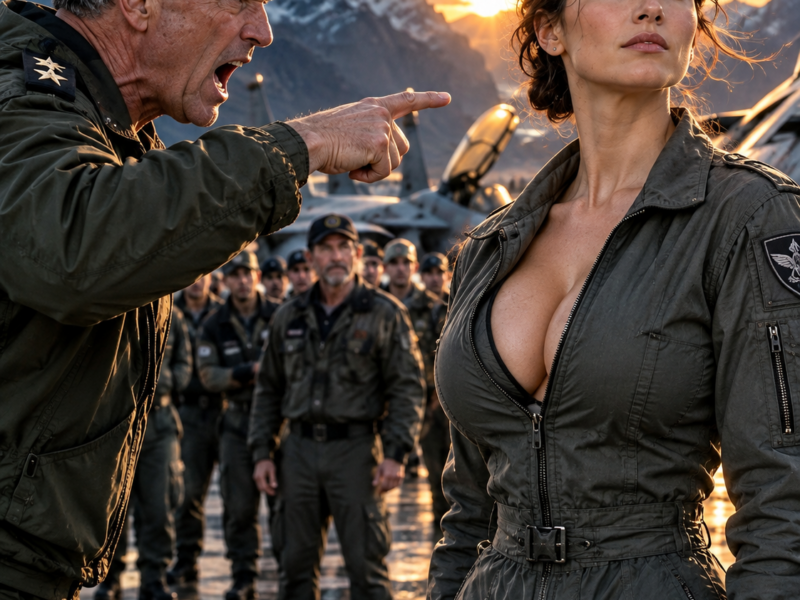
Colonel Hayes humiliated me in front of an entire squadron at Edwards Air Force Base, ordering security to drag me off the runway
The morning sun burned across the tarmac at Edwards Air Force Base, reflecting off the polished wings of multimillion-dollar fighter jets that stood lined up like predatory birds waiting for the signal to hunt. Around me, pilots in flight gear exchanged amused glances, their posture relaxed with the careless arrogance of men who had never lost a wingman to anything worse than a mechanical failure.
Colonel Hayes stood a few feet away, adjusting his sunglasses with deliberate slowness. He pointed toward the administrative hangars behind us, his expression dripping with condescension.
“Take her back to administration,” he ordered the two security officers who had just flanked me. “We don’t have time for someone playing dress-up.”
I swallowed the bitter anger rising in my throat, keeping my features meticulously neutral. I stood beside my battered, unpolished flight helmet—a relic of a different era of combat.
“I have orders, sir,” I said, my voice steady despite the adrenaline hammering against my ribs.
He laughed, a short, dry sound that drew chuckles from the surrounding pilots. “From whom? Your imagination?”
I looked toward the glass-fronted control tower, waiting for the secure confirmation code that was supposed to arrive ten minutes earlier. Nothing. The radio frequency remained silent, heavy with anticipation.
Hayes stepped closer, lowering his voice into a sharp, threatening hiss. “Listen carefully. This isn’t a recruiting commercial. Real pilots are preparing for a real mission. You’re in the way.”
I could have told him who had personally signed my deployment papers. I could have pulled out the classified authorization chip locked inside the lining of my helmet and shoved it into his face. Instead, I simply asked a question designed to puncture his ego.
“Have you checked the strike roster today, Colonel?”
His smug smile vanished instantly. “I don’t need to check anything. I wrote the roster.”
He turned away, dismissing me completely, and waved his hand for security to drag me off.
That exact second, the massive loudspeaker system and every base radio crackled to life with a high-priority digital handshake.
“Attention, all flight personnel. Priority command transmission incoming.”
Every conversation stopped dead. The mechanics froze mid-motion, wrenches hovering over hydraulic lines. The pilots turned their heads toward the nearest speakers.
The controller’s voice came through the comms, suddenly tight, rigid, and stripped of all casual authority. “Ghost Hawk is cleared for immediate launch. Ghost Hawk will assume tactical command of the strike formation. All squadron leaders are to acknowledge and yield.”
For three terrifying seconds, nobody moved. The desert wind was the only sound sweeping across the concrete.
Then, squadron commander Colonel Hayes slowly turned back around, his face draining of color. He froze halfway through adjusting his leather gloves.
“What did you just say?” he demanded into his chest-mounted radio, his voice cracking slightly. “Repeat that callsign. There is no Ghost Hawk on this manifest.”
The tower did not hesitate. “Ghost Hawk has absolute command authority. Confirmed by Central Operations, highest clearance level. Acknowledge immediately.”
One of the younger pilots near the wing of an F-35 stared at me, his jaw slack. “Ghost Hawk? That’s… that’s an urban legend. That’s a ghost callsign from the Black Program.”
I reached down, picked up my heavy helmet, and tucked it under my arm. “That’s me.”
Hayes surged forward, stepping directly in front of me, his face turning a furious, mottled red. “No. Absolutely not. I don’t care what kind of bureaucratic paperwork you forged. I’ve never seen you on this base, and you are not stepping foot near an aircraft under my command.”
“You weren’t supposed to see me,” I replied coldly.
I walked past him toward the waiting, prepped stealth fighter parked at the end of the line.
He lunged out and grabbed my arm, his fingers digging into my flight suit. “You will not fly my mission without explaining yourself right now!”
I looked down slowly at his hand, letting the silence stretch until his grip instinctively loosened and he let go.
“It’s not your mission anymore, sir.”
The words landed harder than I intended. Because beneath my calm, professional expression, my mind was violently racing backward. I wasn’t just thinking about the arrogant man standing in front of me; I was remembering the last combat mission I’d flown eighteen months ago. I was remembering the six advanced aircraft we had mysteriously lost over a hostile sector, and the wingman whose final, frantic transmission still echoed through my nightmares.
My brother.
The official military accident report had blamed enemy fire and pilot error. It had swept the catastrophic failure under the rug with clean, bureaucratic lies. But the raw, unedited classified cockpit recording I had secretly salvaged told a terrifyingly different story—a story of betrayal, scrambled frequencies, and a deliberate sabotage order issued from a command channel that matched Colonel Hayes’s voice print.
The officer who had signed that fraudulent report, the man who had buried my brother’s memory to save his own career, was standing twenty feet away, watching me with growing terror.
Hayes watched in stunned disbelief as I climbed the ladder into the cockpit, his confidence crumbling with every single step I took. The ground crew scrambled to secure the canopy locks, their eyes wide with awe and apprehension.
Just before the heavy glass canopy lowered and sealed me inside, my helmet headset came alive with a low-frequency encrypted tone.
“Ghost Hawk, this is Central Command. Your strike authorization is confirmed. Proceed to waypoint alpha.”
I exhaled a long, steady breath, settling my hands onto the flight controls. The digital displays flickered to life, bathing my face in an emerald glow.
Then, right before the comms channel locked into secure flight mode, another voice abruptly cut through the static.
It was a voice I hadn’t heard in eighteen months. A voice that belonged to a ghost.
“Ghost Hawk, if you can hear me, abort the mission immediately. The target coordinates are entirely compromised. It’s a trap.”
My blood instantly turned to ice in my veins. The cockpit dials blurred.
It was my brother’s voice. Unmistakable. The cadence, the slight rasp, the secure personal identifier code that only he and I possessed.
My brother—whose military funeral I had personally attended, whose casket I had touched, and who had been officially declared KIA by the Department of Defense.
Before I could gasp or shout a response into the mic, the control tower chimed in with one final, chilling automated alert.
“Ghost Hawk, be advised: anomaly detected. Your brother’s transponder signal is currently broadcasting live from inside the heart of the target facility.”
The cockpit canopy sealed with a heavy hydraulic hiss, locking me inside a private world of humming avionics, glowing multi-function displays, and the deafening roar of twin turbofan engines spinning up to idle. Outside, ground crews ducked low against the jet blast as my aircraft taxied smoothly toward the active runway, its matte-black radar-absorbent skin drinking in the harsh desert light.
My fingers moved across the control panels on pure, ingrained muscle memory, but my mind was completely paralyzed by the audio ringing in my ears.
“Ghost Hawk, abort the mission… your brother is currently transmitting from inside the target facility.”
It defied every law of physics, every military record, and every ounce of grief I had carried for a year and a half. I had watched the honor guard fold the American flag over his wooden coffin. I had listened to the haunting notes of taps fading across the Arlington hills. Yet, the voice in my headset was undeniably his. The acoustic signature matched our childhood vocal patterns down to the microscopic frequency modulation.
“Tower, Ghost Hawk,” I spoke into the encrypted mic, my voice entirely devoid of tremor, though my heart was hammering against my ribs like a trapped bird. “Confirm previous transmission regarding transponder anomaly at target grid.”
For several seconds, there was only dead silence from the tower. The controller sounded rattled when he finally came back on the line, his professional composure visibly fractured.
“Ghost Hawk… we copy. Central Operations confirms the signal trace originated from the subterranean bunkers of Site Four. We cannot explain the origin, but the hardware ID matches your brother’s old tactical rig. Proceed with extreme caution.”
“Understood. Rolling for takeoff,” I snapped.
I pushed the throttles forward into full military power. The engines screamed in unison, pinning me hard against the contoured carbon-fiber seat as the runway lights blurred into a continuous streak of white. At three hundred knots, I pulled back gently on the stick, and the heavy stealth fighter broke free of the earth, surging cleanly into the cloudless morning sky.
As I banked hard toward the restricted airspace of the western mountain ranges, I pulled up the mission parameters on my tactical display. Site Four was nestled deep within a jagged, mineral-rich canyon system known for blocking standard radio signals. It was a black-site research and detention facility officially designated as non-existent by the Pentagon.
Colonel Hayes had spent six months lobbying to lead this specific strike. He had claimed it was an arms depot belonging to an insurgent proxy group. But looking at the deep-layer architectural blueprints now automatically decrypting into my onboard computer, I realized the truth. It wasn’t an arms depot. It was an advanced cyber-warfare and human-experimentation black site—and my brother’s unit had stumbled onto it before being wiped out.
My secure tactical data-link flickered, displaying an incoming priority ping from an unknown relay.
“Sister,” a voice whispered through the encrypted channel, bypassing standard military encryption algorithms entirely by using our old backyard radio frequency. “You shouldn’t have come. They’re watching every packet you transmit.”
I gripped the flight stick so tightly my knuckles turned chalk-white. “Where are you? They said you were dead. I buried you!”
“There wasn’t much left to bury in that casket,” he replied bitterly, the static crackling around his words like a dying fire. “They needed a ghost to keep the secrets buried. I survived the crash, but they dragged me down here into the dark. Listen to me very carefully: Hayes didn’t just sign the cover-up report. He engineered the ambush that shot us down eighteen months ago. He’s running this entire operation from the shadows.”
The revelation hit me like a physical blow to the chest. All the pieces clicked into place with horrifying clarity. Hayes’s desperate anger on the runway, his frantic attempt to stop me from launching, his insistence that I had no business being on that base—he hadn’t just been acting like a typical misogynistic commander protecting his boys’ club. He had recognized my callsign. He had known that Ghost Hawk wasn’t just a tactical designation; it was the sibling of the pilot he had murdered in cold blood.
“I’m coming for you,” I said, my voice dropping an octave into a cold, lethal calm. “And I’m bringing the whole roof down on their heads.”
“No,” my brother warned urgently. “You don’t understand. The entire facility is rigged with a localized electromagnetic pulse and a self-destruct failsafe. If you drop conventional ordnance on those coordinates, you’ll trigger the core reactor meltdown. You have to land the bird inside the perimeter hangar and access the master mainframe manually.”
“Land a multi-million-dollar stealth fighter inside a hostile black site?” I scoffed lightly, checking my altitude and airspeed. “That sounds like a terrible flying day.”
“It’s the only way you’ll find the evidence to hang Hayes and walk out of here alive. Look at your secondary radar—they’ve scrambled interceptors from the secret ridge base to shoot you down before you cross the border.”
As if on cue, the radar display blossomed with angry red warning triangles. Four high-speed bogies were screaming across the horizon, cutting off my vector toward Site Four. They weren’t friendly air patrol; they were unmarked, experimental drones equipped with hyper-velocity intercept missiles.
“Ghost Hawk, multiple hostile contacts inbound,” automated computer voice chimed monotonously inside my helmet. “Lock warning. Lock warning.”
I didn’t panic. My combat training took over completely, pushing the grief and shock deep down into a dark, frozen compartment of my mind. I kicked the rudder pedals hard to the left, standing the fighter on its wingtip as a surface-to-air missile roared past my canopy, leaving a twisting trail of white smoke against the blue sky.
“Let them come,” I whispered, arming the internal weapon bays. “Let’s see how good their drones are against a real pilot.”
The sky erupted into violence as the first unmanned interceptor closed the distance at Mach 2, its nose cone tracking my thermal signature with terrifying precision. I slammed the throttles into emergency afterburner, forcing the stealth fighter to leap forward as G-forces slammed into my chest, threatening to blur my vision.
“Warning: Radar lock maintained,” the onboard computer droned mechanically.
I cut the engine thrust abruptly, deploying air brakes while simultaneously pulling the nose straight up into a cobra maneuver—a violent, physics-defying stall that forced my aircraft to hang momentarily on its tail while the high-speed drone rocketed past my lower fuselage, unable to adjust its trajectory in time.
Before the automated pilotless craft could loop back around, I dropped the nose, locked my targeting reticle onto its heat exhaust, and fired a single short-range missile. A blinding flash of orange light bloomed in the rearview monitors as the drone disintegrated into a cloud of glowing metallic confetti.
“Splash one,” I muttered into my oxygen mask.
There was no time to celebrate. Three more interceptors poured through the mountain pass, spreading out in a classic pincer formation designed to trap me against the sheer granite walls of the canyon system. Laser-guided tracer fire zipped past my canopy like angry glowing hornets, scorching the air and painting warning lights across my instrument panel.
“Ghost Hawk, you’re flying straight into a flak trap,” my brother’s voice broke through the static again, urgent and breathless. “Pull up into the narrow crevasse at grid 44-Delta. The drones’ flight stabilization systems can’t handle the turbulence in the tight turns.”
I didn’t hesitate. I trusted his voice over my own navigational instruments. Banking hard, I dove the aircraft into a dangerously narrow fissure between two towering red-rock cliffs. The canyon walls were so close I could practically see the individual striations of ancient sandstone rushing past my wingtips at five hundred miles per hour.
The two leading drones followed blindly into the chasm, their automated guidance systems desperately trying to compensate for the erratic wind shear howling through the gorge. Sparks flew as one of the drones clipped its wing against an outcropping of rock, cartwheeling into a massive fireball that shook the ground beneath the canyon floor.
The remaining interceptor backed off, climbing vertically out of the trap, but I had already anticipated the move. Pulling the stick back into my stomach, my fighter rocketed straight up out of the crevasse like a missile, breaking through the cloud cover directly beneath the belly of the final drone.
With a quick burst of my Gatling cannons, I shredded its starboard stabilizer. The crippled craft spiraled out of control, crashing harmlessly into an empty desert basin far below.
Silence descended on the cockpit, broken only by the rhythmic hum of life-support systems and the steady ticking of my mission timer.
“Clear,” I said, letting out a long breath that fogged my visor.
“Impressive flying,” my brother’s voice echoed softly. “You haven’t lost your touch. But the hard part starts now. You’re approaching the perimeter of Site Four. Their anti-air defense grid is offline because I hacked their primary relay from my terminal, but it won’t stay dark for long. Hayes knows you survived the ambush.”
I banked the fighter toward the coordinates flashing on my heads-up display. Ahead of me, the stark desert floor seemed to ripple and part as a massive subterranean hangar door slid open beneath a camouflage net resembling scrub brush and red dirt. A long, illuminated concrete runway stretched out into the dark cavern beneath the earth like the open jaws of a metallic beast.
“I see the landing slot,” I reported, lowering the landing gear. “Descending now.”
“Be careful,” he warned. “The base is swarming with private security contractors loyal to Hayes. They aren’t regular military—they’re mercenaries who will shoot anything that moves, including me.”
I touched down smoothly on the subterranean runway, the tires squealing against the polished concrete as the braking parachutes deployed behind me, bleeding off our massive forward momentum. The heavy steel doors above my head slowly began to close, plunging the underground hangar into a dim, amber-lit twilight punctuated by blinking emergency strobes.
I taxied the fighter into a designated maintenance bay, killed the engines, and popped the canopy latch. The heavy hiss of depressurization filled the cockpit as I unbuckled my harness, pulled my helmet off, and tossed it onto the seat.
Grabbing my sidearm—a standard-issue military sidearm modified with custom grip plates—I swung my legs over the cockpit rail and dropped gracefully onto the concrete floor. My boots hit the ground with a sharp echo that bounced off the massive stone pillars supporting the subterranean vault.
Before me stood a heavy steel security bulkhead marked with bio-metric keypad locks.
“You’re almost here,” my brother’s voice whispered through a tiny comm-earpiece he had instructed me to activate. “Turn left down corridor B-12. But keep your weapon drawn. You’ve got company.”
The air in the subterranean corridors of Site Four was thick, cold, and smelled faintly of ozone, antiseptic, and old dust. Every footstep echoed hollowly against the reinforced titanium walls, amplifying my movements in a way that felt entirely unnerving. I kept my sidearm raised, sweeping the corners with tactical precision as I followed the dimly lit path toward sector B-12.
“You’re walking right into a secondary checkpoint,” my brother’s voice murmured in my ear, his breathing sounding shallow and strained through the static. “Hayes must have deployed his personal reaction team the second my comm-signal breached their firewall.”
“How many?” I asked quietly, keeping my back pressed against the cold metal wall as I approached a heavy intersection.
“Three guards. Heavily armed, wearing tactical body armor. They’re guarding the primary access lift to the lower medical labs where they’re keeping me.”
I peeked carefully around the corner. Sure enough, three mercenaries clad in unmarked black tactical gear stood outside a massive reinforced blast door, their automatic rifles resting casually across their chests. They were chatting quietly, clearly bored by the monotonous watch duty in the bowels of the earth—until now.
“Watch and learn,” I whispered.
I unclipped a heavy stun grenade from my tactical belt, pulled the pin, and tossed it so it bounced softly off the polished floor ten feet short of their position.
The clattering sound instantly broke their conversation.
“What the hell is that?” one of the guards muttered, stepping forward.
Before he could bend down to inspect it, the grenade detonated with a blinding flash of white light and a concussive shockwave that rattled my teeth even from around the corner. The sharp shriek of high-frequency sound bounced off the metallic walls, sending the guards stumbling backward, clutching their heads in agonizing disorientation.
I rounded the corner in a flash, closing the distance before they could recover. A quick, decisive strike with the butt of my sidearm dropped the first guard to his knees, unconscious. The second lunged blindly forward with a combat knife, but I sidestepped his clumsy lunge, caught his arm, and used his own momentum to flip him hard onto the concrete floor, rendering him motionless.
The third guard managed to raise his rifle, but before he could squeeze the trigger, a heavy metallic pipe swung from the shadows beside him, crashing into his helmet with a sickening crunch. He collapsed instantly, sliding down the wall into a limp heap.
I lowered my weapon, blinking in surprise as a tall, painfully thin figure stepped out from the shadows of a recessed alcove, lowering the heavy steel pipe he had just used as a weapon.
It was my brother.
He looked older, his skin deathly pale from months spent away from natural sunlight, and dark circles bruised the skin beneath his hollow eyes. But there was no mistaking the fierce, familiar spark burning in his gaze.
“Took you long enough,” he rasped, coughing slightly as he dropped the pipe.
I stared at him, the overwhelming urge to cry warring instantly with the military discipline drilled into my bones. I dropped my weapon into its holster, rushed forward, and threw my arms around his thin shoulders, pulling him into a desperate, fierce embrace.
“You’re alive,” I choked out, my voice finally breaking. “They told me you were gone. I saw the report.”
“It was all Hayes,” he murmured, burying his face against my shoulder for a brief second before pulling back with urgent intensity. “He needed our unit out of the way because we intercepted communications proving he was illegally selling classified drone telemetry to foreign private defense contractors. When my plane went down, I survived the ejection, but his extraction team captured me before friendly rescue forces could arrive. They’ve been using me as a human guinea pig for neural-interface experiments.”
“We’re going to expose him,” I said, my voice hardening into steel. “I have the flight recorder from my jet, and your testimony will lock him away for the rest of his life.”
“It’s not enough just to lock him away,” my brother replied grimly, pulling a cracked electronic data-pad from his jumpsuit pocket. “This drive contains every financial transaction, every encrypted email, and the exact coordinates of every illegal operation Hayes has run over the past five years. But look at the system time stamp.”
I leaned in close, reading the glowing digital text on the screen. My blood ran cold once more.
“The self-destruct sequence,” I whispered in horror. “Hayes initiated it the moment my aircraft touched down on the runway.”
“Exactly,” my brother nodded rapidly. “He knew he couldn’t stop you from landing, so he decided to burn the entire facility to ash—destroying all the evidence, the labs, and every single person inside this mountain. We have less than eight minutes before the underground core reactor overloads and detonates.”
“Then we run,” I grabbed his arm, pulling him toward the access lift.
“We can’t just run,” he said, planting his feet firmly on the ground. “The surface blast doors are locked from the central command bunker on the upper surface level. The only way to override them and open an escape route is from the primary control terminal upstairs—where Hayes is currently sitting.”
I looked up at the heavy steel ceiling of the subterranean level, imagining the arrogant face of Colonel Hayes sitting safely in his command chair, sipping coffee while he prepared to burn us alive.
A slow, dangerous smile crept across my face.
“Then I guess it’s time for a promotion,” I said, drawing my sidearm and checking the magazine. “Let’s go pay our commanding officer a visit.”
The reinforced elevator hissed open, discharging us directly into the primary command hub on the upper level of Site Four. The room was a high-tech hive of glowing monitors, frantic technicians, and blinking red emergency lights. The air smelled of burnt electronics and rising panic.
When the metal doors slid back, the armed guards stationed inside turned their weapons toward us, but before they could shout an order, my brother raised his modified data-pad and keyed a high-voltage override code into the facility’s central console.
Sparks rained down from the ceiling-mounted security grids as the automated defense turrets targeted the guards instead of us, discharging non-lethal taser rounds that dropped the mercenaries to the floor in spasms of crackling energy.
In the center of the command platform stood Colonel Hayes.
His immaculate uniform was slightly rumpled, his sunglasses discarded on a nearby desk, and his face was twisted in an expression of sheer, unadulterated disbelief as he stared at my brother walking upright out of the elevator.
“You…” Hayes stammered, taking a stumbling step backward until the edge of the master control console pressed against his spine. “That’s impossible. You died in that crash. I signed the manifest!”
“You signed a lot of lies, Colonel,” my brother said steadily, stepping forward and tossing the cracked data-pad onto the main console with a sharp clatter. “And the signature is no longer classified.”
Hayes’s eyes darted frantically around the room, looking for a weapon, a panic button, or an escape route. Finding none, his expression shifted from panic back into a cold, arrogant sneer.
“You think walking in here with a broken data-pad and a rogue pilot is going to save you?” Hayes laughed harshly, reaching out to press a flashing red manual override switch on the console. “This entire base is wired to blow in three minutes. You’re standing in your own tomb. Nobody leaves this mountain alive.”
I didn’t hesitate. I raised my sidearm, flicked off the safety, and fired a single shot that shattered the glass monitor directly beside his ear. The loud crack of the gunshot echoed deafeningly through the command center, freezing Hayes mid-motion.
“Touch that button again,” I said quietly, stepping right up until the cold barrel of my weapon rested against the center of his chest, “and you won’t live long enough to see the explosion.”
Hayes swallowed hard, his bravado instantly evaporating as he looked into my eyes and saw the exact same terrifying resolve that had driven my brother through eighteen months of hell.
“You’re out of your mind,” he whispered, his hands trembling slightly as he raised them away from the console.
“No, Colonel,” I replied, my voice steady and cold as winter steel. “I’m just a woman in the wrong place—and I’m about to ruin your entire career.”
With my left hand, I reached across the master console, grabbed the override switch Hayes had been desperately trying to activate, and flipped it into the open position. The flashing red emergency lights abruptly shifted to a steady, amber safety glow, and the distant, low-frequency hum of the reactor core spooling up toward detonation ground to a screeching, metallic halt.
Across the room, the primary surface blast doors began to slide open, flooding the subterranean command center with brilliant, blinding shafts of golden desert sunlight.
Sirens began to wail in the distance—not the self-destruct klaxons of the black site, but the unmistakable approach sirens of federal military police and external investigative units summoned by the automated broadcast codes my brother had quietly uploaded to Central Command the second we stepped into the lift.
Hayes slumped against the console, his shoulders shaking as the weight of his crimes finally crushed him beneath the sheer gravity of reality.
My brother stood beside me, leaning heavily against my shoulder, breathing in the fresh desert air rolling through the open blast doors.
“Come on,” I whispered softly, turning away from the disgraced commander and leading my brother out into the sunlight. “Let’s go home.”
The end.









