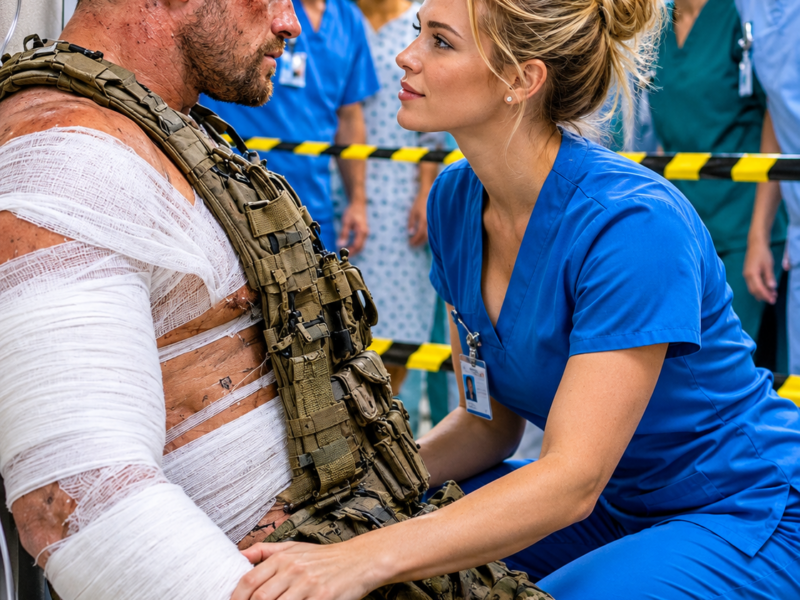
“At Walter Reed, three security officers had failed to get within arm’s reach of the Navy SEAL sniper barricaded in his hospital room
Daniel kept his eyes on the envelope.
For several seconds, neither of us spoke.
The doctors had finally persuaded security to step back, and the room was quiet except for the steady rhythm of the heart monitor.
I recognized the handwriting immediately.
It was my father’s.
The capital letters, the slight slant to the right, even the way he crossed the letter T. I had seen it on birthday cards, grocery lists, and the notes he used to leave on the kitchen counter when I was growing up.
I reached for the envelope.
Daniel pulled it back.
“Before you open that, I need you to answer something.”
I looked at him.
“Did your father ever mention a place called Red Creek?”
I shook my head.
“Never.”
“Did he ever tell you why he left the Marines?”
“He said his health wasn’t good enough to continue.”
Daniel gave a bitter, almost humorless laugh.
“That sounds like Tom.”
My father had always been private about his military years. He didn’t display medals, rarely attended veterans’ events, and changed the subject whenever someone asked about his service.
After my mother died, I had tried to get him to talk more.
He would sit on the back porch with his coffee, watching the trees move in the wind.
“Some things don’t get better because you tell them,” he once said.
I had thought he was talking about grief.
Now I wondered whether he had been talking about something else.
“Why did you say my father was supposed to be dead?” I asked.
Daniel looked toward the window.
“Because the last time I saw him, I watched him disappear into a building that was about to explode.”
My fingers tightened around the edge of the bed.
“What?”
“It was fifteen years ago. Afghanistan. Our team was assigned to escort a small intelligence unit through a village near the Pakistani border. Your father was attached to the operation as a combat medic.”
“He never told me he was there.”
“Of course he didn’t.”
Daniel shifted painfully against his pillow.
“That night, we received information that an American informant was being held inside a compound. We were supposed to get him out before sunrise.”
He paused.
“His name was Ethan Cole.”
I glanced at the photograph beside the bed.
The young man standing next to Daniel.
“Your teammate?”
“My best friend.”
His voice became quieter.
“Ethan had been working undercover for months. He knew the local network, the people involved, and the names of several men who were selling information to the enemy.”
“Then what happened?”
Daniel looked at me.
“Someone gave away our position.”
The words settled heavily between us.
“We entered the village just before midnight. Everything seemed normal. Too normal. No dogs barking, no lights, no movement. Then the first shot came from a rooftop.”
He stopped and rubbed his forehead.
“I was positioned on a ridge overlooking the compound. Ethan was inside with the ground team. Your father was with them.”
“What about the others?”
“Two men were killed before we reached the main building. I lost radio contact with the team. Then I heard Ethan.”
Daniel swallowed.
“He said one thing before the transmission went dead.”
“What?”
“Blue Seven, don’t trust the extraction.”
I remembered the phrase he had repeated during his episode.
Blue Seven.
Daniel’s call sign.
I glanced at the envelope again.
“Who was supposed to extract you?”
“An American military helicopter. The flight had been approved before we entered the village.”
He looked down at his hands.
“But it never came.”
Instead, an explosion tore through the compound.
Daniel had been thrown from his position by the blast. When he regained consciousness, the building was burning.
He saw two bodies near the entrance.
One belonged to a member of his team.
The other was wearing my father’s medical identification.
“I tried to get inside,” he said. “The fire was too intense. Someone pulled me back. By the time we reached the village again, there was nothing left.”
“But you said my father was supposed to be dead.”
“His medical identification was found inside the building. His blood was on the wall. Command told us there were no survivors.”
I stared at him.
“Then how did he get home?”
Daniel didn’t answer immediately.
Instead, he looked at the envelope.
“That’s what I spent fifteen years trying to understand.”
I finally took it from his hand.
The paper was yellowed at the edges. The flap had been sealed with an old strip of tape, but someone had opened it and closed it again.
Inside was a folded letter and a small photograph.
I unfolded the letter first.
The first line nearly made me sit down.
Emma, if you’re reading this, then Daniel Hayes has finally found you.
I read it again.
Then I continued.
I wanted to tell you the truth when you were younger. I wanted to explain why I sometimes woke up shouting, why I never liked helicopters, and why I kept a locked box in the garage.
But I was afraid that knowing the truth would put you in danger.
My throat tightened.
The letter continued for another page.
Fifteen years ago, I made a decision that saved one man’s life and destroyed several others. I have spent every day since trying to decide whether I did the right thing.
Daniel knows what happened to Ethan. But he doesn’t know who ordered the operation.
If he has given you this letter, then the person responsible may have started looking for the truth again.
At the bottom was a final sentence.
Find the photograph. Look at the man standing behind Ethan. You have seen his face before.
I lowered the letter.
The small photograph had slipped into my lap.
It showed the same four men from Daniel’s bedside photograph, but this one had been taken from a different angle.
I recognized my father immediately.
He was standing beside Ethan.
Behind them was a fifth man, partially obscured by the helicopter.
I stared at his face.
I knew that man.
Not personally, but I had seen him dozens of times.
He had been on television during Memorial Day ceremonies. He had spoken at military hospitals. He had appeared in newspaper photographs beside senators and senior military officers.
His name was Admiral Robert Whitaker.
My father had a framed photograph of him in the hallway of our house.
I had always assumed they had served together.
Daniel watched my expression.
“You know him?”
I nodded slowly.
“Admiral Whitaker. My father kept his picture at home.”
Daniel’s jaw tightened.
“That’s impossible.”
“Why?”
“Because Whitaker was the man who signed the extraction order.”
I looked down at the photograph again.
There was something written on the back in my father’s handwriting.
A short sentence.
The man who sent us in knew we weren’t coming out.
Before I could say anything, Daniel’s hospital room door opened.
A man in a dark suit stepped inside.
He was tall, clean-shaven, and probably in his early sixties.
Two security officers followed him.
“Chief Hayes,” he said pleasantly. “I hear you’re having a difficult morning.”
Daniel’s entire posture changed.
He pushed himself upright.
“Get out.”
The man ignored him.
His eyes moved to the photograph in my hand.
Then to the letter.
“Miss Bennett,” he said. “I don’t believe we’ve met.”
I recognized his voice from the television.
Admiral Robert Whitaker.
He smiled as if he had just walked into a routine hospital consultation.
“Your father was a good man.”
I stepped between him and the bed.
“How did you know I was here?”
His smile disappeared for a fraction of a second.
“Military medical records are not difficult to access when there’s a matter of national security.”
“Is that what this is?”
“Something close to it.”
Daniel reached for the call button.
Whitaker glanced at him.
“Please don’t make this harder than it needs to be.”
Daniel gave a short laugh.
“Fifteen years, and that’s the best you can say?”
Whitaker turned toward him.
“You were never supposed to survive that operation.”
The room went silent.
I looked at Daniel.
His expression had gone completely still.
Whitaker seemed to realize he had said too much.
He adjusted his jacket.
“I mean that the circumstances were unpredictable. The mission was compromised, and difficult decisions had to be made.”
“Decisions?” Daniel repeated.
He pointed toward the photograph.
“You left four men in that village.”
“I followed intelligence provided to me at the time.”
“Your intelligence was wrong.”
“Or someone deliberately misled us.”
Daniel leaned forward.
“That’s what you told the families, too?”
Whitaker didn’t answer.
Instead, he extended his hand toward me.
“Miss Bennett, I’ll take that letter. It contains classified information that should never have left military custody.”
I held it against my chest.
“My father wrote this to me.”
“Your father was involved in an operation that resulted in the deaths of American service members. There are matters here that you cannot understand.”
“Then explain them.”
His eyes hardened.
“I don’t think you appreciate the seriousness of your situation.”
Before I could respond, Daniel spoke.
“Emma, don’t give him anything.”
Whitaker looked at the security officers.
“Please escort the nurse outside. Chief Hayes needs rest.”
One of the officers hesitated.
He looked from Whitaker to Daniel.
Then back at me.
I noticed something strange.
The younger officer had been staring at the photograph since he entered.
His face had gone pale.
“Sir,” he said quietly.
Whitaker turned.
“What?”
The officer pointed at the picture.
“That’s my grandfather.”
I looked at him.
He was perhaps twenty-seven, with a small nameplate reading MILLER.
He stepped closer.
“My grandfather was Staff Sergeant James Miller. He died in Afghanistan fifteen years ago.”
Daniel stared at him.
“James Miller?”
The officer nodded.
“Yes, sir.”
Daniel looked at the photograph again.
“Your grandfather was on our team.”
Miller swallowed.
“My family was told he died in an explosion during a routine patrol.”
Whitaker’s expression became unreadable.
“Officer, this is not the time.”
But Miller didn’t move.
He was looking at the photograph as if it had just rewritten the history of his family.
“My grandmother always said the government never gave her the full story,” he whispered. “She spent years trying to get the mission records released.”
Whitaker stepped toward him.
“Stand down.”
For the first time, the young officer didn’t obey immediately.
And in that brief hesitation, I understood something important.
Whitaker wasn’t worried about what Daniel might say.
He was worried about who might believe him.
That evening, I returned to Daniel’s room after my shift officially ended.
I should have gone home.
I should have reported the conversation to hospital administration and allowed the military investigators to handle it.
But I couldn’t stop thinking about my father’s letter.
Daniel was awake.
The photograph lay on his bedside table.
“You’re still here,” he said.
“I could say the same about you.”
He gave the faintest smile.
I sat beside him.
“Tell me what happened after the explosion.”
He looked down at the blanket.
“I woke up in a field hospital three days later. They told me Ethan and your father were dead. They told me the mission had been compromised by an unknown enemy source.”
“And you believed them?”
“I was injured. I had a head wound. I couldn’t remember everything.”
He rubbed his left temple.
“Then, six months later, I received a package.”
“What was inside?”
“A photograph of Ethan.”
“Alive?”
Daniel nodded.
“And a note.”
“What did it say?”
“Stop looking.”
He looked at me.
“I thought it was a cruel joke. Then another package arrived. It contained a photograph of Tom Bennett standing outside a hospital in Germany.”
My mouth went dry.
“My father was in Germany?”
“Apparently. I spent years trying to locate him. Every lead disappeared. Every request was denied. Eventually, I was told to stop asking questions.”
“Why didn’t you go public?”
Daniel looked at his injured shoulder.
“Because the only evidence I had was a photograph and a handwritten note. And because I knew that if the people responsible could make four men disappear, they could make one more disappear too.”
I thought about my father sitting at the kitchen table, carefully folding newspaper articles before placing them in a drawer.
I remembered the way he always checked the locks twice before bed.
I had assumed those were habits left over from military service.
Perhaps they were something else.
“Why did you keep Ethan’s photograph?”
Daniel looked at the young man in the picture.
“Because he was the one who taught me how to come home.”
He paused.
“And because I promised him I wouldn’t forget.”
I reached for the photograph.
There was a small mark in the lower-right corner.
A handwritten number.
714.
I turned it over.
Nothing else.
“Does that mean anything?”
Daniel stared at it.
For the first time, he seemed genuinely confused.
“No.”
I examined the number again.
Then I remembered the date on my father’s envelope.
It was the same date as the explosion.
Fifteen years earlier.
I took out my phone and searched the hospital’s archived patient records.
I knew I shouldn’t have.
But I had a name, a date, and a suspicion that my father had spent years hiding something important.
I searched for Thomas Bennett.
The system returned several old records.
One of them was from a military hospital in Germany.
The date was three days after the explosion.
The patient was listed as an unidentified American civilian.
The medical notes included a brief description:
“Severe burns. Multiple fractures. Patient repeatedly requests contact with a person named Ethan.”
I stopped breathing for a moment.
There was another line.
“Patient discharged under restricted identity authorization.”
I turned the screen toward Daniel.
He read it twice.
Then he closed his eyes.
“Tom survived.”
I nodded.
“But there’s more.”
I scrolled down.
The record showed that the patient had been transferred to a private rehabilitation facility in Virginia eleven months later.
The name of the facility was familiar.
It was only thirty miles from the house where I had grown up.
My father hadn’t simply returned home.
He had been treated nearby under a different identity.
And someone had made sure the records stayed hidden.
Daniel stared at the screen.
“How did you find this?”
“I have access to the hospital system.”
“You shouldn’t have done that.”
“I know.”
He looked at me.
“Emma, listen carefully. If Whitaker knows you’ve seen those records, he may come after you.”
I almost laughed.
“He’s a retired admiral. I’m a nurse.”
“That’s not what I’m worried about.”
Before I could ask what he meant, my phone vibrated.
An unknown number.
One message.
Your father left something at the old house. Don’t let Hayes find it before you do.
I read it again.
Then another message appeared.
And whatever you do, don’t trust the man in the photograph.
I looked at Daniel.
He had been watching my face.
“What is it?”
I handed him the phone.
He read both messages.
His expression changed.
“Who sent that?”
“I don’t know.”
He looked toward the door.
Then he reached for the bedside table and pulled out the small envelope my father had written.
There was something I hadn’t noticed before.
A tiny indentation beneath the handwriting.
A second sheet of paper had been pressed against it when the ink was still wet.
Daniel held it under the bedside lamp.
Slowly, faint letters began to appear.
An address.
A street number.
And a name.
Ethan Cole.
I stared at it.
Daniel whispered something I could barely hear.
“He’s alive.”
I looked at him.
“You think Ethan is alive?”
Daniel shook his head.
“No. I know what I saw in that village. But I also know Ethan never wrote his name on an envelope unless he wanted someone to find him.”
He pointed to the address.
It was in a small town outside Richmond.
I recognized the street.
It was less than twenty minutes from my father’s old house.
The next morning, I requested two days off.
I didn’t tell my supervisor why.
Daniel was still under observation, but his condition had improved enough for him to walk short distances with assistance.
He insisted on coming with me.
The doctor objected.
Daniel looked at him.
“Then give me a wheelchair.”
The doctor sighed.
“You’re not leaving this hospital without clearance.”
Daniel looked at me.
I didn’t know whether to laugh or cry.
For the first time, he almost looked like the man in the old photograph.
Not the frightened patient who had spent days fighting invisible enemies.
Just a stubborn soldier who had found something worth pursuing.
We drove to the address that afternoon.
It was a modest brick house on a quiet street.
A small American flag hung beside the front door.
The mailbox had the name E. Cole written on it.
I knocked.
No answer.
I knocked again.
A dog barked somewhere inside.
Then a man’s voice called out.
“Who is it?”
Daniel stepped forward.
“Someone who owes you a conversation.”
The door opened a few inches.
A gray-haired man stood behind it.
He was thinner than the man in the photograph, with a slight limp and a scar running from his jaw to his neck.
But I recognized him immediately.
Ethan Cole.
Daniel couldn’t speak.
Neither could Ethan.
For several seconds, they simply stared at each other.
Then Ethan opened the door wider.
“Blue Seven.”
Daniel took one step forward.
“Ethan.”
The older man looked at me.
“You’re Tom’s daughter.”
I nodded.
His eyes softened.
“He said you might come someday.”
“Where is my father?”
Ethan lowered his head.
“That’s why I need you both to come inside.”
His house smelled of coffee and old books.
A stack of newspapers sat beside the sofa, and a small American flag stood on the mantel.
There were photographs everywhere.
Some were family pictures.
Others showed men in uniform.
One was a picture of my father standing beside Ethan in front of a hospital.
I walked toward it.
“Where was this taken?”
“Germany,” Ethan answered.
I turned to him.
“Was my father there?”
He nodded.
“He saved my life.”
Daniel slowly sat down.
“Tell me what happened.”
Ethan took a long breath.
“Whitaker didn’t just send us into a compromised operation. He had received information that Ethan Cole was preparing to expose a network of officers selling intelligence to private contractors.”
Daniel looked at him.
“You were the source?”
“I was gathering evidence. I had names, payments, recordings, and operational documents. Whitaker was one of the men involved.”
I stared at the photograph.
“So the mission was a setup?”
“Yes.”
Ethan walked to a cabinet and pulled out a thick folder.
“Whitaker arranged for our extraction to be canceled. He knew the compound would be attacked. He expected the explosion to destroy the evidence and kill everyone who could identify him.”
Daniel’s hands tightened around the arms of the chair.
“Why did Tom survive?”
“Because he got me out.”
Ethan opened the folder.
Inside were several photographs, handwritten reports, and a small digital recorder.
“When the explosion happened, Tom found me beneath a collapsed section of the building. I was badly injured, and he was burned trying to pull me free.”
I thought about the medical record.
The severe burns.
The fractures.
The request to contact Ethan.
“Why didn’t he come home immediately?”
“Because Whitaker had people watching the hospitals. Tom knew that if he was identified, they’d find me too. So he arranged for us to disappear.”
Daniel stared at him.
“And the bodies?”
Ethan looked down.
“Two men from our team died. James Miller and Andrew Price. Their families deserved the truth, but Tom and I didn’t have enough evidence to expose Whitaker without risking everyone involved.”
“Then why didn’t you contact me?” Daniel asked.
Ethan’s expression changed.
“Because I was told you had been killed.”
Daniel went still.
“What?”
“Whitaker’s people sent a report saying you died from your injuries. I didn’t know you were alive until years later.”
Daniel stood, then winced as pain moved through his shoulder.
“Someone made sure we never found each other.”
Ethan nodded.
“Yes.”
He placed the recorder on the table.
“This is the original recording from the mission. It contains Whitaker’s voice ordering the extraction to be canceled.”
I stared at the device.
“Does it prove everything?”
“Not by itself. But it connects to the financial records and the operational logs in this folder.”
Daniel looked at Ethan.
“Why now?”
Ethan glanced toward the window.
“Because Whitaker knows the old records are being accessed. He’s been trying to find this evidence for years.”
My phone vibrated again.
Another unknown number.
This time, there was only one sentence.
You have until midnight to return what belongs to us.
I showed Ethan.
He read it and went pale.
“He’s found us.”
Daniel moved toward the front window.
A black SUV was parked across the street.
Its engine was running.
A man sat behind the wheel.
I recognized him from the hospital.
One of Whitaker’s security officers.
Ethan closed the folder.
“There’s a back door.”
Daniel looked at him.
“We’re not running again.”
“I’m not asking you to run. I’m asking you to make sure the evidence survives.”
He handed me the digital recorder.
“Emma, take this.”
I hesitated.
“Why me?”
“Because they don’t know what your father gave you. And because you aren’t part of their military chain of command.”
Daniel stepped closer.
“I’ll stay with him.”
I shook my head.
“I’m not leaving you both.”
Ethan gave me a sad smile.
“Your father said you’d say that.”
Then he reached into his pocket and handed me a small brass key.
“There’s a storage unit near the old highway. Your father rented it under my name. Everything else is there.”
I looked at the key.
“Everything else?”
“The original documents. The photographs. The names of the men who received the money.”
A loud knock struck the front door.
All three of us turned.
A man’s voice called from outside.
“Federal agents. We need to speak with you.”
Ethan looked at Daniel.
“Those aren’t federal agents.”
Daniel moved toward the hallway.
I held the recorder tightly.
Then the knocking stopped.
A moment later, glass shattered somewhere behind the house.
Ethan grabbed a walking stick from beside the sofa.
Daniel reached for the door.
“Don’t,” I whispered.
He turned toward me.
For the first time, I saw the same fear I had noticed in his hospital room.
Not fear for himself.
Fear that someone else would pay for his decisions.
I looked down at the recorder in my hand.
Then I remembered my father’s letter.
Find the photograph.
Look at the man standing behind Ethan.
There had been something else in that picture.
Something I hadn’t noticed.
The fifth man wasn’t just standing behind them.
He was holding a folder.
And the folder had a symbol stamped on its cover.
A small blue circle with the number 714.
I looked at the photograph on Ethan’s mantel.
The same symbol appeared on a document visible through the glass frame.
“What’s 714?” I asked.
Ethan’s expression changed.
He slowly sat down.
“That’s the original operation number.”
Daniel turned toward him.
“You said the operation records were destroyed.”
“I said the military records were destroyed.”
Ethan looked at me.
“Your father kept a copy.”
The key in my hand suddenly felt heavier.
The storage unit wasn’t just hiding evidence.
It held the one document that could connect Whitaker directly to the operation.
And perhaps explain why he had spent fifteen years trying to bury it.
We left through the back entrance and reached the storage facility just before sunset.
The unit was at the far end of the property, behind a row of abandoned delivery trucks.
The lock opened with the brass key.
Inside were three metal boxes, several old uniforms, and a cardboard container filled with photographs.
There was also a small wooden desk.
On top of it sat a sealed envelope addressed to me.
I recognized my father’s handwriting again.
This time, there were no instructions on the outside.
Only my name.
I opened it carefully.
Inside was a letter dated six months before his death.
Emma,
If you’ve reached this place, then I wasn’t able to tell you everything myself.
I know you’ll be angry. You have every right to be.
I kept this secret because I thought protecting you meant keeping you away from the truth. But I made a mistake. Silence protected the people who caused the damage, not the people who suffered from it.
The documents in this unit are not enough to prove everything. The original recording is the missing piece.
If Daniel Hayes is with you, give him the letter inside the blue box.
I looked at the metal containers.
One was painted blue.
I opened it.
Inside was a second envelope and a small notebook.
The envelope was addressed to Daniel.
I handed it to him.
He opened it slowly.
His eyes moved across the page.
Then his face crumpled.
I had never seen him cry.
Not when he talked about the explosion.
Not when he discovered my father had survived.
Not even when Ethan opened the door.
But now, his hands were shaking.
“What does it say?” I whispered.
He passed me the letter.
Daniel,
You were right about the extraction.
I knew the helicopter wasn’t coming. I heard Whitaker cancel it over the radio before the compound was hit.
I could have warned you sooner. I could have found a way to get you out.
But when I reached Ethan, he was dying, and I had to make a choice.
I chose to save him.
I have spent fifteen years wondering whether I abandoned you.
I didn’t know you survived. If I had known, I would have found you.
I’m sorry.
There was a final paragraph.
You may hate me for what I did. But please understand that I never stopped being grateful for the men who went in with us. Especially you.
Daniel lowered the letter.
For a long time, he said nothing.
Then he whispered, “He thought I died.”
Ethan put a hand on his shoulder.
“He thought we all died.”
Outside, a vehicle engine started.
I looked toward the entrance.
The black SUV had followed us.
Its headlights illuminated the storage unit.
A man’s voice came through a loudspeaker.
“Step away from the evidence.”
Daniel moved in front of us.
I reached for my phone.
Ethan shook his head.
“Don’t call the hospital. Call the FBI.”
I looked at him.
“Do you have someone?”
He nodded.
“A prosecutor in Richmond. I’ve been trying to get this evidence to her for years.”
I dialed the number written inside the notebook.
It rang twice.
A woman answered.
“This is Assistant U.S. Attorney Laura Mitchell.”
I took a breath.
“My name is Emma Bennett. I have evidence relating to Operation 714 and Admiral Robert Whitaker.”
There was a pause.
Then her voice became sharper.
“Where are you?”
I gave her the address.
“Do not leave that location,” she said. “I’m sending federal agents.”
The man outside shouted again.
“Last warning.”
Daniel looked at me.
“Keep the recording.”
I nodded.
He turned toward the doorway.
“Whatever happens, don’t hand it over.”
The next few minutes felt longer than the fifteen years that had come before them.
The men outside tried the lock.
Then someone struck the metal door.
Ethan moved behind the desk.
Daniel stood beside the entrance, breathing carefully through his injured ribs.
I held the recorder in one hand and my father’s letter in the other.
Then we heard sirens.
Not one vehicle.
Several.
Blue and red lights swept across the storage facility.
A voice shouted from outside.
“Federal agents! Put your hands where we can see them!”
The men in the SUV tried to leave.
They didn’t get far.
Within minutes, the property was surrounded.
A woman in a dark coat entered the unit with two agents.
She introduced herself as Laura Mitchell.
“Which one of you is Emma Bennett?”
I raised my hand.
She looked at the recorder.
“Is that the original recording?”
I nodded.
“Along with the operational documents and financial records.”
She glanced toward Daniel.
“Chief Hayes, we’ve been trying to locate you.”
Daniel looked surprised.
“Why?”
“Because a former intelligence analyst came forward six weeks ago with information about Operation 714. We couldn’t verify his account without someone who had been there.”
She looked at Ethan.
“Mr. Cole, we’ve been searching for you even longer.”
Ethan nodded slowly.
“I know.”
The investigation took almost a year.
I gave several statements.
Daniel testified about the mission and the false extraction report.
Ethan provided the original documents and identified the officers involved.
The recording was examined by forensic specialists.
The voice ordering the helicopter to stand down was confirmed as Whitaker’s.
The financial records connected him to a private intelligence contractor that had received payments after the operation.
Whitaker was eventually charged with conspiracy, obstruction of justice, and several related federal offenses.
He pleaded not guilty.
His lawyers argued that the mission had been compromised by enemy intelligence and that the cancellation had been a legitimate operational decision.
But the recording told a different story.
During the trial, the prosecutor played the final radio transmission.
Whitaker’s voice was calm.
Almost bored.
“Cancel extraction. No recovery team. The operation is terminated.”
Then Ethan’s voice came through.
“Blue Seven, do you copy?”
A burst of static followed.
Then my father’s voice.
“Daniel, get down!”
The recording ended.
Daniel sat motionless in the courtroom.
I sat behind him.
I had brought my father’s letter in my handbag.
Not because I needed to read it.
Because I wanted him to know that Tom Bennett had not forgotten him.
The jury returned a guilty verdict on the major charges.
Whitaker was taken into custody.
For the families of James Miller and Andrew Price, the verdict couldn’t bring back the men they had lost.
But it gave them something they had been denied for fifteen years.
The truth.
Several months later, Daniel returned to Walter Reed for a follow-up appointment.
His shoulder had healed, although he still had limited movement.
He was receiving treatment for the trauma he had carried since Afghanistan.
He no longer refused to speak to the mental health team.
And he had stopped sleeping with the lights on.
I found him sitting in the same hospital room where we had first met.
He was looking at the photograph of his team.
The four men stood together in front of the helicopter.
Daniel was smiling in it.
A real smile.
I hadn’t seen that expression on his face before.
“You’re getting better at visiting hospitals,” I said.
He looked up.
“You’re getting better at ignoring security instructions.”
I laughed.
Then I noticed something.
There were two photographs on his bedside table now.
The original team picture.
And another one taken recently.
Daniel stood between Ethan and me.
We were outside the courthouse, the afternoon the verdict was announced.
Ethan had one hand on Daniel’s shoulder.
Daniel was smiling again.
I sat beside him.
“Have you heard from Ethan?”
“Yesterday. He’s coming down next weekend.”
“That’s good.”
Daniel looked at the old photograph.
“I used to think coming home meant surviving the mission.”
He ran a finger along the edge of the frame.
“Turns out, I had no idea what coming home was supposed to look like.”
I thought about my father.
About the years he spent carrying a secret he believed would protect me.
About the letters he never sent.
About the people who had waited fifteen years for someone to tell them the truth.
“Do you think he knew we’d find each other?” I asked.
Daniel considered that.
“I think he hoped we would.”
He reached into the drawer beside his bed and pulled out a small folded paper.
It was an old military patch.
Blue Seven.
The fabric was worn, and one corner had begun to unravel.
“I found this among my things after the surgery,” he said. “I was going to throw it away.”
“Why?”
“Because I thought it belonged to a life that was over.”
He placed it in my hand.
“Your father would have wanted you to have it.”
I looked at the patch.
For fifteen years, my father had carried the memory of that night.
For fifteen years, Daniel had believed he was the only survivor.
And for fifteen years, Ethan had lived knowing the truth but unable to share it.
None of them had been free.
Not until the truth finally came out.
I folded my fingers around the patch.
“Thank you.”
Daniel nodded.
Then he looked toward the window.
Outside, a military helicopter crossed the afternoon sky.
He watched it pass.
His shoulders tensed for a moment.
Then he took a slow breath and looked back at me.
He didn’t reach for the door.
He didn’t ask anyone to leave.
He simply stayed where he was.
And I understood something my father had tried to teach me without ever finding the words.
Sometimes the bravest thing a person can do isn’t surviving the battle.
It’s allowing themselves to live after it.
A year later, Daniel, Ethan, and I attended a memorial ceremony for James Miller and Andrew Price.
Their families had finally received the complete account of what happened.
James’s granddaughter, Officer Miller, stood beside her grandmother.
She held a photograph of the young soldier she had never met.
When the ceremony ended, she approached Daniel.
“Thank you for not letting them forget him.”
Daniel shook his head.
“I should have found the truth sooner.”
She looked at him for a moment.
“My grandmother says he would have wanted you to come home.”
Daniel couldn’t answer.
He just nodded.
I stood beside him as the families placed flowers beneath the memorial.
Later, when everyone had left, I placed my father’s old photograph beside the names of the men.
Four men had entered that village.
Two had died.
Two had survived.
And all four had been separated by a lie that lasted fifteen years.
My father never got to see the truth come out.
But I hoped that somewhere, in whatever peace he had finally found, he knew we had finished what he started.
Before leaving, I looked at Daniel.
“Do you still hear that call sign in your head?”
He glanced at the blue patch in my hand.
“Sometimes.”
“And what do you hear now?”
He thought for a moment.
Then he smiled.
“Not an order anymore.”
He looked toward the memorial.
“A reminder that somebody is still listening.”
I placed the patch beside my father’s photograph.
For the first time, Blue Seven no longer belonged to a night of fire, betrayal, and unanswered radio calls.
It belonged to the men who had finally made it home.
THE END.









