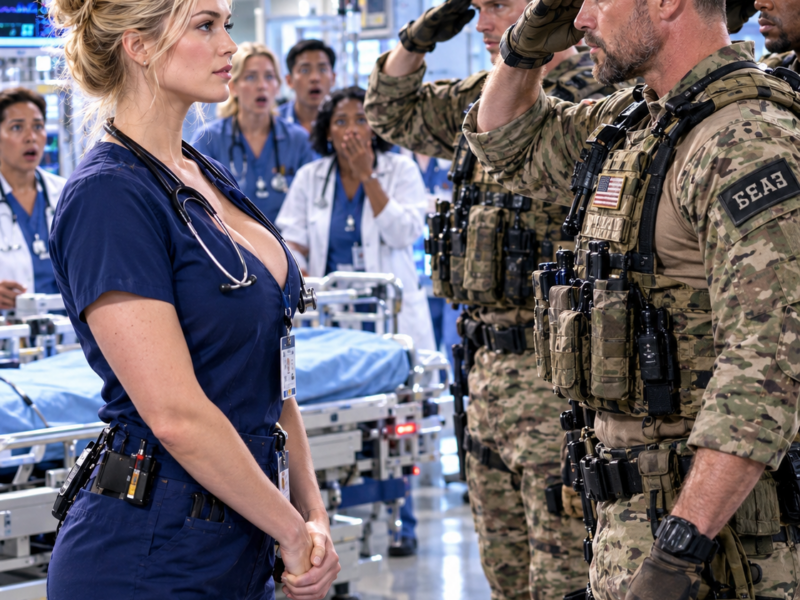
“At the rural emergency room in Cedar Falls, Iowa, my coworkers laughed when the new attending told me to stay out of the way
I stared at the colonel, unable to take my eyes off the photograph.
The young woman in desert camouflage had my face, my eyes, and the small scar beneath my left eyebrow. She stood beside three soldiers, one hand resting on the shoulder of a man named Daniel Reeves.
Daniel had been twenty-nine when he died.
For seven years, I had carried the official explanation of his death like a stone beneath my ribs. A vehicle accident during a medical evacuation. No evidence of misconduct. No further investigation warranted.
I had read those words so many times that I could recite them without looking at the report.
Yet the colonel standing in front of me had just asked about a document the Army claimed had never led to any unresolved questions.
“Who are you?” I asked.
He reached into his coat and withdrew a military identification card.
“Colonel James Whitaker. United States Army Medical Corps. I was the deputy medical commander at Forward Operating Base Mercer when you served there.”
I recognized the name.
Not the face, exactly, but the name.
I remembered seeing it on an email chain seven years earlier, shortly before I was ordered to stop asking questions about Daniel.
“You were never at our medical tent,” I said.
“No. I wasn’t.”
“Then how do you know about my report?”
His eyes moved briefly toward the other people in the room.
“Because your report disappeared from the official record, and three men who tried to find it were told to stop looking.”
Behind him, Dr. Lawson set his coffee cup on the counter.
“Excuse me,” he said, forcing a laugh. “This is an emergency department, not a military reunion. If you have a complaint about an employee, you’ll need to go through administration.”
Colonel Whitaker turned.
“I don’t have a complaint about your employee, Doctor.”
His gaze settled on the incident report Patricia had dropped.
“I do, however, have a question about why a nurse with Captain Carter’s service record is being disciplined for reporting a potential threat to a patient’s circulation.”
Lawson’s expression tightened.
“That is an internal personnel matter.”
“Then I’m sure you’ll have no difficulty explaining it to the hospital’s chief executive.”
Patricia bent to retrieve her clipboard.
I had never seen her move so carefully.
“Colonel, I think there’s been a misunderstanding,” she said. “Emily has had some difficulty adjusting to our new attending’s management style.”
Whitaker looked at her for a long moment.
“Is that what you call it?”
He turned back to me.
“Captain, would you be willing to speak somewhere private?”
I glanced at the clock.
My shift had another six hours to go, and two patients were waiting for reassessment.
“I can’t just leave the department.”
“Then we’ll wait until you’re finished.”
He said it without impatience or entitlement.
That small courtesy almost undid me.
I had spent months being told I was in the way, that my judgment was inconvenient, that I should learn to keep quiet.
Here was a colonel who had crossed half the country to find me, and he was willing to sit in a waiting room until I finished checking a patient’s blood pressure.
“Give me twenty minutes,” I said.
He nodded.
“Take all the time you need.”
I turned toward my workstation.
Dr. Lawson stepped into my path.
“You’re not going anywhere until we discuss this incident report.”
I looked at him.
“For once, Doctor, I’m going to finish taking care of my patients before I discuss anything else.”
His mouth opened, but I was already walking away.
For the first time since he had arrived at Cedar Falls, he didn’t follow me with another correction.
Twenty-seven minutes later, I found Colonel Whitaker in the small family consultation room beside the chapel.
The younger man sat across from him with a laptop open on the table.
Whitaker stood when I entered.
“Thank you for coming.”
I closed the door.
“Start with Daniel.”
The colonel exchanged a glance with the younger man.
“This is Major Samuel Brooks. He’s an investigator assigned to the Army’s medical oversight office. He’s been helping me reconstruct what happened at Mercer.”
Major Brooks offered his hand.
I shook it, noticing that he looked tired enough to have been awake for days.
Whitaker opened the leather folder.
“Seven years ago, Sergeant Daniel Reeves died during a medical evacuation. The official investigation concluded that his vehicle struck an improvised explosive device.”
“That’s what I was told.”
“And you disagreed.”
“I didn’t disagree with the fact that there had been an explosion,” I said. “I disagreed with the timeline.”
I could still see the medical tent in my mind.
The dust blowing beneath the canvas walls. The smell of antiseptic mixed with diesel fuel. Daniel sitting on a folding chair, his uniform sleeve rolled above his elbow while I cleaned a deep cut on his forearm.
He had been unusually quiet that afternoon.
When I asked if he was all right, he looked toward the tent entrance.
“Emily, if anything happens to me, don’t let them tell you it was an accident.”
I had laughed uneasily.
“You’re going to have to give me more than that.”
He shook his head.
“Not yet.”
That night, Daniel was assigned to a medical supply convoy.
The explosion happened at 8:16 p.m.
But at 7:40, I had seen him walking toward the command building with a sealed envelope tucked beneath his arm.
At 8:02, a transport vehicle had returned to the base without its assigned driver.
And at 8:11, someone called the medical tent asking whether Daniel had been brought in alive.
No one had.
I wrote every detail into my report.
The next morning, my commanding officer told me I was exhausted and should leave the investigation to the proper authorities.
Two days later, Daniel’s death was classified as an operational loss.
My report was never mentioned again.
“I submitted a copy to the medical command office,” I told Whitaker. “I kept the original notes in a locked field case until I was ordered to turn everything over.”
“Who ordered you?”
“Lieutenant Colonel Mark Harlan.”
Whitaker’s jaw tightened.
“Did Harlan tell you why?”
“He said my report contained speculation that could damage the unit’s reputation.”
Major Brooks typed something into his laptop.
“Did you ever receive written confirmation that the report had been reviewed?”
“No.”
“Did anyone ask you to amend it?”
I looked down at my hands.
“Yes.”
The word came out quieter than I intended.
Whitaker waited.
“They wanted me to remove the part about Daniel entering the command building. They said I’d mistaken him for someone else.”
“Did you?”
“No.”
The answer had lived inside me for seven years.
I had never doubted what I saw.
What I doubted was whether anyone would ever care enough to believe me.
“I refused to change it,” I continued. “A week later, I was reassigned. Three months after that, I left the Army.”
Whitaker lowered himself into his chair.
“Your separation was recorded as voluntary.”
“It was voluntary.”
He looked up.
“But it wasn’t what I wanted.”
I swallowed.
“I had a daughter waiting for me at home, and I had spent weeks being warned that my insistence on investigating Daniel’s death could affect my future assignments. I was tired. I was scared. I told myself that leaving was the only way to protect my family.”
For a moment, nobody spoke.
Then Whitaker slid a document across the table.
“We found a copy of your original report in an archive that wasn’t supposed to contain it.”
I stared at the first page.
My signature was at the bottom.
Every word was mine.
But someone had written a note across the upper margin in red ink.
DO NOT RELEASE. REFER TO COMMAND REVIEW.
I recognized the handwriting.
Lieutenant Colonel Harlan’s.
My stomach tightened.
“Where did you find this?”
“In a box of records transferred from a decommissioned command office. The box had been mislabeled as routine equipment inventory.”
Major Brooks turned his laptop toward me.
“We also found a record showing that your report was accessed six days after you left the Army.”
“By whom?”
He hesitated.
“That record is incomplete. But we know the account belonged to someone working in medical command.”
I looked back at the document.
Seven years.
Seven years of believing that my questions had died with Daniel.
Now someone had kept my report, hidden it, and opened it again years after I had left.
“Why come here?” I asked. “Why not send me a letter?”
Whitaker’s expression changed.
“Because last month, another former member of your unit contacted me. He told me Daniel had not been the only person who tried to report irregularities in the medical supply system.”
The room seemed to grow smaller.
“What irregularities?”
“Missing equipment. Unexplained transfers. Medication shipments that were marked as delivered but never reached the field hospitals.”
I thought of Daniel’s sealed envelope.
He had been responsible for coordinating medical supplies before his final assignment. It was one of the reasons I had trusted him when he said something was wrong.
“Was he investigating theft?”
“We believe so.”
“Believe?”
“We’re still establishing the facts.”
I appreciated that he didn’t pretend to know more than he did.
Whitaker opened another folder.
“There’s something else. Daniel’s last recorded communication wasn’t with his convoy commander.”
He placed a printed call log on the table.
At 7:53 p.m., Daniel had called a number assigned to the command building.
The call lasted four minutes and twelve seconds.
At 8:02, the transport vehicle had returned to base.
At 8:16, the explosion had occurred.
I traced the numbers with my finger.
“Someone at command knew he was alive less than half an hour before he died.”
“Yes.”
“Then why did the investigation say he never left the convoy?”
“That is one of the questions we’re trying to answer.”
I leaned back, fighting the urge to stand and pace.
For years, I had imagined that if I ever learned the truth, it would come with a clean explanation. Someone would sit me down, show me the missing page, and tell me why everything had gone wrong.
Instead, I had a recovered report, a suspicious call log, and a colonel who admitted that the evidence was incomplete.
“Did Daniel know he was in danger?”
Whitaker didn’t answer immediately.
“I think he suspected it.”
I closed my eyes.
I remembered him standing beside the supply tent, watching two soldiers unload crates.
When I asked why he was staring, he said, “Sometimes the numbers tell you more than the people do.”
At the time, I thought he was talking about inventory.
Now I wasn’t sure.
Major Brooks cleared his throat.
“Captain Carter, there’s a reason we need your help. The report contains references to an incident that was never documented in the official investigation.”
“What incident?”
He pointed to a paragraph halfway down the second page.
I read it once.
Then again.
At approximately 1910 hours, I observed Sergeant Reeves in possession of a sealed medical transfer manifest bearing the authorization code of Lieutenant Colonel Mark Harlan.
Beneath it, I had written that Daniel appeared distressed and had asked whether I could preserve a copy of the document if he brought it to me.
I remembered writing those words.
I remembered waiting for him to return.
He never did.
“Do you have the manifest?” I asked.
“No,” Brooks said. “But the authorization code was used to approve several shipments that later disappeared from the records.”
“Then Harlan was responsible?”
“We can’t conclude that from the code alone. Someone else could have used it, or the records could have been altered.”
I nodded slowly.
It was the answer I needed to hear.
I had spent too much of my life watching people turn suspicion into certainty whenever certainty served them.
“I won’t accuse anyone without proof,” I said.
“That’s why we’re here,” Whitaker replied.
For the first time, I noticed the weariness in his face.
He wasn’t a man arriving to deliver a triumphant revelation.
He looked like someone who had spent years regretting that he hadn’t acted sooner.
“I should have questioned the original investigation,” he said. “I accepted the summary because I was told the evidence had been reviewed by people I trusted. When I learned that the medical records were incomplete, I started asking questions.”
“Why now?”
“Because the former soldier who contacted me provided a name we hadn’t considered.”
He slid another page across the table.
The name at the top belonged to a man who had served with Daniel and me.
Staff Sergeant Aaron Bell.
I remembered Aaron as a broad-shouldered medic with a dry sense of humor and a habit of tapping his pen against his teeth when he was thinking.
He had been reassigned shortly after Daniel’s death.
I hadn’t spoken to him since.
“Where is he?” I asked.
“Des Moines,” Brooks said. “He agreed to meet with us, but he insisted that you be present.”
“Why?”
“He said you were the only person who had written down what happened before anyone knew there was something to hide.”
I stared at Aaron’s name.
For seven years, I had told myself that leaving the Army meant leaving Daniel’s death behind.
But I had never truly left it.
It followed me into every quiet room, every late-night shift, every moment when someone in authority told me not to question an order.
I looked at Whitaker.
“If I agree to help, what happens to the original report?”
“It becomes part of a formal review. Your testimony will be documented, and you’ll have access to the evidence relevant to your statements.”
“And if the evidence proves I was wrong?”
“Then we establish that, too.”
His answer settled something inside me.
I didn’t need Daniel to have been right about everything.
I needed the truth to stop being something other people could bury whenever it became inconvenient.
“I’ll meet Aaron,” I said.
Whitaker nodded.
“Thank you.”
“But I have one condition.”
He waited.
“Nobody contacts my daughter, my family, or my workplace about this without my permission. I don’t want Sophie dragged into something she doesn’t understand.”
“Agreed.”
“And I want copies of every document you show me.”
“That’s reasonable.”
When I returned to the nurses’ station, Dr. Lawson was waiting beside my computer.
Patricia stood a few feet away, pretending to review the schedule.
“Where have you been?” Lawson asked.
“Speaking with a visitor.”
“You left your assigned area.”
“I arranged coverage before I went.”
“That’s not the point.”
He lowered his voice.
“You need to understand that this hospital has a chain of command. You don’t get to decide which rules apply to you.”
I thought of the photograph on the counter, the recovered report, and Daniel’s name on the call log.
For years, I had confused obedience with professionalism.
I had believed that if I stayed calm enough, worked hard enough, and never made trouble, people would eventually recognize my worth.
They hadn’t.
“I’m happy to discuss any legitimate concerns through the proper process,” I said. “But I’m not signing another statement that misrepresents my actions.”
His eyes narrowed.
“You think having a colonel visit you makes you untouchable?”
“No.”
I opened the patient’s chart.
“I think taking care of people is still my job, and that’s what I’m going to do.”
Lawson stared at me as if he couldn’t decide whether to be angry or embarrassed.
Then he walked away.
Patricia followed him into the office.
I heard the door close behind them.
For the first time in months, I didn’t spend the rest of my shift wondering what they were saying about me.
I finished my assessments, checked on Tyler’s transfer status, and called his father to let him know the receiving hospital had taken his son into surgery.
When the father answered, his voice was exhausted.
“Is he going to be okay?”
“They’re doing everything they can,” I told him. “I’ll share any update I receive.”
He thanked me before hanging up.
I sat quietly for a moment, looking at my hands.
They were the same hands that had held Daniel’s arm while I cleaned his wound seven years earlier.
The same hands that had signed the report.
The same hands I had kept folded in my lap every time someone told me to move on.
I no longer wanted to keep them still.
Two days later, I drove to Des Moines.
The sky was low and gray, and the heater in my old sedan made a rattling sound whenever I turned it above medium.
I had told Sophie I was meeting a former Army friend about an old work matter.
She’d asked whether I’d be home for dinner.
“I’ll be back before bedtime,” I promised.
I hated making promises when I wasn’t sure what the day would bring, but I didn’t want to frighten her.
Aaron Bell was waiting in a private room at a veterans’ community center.
He looked older than I remembered, with gray at his temples and a slight limp I didn’t recall from our time overseas.
When he saw me, he stood.
“Emily.”
“Aaron.”
For several seconds, neither of us moved.
Then he pulled me into a brief, awkward hug.
“I’m sorry,” he whispered.
I stepped back.
“For what?”
His eyes filled.
“For letting you think you were alone.”
Colonel Whitaker and Major Brooks sat at the far end of the table.
A recorder rested between them.
Aaron looked at it and shook his head.
“Before we start, I need to tell you something about Daniel.”
He sat down slowly.
“Three days before he died, Daniel came to me with copies of two shipment manifests. The quantities didn’t match the inventory, and the signatures belonged to people who claimed they’d never approved the shipments.”
“Why didn’t he report it?”
“He did. Twice. The first complaint disappeared. The second was returned with a note saying the discrepancies had been corrected.”
“Who signed the note?”
Aaron rubbed his palms against his trousers.
“Harlan.”
Major Brooks leaned forward.
“Do you still have the copies?”
“Not the originals.”
Aaron reached into his jacket and withdrew a small envelope.
Inside were two faded photocopies, their edges soft from years of handling.
“I made these before Daniel died,” he said. “He asked me to keep them somewhere safe. After the explosion, someone searched my quarters. They took his notebook and every paper I had left on my desk.”
He touched the envelope.
“They missed these because I had hidden them inside a book.”
Whitaker examined the documents.
The shipment numbers matched those in my report.
So did the authorization code.
But the quantities were different from the figures recorded in the official inventory.
“Why didn’t you come forward sooner?” I asked.
Aaron lowered his head.
“Because I was scared. Harlan had friends in command, and after Daniel died, I heard people saying you were unstable and obsessed with proving there had been a cover-up.”
My throat tightened.
“I wasn’t unstable.”
“I know that now.”
He looked at me.
“I should have said it then.”
There was no dramatic excuse in his voice, no attempt to make his fear sound noble.
He had been afraid, and his silence had hurt me.
I could understand that without pretending it hadn’t mattered.
“Did you know Daniel was going to meet someone that night?” I asked.
Aaron hesitated.
“Yes.”
The room went still.
“Who?”
“Someone from the command building. Daniel told me he had enough evidence to force a review, but he needed to hand over the originals.”
“Did he tell you the person’s name?”
“No. He said if he told too many people, the evidence might disappear before he could deliver it.”
I looked at the call log Whitaker had brought.
The call at 7:53 p.m.
The return of the vehicle at 8:02.
The explosion at 8:16.
“Was Daniel already in the vehicle when it left the base?”
Aaron shook his head.
“Not according to the driver who came back.”
Whitaker leaned forward.
“You spoke to the driver?”
“Briefly. He said Daniel had been ordered out of the vehicle at the command building. He was told to wait for another transport.”
“Who gave the order?”
“I don’t know.”
“Did you report that?”
“I tried. The driver was reassigned before I could get a formal statement, and then I was told not to discuss the incident.”
Major Brooks wrote something down.
“Do you remember the driver’s name?”
“Corporal Michael Dwyer.”
Whitaker looked at Brooks.
“Can we locate him?”
“We’ll try.”
Aaron’s shoulders sagged.
“I thought if I kept the copies, maybe someday they’d matter. But every year that passed made it harder to explain why I had waited so long.”
I understood that feeling too well.
The longer I had stayed silent, the more impossible it had seemed to speak.
I reached across the table, not to absolve him, but to acknowledge the courage it had taken to come here.
“Then help us finish what Daniel started.”
Aaron nodded.
For the next three hours, we reviewed the manifests, compared shipment records, and reconstructed the final evening as carefully as we could.
Nothing proved that Harlan had caused Daniel’s death.
But the documents established that the inventory discrepancies were real, that Daniel had tried to report them, and that the official investigation had omitted a key part of the timeline.
For the first time, the questions in my old report had somewhere to go.
Over the following weeks, Major Brooks contacted former personnel, obtained archived records, and arranged interviews with the surviving members of Daniel’s unit.
Some remembered little.
Others remembered more than they had admitted before.
A retired logistics officer eventually produced an email showing that several shipments had been redirected to a contractor that had never been authorized to receive them.
A second record showed that Harlan had approved an exception to the normal transfer procedure.
That was evidence of serious misconduct, but it still didn’t establish who had ordered Daniel out of the vehicle or whether anyone had intended him harm.
The investigation moved slowly.
There were legal reviews, requests for additional documents, and long stretches when we heard nothing at all.
I began to understand that truth was rarely a single locked door someone could finally open.
Sometimes it was a hallway of doors, each requiring another key.
At Cedar Falls, my life continued with its usual demands.
I worked my shifts, packed Sophie’s lunches, and attended parent-teacher conferences.
Dr. Lawson stopped making public remarks about my competence after the hospital received a formal request to preserve the records connected to my personnel complaint.
He didn’t apologize.
Patricia eventually called me into her office and said the original incident report would be reviewed.
“We should have handled the situation more carefully,” she told me.
I waited for her to say more.
She didn’t.
I signed the acknowledgment of the review, not because I believed everything was suddenly fair, but because I wanted the record to reflect what had actually happened.
A month later, the hospital removed the disciplinary notation from my file after reviewing the patient’s chart and speaking with the receiving physician.
Tyler recovered.
His father sent a handwritten card addressed to the emergency department, thanking the staff who had treated his son.
My name appeared in the second paragraph.
I put the card in my locker.
It wasn’t revenge, and it wasn’t an apology from Lawson.
It was simply proof that the work I had done mattered to someone who had needed it.
Then, almost four months after Colonel Whitaker first walked through the ER doors, Major Brooks called me.
“We found Michael Dwyer,” he said.
I sat down at my kitchen table.
“Is he willing to speak?”
“Yes. And he remembers the night Daniel died.”
Dwyer had left the Army years earlier and was living in Wisconsin.
He agreed to an interview, but he wanted to speak with me before giving a formal statement.
When I met him, he was thinner than I expected and kept turning a paper cup between his hands.
“I’ve wanted to tell someone for years,” he said.
“Then tell me what you remember.”
He took a breath.
“Daniel wasn’t in the vehicle when it left the command building. Harlan’s aide told me to take the convoy back to the base and wait for further instructions.”
“What happened to Daniel?”
“I don’t know. I never saw him again.”
“Did you tell the investigators?”
“I told them I had been ordered to return without him. They said my memory was confused because of the blast and that I should stick to the official timeline.”
His eyes dropped to the cup.
“I was twenty-three. I had a wife at home, a baby on the way, and no idea how to challenge a senior officer without destroying my career.”
I knew that kind of fear.
I had carried my own version of it all the way back to Iowa.
“Did you see who gave the order?”
“Not Harlan himself. His aide, Captain Robert Vance.”
Major Brooks wrote down the name.
Dwyer continued.
“There’s one more thing. Daniel handed me a small envelope before we reached the command building. He told me that if he didn’t return, I should make sure it reached the medical tent.”
My fingers tightened around the edge of the table.
“What did you do with it?”
“I left it in the vehicle when I was ordered back. When I returned, the vehicle had been searched.”
“Was the envelope still there?”
“No.”
He looked directly at me.
“But I remember what Daniel said before he got out.”
“What?”
Dwyer swallowed.
“He said, ‘If Emily asks, tell her I was right to trust her.'”
For a moment, I couldn’t speak.
I had spent seven years wondering whether Daniel had regretted involving me in his concerns.
Whether he had believed my report would help him.
Whether my inability to protect him had somehow made me responsible for what happened.
Now I knew that, in the last hours before his disappearance, he had trusted me enough to leave something in my care.
I just didn’t know what it was.
The formal investigation continued for another six months.
Eventually, the Army confirmed that the original inquiry into Daniel’s death had been compromised by incomplete records and inaccurate statements about his movements before the explosion.
The missing medical shipments were traced to an unauthorized network of transfers involving a private contractor and several officers who had approved or concealed the transactions.
Lieutenant Colonel Harlan had retired years earlier.
When investigators confronted him with the recovered documents and testimony from former personnel, he denied ordering anyone to harm Daniel.
There was not enough evidence to prove that he had planned Daniel’s death.
But there was enough to establish that he had helped suppress the reports that could have exposed the supply scheme.
Captain Robert Vance admitted that he had ordered Dwyer to return to base without Daniel, claiming he had been following Harlan’s instructions.
He said he believed Daniel was being taken for questioning.
He did not know what happened afterward.
Investigators were unable to establish the precise circumstances of Daniel’s final hours.
The explosion that killed him had destroyed the vehicle and much of the surrounding evidence, and the people who might have known more had spent years protecting themselves with silence.
The official finding was amended.
Daniel’s death remained a fatality during military operations, but the investigation acknowledged that the circumstances preceding it had been misrepresented and that evidence of suspected misconduct had been improperly withheld.
It wasn’t the complete answer I had wanted.
There was no final confession, no neat explanation of every missing minute, no courtroom scene in which someone admitted everything.
There was, however, an official record that no longer called my report baseless.
My testimony was included.
The original document was preserved.
And the men who had once told me to stop asking questions could no longer pretend the questions had never existed.
When Colonel Whitaker came to Iowa again, he asked whether I’d meet him for coffee.
We sat at a small diner outside town, where the waitress called everyone honey and the coffee tasted as if it had been sitting on the burner since dawn.
Whitaker placed a thin envelope on the table.
“I wanted you to have this.”
Inside was a copy of the amended finding and a letter recognizing my actions in documenting the discrepancies.
I read the letter twice.
Then I folded it carefully.
“Thank you,” I said.
He watched me for a moment.
“I should have found you sooner.”
“You didn’t know where I was.”
“I knew there was a nurse who had tried to tell the truth. I should have made more of an effort to find out what happened to her.”
I looked out the window at the parking lot.
“I spent a long time thinking that leaving meant I’d failed Daniel.”
Whitaker shook his head.
“You were a young mother who had been placed in an impossible position. Leaving was a decision you made to protect your family. That doesn’t erase what you did for him.”
I thought of Sophie waiting at home with a spelling worksheet and a storybook she wanted me to read.
For years, I had treated my life after the Army as something separate from the person I had been before it.
As if returning home had meant abandoning the part of me that had served.
But the nurse I was now had not replaced the captain I had been.
They were the same person.
I had simply spent a long time trying to keep one of them quiet.
“Did you ever find out what was in the envelope Daniel gave Dwyer?” I asked.
“No,” Whitaker said. “We never recovered it.”
I nodded.
It would always be one of the unanswered questions.
Not every missing piece had been found, and I no longer needed to pretend otherwise.
Before we left, Whitaker stood beside the table.
“I owe you a salute, Captain.”
I shook my head.
“You already gave me one.”
“That one was for your service. This one would be for your courage.”
I looked at him for a long moment.
Then I held out my hand.
“Just remember the next person who speaks up, Colonel. They shouldn’t have to wait seven years for someone to listen.”
He took my hand and nodded.
“I won’t forget.”
That evening, Sophie was sitting cross-legged on the living room rug when I came through the door.
She looked up from her book.
“Mom, did you solve your work problem?”
I set my bag down and sat beside her.
“Some of it.”
“Was it a big problem?”
I thought about Daniel, Aaron, Dwyer, and all the years that had passed while people kept their heads down because speaking seemed too dangerous.
“Big enough,” I said.
Sophie leaned against my shoulder.
“Are you going to be okay?”
I wrapped an arm around her.
“Yes, sweetheart. I think I am.”
She returned to her book, apparently satisfied, and began reading a paragraph aloud.
I listened to her voice fill the room.
For the first time in years, the silence inside me didn’t feel like a place where Daniel’s death had been buried.
It felt like space I could finally use to live.
The next morning, I went back to Cedar Falls Community Hospital for another twelve-hour shift.
The emergency department smelled of disinfectant and burnt coffee.
A new nurse stood at the medication station, struggling to reconcile two conflicting orders while Dr. Lawson spoke impatiently from the doorway.
I recognized the look on her face.
It was the look of someone deciding whether speaking up would be worth the trouble.
I walked over and stood beside her.
“Show me what you’ve got,” I said.
She turned the chart toward me.
We reviewed the orders together, checked the patient’s history, and contacted the physician responsible for the medication.
The discrepancy was corrected before the dose was given.
The new nurse let out a breath.
“I thought I was going to get in trouble.”
I handed her back the chart.
“You might still get questioned. But if something doesn’t look right, you have every right to ask.”
Across the room, Dr. Lawson watched us.
This time, I didn’t lower my eyes.
I had once believed that courage meant refusing to leave, no matter how much it cost.
Now I understood that courage could also mean walking away when you needed to, returning when you were ready, and refusing to let someone else’s authority convince you that your voice had no value.
Daniel never came home.
I never learned exactly what he had intended to place in that missing envelope, or what happened in the minutes between his final call and the explosion.
Those gaps remained, painful and real.
But the report he had trusted me to write was no longer hidden in a mislabeled box.
His name had been cleared of the questions that were never his to carry, and mine was no longer attached to an accusation of insubordination.
Sometimes I still remembered the colonel stepping into the ER, the rain shining on his coat, and the sudden silence that fell over the people who had spent months treating me as if I didn’t belong.
His salute had not made me important.
It had reminded a room full of people that they had failed to see what was already there.
And when I walked into the next patient’s room, I carried that reminder with me—not as a medal, not as a victory, but as a promise that no one in my care would have to earn the right to be heard.
THe ENd.









