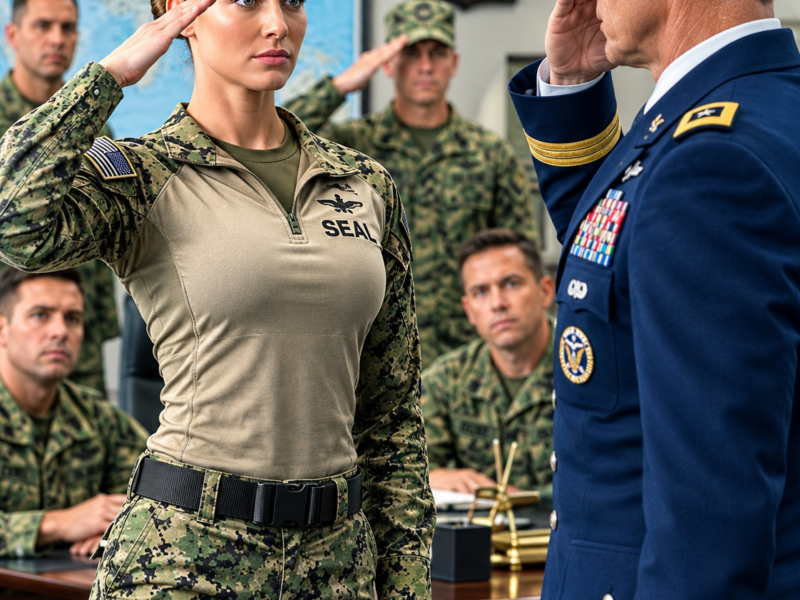
“At the Navy’s elite training facility in Virginia, three senior officers laughed when I walked into the briefing room wearing a plain uniform with no combat decorations
The admiral kept his eyes on me for another moment before turning toward Commander Mercer.
“Commander, would you mind explaining why Lieutenant Commander Hayes was asked to justify her presence in this room?”
Mercer swallowed.
“Sir, there appears to have been a misunderstanding. We were simply reviewing her assignment and making sure everyone understood the purpose of the evaluation.”
Admiral Whitaker glanced at the chairs around the table.
“Is that what you call it?”
Nobody answered.
He placed a leather portfolio on the table and opened it.
“I’ve known Commander Hayes for nearly seven years. I’ve seen her operate under conditions that would make most experienced officers question whether they could finish the mission.”
His gaze moved toward the men standing beside Mercer.
“She has earned every qualification she carries. And she has earned the respect of this command many times over.”
I remained still.
I didn’t need the admiral to defend my career. But I knew why he had come, and it had very little to do with the jokes made that morning.
Mercer cleared his throat.
“Admiral, with respect, nobody here was aware of her previous operational background.”
Whitaker looked at him.
“Then perhaps you should have asked before deciding she had none.”
The silence that followed was uncomfortable enough that I could hear the ventilation system humming above us.
The admiral turned back to me.
“Rebecca, would you like to explain what you found?”
I opened my folder.
“Yes, sir.”
I connected my laptop to the presentation screen.
The first slide showed the October coastal extraction exercise.
“On October seventeenth, this unit conducted a simulated extraction operation along the Virginia coastline. The final report lists twelve participants and records the exercise as a complete success.”
I changed the slide.
“This is the communications log. It accounts for ten personnel.”
Another slide appeared.
“This is the equipment inventory. Two emergency locator beacons were issued but never returned to storage.”
I heard someone shift behind me.
“At first, I assumed the missing information was an administrative mistake. But then I compared the original report with the amended version.”
I displayed two documents side by side.
“The original report recorded a communications failure lasting twenty-three minutes. The amended report reduced that failure to four minutes.”
Mercer leaned forward.
“That correction was made after the exercise.”
“Yes. Three weeks afterward.”
“Because the initial recording was incomplete.”
“Then why was the amendment authorized using the digital credentials of Lieutenant Aaron Brooks?”
A man near the far end of the table looked up sharply.
He was in his early thirties, with tired eyes and a wedding ring he kept turning around his finger.
I had noticed him during the briefing.
He hadn’t spoken once.
Mercer answered before he could.
“Lieutenant Brooks was the administrative officer responsible for maintaining those records.”
I looked at Brooks.
“Did you authorize the amendment?”
He opened his mouth.
Then closed it.
Mercer turned toward him.
“Lieutenant?”
Brooks stared at the table.
“No, sir.”
The answer was quiet.
But everyone heard it.
Mercer straightened.
“Be careful what you’re saying.”
Brooks lifted his eyes.
“I didn’t make that change.”
The admiral placed both hands on the table.
“Nobody is going to be punished for answering a question honestly. Continue, Commander.”
I switched to the next slide.
It showed a photograph taken during the exercise.
A shoreline at night.
A rescue boat.
A group of trainees gathered near a temporary command station.
I enlarged the image.
“Two people were removed from the final participant list. One was a trainee. The other was a medical officer assigned to the exercise.”
I pointed toward the photograph.
“Neither appears in the final report.”
Mercer shook his head.
“They were observers.”
“Then why did the medical officer submit a casualty assessment?”
That question seemed to take something out of him.
He leaned back.
I continued.
“The trainee’s name was Ethan Cole. Twenty-six years old. He suffered a serious injury during the exercise and was evacuated from the site.”
A few officers exchanged looks.
“According to the hospital record, he arrived with a fractured rib, a head injury, and symptoms consistent with prolonged oxygen deprivation.”
I let the information settle.
“Yet the official report states that all participants completed the exercise without injury.”
Admiral Whitaker looked toward Mercer.
“Is that accurate?”
Mercer rubbed his jaw.
“Sir, I was not personally responsible for the medical documentation.”
“That wasn’t my question.”
He looked down.
I understood the instinct to protect a unit’s reputation.
I’d spent enough years in the Navy to know that a bad report could damage careers, end assignments, and create investigations that lasted longer than the missions themselves.
But hiding an injury was something different.
And hiding the circumstances surrounding one could put people in danger.
I opened another document.
“This is where the situation becomes more serious.”
The screen displayed a series of encrypted communications records.
“After the exercise, someone accessed the original incident report and replaced several files. The access originated from a terminal assigned to the command office.”
Mercer stood.
“That’s a serious accusation.”
“I’m not accusing anyone yet.”
“You’re implying that someone in this room falsified an official record.”
“I’m saying the records were altered. The access logs are attached.”
Admiral Whitaker raised one hand.
“Commander Mercer, sit down.”
Mercer hesitated before returning to his chair.
I looked at the final page in my folder.
There was one name I had deliberately avoided displaying.
A name that connected the October incident to something much larger.
Before I could continue, Brooks spoke.
“Commander Hayes?”
I turned.
He was pale.
“There’s something you need to know about Ethan.”
I nodded.
“Go ahead.”
Brooks looked toward Mercer.
Then toward the admiral.
“Ethan wasn’t supposed to be on that exercise.”
Nobody spoke.
“His assignment had been changed the afternoon before. He was transferred into the training group without the usual medical clearance.”
Mercer shook his head.
“That’s not true.”
Brooks took a breath.
“I processed the transfer, sir. You gave me the paperwork.”
The room went still.
I studied Brooks.
“Do you still have the original order?”
He nodded slowly.
“I kept a copy.”
“Why?”
His fingers stopped turning the wedding ring.
“Because Ethan called me from the hospital that night and asked me why his name had disappeared from the report.”
He looked down.
“I didn’t know what to tell him.”
For the first time that morning, I felt the anger behind my ribs become something heavier.
Not because of the officers’ comments.
Not because of the humiliation.
Because somewhere, a young sailor had been hurt, and the people responsible for protecting him had apparently decided that the easiest way to handle it was to make his injury disappear on paper.
I closed the folder.
“Admiral, I’d like to speak with Ethan Cole.”
Whitaker nodded.
“I’ve already arranged for him to be available by secure video conference.”
Mercer looked up.
“You arranged that before coming here?”
“Yes.”
The admiral took out his phone and sent a short message.
Less than a minute later, the large screen changed.
A young man appeared.
He was sitting in what looked like a modest apartment. A framed photograph rested on a shelf behind him, showing him in uniform beside two other sailors.
He looked thinner than he did in the exercise photograph.
A faint scar crossed his right eyebrow.
“Mr. Cole,” I said, “my name is Rebecca Hayes. I’m reviewing the October seventeenth exercise. Do you feel comfortable speaking with us?”
He looked at the camera.
“Yes, ma’am.”
“Can you tell me what happened?”
He hesitated.
“I was told I was being moved to a different training group. I thought it was a routine assignment.”
“Did you receive medical clearance?”
“No, ma’am. I had been treated for a respiratory infection the week before. The medical office told me to wait another week before returning to strenuous activity.”
I wrote that down.
“Who told you to report?”
He glanced away.
“Commander Mercer.”
Mercer immediately spoke.
“That’s a lie.”
Ethan’s shoulders tightened.
I raised my hand.
“Please let him finish.”
Ethan continued.
“During the exercise, we were supposed to move through a simulated extraction route. The conditions changed, and our communication equipment stopped working.”
He swallowed.
“We were told to continue.”
“Who gave that instruction?”
“I heard Commander Mercer on the radio.”
Mercer shook his head.
Ethan looked directly into the camera.
“I was having trouble breathing. I told them I needed medical assistance, but the team leader said we couldn’t stop the exercise unless command authorized it.”
My pen stopped moving.
“What happened next?”
“I fell.”
His voice became quieter.
“I remember someone shouting my name. Then I woke up in the hospital.”
A few seconds passed.
“Did anyone from the command visit you?”
Ethan nodded.
“Lieutenant Brooks came.”
He paused.
“Commander Mercer called me once.”
Mercer looked up.
Ethan continued.
“He told me the incident would be handled internally and that I should focus on recovering. He also said that discussing the exercise outside the unit could damage my future.”
The admiral’s expression hardened.
“Did anyone ask you to sign a statement?”
Ethan nodded.
“They sent me a document saying I had voluntarily continued the exercise and that my injuries weren’t caused by a training decision.”
“Did you sign it?”
“No, sir.”
“Why not?”
Ethan looked down at his hands.
“Because it wasn’t true.”
The screen remained silent.
Then Ethan said something I hadn’t expected.
“I didn’t want anyone fired. I just wanted someone to admit that I shouldn’t have been there.”
That sentence stayed with me.
It was the simplest description of what had gone wrong.
Not a complicated operational failure.
Not an argument over paperwork.
A sailor had asked for help, and the people responsible for him had decided their careers mattered more.
The admiral ended the conference after confirming that Ethan would receive an independent medical review and that his records would be preserved.
Mercer remained seated.
His face had lost its earlier confidence.
But the meeting wasn’t over.
I opened the last section of my folder.
“There’s another reason I was assigned to this evaluation.”
Admiral Whitaker looked toward me.
“Go ahead.”
I displayed a photograph of a damaged radio component.
It had been recovered during a separate training exercise two months earlier.
“On August twenty-second, a communications failure occurred during an advanced maritime operation. One of the teams lost contact with its support vessel for eleven minutes.”
Mercer looked confused.
“What does that have to do with October?”
I changed the slide.
The radio component had the same serial number prefix as equipment listed in the October exercise inventory.
“The communications system used during both operations came from the same equipment batch.”
I pointed toward a technical report.
“An independent inspection found evidence that a firmware update had been installed without authorization.”
Admiral Whitaker leaned forward.
“Are you saying the communications failures were connected?”
“I’m saying we have reason to investigate that possibility.”
Mercer looked toward the screen.
“That equipment was approved by the technical department.”
“According to the records, yes.”
“Then why are you questioning this command?”
“Because the equipment was transferred through this unit, and the transfer records were altered.”
I brought up a final document.
A list of authorization codes.
One belonged to the technical department.
Another belonged to the training command.
The third was attached to a temporary administrative account.
I enlarged the last entry.
It had been used at 2:14 a.m. on October eighteenth, several hours after Ethan was admitted to the hospital.
The account belonged to Commander Mercer’s office.
Mercer stood again.
“That account was used by multiple personnel.”
“Who had access to it?”
He didn’t answer.
The admiral turned toward his aide.
“Secure the original records. Nobody accesses those systems until the investigative team arrives.”
“Yes, Admiral.”
Mercer looked around the room.
“This is getting out of proportion.”
Whitaker’s voice remained calm.
“A sailor was injured. His medical clearance was bypassed. His injury was omitted from an official report. Then the report was altered.”
He paused.
“Tell me which part of that you consider proportionate.”
Mercer sat down.
I could see that he wanted to say something.
But for the first time that morning, he seemed unsure which version of the truth would protect him.
The admiral turned toward me.
“Rebecca, I think we should speak privately.”
I nodded.
We left the conference room through a side door and walked into a small office overlooking the training grounds.
The moment the door closed, Whitaker exhaled.
“That was difficult.”
“Yes, sir.”
He studied me.
“Are you all right?”
I gave him a tired smile.
“I’ve had worse briefings.”
He didn’t smile back.
“I know.”
He moved toward the window.
For several seconds, neither of us spoke.
Then he said, “There’s something I haven’t told the room.”
I waited.
“Three months ago, I received an anonymous report about the October exercise. It suggested that the incident wasn’t an isolated failure.”
“Who sent it?”
“We don’t know. The message came through an encrypted channel. The sender attached part of the original medical report and a recording from the exercise.”
I looked at him.
“Why wasn’t that included in my assignment?”
“Because the report contained information that could compromise an ongoing investigation.”
I considered that.
“Then why send me here?”
Whitaker turned toward me.
“Because I needed someone who understood both sides of the problem.”
“Operations and command?”
“More than that.”
He paused.
“Someone who knows what it feels like when a room decides who you are before you have a chance to speak.”
I looked out the window.
Below us, several sailors were running through an obstacle course.
I recognized the expression on some of their faces.
The same determination.
The same exhaustion.
The same need to prove that they belonged.
“Sir,” I said, “I don’t want this to become a story about me.”
“I know.”
“Those men weren’t wrong to question an evaluator. They were wrong to dismiss me without knowing anything about my qualifications. But that’s not the main issue.”
Whitaker nodded.
“Then what is?”
“Ethan.”
I turned back toward him.
“He needs to know somebody finally believes him.”
The admiral was quiet for a moment.
“That’s why I asked you to lead the review.”
I frowned.
“I thought this was an evaluation assignment.”
“It was. It’s also an opportunity to rebuild the program before another sailor gets hurt.”
He handed me a sealed envelope.
Inside was a formal appointment letter naming me acting director of an independent operational review.
I read it twice.
“You want me to take over the investigation?”
“With a separate investigative team and full access to the relevant records.”
I looked at the signature.
Then at him.
“Mercer won’t cooperate.”
“Then we will follow the proper procedures to ensure he doesn’t interfere.”
I put the letter back into the envelope.
“Understood.”
Before we returned to the conference room, Whitaker stopped me.
“One more thing.”
“Sir?”
“The people who mocked you this morning may have a great deal to answer for. But don’t let their behavior become the reason you make decisions.”
I nodded.
“I won’t.”
He placed a hand briefly on my shoulder.
“Good. That’s why I trust you.”
When I returned to the conference room, the atmosphere was different.
Two security officers stood near the entrance.
An investigative team had arrived.
Mercer was speaking quietly with his legal representative.
Scott Miller, the officer who had approached me during the break, was standing near the window.
He looked at me when I entered.
Then he looked away.
I took my seat.
“Commander Mercer,” I said, “until the investigation is complete, all records relating to the October exercise must be preserved. No files are to be deleted, amended, or transferred.”
He nodded stiffly.
“Understood.”
“Lieutenant Brooks, I need the original transfer order and any communication you received regarding Ethan Cole.”
Brooks nodded.
“I’ll provide everything.”
I looked around the room.
“I also want to make something clear. This investigation isn’t about proving that one person is guilty. It’s about establishing what happened, who made the decisions, and why the reporting system failed.”
Nobody interrupted.
“If someone made an honest mistake, the evidence will show that. If someone deliberately concealed information, the evidence will show that too.”
I closed my folder.
“Either way, we are not going to erase another sailor to protect an impressive quarterly report.”
That was the first time Scott Miller looked directly at me without a trace of amusement.
The investigation lasted six weeks.
During that time, I returned to the facility almost every day.
I interviewed sailors, reviewed equipment logs, examined medical records, and worked with technical specialists to reconstruct the communications failures.
Some findings were worse than we had expected.
The firmware update had been installed by a civilian contractor using an unauthorized test configuration.
Several officers had been informed of intermittent failures but continued using the equipment because replacing the system would have delayed a major readiness inspection.
Mercer had received two written warnings about the issue.
He had not reported either one to the next level of command.
The October exercise had been allowed to proceed despite the communications problems.
And Ethan’s medical restrictions had been bypassed.
But the investigation also uncovered something unexpected.
Mercer hadn’t personally altered every document.
An administrative specialist had made the final changes using credentials that had been shared across the command office.
That specialist initially claimed the amendments were routine.
When confronted with the original files, she admitted that Mercer had instructed her to remove references to Ethan’s injury until the command could review the incident.
She said she believed the changes were temporary.
They weren’t.
The report had remained inaccurate for months.
Mercer was relieved of his command duties pending formal proceedings.
The technical officers responsible for approving the firmware configuration faced separate administrative action.
The contractor’s access was suspended.
And the Navy ordered an independent inspection of the affected equipment across several training facilities.
Scott Miller came to my office during the fifth week.
He stood in the doorway holding a thin folder.
“Commander Hayes?”
“Come in.”
He closed the door behind him.
For a moment, he seemed unsure where to sit.
Then he placed the folder on my desk.
“These are my notes from the October exercise.”
I opened it.
Inside were handwritten observations, radio logs, and a copy of a message he had sent to Mercer the night of the incident.
The message said Ethan was struggling and needed medical attention.
Mercer had replied that the exercise should continue until command authorization was received.
I looked up.
“Why didn’t you provide this earlier?”
Miller rubbed the back of his neck.
“I was told the report was being handled.”
“That doesn’t answer my question.”
He looked at the floor.
“I was afraid.”
I waited.
He finally met my eyes.
“I’d spent years trying to earn a position here. I thought if I challenged the commander, I’d lose everything.”
I closed the folder.
“And what do you think now?”
He gave a short, humorless laugh.
“I think Ethan lost more than I ever could.”
I didn’t answer immediately.
Miller shifted in his chair.
“I also owe you an apology.”
“For what?”
“For the way I spoke to you that morning.”
He looked uncomfortable saying it.
“I made assumptions about your experience because you didn’t look like the officers I was used to following.”
I studied him.
“Did you think about what that meant?”
“Yes.”
“And?”
He took a breath.
“I think I was so concerned with protecting my place in that room that I forgot what the room was supposed to be for.”
That was the first honest thing I’d heard him say.
“Thank you for bringing the evidence,” I said.
He nodded.
Then he stood.
“Commander?”
“Yes?”
“I hope you know that not everyone here felt the same way Mercer did.”
“I know.”
After he left, I placed his folder beside the others.
I didn’t forgive him in that moment.
But I didn’t need to carry his apology as another assignment either.
The following Monday, I visited Ethan at a rehabilitation center outside Norfolk.
He was sitting near a window with a physical therapist, working through a series of exercises.
When he saw me, he smiled.
“Commander Hayes.”
“How are you doing?”
“Better than I was.”
He moved carefully as he reached for the chair beside him.
I sat down.
“Your medical review is complete. The record now reflects that your injury occurred during the October exercise, and that your assignment was made despite your medical restrictions.”
He looked down.
“So it’s official?”
“Yes.”
He stared at his hands.
For a moment, I thought he might cry.
Instead, he nodded.
“Thank you.”
“You don’t have to thank me for correcting a false report.”
“I know.”
He looked toward the window.
“But I spent months thinking nobody believed me.”
I let him sit with that.
Then I said, “Your recovery is going to take time. You don’t have to decide what comes next right now.”
He nodded.
“Can I ask you something?”
“Of course.”
“Do you think I’ll ever be able to serve again?”
I considered my answer carefully.
“I think that decision should be made by you, your doctors, and the people responsible for evaluating your recovery. Not by a report written to protect somebody else’s career.”
He gave a small smile.
“That’s fair.”
We talked for another twenty minutes.
Before I left, he reached into a drawer beside his chair and took out a folded photograph.
It showed him with his team before the exercise.
He was standing in the middle, grinning, one arm around another sailor’s shoulder.
“I thought about throwing this away,” he said.
“Why didn’t you?”
He looked at it for a while.
“Because I still like the person I was before all this happened.”
I handed the photograph back.
“Then don’t let anyone take that away from you.”
He folded it carefully and put it in his pocket.
Two months later, the Navy held a formal review at the training facility.
The purpose was to announce the findings, outline corrective actions, and introduce the new operational oversight procedures.
Admiral Whitaker attended.
So did several senior officers from other commands.
I stood near the front of the room in my dress uniform.
The same room where Mercer had laughed when I first walked in.
The same table.
The same chairs.
The same large screen.
But this time, nobody questioned why I was there.
Whitaker stepped to the microphone.
“Today’s review is not about rank or reputation. It’s about responsibility. Every person entrusted with the safety of our sailors must be willing to report the truth, even when that truth is inconvenient.”
He outlined the investigation’s findings and announced the new oversight process.
Then he turned toward me.
“Lieutenant Commander Hayes led the independent operational review. Her work helped identify failures that could have put additional personnel at risk.”
He paused.
“Commander Hayes, please come forward.”
I walked to the front.
The admiral extended his hand.
I shook it.
Then he delivered a formal salute.
This time, the room was already standing.
I returned it.
But my eyes moved past the senior officers and settled on a group of young sailors near the back.
One of them was Ethan Cole.
He was standing with a walking cane, wearing a clean uniform and a quiet smile.
He wasn’t returning to active duty yet.
His doctors had recommended more recovery time.
But he had come anyway.
After the ceremony, he approached me.
“Commander, I wanted to say thank you in person.”
I smiled.
“You already did.”
He shook his head.
“Not for the report. For listening.”
I looked at him.
He continued.
“When I first got hurt, I thought being a good sailor meant not making trouble. I thought if I complained, I’d be letting my team down.”
He glanced toward the training grounds.
“I don’t think that anymore.”
I nodded.
“Good.”
He hesitated.
“Can I tell you something?”
“Go ahead.”
“I saw what happened in the briefing room that first morning.”
I raised an eyebrow.
“The jokes?”
He nodded.
“I heard them talking before you arrived. I recognized your insignia, but I wasn’t sure it was really you.”
I smiled faintly.
“Why didn’t you say anything?”
He looked embarrassed.
“I was a junior lieutenant. I thought nobody would listen.”
I considered that.
Then I said, “You spoke up when it mattered.”
He shook his head.
“I should have done it sooner.”
“Maybe. But you did it.”
We stood quietly for a moment.
Then he extended his hand.
I shook it.
As he walked away, I watched him join the other sailors near the exit.
I thought about the morning I had first entered that room.
The laughter.
The dismissive questions.
The way the officers had measured my worth before learning my name.
For years, people had asked me what it felt like to be a woman in a profession where so few women had served in the same roles.
I had learned that the hardest part wasn’t always getting through the door.
Sometimes it was making sure the people already inside remembered why the door existed in the first place.
I never needed those officers to admire me.
I needed them to do their jobs.
And I needed every sailor who walked into that facility afterward to know that their safety mattered more than somebody else’s pride.
On my way out, I passed the conference room.
The door was open.
Inside, a young woman in a Navy uniform was standing beside a training instructor, reviewing a set of operational notes.
She looked nervous.
The instructor was speaking to her with patience, pointing toward the screen.
She glanced up and caught my eye.
I gave her a small nod.
She returned it.
Then I kept walking.
I had spent years learning how to earn my place in rooms where people thought I didn’t belong.
But that day, I understood something I hadn’t fully understood before.
The real victory wasn’t getting a four-star admiral to salute me.
It was making sure the next sailor wouldn’t have to wait for one before someone listened.
The end.









