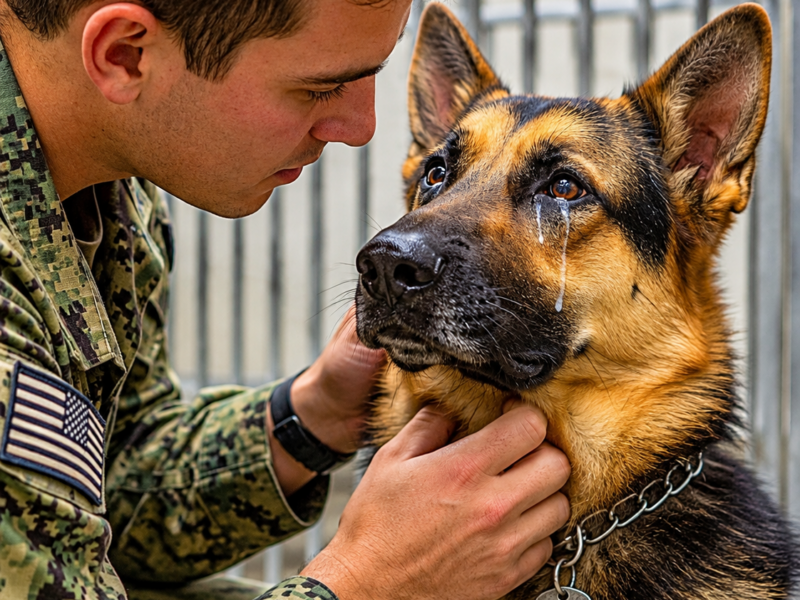
“At the Navy base adoption event in Virginia Beach, I watched people walk past the old German Shepherd without giving him a second look
The SEAL didn’t answer Melissa immediately.
He was still staring at the engraving beneath Ranger’s identification plate.
Rain tapped against the canvas roof while the old German Shepherd stood beside him, pressing his shoulder against the man’s knee.
“Chief?” Melissa asked carefully. “What does it say?”
The man looked toward the office windows.
Then he turned the collar so I could see it.
There were only a few words, scratched into the metal in uneven letters.
IF FOUND, RETURN TO ECHO SIX. DO NOT REPORT TO COMMAND.
I read it twice.
“Echo Six?” I asked.
The SEAL nodded slowly.
“That was our team designation.”
He looked down at Ranger.
“But this wasn’t an official identification marking. Someone put it there after the mission.”
Melissa held the folder against her chest.
“Why would someone tell us not to report him to command?”
“That’s what I’m trying to find out.”
The man finally introduced himself.
“Staff Sergeant Daniel Hayes. Retired Navy. Former SEAL.”
He paused.
“And Ranger was supposed to be dead.”
I looked at the dog.
He was no longer watching the entrance.
He was watching Daniel.
There was an expression in his eyes I couldn’t explain, almost as if he had been waiting for that particular voice for years.
Daniel gently rubbed the scar behind his ear.
“Easy, old man. I know. I’m here.”
I had seen grown men cry at military funerals.
I’d watched families receive folded flags.
I’d stood in silence when names were read at memorial services.
But there was something especially painful about watching a man speak to a dog he had already mourned.
“Tell us what happened,” I said.
Daniel glanced at me.
“Six years ago, our team was assigned to escort a local intelligence source through a remote area in Afghanistan. Ranger was attached to our unit. His handler was Petty Officer First Class Michael Carter.”
“Was?”
Daniel’s expression tightened.
“Michael didn’t come home.”
Melissa lowered the folder.
“I’m sorry.”
“Don’t be. We were told he died during the extraction. We were told Ranger was lost in the same attack.”
He looked at the dog again.
“I attended Michael’s memorial. His wife was there. His little girl was there.”
Daniel rubbed his forehead.
“We buried an empty casket because they never recovered his body.”
The words settled heavily beneath the tent.
I asked the question nobody else seemed willing to ask.
“If Ranger survived, why didn’t anyone tell you?”
Daniel looked toward the office.
“That’s the question that kept me awake for six years.”
Melissa opened the folder.
“There’s something else.”
She turned to the last page.
“The transfer came from a private military veterinary facility in North Carolina. The authorization signature belongs to a Lieutenant Commander who retired four years ago.”
“Name?”
“Richard Voss.”
Daniel’s face changed.
He knew that name.
I could see it before he said anything.
“Voss was the operations officer who coordinated our mission.”
“Was he there?” I asked.
Daniel shook his head.
“No. He was back at headquarters.”
He looked at the folder.
“And he was the man who told us Ranger had died.”
A gust of wind pushed rain beneath the tent.
Ranger moved closer to Daniel.
For a moment, the dog seemed to notice the tension in the man’s body. He pressed his muzzle against Daniel’s hand.
Daniel looked down.
“Good boy.”
Then he turned to Melissa.
“I need copies of everything in that file. Every transfer record, every medical report, every signature.”
She nodded.
“I’ll have to speak to our director.”
“Then get him.”
She hurried toward the office.
I remained beside Daniel.
“You’re thinking someone deliberately kept this dog hidden.”
“I’m thinking someone had a reason.”
“Could it have been a paperwork mistake?”
Daniel looked at me.
“Six years of mistakes? A missing handler? A dog declared dead? A collar with a message telling whoever found him not to report him to command?”
He shook his head.
“No. Somebody made choices.”
Before I could respond, Ranger suddenly lifted his head.
His nose moved toward the entrance.
A dark SUV had pulled into the parking area.
A man in a gray jacket stepped out, holding a black umbrella.
He was older than Daniel, perhaps in his late fifties, with silver hair and a narrow face.
He walked directly toward the tent.
Daniel’s hand tightened around Ranger’s collar.
“That’s Richard Voss.”
The retired officer stopped several feet away.
His eyes went from Daniel to the dog.
For a moment, his expression was unreadable.
Then he smiled.
“Hayes. I heard you were here.”
Daniel didn’t return the greeting.
“Funny. I didn’t know you were interested in retired working dogs.”
Voss glanced at Ranger.
“That animal should have been transferred to another facility.”
“Why?”
“Because he’s medically unsuitable for adoption.”
“That’s not what I asked.”
Voss’s smile disappeared.
He turned toward Melissa, who had just stepped outside with the director.
“Has anyone explained the dog’s medical history?”
Melissa looked uncomfortable.
“Not completely.”
Voss sighed.
“Then perhaps we should avoid creating unnecessary confusion.”
Daniel stepped closer.
“Six years ago, you told me this dog died.”
Voss looked at the collar.
“That was a long time ago.”
“Where was he?”
“Hayes, this isn’t the place.”
“Then tell me where.”
Voss lowered his umbrella.
“Some things were classified.”
Daniel laughed once, without humor.
“Since when does a dog’s survival become classified?”
Voss didn’t answer.
Instead, he looked at me.
“Who are you?”
“Someone who was considering adopting Ranger.”
“Then I suggest you reconsider.”
His tone was polite, but the warning was unmistakable.
I had spent enough years around military officers to recognize the difference between someone offering advice and someone trying to control a conversation.
Daniel noticed it too.
“You’re not taking him anywhere.”
Voss looked at him for several seconds.
Then he turned and walked back toward his SUV.
But before getting inside, he stopped.
“Hayes, if you care about that dog, leave the past alone.”
The SUV pulled away.
Ranger watched it disappear.
Then he turned toward Daniel and gave a low, uncertain whine.
Daniel knelt and placed both hands against the dog’s face.
“I don’t know what they did to you, buddy.”
His voice cracked.
“But I’m going to find out.”
That afternoon, the adoption event ended early.
The director agreed to keep Ranger at the facility while the paperwork was reviewed.
Daniel gave them his phone number and asked to be contacted before anyone authorized another transfer.
I stayed longer than I intended.
When I finally stood to leave, Daniel was sitting on the floor beside Ranger’s enclosure.
The dog had fallen asleep with his head resting on Daniel’s boot.
I looked at the two of them.
“You going to adopt him?”
Daniel glanced down.
“If they’ll let me.”
I nodded.
“Looks like he already chose you.”
Daniel smiled faintly.
“Yeah. I think he did.”
Three days later, Daniel called me.
His voice sounded different.
Not angry.
Not relieved.
Just tired.
“They found something in the medical records,” he said.
“What?”
“An old microchip registration. It was changed two months after the mission.”
“Changed to whom?”
There was a pause.
“Michael Carter.”
I sat down.
“But you said he was dead.”
“I know.”
“Could someone have used his information?”
“That’s what I thought. Until I saw the signature.”
Daniel sent me a photograph of the document.
At the bottom was a name.
Michael Carter.
Beneath it was a handwritten note.
Patient to remain under restricted observation. Do not release without direct authorization from R. Voss.
The date was six years old.
I stared at the photograph.
“Daniel, this means somebody knew Michael was alive, or at least wanted everyone to believe he was.”
“There’s more.”
He sent another image.
It was a photograph taken inside the veterinary facility.
A younger Ranger stood beside a man in a military uniform.
The man’s face was partly turned away from the camera.
But the scar on his left hand was unmistakable.
Daniel had told me about that scar.
Michael Carter had received it during a training accident years earlier.
I looked at the picture again.
“That’s him, isn’t it?”
Daniel didn’t answer immediately.
Then he said, “I think I just found the reason they kept Ranger quiet.”
The next morning, we drove to North Carolina.
The veterinary facility was located outside a small town, behind a row of pine trees and a security gate.
It looked ordinary from the road.
A low brick building.
A parking lot.
A sign advertising rehabilitation services for retired working dogs.
But Daniel had already called ahead.
The facility director, Dr. Elaine Foster, agreed to meet us.
She was in her early sixties, with short white hair and the kind of calm expression that comes from years of dealing with frightened animals.
When she saw Daniel, she recognized him.
“Mr. Hayes.”
“Thank you for seeing us.”
She glanced at the folder beneath his arm.
“I was wondering when someone would come asking.”
Daniel went still.
“You knew?”
She looked toward the hallway.
“I knew there were questions. I didn’t know whether anyone would ever be allowed to ask them.”
She led us into a small examination room.
Ranger wasn’t with us.
The facility had agreed to bring him later after Daniel insisted he shouldn’t be separated from the dog again.
Dr. Foster placed a thick medical file on the table.
“Ranger arrived here under a restricted transfer order. He had injuries consistent with an explosion and a long period of inadequate treatment.”
Daniel opened the folder.
“Who brought him?”
“A private transport contractor. The paperwork listed a government medical liaison.”
“Voss?”
She nodded.
Daniel’s fingers tightened around the pages.
“Did you see him?”
“Once.”
“When?”
“About six years ago. He came to inspect the facility and asked whether the dog could be kept alive without being entered into the standard military working dog database.”
I stared at her.
“Why would he ask that?”
Dr. Foster looked at me.
“He said the dog was part of a sensitive investigation.”
Daniel leaned forward.
“What investigation?”
She shook her head.
“He didn’t tell me.”
Then she opened a second folder.
“This is something I kept separately.”
Inside were several handwritten treatment notes.
Most were routine.
Medication schedules.
Wound care.
Physical therapy.
But one page had a short message written in the margin.
Dog responds to name Michael.
Daniel stopped turning pages.
“What?”
Dr. Foster pointed to the note.
“During his first few weeks here, Ranger would become agitated whenever staff used his assigned kennel number. But if someone said Michael’s name, he’d calm down.”
I felt a chill move through me.
Daniel looked up.
“Did anyone else notice?”
“Yes. One of the technicians. She told me the dog would sit by the door every evening at approximately six.”
“Waiting for someone?”
“That’s what we thought.”
Dr. Foster took a breath.
“One evening, I asked the technician to say Michael’s name while the dog was facing the door.”
She paused.
“Ranger walked straight to the entrance and began scratching at it.”
Daniel looked down at the file.
“God.”
Dr. Foster closed the folder.
“Mr. Hayes, there’s something I need to tell you. I don’t think Ranger was simply hidden because someone wanted to cover up a failed mission.”
“Then why?”
She hesitated.
“Because I believe he was being kept alive as evidence.”
Daniel slowly raised his eyes.
“Evidence of what?”
Before she could answer, the door opened.
A young technician stepped inside.
“Dr. Foster, there’s someone at reception asking for you.”
“Who?”
The technician looked at Daniel.
“Michael Carter.”
Nobody moved.
Daniel’s chair scraped backward.
“That’s not possible.”
The technician swallowed.
“He says he knows the dog.”
Dr. Foster stood.
“Where is he?”
“Outside.”
Daniel walked toward the door so quickly that I had to catch up.
The man standing in reception looked thinner than the photograph.
His hair was almost completely gray.
He wore an old brown jacket, jeans, and a baseball cap pulled low over his forehead.
But the scar on his left hand was exactly where it had been in the photograph.
Daniel stopped several feet away.
“Michael?”
The man looked up.
His eyes filled.
“Hey, Danny.”
Daniel crossed the room in three steps.
They embraced without another word.
It wasn’t a dramatic reunion.
There was no speech.
Just two men holding on to each other as if the floor beneath them might disappear.
When they finally separated, Daniel stepped back.
“I buried you.”
Michael nodded.
“I know.”
“We held a memorial.”
“I know.”
“Your daughter was there.”
Michael lowered his eyes.
“I know.”
Daniel’s voice became rough.
“Then why didn’t you come home?”
Michael sat down slowly.
For a long time, he looked at his hands.
Then he began to explain.
The mission six years earlier had gone wrong before the team ever reached the extraction point.
Their intelligence source had provided information about a weapons shipment.
But the location was a trap.
The convoy was attacked.
Communications failed.
Several members of the team were wounded.
Michael had been thrown from the vehicle and suffered a serious head injury.
Ranger had found him beneath a collapsed section of the road.
The dog stayed beside him.
He barked whenever anyone approached and refused to leave even when he was injured himself.
A local family eventually helped them reach a small medical station.
Michael was barely conscious.
He remembered seeing a man in civilian clothes arrive with two armed guards.
The man said he was there to evacuate them.
Michael believed him.
It was Richard Voss.
But the evacuation never went to the military hospital.
Instead, Michael was taken to a private medical facility.
When he regained consciousness, he was told his team had been killed.
He was also told that an intelligence source had been compromised and that his survival could expose a much larger operation.
“They said my family was in danger,” Michael explained.
“They showed me photographs of my wife and daughter. They told me that if I contacted them, people would use them to find me.”
Daniel stared at him.
“So you believed them?”
“I was recovering from a head injury. I was on medication. I had no phone, no identification, and no way to verify anything.”
Michael rubbed his forehead.
“I thought I was protecting them.”
“What about Ranger?”
Michael’s eyes moved toward the hallway.
“They told me he died.”
Daniel shook his head.
“He was alive.”
Michael closed his eyes.
“I found out six weeks later.”
Dr. Foster had discovered that Michael became agitated whenever Ranger’s name was mentioned.
Eventually, she allowed him to see the dog.
Michael remembered the first time.
Ranger had been lying on a blanket, barely able to stand.
When he heard Michael’s voice, he dragged himself across the floor.
“He put his head in my lap,” Michael whispered.
“I thought I’d lost everything. Then that dog looked at me like I’d never been gone.”
Daniel wiped his face.
“Why didn’t you leave?”
Michael stared at him.
“Because Voss told me that if I disappeared, Ranger would be transferred to a facility where nobody would know his medical history. He said he could make sure the dog never received proper treatment.”
I understood then why Ranger’s records had been so carefully controlled.
He hadn’t simply been hidden.
He had been used to keep Michael obedient.
But Daniel wasn’t satisfied.
“Why did they tell us you were dead?”
Michael took a long breath.
“Because the mission wasn’t just about a weapons shipment.”
He looked at Daniel.
“We found evidence that someone inside the operation had been selling intelligence about our movements.”
Daniel became very still.
“Who?”
“Voss.”
The room fell silent.
Michael explained that the convoy route had been changed shortly before departure.
Only a small number of people had access to that information.
After the attack, Michael recovered a damaged communications device.
It contained messages linking Voss to a private contractor who had been receiving payments from an overseas weapons network.
Michael had hidden the device before he was captured.
He never got the chance to retrieve it.
“Did you tell anyone?” Daniel asked.
“Once. To a medical officer I thought I could trust.”
“And?”
“He disappeared.”
Daniel looked toward Dr. Foster.
“Did Voss know Michael was alive?”
She nodded.
“He visited twice after the first year.”
Michael gave a bitter smile.
“He wanted to make sure I understood the arrangement.”
“What arrangement?”
Michael looked down.
“That I would remain officially dead, and Ranger would remain under his control. In exchange, my family would be left alone.”
Daniel stood and walked toward the window.
For several moments, he didn’t speak.
Then he turned.
“Your daughter. Does she know you’re alive?”
Michael’s face crumpled.
“No.”
“Your wife?”
“No.”
“Michael…”
“I know.”
His voice broke.
“I know what you’re thinking. I’ve thought about it every day.”
He pulled a small photograph from his wallet.
It showed a little girl with two missing front teeth standing beside a Christmas tree.
She looked about seven.
“Her name is Lily. She’s thirteen now.”
He stared at the photograph.
“I don’t even know whether she’d recognize me.”
Daniel sat beside him.
“She deserves the truth.”
Michael nodded.
“But I can’t walk into her life and pretend six years didn’t happen.”
Nobody argued.
Because he was right.
The truth wouldn’t erase the birthdays, the school plays, or the nights his daughter had cried for a father she believed was gone.
But it could give her a choice.
And for the first time in six years, Michael had the power to offer her one.
Before we could decide what to do next, Dr. Foster’s phone rang.
She answered.
Her expression changed almost immediately.
“Yes. He’s here.”
A pause.
“No, I haven’t released anything.”
Another pause.
She looked directly at Daniel.
“Understood.”
She hung up.
“Richard Voss knows you’re here.”
Daniel reached for his phone.
“How?”
“Someone called the facility asking whether a former Navy SEAL had arrived.”
Michael stood.
“We need to leave.”
Daniel shook his head.
“No. Not this time.”
He turned toward me.
“Do you still have the photograph of that transfer document?”
I nodded.
“Send it to me.”
Then he called an attorney he knew from his service days.
Within an hour, the documents were copied and secured.
Dr. Foster agreed to provide a signed statement about the restricted medical records.
Michael gave a formal account of his captivity.
Daniel contacted the appropriate military investigative office through a channel that bypassed Voss.
For the first time, the story was no longer controlled by the man who had buried it.
But the most important piece of evidence was still missing.
The communications device Michael had hidden during the attack.
He had buried it near the original evacuation site, beneath a concrete drainage structure.
He had never been able to return.
And now we had to decide whether it was worth going back.
Two weeks later, investigators arranged a secure visit to the area.
Michael was not physically fit to travel.
Daniel volunteered to go with the recovery team.
Before leaving, he visited Ranger.
The dog was lying on a padded bed, his left hind leg wrapped after physical therapy.
Daniel crouched beside him.
“Listen, old man. I need you to stay here and behave.”
Ranger lifted his head.
Daniel smiled.
“I know. You never were very good at following orders.”
He looked toward Michael, who was standing in the doorway.
“Take care of him.”
Michael nodded.
“I should be saying that to you.”
Daniel put his hand on Ranger’s head.
“Six years ago, I thought I lost both of you.”
Ranger licked his wrist.
Daniel stayed there another minute before leaving.
The recovery team found the device exactly where Michael had described.
It was damaged by moisture, but the storage unit remained intact.
Investigators later confirmed that the messages contained evidence of unauthorized intelligence transfers and payments connected to the attack.
There were also records showing that Voss had approved Michael’s restricted medical transfer and signed the order declaring him deceased.
The investigation lasted several months.
Voss initially denied everything.
Then he claimed the restricted orders had been issued to protect an intelligence operation.
But the financial records told a different story.
He had received payments through a private contractor for years.
The same contractor had supplied information that led the convoy into the ambush.
The military investigation eventually referred the evidence to federal authorities.
Voss was arrested while attempting to leave the country.
He was charged with multiple offenses related to the conspiracy and the falsification of military records.
Not every question was answered.
Some of the people involved had disappeared.
Others were never identified.
But the truth about Michael and Ranger was finally part of an official record.
And that was only the beginning of the difficult part.
Michael had to go home.
He had to face the woman who had spent six years learning how to live without him.
He had to meet the daughter who remembered him mostly through photographs.
Daniel offered to accompany him.
Michael refused at first.
“I can’t ask you to stand there while I explain why I disappeared.”
Daniel shook his head.
“You don’t have to ask.”
The reunion took place on a quiet Saturday afternoon in a small house outside Norfolk.
Michael’s wife, Sarah, opened the door.
She looked older than she did in the photograph.
Her hair was shorter.
There were faint lines around her eyes.
For several seconds, she stared at the man standing on her porch.
Then she stepped backward.
“No.”
Michael didn’t move.
“Sarah…”
She shook her head.
“No. Don’t.”
He looked down.
“I know.”
She covered her mouth.
Her eyes moved over his face, searching for something familiar.
Then she began to cry.
“You’re alive?”
Michael nodded.
Sarah reached toward him, then pulled her hand back.
“Six years?”
“I know.”
“Six years, Michael.”
“I know.”
“Do you have any idea what that did to us?”
He didn’t defend himself.
He didn’t tell her he had been afraid.
He didn’t explain the threats or the medical facility.
Not yet.
He simply stood there and accepted the anger he had spent six years imagining.
Sarah finally opened the door wider.
“Come inside.”
Lily was upstairs.
She was doing homework when her mother called her down.
She entered the living room wearing a sweatshirt and holding a pencil.
Then she saw him.
Her face became blank.
Michael stood up.
“Hi, sweetheart.”
She stared at him.
Then she looked at her mother.
“Why is he here?”
Sarah couldn’t speak.
Michael swallowed.
“I’m your dad.”
Lily shook her head.
“My dad is dead.”
The words struck harder than anything Daniel had heard during the mission.
Michael lowered himself into a chair.
“I know that’s what you were told.”
“Then why are you saying you’re him?”
He reached for the photograph in his wallet.
It was the same picture he had shown us.
Lily at seven, smiling beside the Christmas tree.
“I kept this with me.”
She looked at the photograph.
Her lower lip trembled.
“Where have you been?”
Michael’s eyes filled.
“I was hurt. And people made me believe that coming home would put you and your mom in danger.”
“Why didn’t you call?”
He couldn’t find an answer that would make six years disappear.
“Because I was scared, and because I made a terrible decision.”
Lily looked at him for a long time.
Then she asked something that none of us expected.
“Did you think about me on my birthday?”
Michael nodded.
“Every single one.”
“Even last year?”
“Especially last year.”
She looked down at her pencil.
“I got an award at school.”
“I know.”
Her head snapped up.
“You know?”
“Someone sent me a photograph. I kept it.”
Lily’s eyes filled.
She walked closer, slowly, as if she didn’t trust what she was seeing.
Then she stopped in front of him.
“Can I hug you?”
Michael covered his face.
“Whenever you want.”
She wrapped her arms around his shoulders.
He held her carefully, afraid that even the smallest movement might make her disappear.
Sarah watched from the doorway.
She didn’t join them.
Not that day.
But she didn’t ask him to leave either.
And sometimes, I learned, that was the first step toward something neither person knew how to name.
Ranger came home three weeks later.
Daniel had completed the adoption paperwork.
The facility had finally cleared him for a quiet home with ongoing medical care.
But Daniel refused to bring him to his house without asking Michael first.
They met in the facility parking lot.
Ranger was wearing a new collar.
It was dark blue, with a small silver identification plate.
Daniel had kept the old collar in a sealed evidence bag.
The new one carried three words.
RANGER. ECHO SIX. HOME.
When Michael saw it, he lowered his head.
“That’s good.”
Daniel opened the rear door of his truck.
Ranger climbed inside slowly.
His injured leg still troubled him.
He needed help getting settled, and Daniel carefully placed a blanket beneath him.
Michael stood beside the door.
“Take care of my boy.”
Daniel looked at him.
“Our boy.”
Michael smiled through his tears.
Ranger lifted his head and placed his muzzle against Michael’s hand.
For several seconds, neither man moved.
Then Daniel closed the door.
He drove Ranger to his home, where a soft bed waited beside the living room window.
The first few nights weren’t easy.
Ranger woke frequently.
He sometimes paced the hallway at six in the evening.
He still reacted to certain mechanical sounds.
Daniel never forced him to do anything.
He let the dog choose where to sleep.
He let him take his time.
And every morning, he walked him down the quiet street, even when Ranger could manage only a few houses before needing to rest.
I visited them a month later.
Daniel was sitting on his porch with a cup of coffee.
Ranger lay beside him, his gray muzzle resting on a folded blanket.
A small tennis ball sat near his paws.
“He doesn’t play much,” Daniel said.
“Doesn’t have to.”
Daniel smiled.
“That’s what I told him.”
I sat beside him.
For a while, we watched the dog sleep.
Then I asked, “Have you heard from Michael?”
“Every few days.”
“How’s he doing?”
“Slowly. Sarah hasn’t forgiven him. Not yet. But she’s agreed to counseling, and Lily has been visiting him.”
Daniel took a sip of coffee.
“He told me she asked him to come to her school science fair.”
“That’s good.”
“Yeah.”
He looked at Ranger.
“She wants him there as her dad. Not as some story about a dead soldier.”
We sat quietly.
A car passed.
Somewhere down the street, a lawn mower started.
Ranger lifted one ear, then settled again.
I looked at the new collar.
“Do you ever think about what would have happened if you hadn’t noticed that engraving?”
Daniel stared at the yard.
“Every day.”
He rubbed Ranger’s head.
“Someone would have taken him somewhere else. Maybe nobody would have asked about Michael. Maybe the truth would have stayed buried.”
He paused.
“But that’s not what happened.”
A few minutes later, Ranger pushed himself upright.
His back leg trembled.
Daniel immediately reached down to help, but the dog took a step toward the edge of the porch.
There was a squirrel near the fence.
For the first time since I’d met him, Ranger looked almost mischievous.
Daniel laughed.
“Don’t even think about it, old man.”
Ranger wagged his tail once.
Then he returned to his blanket and rested his head against Daniel’s knee.
I thought about the people at the adoption event who had walked past him.
They had seen an old dog with a damaged leg.
They had seen expensive medical needs and a quiet temperament.
They hadn’t seen a soldier who had stayed beside a wounded man when the world had abandoned him.
They hadn’t seen six years of loyalty carried in a faded collar.
And they certainly hadn’t seen the truth hidden beneath a piece of scratched metal.
A few months later, Daniel sent me a photograph.
It showed Ranger asleep on a sunny patch of carpet.
Michael was sitting on the floor beside him, one hand resting gently on the dog’s back.
Lily was curled up on the other side, reading a book.
Sarah stood in the background, holding two cups of coffee.
Nobody was smiling for the camera.
It was just an ordinary afternoon.
But I looked at that photograph for a long time.
Because after everything they had lost, nobody in that room was pretending that the past had never happened.
They were simply trying to build something honest with the time they had left.
Daniel later told me that Ranger still woke sometimes at six in the evening.
He would walk to the front door and wait.
Some evenings, Michael came by.
Some evenings, he didn’t.
But Daniel never made the dog stop waiting.
He just sat beside him until he was ready to return to his bed.
The old collar now hangs above Daniel’s fireplace.
Not as a trophy.
Not as a reminder of a mission.
But as proof that even when someone has been declared lost, the truth can still find its way home.
And the old German Shepherd who nobody wanted at that adoption event finally had something he had been denied for six years.
A place where nobody would ever mistake his silence for worthlessness again.
THE END.









