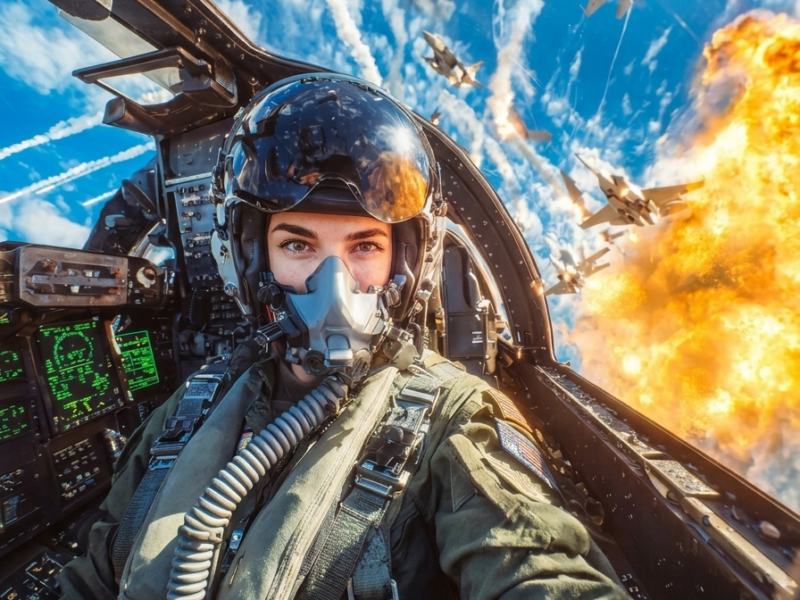
At a crowded Air Force briefing in Nevada, a senior commander laughed when I was told to stand beside the men who would fly the mission, unaware that the woman he called “dead weight”
The recycled air inside the Nevada briefing room always smelled faintly of stale coffee, ozone, and the distinct, unyielding arrogance of men who had spent their entire lives believing the sky belonged exclusively to them. I stood near the back, my boots planted firmly on the worn industrial carpet, my hands clasped securely behind my back. My posture was military-straight, rigid, and completely still. Around me, pilots from the elite tactical fighter wing shifted in their ergonomic chairs, their flight patches a colorful mosaic of ego, achievement, and accumulated pride.
At the head of the long, dark oak table stood Colonel Richard Hayes. He was a man who wore his rank like heavy armor, his salt-and-pepper hair cut to a punishing standard, his eyes perpetually narrowed into an expression of calculated skepticism. He had spent the last twenty minutes systematically dissecting every operational plan on the projector, his voice ringing with a sharp, gravelly authority that demanded total submission.
Then came the transition to the reinforcement roster. My name had appeared on the secondary monitor in clean, unblinking alphanumeric characters: Capt. E. Carter – Special Assignment / Unassigned Tactical Evaluation.
Colonel Hayes had stopped pacing. He turned his heavy-set frame toward the screen, squinted at the glowing letters, and then let out a sharp, dismissive bark of laughter that echoed off the concrete walls. The laughter wasn’t just his; it rippled through the room, a collective wave of amusement from pilots who looked at my lean frame, my unadorned service ribbons, and the quiet demeanor I maintained.
“You’re telling me this girl is supposed to fly with my best pilots?” Hayes asked, his voice dripping with condescension as he gestured toward me with a rolled-up laminated map. He didn’t bother lowering his voice, treating me as if I were an abstract equipment malfunction rather than a living, breathing officer. “We are running high-altitude intercept sweeps against unknown electronic profiles, Captain. This isn’t a simulation back at flight school. We don’t need dead weight cluttering up the combat air patrol corridors.”
Nobody defended me. In a fighter squadron, loyalty was a currency earned exclusively through shared sweat in the cockpit, and since I had just arrived from a lateral transfer shrouded in thick bureaucratic fog, I was an outsider. I had learned long ago that explaining yourself to people determined to underestimate you was a complete waste of oxygen. Words were cheap; altitude and execution were everything.
My name was Captain Emily Carter, and for three years, my service record had remained sealed under a classification level—Project Vanguard—that most officers sitting in that room could never hope to access. They knew I had been transferred from an experimental flight evaluation detachment out in the remote expanses of the Utah desert. They knew my flight hours were staggering. But they didn’t know why. They didn’t know about the black-budget hypersonic stability tests, the neural-link interface trials, or the terrifying anomaly we had encountered six months prior over the Pacific—an encounter that had left my previous wingman dead and my own cockpit scarred with micro-fractures from a localized electromagnetic discharge.
“Colonel,” I finally spoke, my voice cutting through the murmurs with a quiet, icy clarity that made a few heads turn. “My operational clearance is active and verified by Strategic Command. If the board assigned me to this wing, it is because the tactical parameters require someone who has handled anomalous signatures before.”
Hayes sneered, stepping down from the dais. He stopped a few feet away from me, towering over my frame, his eyes flashing with open hostility. “Clearance on a piece of paper doesn’t keep a Raptor in the air when an adversary locks a radar-guided missile onto your tail, Captain. Until you prove otherwise, you’re just a logistical paperwork error that I am legally obligated to tolerate.”
Before I could deliver the sharp retort forming behind my teeth, the low, pulsing wail of the bunker’s emergency warning sirens erupted overhead. The red strobe lights mounted along the ceiling began to flash in a frantic, rhythmic pulse, casting long, bruised shadows across the briefing tables.
Instantly, the casual atmosphere vanished. Men surged to their feet, chairs scraping violently against the floor.
A junior tactical officer bolted from the side alcove, his face pale under the emergency lights. “Colonel! We have an unscheduled radar bloom crossing the restricted perimeter over the northern border. Eight unidentified enemy fighters, high-speed, low-radar-cross-section profile. They just intercepted our return reconnaissance package—Falcon Flight is currently boxed in!”
The room descended into a chaotic scramble of shouted orders and frantic terminal tapping. Hayes spun back toward the main tactical display, his initial confidence instantly cracking under the weight of an active crisis. The giant overhead screen updated in real-time, showing a cluster of blue friendly icons being aggressively enveloped by eight bright red symbols closing in from multiple vector angles like a closing fist.
“Scramble the squadron!” Hayes roared, jabbing a finger toward the ready room doors. “Get every available bird off the tarmac now! Form a defensive corridor and extract Falcon Flight before those bandits close the trap!”
Pilots broke into a dead sprint toward the exit, their heavy flight gear clanking against their legs. But the situation deteriorated at a velocity that defied all standard projection models. The enemy fighters didn’t just engage; they split into two synchronized, aggressive pincer groups, executing high-G flanking maneuvers that completely severed the American aircrafts’ primary and secondary escape routes through the mountain passes.
“We’re losing visual contact with Falcon Leader!” a radar controller shouted over the din, his voice cracking with panic. “Their radar warning receivers are screaming—they’re being painted by multi-band fire-control radars!”
Hayes stared fixedly at the screen, his knuckles whitening as he gripped the edge of the console. His tactical certainty had completely evaporated, replaced by the grim realization that his best pilots were flying blind into a well-coordinated slaughter.
Then, his eyes darted across the room and locked onto me.
“Carter,” he barked, his voice laced with desperate frustration. “You’re on standby status. Stay put. Don’t touch a damn thing unless I explicitly tell you to. If you launch now, you’ll just fly straight into their kill zone and give them another target to shoot down.”
I looked past him, my gaze fixed firmly on the eight red symbols tightening their deadly circle around our trapped reconnaissance aircraft. My blood ran cool and steady. I had seen this exact tactical geometry before—not in manuals, but in classified simulation logs derived from recovered foreign intelligence that detailed a ghost squadron operating without transponders.
“Sir, they aren’t trying to force a retreat,” I said quietly, taking a half-step forward. “They’re herding our pilots directly toward an artificial canyon ambush. If Falcon breaks west, they walk right into a surface-to-air crossfire.”
Hayes glared at me, his face flushing a furious crimson. “Shut your mouth, Captain! I am commanding this wing, not you! You don’t know a damn thing about—”
Before he could finish his sentence, the heavy secure communications console on the side desk chimed with a double-tone cryptographic handshake—a high-priority override channel he hadn’t even been monitoring. The green light blinked steadily, followed by an automated text stream scrolling across the terminal.
My personal assignment code flashed on the screen, overriding the base roster. My name was automatically slotted directly beside the lead aircraft designation for the immediate tactical intervention package.
For the first time that morning, absolute silence descended upon the briefing room. Every eye snapped from the tactical display back to me.
Without waiting for Hayes’s permission, I turned on my heel and walked out of the briefing room toward the subterranean tunnel leading directly to the reinforced hangars. As the heavy steel doors slid open, revealing the sleek, matte-gray silhouette of the F-22 Raptor waiting in its hardened bay with ground crews swarming around it, my heart didn’t race with fear. It settled into a rhythmic, absolute focus.
I climbed up the boarding ladder, slid into the contoured ejection seat, and lowered the heavy canopy. The mechanical hiss of seals locking into place shut out the ambient noise of the base. I plugged in my helmet comms, ran through the pre-start sequence with practiced, mechanical precision, and listened as the twin Pratt & Whitney turbofan engines ignited beneath me, sending a deep, shuddering vibration through the airframe that I felt in my bones.
The radio crackled to life in my headset, clear and crisp through the secure quantum-encrypted channel.
“Viper One, confirm identity and status.”
I settled my hands onto the flight stick and throttle, my eyes scanning the multi-function glass displays as they booted up.
“Viper One, Captain Emily Carter. Systems green. Ready for immediate departure.”
A brief, heavy silence followed over the encrypted line, as if the command structure miles away was weighing the sheer gravity of what was about to happen.
Then, a familiar, weathered voice answered—a voice that belonged to a man Hayes and every officer in that bunker answered to, but rarely heard directly.
“Emily, this is General Morgan. You are cleared to engage across all operational sectors. Your previous Vanguard authorization remains fully active. Show them what you were trained for.”
The transmission clicked off.
Back in the command bunker, Hayes had undoubtedly heard every single word through the master monitoring feed. I didn’t need to see his face to know the exact expression of shock, realization, and sudden, icy dread washing over him. He finally understood that I wasn’t just an administrative transfer or an inexperienced pilot filling a quota. I had been specifically hand-picked and assigned to a clandestine program that trained elite aviators for combat scenarios the military leadership refused to acknowledge in public. And someone within the upper echelons of the Pentagon had deliberately kept my identity hidden under layers of bureaucratic smoke to protect the operation’s integrity.
I nudged the throttles forward. The Raptor surged out of the hardened revetment, tearing down the tarmac with blistering acceleration, and punched straight up into the slate-gray Nevada sky, leaving the ground far below as I climbed toward the thunderous edge of the stratosphere.
The transition from the dense, oxygen-rich lower atmosphere to the thin, silent expanse of high-altitude flight happened in a matter of seconds. The F-22 Raptor didn’t just climb; it defied gravity with an aggressive, effortless grace, slicing through the cloud deck like a silver blade through silk. Through my tinted visor, the sky transformed from a hazy blue into a deep, bruised indigo where the curvature of the earth became visible at the horizon.
My heads-up display flickered to life with tactical data feeds streaming directly from airborne warning and control systems, augmented by the Raptor’s internal sensor fusion suite. The situation ahead was a complete mess.
“Viper One, be advised, Falcon Flight is taking heavy electronic jamming,” an agitated voice crackled over the tactical frequency—it was Lieutenant Colonel Vance, one of Hayes’s senior squadron leaders, currently trapped in the thick of the fray. “Our radar is completely blinded! We’re flying defensive circles and bleeding energy fast!”
“Vance, maintain your current heading and hold your breath,” I transmitted back, my voice cool and even, devoid of the panic echoing in his tone. “Do not execute the standard defensive break. If you bank left now, you walk straight into their primary fire-control lock.”
“Who the hell is this?” Vance barked back over the secure channel, his breathing heavy under high G-load. “Identify yourself, pilot! We have multiple bogeys painting us from every quadrant!”
“This is Viper One. Fall in behind my vector when I pass your waypoint. I’m going to peel them off your tail.”
Without waiting for his acknowledgment, I engaged the afterburners. The twin engines roared with a deep, mechanical growl, pushing the aircraft past Mach 1.5 in a vertical climb that compressed my chest against the seat. The G-meter ticked upward—4G, 5G, 6.5G—as I looped the Raptor over in a classic high-angle maneuver, positioning myself directly above the chaotic dogfight unfolding ten thousand feet below us.
From my altitude, the enemy formation looked like a cluster of predatory insects circling wounded prey. There were eight sleek, delta-wing fighters sporting unpainted composite hulls—aircraft that bore no standard national insignia, utilizing advanced vector-thrust nozzles and electronic countermeasure suites that mimicked fifth-generation platforms. But I knew what they were. During my time with Project Vanguard, we had spent hundreds of hours analyzing telemetry data from a rogue aerospace contractor syndicate that had gone dark years ago, selling high-end tactical hardware to the highest bidder.
The enemy pilots were good. They were flying with a cold, algorithmic precision that suggested either heavy automated assistance or pilots wired into neural-feedback flight controls similar to the ones we had tested in Utah. They had Falcon Flight completely pinned, systematically stripping away their missile inventory through relentless electronic chaff deployment and feigned attacks.
“Viper One closing in on waypoint Whiskey,” I muttered to myself, my fingers dancing across the HOTAS controls as I cycled through weapon bay configurations.
The internal weapons bay doors slid open with a smooth, hydraulic hum, exposing the sleek white bodies of four AIM-120D AMRAAM missiles and two sidewinders tucked neatly into the fuselage to maintain absolute radar stealth.
“Target locked: Lead bogey,” the onboard tactical computer chimed in a synthetic, calm female voice, accompanied by a sharp audio tone in my headset.
I didn’t hesitate. I pulled the trigger.
The missile dropped cleanly from the internal bay before its solid-fuel rocket motor ignited with a blinding flash of white light, tearing away from my aircraft at hypersonic speed leaving a curling spiral of white smoke against the dark sky. Before the enemy pilot even realized his tactical awareness system had been compromised, the missile’s active radar seeker acquired its thermal and electronic profile.
A brilliant orange flash blossomed ten miles below me as the enemy aircraft disintegrated into a brilliant cloud of shrapnel and burning composite material, spinning out of control toward the jagged mountain ranges far beneath us.
The radio erupted into stunned silence. For three full seconds, not a single pilot spoke.
“What… what the hell was that?” Vance’s voice cut through the static, filled with a mixture of sheer disbelief and residual adrenaline. “Who just took out lead?”
“Viper One. I told you to fall in behind my vector,” I replied sharply, banking the Raptor hard to the right to evade an incoming radar sweep from the remaining enemy flight. “Your window to clear the combat zone is closing. Move now!”
The remaining seven enemy fighters instantly broke their formation around the trapped American reconnaissance jets. Instead of pressing their attack on Falcon Flight, their tactical computers recalibrated in an instant, shifting all multi-band tracking sensors directly toward my position. They realized that a single, highly invisible variable had just entered the equation, threatening to dismantle their entire ambush.
“Multiple launches! Incoming surface-to-air and air-to-air telemetry!” the warning system blared in my helmet, a chorus of high-pitched electronic shrieks that would have caused an ordinary pilot to panic.
“Break left, flare, chaff, chaff!” I ordered, executing a high-G split-S maneuver that sent my stomach surging into my throat as the world outside my canopy spun in a dizzying blur of earth and sky.
Two enemy missiles streaked past my canopy within a hundred yards of each other, their proximity fuzes detonating prematurely as they chased the decoy chaff clouds I had dumped into the slipstream. The concussive shockwave hit the Raptor with a violent shudder, rocking the aircraft sideways, but the composite skin held firm.
This wasn’t just a routine border skirmish anymore. This was a calculated, high-stakes chess match at nine hundred miles per hour, and I was holding the only pieces capable of turning the board.
The sky above the Nevada test range turned into a high-altitude abattoir where physics and reflex fought a relentless war for survival. The remaining seven enemy fighters weren’t ordinary adversaries; they operated with a coordinated, hive-mind aggression that ignored standard tactical retreat protocols. They split into two distinct packs of three, leaving a single designated hunter-killer trailing directly behind my six-o’clock position, trying to lock onto my thermal plume.
“Viper One, you’ve got a hostile closing fast on your tail! Break right, break right!” Vance screamed over the emergency frequency, his voice tight with lingering terror as his own crippled aircraft limped toward home plate.
“Negative, Vance. I’m drawing them into the inversion layer,” I replied calmly, my breathing steady despite the crushing 7.5 Gs pressing my spine deep into the ejection seat cushion.
I hauled back on the flight stick, pulling the Raptor into a steep, vertical loop that pushed the aerodynamic limits of the airframe. The twin Pratt & Whitney engines roared in protest, screaming as they wrestled the heavy aircraft upward against the crushing pull of gravity. The enemy pilot trailing me attempted to match my climb, his vector-thrust nozzles glowing a dull, angry orange through the thin atmosphere. But the F-22’s supercruise capability and superior thrust-to-weight ratio gave me an invisible edge that no other aircraft in the world could replicate.
As we crested the apex of the loop at forty thousand feet, the air became so thin that the stars were visible even in broad daylight. The trailing enemy aircraft lost stability for a fraction of a second, its nose dipping slightly as its engines starved for oxygen in the rarified air.
That microsecond of hesitation was all the opening I required.
I flipped the Raptor over in a brutal, lightning-fast maneuver known as a Herbst maneuver—a post-stall Cobra turn that defied conventional aerodynamics, instantly pointing my nose backward while my momentum carried me forward. My onboard targeting computer locked onto the enemy fighter’s forward canopy with laser-like precision.
“Fox Two,” I whispered.
The infrared sidewinder missile hissed off its rail, arcing through the freezing void with terrifying speed. It didn’t even need a direct impact; its proximity warhead detonated three feet from the enemy cockpit, shattering the canopy glass and instantly shearing off the starboard wing in a brilliant flash of white-hot plasma. The hostile fighter pitched sideways into an unrecoverable flat spin, disappearing downward into the thick undercast of clouds.
“Holy mother of God,” Vance breathed over the radio link, his voice trembling audibly. “Did you just… did you just pull a Kulbit at Mach 1.2?”
“Save the commentary for the debriefing room, Vance. We still have six bogeys playing shadow games in the sector,” I snapped back, scanning my tactical displays as the remaining enemy fighters abruptly broke off their coordinated attack pattern and scattered in six different directions, executing a high-speed dispersion maneuver designed to overwhelm my radar sensors.
They thought they could out-spread my tracking capabilities and ambush me from my blind spots. They didn’t understand the neural-link interface embedded within my flight helmet—a classified technology developed during my time at Project Vanguard that linked my optical tracking directly to the Raptor’s passive sensor array. Wherever I looked, the aircraft’s weapon systems automatically queued up targeting vectors without requiring manual radar locks that could give away my position.
Over the next four minutes, the sky became a masterclass in aerial dominance. I hunted them down one by one across a hundred-mile combat radius. I used the cloud banks to mask my thermal signature, slipped past their electronic jamming suites by utilizing passive optical tracking, and delivered calculated, surgical strikes that eliminated the threat without wasting a single round of ammunition.
By the time the eighth and final enemy fighter broke apart over the salt flats below, my fuel warning indicator was blinking a persistent, amber caution message on my primary multi-function display.
“All hostile signatures neutralized,” the automated computer voice reported in its flat, soothing monotone.
I let out a long, slow breath, releasing the iron grip I had maintained on the flight controls. My muscles ached from the sustained G-forces, and a thin film of sweat coated my forehead inside the heavy helmet.
“Viper One to Command,” I transmitted, my voice steady and composed as if I had just returned from a routine patrol. “Sector secure. Returning to base plate.”
“Copy that, Viper One,” General Morgan’s voice crackled back over the secure line, carrying a strange, heavy undertone that sent a subtle chill down my spine. “Land at Hangar Four. Do not taxi to the main ramp. And keep your canopy sealed until security personnel arrive.”
I frowned inside the cockpit. That wasn’t standard protocol. Normally, a successful combat intercept resulted in a debriefing at the main command center, not an isolated lockdown in a secondary hangar.
“Understood, Command,” I replied, banking the Raptor toward the sprawling expanse of the Nevada test facility below.
As I guided the sleek aircraft down toward the runway, the vast desert landscape rolled out beneath me like a sun-baked canvas. The concrete strip grew larger in my windshield, and as the landing gear locked into place with a reassuring mechanical thud, I caught sight of the ground crew waiting beside Hangar Four.
They weren’t cheering. There were no smiles, no congratulatory fist-pumps, and no triumphant nods from the maintenance teams. Instead, a full platoon of heavily armed base security personnel clad in black tactical gear and carrying carbines stood in a rigid semicircle around the landing zone. Behind them stood Colonel Hayes, his arms crossed tightly over his chest, his face pale and set in a mask of grim disbelief. And standing slightly ahead of the security detail was General Morgan himself, holding a thick, manila folder sealed with a red wax stamp that screamed the highest level of military classification.
I touched down smoothly, taxied the Raptor into the dim recesses of Hangar Four, and cut the engines. As the twin turbines slowly wound down with a dying whine, the heavy hydraulic canopy hissed open, letting in the dry, desert air.
I unbuckled my harness, removed my helmet, and tossed it onto the side console. As I stood up in the cockpit and looked down at the silent, watching crowd below, I realized with absolute certainty that surviving the dogfight was only the beginning of a much darker storm.
The hydraulic boarding ladder extended with a slow, mechanical whine that echoed loudly in the cavernous expanse of Hangar Four. I climbed down the rungs with measured, deliberate steps, my flight boots hitting the concrete floor with a sharp, heavy thud.
The security detail parted slightly, their weapons held at a low, ready position—not pointed at me, but angled outward as if they were guarding against an invisible threat rather than greeting a returning pilot.
Colonel Hayes stepped forward, his usual bluster completely gone, replaced by a tense, unsettled expression that made him look a decade older than he had that morning in the briefing room. He looked at me not with contempt anymore, but with a chilling mixture of apprehension and reluctant awe.
“Captain Carter,” Hayes began, his voice lacking its former gravelly bite. “Nobody… nobody flies an F-22 like that. That wasn’t standard tactical training. That was something else entirely.”
Before I could offer a cold reply, General Morgan stepped between us, his silver hair catching the fluorescent hangar lights. His expression was graver than any military commander’s face had a right to be. He didn’t offer a handshake or a nod of approval. Instead, he raised the thick, red-wax-sealed manila folder he had been carrying.
“At ease, Colonel,” Morgan said softly, never breaking eye contact with me. Then he turned his gaze toward Hayes. “You wanted to know why Captain Carter was assigned to your squadron without your prior approval, Richard? You called her dead weight this morning. You laughed when her name appeared on the roster.”
Hayes swallowed hard, his jaw tightening. “General, with all due respect, my squadron—”
“Your squadron was walking straight into a trap that you were completely blind to,” Morgan interrupted, his voice dropping to a harsh whisper that carried an immense, crushing authority. “Those eight aircraft we intercepted today? They weren’t a rogue foreign patrol. They weren’t even the real target.”
I narrowed my eyes, stepping closer to the general. “Explain, General. What do you mean they weren’t the real target?”
Morgan sighed, running a weathered hand across his forehead before glancing up toward the glass-enclosed observation deck overlooking the hangar floor.
“The radar telemetry from those eight bogeys was a sophisticated decoy network,” Morgan explained, his voice grim. “While you were engaging them over the northern range, a silent data-packet transmission was broadcast from an encrypted relay station located right here on this base—transmitting our entire tactical deployment schedule, including the encrypted frequency codes for Project Vanguard, directly to an off-site receiver.”
My blood ran cold. The realization hit me with the force of a physical blow. The ambush wasn’t just an external attack; it was an inside job designed to draw me into the air, test my combat parameters in a live-fire scenario, and expose the operational capabilities of the Vanguard flight protocols to an unknown buyer.
“Who?” I asked, my voice dropping an octave, carrying an edge of lethal calm that made the surrounding security guards tense visibly. “Who had access to the primary broadcast frequencies?”
General Morgan didn’t answer with words. Instead, he raised his hand and gestured toward the upper observation tower.
Through the tinted glass of the control deck, two armed security officers emerged, leading a man whose hands were securely cuffed behind his back. They pushed him toward the large glass window so he could look down directly onto the hangar floor.
Under the harsh overhead lights, the prisoner lifted his head, his face illuminated against the glass.
A slow, deliberate smile crept across his lips—a familiar, mocking grin that I had burned into my memory during the darkest days of my life.
It was Dr. Nathan Vance—not the lieutenant colonel flying in our squadron, but his identical twin brother, a brilliant aerospace systems engineer who had allegedly died in a classified laboratory explosion three years ago during the early development phase of Project Vanguard.
The man I had watched burn on a security monitor in a subterranean bunker in Utah was standing three hundred feet above me, smiling as if he were watching a play he had written from beginning to end.
The hangar seemed to shrink around me as I stared up through the reinforced glass at the man in handcuffs. The air felt thick, heavy with the realization of a betrayal so deep and calculated that it threatened to unravel everything I had fought, bled, and trained to protect.
Dr. Nathan Vance. Not a ghost. Not a casualty of a tragic laboratory accident. He had faked his own death with the assistance of internal rogue elements within the defense apparatus, taking the core algorithms of Project Vanguard with him into the dark underbelly of black-market weapons syndicates.
“How?” I whispered, my voice barely audible over the hum of the hangar’s auxiliary power generators, yet clear enough for General Morgan to hear.
“We tracked the encrypted data stream back to a secure terminal inside the base’s primary communications vault,” General Morgan said quietly, stepping beside me and keeping his eyes fixed on the man above. “He didn’t just leak our flight paths today, Captain. He set up the entire scenario. He wanted to force an encounter where your tactical capabilities would be pushed to their absolute limit—not to destroy you, but to record every single microsecond of your flight telemetry for an external buyer.”
Colonel Hayes looked back and forth between us, his face draining of all color as the terrifying implications finally sank in. “An external buyer… General, are you telling me we’ve been compromised from the inside out?”
“For over two years, Colonel,” Morgan replied grimly. “And Captain Carter was the only pilot on active rosters with the neural-link compatibility to neutralize the automated drone swarm he deployed against us today. Nathan knew that. He engineered this entire confrontation just to see if his new generation of autonomous fighters could defeat the very system he helped design.”
Up in the observation tower, the security guards shoved Nathan toward the heavy steel exit door, preparing to bring him down to the hangar floor for formal interrogation. As he moved toward the exit, his lips parted, and though I couldn’t hear his words through the thick glass, I could read the exact shape of his mouth forming a sentence directed straight at me:
“We’ve only just begun, Emily. The sky was never big enough for both of us.”
A cold fury surged through my veins, washing away the physical exhaustion from the grueling dogfight at the edge of the stratosphere. I reached down, picked up my heavy flight helmet from the console, and tucked it securely under my arm.
“General,” I said, turning my gaze away from the tower and locking eyes with the commander. “Where are you holding him?”
Morgan hesitated for a fraction of a second, then looked down at the red-wax-sealed folder in his hands. He didn’t open it. Instead, he handed the entire package directly to me.
“Sub-Level Four, Maximum Security Isolation,” Morgan replied, his voice firm and unwavering. “And as of five minutes ago, Captain, you have been formally reassigned as the lead operational director of the Vanguard Recovery Task Force. Your mission doesn’t end when you land the plane, Carter. It ends when we pull every last thread of this conspiracy out by the roots.”
I took the heavy folder, its cover stamped with a classification clearance that superseded every rank in the room, including Hayes’s. I didn’t smile, and I didn’t offer a celebratory nod. I simply turned on my heel, my boots clicking rhythmically against the concrete floor as I walked toward the elevator banks leading down into the dark, secure heart of the mountain.
The battle in the sky was over, but the real war—the war hidden in the shadows of classified files and phantom signatures—was just beginning.
The end.









