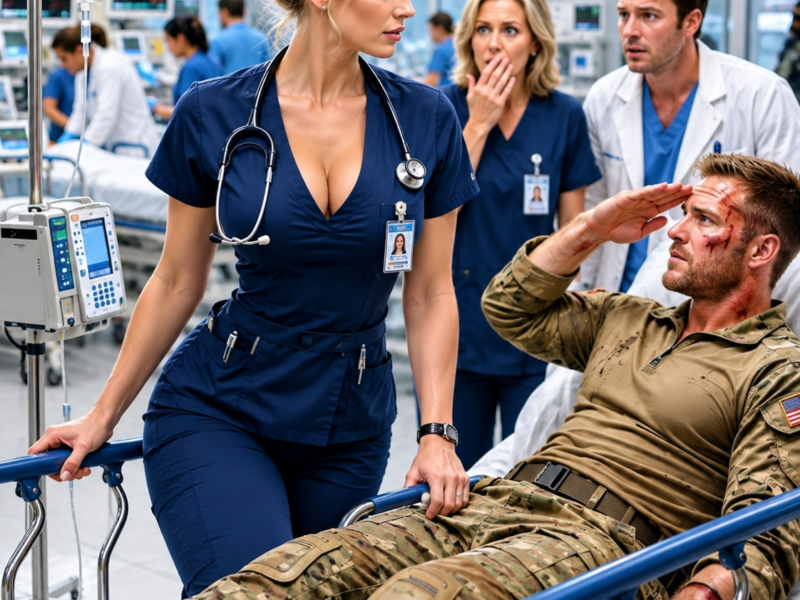
“At 2:17 a.m. in the emergency room at St. Mary’s Hospital, three wealthy men laughed as they knocked a cup of coffee out of my hand and called me a useless night-shift nurse
The monitor continued beeping as Daniel’s eyes drifted toward the older man.
I leaned closer to the stretcher.
“Daniel, I need you to stay with me. What do you mean they’re the reason we’re here?”
His lips moved, but no sound came out.
The attending physician, Dr. Harris, stepped between us.
“Claire, we need to stabilize him. Whatever conversation you’re having can wait.”
He was right.
Daniel’s blood pressure was dropping, and the wound beneath his tactical shirt was bleeding faster than we could control.
I forced myself back into nurse mode.
“Two units of O-negative blood. Get the trauma surgeon down here. We need another IV line.”
Rachel moved immediately.
I pressed gauze against Daniel’s wound while the physician worked.
But Daniel wouldn’t release my wrist.
“Sir,” I said quietly, “I need you to let go.”
He looked at me with exhausted eyes.
“Don’t let them take the drive.”
My hands stopped for half a second.
“What drive?”
His fingers slipped from my wrist.
“Hayes!” I called.
His eyes closed.
The attending physician looked toward the monitor.
“Let’s move. Now.”
They rushed Daniel toward surgery.
I followed until the doors closed in front of me.
For several seconds, I stood in the hallway with blood on my gloves and Daniel’s last words repeating in my head.
Don’t let them take the drive.
Behind me, someone cleared his throat.
It was the silver-haired man.
He had cleaned the blood from his forehead and was speaking to the security guard.
“That nurse needs to be removed from the trauma area. She’s clearly disturbing patients.”
I turned around.
He looked at me as if the last five minutes had been an inconvenience.
“What’s your name?” I asked.
He raised an eyebrow.
“You just read it.”
“No. Your full name.”
One of the younger men stepped forward.
“Listen, lady. You need to watch how you speak to him.”
The security guard moved closer.
“Everyone needs to calm down.”
The older man adjusted his expensive watch.
“Martin Caldwell. And I intend to speak to the hospital administrator about your conduct.”
Martin Caldwell.
The name struck something in my memory.
I couldn’t place it immediately, but I knew I had heard it before.
“Claire?” Rachel called from the nurses’ station.
I looked toward her.
She was holding a chart.
“Your patient is in surgery. Dr. Harris wants you to finish the incident report.”
I nodded and walked away.
I could feel Martin watching me.
Six years earlier, I had learned that the most dangerous people weren’t always the ones carrying weapons.
Sometimes they wore tailored suits, shook hands with important people, and knew exactly how to make an honest person look guilty.
I had promised myself I would never get involved in that world again.
Apparently, that promise hadn’t lasted.
At 3:40 a.m., I sat in the break room with a paper cup of water.
My hands were clean, but I could still smell the antiseptic and blood.
Rachel came in and shut the door.
“Okay. What was that?”
“What?”
“Don’t do that. I’ve worked with you for four years. I’ve never seen you look at a patient like that.”
I stared at the water.
“He knows me from somewhere.”
“Military?”
I looked up.
Rachel’s expression changed.
She had never asked me directly about my past.
I had told her I served in the Army, but nothing more.
“Yes.”
“Claire, you were a major?”
I nodded.
She sat down slowly.
“Why didn’t you ever tell anyone?”
“Because I came here to be a nurse.”
“That’s not an answer.”
“It was the only one I had.”
She studied my face for a moment.
Then she lowered her voice.
“Those three men asked the charge nurse whether Daniel had been brought in under a different name.”
I looked at her.
“What?”
“They wanted to know which hospital entrance the ambulance used. They also asked whether his personal belongings had been secured.”
“Did you tell them anything?”
“Of course not.”
She hesitated.
“But Claire, one of them mentioned a missing piece of equipment. Something about a recording device.”
The room seemed to shrink.
A recording device.
A drive.
I stood up so quickly that my chair scraped against the floor.
“Where are his belongings?”
“Security has them. Why?”
“Because Daniel specifically told me not to let anyone take the drive.”
Rachel watched me.
“Do you know what he’s talking about?”
I didn’t answer.
I was beginning to remember.
Six years earlier, I had been assigned to a special operations support unit in Afghanistan.
My official role involved coordinating medical evacuation and field operations.
Unofficially, I was responsible for making sure every person under my command came home.
I had a team of eleven.
One of them was a young communications specialist named Daniel Hayes.
He had been twenty-eight then, with a crooked smile and a habit of humming old country songs whenever the radio went quiet.
During a mission near the eastern border, our unit received intelligence about an impending attack on a civilian evacuation route.
The information came through an authorized military channel.
We were told the route was secure.
I questioned the intelligence.
The coordinates didn’t match the latest reconnaissance.
I asked for confirmation.
My request was denied.
My commanding officer ordered us to proceed.
I obeyed.
And people died.
The official investigation concluded that the attack had been carried out by enemy forces using information obtained through an intercepted transmission.
My written report questioned whether the interception had been accidental.
I also questioned why the evacuation route had been changed at the last minute.
Those questions were never answered.
Daniel survived.
Two other members of our team did not.
I resigned from active service eleven months later.
I never saw Daniel again.
Until tonight.
I looked at Rachel.
“Can you find out whether the security office has logged his belongings?”
“Claire, if this is military business—”
“It’s a patient safety issue.”
She gave me a look.
“That’s not what I asked.”
I took a breath.
“Please.”
Rachel studied me, then stood.
“Give me five minutes.”
She left.
I remained in the break room, staring at the clock.
At 4:02 a.m., my phone vibrated.
An unknown number.
I answered.
“Hello?”
A man’s voice came through.
“Claire Bennett?”
“Who’s calling?”
“You need to stop asking questions about Daniel Hayes.”
I stood.
“Who is this?”
“You’ve been out of the military for six years. You have a quiet life. A job. Friends. Don’t throw all that away.”
My throat tightened.
“Is this Martin Caldwell?”
Silence.
Then a quiet laugh.
“You’re still as stubborn as you were back then.”
The call ended.
I looked at the screen.
No number.
Just a blocked caller ID.
For a few seconds, I couldn’t move.
Then I walked straight to the charge nurse’s desk.
“Can you document a threatening phone call?”
She looked up.
“From whom?”
“An unidentified caller.”
“Claire, are you okay?”
“No. But I will be.”
At 4:19 a.m., Rachel returned.
She was carrying a small clear property bag.
“Security found this in Daniel’s belongings.”
Inside were a wallet, a set of keys, a damaged phone, and a small black flash drive.
I stared at it.
The drive had a strip of blue tape wrapped around its center.
On the tape, someone had written two words in black marker.
BLUE HARBOR.
I felt the air leave my lungs.
Rachel noticed.
“You recognize that?”
I nodded slowly.
“That was the name of our operation six years ago.”
She glanced at the bag.
“Why would he still have something from that mission?”
I didn’t know.
But I remembered the last transmission before the ambush.
A distorted voice.
A warning that had come too late.
And a second voice in the background, one that should never have been on our channel.
I had spent six years wondering whether I had imagined it.
Now Daniel had brought something back with him.
Something that could finally explain what happened.
Before I could say anything, the property bag disappeared from Rachel’s hands.
Martin Caldwell stood at the end of the hallway.
His two companions were behind him.
“That belongs to my company,” he said.
I stepped in front of Rachel.
“Your company?”
“Daniel was working under a defense contract. His equipment is proprietary.”
“He’s a Navy SEAL. His personal belongings aren’t yours.”
Martin smiled.
“That’s an interesting interpretation.”
Rachel clutched the bag.
“Sir, this property was recovered from the patient. You cannot take it.”
Martin looked at her.
“I suggest you think very carefully about your career.”
Then he turned to me.
“Claire, I know you remember what happened in Afghanistan.”
My stomach tightened.
“What happened there has nothing to do with you.”
He leaned closer.
“Are you sure?”
For the first time, I saw something behind his polished expression.
Not confidence.
Calculation.
He knew more than he was saying.
I reached for the hospital security phone.
“Security, please come to the east hallway.”
Martin’s smile faded.
“You really want to do this?”
“Yes.”
He stepped back.
His companions exchanged a glance.
The security guard arrived less than a minute later.
Martin immediately changed his expression.
“This nurse is interfering with a federal investigation.”
The guard looked between us.
“Do you have identification?”
Martin reached into his jacket and produced a business card.
“I am the regional director of Caldwell Strategic Systems. We have a contractual relationship with the Department of Defense.”
The guard examined the card.
“That doesn’t give you access to patient belongings.”
Martin’s jaw tightened.
He left without another word.
But I noticed something as he walked away.
His right hand was trembling.
At 5:10 a.m., Dr. Harris came out of surgery.
Daniel was alive.
He had lost a dangerous amount of blood, but the surgeon had controlled the bleeding.
“He’ll need intensive care,” Dr. Harris said. “The next twenty-four hours are important.”
I nodded.
“Can I see him?”
“Briefly. He’s sedated, but he may respond.”
I entered the ICU.
Daniel looked smaller beneath the white blankets.
The monitor showed a steady rhythm, and the ventilator moved gently beside him.
I stood near the bed.
“Hey, Hayes.”
I hadn’t called him that in years.
I pulled a chair closer.
“You always did have a talent for showing up at the worst possible time.”
His fingers moved.
I leaned forward.
His eyes opened slightly.
“Major?”
I swallowed.
“Not anymore.”
He tried to smile.
“Still looks like you.”
I lowered my voice.
“Daniel, I need to know what happened.”
He closed his eyes briefly.
Then he whispered, “Caldwell.”
I nodded.
“I know.”
“Not just him.”
He struggled to breathe.
“Your colonel.”
My entire body went still.
Colonel Richard Vance.
My former commanding officer.
The man who had approved the evacuation route six years earlier.
The man whose signature appeared on the order I had questioned.
I leaned closer.
“Daniel, are you saying Vance was involved?”
He moved his eyes toward me.
“Blue Harbor wasn’t an operation.”
“What?”
“It was a test.”
I stared at him.
He swallowed.
“Testing response times. Testing routes. They sold access to the evacuation network.”
The words didn’t fit together.
“Who sold it?”
“Contractors. People inside.”
“Do you have proof?”
His gaze shifted toward the door.
“Drive.”
I glanced at the hallway.
“Security has it.”
He shook his head weakly.
“Not safe.”
I took his hand.
“Listen to me. I’m not going anywhere.”
His eyes held mine.
“They knew your team would follow the order. You were the cover.”
I felt something cold settle in my chest.
“Daniel, I need you to explain.”
But he was fading again.
A nurse came in to check his medication.
I stepped away.
For the first time in six years, I wondered whether the worst thing I had done in Afghanistan had never been my decision at all.
It had been someone else’s plan.
By 7:00 a.m., the day shift had arrived.
Rachel insisted I go home and rest.
I refused.
I was completing the incident report when the hospital administrator called me into his office.
A woman named Susan Miller stood beside his desk.
She was in her early fifties, with silver-framed glasses and a reputation for being fair.
“Claire, please sit down.”
I remained standing.
“What’s happened?”
Susan folded her hands.
“We’ve received a complaint from Mr. Caldwell.”
“About what?”
“Alleged harassment, unauthorized access to patient property, and inappropriate conduct toward a hospital guest.”
I almost laughed.
“He knocked my coffee onto the floor, threatened my colleague, attempted to remove a patient’s belongings, and now he’s filing a complaint against me?”
The administrator sighed.
“He’s threatening legal action.”
“Then document his behavior, too.”
Susan looked at me.
“We will. But there’s something else.”
She slid a printed letter across the desk.
It was from Caldwell Strategic Systems.
They were requesting access to Daniel’s medical records under the claim that he had been injured during contracted work.
I read the letter twice.
“They aren’t authorized to receive this.”
“That’s our position as well.”
“Then why am I here?”
Susan hesitated.
“Because the letter specifically names you.”
I looked down.
My name appeared in the second paragraph.
Claire Bennett, former military officer and known associate of the injured contractor.
They were trying to connect me to Daniel before anyone had even asked me what I knew.
I sat down slowly.
Susan lowered her voice.
“Claire, I need to ask you something. Are you involved in anything that could place this hospital at risk?”
I thought about the call.
The flash drive.
Daniel’s warning.
“No,” I said. “But someone is trying to make it look that way.”
Susan studied me for a moment.
Then she nodded.
“All right. We’ll preserve the security footage and the property records. Nobody touches anything without proper authorization.”
For the first time that morning, I felt I wasn’t entirely alone.
At 9:30 a.m., I received a message from an unknown number.
It contained a photograph.
The photograph showed an old military operations room.
There were maps on the wall, folding chairs, and a table covered with radios.
I recognized the room immediately.
It was the command center used during Blue Harbor.
Beneath the photograph was a single sentence.
YOU NEVER SHOULD HAVE QUESTIONED THE ORDER.
I stared at the screen.
Then another message arrived.
CHECK THE TIME STAMP.
I zoomed in.
The photograph had been taken six years earlier.
The timestamp was visible in the corner.
Two hours before the attack.
And in the background, standing beside Colonel Vance, was Martin Caldwell.
He wasn’t a stranger who had appeared in the hospital that morning.
He had been there before the mission.
He had been inside our command center.
I saved the photograph and sent it to a secure email account I had kept from my military days.
Then I made a call I had avoided for six years.
“Colonel Mercer?”
The older man answered after the third ring.
“Who is this?”
“Claire Bennett.”
Silence.
Then his voice softened.
“Claire. I wondered when you’d call.”
I closed my eyes.
“I need help.”
He didn’t ask why.
He simply said, “Where are you?”
“Norfolk.”
“I’ll be there this afternoon.”
Colonel James Mercer had been the inspector general assigned to review our mission after the ambush.
He had questioned the official findings, but the investigation had been closed before he could complete his work.
He had tried to contact me twice after I resigned.
I never answered.
I had been too ashamed to hear anyone say that I wasn’t responsible.
At 2:15 p.m., Mercer arrived at St. Mary’s.
He was sixty-one, walked with a slight limp, and carried a worn leather folder.
We sat in a small consultation room.
He looked at me for a long moment.
“You look tired.”
“I am.”
“Still carrying it?”
I nodded.
He opened the folder.
“Claire, I never believed the official report.”
I stared at him.
“Why didn’t you tell me?”
“I tried.”
“I didn’t want to hear it.”
“I know.”
He placed several printed documents on the table.
“Blue Harbor involved unauthorized access to a classified logistics system. Someone was selling movement information to a private network.”
I looked at the papers.
“Who?”
“That’s what we couldn’t establish. We found irregular payments, altered routing records, and a series of communications linked to Caldwell Strategic Systems.”
My hands tightened around the edge of the table.
“What about Vance?”
Mercer paused.
“Colonel Vance retired eighteen months after the incident. He was never charged.”
“Did he sell the route?”
“We couldn’t prove that.”
“Did he know Caldwell was in the command center?”
Mercer looked at me.
“Yes.”
The room went quiet.
I thought about the mission.
The last transmission.
The coordinates that didn’t match.
My team following orders because I had told them we were safe.
“Why wasn’t that in the report?”
“Because the original communication logs were missing.”
I looked up.
“Missing?”
“Not deleted. Removed from the archive before the review began.”
I leaned back.
“Daniel has a flash drive.”
Mercer’s expression changed.
“Does he?”
“Yes. He says it contains proof.”
Mercer closed the folder.
“Then we need to preserve it properly. No private investigators, no confrontation, no attempt to access classified material on your own.”
“I understand.”
He looked directly at me.
“Claire, I need you to understand something else. If this is what I think it is, people may try to discredit you.”
“They already have.”
“Then we make sure the evidence speaks louder than they do.”
That evening, Daniel was awake enough to speak in short sentences.
Mercer met him with the hospital’s permission and under the supervision of the medical team.
Daniel looked at the older colonel and gave a faint smile.
“Still carrying that folder?”
Mercer pulled a chair closer.
“Still carrying that limp?”
Daniel laughed, then winced.
The two men had known each other during the original investigation.
Mercer leaned forward.
“Hayes, where did you get the drive?”
Daniel looked toward me.
“Not where you think.”
He explained that six months earlier, he had been assigned to a Navy security review involving an overseas communications network.
During the review, he found a series of archived transmissions that appeared to have been copied from Blue Harbor.
The records included routing changes, access logs, and audio from the original command channel.
He recognized my voice immediately.
He also recognized the voice of Colonel Vance.
But the most important discovery was a recording made forty-seven minutes before the attack.
A conversation between Vance and Caldwell.
Daniel had copied the files to the drive after discovering that the original archive had been altered.
He intended to deliver the evidence through proper military channels.
Before he could do so, his vehicle was forced off a road during what was initially described as a training accident.
He had been injured, and someone had attempted to recover the drive.
“Who?” Mercer asked.
Daniel shook his head.
“I don’t know. But I know Caldwell’s people were involved.”
I stared at him.
“Why didn’t you contact me earlier?”
Daniel looked down.
“I tried.”
My throat tightened.
“When?”
“Three years ago. I sent a letter to your old address.”
I remembered the apartment I had shared with another officer before leaving the military.
I had moved twice since then.
“I never received it.”
“I figured.”
He paused.
“I should’ve tried harder.”
I looked at him.
“You were injured, Daniel. You don’t owe me an explanation.”
He shook his head.
“I owe you the truth.”
Mercer placed a small recorder on the table.
“Can you tell us what’s on the drive?”
Daniel nodded.
“Enough to show that the route change was ordered before the intelligence report came in.”
I stared at him.
“Before?”
“Yes.”
The words settled heavily between us.
That meant the order I had followed wasn’t a reaction to changing intelligence.
It had been prepared in advance.
Mercer asked, “Does the recording establish who approved it?”
Daniel looked at me.
“Yes.”
He swallowed.
“Vance gave the final authorization.”
My mouth went dry.
“And Caldwell?”
Daniel’s eyes moved toward the window.
“He was there. He knew exactly what the route was being used for.”
The next morning, Mercer contacted the appropriate military investigative authorities.
The flash drive was transferred under documented custody, with the hospital’s security office recording the handover.
I signed nothing that would give Caldwell access to Daniel’s medical information.
I also filed a formal report about the threatening call.
For two days, nothing happened.
Then, on the third morning, a uniformed Navy investigator arrived at the hospital.
He introduced himself as Lieutenant Commander James Porter.
He had a calm voice and carried a thin folder.
“Ms. Bennett, we have reviewed the initial material recovered from the drive.”
I stood.
“And?”
He glanced at Daniel’s room.
“There’s enough to reopen the investigation.”
I felt my knees weaken.
“What about Colonel Vance?”
“He’s been contacted.”
“And Caldwell?”
“His company is under review. We are coordinating with federal investigators.”
I looked down.
“Will anyone finally tell my team what happened?”
Porter closed his folder.
“Yes. But we need your testimony.”
I nodded.
“I’ll testify.”
He studied me.
“Ms. Bennett, you should know that the recording includes your name.”
I looked up.
“Why?”
“Because Colonel Vance discussed your role specifically.”
My stomach tightened.
“What did he say?”
Porter took a breath.
“He described you as the ideal officer to issue the order because you had a reputation for following procedures and protecting your team.”
I felt the room tilt slightly.
He hadn’t simply trusted me.
He had chosen me.
Porter continued.
“He believed you would take responsibility if the mission failed.”
I sat down.
For six years, I had carried the belief that my decision had killed people.
Now I was learning that someone had built the entire situation around my trust.
I didn’t cry.
Not then.
I simply asked, “When do you need my statement?”
“Tomorrow morning.”
“I’ll be there.”
That afternoon, Daniel asked me to visit him alone.
He was sitting upright, with a blanket across his lap.
The color had begun returning to his face.
He looked more like the man I remembered.
I pulled a chair beside him.
“How are you feeling?”
“Like I got hit by a truck.”
“You practically did.”
He smiled.
Then his expression became serious.
“Claire, I need to tell you something about the night of the ambush.”
I waited.
He looked at his hands.
“When the first transmission came through, I heard another voice.”
I nodded.
“I remember.”
“It wasn’t just background noise. Someone was giving instructions.”
“To whom?”
“To the people waiting along the evacuation route.”
I stared at him.
“Did you recognize the voice?”
Daniel nodded.
“Not at the time.”
He looked at me.
“But when I heard the recording again, I recognized him.”
I leaned forward.
“Who?”
Daniel’s voice dropped.
“Vance.”
I closed my eyes.
He continued.
“He wasn’t just approving the route. He was coordinating with someone on the other side.”
I opened my eyes.
“Did he know the people who were going to attack us?”
Daniel hesitated.
“The recording doesn’t prove he knew every detail. But it proves he knew the route was compromised.”
I looked away.
There was a difference between knowing a route was unsafe and arranging for people to walk into danger.
But neither was something I could forgive.
Daniel reached for my hand.
“I’ve replayed that night hundreds of times.”
“So have I.”
“I kept thinking I should have done something.”
I shook my head.
“You were a communications specialist. You raised concerns. You reported what you heard.”
“Not enough.”
“Daniel, we were given an order by people we trusted.”
He looked at me.
“And you were the one who had to carry it.”
I swallowed.
“I signed the operational acknowledgment.”
“You did what you were trained to do.”
“Two people died.”
Daniel’s eyes filled.
“Two people died because someone used our trust as a weapon. Don’t let them make you believe that was your fault.”
I looked at him for a long time.
Then I finally let myself cry.
Not loudly.
Not dramatically.
Just the kind of crying that comes after years of holding something in place with both hands.
Daniel didn’t try to comfort me with empty promises.
He simply stayed.
The following week, I gave my statement.
The investigators played the recording in a secure room.
I recognized my own voice immediately.
Then came Vance’s.
Calm.
Measured.
Almost bored.
He discussed the route change and referred to my team as a reliable unit.
Caldwell’s voice followed.
He asked whether the revised schedule would provide enough time for the buyers to move their equipment.
Vance replied, “Bennett will handle the execution. She won’t question a direct order once the authorization comes through.”
I stared at the table.
The recording continued.
Caldwell asked what would happen if the team encountered resistance.
Vance answered, “The report will reflect hostile interference. The officer in charge will carry the operational responsibility.”
The room remained silent.
Then the investigator paused the recording.
“Ms. Bennett, do you recognize the voices?”
“Yes.”
“Can you identify them?”
“Colonel Richard Vance and Martin Caldwell.”
He nodded.
“Thank you.”
I sat there for several seconds.
Six years of memories had been reduced to a few minutes of audio.
But hearing the words didn’t make the loss disappear.
It only gave the loss a name.
Over the next month, the investigation expanded.
Financial records showed payments moving through shell companies connected to Caldwell Strategic Systems.
Military logs confirmed that the evacuation route had been changed before the final intelligence assessment.
Several archived communications had been deliberately removed.
Vance was eventually charged with conspiracy, obstruction, and other offenses related to the operation.
Caldwell was arrested after investigators established his role in the unauthorized transfer of military movement information.
Neither man became a cartoon villain during the proceedings.
Vance maintained that he had believed the operation was being conducted for a legitimate intelligence purpose.
Caldwell claimed he had only provided logistical services.
But the recordings, financial records, and witness testimony told a different story.
The case took months.
There were hearings, delays, and days when I came home too exhausted to turn on the lights.
Sometimes I wondered whether I should have stayed away.
Then I would remember the names of the two men we had lost.
And I would return.
Daniel recovered slowly.
He spent several weeks in the hospital before being transferred to a rehabilitation facility.
I visited when my shifts allowed.
We didn’t talk about Afghanistan every time.
Sometimes we argued about baseball.
Sometimes he complained about hospital food.
Once, he asked me whether I still drank the terrible coffee from the emergency room.
I told him it was an acquired taste.
He laughed.
One afternoon, I found him looking at an old photograph on his phone.
It showed our original team standing together beside a transport vehicle.
I recognized everyone.
Eleven people.
Young, tired, sunburned, and smiling.
Daniel handed me the phone.
“Remember this?”
I nodded.
“Marcus was trying to make everyone laugh.”
“He succeeded.”
I smiled despite myself.
Then I noticed the two empty spaces in the group photo where the men who had died had once stood in our formation before the picture was taken.
Daniel lowered his eyes.
“I used to think surviving meant I had to make every decision right afterward.”
I looked at him.
“What do you mean?”
“Like I had to justify why I was still here.”
I sat beside him.
“You don’t.”
He nodded slowly.
“I know that now.”
A few weeks later, Daniel attended a formal military review.
I was there as a witness.
Afterward, he found me outside the building.
The sky was gray, and a cold wind moved through the parking lot.
“Major Bennett,” he said.
I gave him a tired look.
“Don’t start.”
He smiled.
“Sorry. Nurse Bennett.”
“Better.”
He stood beside me for a moment.
Then he said, “You know, that night in the emergency room, I thought I was going to die.”
I looked at him.
“I know.”
“I saw you, and for a second I thought I was back in that command center.”
I waited.
“Then I remembered what happened after the mission. You were the only person who kept asking why the route had changed.”
I looked down.
“I should have pushed harder.”
“You did.”
“Not hard enough.”
Daniel shook his head.
“Claire, you spent six years punishing yourself for not seeing something that was deliberately hidden from you.”
I didn’t answer.
He continued quietly.
“You don’t have to keep doing that.”
I looked toward the parking lot.
For years, I had imagined that justice would feel like relief.
But it didn’t erase the two empty spaces in the photograph.
It didn’t bring back the men we had lost.
It didn’t return the years I had spent believing I was responsible.
Still, it mattered.
It mattered that the truth had been recorded.
It mattered that the people who had manipulated our mission were finally being held accountable.
And it mattered that Daniel had survived long enough to tell the story.
When I returned to St. Mary’s, Rachel was waiting near the nurses’ station.
She held up a fresh cup of coffee.
“Peace offering?”
I looked at the cup.
“What’s in it?”
“Coffee.”
“That’s not reassuring.”
She laughed.
Then her expression softened.
“I heard about the investigation.”
I nodded.
“Thank you for not giving up on me.”
Rachel shrugged.
“You’ve covered enough of my shifts. I wasn’t about to let some rich guy chase you out of the hospital.”
I smiled.
It felt unfamiliar at first.
Then it came naturally.
A few months later, I received a letter from the military review board.
The official findings had been amended.
My actions during Blue Harbor were no longer described as negligent.
The report acknowledged that I had raised concerns about the altered route and had followed an order based on falsified intelligence.
It also recognized the actions I had taken to protect the members of my team once the attack began.
I read the letter twice.
Then I placed it in a drawer.
I didn’t need it to tell me that I had loved those men.
But I was grateful that the record finally told the truth.
I never returned to active duty.
I remained a nurse at St. Mary’s.
I still worked nights.
I still drank terrible coffee.
I still held frightened patients’ hands while their families waited outside the trauma rooms.
And I still believed that the most important thing a person could do was show up when someone needed them.
One evening, Daniel came to the hospital for a follow-up appointment.
He was walking without assistance, although he still moved carefully.
He found me at the nurses’ station.
“Hey, Claire.”
I looked up.
“You’re looking better.”
“That’s because I’m not bleeding all over your floor this time.”
Rachel laughed from behind me.
Daniel handed me a small envelope.
“What’s this?”
“Something I wanted you to have.”
Inside was a photograph.
It showed our old team, the same picture he had shown me during rehabilitation.
But this time, someone had written the names of every person on the back.
Including the two men who hadn’t come home.
At the bottom, Daniel had written one sentence.
WE REMEMBER WHAT HAPPENED. WE DON’T HAVE TO CARRY THE BLAME.
I held the photograph for a long time.
Then I looked at him.
“Thank you.”
He nodded.
“You saved my life that night.”
I shook my head.
“The doctors saved your life.”
“Maybe.”
He glanced toward the emergency room doors.
“But you reminded me that I wasn’t alone.”
I looked at the photograph again.
Six years earlier, I had walked away from the military believing that I had failed the people who trusted me.
I had spent years trying to become someone who could never make that kind of mistake again.
I thought being a good nurse meant keeping my past separate from my work.
But that night, when Daniel called me Major, I understood something I had been avoiding.
The person I had been before the hospital wasn’t someone I needed to bury.
She was the same person who had spent years protecting others, even when she had been wronged herself.
The next time someone asked why I worked the night shift, I simply smiled and said it suited me.
I didn’t tell them about the mission.
I didn’t tell them about the recording.
I didn’t tell them about the men who had tried to take a patient’s belongings or the colonel who had betrayed his own team.
I just checked my patients, adjusted their blankets, and made sure nobody had to face the darkest hours alone.
And sometimes, when a frightened young soldier came through the emergency room doors, I would remember the words Daniel had spoken that night.
“Stand down, Major.”
For the first time in six years, those words no longer sounded like a warning.
They sounded like someone reminding me that I could finally put the weight down.
ThE end.









