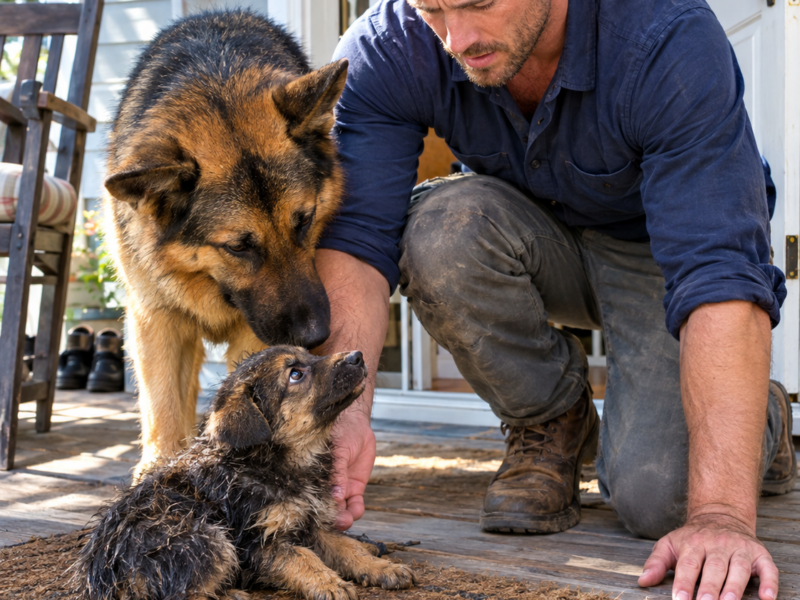
“At 2:17 a.m., I opened my front door to find a wounded German Shepherd puppy dragging himself across my porch
I kept my eyes on the man in the dark vehicle.
“Get out of the car,” I called.
He didn’t move.
Instead, he glanced toward the passenger seat, where the wounded puppy lay wrapped in my jacket, then looked directly at Ranger.
“Your dog remembers me,” he said. “Ask him what happened at the warehouse.”
Ranger’s growl deepened.
I felt the words settle somewhere beneath my ribs.
The warehouse.
I hadn’t heard that word connected to Ranger in nearly three years, and the man had no business knowing anything about our deployment history.
“Who are you?” I demanded.
He ignored the question.
“That puppy needs treatment, Daniel. But if you take him to that clinic, people who have been looking for him will find you before sunrise.”
I opened my truck door.
“Then they’d better be ready to explain why a ten-week-old puppy is bleeding on my porch.”
For the first time, the man looked angry.
“You’re making a mistake.”
“That’s possible,” I said. “But it’s going to be my mistake.”
I climbed into the truck and locked the doors.
Ranger jumped into the back seat, positioning himself behind the puppy as if he understood exactly what mattered now.
The dark vehicle remained in my driveway until I backed onto the road.
Only when I turned toward the highway did its headlights come on.
It followed me.
I drove to the emergency veterinary clinic without changing speed, checking my mirrors every few seconds.
The vehicle stayed three car lengths behind me until I reached a brightly lit gas station near the main road.
Then it turned off.
I didn’t relax.
I’d spent enough years in the military to understand that someone who wanted to follow you didn’t always need to stay directly behind you.
At the clinic, a veterinary technician hurried out with a stretcher.
I carried the puppy inside while Ranger walked beside me, his leash loose in my hand.
The technician took one look at the injuries and called for the veterinarian.
Within minutes, the puppy disappeared through a set of swinging doors.
I stood beneath the fluorescent lights with rainwater dripping from my sleeves.
Ranger sat beside my boot, watching the doors.
A woman in blue scrubs approached me.
“I’m Dr. Emily Carter,” she said. “I need to ask you a few questions about the puppy.”
“Ask away.”
“How long have you had him?”
“About forty minutes.”
“Did you see anyone else near your house?”
I looked at her.
“Why?”
She hesitated.
“Because someone called our clinic earlier tonight asking whether we’d received an injured German Shepherd. They described his injuries before we had any patient information on file.”
“Did they give you a name?”
“No. But they knew the puppy had a metal tag beneath his collar.”
My hand instinctively went to my pocket.
I hadn’t mentioned the tag to anyone at the clinic.
“Whoever called knew what they were looking for,” I said.
Emily nodded.
“That’s what concerns me.”
She led me into a small examination room and closed the door.
“The puppy is dehydrated and has several injuries. His leg may be fractured, but we won’t know until we get the X-rays. The wound along his side is infected, and that collar has caused significant damage to his neck.”
“Will he survive?”
“We’re going to do everything we can.”
Her voice was gentle, but she didn’t offer false reassurance.
I appreciated that.
She glanced at Ranger, who had positioned himself between me and the door.
“Is he a working dog?”
“Former military K9.”
“That explains a few things.”
“Such as?”
“He’s been watching the hallway since you arrived. Every time someone approaches the treatment room, he checks their hands before he looks at their face.”
I stared at Ranger.
It was a habit I’d trained into him during deployment.
“He’s had a lot of experience learning who to trust,” I said.
Emily’s expression changed slightly.
“Maybe this puppy has, too.”
She returned to the treatment area, leaving me alone with my thoughts.
I took the silver tag from my pocket and turned it beneath the fluorescent light.
K-17.
The symbol on the reverse was unmistakable now.
I remembered seeing it on a small number of records connected to a specialized military working-dog program. The program had been discontinued before my last deployment, and I’d never worked directly with it.
But I remembered one detail from a briefing years earlier.
Several dogs assigned to a private contractor had been reported missing after an equipment transfer went wrong.
The investigation had been closed.
No criminal charges were announced, and the details had never reached most of the personnel on base.
At the time, I’d assumed the missing dogs had been reassigned or recovered.
Now I wasn’t so sure.
I took out my phone and searched through my old contacts.
There was one person who might know more.
Chief Petty Officer Marcus Reed had served with me for eight years. He was retired now, living in North Carolina, and he had a memory for details that most people would forget before lunch.
I called him.
He answered on the fourth ring.
“Brooks? You know what time it is?”
“I need you to look something up for me.”
“At two in the morning?”
“An old K9 program. Private contractor, military working dogs, missing animals. I found a puppy with a tag marked K-17.”
The joking tone vanished from his voice.
“Where did you get that number?”
“On a wounded German Shepherd.”
Marcus went quiet.
Then I heard him shut a door.
“Listen carefully,” he said. “Don’t send me a picture of that tag over an ordinary message, and don’t post anything online. Where are you?”
“An emergency veterinary clinic outside Norfolk.”
“Are you alone?”
“Ranger’s with me.”
“That wasn’t what I asked.”
I looked through the window in the examination-room door.
A man in a gray jacket stood near the reception desk, speaking to the technician.
He wasn’t looking at the appointment board.
He was looking at the hallway leading to the treatment rooms.
“No,” I said. “I don’t think I am.”
Marcus swore softly.
“Stay inside. I’m going to call you back from a number you recognize.”
He hung up.
I didn’t like the way he’d said it.
Marcus wasn’t a man who frightened easily, and he’d never been one to dramatize a situation.
If he was worried, I needed to take that seriously.
I walked to the door and looked through the narrow window.
The man in the gray jacket had disappeared.
Ranger stood before the door, his ears forward.
I placed a hand on his shoulder.
“Easy.”
He looked up at me, then back toward the corridor.
A few minutes later, Emily returned.
“The puppy is stable for now,” she said. “We’re giving him fluids and pain medication. His leg is fractured, but it can likely be treated. He’ll need surgery on the wound after we control the infection.”
“Can I see him?”
“For a minute.”
She led me into the treatment area.
The puppy lay on a padded table beneath a warm blanket. An IV line ran into his front leg, and a small bandage covered the worst of the wound on his side.
When I approached, his eyes opened.
I rested two fingers against the edge of the blanket.
“You’re doing good, little man.”
He tried to lift his head.
Ranger approached the table, sniffed gently, and lay down on the floor beside it.
The puppy settled.
Emily watched them for a moment.
“He’s calmer when Ranger is near him,” she said.
“Ranger has that effect on some people, too.”
She smiled faintly.
Then she noticed something near the puppy’s collar.
“Daniel, did you remove anything else from this?”
I took out the silver tag.
“No. Just this.”
Emily studied the collar.
“There may be something sewn into the lining.”
She used a small pair of medical scissors to examine the inside edge, careful not to disturb the injured skin.
After a minute, she found a narrow pocket hidden beneath a strip of black fabric.
Inside was a folded piece of plastic, no bigger than a postage stamp.
It contained a handwritten number and a tiny symbol resembling the anchor on the tag.
I leaned closer.
The number was followed by two letters: E.C.
Emily’s face went pale.
“What is it?” I asked.
She didn’t answer immediately.
Instead, she looked toward the door, then back at the puppy.
“I’ve seen that symbol before.”
“Where?”
“My father worked as a veterinary technician for a defense contractor when I was a teenager. He used to tell me about a program that trained dogs for search, detection, and rescue operations.”
She touched the plastic packet with one gloved finger.
“He quit after an animal was injured during a transfer. He said the paperwork didn’t match what he’d seen with his own eyes.”
“Did he ever tell you the company’s name?”
“Not directly. He was afraid he’d signed too many confidentiality agreements to talk about it.”
“Is he still alive?”
Emily lowered her eyes.
“He died six years ago.”
“I’m sorry.”
She nodded, pressing her lips together.
“He kept a box of old documents in his garage. After he died, I couldn’t bring myself to throw anything away, so I still have it.”
She looked at the puppy again.
“If that symbol belongs to the same program, I might have records that could help you.”
Before I could respond, my phone rang.
Marcus.
I answered immediately.
“Tell me you found something,” I said.
“I found enough to know this isn’t a stray.”
“What do you know?”
“The program you described was operated through a contractor called Sentinel Canine Solutions. It handled training and transport for several government agencies. There was an investigation after a group of working dogs disappeared during a transfer.”
“How many?”
“Seven were listed as missing. Three were later accounted for. The other four were never officially recovered.”
I looked at the puppy.
“K-17?”
“That’s one of the identifiers used on the transfer paperwork.”
“Why would a puppy have it?”
“That’s the part I don’t understand. Those identifiers were assigned to animals in a restricted breeding and training program, not ordinary litters.”
He paused.
“Daniel, I need to tell you something else.”
I waited.
“One of the dogs involved in the investigation was a female German Shepherd named Mara. She was reported as having died during transport. But the veterinarian who signed the death certificate later withdrew his statement.”
“Why?”
“He claimed he’d never examined the dog.”
I looked at the plastic packet.
“Was there any follow-up?”
“Not that I can find. The investigation was closed after the contractor provided a revised set of records.”
“And everyone accepted that?”
“No. Some people kept asking questions. One of them was a handler named Thomas Vale.”
The name meant nothing to me.
“What happened to him?”
“He left the program shortly afterward. His service record says he resigned. A colleague told me he believed the missing dogs had been sold through an illegal breeding network.”
My jaw tightened.
“Do you have his contact information?”
“An old address. I’ll send it to you, but don’t go charging into anything. If someone is watching you already, you need to be careful.”
“I hear you.”
“No, Daniel. Hear me properly. You have a wounded puppy, an unexplained tag, and someone who knows your name. You need to protect the evidence and make sure the animal gets treated.”
“I know.”
“Then call me when you’re somewhere secure.”
The call ended.
I stood beside the examination table, trying to connect the pieces.
A missing-dog investigation.
A contractor that had revised its records.
A wounded puppy carrying a hidden message.
And a stranger who had somehow known where to find me.
I looked at Emily.
“Can you keep the collar and everything attached to it?”
“Yes. I’ll document it, photograph it, and store it separately.”
“Don’t alter anything else until we’ve recorded what we have.”
She nodded.
“I’ll also give you a copy of the medical report.”
For the first time that night, I felt as if I had a path forward.
Then the lights in the treatment area flickered.
Once.
Twice.
The room went dark.
Somewhere beyond the door, a metal tray hit the floor.
A technician shouted.
Ranger was on his feet before I could move.
Emergency lights came on, washing the room in dim red.
Emily hurried to the door, but I caught her arm.
“Wait.”
“What?”
“Someone may be trying to get inside.”
We listened.
Footsteps moved down the corridor.
Then a man’s voice said, “The dog. We need the dog.”
Emily stepped back.
I moved between her and the door.
Ranger stood at my side, his body rigid but controlled.
A shadow passed the narrow window.
The door handle turned.
I braced myself, but the handle stopped before the latch released.
Then came a knock.
Three slow taps.
A familiar voice spoke through the door.
“Daniel, it’s Marcus. Open up.”
I almost reached for the lock.
Then I remembered something.
Marcus had told me he’d call from a number I recognized.
He hadn’t said he would come to the clinic.
I looked at Emily.
“Did you tell anyone I was here?”
“No.”
The voice came again.
“Daniel, we don’t have time. Open the door.”
Ranger’s ears flattened.
I drew my phone from my pocket and called Marcus’s number.
He answered immediately.
“What’s going on?”
“Are you at the clinic?”
“No. I’m at home. Why?”
“Someone’s outside the treatment room claiming to be you.”
Marcus’s voice hardened.
“Do not open that door.”
The handle turned again.
This time, the person outside pushed against it.
I backed away with Emily while Ranger positioned himself in front of us.
Then the voice changed.
It was no longer pretending to be Marcus.
“Give us the puppy, and nobody gets hurt.”
Emily’s hand flew to her mouth.
I called 911.
The person outside struck the door once with enough force to rattle the frame.
Then the footsteps retreated.
We heard another door open somewhere down the corridor, followed by running steps and a crash.
By the time security arrived, the intruder had vanished.
The police found a service entrance propped open with a folded piece of cardboard.
Outside, tire marks crossed the wet pavement.
The clinic’s security camera had stopped recording for eleven minutes during the power interruption.
It wasn’t an accident.
The officers took my statement and reviewed what footage remained.
One of them, a sergeant named Alvarez, listened without interrupting as I described the vehicle at my house, the caller, and the attempted entry.
When I finished, he rubbed a hand over his jaw.
“We’ll document all of this,” he said. “But I want you to understand something. A stranger claiming ownership of a dog isn’t enough to prove a crime. The threats and the attempted entry are separate matters, and we’ll investigate them.”
“I understand.”
“Do you have somewhere safe to stay tonight?”
I looked at Ranger.
“Yes.”
“Then don’t go back to your house alone. And don’t confront anyone you suspect is involved.”
I gave him copies of the photographs and the tag number.
For the first time since the puppy arrived, I felt the weight of my decisions.
I’d wanted to save an injured animal.
Now a veterinarian, a retired Navy chief, and a police sergeant were all involved in something that might be far bigger than a case of animal abuse.
And I couldn’t shake the feeling that someone had known the puppy would lead me here.
By dawn, the rain had stopped.
The puppy’s condition had stabilized enough for Emily to transfer him to a quiet recovery room. She said he would need surgery, but she was cautiously optimistic.
I sat beside his kennel while Ranger rested on the floor.
I hadn’t slept.
Every time I closed my eyes, I heard the stranger’s voice at my driveway.
You have no idea what you’ve gotten yourself into.
Emily appeared with a cup of coffee.
“I called my brother,” she said. “He works in digital forensics. He told me not to open any files from an unknown source, but he can help examine the documents from my father’s box.”
“That could be useful.”
“I want to help this puppy.”
She said it plainly, without trying to sound brave.
I looked at the small dog sleeping beneath the blanket.
“Then we’ll do this properly.”
My phone buzzed.
Marcus had sent me an address and a message.
Thomas Vale. Retired handler. Lives outside Richmond. I spoke to him briefly. He agreed to meet you, but he wants you to bring no one from the contractor.
I called Marcus.
“Why would Vale trust me?”
“He doesn’t know you. But he remembers the military K9 community, and I told him you served with Ranger.”
“Did you tell him about the puppy?”
“Only that you found an injured German Shepherd with an old program identifier. He asked whether the dog was alive. When I said yes, he went quiet.”
“Did he explain why?”
“No. He said he wanted to see the tag in person.”
I looked at the sleeping puppy.
“Then I’ll go.”
“Not alone,” Marcus said.
“I won’t.”
After discussing it with Sergeant Alvarez, I agreed to meet Vale at a public location outside Richmond. The sergeant arranged for an officer to accompany me without making a spectacle of the meeting.
Emily stayed at the clinic with the puppy.
Before I left, she crouched beside Ranger.
“Look after him,” she murmured.
Ranger nudged her hand.
For a moment, she smiled.
Then she looked at me.
“My father always said the hardest part of rescuing an animal was convincing it that nobody was going to hurt it again.”
I glanced toward the recovery room.
“Maybe the hardest part is convincing the people around it, too.”
She nodded.
The drive to Richmond took nearly two hours.
The morning traffic grew heavier as I approached the meeting place, a small diner near the edge of town. I parked where I could see the entrance and waited.
At nine fifteen, an older man in a brown jacket stepped out of a pickup truck.
He walked with a slight limp, his shoulders bent forward, and he kept glancing at the cars around him.
When he reached my table, he didn’t sit.
“You’re Daniel Brooks?”
“Yes.”
“Where’s the dog?”
“At a veterinary clinic. He’s alive.”
Vale closed his eyes briefly.
“Good.”
He finally sat down.
I placed a photograph of the silver tag on the table.
His fingers trembled when he saw it.
“K-17,” he whispered.
“You know what it means.”
He looked up at me.
“I know what they did to the dogs assigned to that program.”
“Tell me.”
Vale glanced toward the window.
“Not here. I need to know whether you brought the actual tag.”
I didn’t answer.
He nodded as if he’d expected that.
“Good. Don’t hand it to anyone until you’ve made copies and documented where it came from.”
“Why?”
“Because the last person who tried to expose what happened was accused of stealing government property and falsifying records.”
“Was that you?”
He stared at me.
“Yes.”
For several seconds, neither of us spoke.
Then Vale reached into his jacket and removed a folded photograph.
It showed a younger man standing beside a German Shepherd in front of a chain-link kennel. The dog was lean, alert, and wore a collar bearing the same anchor symbol.
On the back, someone had written a name.
Mara.
“She was one of the best dogs I’d ever worked with,” Vale said. “She could locate a person in darkness, move through a search area without panicking, and remain calm when everyone around her was losing control.”
“What happened to her?”
“She was assigned to a breeding program after an injury ended her operational work. The official record said she died during transport.”
“But she didn’t.”
Vale looked at the photograph.
“No. I saw her alive three days after the paperwork said she’d died.”
My stomach tightened.
“Where?”
“At a private facility in Virginia. The contractor had transferred several dogs there without proper authorization. Some were injured. Some were being bred for sale. A few had been trained for work that wasn’t listed in their official files.”
“What kind of work?”
Vale hesitated.
“Detection and security. The problem wasn’t that the dogs were being trained. It was that their identities and histories were being altered so no one could trace them.”
“Why would anyone do that?”
“Money. Contracts. Breeding rights. There are people who see a working dog as equipment, and equipment can be sold, replaced, or hidden.”
He pushed the photograph toward me.
“Mara was pregnant when I saw her. If she survived and had a litter, those puppies could have been worth a great deal to someone who wanted her bloodline.”
I thought about the tiny body on the clinic’s recovery table.
“Are you saying this puppy could be hers?”
“I’m saying the tag makes that possible. The marking was used on records connected to her transfer.”
He paused.
“But there’s something else you need to understand. I didn’t steal any dogs. I tried to get them out.”
“What happened?”
“The contractor discovered I was keeping copies of the transfer records. I was removed from the program, and they told investigators I’d falsified the paperwork to cover my own theft.”
“Did you have proof?”
“I had enough to make them nervous, but not enough to make them lose their contracts.”
“Where is that evidence now?”
Vale’s eyes shifted toward the diner entrance.
“Some of it was hidden in a storage unit. The rest was given to someone I trusted.”
“Who?”
He looked directly at me.
“Emily Carter’s father.”
The name struck me with unexpected force.
I thought of Emily standing beside the puppy, her voice quiet as she spoke about the box of documents her father had kept.
“Did he know about the missing dogs?”
“He was one of the people who helped me document what happened. He found discrepancies between the animals he examined and the animals listed on the paperwork.”
“Why didn’t he go to the authorities?”
“He tried. The complaint disappeared. Then his employer threatened to sue him for violating his confidentiality agreement. He had a family, Daniel. He wasn’t proud of backing away, but he was afraid.”
I thought of Emily’s father, a man I’d never met, who had spent the rest of his life keeping a box of papers in his garage.
“Why are you telling me this now?”
“Because someone brought you a puppy with that tag. And whoever did that wants something from you.”
“Or wants me to find something.”
Vale studied me.
“That’s possible.”
He took a breath.
“I don’t know who left that puppy at your house. But if the contractor is involved, they’ll try to get the dog back before anyone connects him to the old records.”
“Do you know who runs the company now?”
“Richard Shaw. He wasn’t in charge when I worked there, but he took over after the investigation was closed.”
I recognized the name from a business article I’d read months earlier. Shaw had appeared at charity events, donated to veterans’ organizations, and funded animal-rescue programs.
A man who publicly supported the people and animals his company might have harmed.
I felt sick.
“Do you have anything that can prove it?”
Vale reached into his pocket and handed me a small key.
“Storage unit outside town. The original records are there, along with a drive containing photographs and copies of the transfer logs.”
“Why haven’t you taken them to the police?”
“I did. Once. They said the documents couldn’t be authenticated because I couldn’t prove where they came from. Then the storage unit was broken into, and I thought the evidence was gone.”
“How do you know it’s still there?”
“Because I replaced the lock and moved the important files into a concealed compartment.”
I turned the key in my fingers.
“Why trust me?”
Vale gave a tired, humorless smile.
“I don’t. Not yet. But I trust that dog has been hurt enough, and I’m tired of waiting for someone else to care.”
We agreed to meet again after the police had reviewed the evidence.
I didn’t go to the storage unit alone.
Sergeant Alvarez arranged for an officer to accompany us, and Vale provided a written statement before we approached the door.
The lock was intact.
Inside, dusty shelves held old boxes, spare furniture, and several plastic containers marked with dates.
Vale moved a stack of blankets and pulled a narrow panel from the back of a cabinet.
Beneath it was a metal case.
He unlocked it.
Inside were printed transfer records, photographs, veterinary reports, and a portable drive sealed in a plastic bag.
The first file listed seven missing dogs.
Three had been marked recovered.
Four remained unaccounted for.
Mara’s name appeared beside one of the missing entries.
I examined the veterinary reports.
Several documents listed injuries that didn’t match the official incident summaries. Others showed examinations performed on dates when the dogs were supposedly in a different state.
There were signatures, dates, and shipping records.
But the most disturbing evidence was a photograph of a kennel with a young German Shepherd lying against the fence.
A small tag hung from his collar.
K-17.
On the back, someone had written a date from less than three months earlier.
The puppy hadn’t simply been born into an old mystery.
He had been inside a system that was still operating.
Sergeant Alvarez photographed each document and arranged for the drive to be examined by the appropriate investigators.
We didn’t post anything online or confront Shaw.
The evidence needed to be preserved, and the case needed people who could authenticate it.
For the first time, I understood why Vale had spent years living with the fear that no one would believe him.
The records were compelling, but they were not yet a complete explanation.
We needed to find out where the puppy had come from and who had placed him on my porch.
That answer arrived three days later.
The puppy’s surgery had gone well.
Emily told me he was beginning to eat on his own, though he still needed rest and careful rehabilitation.
I visited every afternoon.
Ranger came with me when the clinic allowed it, and the two dogs had developed a quiet routine. Ranger would lie beside the puppy’s bed while the little Shepherd slept, lifting his head whenever a technician approached.
We began calling the puppy Scout.
It wasn’t his official name, if he’d ever had one.
It was simply the first name that felt right.
On the third afternoon, Emily called me into her office.
“My brother has examined the documents from my father’s box,” she said. “He found a connection between one of the old veterinary records and the recent transfer log.”
“What kind of connection?”
“A shipment number. The same number appears on the plastic packet from Scout’s collar.”
She turned her laptop toward me.
A scanned document showed a list of animals moved from a private facility to a storage property outside Norfolk.
One entry had been crossed out.
The name beside it was Mara.
The destination field had been changed twice.
The final destination was a property owned by a company affiliated with Sentinel Canine Solutions.
“Can we prove the document is genuine?” I asked.
“Not yet. But my brother found a second version in a backup file. The dates and signatures match.”
She scrolled down.
“There is also a name attached to the transport authorization.”
Richard Shaw.
My jaw tightened.
“That puts him close to the transfer.”
“It does. But it doesn’t prove he ordered the dogs to be moved illegally or knew what happened afterward.”
I nodded.
We needed facts, not assumptions.
Emily looked at Scout through the glass wall.
“My father spent years trying to prove someone was changing the records. He never knew whether the dogs survived.”
“Now we know at least one of them did.”
She swallowed.
“If Scout is Mara’s puppy, he may be the only living link to what happened.”
Before I could respond, Sergeant Alvarez called.
The investigators had traced the vehicle that followed me from my house to the gas station. It had been rented through a company account linked to a security contractor that occasionally worked with Sentinel.
The account itself had been used by several employees, so the investigators were still determining who had been behind the wheel.
But they had found something else.
A security guard from a private kennel had contacted the police after recognizing the description of the puppy.
He claimed he had seen a young German Shepherd escape from the facility three nights earlier.
The guard had not reported it immediately because he feared losing his job.
He agreed to meet us.
We met in a small interview room at the police station.
The guard’s name was Kevin Miller. He was in his late twenties, with tired eyes and a habit of rubbing his palms against his jeans.
“I didn’t hurt the dog,” he said before anyone asked him a question. “I swear I didn’t.”
Sergeant Alvarez motioned for him to sit.
“We’re here to understand what happened, Kevin. Start wherever you can.”
Kevin stared at the table.
“The puppy was kept in a separate enclosure. He was too young to be part of the regular training groups. There were other dogs there, too, but he was the only one I saw with that tag.”
“Who was responsible for him?” I asked.
“One of the supervisors. He said the puppy was valuable and that nobody was supposed to handle him without permission.”
“Did you see the puppy injured?”
Kevin nodded slowly.
“Two nights before he disappeared, I heard barking from the back kennels. When I went to check, the supervisor was there with another man. The puppy was on the floor, and his leg was hurt.”
“Did they take him to a veterinarian?”
“No. The supervisor said the injury had happened during transport and that the dog would be moved somewhere else before anyone noticed.”
Kevin’s hands began to shake.
“I thought about calling the police, but I needed the job. My wife is pregnant. We have a mortgage.”
I didn’t interrupt him.
He looked at me, ashamed.
“I know that sounds terrible.”
“It sounds like you were scared,” I said. “That doesn’t make what happened right, but it explains why you hesitated.”
He nodded, wiping his face.
“That night, I saw a woman come through the service gate. She had a truck and a carrier. She asked about the puppy, and the supervisor told her to leave.”
“Did you recognize her?”
“No. But she knew the dog’s name.”
“What did she call him?”
Kevin closed his eyes, trying to remember.
“She called him Scout.”
I felt a strange pressure in my chest.
The name we’d given him had been a coincidence.
Or perhaps it hadn’t.
“What happened next?” Sergeant Alvarez asked.
“The supervisor left the enclosure open while he argued with her. The puppy crawled out. The woman wrapped him in a blanket and carried him to her truck.”
“Did she hurt him?”
“No. She was crying. She kept saying, ‘I’m sorry, baby. I’m so sorry.'”
Kevin took a breath.
“I didn’t stop her. I should have reported it, but I was afraid they’d blame me for letting him escape.”
“Did you see where she went?”
He shook his head.
“But I heard her tell the supervisor something before she left.”
“What?”
Kevin looked at me.
“She said, ‘If you want him back, you’ll have to explain what happened to his mother.'”
The room fell silent.
For the first time, the pieces began to form a picture.
Someone had taken Scout from the kennel, but not to sell him.
Someone had carried him through the rain and brought him to my doorstep.
Someone had known enough about my history with Ranger to believe I might protect him.
I thought of the strange man in the driveway.
He hadn’t simply wanted the puppy returned.
He’d wanted to prevent us from discovering where the puppy came from.
The investigators asked Kevin to help identify the woman from photographs of employees and visitors.
He couldn’t find her in the official staff directory.
But when Emily showed him a photograph of her father’s old records, he pointed to a name on a transport authorization.
“That’s her,” he said.
“You’re certain?” Alvarez asked.
Kevin nodded.
“Her name is Laura Bennett. She worked in administration at the kennel. She used to bring food to the dogs when the supervisors weren’t around.”
“Where is she now?”
Kevin looked down.
“I don’t know. She quit a few weeks ago.”
The investigators tracked her to a small rental house on the outskirts of Chesapeake.
They did not send me to confront her.
Instead, Sergeant Alvarez asked whether I would be willing to help identify Scout and provide the original tag for comparison if she agreed to speak with them.
I said yes.
Two days later, Laura Bennett walked into the police station.
She looked younger than I’d expected, perhaps in her early thirties, with dark circles beneath her eyes and a thin scar along one wrist.
When she saw the photograph of Scout, she covered her mouth.
“He’s alive,” she whispered.
I watched her carefully.
“You brought him to my house.”
She nodded, tears gathering in her eyes.
“Yes.”
“Why?”
She sat down slowly.
“Because I knew someone would be watching the clinic. I needed him somewhere they wouldn’t think to look.”
“Why my house?”
She looked at Ranger, who lay beside my chair.
“Because of him.”
I waited.
“Three years ago, I worked as a veterinary assistant for a subcontractor that provided care for military working dogs. I helped with routine examinations, vaccinations, and recovery after training injuries. I wasn’t part of the security team, and I didn’t know everything that happened inside the facility.”
She drew a shaky breath.
“But I knew the dogs were being treated as property, not living animals. I saw records changed. I saw animals moved without the required medical clearance. When I asked questions, my supervisor told me to stop looking for trouble.”
“How did you learn about Scout?”
“His mother was brought in under a false identity. She was badly underweight, and she had an old injury that hadn’t been properly treated. The paperwork said she’d been transferred from another facility, but the transport dates didn’t match.”
“Mara,” I said.
Laura nodded.
“I didn’t know her original name at first. I only knew she was gentle, even when she was frightened. She would lean against the kennel door whenever I came near.”
Her voice broke.
“She gave birth to four puppies. Two died within days. One was moved before I could find out where he went. Scout was the only one left at the facility when I discovered the records.”
“What happened to Mara?”
Laura closed her eyes.
“She died after complications from an untreated infection. They waited too long to get her proper care.”
I stared at her.
“Did anyone investigate?”
“No. The official report said she had a congenital condition and that her death was unavoidable.”
“Was that true?”
“No.”
The word came out barely above a whisper.
Laura reached into her bag and took out a small notebook.
“I copied the medical notes before they changed them. I also kept photographs of her injuries and the original transfer paperwork.”
She slid the notebook across the table.
“I wanted to report everything, but I was afraid. They knew where I lived. They knew my family. When I learned Scout was being moved again, I couldn’t let them take him.”
“So you took him.”
“I did.”
“Why not go to the police?”
“I tried to contact an investigator once. The next day, my supervisor told me he knew about the call. He said if I caused trouble, he’d make sure I never worked in animal care again.”
She looked at me.
“Then I saw your name in an old personnel file. Your military K9, Ranger, had been listed as an approved placement after his service. I remembered reading that you had retired in Norfolk.”
My eyes narrowed.
“You found my address in a personnel file?”
“No. I found it through a public veterans’ charity newsletter. You and Ranger were pictured at an adoption event. The article mentioned that you lived outside Norfolk.”
She wiped her cheeks.
“I didn’t know whether you’d help. I only knew you had worked with a dog who was trained to protect people, and I hoped you’d understand why this puppy needed someone to stand between him and the people who wanted him back.”
I looked at Ranger.
He lay quietly beside my chair, his head resting on his paws.
Laura’s explanation made sense, but it didn’t excuse everything.
“You could have put me in danger,” I said.
“I know.”
“You could have taken Scout to an animal shelter and reported what you knew.”
“They had people watching the shelters. I heard the supervisor say they were checking nearby clinics and rescue groups. I panicked.”
“And you brought a wounded puppy to a stranger’s doorstep.”
Laura’s face crumpled.
“I didn’t know what else to do.”
For a moment, I wanted to be angry.
I wanted to tell her that fear wasn’t an excuse for making decisions that put other people at risk.
But I remembered the puppy’s tiny body on my porch and the way he’d struggled to lift his head.
I remembered the first time I’d brought Ranger home after a deployment, both of us exhausted and unsure how to live without a mission.
Sometimes people made terrible decisions because they were trying to stop something worse.
That didn’t make the decisions harmless.
It made them human.
Sergeant Alvarez reviewed Laura’s documents and arranged for the original files to be compared with the records from Vale’s storage unit.
The evidence finally connected the missing-dog investigation to the more recent kennel operations.
The revised records, the transport authorizations, and the veterinary notes told a consistent story.
Several dogs had been moved under false identities. Their medical histories had been altered, and their breeding records had been used to justify private transfers.
The evidence did not prove every person at Sentinel had been involved.
It did, however, point to a small group of supervisors and administrators who had approved unauthorized transfers and concealed animal injuries.
Richard Shaw’s signature appeared on several authorization forms.
Investigators found additional records on the portable drive, including emails discussing the removal of “unrecoverable assets” before an inspection.
One email referred to Mara by her original identifier and instructed staff to replace her medical file with a revised report.
Another discussed moving Scout to a private buyer after his injuries had healed.
The case was no longer built on one man’s recollection or a frightened woman’s notebook.
It had documents, photographs, medical evidence, and witnesses whose accounts supported one another.
The authorities executed search warrants at two properties associated with the contractor.
They recovered several dogs, including one older German Shepherd whose records had been altered.
The dog was alive, but badly neglected.
I later learned that investigators found evidence of financial fraud and false reporting connected to the transfers. The animal-welfare charges moved forward alongside the investigation into the company’s records.
Shaw denied knowing that dogs had been injured or transferred illegally.
His lawyers argued that lower-level employees had acted without his authorization.
The investigation continued, and the court would ultimately decide which allegations could be proven against him and the other executives.
I was never interested in guessing what the verdict would be.
I wanted the dogs treated.
I wanted the records preserved.
And I wanted Scout to have a life in which nobody could take him away in the middle of the night.
Three weeks after the rescue, Emily called me with an update.
“Scout’s leg is healing well,” she said. “He’ll need physical therapy, but he should be able to walk normally.”
“Can he come home?”
She laughed softly.
“If you can keep him quiet, follow the medication schedule, and bring him in for his checkups, yes.”
“I can manage that.”
“Daniel, he’s going to need patience. He may be frightened by loud noises, unfamiliar people, and being handled around his neck.”
“I understand.”
“Ranger will probably help. But Scout will need to learn that he’s safe even when Ranger isn’t in the room.”
I looked at my older dog, who had been waiting beside the front door every afternoon since Scout entered the clinic.
“We’ll work on that.”
When I arrived to bring Scout home, Emily carried him out in a soft recovery harness.
He had grown a little stronger. His ears stood more evenly, and his eyes no longer looked clouded by pain.
When he saw Ranger, he let out a small sound and leaned forward.
Ranger approached, sniffed his face, and sat down.
Scout pressed his nose against Ranger’s shoulder.
I had seen dogs form bonds before, but there was something especially moving about watching a frightened puppy choose trust after so many reasons to avoid it.
Emily handed me the medication instructions and a folder containing the veterinary reports.
“Keep these somewhere safe,” she said. “They document his injuries and treatment.”
“I will.”
She hesitated.
“There’s something else.”
“What is it?”
“My brother found a photograph in my father’s records that we hadn’t noticed before. It shows Mara with her puppies. The image was taken shortly after the litter was born.”
She handed me a copy.
Mara lay on a blanket with her head raised, watching four tiny puppies nestled against her belly.
One puppy had a small white mark beneath his chin.
Scout had the same mark.
I traced the edge of the photograph with my thumb.
For weeks, I’d thought the silver tag was the most important thing Scout carried.
It had opened a door into a hidden history, and it had helped connect people who had spent years trying to expose what happened.
But the photograph reminded me that before Scout became evidence, he had been somebody’s puppy.
He had belonged to a mother who had tried to protect him.
And he’d survived long enough for someone else to do the same.
I brought him home that afternoon.
The first night, he wouldn’t enter the living room until Ranger walked in ahead of him.
The second night, he fell asleep beside the couch but woke whenever a car passed outside.
By the end of the week, he had learned where I kept his food and which patch of grass Ranger preferred in the morning.
He still limped when he was tired, and he still needed help getting onto the porch.
But he no longer cried at the front door.
I built him a low bed beside Ranger’s, close enough that he could see the older dog without having to leave his blanket.
On quiet evenings, I sat outside with a cup of coffee while the two dogs rested in the yard.
Sometimes Scout would chase a leaf for a few feet before remembering his leg still hurt.
Sometimes Ranger would nudge him back toward the shade.
And sometimes Scout would simply lie beside him, his small body pressed against Ranger’s broad shoulder.
Laura kept in contact with the investigators and cooperated with the case. She accepted responsibility for taking Scout without authorization, but the evidence showed that she had acted to remove him from a facility where he was at risk.
She also helped investigators identify other employees who might have information about the missing dogs.
It wasn’t a clean story about heroes and villains.
Some people had knowingly concealed abuse.
Others had looked away because they were afraid of losing their livelihoods.
Some had tried to help and made mistakes along the way.
The consequences would take time to sort out.
What mattered was that the dogs were no longer hidden behind false records and locked doors.
Months later, Scout was cleared for normal activity.
His leg had healed, his coat had grown thick and glossy, and he had discovered that tennis balls were worth risking a little dignity for.
He was still smaller than Ranger, though he had begun to catch up quickly.
One afternoon, I watched him race across the yard with a ball in his mouth.
Ranger followed at an easy trot, letting the puppy believe he was winning.
When Scout finally dropped the ball at my feet, he sat proudly and waited for me to throw it again.
I laughed.
“You’ve got a lot of confidence for a dog who arrived here unable to climb three porch steps.”
Scout barked once, as if he disagreed.
I threw the ball.
He bounded after it, his paws kicking up grass.
For the first time since that rainy night, I thought about my front porch without remembering blood on the wood.
The case against the people responsible was still moving through the legal system, and not every missing dog had been found.
Some questions remained unanswered.
But Scout was alive.
He was safe.
And Ranger, who had spent years learning how to recognize danger, had helped him find a place where he no longer had to live as though danger were always waiting outside.
On the anniversary of the night Scout arrived, I stood at the front door just after two in the morning.
The porch was dry, and the street was quiet.
I remembered the wounded puppy who had dragged himself toward the only light he could find.
Then I looked down at Scout, now strong enough to stand beside Ranger without trembling.
He pressed his nose against my hand.
I opened the door wider.
This time, neither dog was afraid to cross the threshold.
THe end.









