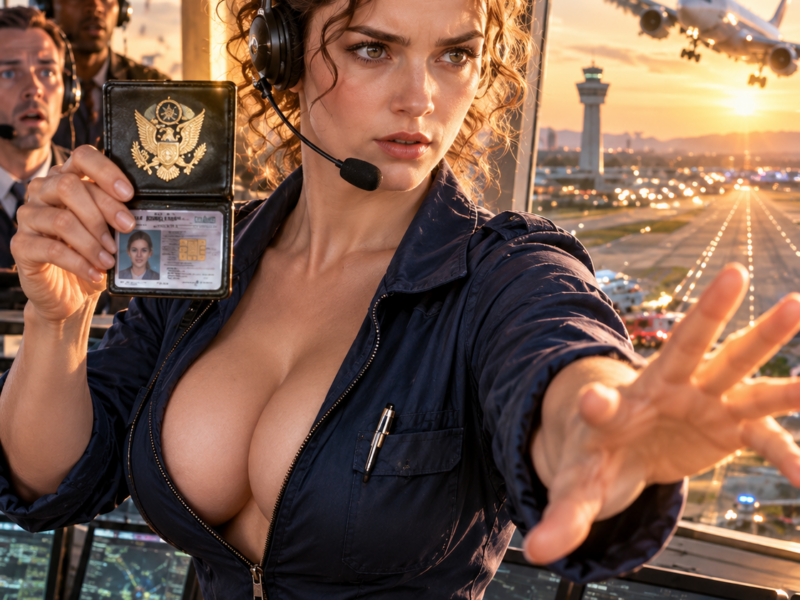
“At 2:17 a.m., I crawled out from beneath a military transport aircraft, wiped hydraulic fluid from my hands, and told the pilot he couldn’t take off
The aircraft was already moving toward the runway when I heard Colonel Harris’s warning.
For a moment, I couldn’t move.
The person who had approved the aircraft’s departure was in the control tower.
I looked through the window at the transport plane.
Its navigation lights blinked against the darkness as it approached the runway threshold.
Forty-two people were aboard.
Forty-two people who had no idea that someone might have knowingly sent them into the air with a compromised aircraft.
“Colonel, I need you to tell me exactly who is in that tower.”
“Claire, listen to me. I don’t have time to explain everything over an unsecured line.”
“Then give me a name.”
He hesitated.
“Major Richard Vance.”
I recognized the name immediately.
Vance was the deputy operations commander at the base. He had signed several readiness certifications during the months surrounding Daniel’s death.
He had also been one of the officers who refused to meet with me when I requested access to my brother’s investigation records.
“Are you telling me he’s responsible?”
“I’m telling you he has information you don’t have. And I have reason to believe he knows you’re there.”
I looked toward Frank Dawson.
He was watching me carefully.
“Colonel, the aircraft is moving.”
“I know. I’ve already contacted the base commander. But I need you to do something for me.”
“What?”
“Get the aircraft stopped without confronting Vance directly. Don’t let him know we’ve identified him.”
The line went dead.
I lowered the phone.
Frank stepped closer.
“What did Harris say?”
“Major Vance is in the tower.”
Frank closed his eyes.
For a moment, he looked older than I had ever seen him.
“Then it’s worse than I thought.”
“What do you know about him?”
Frank looked toward the hangar doors.
“Enough to know you shouldn’t be standing here alone.”
Before I could ask another question, my radio crackled again.
“Aircraft 684, cleared for departure. Wind conditions favorable. Runway two-seven.”
I grabbed the radio.
“Control tower, this is maintenance. Aircraft 684 has an unresolved safety discrepancy. I am requesting an immediate hold.”
A male voice responded.
“Maintenance, your discrepancy has been reviewed and accepted by the aircraft commander. Maintain radio discipline.”
It was Vance.
I knew his voice from the recordings attached to Daniel’s investigation.
“Major Vance, this is Claire Bennett. I am the mechanic who inspected the left engine. The aircraft is not safe for departure.”
There was a brief pause.
Then he answered.
“Ms. Bennett, your job is to document maintenance concerns. You do not have authority to interfere with flight operations.”
“I have documented the concern.”
“Then stand down.”
I looked at the clock.
2:49 a.m.
The aircraft had reached the runway.
Frank grabbed my arm.
“Claire, don’t.”
I pulled away gently.
“Forty-two people.”
“I know.”
“No, Frank. You don’t understand. My brother was on an aircraft with the same maintenance signature.”
His face changed.
I returned to the radio.
“Aircraft 684, this is maintenance. Abort departure. Repeat, abort departure.”
For several seconds, there was nothing.
Then Captain Mitchell’s voice came through.
“Maintenance, we have been cleared for takeoff. We are proceeding.”
I stepped toward the desk.
“Captain, I am formally declaring an immediate safety hold based on an unresolved hydraulic system defect.”
Vance interrupted.
“That instruction is unauthorized. Aircraft 684, continue.”
The aircraft began its takeoff roll.
I stared at the monitor showing its position.
The engines grew louder.
The nose lifted slightly.
Then, suddenly, the aircraft slowed.
A sharp voice came through the radio.
“Tower, this is aircraft 684. We have an abnormal hydraulic pressure indication.”
My fingers tightened around the radio.
Mitchell continued.
“Requesting permission to abort.”
Vance answered immediately.
“Negative. Continue departure. The indication is consistent with the previously reported minor fluctuation.”
I looked at Frank.
He was already reaching for the emergency maintenance telephone.
“That’s not a minor fluctuation,” I whispered.
The aircraft accelerated again.
Then Porter spoke.
“Captain, the pressure is dropping.”
Mitchell answered.
“I see it.”
Another voice interrupted.
“Aircraft 684, tower. Continue departure.”
I grabbed the radio.
“Captain Mitchell, listen to me. Your left hydraulic assembly has a compromised locking mechanism. If the pressure line ruptures, you may lose control assistance during flight.”
The radio went quiet.
Then Mitchell answered.
“Who is this?”
“Claire Bennett. I inspected your aircraft.”
“You said there was a possibility of cascading failure.”
“Yes.”
“How serious?”
I looked at the pressure readings.
“Serious enough that I would not take that aircraft off the ground.”
There was a long pause.
Then Porter spoke.
“Captain, I’m seeing another pressure drop.”
Mitchell made his decision.
“Tower, aircraft 684 aborting takeoff.”
Vance’s voice came back.
“Captain, you are ordered to continue.”
Mitchell didn’t hesitate.
“I said we’re aborting.”
The aircraft decelerated.
Its tires screamed against the runway.
A moment later, the transport plane came to a complete stop.
Nobody in the maintenance office spoke.
I watched the position marker stop moving.
Then the radio crackled.
“Tower, aircraft 684. We are stopping on the runway and requesting emergency ground assistance.”
I released a breath I hadn’t realized I was holding.
Forty-two people were still alive.
But the danger wasn’t over.
The control tower went silent.
Frank looked at me.
“Vance knows.”
I nodded.
And I knew something else.
He had just tried to send an aircraft into the air after being warned that its hydraulic system might fail.
That was no longer a maintenance disagreement.
It was evidence.
Within minutes, emergency vehicles surrounded aircraft 684.
The passengers were evacuated.
The crew remained near the aircraft while ground technicians began a preliminary inspection.
Captain Mitchell approached me shortly afterward.
He had removed his flight jacket and was carrying his helmet.
“You’re Bennett?”
“Yes, sir.”
He looked toward the aircraft.
“Show me what you found.”
I led him to the left engine.
Porter followed.
Under the inspection lights, the damaged fitting looked worse than it had earlier.
A fresh line of hydraulic fluid had appeared beneath the connection.
Mitchell crouched.
“How did this pass inspection?”
“That’s what I’m trying to determine.”
He studied the mismatched seal.
Then he looked at me.
“How did you know?”
I hesitated.
“Because I’ve seen the same authorization code on another aircraft.”
“Which one?”
I looked down.
“My brother’s.”
Mitchell’s expression softened.
“Your brother was the flight engineer?”
“Daniel Bennett.”
He took a breath.
“I remember that accident.”
I nodded.
“Then you understand why I couldn’t let this aircraft leave.”
He looked toward the runway.
“Yes. I do.”
A vehicle pulled up near the hangar.
Two military police officers stepped out, followed by a senior captain carrying a document folder.
They approached Frank.
“Mr. Dawson, we’re looking for Claire Bennett.”
I stepped forward.
“I’m here.”
The captain studied my identification badge.
“You’re requested at the operations building.”
“By whom?”
“Major Vance.”
I glanced at Frank.
He shook his head almost imperceptibly.
“Tell Major Vance I’ll speak with the base commander or an investigating officer.”
The captain looked uncomfortable.
“Ma’am, he specifically requested that you come alone.”
“Then the answer is no.”
One of the military police officers shifted his stance.
The captain lowered his voice.
“Ms. Bennett, this is not a request I can simply disregard.”
Before I could answer, another vehicle arrived.
Colonel Harris stepped out.
He was wearing his uniform and carrying a thick black folder.
“That’s enough, Captain.”
The younger officer turned.
“Colonel.”
Harris approached me.
“Claire, are you hurt?”
“No, sir.”
“Good. You’re coming with me.”
He looked toward the military police.
“She is a protected witness in an active safety investigation. Nobody interviews her without authorization from the investigating officer.”
The captain stepped back.
“Understood, sir.”
Harris turned toward the aircraft.
“How many people?”
“Forty-two passengers. Six crew members.”
He nodded.
“All accounted for?”
“Yes.”
He closed his eyes briefly.
“Good.”
Then he looked at me.
“Now we need to talk about Daniel.”
I followed him into a secure conference room.
Frank came with us.
Harris locked the door and placed his folder on the table.
For several seconds, he didn’t speak.
Then he removed a photograph.
It showed Daniel standing beside a transport aircraft, smiling at the camera.
He was wearing his flight suit and holding a coffee cup.
I knew the photograph.
I had taken it during a family visit to the base.
Harris placed another document beside it.
“This is the original maintenance discrepancy report from Daniel’s aircraft.”
I leaned forward.
It was dated two days before the crash.
The report described an intermittent hydraulic pressure warning and an unexplained vibration in the left engine.
I read it twice.
“Why haven’t I seen this?”
“Because it was removed from the official investigation package.”
My eyes moved to the signature at the bottom.
Major Richard Vance.
I felt my throat tighten.
“He approved the aircraft?”
“According to this document, yes.”
Frank pulled out a chair.
“There’s more.”
He reached into his jacket and removed a small envelope.
“I’ve kept this since the accident.”
I looked at him.
“What’s inside?”
“A copy of a maintenance request Daniel sent me.”
I opened the envelope.
The paper was folded into quarters.
Daniel’s handwriting was unmistakable.
He had written:
Hydraulic pressure instability persists despite reported repair. Replacement seal does not match original inventory. Requesting independent inspection before next flight.
I read the words again.
At the bottom was a handwritten note.
If this gets buried, ask Frank.
I looked up.
“Daniel sent this to you?”
Frank nodded.
“He called me the night before the accident. He said he didn’t trust the maintenance report.”
“Why didn’t you tell me?”
His eyes filled.
“Because I was afraid.”
I stared at him.
“Afraid of what?”
“Vance had already warned me to stay out of it. He said the issue had been reviewed and that further complaints would damage the unit.”
Frank rubbed his forehead.
“I had a mortgage, two kids in college, and twenty years of service. I convinced myself that somebody above me knew what they were doing.”
His voice broke.
“Then Daniel died.”
I looked back at the note.
My brother had tried to warn someone.
He had tried to make sure the next crew wouldn’t face the same problem.
And nobody had listened.
I folded the paper carefully.
“Who else knew?”
Harris opened the black folder.
“An independent technical specialist reviewed the original engine data after the accident. Her findings indicated that the hydraulic failure was consistent with the defect you identified tonight.”
“Who was she?”
“Dr. Elaine Foster. She was employed by a civilian aviation contractor.”
“Was her report included?”
“No.”
“Why?”
“She withdrew it after receiving threats.”
Frank looked up.
“Threats?”
Harris nodded.
“She reported that someone had accessed her office and removed the original diagnostic samples. Shortly afterward, her contract was terminated.”
I stared at the table.
The same pattern.
The same missing reports.
The same quiet pressure.
I turned toward Harris.
“Where is she now?”
“We’re trying to locate her.”
“Then find her.”
“We will.”
“No, sir. You don’t understand. She may be the only person who can explain what happened to Daniel’s aircraft.”
Harris looked at me.
“That’s why I came here.”
He pushed another document across the table.
It contained a photograph of Major Vance entering the control tower earlier that night.
Beside it was a copy of the flight authorization.
“Vance approved aircraft 684’s departure despite the unresolved discrepancy. We have the radio recordings.”
I looked at the time stamp.
2:42 a.m.
Then at the authorization signature.
2:43 a.m.
“He knew.”
Harris nodded.
“At minimum, he knew the maintenance issue had been raised. We need to establish what else he knew.”
I leaned back.
“What happens now?”
“Vance has been removed from operational control pending investigation. His access credentials are suspended. The aircraft is grounded.”
“And the previous incidents?”
“We’re reopening the investigation into Daniel’s accident.”
For the first time in eight months, I felt that someone was actually willing to look.
Not at the convenient explanation.
Not at the final report.
At the evidence.
But I wasn’t ready to celebrate.
Because I had learned something important that night.
A person who had spent months hiding evidence didn’t usually stop because someone finally asked the right question.
Sometimes they simply found another way to make the evidence disappear.
The next morning, the investigation team began securing records.
The hangar was sealed.
Aircraft 684 was moved to a restricted maintenance area.
Every technician who had worked on the aircraft was interviewed.
And Major Vance was escorted from the operations building by military police.
I watched from the corridor as he walked past.
He was carrying a briefcase.
His face was calm.
Too calm.
When he saw me, he stopped.
“Ms. Bennett.”
I didn’t answer.
He looked at my maintenance coveralls.
“Still playing mechanic?”
I stepped toward him.
“I’m still trying to find out why two aircraft were cleared to fly with the same defect.”
His expression barely changed.
“You should be careful about making accusations you can’t support.”
“I have the maintenance records.”
“Records can be misunderstood.”
“And radio recordings?”
His jaw tightened.
He leaned closer.
“Your brother made a mistake, Claire.”
The words struck harder than I expected.
I kept my voice low.
“Don’t say his name.”
“He was a good man, but he didn’t understand the pressure involved in maintaining operational readiness.”
I stared at him.
“You’re blaming him?”
“I’m explaining the circumstances.”
“No. You’re explaining why you thought nobody would question you.”
His eyes hardened.
“You have no idea how the military works.”
“Maybe not the way you do.”
I stepped aside.
“But I know how an aircraft sounds when something is wrong. And I know what happens when people decide paperwork matters more than the people inside it.”
The military police officer touched his arm.
“Major, we need to go.”
Vance walked away without another word.
I watched until he disappeared around the corner.
Then I went back to work.
The investigation took four months.
Four months of interviews, technical examinations, document comparisons, and forensic analysis.
The deeper the team looked, the more disturbing the evidence became.
The contractor responsible for the unauthorized firmware configuration had been using a modified testing system that generated misleading diagnostic readings.
Several components had been transferred between aircraft without proper documentation.
Maintenance discrepancies were routinely downgraded to avoid delaying scheduled departures.
And Vance had repeatedly approved readiness certifications despite receiving warnings from technicians.
But the most important evidence came from Dr. Elaine Foster.
Investigators eventually located her in Colorado.
She had been working as an independent aviation consultant under a different contract.
At first, she refused to speak.
Then Harris sent her the photographs from aircraft 684.
She recognized the damaged assembly immediately.
She agreed to meet us.
I flew to Denver with two investigators.
When she entered the conference room, she looked at me for a long moment.
“You’re Daniel’s sister.”
“Yes.”
She sat down.
“I’m sorry.”
I nodded.
“I need to know what you found.”
She opened her laptop.
“After your brother’s accident, I was asked to examine the original engine data. The results suggested a progressive failure in the hydraulic pressure regulation system.”
She displayed a series of diagnostic readings.
“The problem wasn’t a sudden malfunction. It had been developing over several flights.”
I leaned closer.
“Could the crew have detected it?”
“Yes. The pressure fluctuations were intermittent, but the trend was visible.”
She opened another file.
“This is the report I submitted.”
I read the first page.
It contained the same warnings Daniel had written in his maintenance request.
“Why wasn’t this included in the final investigation?”
Elaine looked down.
“Because I was told the data was unreliable.”
“Was it?”
“No.”
She turned the laptop toward me.
“I kept a backup of the original diagnostic files. The official report used a later data set that had been altered.”
One of the investigators leaned forward.
“Can you establish when the alteration occurred?”
Elaine nodded.
“I retained the original file metadata and the transfer logs.”
She clicked another document.
The authorization code appeared on the screen.
The same one.
The same account.
The same signature.
But this time, there was something else.
An internal email.
It had been sent two days after Daniel’s accident.
The sender was Major Vance.
The recipient was a senior executive at the aviation contractor.
The message was short.
The incident report must reflect the approved maintenance status. Further discussion of the diagnostic irregularities should be handled through command channels. No additional copies are to be circulated.
I read it twice.
Then I looked at Elaine.
“Did you receive this?”
“No. It was recovered from the contractor’s archived server.”
“Did they know you kept the original data?”
She shook her head.
“Not until now.”
I sat back.
For months, I had wondered whether Daniel had missed something.
Whether he had misunderstood a reading.
Whether the aircraft had simply suffered a failure nobody could have predicted.
Now I knew.
He had seen the problem.
He had documented it.
He had asked for an independent inspection.
And the people responsible for reviewing his concerns had chosen to bury them.
I pressed my hands together.
“Thank you for keeping the file.”
Elaine’s eyes filled.
“I wish I’d done more.”
I looked at her.
“So do I.”
We sat quietly for a moment.
Then she reached across the table and touched my hand.
“I should have been braver.”
I shook my head.
“Then help us make sure nobody else has to be.”
She nodded.
“I will.”
The final investigative hearing took place six weeks later.
Major Vance was charged through the appropriate military administrative and legal processes with offenses related to the falsification and concealment of safety records.
The contractor faced separate federal scrutiny over the altered diagnostic data and unauthorized maintenance practices.
Several other officers received disciplinary action for approving incomplete reports.
The investigation did not find evidence that Vance had deliberately caused Daniel’s aircraft to crash.
But it did establish that he had knowingly concealed warnings about a dangerous mechanical condition.
That distinction mattered.
Not because it made Daniel’s death easier to accept.
But because the truth deserved to be stated accurately.
I attended every hearing.
I listened to the testimony.
I watched the original maintenance reports appear on the screen.
And when the recording of Daniel’s final maintenance request was played, I heard his voice for the first time in months.
It was calm.
Professional.
Almost casual.
“Hydraulic pressure instability persists. I recommend grounding the aircraft pending independent inspection.”
Then a second voice answered.
Vance.
“Your concerns have been reviewed. The aircraft is cleared for service.”
I closed my eyes.
I knew that voice.
I’d heard it in the tower the night aircraft 684 nearly took off.
The same cold certainty.
The same refusal to listen.
After the hearing, Harris found me outside the building.
“You did well, Claire.”
I looked at him.
“I didn’t save Daniel.”
He was quiet.
“No. You didn’t.”
I appreciated that he didn’t try to soften the truth.
“But you saved forty-eight people last night,” he continued. “And you helped prevent the same failure from happening again.”
I looked across the parking lot.
A group of young airmen were walking toward the maintenance hangar.
“That isn’t enough.”
“It never feels like enough when someone you love is gone.”
I looked down.
Harris continued.
“Daniel’s report changed this investigation. Your work made sure it couldn’t be ignored.”
I nodded.
I didn’t know what to say.
A week later, I visited Emily and my niece, Sophie.
They lived in a small house outside Austin.
Sophie’s drawings were still taped to the refrigerator.
One showed a blue airplane flying over a green field.
Another showed three people holding hands.
Her father was drawn in the middle, wearing a uniform.
Emily opened the door.
“Claire.”
She hugged me tightly.
“Come in.”
Sophie ran from the living room.
“Aunt Claire!”
I knelt and hugged her.
“Hey, sweetheart.”
She held up a piece of paper.
“I made Daddy a new picture.”
I looked at it.
It showed a large airplane with a bright yellow sun above it.
Beneath the wings, Sophie had drawn a little family.
“That’s beautiful.”
She smiled.
“Mommy said Daddy helped people.”
I looked at Emily.
She gave me a small nod.
I swallowed.
“He did, sweetheart.”
Sophie studied the drawing.
“Did you help people too?”
I smiled.
“I tried.”
She thought about that.
Then she handed me the paper.
“You can keep this one.”
I took it carefully.
“Are you sure?”
She nodded.
“I have another one.”
I hugged her again.
For the first time since Daniel died, I felt something loosen inside me.
Not the grief.
That would always be there.
But the weight of wondering whether his last warning had mattered.
It had.
And now his daughter would grow up knowing that her father had done everything he could to protect the people on his aircraft.
The following month, I received an offer from the Air Force safety division.
They wanted me to join a new independent aircraft inspection team.
The position would allow me to work directly with maintenance units and review discrepancies before aircraft were cleared for departure.
It was a difficult decision.
I had spent eight months hiding behind a mechanic’s badge because I needed answers.
But I didn’t want to spend the rest of my life looking backward.
I wanted to make sure the next person who raised a concern was heard before a plane reached the runway.
I accepted.
On my first official day, I walked into a hangar wearing my engineering uniform rather than grease-stained coveralls.
A young mechanic was standing beside an aircraft, holding a maintenance report.
He looked nervous.
“Ma’am?”
I turned.
“Yes?”
“I found something in the hydraulic system. It’s probably nothing, but the readings don’t match the previous inspection.”
I looked at the report.
Then at him.
“Show me.”
He hesitated.
“You’re not going to think I’m wasting your time?”
I shook my head.
“Not when you’re trying to keep an aircraft safe.”
We walked toward the engine together.
As he explained what he had found, I listened carefully.
I didn’t interrupt.
I didn’t tell him to trust the paperwork.
And I certainly didn’t ask him to prove he deserved to speak.
Because I remembered the night aircraft 684 began its takeoff roll.
I remembered forty-eight lives depending on one mechanic’s warning.
And I remembered the brother who had tried to give that same warning before anyone was willing to listen.
Daniel never came home.
But his final report did.
And every time an aircraft was grounded because someone had the courage to question a maintenance signature, a little more of his work continued.
I kept Sophie’s drawing beside my desk.
The blue airplane.
The yellow sun.
The three people holding hands beneath the wings.
Sometimes, when the hangar grew quiet late at night, I looked at it and thought about the difference between being the person who fixes an aircraft and being the person who has the courage to say it should never leave the ground.
I had once believed my job was to make machines fly.
Now I knew it was to make sure the people inside them had a chance to come home.
The end.









