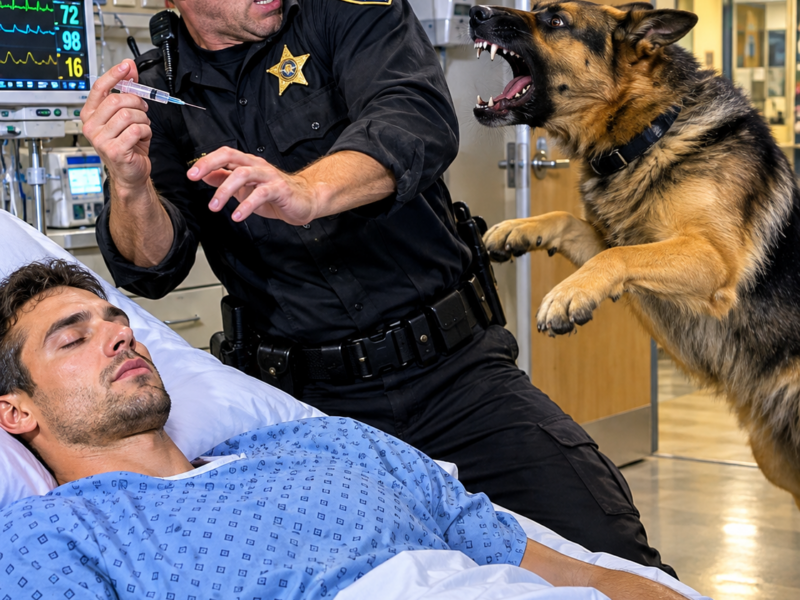
“At 2:17 a.m., a corrupt deputy slipped into my hospital room with a syringe in one hand and his service pistol hidden beneath his jacket
The phone was still glowing in Deputy Cole’s hand when I realized the man who had promised to protect me might be the same man who had ordered my death.
“IF COLE FAILED, ELIMINATE THE DOG FIRST.”
I read the message twice. Not because I didn’t understand it, but because some part of me refused to accept that Lieutenant Raymond Pike had been involved from the beginning.
Pike had served eighteen years in law enforcement. He had a reputation for being calm under pressure, a man who remembered the names of victims and stayed late to help families navigate paperwork. When I woke up in the hospital after taking a bullet in that warehouse, Pike had been the first officer to visit me.
He had stood beside my bed, placed a hand on my shoulder, and told me I was safe.
Now his photograph stared back at me from the screen of a man who had just tried to kill me.
And somewhere beneath the hospital bed, Ranger was growling.
The nurses had frozen near the doorway. Two hospital security officers stood behind them, staring at Cole, who was pinned against the wall with one hand twisted behind his back. The syringe had shattered on the floor. His concealed pistol lay beneath a rolling table.
“Get that phone away from him,” I said.
One of the guards glanced at me. “Sir, you need to stay still.”
“I’ve been shot, drugged, and nearly murdered in a hospital room. I’m done staying still.”
My voice came out weaker than I wanted, but it carried enough authority to make him move.
The guard picked up the phone with a gloved hand. Cole jerked against the other officer.
“You don’t know what you’re looking at,” he snapped. “That message could mean anything.”
“Then explain it,” I said.
He looked at me, and for the first time since entering my room, his confidence faltered.
“Pike said you were dangerous,” he muttered.
“Dangerous enough to need a syringe?”
Cole’s jaw tightened.
Ranger stepped out from beneath the bed. His ears were forward, his body rigid, and his eyes fixed on Cole. The dog didn’t bark. He didn’t need to. Every person in that room understood that if Cole made another sudden move, Ranger would respond.
“Put the dog away,” Cole demanded.
“No,” I said. “You’ve already made it clear what you think of him.”
The hospital security supervisor arrived minutes later with two more officers. Cole was handcuffed, searched, and taken out through the service corridor. Before they moved him, I watched him turn toward me.
“You think you’ve won?” he whispered. “Pike has people everywhere.”
I held his gaze.
“Then he should have chosen better people.”
The door shut behind him.
For several seconds, nobody spoke. The room smelled of antiseptic and broken plastic. My heart monitor kept its steady rhythm, indifferent to the fact that my life had just narrowed to a handful of names on a phone screen.
A nurse approached my bed.
“Mr. Mercer, we need to examine you immediately. Did he inject anything into your IV?”
“No. He was trying to.”
She checked the line, called for another nurse, and ordered the medication bag replaced. A doctor arrived to assess my wound and check my vital signs. The movement tugged at the stitches beneath my ribs, and pain spread across my side like a hot wire.
I gritted my teeth.
“Easy,” the doctor said. “You’ve had a serious injury. If you keep twisting like that, you’re going to make your recovery harder.”
“I understand.”
“No, I don’t think you do. Whoever that man is, the police can deal with him. Your job right now is to stay alive.”
I looked toward Ranger.
“That’s been my job for a while.”
The doctor followed my gaze. Ranger had settled beside the bed, but he remained alert, watching every person who entered the room.
“Your dog can stay for now,” the doctor said. “But we’ll need to coordinate with hospital administration.”
“Thank you.”
When the staff finally left, a security supervisor named Alvarez remained beside the door. He was a broad-shouldered man in his fifties, with tired eyes and a radio clipped to his belt.
“I’ve called the hospital administrator,” he said. “We’ve also secured the corridor and reviewed the access logs. Deputy Cole entered using a staff badge that doesn’t belong to him.”
“Can you tell who issued it?”
“We’re checking.”
“Don’t just check the badge. Preserve the access records, camera footage, and visitor logs. Make copies before anyone has a chance to alter them.”
Alvarez studied me for a moment.
“You’ve done this before.”
“I’ve seen what happens when people assume evidence will still be there tomorrow.”
He nodded slowly.
“I’ll make sure it’s preserved.”
“Who’s assigned to my room?”
“According to the visitor log, Lieutenant Pike.”
“Then he doesn’t come near me.”
Alvarez’s expression changed. He had clearly seen the message on the phone, or heard enough from the guards to understand why I was asking.
“Do you believe he’s involved?”
“I believe a deputy tried to kill me, and his phone contained instructions to eliminate my dog. The sender’s picture was Pike’s. That’s enough to keep him away until someone independent investigates.”
Alvarez picked up his radio and spoke quietly to the security desk. He ordered that Pike be denied access to my room and that no visitor be admitted without direct authorization from the hospital administrator.
For the first time since Cole had entered, I felt the smallest measure of control return.
Then Alvarez looked at me.
“There’s something else you should know. Before Cole arrived, a man came to the nurses’ station asking whether your condition had changed. He said he was a police supervisor. He left when the nurse asked for identification.”
“What did he look like?”
“Tall. Gray hair. Dark jacket.”
Pike.
“Did the cameras capture him?”
“We’re checking that too.”
“Good. Don’t confront him. Don’t send anyone to find him. If he’s involved, we don’t want him to know exactly what we have.”
Alvarez nodded and stepped into the hallway to make another call.
I reached down and placed my hand on Ranger’s neck. His fur was warm beneath my fingers. He leaned into my touch, but his eyes remained on the door.
“Good work, buddy,” I whispered.
His tail moved once against the floor.
Three nights earlier, I had believed the danger was confined to an abandoned warehouse outside Savannah. I had thought that once I identified the men responsible and handed over the evidence, the truth would take care of itself.
I had been wrong.
The warehouse had only been the beginning.
My name is Jack Mercer. I spent years in the Navy as a SEAL, learning to recognize the difference between a dangerous situation and a situation that only looked dangerous. The first could be survived with discipline and preparation. The second was often worse because people underestimated it.
I had underestimated Raymond Pike.
I had also underestimated how much he stood to lose.
The warehouse had been full of stolen cash, sealed evidence bags, and boxes marked with case numbers. I had been passing through the area after meeting a former service friend when I noticed an unmarked truck parked behind the building. The side door was open. Two men were carrying heavy bags inside while a third watched the road.
At first, I thought it was an ordinary robbery in progress. Then I saw a sheriff’s vehicle parked near the loading entrance.
The deputy beside it was Travis Cole.
I recognized him from a local news report about a drug seizure. He had been standing beside Pike in the photograph, smiling as they posed in front of a table covered with confiscated weapons.
I should have kept my distance and called for assistance.
Instead, I moved closer to get a clear view of the license plate and the markings on the evidence bags. I saw case numbers that I recognized from reports about unsolved robberies. One bag carried a label from a case that had supposedly been closed months earlier.
Then Cole noticed me.
He drew his weapon.
The first shot struck my side. The second hit the metal frame behind me. I remember falling, the taste of blood, and the sound of someone shouting that I had seen too much.
I remember another voice answering, “Make sure he doesn’t leave here alive.”
I never saw who fired that second shot.
I woke up in the hospital with Ranger lying near my bed and Pike telling me I was safe.
Now I understood that every hour I had spent unconscious had given him time to plan.
The next morning, a woman named Special Agent Elena Brooks arrived at the hospital with a federal identification card and a folder tucked beneath her arm. Alvarez checked her credentials before allowing her into my room. She came alone and left the door open.
“I’m investigating corruption involving seized evidence and missing funds,” she said. “Your name came up in connection with an incident at a warehouse three nights ago.”
“Then you know why I’m here.”
“I know you were shot. I know Deputy Cole was arrested inside this hospital. And I know Lieutenant Pike’s name has appeared in records connected to several cases under review.”
“Do you know about the messages on Cole’s phone?”
“We do now. The hospital security supervisor contacted us after the phone was secured.”
She set a small recorder on the table but didn’t switch it on.
“Before we discuss the details, I need to make something clear. We’re not asking you to investigate this yourself. You’re a witness and a victim. Your safety and the preservation of evidence are our priorities.”
“That’s good, because I’m not in any condition to chase anyone.”
Her gaze moved briefly to Ranger.
“Your dog seems to disagree.”
“Ranger doesn’t understand the concept of taking a day off.”
For the first time, she smiled.
Then her expression became serious again.
“Did you personally see Pike at the warehouse?”
“No. I saw Cole and two unidentified men. I heard one of them say I shouldn’t leave alive. Pike’s name came from the records and the messages.”
“Did you see any documents, labels, or other details that could identify the evidence?”
“I remember several case numbers. I also remember a blue ledger on a folding table near the loading door. Cole looked at it before he ordered the men to move the bags.”
“Could you identify the case numbers if we showed you a list?”
“Possibly.”
Brooks made a note.
“We recovered the phone from Cole. The messages are being preserved for forensic examination. We’ll also obtain the hospital’s access logs and surveillance footage through the proper channels. Until we know more, we’re treating the threat as credible.”
“Where’s Pike now?”
“We haven’t contacted him.”
“Good. If he knows Cole is in custody, he may try to destroy whatever connects him to the warehouse.”
“That’s one of the possibilities we’re considering.”
I watched her carefully. She was composed, but not careless. She asked direct questions, and when she didn’t know something, she said so.
It was the first conversation I’d had since waking up in which I didn’t feel someone was trying to steer me toward a convenient answer.
Before she left, I asked her one question.
“Can you protect Ranger?”
Brooks looked at the dog, who was resting his chin on his paws but still watching us.
“We’ll make arrangements for both of you. And we won’t put him in danger to make this case easier.”
“That’s all I needed to hear.”
She stood.
“Mr. Mercer, the messages suggest Pike may have been giving orders, but we need to establish what happened and who else was involved. Don’t contact him. Don’t respond to anyone who claims to be helping you unless we verify their identity.”
“I won’t.”
“And if anyone tries to reach you through the hospital?”
“I’ll tell Alvarez.”
Brooks nodded and left.
For the rest of the morning, I did what the doctors told me. I rested, took medication, and tried not to think about the fact that someone had been willing to walk into a hospital to silence me.
Ranger stayed close.
At noon, Alvarez returned with a sealed evidence bag containing a printed copy of the hospital access report. He didn’t hand it to me; instead, he showed it to Agent Brooks, who had come back with another investigator.
The record showed that Cole’s temporary badge had been activated shortly before he entered my corridor. It had been issued using credentials belonging to a hospital contractor. The contractor denied requesting it and said his password had been reset the previous evening.
The camera footage showed Cole entering through a staff door wearing surgical scrubs. A second camera captured a man in a dark jacket leaving the hospital through the parking garage less than ten minutes before Cole entered.
The image was grainy, but the man’s height and build matched Pike.
Brooks studied the screen without speaking.
“Can you enhance the image?” she asked.
“We’re working on it,” Alvarez said.
“Keep the original footage untouched. Make a verified copy and document everyone who handles it.”
She turned to me.
“This is useful, but it doesn’t prove the man in the footage is Pike.”
“I know.”
“We’re not going to pretend otherwise.”
That answer mattered more than she probably realized.
A few hours later, I was moved to a room closer to the nurses’ station. The hospital said it was for monitoring, but I understood the real reason. My old room had too many entrances and too many people who could reach it without passing a staffed desk.
Two security officers were posted outside. Alvarez arranged a code word with the nurses so no one could obtain my medical details by pretending to be a family member or colleague.
Ranger came with me.
The hospital administrator approved his presence under strict supervision, and the staff placed his bed beside mine. He was not a weapon or a security system. He was a trained dog who knew my routines, recognized my distress, and responded to threats with an instinct I trusted.
That night, I slept for almost four hours without waking.
The following morning, Agent Brooks returned with news.
“Cole has agreed to speak with us.”
“About Pike?”
“About the warehouse, the stolen evidence, and the messages. He’s requesting legal counsel, and we’ll respect that. We’re not relying on a confession alone.”
“Good.”
“He says Pike coordinated the operation through a network of deputies and private contractors. He also claims the warehouse was being used to store evidence removed from several investigations before it could be logged into the official system.”
I felt the muscles in my jaw tighten.
“So they weren’t just stealing money.”
“No. If Cole is telling the truth, they were controlling which evidence survived and which cases could be solved.”
That explained the old case numbers I had seen on the bags. It explained why the operation had seemed so organized, and why Pike had been so eager to assure me that I was safe.
“What about the men with Cole?”
“We’ve identified one of them as a former evidence technician. The other is a contractor who worked on secure storage facilities for local agencies. We’re tracing their financial records and communications.”
“Do they have enough to arrest Pike?”
“Not yet. We need evidence that can stand up in court.”
I looked at Ranger. He was asleep, one ear twitching whenever a cart rattled down the corridor.
“Then don’t rush it,” I said. “If you move too early, the people who are still free will have time to destroy what remains.”
Brooks closed the folder.
“That’s exactly why we’re proceeding carefully.”
She paused at the door.
“There’s one more thing. We found an encrypted backup on Cole’s phone. The technical team is working on it. It may contain communications with Pike, but we don’t know what’s inside yet.”
I didn’t ask her to show me. I had no authority to access it, and I wasn’t about to compromise an investigation because I wanted answers faster.
Instead, I asked, “What happens if Pike tries to leave?”
“We’ve notified the appropriate authorities and are monitoring the situation. We’ll act when we have the legal basis.”
She left me with that answer.
It wasn’t certainty. It was a plan.
By the afternoon, the hospital corridor had become quieter. The officers changed shifts, nurses checked my wound, and the doctors discussed when I might be able to move without reopening the injury. I was frustrated by how slowly my body recovered, but I understood that a damaged body could not be bullied into healing.
Ranger seemed to understand it better than I did.
Whenever I tried to sit up too quickly, he lifted his head and watched me until I settled back against the pillows.
“Don’t start,” I told him.
He blinked.
“I’m supposed to be the one giving orders.”
His tail thumped once.
For the first time since the shooting, I laughed.
The moment didn’t last long.
At 4:30 p.m., Agent Brooks called Alvarez from the secure area outside the ward. She returned to my room with a second agent, and I knew from their expressions that something had changed.
“We’ve recovered the backup,” she said. “There are messages between Cole and Pike, along with financial records and photographs of evidence bags.”
“Anything that ties Pike to the hospital?”
“Several messages refer to your condition. One was sent after Cole entered the building. Another was sent after he was arrested.”
“What did it say?”
Brooks glanced at her colleague, then back at me.
“Pike asked whether the dog had been dealt with.”
Ranger raised his head as if he recognized the subject of the conversation.
I felt a cold anger settle inside me.
“Did Cole answer?”
“He told Pike the attempt had failed. He also said the hospital security team had intervened.”
“And Pike?”
“He replied that Cole should stop contacting him and wait for further instructions.”
That was the first moment I believed Pike might actually be afraid.
Brooks continued. “The records also show transfers from an account controlled by a private security company to accounts connected to Cole and two other deputies. We’re coordinating with prosecutors now.”
“Can you arrest him?”
“We have enough to seek a warrant. We’re moving on it.”
She left to make another call.
I stared at the wall for a long time. I had spent years believing that corruption was usually obvious: a bad decision, a careless lie, a person who couldn’t resist greed. But Pike had hidden behind the ordinary rituals of public service. He had shaken hands, attended briefings, spoken at community meetings, and stood beside grieving families.
He had used the trust people placed in his uniform as cover.
That was what made him dangerous.
At 6:12 p.m., Alvarez received a call from the hospital’s front desk. He listened without interrupting, then turned to the officers guarding my room.
“Lock down this corridor,” he ordered. “No one comes through without authorization.”
He ended the call and looked at me.
“Lieutenant Pike is downstairs.”
My heart began to beat faster.
“Alone?”
“He says he’s here to provide an update on the investigation.”
“Did you tell him I was moved?”
“No.”
“Then he doesn’t know which room I’m in.”
“Not from us.”
Alvarez spoke into his radio. The officers took positions at the corridor entrance. A nurse closed the door, and the administrator instructed staff to use the alternate hallway.
I forced myself to breathe slowly.
“Don’t let him know we’re prepared for him,” I said.
Alvarez gave me a hard look.
“We’re not going to engage him unless there’s a reason. Agent Brooks is on her way.”
Through the partly open door, I heard footsteps approaching the nurses’ station. A familiar voice spoke with the calm authority I remembered from my first day in the hospital.
“I’m Lieutenant Pike. I’m assigned to this patient.”
A receptionist answered, “I’m sorry, sir. Your access has been restricted pending verification.”
“Restricted by whom?”
“The hospital administrator.”
“I need to speak with him.”
“Please wait here.”
The pause that followed was brief, but I could imagine Pike calculating his options. He had spent years using authority to make people move out of his way. Now someone was telling him no.
His voice hardened.
“This is a law enforcement matter.”
“And this is a hospital,” the receptionist replied. “You’ll need to wait.”
Footsteps moved away from the desk.
Then the radio on Alvarez’s shoulder crackled.
“Subject is walking toward the east exit. Do we stop him?”
Alvarez looked at me, then answered.
“Maintain observation. Do not detain him without the agents’ direction.”
For one awful second, I thought Pike would escape again.
Then another voice came over the radio.
“Federal agents are at the entrance. They’re approaching him now.”
The corridor went silent.
I couldn’t see the lobby from my room. I heard only fragments over the radio: instructions, a request for identification, the scrape of shoes against the floor.
Then Agent Brooks’s voice came through clearly.
“Raymond Pike, we have a federal arrest warrant. Turn around and place your hands where we can see them.”
No one spoke for several seconds.
Pike’s reply was quiet enough that I almost missed it.
“You have no idea what you’re doing.”
“We’ll discuss that after you’re secured.”
A moment later, the radio confirmed that he was in custody.
I closed my eyes.
The relief that followed wasn’t triumphant. It was heavy, almost painful. I had wanted Pike stopped, but hearing the words made me understand how close I had come to never learning the truth.
Ranger rose from his bed and rested his head against my arm.
“I’m still here,” I whispered.
His breathing slowed, and mine followed.
The arrest did not end the investigation. Over the next several weeks, agents searched Pike’s office and a storage unit linked to the private security contractor. They recovered financial records, duplicate evidence labels, and documents showing that property had been removed from official custody without authorization.
The blue ledger from the warehouse was found in a locked cabinet at the storage unit. It listed case numbers, dates, and payments. Investigators compared those entries with bank records and evidence logs. Several cases that had stalled for months suddenly had a clear explanation: crucial evidence had been diverted, altered, or hidden before prosecutors could review it.
The evidence also connected Pike to the attempt on my life. Messages recovered from the encrypted backup showed that he had learned I was alive and had directed Cole to ensure I could not testify. His instructions about Ranger were included in the same conversation.
Cole’s statement helped investigators identify the other men at the warehouse, but it was the records, surveillance footage, and financial trail that built the case.
The contractor was arrested after agents found him trying to destroy a set of storage drives. The former evidence technician cooperated with investigators after learning that the ledger and payment records had been recovered. Two additional deputies were placed on leave and later charged in connection with the scheme.
Pike pleaded not guilty.
His attorney argued that the messages had been taken out of context and that the financial transfers were legitimate payments. But the prosecution had more than messages. It had access records, recovered evidence, bank transfers, witness testimony, and records linking Pike to the warehouse operation.
I gave my statement when doctors said I could travel safely. I described what I had seen at the warehouse, the shots, the words spoken as I fell, and the attempt on my life in the hospital. I was careful to separate what I remembered from what I had learned afterward.
I could not identify the person who fired the second shot. I said so.
I could not claim to have seen Pike at the warehouse. I said that too.
The truth did not need embellishment. The evidence was strong enough without it.
Months later, Pike and Cole faced trial. Cole accepted a plea agreement and testified about the operation. Pike was convicted on federal charges connected to the conspiracy, obstruction, and the attempt to silence me. The court would determine the final sentence after reviewing the full record and the impact on the victims whose cases had been compromised.
When I heard the verdict, I sat in the back of the courtroom with Ranger beside my chair. My wound had healed enough for me to walk without assistance, though a long day still left a deep ache beneath my ribs.
Pike stood motionless as the verdict was read. He didn’t look toward me.
I had imagined that moment many times during my recovery. In those imagined scenes, I was angry or satisfied, ready with something sharp to say.
In reality, I felt tired.
Justice had arrived, but it could not return the years lost by the people whose cases had been corrupted. It could not erase the fear of the families who had been told that evidence was missing or that a case could not move forward. It could not give me back the nights I had spent waking at every sound in the hallway.
What it could do was establish the truth in a place where lies had once been protected by a badge.
After the hearing, Agent Brooks met me outside the courthouse.
“You did the right thing,” she said.
“I got shot for noticing something I wasn’t supposed to see.”
“You still told the truth when it mattered. That counts.”
I looked down at Ranger. He was watching a group of people cross the pavement, calm and alert.
“I couldn’t have done it without him.”
Brooks smiled.
“I know. The hospital staff still talk about the dog who refused to leave your side.”
“He’s going to become impossible to live with.”
“He already sounds pretty confident.”
That made me laugh.
Before we parted, Brooks told me that the recovered evidence had allowed investigators to reopen several cases. Some families were receiving answers for the first time. Others were learning that the people they had trusted had deliberately withheld information from them.
The work would continue long after the headlines faded.
I understood that.
For a while, I stayed in Savannah and focused on getting my strength back. I attended follow-up appointments, worked with a physical therapist, and gradually returned to the ordinary routines I had taken for granted. Ranger went everywhere he was allowed and waited patiently whenever I needed to stop and rest.
At night, I sometimes woke convinced I could hear Cole’s shoes on the hospital floor. My hand would move toward the empty space beside the bed before I remembered that I was home.
Then Ranger would lift his head.
I would put my hand on his neck, feel the steady warmth of him, and remind myself that the danger had passed.
It took longer to believe that than I expected.
One morning, several months after the trial, I received a letter from a woman whose brother’s case had been among those affected by the evidence scheme. She wrote that the investigation had finally revealed why the original case had fallen apart. She didn’t ask me to fix anything. She simply thanked me for speaking up when it would have been easier to stay quiet.
I read the letter twice and placed it in a drawer beside my service records.
Then I took Ranger outside.
The air was cool, the sky bright, and the street looked ordinary in the way streets often do after terrible things have happened. People walked to work carrying coffee. A delivery truck stopped at the corner. Somewhere nearby, a child laughed.
Ranger moved beside me, his leash loose in my hand.
I had spent years believing courage meant moving toward danger without hesitation. My time in the Navy had taught me how to act under pressure, how to trust training, and how to keep going when fear threatened to take over.
But this experience had taught me something different.
Sometimes courage meant admitting that you had been deceived. Sometimes it meant asking for help instead of trying to control everything yourself. And sometimes it meant allowing other people to do their jobs while you focused on surviving long enough to tell the truth.
I stopped at the end of the block and looked down at Ranger.
“You know,” I told him, “I owe you a lot.”
He looked up at me, then nudged my hand with his nose.
“I know. You’re not going to let me forget it.”
His tail wagged.
For the first time in months, I felt no need to look over my shoulder.
Raymond Pike had believed his badge made him untouchable. Travis Cole had believed a wounded man in a hospital bed was helpless. Both had mistaken silence for weakness, and both had underestimated the consequences of the truth coming to light.
I was still alive. Ranger was still beside me. The evidence had survived, and the people who had tried to bury it had been forced to answer for what they had done.
That was enough.
I continued down the street with Ranger at my side, no longer measuring every shadow for danger, no longer waiting for the next message to appear on a phone screen.
The fight had ended, and this time, there was no one left in the darkness telling me otherwise.
The end.









