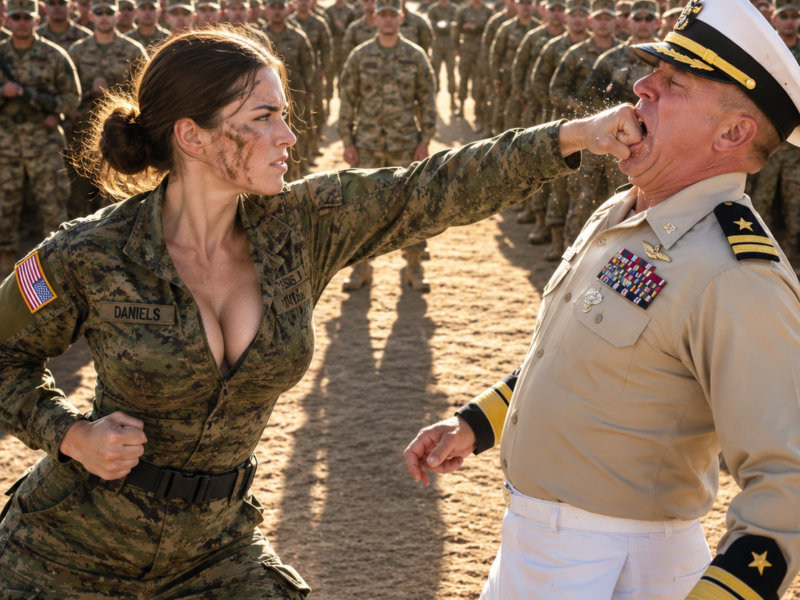
“An admiral punched me in front of a thousand service members because I refused to apologize for exposing his secret
The admiral knows you have the second file.
I read the message again, hoping the words would somehow change.
They didn’t.
Captain Lewis locked his office door.
“Show me.”
I handed him my phone.
He studied the message, then looked at the photograph of Daniel Price.
“Who else knows about this second file?”
“Until ten seconds ago, I thought nobody.”
“That’s not an answer.”
“Daniel told me he had two copies of the evidence. One was supposed to be delivered to an investigator. The other was insurance.”
“Insurance against what?”
“Against someone making the first copy disappear.”
Lewis walked to the window and checked the parking lot.
“Where is it?”
“I don’t know.”
He turned.
“You’re telling me you don’t know where the file is?”
“Daniel never gave me a location. He said if anything happened to him, I’d receive instructions from someone he trusted.”
“And did you?”
I nodded.
“Three weeks ago, I received a package at my apartment. No return address. Inside was a photograph of Daniel, a key, and a note telling me not to open anything until I found out who had altered the incident report.”
“Do you have the package?”
“The key and note are in my locker. The photograph is at home.”
Lewis stared at me.
“You’ve been sitting on evidence connected to a dead officer, a potentially falsified report, and a four-star admiral?”
“I was trying to establish what was real before accusing anyone.”
“And now?”
I glanced at the message.
“Now someone knows I have it.”
Lewis picked up his desk phone.
“I’m calling the regional legal office. Nobody touches your locker until we have witnesses.”
Before he could dial, the phone rang.
He answered.
“Captain Lewis.”
He listened.
His face hardened.
“Yes, sir. She’s here.”
A pause.
“No, sir. I will not surrender her personal effects without written authorization.”
He hung up.
“What was that?”
“Admiral Whitaker’s chief of staff.”
“What did he want?”
“Your locker key. Your phone. And the encrypted drive.”
I felt a cold weight settle in my stomach.
“They’re trying to take the evidence.”
“They’re trying to control the investigation.”
Lewis opened a drawer and removed a sealed envelope.
“Write down everything you remember about Daniel’s final week. Dates, conversations, names. Leave nothing out.”
I sat down.
For the next forty minutes, I wrote.
I described Daniel’s warnings, the maintenance logs, the unusual equipment failures, and the meeting where he had confronted a senior officer about missing communications components.
I wrote about the night he called me from overseas.
I wrote the exact words he used.
“Someone changed the maintenance authorization,” he had said. “I have the original.”
Then he had lowered his voice.
“If they come asking you to sign anything, don’t.”
Three days later, Daniel was dead.
The official report said he had fallen from a service platform during an inspection.
But Daniel had been assigned to a secured communications facility.
The platform was inside a restricted area.
There had been no reason for him to be there after hours.
And according to the report, the security cameras had been offline.
I finished writing and slid the pages toward Lewis.
He read them without speaking.
Then he looked up.
“Did you ever see the original maintenance authorization?”
“No.”
“Could Daniel have copied it?”
“He said he had.”
Lewis tapped the photograph.
“Then we need to find that second file.”
A knock interrupted us.
A military police lieutenant entered with two officers.
“Captain, I have orders to escort Lieutenant Commander Morgan to the command conference room.”
Lewis stood.
“Whose orders?”
“Admiral Whitaker’s chief of staff.”
“Is there a written directive?”
The lieutenant handed him a document.
Lewis read it.
His expression darkened.
“This says she’s being temporarily restricted from accessing classified systems.”
“That’s correct, sir.”
“It says nothing about escorting her to a conference room.”
The lieutenant hesitated.
“Those are my instructions.”
Lewis looked at me.
“Stay here.”
“Captain—”
“That’s an order.”
He stepped into the hallway and pulled the door shut.
I heard voices.
One of the officers spoke quietly.
Lewis answered more sharply.
Then someone said, “The admiral expects compliance.”
A few seconds later, the door opened.
Lewis returned alone.
“They’re waiting outside.”
“Are you coming?”
“I’ll walk with you.”
We entered the hallway.
Two military police officers stood near the stairwell.
A third man waited beside them in a dark civilian suit.
He introduced himself as Martin Cole, counsel to the admiral.
“Lieutenant Commander Morgan,” he said. “We need to discuss your conduct this morning.”
“I’ll cooperate with a lawful investigation.”
“Good. Then you’ll understand why we’re asking you to surrender your phone and any electronic devices that may contain classified information.”
“My phone contains personal messages and evidence relevant to an ongoing matter.”
“That’s precisely why we need it.”
“Then I want independent legal counsel present.”
Cole’s smile disappeared.
“Your refusal will be noted.”
“Please note it accurately.”
He glanced at the military police.
“Escort her.”
Lewis stepped between us.
“She’s not under arrest.”
“No one said she was.”
“Then she can walk without being physically handled.”
The officers exchanged a look.
Cole finally stepped aside.
We walked to the conference room.
Inside, Admiral Whitaker was waiting.
A medical dressing covered the side of his face.
His right cheek was swollen, and one eye had begun to darken.
He was standing when we entered.
“You look comfortable,” he said to me.
I kept my expression neutral.
“I’m awaiting instructions, sir.”
“You put me on the ground in front of a thousand sailors.”
“You struck me first, sir.”
His jaw tightened.
“You think that gives you permission to attack a superior officer?”
“No, sir. I responded to an imminent second strike.”
“You’re going to regret this.”
Captain Lewis moved beside me.
“Admiral, any discussion of the incident should be conducted through the formal investigative process.”
Whitaker ignored him.
“Your career is finished, Morgan.”
I looked at the dressing on his face.
“Then I suppose the investigation will establish what happened.”
For a moment, he said nothing.
Then he gestured toward a chair.
“Sit.”
I remained standing.
Cole opened a folder.
“We’ve reviewed the preliminary footage. It appears Lieutenant Commander Morgan used unnecessary force.”
“The footage begins after the first punch,” Lewis said.
“Additional recordings are being collected.”
“Then collect all of them.”
Whitaker leaned forward.
“Enough. This is not a courtroom.”
“No, sir,” I said. “It’s a conference room.”
His eyes narrowed.
“You always did have a problem knowing your place.”
I thought about Daniel.
About the messages.
About the report that had turned his death into a line in a file.
“I know my place, Admiral. It’s beside the people who trust me to tell the truth.”
The silence was immediate.
Whitaker looked at Cole.
“End this meeting.”
Cole closed the folder.
“Lieutenant Commander Morgan, you’ll remain restricted from operational duties pending further review.”
“Understood.”
“You’ll also surrender your base access credentials.”
I removed my identification card and placed it on the table.
Whitaker watched me.
“You’re making a mistake.”
I met his eyes.
“No, sir. I think someone made that mistake a long time ago.”
The meeting ended.
Outside, Lewis walked me back to his office.
He shut the door and spoke in a low voice.
“I’m going to tell you something, and I need you to listen.”
“I am.”
“Whitaker has friends in places you haven’t even considered. If Daniel’s evidence points where you think it does, you need to stop trying to handle this alone.”
“I wasn’t planning to.”
“Good. Because I’ve already contacted an independent inspector general investigator.”
I looked at him.
“Who?”
“Rear Admiral Evelyn Brooks.”
I knew the name.
Brooks had spent years investigating procurement fraud and command misconduct. She had a reputation for being difficult to intimidate.
“Will she take the case?”
“She said she’ll meet us tomorrow.”
Lewis opened his desk drawer.
“Until then, don’t access your locker alone. Don’t go to your apartment alone. And don’t respond to unknown messages.”
I nodded.
Then I remembered the key.
“Captain, I need to get my locker.”
“We’ll arrange witnesses.”
We went to the secure storage area with two independent witnesses and a legal representative.
My locker was untouched.
The key from Daniel’s package was inside a small envelope behind my spare uniform.
It was brass, with the number 417 stamped into its surface.
The note was folded around it.
I had read it dozens of times.
But that afternoon, something caught my attention.
The handwriting wasn’t Daniel’s.
It was written in block letters.
IF YOU WANT THE ORIGINAL, FIND THE PLACE WHERE THE SIGNAL NEVER DIES.
Below that was a date.
And a set of coordinates.
I showed Lewis.
He frowned.
“Those coordinates are outside the base.”
“Do you recognize them?”
He studied the numbers.
“Not immediately.”
One of the witnesses photographed the note and logged it as evidence.
Then Lewis called a trusted contact who had worked with Daniel.
The answer came back twenty minutes later.
The coordinates pointed to an abandoned naval communications station near the coast.
The facility had been decommissioned years earlier.
Its equipment was supposedly removed.
But according to the contact, one underground storage room remained sealed.
The key might open it.
“That’s where we’re going,” I said.
Lewis shook his head.
“Not tonight.”
“Why?”
“Because we don’t know who sent the note. And if Whitaker knows about the second file, he may already have someone watching the location.”
I wanted to argue.
Instead, I looked at the message on my phone.
THE ADMIRAL KNOWS YOU HAVE THE SECOND FILE.
Someone was waiting for me to make a mistake.
I wasn’t going to give them one.
The following morning, Rear Admiral Brooks arrived with a small team.
She was shorter than I expected, with silver hair and an expression that suggested she had heard every excuse the Navy could produce.
She listened to my account without interrupting.
Then she watched the parade-ground video.
Twice.
“Did you intend to strike him?” she asked.
“No, ma’am.”
“Did you know how to defend yourself?”
“Yes, ma’am.”
“Did you understand that using force against a flag officer could end your career?”
“Yes.”
“Then why did you do it?”
I considered the question.
“Because he was about to hit me again, and I wasn’t going to let him.”
Brooks studied me.
“That’s not the answer most people give.”
“It’s the truth.”
She turned to Lewis.
“Where are the maintenance records?”
He placed the encrypted drive on the table.
Brooks examined it.
“Have these been accessed?”
“Not since Lieutenant Commander Morgan transferred them to me,” Lewis said.
“Good. We’ll preserve them.”
She looked back at me.
“Now tell me about Daniel Price.”
I described his work, his warnings, and his death.
When I mentioned the second file, she stopped writing.
“Who told you it existed?”
“Daniel.”
“Did he say what was in it?”
“An original authorization and evidence showing who ordered the equipment to remain operational.”
“Do you believe it implicates Admiral Whitaker?”
“I believe it implicates someone in his chain of command.”
“That’s a careful distinction.”
“It’s the only honest one I can make.”
Brooks nodded.
“Good. We investigate facts, not suspicions.”
She asked about the coordinates.
When I showed her the note, she studied it for several seconds.
Then she called someone from her team.
“Find out who owns that site, who has access, and whether anyone has visited recently.”
She put down the phone.
“We’re not going there until we know what we’re walking into.”
That afternoon, the Navy announced that I had been relieved of my operational duties pending an investigation.
The statement made no mention of the admiral’s first punch.
It described my actions as an “unauthorized use of force during an official military ceremony.”
The video had already gone viral.
Some people called me a hero.
Others called me reckless.
A retired officer wrote that no junior commander had the right to strike a flag officer under any circumstances.
A former sailor replied that no rank gave anyone the right to assault a subordinate.
I stopped reading.
The next surprise came from Daniel’s sister.
Her name was Emily Price.
She called just after sunset.
“I heard what happened,” she said.
“I’m sorry you had to hear it that way.”
“I saw the video.”
I closed my eyes.
“Then you know I hit him.”
“I know he hit you first.”
Her voice broke.
“Daniel would have been proud of you.”
I didn’t know what to say.
Emily had never forgiven the Navy for the way her brother’s death had been handled.
She had spent months asking for records, only to receive letters stating that the investigation had found no evidence of wrongdoing.
“Emily, I think Daniel left something behind.”
There was a long pause.
“What do you mean?”
“A second file. Maybe the original evidence.”
She began breathing faster.
“He told me there was something he couldn’t keep at home.”
“Did he tell you where?”
“No. But a week before he died, he asked me to memorize a number.”
My heart began pounding.
“What number?”
“Four-one-seven.”
I looked at the brass key on my desk.
“Emily, I have a key with that number.”
She went silent.
Then she said something that changed everything.
“Rachel, he didn’t give that number to me. He gave it to someone else.”
“Who?”
“Admiral Whitaker.”
I stood.
“What?”
“Daniel told me he was going to meet Whitaker. He said the admiral had agreed to protect the evidence.”
I stared at the key.
“Are you sure?”
“I remember because I asked him why he would trust an admiral he barely knew. Daniel said, ‘Because he’s the only one who can stop this from becoming a disaster.’”
I sat down slowly.
The person I had accused of trying to silence Daniel might once have been the person Daniel trusted.
Or someone had used that trust to destroy him.
“Emily, did Daniel ever tell you what happened at that meeting?”
“No. But after he died, I received a letter.”
“What letter?”
“It was returned to sender. I never opened it.”
“Do you still have it?”
“Yes.”
“Can you bring it to the investigator?”
“I will.”
The next morning, Emily arrived at the regional office carrying a small cardboard box.
Inside was the returned letter.
The envelope was addressed to Admiral Thomas Whitaker.
The return address was Daniel’s apartment.
It had been postmarked two days after his death.
Brooks examined it.
“Has anyone opened this?”
“No,” Emily said.
The seal was intact.
Brooks had the envelope photographed and opened under evidence protocol.
Inside was a single sheet of paper.
Daniel’s handwriting was unmistakable.
Admiral,
I gave you the opportunity to correct this before it became public. You promised me the original authorization would be preserved.
If the report is changed again, I will send the complete record outside the command.
I am giving you one final chance to do the right thing.
Daniel.
There was no signature at the bottom.
Only a line of numbers.
417.
Brooks looked at me.
“Now we know why Whitaker recognized the number.”
I thought about the message.
The admiral knows you have the second file.
Maybe he knew because Daniel had trusted him with the first.
Maybe the admiral had tried to protect Daniel.
Or maybe he had been the one who betrayed him.
Brooks ordered a formal interview with Whitaker.
He refused.
His attorney sent a statement claiming that he had no knowledge of the letter and had never received any evidence from Daniel.
But the envelope had never been delivered.
It had been returned because the address was incomplete.
Daniel had written it after the meeting, but never mailed it.
That meant the letter could not prove Whitaker had received the warning.
It did prove Daniel believed the admiral had made a promise.
And that promise had not been kept.
Three days later, Brooks received the site report.
The old communications station was still under military ownership.
The underground storage room had been sealed, but its access logs showed that someone had entered it twice in the past six months.
The first entry was authorized under a maintenance contractor’s credentials.
The second was made using an emergency override.
The override code belonged to Admiral Whitaker’s office.
Brooks looked at the report.
“Now we have a reason to go.”
We arrived at the station shortly after sunrise.
A security team secured the perimeter.
The building looked abandoned from the road.
Weeds covered the entrance.
The windows were boarded.
A faded sign warned that the facility was restricted.
Inside, dust covered the floors.
Old equipment cabinets stood in rows.
The air smelled of metal and damp concrete.
The underground door was at the end of a narrow corridor.
It had a brass lock.
I held the key.
My hand was shaking.
Brooks stood beside me.
“Ready?”
I nodded.
The key turned.
The lock opened.
Inside was a small room with shelves, a metal desk, and a single filing cabinet.
Most of the shelves were empty.
But the cabinet had a fresh scratch near its handle.
Someone had opened it recently.
A forensic technician photographed everything before touching the drawers.
The first drawer contained old maintenance manuals.
The second contained equipment inventories.
The third was locked.
The brass key opened that one too.
Inside sat a black binder, a small digital recorder, and a sealed plastic bag.
I recognized the handwriting on the binder.
Daniel Price.
Brooks put on gloves.
“Let’s see what he left us.”
The binder contained copies of the original maintenance authorization.
The signature at the bottom belonged to Admiral Whitaker.
I felt my stomach tighten.
The order instructed my team to continue operating the system despite repeated warnings of a critical defect.
But there was something else.
A handwritten note attached to the authorization.
DO NOT ENTER THIS INTO THE STANDARD LOG.
I stared at the page.
“That’s the order they told me didn’t exist.”
Brooks photographed it.
The digital recorder contained a single audio file.
She had it copied by the technician before playing it.
Daniel’s voice filled the room.
“If this recording is being played, the original report has been altered. The system was not cleared for operation. The failure was known, documented, and deliberately concealed.”
There was a pause.
Then another voice spoke.
A man’s voice.
“Daniel, you need to understand what happens if this reaches the inspector general.”
I recognized it immediately.
Admiral Whitaker.
“I understand exactly what happens,” Daniel replied.
“You could destroy this entire command.”
“The command isn’t the problem. The people making these decisions are.”
“You have no idea how many people are involved.”
“Then tell me.”
The recording crackled.
Whitaker’s voice became quieter.
“Give me time.”
“I already gave you time.”
Another pause.
Then Daniel said something that made my blood run cold.
“If anything happens to me, the person who ordered the original report changed it again. And this time, the person who signed the new version wasn’t you.”
Brooks stopped the recording.
She looked at the technician.
“Make three verified copies. Preserve the original.”
Then she turned to me.
“Who signed the new report?”
I already knew.
The final incident report that had been presented to my team carried the signature of Vice Admiral Charles Rourke.
Whitaker’s superior.
A man who had publicly praised the equipment program and defended its results.
A man whose office had approved the original procurement contract.
The trail was no longer pointing only at Whitaker.
It was pointing higher.
Brooks contacted the inspector general’s office.
Before she finished the call, the station’s security officer approached.
“Ma’am, we’ve got a problem.”
“What?”
“Someone just attempted to access the facility’s security network using an administrator credential.”
“From where?”
“Headquarters.”
Brooks looked at me.
“Which office?”
The officer checked his tablet.
“Admiral Whitaker’s command.”
Nobody spoke.
Then the technician raised his head.
“Ma’am, there’s something else.”
He pointed to the sealed plastic bag.
Inside was a small memory card.
A label had been written across it.
FOR RACHEL MORGAN.
I felt the room close around me.
Brooks asked the technician to preserve it.
We waited while he made a verified copy.
Then he opened the file.
The video showed Daniel sitting in a parked vehicle.
He looked tired.
His face was bruised.
He stared directly into the camera.
“Rachel, if you’re seeing this, I’m sorry I didn’t tell you everything.”
I stepped closer.
Daniel continued.
“I found the original authorization, but I also found the record of who ordered the revised report. The signature belongs to Rourke. Whitaker knows. He tried to stop it, but he waited too long.”
He looked away from the camera.
Then back.
“I don’t know if I can trust him anymore. I don’t know if I can trust anyone in this command.”
My eyes burned.
“I need you to understand something. The equipment failure wasn’t the only thing they were hiding. The system was being used to monitor communications outside its approved purpose. Someone wanted access to information they were never authorized to collect.”
The video ended.
I stood frozen.
Brooks turned to the technician.
“Can you recover the date?”
He checked the file.
“Six months ago.”
That was two weeks before Daniel died.
The next part came from the recorder.
A second audio file was hidden in the device’s memory.
This one was shorter.
Daniel’s voice said:
“Rourke, I have the original. You can’t bury this.”
A second voice answered.
“Then you should have thought about that before you took it.”
The recording ended with a sudden impact and several seconds of static.
Brooks ordered the room sealed.
She called for additional investigators.
Then she looked at me.
“Rachel, I need you to understand that this is no longer just about a falsified report.”
“I understand.”
“Your name is in the evidence. Daniel addressed the video to you. That makes you a potential witness.”
“I’ll cooperate.”
“You may also be a target.”
I thought of the message.
The admiral knows you have the second file.
I had believed the warning was about Whitaker.
Now I wasn’t sure.
That evening, the inspector general announced a formal investigation into the equipment program and the altered reports.
Vice Admiral Rourke was placed on temporary administrative leave.
Admiral Whitaker was also relieved of his command responsibilities pending review.
The public statement was brief.
It did not mention Daniel.
It did not mention the recording.
It did not mention the thousand sailors who had watched an admiral punch a lieutenant commander on a parade ground.
But the video of the incident continued circulating.
A reporter contacted me through my attorney.
I declined the interview.
I wasn’t interested in becoming a symbol.
I wanted the truth established.
Then Whitaker asked to speak with me.
The request came through Admiral Brooks.
She warned me that I did not have to accept.
I agreed.
We met in a secure interview room with Brooks and legal counsel present.
Whitaker entered without his usual entourage.
His face had mostly healed.
He looked older.
For several seconds, he said nothing.
Then he removed his cap and placed it on the table.
“I owe you an apology.”
I didn’t respond.
“I should never have struck you.”
“No, sir.”
“I lost control.”
“That doesn’t excuse it.”
“No.”
He looked at his hands.
“Daniel Price came to me because he believed I could stop Rourke.”
“Could you?”
“I thought I could.”
“What did you do?”
“I ordered the original authorization preserved. I told him I would make sure the investigation was handled properly.”
“But you didn’t.”
“No.”
“Why?”
He took a breath.
“Because Rourke had influence over the entire program. He controlled the budget, the contractors, and the officers who signed the reports. I thought I could get him to correct the record quietly.”
“You gave him time.”
“Yes.”
“And Daniel died.”
Whitaker’s face tightened.
“I don’t know who caused his death.”
“But you knew he was in danger.”
“I knew he was receiving threats.”
“And you didn’t protect him.”
He looked at me.
“I failed him.”
I wanted to hate him.
Part of me did.
But anger wasn’t enough to answer the questions that had kept me awake for months.
“Why did you punch me?”
His eyes dropped.
“Because you reminded me of Daniel.”
I stared at him.
“That makes no sense.”
“You refused to sign the report. You stood in front of everyone and told me the truth. I saw the same look Daniel had when he confronted me.”
“You hit me because I reminded you of the man you failed?”
He closed his eyes.
“Yes.”
I sat back.
“That isn’t an explanation. It’s another failure.”
“I know.”
Brooks asked the next question.
“Admiral, did you authorize access to the communications station?”
Whitaker hesitated.
“Yes.”
“Why?”
“I believed the second file was there. I wanted to retrieve it before Rourke’s people did.”
“Why didn’t you report that?”
“Because I still thought I could control the situation.”
Brooks leaned forward.
“You cannot conduct a private investigation into evidence connected to a possible crime.”
“I understand that now.”
“Did you know someone had accessed the room before you?”
“No.”
“Did you remove anything?”
“No.”
Brooks looked at the report.
“Then we will verify that.”
The interview lasted another hour.
Whitaker admitted that he had authorized the original maintenance order.
He claimed he had done so under pressure from Rourke, who insisted that shutting down the system would jeopardize a major operational exercise.
He admitted he had later agreed to preserve the original records.
But when the revised report appeared, he had failed to challenge it publicly.
He had chosen his career and the command’s reputation over the truth.
It was the closest thing to an honest confession I had heard from a senior officer in months.
It did not make him innocent.
And it did not bring Daniel back.
The investigation continued for seven months.
The evidence from the station was authenticated.
The maintenance records were matched against contractor invoices.
The original authorization was compared with the altered report.
Investigators found that Rourke had directed the system’s continued operation despite documented safety concerns.
They also found that his office had approved unauthorized monitoring functions and concealed the related technical records.
Several contractors were charged with fraud.
Two officers were charged with obstruction.
Rourke was indicted on federal charges connected to the altered records and the misuse of government resources.
Whitaker was not charged with Daniel’s death.
But he faced a separate disciplinary review for his role in the original authorization, his failure to report the altered findings, and his assault on me.
The military investigation concluded that his conduct had violated the standards expected of a flag officer.
He was relieved of command and later retired under disciplinary scrutiny.
As for me, the investigation into the parade-ground incident reached its conclusion three months after the criminal case began.
The complete video showed Whitaker striking me first.
It showed him raising his fist a second time.
It showed me attempting to disengage before using a defensive counterstrike.
The review board determined that my response had been proportionate to the immediate threat.
I was cleared of the assault allegation.
But the Navy also reminded me that the use of force, even in self-defense, would always be examined carefully.
I accepted that.
I never wanted another officer to experience what I had.
The most difficult day came when Daniel’s family received the final investigative report.
Emily invited me to her home.
She had placed his photograph on the mantel.
Beside it was a folded American flag from his funeral.
She read the report silently.
When she reached the section confirming that Daniel had repeatedly raised concerns before his death, she began to cry.
“They knew,” she whispered.
I sat beside her.
“Yes.”
“They knew he was telling the truth.”
“Yes.”
“And they let everyone call it an accident.”
I had no answer.
She folded the report and placed it on the table.
“Did you ever find out who killed him?”
“The investigation couldn’t establish that.”
She nodded slowly.
“I thought that might be the answer.”
Then she looked at me.
“But at least they can’t say he made it up.”
“No.”
She took a small envelope from a drawer.
Inside was a photograph of Daniel and me at a training exercise years earlier.
We were both laughing.
I had forgotten the picture existed.
“He wanted you to have this,” she said.
I turned it over.
On the back, in Daniel’s handwriting, were the words:
DON’T LET THEM MAKE YOU THINK THE TRUTH IS A MISTAKE.
I held it for a long time.
A year after the parade-ground incident, I returned to active duty.
My first assignment was not a command position.
It was a review team tasked with examining equipment safety reports and ensuring that technical warnings could not be quietly buried.
I accepted.
Some people asked whether I was disappointed.
I told them no.
I had spent months thinking my career would be defined by the moment I knocked an admiral unconscious.
It wasn’t.
It was defined by what happened after.
The Navy eventually revised its reporting procedures.
Technical personnel received a protected channel for raising safety concerns outside their immediate chain of command.
The new process was named after Daniel Price.
At the ceremony, Emily sat in the front row.
Captain Lewis stood beside me.
Rear Admiral Brooks delivered the opening remarks.
There were hundreds of sailors in attendance.
Not a thousand this time.
But enough.
When it was my turn to speak, I walked to the microphone.
I looked at the rows of uniforms.
I thought about the punch.
The blood.
The sudden silence.
And the man who had once trusted me enough to leave behind evidence he knew might never be found.
“I want to make something clear,” I began. “This program isn’t about one admiral, one investigation, or one day on a parade ground. It’s about making sure the next sailor who reports a dangerous failure doesn’t have to choose between telling the truth and keeping a career.”
I paused.
“Daniel Price did his job. He documented what he saw. He raised concerns through the proper channels. And when those channels failed him, he kept trying.”
I looked toward Emily.
“He deserved better.”
After the ceremony, she came to stand beside me.
“You think he’d be happy with this?” she asked.
“I think he’d say we took long enough.”
She laughed through her tears.
For the first time in a long time, the sound didn’t hurt.
Later that afternoon, I found Captain Lewis waiting outside my office.
He handed me a sealed envelope.
“Your promotion recommendation,” he said.
I stared at it.
“Sir?”
“Your review board cleared you. Your performance record is strong. And apparently, the Navy has decided it can survive having a lieutenant commander who once knocked an admiral off his feet.”
I laughed despite myself.
“That’s a generous interpretation.”
“Don’t get used to it.”
I opened the envelope.
The recommendation was approved.
I wasn’t proud of the punch.
I wasn’t proud that a thousand sailors had witnessed a senior officer lose control.
But I was proud that I had refused to sign a lie.
I was proud that Daniel’s evidence had survived.
And I was proud that the next officer who found a dangerous problem would have a better chance of being heard.
Before leaving that evening, I stopped at the parade ground.
The same place where Whitaker had struck me.
The same place where I had knocked him down.
The markings had been repainted.
The reviewing stand was empty.
A few sailors crossed the far side of the field, talking and laughing.
I stood there for a moment, remembering how quickly a career could turn into a headline.
Then I remembered Daniel’s last message.
IF THEY SAY IT WAS AN ACCIDENT, DON’T BELIEVE THEM.
For months, I had thought those words were a warning about his death.
Now I understood they were also a warning about what silence could do to the living.
I turned away from the empty parade ground and walked back toward my office.
The admiral had hit me in front of a thousand soldiers.
I had knocked him down in front of the same thousand.
But the moment that mattered most had happened long after the crowd went home.
It was the moment we finally put the truth on the record.
The end.









