When Walter Briggs threw my cooking apron onto the floor at Red Willow Station, he called me useless, unaware I had discovered a deadly secret in the winter supplies.
Walter’s fist struck the kitchen door again, harder this time, but I barely heard it over the terrible pounding of my own heart.
I stood beneath the dying lamplight, holding Margaret Mercer’s letter while the man I had begun to love stared at me with an expression I could no longer recognize.
“Daniel,” I whispered, “what did my daughter tell you?”
He opened his mouth, but no words came.
Outside, Walter called his name, his voice carrying an impatience that sounded dangerously close to fear.
“Mercer, open this door. We need to settle something.”
Daniel reached toward me, but I stepped backward before his fingers could touch my arm.
For weeks, I had trusted those hands.
They had carried firewood beside me during the blizzard, steadied frightened children, and held mine when memories of Annie became too painful to bear.
Now I wondered what else those hands had done.
“Answer me,” I said.
Daniel looked toward the door, then back at the photograph trembling between my fingers.
“Annie came to this station twelve years ago. She told me something about Walter’s freight shipments.”
The words seemed to drain the warmth from the room.
I remembered that winter with a clarity that made breathing difficult.
Annie had been eleven years old, with bright brown eyes and a habit of asking questions adults preferred not to answer.
She loved horses, hated boiled cabbage, and believed every stranger deserved a second chance.
Three days before she became sick, she had returned home unusually quiet.
I had asked what troubled her.
She had shaken her head and said, “Sometimes grown people do bad things because they’re afraid of losing money.”
I had been exhausted after cooking for twenty railroad workers, and I had told her to wash her hands before supper.
That ordinary moment had haunted me for twelve years.
Now I understood that my daughter had been trying to tell me something important.
“You knew she was frightened,” I said.
Daniel lowered his eyes.
“Yes.”
“And you never told me?”
“I didn’t know you were her mother until you came here last winter.”
“Then why didn’t you tell me afterward?”
His silence answered before his voice did.
“Because I was afraid you’d leave.”
Something inside me cracked.
I had survived being widowed, losing my child, and years of strangers treating my body as though it measured my worth.
But I had never imagined that the gentleness I found at Red Willow Station might be built upon another person’s silence.
Walter struck the door a third time.
Daniel moved toward it.
“Stay behind me.”
“No,” I said, surprising us both with the firmness of my voice.
“I have spent too many years standing behind other people while they decided which truths I could bear.”
I folded Margaret’s letter and slipped it into my apron.
“Open the door.”
Daniel hesitated, then lifted the latch.
Walter Briggs entered with snow melting across his shoulders, followed by a tall stranger whose dark coat concealed most of his face.
The stranger carried a leather satchel.
Walter’s eyes moved immediately toward the open notebook on the table.
His expression hardened.
“So you’ve finally found Margaret’s little collection.”
Daniel stood between Walter and the table.
“You told me those records had been destroyed.”
Walter gave a humorless laugh.
“Your wife never understood when to leave business matters alone.”
I felt my grief sharpen into something colder.
“Neither did my daughter, apparently.”
Walter turned toward me.
For a moment, the room became completely still.
Then he smiled.
“Mrs. Bennett, I think you’ve misunderstood an unfortunate situation.”
I stepped closer.
“Did you sell spoiled flour to families in Mill Creek twelve years ago?”
His smile vanished.
The stranger shifted uneasily beside the door.
Walter glanced at him before answering.
“Freight was difficult that winter. Supplies spoiled. Mistakes happened.”
“Children died.”
His jaw tightened.
“Children die every winter in Wyoming.”
I had imagined confronting the man responsible for Annie’s suffering more times than I could count.
In those imaginings, I screamed, struck him, or collapsed beneath the weight of everything I had lost.
But standing before Walter, I felt strangely calm.
“My daughter was eleven,” I said.
“She liked cinnamon biscuits, collected smooth stones from the creek, and believed the world was full of good people.”
Walter looked away.
“That has nothing to do with me.”
“It has everything to do with you.”
Daniel reached for the notebook.
Walter’s companion suddenly stepped forward.
“Mr. Briggs, you said we were collecting old freight records, not threatening a woman.”
Walter rounded on him.
“Keep quiet, Harlan.”
The stranger stopped.
I studied his weathered face and the nervous way he held the satchel against his chest.
Something about him seemed familiar.
Then I remembered the photograph.
The wagon.
The partially hidden man standing beside Annie.
“You were there,” I whispered.
The stranger looked at me.
“Where?”
“Mill Creek. Twelve years ago.”
His face changed.
I removed Annie’s photograph and held it toward him.
“That’s you behind the wagon.”
The man stared at the picture as though he had seen a ghost.
“My name is Thomas Harlan,” he said slowly.
“I drove freight for Briggs Transport that winter.”
Walter grabbed his arm.
“Not another word.”
Thomas pulled away.
For the first time, I saw real fear in Walter’s eyes.
Thomas swallowed.
“I’ve spent twelve years wishing I’d told the truth.”
Walter lunged toward the table.
Daniel caught his wrist before he could seize Margaret’s notebook.
The two men struggled, knocking a chair against the stove.
I snatched the notebook and backed toward the pantry.
Walter shoved Daniel hard enough to send him crashing against the counter.
“Give me those papers, Ruth!”
His voice no longer carried the polished authority of a freight supervisor.
It sounded desperate.
Thomas stepped between us.
“Enough, Walter.”
Walter froze.
Thomas opened his satchel and removed a bundle of yellowed documents tied with string.
“I kept copies.”
Walter stared at him.
“You fool.”
Thomas placed the documents beside Margaret’s notebook.
“Maybe. But I’m tired of being a coward.”
For several seconds, nobody moved.
Then Daniel straightened, holding his bruised shoulder.
“Walter, leave this station.”
Walter looked from one face to another.
His gaze settled on me.
“You think a handful of old papers will change anything?”
I held his stare.
“They already have.”
He stepped backward toward the door.
“This isn’t finished.”
Daniel opened it.
“It is for you.”
Walter disappeared into the darkness, leaving Thomas standing in the kitchen with tears gathering in his eyes.
I wanted to demand every answer immediately.
Instead, I looked toward Daniel.
“You knew he was involved.”
Daniel nodded.
“Margaret suspected him. I believed her, but I couldn’t prove it.”
“And Annie?”
He closed his eyes.
“She told me she had seen Walter and two drivers unloading spoiled flour behind the warehouse. She said they were moving the damaged sacks into wagons bound for Mill Creek.”
My knees weakened.
Daniel reached for a chair, but I remained standing.
“Why didn’t you stop them?”
His voice broke.
“I tried.”
He told me how he had confronted Walter that same evening.
Walter claimed the flour was being returned for disposal and showed him a freight order bearing an inspector’s signature.
Daniel had believed the explanation because he wanted to believe it.
Two weeks later, when news of the sickness reached Red Willow Station, Margaret began investigating.
By then, the freight records had been altered.
“And you never came to Mill Creek?” I asked.
“I did. I arrived after the worst of the outbreak.”
He looked at Annie’s photograph.
“I remember seeing notices for the children who died. I didn’t know which family belonged to her.”
I wanted his explanation to comfort me.
It did not.
Because beneath every word lay the terrible possibility that one more question, one more inspection, or one more act of courage might have changed my daughter’s fate.
Thomas spoke softly.
“Mrs. Bennett, there’s something else you should know.”
I turned toward him.
He explained that Walter had purchased damaged flour at a fraction of its value, repacked it, and sold it as sound provisions to isolated settlements.
The scheme had continued for years, though not every shipment contained spoiled food.
Walter used false inventory records and dishonest freight agents to conceal the difference.
When Annie witnessed the repacking, Walter became frightened that someone might investigate.
“He didn’t hurt her himself,” Thomas said quickly.
“But he knew the flour was unsafe, and he sent it anyway.”
I pressed a hand against my chest.
“Was Annie’s illness caused by that flour?”
Thomas hesitated.
“I can’t swear to it. But the families who bought from those shipments were among the hardest hit.”
It was not the certainty I wanted.
It was something worse.
A truth large enough to explain the tragedy, yet incomplete enough to leave questions that might never be answered.
Daniel brought me a chair.
This time, I sat.
Thomas continued speaking while I stared at the wooden floorboards.
He had kept copies of freight orders, purchase receipts, and a letter in which Walter instructed him to remove damaged markings from flour barrels.
He had hidden them because Walter threatened to ruin his family if he spoke.
“My wife was sick,” Thomas said.
“I had three children to feed.”
I looked up.
“So did the families who bought that flour.”
He nodded, tears slipping down his cheeks.
“I know.”
I wanted to hate him.
Part of me did.
But another part remembered how easily fear could turn decent people into silent witnesses.
“Then help us make certain it never happens again,” I said.
Thomas placed the satchel in my hands.
“I will.”
By morning, Walter had vanished.
His rented room stood empty, and his horse was missing from the stable.
Daniel sent a rider toward Cheyenne with copies of the records and a letter requesting an investigation.
Thomas agreed to remain at Red Willow Station until the authorities arrived.
I returned to the kitchen because forty travelers had taught me something the winter before.
When life becomes unbearable, people still need breakfast.
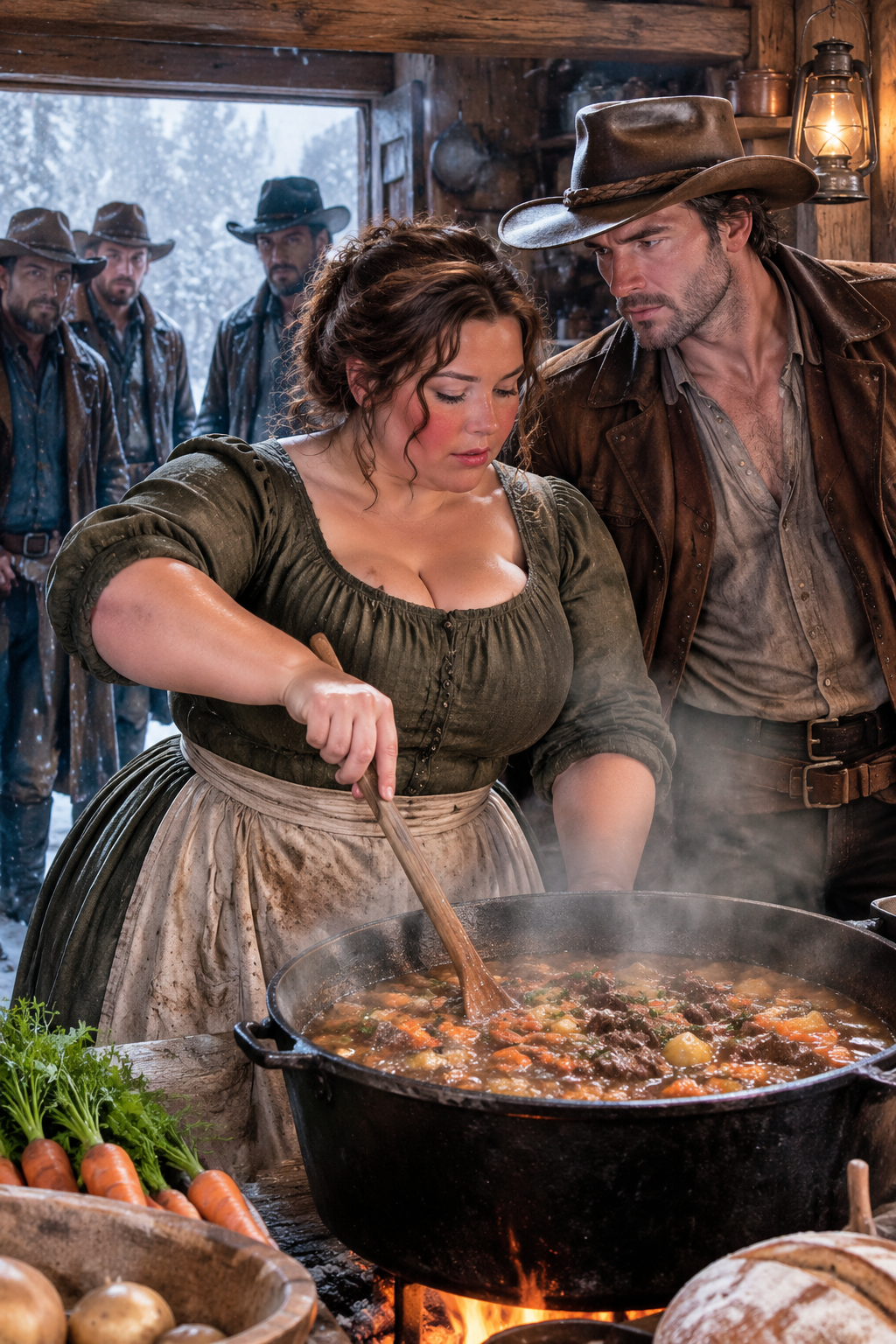
I measured flour, stirred porridge, and kneaded dough while the first sunlight spread across the windows.
My hands knew what to do even when my heart did not.
Daniel entered carrying fresh firewood.
He placed it beside the stove without speaking.
For several minutes, we worked in silence.
Then he said, “I should have told you everything the moment I recognized Annie’s name.”
“Yes,” I answered.
“I thought I was protecting what we had.”
I pressed my palms into the dough.
“You were protecting yourself from losing it.”
He accepted the words without argument.
That made them harder to say.
“I love you, Daniel.”
He looked up sharply.
My throat tightened.
“But love cannot survive if one person decides the other is too fragile to hear the truth.”
His eyes filled.
“I know.”
“I don’t think you do. Not yet.”
He set down the last piece of firewood.
“What can I do?”
I looked at the man who had stood beside me through the blizzard, who had learned to share responsibility, and who had still hidden the most painful truth between us.
“Tell me everything, even when you’re afraid.”
He nodded.
“I will.”
I wanted to believe him.
But trust, I was discovering, was not repaired by one promise.
Three days later, the first investigator arrived.
His name was Marshal Edward Collins, a broad-shouldered man with a gray mustache and a habit of listening without interrupting.
He spent hours examining Margaret’s notebook and Thomas’s documents.
Then he asked to speak with me privately.
We sat in the empty dining room while the afternoon light faded across the tables.
“Mrs. Bennett, I need to ask about your daughter’s final illness.”
I folded my hands in my lap.
“All right.”
“Do you remember where your family purchased flour that winter?”
“From the Mill Creek supply store.”
“Did you keep any receipts?”
I almost laughed at the cruelty of the question.
Twelve years had passed.
I had moved three times, buried my husband, and spent countless nights trying to survive memories I could not escape.
Then I remembered a small wooden box beneath my bed.
Inside were Annie’s ribbons, a broken porcelain doll, and the last grocery receipt my husband had brought home before she became ill.
I had kept it because Annie had drawn a tiny flower on the back.
“I might have something,” I whispered.
The marshal followed me upstairs.
My fingers shook as I opened the box.
There, beneath the faded blue ribbon, lay the folded paper.
I handed it to him.
He examined the merchant’s stamp and delivery number.
Then he looked at Margaret’s records.
The numbers matched.
For a long moment, he said nothing.
Finally, he removed his spectacles.
“This connects your household to one of the shipments under investigation.”
I stared at the receipt.
A small piece of paper I had saved because my daughter had drawn a flower might help expose the men who profited from dangerous food.
I began crying before I understood why.
The marshal waited quietly.
When I could speak, I asked the question that had followed me through every winter.
“Would she have lived if we’d never bought that flour?”
He answered carefully.
“I can’t tell you that, Mrs. Bennett.”
I nodded.
Somewhere deep inside, I had known he would say it.
“But I can tell you,” he continued, “that what happened deserves a proper investigation, and the people responsible must answer for what they did.”
That evening, I sat alone in the kitchen after everyone had gone to bed.
Daniel found me holding Annie’s ribbon.
He stopped in the doorway.
“May I sit?”
I nodded.
He took the chair beside mine.
For a while, we listened to the wind moving gently around the station.
Then I told him about the day Annie was born.
How she had arrived during a summer thunderstorm.
How my husband had been so frightened he dropped the clean towels.
How the first thing she did was wrap her tiny fingers around mine.
Daniel smiled through his tears.
“She sounds wonderful.”
“She was.”
I looked down at the ribbon.
“For years, I thought I had failed her because I couldn’t save her.”
He waited.
“Now I know there were things happening around us that I never understood.”
I swallowed.
“But knowing that doesn’t make me miss her any less.”
Daniel reached across the table, then stopped, giving me the choice.
I placed my hand in his.
“I don’t need you to take away my grief,” I whispered.
“I need you to stop being afraid of it.”
He held my hand gently.
“I can do that.”
For the first time since discovering Margaret’s letter, I believed we might find our way back to each other.
But the next morning brought news that shattered our fragile peace.
Walter Briggs had been found near an abandoned freight depot twenty miles east of Red Willow Station.
He was alive, but badly injured.
And before losing consciousness, he had told the rancher who discovered him that someone else had ordered the fraudulent shipments.
The marshal returned immediately.
“Did he name anyone?” Daniel asked.
Collins hesitated.
“He said the man was connected to the railroad’s regional purchasing office.”
Thomas went pale.
I noticed.
“Who?” I asked.
Thomas stared at the floor.
“Harold Vance.”
The name meant nothing to me.
But Daniel’s expression changed.
“Vance approved the station’s freight contracts for years.”
Thomas nodded.
“He controlled which suppliers received orders and which inspectors were sent to examine shipments.”
The marshal closed his notebook.
“Then we’ll find him.”
Two days later, a telegram arrived from Cheyenne.
Harold Vance had disappeared.
His office had been emptied, and several financial ledgers were missing.
The investigation was suddenly larger than anyone had imagined.
For weeks, Red Willow Station became a gathering place for witnesses.
Freight drivers arrived carrying old receipts.
Families traveled from distant settlements to describe sicknesses that had never been properly investigated.
A retired inspector admitted that his signature had been forged on several delivery certificates.
The more people spoke, the clearer the pattern became.
Damaged provisions had been purchased cheaply, relabeled, and distributed through freight contracts controlled by Vance.
Walter had supervised shipments and concealed shortages.
Thomas and other drivers had obeyed orders they knew were wrong.
And ordinary families had paid the price.
Not every illness could be traced to the scheme.
Not every death could be explained.
But enough evidence emerged to expose years of dishonesty.
One afternoon, a woman named Eleanor Price arrived with two grown sons.
She had lost her youngest boy during the same winter as Annie.
We sat together at the kitchen table while she held a photograph of a smiling child with dark curls.
“His name was Benjamin,” she said.
“He was nine.”
I showed her Annie’s picture.
For a long time, neither of us spoke.
Then Eleanor reached across the table and took my hand.
“I thought I was the only mother who still counted the years.”
I shook my head.
“Every single one.”
We cried together, not because the investigation could return our children, but because someone finally understood the shape of our sorrow.
That evening, I began writing down the names of families who had suffered.
I wanted the authorities to remember them as more than figures in a ledger.
I wrote Annie Bennett first.
Then Benjamin Price.
Then every name people entrusted to me.
Within a week, the pages filled.
Daniel helped me arrange the statements, and Thomas spent his evenings identifying old shipment routes.
For the first time, I saw what could happen when people who had carried their burdens alone chose to share them.
Then, just as the investigation appeared ready to move forward, disaster struck.
A fire broke out in the old freight warehouse shortly after midnight.
I woke to shouting and the smell of smoke.
By the time I reached the yard, flames were climbing the wooden walls, throwing orange sparks into the darkness.
Daniel and several workers formed a bucket line from the well.
Thomas was already inside, searching for a locked chest containing additional freight records.
I saw him disappear through the smoke.
“Thomas!” I shouted.
No answer came.
The warehouse roof groaned.
Daniel started toward the entrance, but I caught his arm.
“Get the ladder!”
He looked at me.
“The roof’s going to collapse.”
“Then we have to move quickly.”
We dragged a ladder beneath a side window while two workers soaked blankets in water.
I climbed the first rungs before Daniel could protest.
My heavy frame had been mocked by strangers for years.
Now my strong legs and steady hands carried me toward a window where smoke poured into the freezing air.
I broke the glass with a shovel handle.
Inside, Thomas lay near a fallen beam.
He was conscious but unable to stand.
“Can you reach me?” I shouted.
He coughed.
“My ankle.”
Daniel climbed beside me.
Together, we pushed the ladder through the opening and guided Thomas toward it.
The heat burned my face.
Smoke filled my lungs.
For one terrifying moment, I heard the roof timbers crack above us.
“Move!” Daniel shouted.
Thomas slid onto the ladder.
Daniel supported him from below while I steadied his shoulders.
We reached the ground seconds before part of the roof collapsed.
A shower of sparks rose into the night.
I stumbled backward, coughing so violently I could barely breathe.
Daniel caught me.
“Ruth!”
“I’m all right,” I managed.
But my eyes remained fixed on the burning warehouse.
Someone had started that fire.
And whoever it was had nearly killed a man trying to tell the truth.
The marshal arrived before dawn.
By then, the warehouse was a blackened skeleton.
Fortunately, most of the important evidence had already been moved to the station office.
Thomas’s locked chest was destroyed, but the copies he had delivered earlier remained safe.
Investigators found traces of lamp oil near a rear entrance.
The fire had not been an accident.
Daniel stood beside me as the marshal examined the remains.
“Vance?” he asked.
“Possibly,” Collins replied.
“But we need proof.”
That proof arrived four days later from an unexpected source.
Walter Briggs requested to speak with me.
He had been taken to a small medical office outside Cheyenne, where his injuries were healing slowly.
The marshal offered to accompany me.
Daniel asked if I wanted him there.
I thought about it.
Then I nodded.
“I do.”
The journey took most of the day.
When we entered Walter’s room, I barely recognized him.
His face was bruised, one arm rested in a sling, and the arrogance that once filled every room had vanished.
He looked older than I remembered.
“Mrs. Bennett,” he said.
I remained standing.
“You asked for me.”
He nodded toward a chair.
I did not sit.
Walter stared at his hands.
“I heard about the warehouse fire.”
“Thomas nearly died.”
“I know.”
He swallowed.
“Vance ordered it.”
The marshal stepped forward.
“Can you prove that?”
Walter reached beneath his pillow and withdrew a folded document.
It contained instructions for destroying freight records, signed with Harold Vance’s initials.
“I kept it because I thought I might need protection someday.”
I looked at the paper.
Then at Walter.
“Protection for yourself.”
He nodded.
“Yes.”
The honesty surprised me.
Walter drew a painful breath.
“Vance threatened me when I said I wanted out. He had men attack me near the depot.”
The marshal examined the document.
“Will you testify?”
Walter looked toward me.
“I will.”
I waited for him to say something about Annie.
For a moment, he seemed unable to meet my eyes.
Then he whispered, “I remember your daughter.”
The room grew painfully quiet.
“She came to the warehouse asking why we were changing the markings on the sacks.”
My fingers tightened around the back of the chair.
“She was frightened,” he continued.
“But she wouldn’t leave until someone answered her.”
I could almost see Annie standing there, small and determined, her blue ribbon moving in the winter wind.
Walter’s voice shook.
“I told her to go home.”
“Did you threaten her?”
He closed his eyes.
“I told her people who interfered in freight business could bring trouble on their families.”
My stomach turned.
“She was a child.”
“I know.”
“You knew those provisions were unsafe.”
“Yes.”
“And you sent them anyway.”
He nodded.
I had waited twelve years to hear someone admit those words.
I expected relief.
Instead, I felt the terrible weight of all the years in which the truth had been buried.
Walter began crying.
“I’m sorry.”
I looked at the man whose greed had helped destroy families.
For a moment, I remembered how he had humiliated me in front of forty stranded travelers, believing my body made me less capable than him.
Now he sat broken before me, asking for something he had never offered others.
Mercy.
“I believe you’re sorry,” I said.
He looked up hopefully.
“But your sorrow cannot undo what happened.”
His face crumpled.
“And forgiveness isn’t something you can demand from the people you hurt.”
I turned toward the door.
Before leaving, I stopped.
“Tell the whole truth, Walter. Not because it will save you, but because those children deserved better.”
Outside, Daniel waited beside the wagon.
He helped me climb onto the seat, then sat quietly while I gathered myself.
Finally, I leaned against his shoulder.
He wrapped his arm around me.
For the first time, I did not feel that accepting comfort meant surrendering my strength.
The investigation continued through summer.
Harold Vance was eventually arrested in Nebraska after attempting to flee west under another name.
The recovered financial records connected him to fraudulent purchases, altered inspections, and payments made to conceal damaged shipments.
Walter testified against him.
Thomas testified too.
Several former employees admitted their involvement.
The hearings lasted weeks.
I attended whenever I could, carrying Annie’s photograph inside my handbag.
When my turn came to speak, I stood before the officials with trembling hands.
I told them about the winter Annie died.
About the flour we had purchased.
About the fever that took her strength.
And about the little girl who had tried to tell adults something was wrong.
I did not claim to know more than the evidence could prove.
I could not say with certainty which meal had made Annie ill or whether proper treatment might have saved her.
But I could explain what it meant to discover that men had knowingly placed dangerous food into the hands of families who trusted them.
“My daughter believed grown people were supposed to protect children,” I said.
“She was right to believe that.”
My voice faltered.
“The shame belongs to those who betrayed that trust, not to the children who suffered because of it.”
When I finished, the room remained silent.
Then Eleanor Price reached for my hand.
Other parents nodded through their tears.
I sat down knowing I had finally spoken the words Annie never lived long enough to say.
By autumn, Vance and several accomplices had been convicted of fraud and related offenses.
Walter received a prison sentence for his part in the scheme.
The court’s findings did not establish responsibility for every illness or death, but they exposed the deliberate deception that had endangered so many families.
New freight inspections were ordered.
Damaged provisions could no longer be quietly relabeled and sold through the same contracts.
The reforms were imperfect, and I knew no rule could guarantee that greed would disappear.
But something had changed.
People had learned that silence could be as dangerous as dishonesty.
Back at Red Willow Station, life gradually settled into a gentler rhythm.
The kitchen filled with the familiar smells of fresh bread, roasted meat, and cinnamon.
Travelers came and went.
Children laughed around the dining tables.
Workers no longer questioned whether I belonged behind the stove.
Daniel had a new sign painted above the kitchen entrance.
It read, “Ruth Bennett’s Kitchen.”
When I saw it, I laughed through my tears.
“You didn’t have to do that.”
He smiled.
“I know.”
I touched the painted letters.
For years, people had introduced me as the large woman who cooked.
Now my name stood above the doorway because of what I had accomplished.
Daniel stepped beside me.
“There’s something else I’d like to show you.”
He led me behind the station, where an old storage room had been renovated into a small sitting room.
Sunlight entered through two wide windows.
A sturdy table stood beside a shelf filled with books.
On the wall hung a framed photograph of Annie.
I stopped in the doorway.
Daniel waited quietly.
“I thought you might want a place where you could sit with her memories,” he said.
I walked toward the photograph.
Annie’s smile shone beneath the glass.
For years, I had kept her picture hidden in a wooden box because looking at it hurt too much.
Now it hung in a room filled with sunlight.
I touched the frame.
“She would have loved this.”
Daniel stood beside me.
“I wish I’d known her.”
I looked at him.
“You did know a little of her.”
He nodded.
“Not enough.”
“No,” I whispered.
“But enough to remember that she was brave.”
We stood together in silence.
Then Daniel reached into his pocket and removed a small velvet box.
My breath caught.
He opened it, revealing a simple gold ring with a tiny engraved willow leaf.
“Ruth, I can’t promise there won’t be more storms.”
His voice trembled.
“I can’t promise I’ll never make another mistake.”
I smiled through my tears.
“That would be a foolish promise.”
He laughed softly.
“But I can promise to tell you the truth, even when I’m afraid, and to stand beside you instead of trying to carry everything alone.”
He took my hand.
“Would you marry me?”
I looked at the ring, then at the man who had learned that love required more than kindness.
It required courage.
The courage to admit mistakes.
The courage to listen.
And sometimes the courage to let another person see the parts of us we most wanted to hide.
“Yes,” I whispered.
Daniel’s eyes filled.
“Yes?”
I laughed.
“Yes, Daniel Mercer.”
He slipped the ring onto my finger and kissed me with a tenderness that made the years of loneliness feel a little less endless.
We married that October beneath the golden cottonwoods beside Red Willow Station.
Thomas attended with his family.
Eleanor brought flowers from her garden.
Several travelers who had survived the blizzard returned to celebrate with us.
Samuel Carter, the little boy whose fever had frightened us all, carried the rings on a small velvet cushion.
His mother cried when she saw me.
“You saved my son,” she whispered.
I embraced her.
“We saved each other.”
Daniel stood waiting beneath the trees, his eyes never leaving mine.
As I walked toward him, I thought about the woman I had been when Walter threw my apron onto the dining room floor.
She had been tired of proving her worth.
Tired of swallowing humiliation.
Tired of believing that love, respect, and belonging were things she had to earn by making herself smaller.
I wished I could reach back through time and take her hand.
I would tell her that her strength had never been hidden inside a thinner body or a quieter voice.
It had lived in the hands that fed hungry strangers, the patience that comforted frightened children, and the courage that refused to abandon the truth.
When Daniel took my hands, I smiled.
For the first time in many years, I felt no need to apologize for the space I occupied in the world.
Winter returned sooner than expected.
One evening in November, snow began falling across the station yard, covering the wagon tracks and softening the distant hills.
I stood in the kitchen preparing supper while Daniel checked the windows.
The dining room was crowded with travelers seeking warmth.
A little girl sat near the stove, watching me roll dough.
She had dark braids and curious brown eyes.
“Mrs. Mercer,” she asked, “why do you always make extra biscuits?”
I smiled.
“Because you never know who might arrive hungry.”
She considered that answer.
Then she pointed toward Annie’s photograph, which I had brought into the dining room for the winter.
“Is that your daughter?”
“Yes.”
“Where is she?”
I knelt beside the girl.
“She died a long time ago.”
The child’s face grew solemn.
“Do you still miss her?”
I brushed a strand of hair from her forehead.
“Every day.”
“Does it still hurt?”
I looked toward Daniel, who was helping an elderly traveler remove his snow-covered coat.
Then I looked back at the child.
“Sometimes very much.”
She frowned.
“Then why are you smiling?”
I thought carefully before answering.
“Because missing someone and being happy aren’t opposites, sweetheart. Sometimes love leaves room for both.”
The little girl nodded as though she understood.
Perhaps children understood more than adults imagined.
That night, after the travelers had eaten and the station had grown quiet, Daniel found me sitting beside Annie’s photograph.
He placed a warm blanket around my shoulders.
“Thinking about her?”
I nodded.
“Always.”
He sat beside me.
Outside, the snow fell steadily.
Inside, the stove glowed, the pantry shelves were stocked, and forty clean blankets waited for anyone who might need shelter.
I thought of Margaret Mercer, whose courage had helped uncover a terrible wrong.
I thought of Thomas, who had finally chosen truth over fear.
I thought of Walter, whose confession had come too late to erase the suffering he caused.
And I thought of Annie, whose small voice had carried farther than she could ever have imagined.
Daniel rested his head gently against mine.
“Are you happy, Ruth?”
I looked around the room.
At the kitchen I had built.
At the people who trusted me.
At the man who had learned to love me without asking me to hide my grief.
“Yes,” I whispered.
“Not because everything turned out the way I wanted.”
I took his hand.
“But because I finally understand that a life can hold terrible sorrow and still become something beautiful.”
The wind pressed against the windows.
Somewhere upstairs, a child laughed in her sleep.
And beneath the quiet glow of the lamp, I realized that Annie had not vanished from my life when I buried her.
She lived in every hungry child I fed, every frightened stranger I welcomed, and every moment I chose courage instead of silence.
I leaned against Daniel, listening to the steady rhythm of his breathing.
For twelve winters, I had believed my daughter’s death marked the end of the best part of my life.
But love had never asked me to forget her before beginning again.
It had simply waited until I was ready to open the door.
And as snow covered Red Willow Station once more, I finally understood something my daughter had known long before I did.
A person’s worth is never measured by the space they take up, the mistakes they have made, or the sorrow they carry.
It is measured by the kindness they offer when kindness is difficult, the truth they defend when silence is easier, and the courage they find to love again after losing what they thought they could never live without.
That night, I left an extra loaf of bread cooling beside the stove.
I set another place at the table.
And when a distant knock sounded through the winter darkness, I rose without hesitation.
Because once, a frightened little girl had tried to warn the world that something was wrong, and too many people had refused to listen.
I would spend the rest of my life making certain that anyone who came through our door would be heard.
Daniel opened the door beside me.
A young mother stood outside holding a sleeping child, her face pale from the cold.
“Please,” she whispered, “we were told this station helps people.”
I looked at the child in her arms and felt Annie’s memory settle gently around my heart.
I stepped aside and welcomed them into the warmth.
“Come inside, sweetheart,” I said.
“There’s always room for one more.”
And for the first time, those words were not simply a promise to a stranger.
They were the promise I had finally learned to make to myself.
THE END.