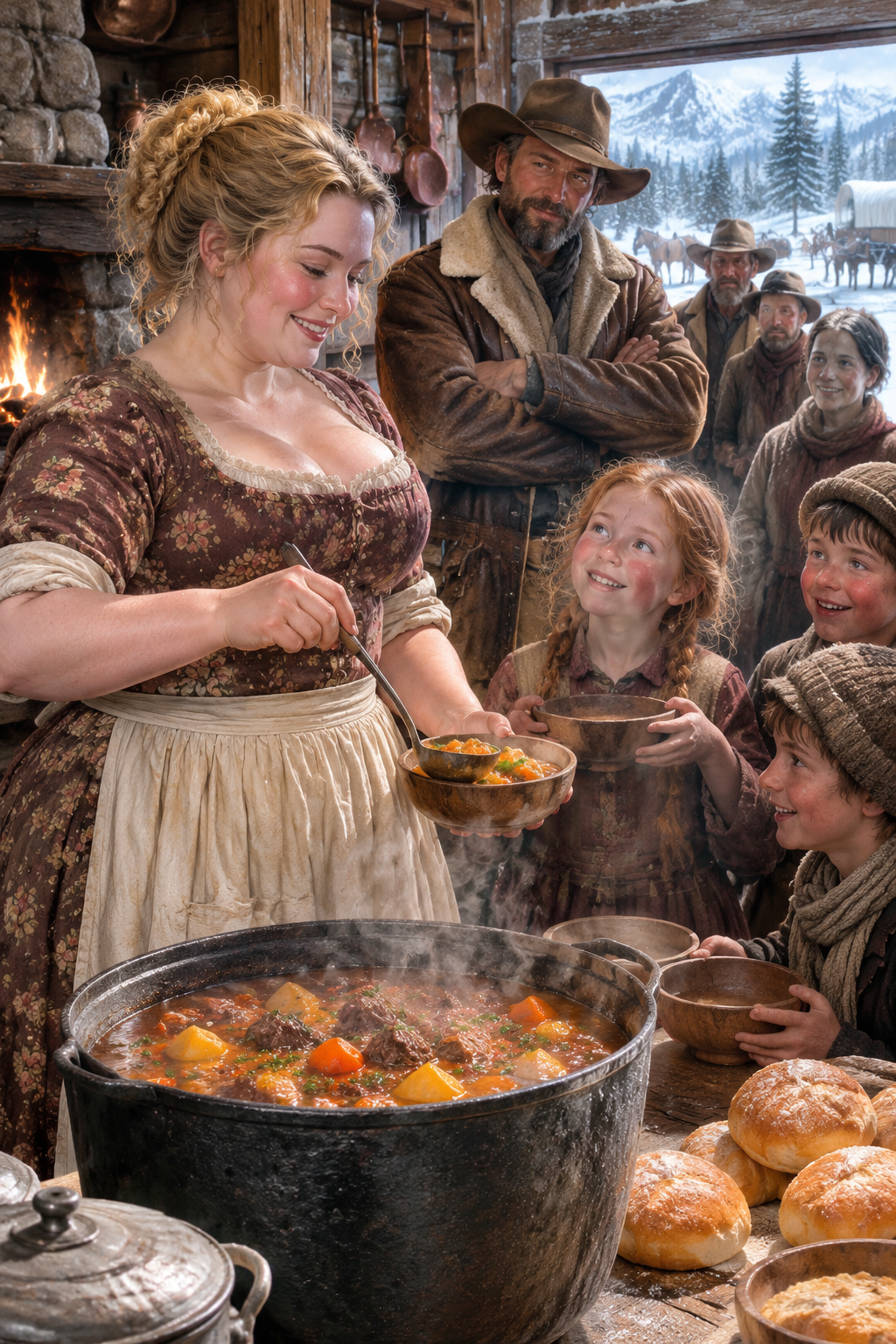
When Nathaniel Brooks called me selfish before eighteen stranded wagon families in his Wyoming barn, I knew someone was hiding the truth about our disappearing food.
The stranger stood beside his exhausted horse, staring at the letter in my hand as though he had just seen a dead man rise from his grave.
Nathaniel moved between us, his expression hardening into something I had never witnessed before.
“You’re not welcome here, Elias.”
The stranger removed his hat, revealing a narrow face marked by years of hardship and a pale scar running from his left eyebrow toward his temple.
“I didn’t come for you, Brooks,” he answered quietly.
His eyes found mine.
“I came because Thomas Whitcomb deserves to have his name cleared.”
For a moment, I could hear nothing except the wind moving through the bare cottonwood branches.
My husband’s name had been spoken by strangers before, usually with sympathy, occasionally with pity, but never with the terrible certainty I heard in this man’s voice.
“What do you mean, cleared?”
Elias looked toward Nathaniel, who stood motionless beside the stable.
“Your husband didn’t die because he was careless, Mrs. Whitcomb.”
The words struck me so violently that I reached for the doorframe.
For four years, I had carried the memory of Thomas’s final journey like a stone inside my chest.
The sheriff had told me that his wagon overturned near Miller’s Crossing during a spring storm.
His horse had returned alone, and Thomas had been found beneath the wreckage the following morning.
There had been no reason to question the accident.
At least, that was what everyone had told me.
Nathaniel stepped forward.
“Not here, Elias.”
I turned toward him.
“No, Nathaniel. Whatever this man knows, he will tell me here.”
The rancher looked at me with an expression so full of regret that I almost wished I had never opened the letter.
Elias reached inside his coat and withdrew a small leather pouch.
He placed it carefully in my palm.
Inside lay Thomas’s silver pocket watch.
I recognized the dent along its edge immediately.
I had given him that watch on our second wedding anniversary, after saving for nearly six months.
The sheriff had told me it was lost in the accident.
I closed my fingers around it.
“Where did you get this?”
Elias swallowed.
“Thomas gave it to me at Miller’s Crossing, three hours before he died.”
My knees weakened.
Nathaniel caught my elbow, but I pulled away.
For the first time since arriving at Brooks Creek Ranch, I was afraid of the man who had given me shelter.
We moved into the empty stone building, where the afternoon light stretched across the floorboards.
Ruth brought a lantern and quietly disappeared after seeing my face.
Elias remained standing near the doorway, twisting his hat between his hands.
He explained that he had worked as a freight driver for a merchant named Gideon Vale, a powerful businessman who controlled several supply routes between Laramie and the surrounding settlements.
Vale had also served as the financial agent for Nathaniel’s father.
Years earlier, the elder Brooks had borrowed money against portions of the ranch during a devastating cattle winter.
The debt had been repaid, but Vale had continued collecting interest through falsified records.
Thomas discovered the discrepancy while helping settle an estate belonging to his late uncle.
Among the documents was a deed showing that the southern pasture, its spring, and the old preservation building legally belonged to the Whitcomb family.
My husband had traveled to Laramie intending to record the deed and challenge the fraudulent accounts.
He never arrived.
“Vale knew Thomas had the original papers,” Elias said.
“He ordered me to meet your husband at Miller’s Crossing and offer him money to surrender them.”
My stomach turned.
“And Thomas refused?”
Elias nodded.
“He said some things couldn’t be purchased.”
I could almost hear my husband’s voice.
Thomas had been gentle, patient, and painfully stubborn whenever he believed something was unjust.
He would mend a broken fence for a stranger without asking payment, but he would argue for hours over a dishonest penny.
Elias stared at the floor.
“I warned him that Vale wasn’t a man who accepted refusal.”
“What happened next?”
He hesitated.
“Two men followed him when he left the crossing.”
I waited.
The silence grew unbearable.
“Did you see them hurt him?”
“No, ma’am. I heard the wagon overturn after dark, but by the time I reached the ravine, the men were already gone.”
I pressed Thomas’s watch against my chest.
“Why didn’t you tell the sheriff?”
Elias looked ashamed.
“Because Vale had my brother’s debts in his hands, and I was afraid.”
The confession settled between us like cold ashes.
Nathaniel stood beside the window, his face drawn.
I turned toward him.
“And you knew?”
He closed his eyes.
“I knew Thomas was investigating the land records. I knew he believed Vale had cheated both our families.”
“Did you know someone threatened him?”
Nathaniel said nothing.
That silence hurt more than any answer.
I stepped away from him.
“For four years, I believed my husband died because he took a dangerous road in bad weather.”
“I tried to find proof, Clara.”
“You could have told me.”
“I should have.”
His voice broke on the final word.
I had seen Nathaniel exhausted, furious, frightened, and grieving, but never so completely defeated.
Yet his remorse could not restore the years I had spent blaming Thomas for leaving me alone.
That night, I slept with the pocket watch beneath my pillow.
Every time I closed my eyes, I saw Thomas climbing into his wagon, unaware that someone might be waiting along the road.
By dawn, I had made my decision.
I would go to Laramie.
I would examine the records myself, and if Gideon Vale had stolen my husband’s life or property, I would not allow another winter to bury the truth.
Nathaniel found me saddling a horse.
“The roads are still dangerous.”
“So is ignorance.”
“Let me come with you.”
I tightened the saddle strap.
“You’ve already decided too much about my life without asking me.”
He accepted the words without argument.
Then Ruth appeared carrying a small bundle of bread and dried apples.
She placed it in my saddlebag.
“Please come back, Clara.”
Her eyes were red.
I remembered the frightened girl secretly feeding hungry children during the blizzard.
She had acted from love, even when her choices endangered others.
Perhaps Nathaniel had done something similar.
But love did not erase consequences.
“I intend to,” I told her.
Elias rode beside me toward Laramie, keeping his horse a respectful distance from mine.
The snow had begun to retreat from the lower hills, exposing dark earth beneath the trees.
For several miles, neither of us spoke.
Then Elias told me something that made me pull sharply on the reins.
“Thomas wasn’t carrying the original deed when he left Miller’s Crossing.”
I turned toward him.
“What?”
“He told me he’d hidden it somewhere Vale would never think to search.”
“Where?”
Elias shook his head.
“He wouldn’t say.”
I looked toward the distant mountains, remembering the cedar chest that had held my carefully saved provisions.
Thomas had built that chest during our first winter together.
He had carved a small wildflower into the lid and lined the interior with thin cedar boards.
For years, I had kept it beside my bed.
I had never examined its construction closely.
A strange uneasiness settled over me.
But before I could question Elias further, we reached Miller’s Crossing.
The place looked painfully ordinary.
A narrow wooden bridge crossed a rocky creek, and a weathered freight shed stood beside the trail.
There were no monuments, no warnings, nothing to suggest that my life had changed forever on that stretch of road.
Elias pointed toward a shallow ravine beyond the bridge.
“That’s where they found him.”
I dismounted.
The earth was damp beneath my boots, and small patches of ice clung to the shaded rocks.
I walked slowly toward the ravine, imagining Thomas’s final moments.
Had he been frightened?
Had he called my name?
Had he known he would never see our home again?
I knelt beside a weathered cottonwood stump and finally allowed myself to cry.
Not the quiet tears I had shed beside his grave, but the desperate, angry sobs I had swallowed for four years.
“I should have been there,” I whispered.
Elias remained behind me.
After a long while, he spoke.
“Mrs. Whitcomb, your husband was trying to make sure you would never have to depend on another man’s generosity.”
I wiped my face.
“He never understood that I didn’t need land or money to feel safe. I needed him.”
Elias lowered his head.
We continued toward Laramie beneath a sky heavy with gathering clouds.
By late afternoon, we reached the county records office, where an elderly clerk named Mrs. Bell recognized the Whitcomb name immediately.
Her expression changed when I mentioned Gideon Vale.
“Your husband came here once before his final journey,” she said.
“He asked me to compare several property transfers.”
She led us into a narrow room lined with dusty shelves.
From a locked drawer, she removed a packet tied with faded blue ribbon.
“Thomas asked me to keep copies until he returned.”
My heart began pounding.
“Why didn’t you send them to me?”
Mrs. Bell looked miserable.
“After his death, Mr. Vale informed us that the matter had been settled privately. I believed his attorney had contacted you.”
I opened the packet.
Inside were copies of payment receipts, survey maps, and a statement written in Thomas’s hand.
He had documented irregularities involving the southern pasture and several neighboring properties.
The same false charges appeared repeatedly, each one carefully disguised as an unpaid fee.
Mrs. Bell pointed to a column of figures.
“These amounts were added after the original payments were made.”
Elias leaned closer.
“Vale used the same method with freight accounts.”
I felt the first flicker of something stronger than grief.
Evidence.
Not rumors, not suspicions, but numbers that could be examined and challenged.
I asked Mrs. Bell whether she would testify to the records she had preserved.
She straightened her shoulders.
“Your husband treated me with more respect than most men who entered this office. I owe him the truth.”
We carried the packet to Sheriff Daniel Price, a broad-shouldered man with tired eyes and a reputation for being difficult to impress.
He listened without interruption.
Then he examined the papers.
“These records may establish fraud,” he said, “but they don’t prove murder.”
I forced myself to remain calm.
“What would?”
“A witness, physical evidence, or a confession that can be supported.”
Elias shifted beside me.
“I can identify the men Vale sent after Thomas.”
The sheriff looked up.
“Are they still alive?”
“One is.”
“Where?”
Elias hesitated.
“Working for Vale at his freight warehouse.”
The sheriff closed the packet.
“Then we proceed carefully.”
He explained that Vale was influential and that accusing him publicly without sufficient evidence could destroy our chances of obtaining a lawful judgment.
I understood.
For years, I had survived by measuring every ingredient before placing it in a pot.
Now I would have to measure every word.
We spent the night at a modest boardinghouse near the courthouse.
I barely slept.
Just before sunrise, someone slipped a folded note beneath my door.
It contained only one sentence.
“Leave Laramie before sunset, or the next widow will be Ruth Brooks.”
I read it twice.
Then I ran downstairs.
Elias was waiting beside the stove, speaking with the boardinghouse keeper.
I showed him the note.
His face went pale.
“Vale knows you’re here.”
My first instinct was to ride back to Brooks Creek Ranch.
Ruth was seventeen, trusting, and utterly unaware that my search for justice might place her in danger.
But fear was exactly what Gideon Vale had relied upon for years.
I carried the note directly to Sheriff Price.
He examined the handwriting, then summoned a deputy.
“Nobody leaves town alone,” he ordered.
I insisted that someone warn Nathaniel.
The sheriff sent a rider immediately.
By noon, we learned that Vale had left his warehouse shortly after dawn.
His surviving hired man, a former drover named Harlan Pike, had disappeared with him.
The sheriff organized a search.
I waited in his office, staring at the clock above the door.
Every passing minute brought another terrible possibility.
Then Nathaniel arrived.
His horse was lathered with sweat, and snow clung to the hem of his coat.
“Ruth is safe,” he said before I could speak.
I nearly collapsed with relief.
“She’s staying with the Millers, and two ranch hands are watching the house.”
He looked at the threatening note lying on the sheriff’s desk.
“Clara, I’m sorry.”
I wanted to tell him that apologies were no longer enough.
Instead, I asked the question that had haunted me since Elias appeared.
“Why did Thomas trust you?”
Nathaniel pulled a chair beside mine.
“Because when my father died, Thomas helped me understand what Vale had done. He could have demanded the land immediately, but he knew the ranch was close to failing.”
I listened silently.
“He offered me time to repay what our families owed each other. I promised to help him record the deed once the accounts were settled.”
“Then why didn’t you?”
“Because I was afraid of losing the ranch.”
His admission was painfully simple.
“I told myself I was protecting Ruth and the people who depended on me. Every year I waited, the truth became harder to face.”
I looked at the man who had sheltered eighteen stranded families while risking his own household’s survival.
He could be extraordinarily generous with what belonged to him.
Yet he had struggled to surrender something that rightfully belonged to someone else.
The contradiction hurt because it was so human.
“You should have trusted me,” I said.
“I know.”
Before either of us could continue, the sheriff entered carrying a bloodstained glove.
His deputies had found an abandoned wagon near the northern timber road.
Beside it lay a torn page from a freight ledger.
The handwriting matched Gideon Vale’s accounts.
More importantly, the page listed a payment made four years earlier to Harlan Pike.
The date was the day Thomas died.
The entry described the payment as compensation for removing an obstruction near Miller’s Crossing.
Sheriff Price studied the wording.
“That could mean almost anything.”
Elias shook his head.
“Not with the amount listed. That’s more than a freight hand earned in six months.”
The sheriff ordered the warehouse searched under a warrant based on the financial evidence.
By evening, his deputies returned with several account books and a frightened young bookkeeper.
The young man admitted that Vale had ordered old records destroyed after learning I had arrived in town.
He had saved several pages because he feared being blamed for the missing money.
Among them was a receipt signed by Harlan Pike for work performed at Miller’s Crossing.
My hands trembled as I examined the signature.
For the first time, Thomas’s death seemed connected to something more substantial than a terrible possibility.
But Gideon Vale remained missing.
The following morning, a ranch hand arrived from Brooks Creek with another message.
Someone had broken into the little stone building during the night.
Nothing valuable appeared to have been stolen.
The intruder had searched the shelves, lifted floorboards, and overturned the empty cedar chest.
I stared at the messenger.
“My chest?”
He nodded.
“Mr. Brooks told me to mention it particularly.”
Suddenly, I remembered Elias’s words about Thomas hiding the original deed.
I turned toward Nathaniel.
“We have to go back.”
The ride home felt endless.
By the time we reached Brooks Creek, dusk had settled over the pasture.
Ruth ran from the house and threw her arms around me.
I held her tightly, grateful for the warmth of someone still alive.
Then I hurried toward the stone building.
The door hung crookedly from its hinges.
Inside, broken jars glittered across the floor.
My cedar chest stood open beneath the window, its lining torn and scattered.
I knelt beside it.
Thomas had made the chest with extraordinary care, fitting each board so precisely that the seams were almost invisible.
I ran my fingers along the bottom.
One corner felt slightly raised.
Nathaniel brought a small knife.
Together, we loosened the narrow wooden panel.
Beneath it lay a folded oilcloth packet.
My heart stopped.
Inside were the original deed, several signed receipts, and a letter addressed to me.
I unfolded the letter beneath the lantern.
“My dearest Clara, if these papers reach you, I hope they bring you freedom rather than sorrow.”
The words blurred.
Thomas explained that he had hidden the documents before leaving for Laramie because he feared someone might search his wagon.
He had intended to return and tell me everything once the transfer was recorded.
Then came the sentence that broke me.
“I am not trying to leave you wealthy, my love. I am trying to leave you choices.”
I covered my mouth.
For four years, I had believed my husband left me nothing but memories and unpaid bills.
Yet he had been fighting for a future he might never see.
Nathaniel knelt beside me.
“I didn’t know where he hid them.”
I believed him.
But belief did not mean forgetting what he had concealed.
We carried the documents to the ranch house, where Ruth prepared coffee while Nathaniel examined the survey.
The deed confirmed that the southern pasture and stone building had been transferred to Thomas’s family decades earlier.
The receipts supported his claim that the disputed debt had been paid.
Still, the records would need legal review before ownership could be settled.
I placed everything inside a locked tin box.
For the first time, I felt that Thomas had returned a small piece of my life to me.
Then a horse screamed outside.
Nathaniel rushed to the window.
A lantern burned near the hay barn.
Beyond it, two figures moved through the darkness.
One carried a rifle.
The other was dragging a heavy sack toward a wagon.
Nathaniel reached for his coat.
“Stay inside.”
I caught his arm.
“No more deciding for me.”
He looked at me for one long moment, then nodded.
We sent Ruth through the rear door toward the bunkhouse to summon the ranch hands.
Nathaniel and I stepped onto the porch.
The taller stranger turned.
Even in the uncertain lantern light, I recognized Gideon Vale from the portrait hanging in his Laramie office.
He was older than I expected, with a carefully trimmed beard and a fine wool coat that looked absurdly elegant beside the muddy wagon.
“Mrs. Whitcomb,” he called.
“I believe you have something that belongs to me.”
Nathaniel moved slightly in front of me.
“Leave this property, Gideon.”
Vale smiled.
“Property is precisely what we’re discussing.”
The man beside him raised his rifle.
I felt Nathaniel stiffen.
Vale’s eyes shifted toward the tin box visible through the open doorway.
“Your husband caused a great deal of trouble over a few worthless acres, Clara. It would be unfortunate if you repeated his mistake.”
My fear hardened into anger.
“Did you have Thomas killed?”
Vale’s smile vanished.
“I warned him to stop interfering.”
“That wasn’t my question.”
He looked toward the armed man.
“Harlan, get the papers.”
Before Pike could move, a voice rang out from the darkness.
“Put down the rifle.”
Sheriff Price emerged beside the corral with two deputies.
Elias stood behind them, holding the reins of their horses.
The sheriff had followed Vale’s trail after discovering fresh tracks near the abandoned wagon.
Pike hesitated.
Nathaniel raised both hands, careful not to provoke him.
“Nobody needs to die tonight.”
For one terrible second, I thought Pike would fire.
Then Ruth appeared beside the bunkhouse with three ranch hands carrying lanterns.
The sudden light exposed everyone standing in the yard.
Pike looked around and slowly lowered his weapon.
Vale tried to retreat toward the wagon, but a deputy intercepted him.
Sheriff Price took the rifle and ordered both men restrained.
The confrontation lasted less than a minute.
Yet when it ended, my legs shook so badly that I could scarcely stand.
Vale stared at me as the deputies led him away.
“Your husband should have accepted my offer.”
I stepped toward him.
“He accepted something worth more than your money.”
Vale laughed bitterly.
“And what was that?”
I looked at the little stone building beyond the yard.
“His own conscience.”
The sheriff took the deed and letters into safekeeping, promising to have certified copies prepared.
Over the following weeks, the investigation uncovered far more than the disputed Whitcomb property.
Vale had manipulated freight charges, falsified debts, and pressured struggling ranchers into surrendering land.
Several families came forward after learning that his records had been seized.
Harlan Pike eventually admitted that he and another hired man had been ordered to stop Thomas from reaching Laramie.
According to Pike, they had confronted him near Miller’s Crossing and attempted to seize his papers.
When Thomas refused, the struggle frightened his horse, sending the wagon down the ravine.
Pike claimed they had never intended to kill him.
I listened to his statement in the sheriff’s office, my hands folded tightly in my lap.
Whether Thomas’s death had been planned or resulted from their reckless violence, the truth remained unbearable.
He had died because men believed their greed mattered more than another person’s life.
The prosecutor filed charges connected to Thomas’s death and the fraudulent transactions.
Months later, after witnesses testified and the surviving records were examined, Pike was convicted for his part in the fatal confrontation.
Vale was convicted of fraud and conspiracy connected to the attempt to seize the documents, while his responsibility for Thomas’s death remained a matter of bitter dispute.
The verdicts could not give me back my husband.
But they ended the silence surrounding his final journey.
The civil proceedings took longer.
Eventually, the court recognized the Whitcomb family’s claim to the southern pasture and ordered the fraudulent records corrected.
I became the lawful owner of the stone building, the orchard, and the spring-fed land surrounding them.
Nathaniel attended the final hearing.
When the judge announced the decision, he stood quietly beside me.
Afterward, he handed me the lease he had prepared months earlier.
“I suppose you won’t be needing this.”
I looked at the paper, remembering how deeply his offer had moved me when I believed myself penniless.
“No,” I answered softly.
“But I won’t forget that you offered it when you thought it was yours.”
He nodded.
“I hope someday you’ll forgive me for everything I didn’t tell you.”
I studied his face.
Forgiveness had once seemed like a simple word, something people offered to make painful conversations end.
Now I understood that it required more than kindness.
It required honesty, accountability, and the willingness to live differently afterward.
“I don’t know when that day will come,” I told him.
“But I would like to believe it can.”
Spring arrived slowly at Brooks Creek Ranch.
The snow retreated into the mountains, the creek swelled with clear water, and the first green shoots appeared beneath the cottonwoods.
I spent my mornings repairing the stone building and my evenings planning the preservation kitchen Thomas had always encouraged me to build.
Nathaniel offered labor, lumber, and tools.
This time, I insisted on paying a fair price for everything.
He accepted without argument.
Ruth helped me scrub shelves, polish jars, and plant vegetables beside the spring.
One afternoon, she found me standing beside the empty cedar chest.
“Are you sad about losing all your savings?” she asked.
I looked at the chest, remembering the blizzard, the hungry families, and the exhausted men clearing the timber blockade.
“Sometimes,” I admitted.
“Then why did you give everything away?”
I considered her question carefully.
“Because there are moments when keeping what you have means losing the person you want to be.”
Ruth thought about that for a while.
“Father says you saved everyone.”
“Your father opened his doors. The men cleared the road. You cared for the children. We all saved one another.”
She smiled.
I touched her shoulder.
“But next winter, we’ll count the flour before we start handing out bread.”
She laughed, and the sound filled the little kitchen with unexpected warmth.
By early summer, the shelves were lined with preserved cherries, pickled vegetables, dried apples, and jars of golden peach preserves.
I painted a wooden sign myself.
Whitcomb Preservation Kitchen.
The letters were uneven, but I loved every one.
My first customers came from nearby ranches.
Then a freight driver purchased six jars of preserves for the stage station.
Within a month, I had more orders than I could manage alone.
I hired two widows from Laramie, women who understood what it meant to stretch a dollar until it nearly disappeared.
We worked side by side, laughing over crooked labels and stubborn lids.
For the first time in years, I went to bed exhausted by something I had chosen rather than something I had endured.
One afternoon, a wagon arrived carrying a familiar family.
Silas Mercer climbed down, followed by his wife and their children.
They had survived the winter and found work near Cheyenne.
His youngest son, the baby Ruth had secretly fed, was now round-cheeked and smiling.
Silas placed a small wooden crate on my table.
Inside were fresh seeds, carefully wrapped in paper.
“We heard you opened your kitchen,” he said.
“My wife wanted you to have these.”
I looked at the labels.
Beans, squash, carrots, and several varieties of herbs.
“You don’t owe me anything.”
Silas shook his head.
“That’s not why we’re here.”
His wife stepped forward.
“During the storm, we thought we were going to lose our children. You gave us a chance to watch them grow.”
I held the seed packets against my chest.
No amount of money could have meant more.
That evening, after the Mercers departed, Nathaniel came to the kitchen carrying a basket of freshly picked apples.
He placed them beside the stove.
“Ruth says you’re planning another batch of preserves.”
“I am.”
He glanced around the room, taking in the shelves, the polished worktable, and the sunlight falling across the floor.
“Thomas would have been proud.”
The words hurt, but not in the way they once had.
I looked toward the window, where the orchard stretched into the golden evening.
“I think he would have liked seeing this place full of people.”
Nathaniel smiled faintly.
“He always said you could make something worthwhile out of almost nothing.”
I shook my head.
“Not nothing. I had people who helped me.”
We stood together in comfortable silence.
Then Nathaniel reached into his coat and withdrew a small folded paper.
It was a receipt for the lumber and labor he had provided.
At the bottom, he had written that the account was paid in full.
I frowned.
“Nathaniel, I haven’t finished paying you.”
“You paid more than enough when you fed those men during the storm.”
I started to object, but he raised a hand.
“Then consider the balance a contribution to the community emergency pantry you’ve been talking about.”
I stared at him.
He had remembered.
For weeks, I had been considering setting aside a portion of my profits to maintain a shared supply of preserved food for travelers and families facing hardship.
Not an endless charity that ignored practical limits, but a carefully managed reserve supported by local contributions.
A pantry where generosity and responsibility could stand together.
“Only if we keep proper records,” I said.
Nathaniel laughed.
“Every single jar, Clara.”
By autumn, the emergency pantry occupied one wall of the kitchen.
Each participating ranch contributed what it could.
We recorded every donation, every withdrawal, and every household helped.
When a family needed assistance, nobody was humiliated for asking.
When supplies ran low, everyone knew.
I had learned during the blizzard that compassion without planning could become dangerous.
But planning without compassion could become something equally cruel.
The kitchen prospered, and the pantry grew.
One cold evening, almost a year after the stranded families had arrived, I found Ruth sitting beside the stove with Thomas’s pocket watch in her hands.
I had left it on the mantel while cleaning.
She looked embarrassed.
“I’m sorry. I wasn’t trying to pry.”
“It’s all right.”
She turned the watch over carefully.
“Was he a good man?”
I sat beside her.
“He was kind, but he wasn’t perfect. He worried too much, worked too hard, and sometimes believed he could protect me by keeping his troubles to himself.”
Ruth looked down.
“Like Father.”
I smiled sadly.
“Sometimes.”
She handed the watch back.
“Do you think people can change?”
I thought about Nathaniel standing in the courtroom, accepting responsibility for his silence.
I thought about Elias risking his safety to tell the truth after years of fear.
I thought about myself, learning that independence did not require refusing every helping hand.
“Yes,” I answered.
“But only when they stop making excuses for the things they’ve done.”
Outside, the first snow of the season began falling across the pasture.
I walked to the window and watched the flakes settle on the fence rails.
For a moment, I remembered the terrible winter when eighteen families had crowded into the barn and eleven days of food had stood between us and disaster.
I remembered the empty chest, the blocked trail, and the fear in Nathaniel’s eyes.
Then I looked around my kitchen.
The shelves were full.
The stove was warm.
Ruth was humming softly while arranging jars for the morning deliveries.
Beyond the window, Nathaniel was walking toward the barn with a lantern in his hand.
I no longer believed that life rewarded every sacrifice or that suffering always led to something beautiful.
Thomas had died, and no successful business or legal victory could make that loss fair.
But I had learned that grief did not have to be the final thing I built with my life.
I opened the cedar chest one last time.
Its hidden compartment was empty now, and the wood still carried the faint scent of apples and cinnamon.
I placed Thomas’s watch inside, along with his final letter.
Then I added the first dollar I had earned from my preservation kitchen.
Not because money mattered more than memories, but because I wanted to remember what those three things represented.
Love.
Truth.
And the freedom to begin again.
A gentle knock sounded at the door.
Nathaniel stood outside, holding his hat against the falling snow.
“The stage driver says another storm is coming,” he told me.
“Three wagons are still on the western trail.”
I looked toward the darkening mountains.
For one heartbeat, I felt the old fear return.
Then I glanced at the pantry ledger hanging beside the kitchen door.
We had enough provisions to help, provided we planned carefully and brought the travelers in before the roads closed.
I reached for my coat.
“How many people?”
“Nine, perhaps ten.”
I took the lantern from its hook.
“Then we’d better get the soup started.”
Nathaniel looked at me with quiet admiration.
This time, he did not promise that nobody would go hungry without knowing what we could provide.
Instead, he asked how much food we had and what work needed doing.
And as we walked together through the falling snow, I realized that was the beginning of something more valuable than an apology.
It was trust being rebuilt through action.
Years later, people would remember the winter when eighteen stranded families found shelter at Brooks Creek Ranch.
Some would tell the story of the widow who sacrificed her savings to feed the men clearing the trail.
Others would speak of the rancher who opened his gates or the young girl who gave hungry children more bread than she should have.
But whenever anyone asked me what truly saved us, I gave the same answer.
It was not the food alone.
It was the moment we stopped pretending that courage meant never being afraid, generosity meant never saying no, or love meant hiding painful truths.
We survived because we finally learned to face what was real and carry the burden together.
And every winter afterward, when the first snow touched the roof of Whitcomb Preservation Kitchen, I would open the pantry ledger, count every jar, and leave one lantern burning in the window.
Not because I expected another miracle.
But because somewhere beyond the darkness, there might be another frightened family searching for a place where someone had prepared enough to welcome them.
And I knew, at last, that the future Thomas wanted for me was never simply a piece of land or a building filled with preserves.
It was a life in which I could stand on my own feet, open my door by choice, and offer kindness without surrendering myself.
That was the inheritance he had fought to leave me.
And that was the promise I intended to keep.
THE END.