When Jedediah Mallister threw my suitcase into the muddy barnyard before his laughing ranch hands, I recognized the silver watch belonging to the man who murdered my father.
I read my father’s final warning three times before the words began to make sense, and each time, the terrible possibility grew heavier inside my chest.
“The man who ordered my death shares our blood.”
For three years, I had believed my uncle Samuel Whitmore was dead, another innocent victim of the powerful men who had destroyed our family.
Now he was riding toward Broken Anvil Ranch, prepared to swear that I was an impostor and that my father’s final letters were nothing but carefully manufactured lies.
The man who had carried me on his shoulders through the streets of Philadelphia might have been responsible for putting my father in the ground.
I looked at Jedediah Mallister, searching his weathered face for an explanation that could make the nightmare disappear.
“Did you know my uncle was alive?”
He hesitated.
That hesitation told me everything.
“Hadtie, there are things your father made me promise never to tell you.”
I folded the letter carefully, although my hands were trembling so violently that the paper crackled between my fingers.
“My father is dead, Jedediah. Whatever promises you made to him died the moment you allowed me to bury my family believing a lie.”
The words struck him harder than I expected.
He lowered his eyes, and for the first time since arriving at Broken Anvil, I saw something beyond his anger and stubborn pride.
I saw shame.
Outside the barn, Caleb waited beside his exhausted horse while the ranch hands gathered beneath the yellow glow of the kitchen windows.
The celebration that had filled the property only an hour earlier had vanished.
Everyone understood that Bartholomew Finch’s arrest had not ended our troubles.
It had merely forced our enemies to reveal how far their influence reached.
Jedediah finally spoke.
“Your uncle worked with Finch long before your father discovered the stolen cattle. Samuel handled the money, arranged the false accounts, and made certain the profits disappeared into companies nobody could trace.”
I remembered Uncle Samuel’s expensive Christmas presents, his beautiful carriage, and the way my father had grown increasingly uncomfortable whenever his younger brother visited.
At the time, I thought they were arguing about money.
Perhaps they had been arguing about something far worse.
“Why would Samuel want my father dead?”
Jedediah looked toward the dark prairie.
“Because your father found the original ledger.”
The word stirred something in my memory.
During my father’s final winter, he had spent several evenings locked inside his study, copying figures from a thick brown book.
He had told me that numbers could reveal truths people spent their entire lives trying to bury.
Then, one morning, the book disappeared.
My father had been frightened afterward.
I remembered that clearly now.
He had begun checking the windows before supper and insisting that I never open the front door after sunset.
“Where is the ledger?” I asked.
Jedediah shook his head.
“Your father never told me.”
For a moment, disappointment nearly overwhelmed me.
Then I remembered something else.
My father had always said that the safest hiding place was somewhere a dishonest man would never think to look.
I turned toward the ranch house.
“The kitchen,” I whispered.
Jedediah frowned.
“What about it?”
“My father taught me to cook when I was a girl. He used to say that people who believed kitchens were beneath them rarely noticed what happened inside.”
I hurried across the yard before anyone could stop me.
The kitchen was warm, filled with the lingering smell of biscuits and beef stew, but suddenly every familiar object seemed capable of holding a secret.
I searched beneath the flour bins, inside the cupboards, and behind the loose boards near the stove.
Nothing.
Caleb joined me, followed by Jedediah, who moved slowly because his wounded shoulder had not fully healed.
We worked until midnight.
At last, exhausted and discouraged, I sat beside the old cast-iron stove.
That was when I noticed the small iron plate beneath its warming shelf.
Three screws held it in place.
Two were covered in years of grease.
The third was remarkably clean.
My heart began pounding.
I borrowed Caleb’s pocketknife and carefully loosened the screws.
Behind the plate lay a narrow hollow space.
Inside was a small oilcloth package.
I pulled it free with shaking hands.
The wrapping contained a brown leather ledger, a bundle of letters, and a photograph of my father standing beside a younger Jedediah Mallister.
On the back, my father’s handwriting read, “Broken Anvil, 1879. The beginning of something worth saving.”
Jedediah stared at the photograph as though he were looking into another lifetime.
“He believed this place could become a refuge,” he said quietly.
“For whom?”
“For families ruined by men like Finch.”
I opened the ledger.
Page after page recorded stolen cattle, false purchases, bribed railroad agents, and enormous sums transferred between Philadelphia, Colorado, and Wyoming.
But the most horrifying entries were not financial.
Beside certain names, someone had written a single word.
“Removed.”
I recognized three of those names from newspaper reports about mysterious deaths.
My father’s name appeared near the end.
Beside it was a date.
October 14, 1880.
The day before his body was discovered.
And beneath that date stood Samuel Whitmore’s signature.
I could not breathe.
For years, I had imagined my father dying alone, perhaps frightened, perhaps calling for help that never came.
Now I knew someone had planned his death as casually as ordering supplies.
I pressed my hand against my mouth, but the sob escaped anyway.
Jedediah reached toward me, then stopped.
He seemed to understand that some grief could not be comforted by the person who had helped conceal it.
Caleb quietly stepped outside, leaving us alone.
For several minutes, the only sound was the ticking of the kitchen clock.
Then Jedediah said something that changed the way I understood everything.
“Your father came here because I asked him to help me save the ranch. I never expected him to risk his life.”
I looked at the photograph again.
Two men stood smiling beneath the Wyoming sun, unaware that their friendship would eventually become tangled in betrayal, blood, and unbearable regret.
“Then help me finish what he started,” I said.
Jedediah nodded.
“Whatever it costs.”
By dawn, we had copied the most important pages and hidden the original ledger beneath a loose floorboard in the barn.
Caleb volunteered to ride toward Cheyenne, where a federal marshal named Nathaniel Brooks was reportedly investigating cattle theft across state lines.
But before he could leave, a rider appeared on the eastern ridge.
He carried a white cloth tied to his saddle.
When he approached the gate, I recognized the polished boots and expensive gray coat before I saw his face.
Samuel Whitmore.
My uncle.
He looked older than I remembered, with silver threading through his dark hair and deep lines around his mouth.
But his smile was exactly the same.
The smile that had once made me feel safe.
“Hattie, my dear girl,” he called, using the childhood spelling of my nickname.
He dismounted and opened his arms.
For one terrible instant, I wanted to run toward him.
I wanted to believe that every suspicion was a mistake, that he had survived some terrible ordeal and returned to rescue me.
Then I remembered my father’s name beside that dreadful word.
Removed.
I remained on the porch.
“Where have you been, Uncle Samuel?”
His smile faltered.
“I’ve been searching for you.”
“That’s strange. I’ve been living under my own name for three years.”
He glanced toward Jedediah.
“I see Mallister has been filling your head with stories.”
I stepped down from the porch.
“Did you kill my father?”
Samuel’s expression changed so quickly that I almost missed it.
The warmth disappeared.
In its place came the cold calculation of a man deciding whether a lie was still useful.
“Your father destroyed himself, Henrietta. He became obsessed with accusations he couldn’t prove.”
I felt the old familiar ache of being treated like a foolish child.
But I was no longer the frightened girl who had stood beside a coffin in Philadelphia.
I had crossed half a continent alone.
I had survived hunger, humiliation, and the bitter Wyoming winter.
And I had learned that powerful men often mistook kindness for weakness.
“You came to testify that I’m not Henrietta Whitmore,” I said.
Samuel’s eyes narrowed.
“Someone has been talking.”
“Someone has been keeping records.”
For the first time, genuine alarm crossed his face.
He recovered quickly.
“Be careful, child. Possessing stolen documents can bring serious consequences.”
Behind me, Jedediah shifted his weight.
Samuel noticed the movement.
“Still playing the protector, Mallister? You weren’t much good at it the last time.”
Jedediah’s face hardened.
“Leave my property.”
Samuel laughed softly.
“That’s precisely why I’m here. By tomorrow, this property may no longer belong to either of you.”
He handed me a folded paper.
It was a petition challenging my identity and my father’s ownership agreement.
According to the document, Samuel was the lawful administrator of my father’s estate.
If the court accepted his claim, he could challenge my inheritance and help Finch seize the ranch.
I studied the paper, pretending to be frightened.
Inside, my thoughts were moving rapidly.
Samuel had come himself because he needed something.
The ledger.
He did not know we had found it.
And I intended to keep him uncertain.
“I suppose there’s nothing I can do,” I said quietly.
Samuel smiled again.
“There is always a sensible solution, my dear.”
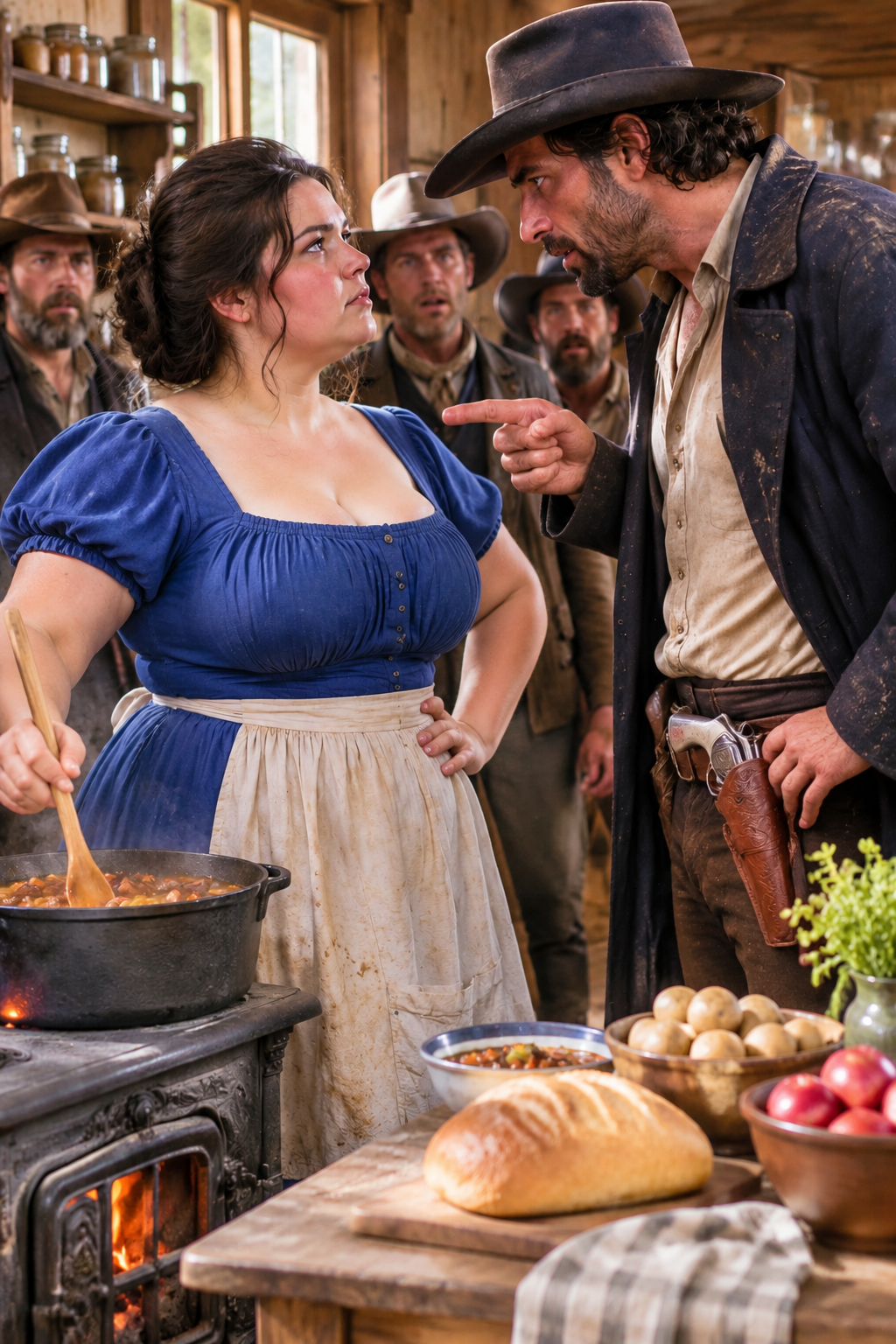
He offered to arrange my passage back to Philadelphia, settle my father’s remaining debts, and provide a modest allowance.
All I had to do was sign away my claim to Broken Anvil.
I looked at the document.
Then I looked at him.
“I’ll consider it.”
His relief was almost invisible.
Almost.
He promised to return the following evening and rode away.
The moment he disappeared beyond the ridge, Jedediah turned toward me.
“You don’t intend to sign.”
“No,” I answered. “I intend to make him confess.”
That afternoon, I prepared an ordinary supper for the ranch hands while Caleb rode toward Cheyenne carrying copies of the ledger.
I gave him a letter explaining everything and begged him to deliver it directly to Marshal Brooks.
If Samuel’s influence reached the local sheriff, we needed someone outside Finch’s circle.
Caleb promised he would not stop until the documents reached trustworthy hands.
I watched him disappear into the fading sunlight, knowing that our future now depended on a young cowboy who had once believed his greatest ambition was owning a good horse.
The following day passed slowly.
I baked bread, washed dishes, and tried to ignore the fear gathering beneath my ribs.
Jedediah ordered the men to remain close to the ranch house.
He checked every rifle and positioned two riders near the northern fence.
But I understood something he did not.
Samuel was not a man who preferred open violence.
He preferred agreements, signatures, and respectable witnesses.
He would arrive looking like a gentleman.
And he would expect me to behave like a helpless woman.
Just before sunset, three carriages approached the ranch.
Samuel stepped from the first.
Bartholomew Finch emerged from the second, wearing a satisfied smile despite the bruises left by his brief imprisonment.
A local attorney and two armed deputies followed.
My stomach tightened.
Finch should have been awaiting trial.
Instead, he stood in my yard as though the law existed solely for his convenience.
Samuel approached the porch.
“Have you made your decision, Henrietta?”
I stood beside the kitchen doorway wearing my plain blue dress and the apron I had used since arriving at Broken Anvil.
“Yes, Uncle Samuel.”
I invited them inside.
Finch looked amused.
“How touching. The little cook has finally learned her place.”
I smiled politely.
“Would anyone care for coffee?”
Samuel accepted.
Finch refused.
The attorney spread several documents across the dining table while the deputies remained near the door.
Jedediah stood beside the stove, his injured arm resting against his chest.
The room smelled of fresh bread and roasted coffee.
It might have been an ordinary evening if not for the men preparing to steal everything we possessed.
Samuel pointed toward the signature line.
“Once you sign, this unfortunate business can end.”
I picked up the pen.
Then I asked a simple question.
“Before I sign, will you tell me why my father died?”
Samuel sighed.
“Henrietta, we’ve discussed this.”
“Please. I want to understand.”
Finch shifted impatiently.
“Her father’s death has nothing to do with this agreement.”
I looked directly at him.
“Then why was his name written in your shipping ledger?”
Silence fell.
Samuel’s eyes moved toward Finch.
Finch stared at me.
“What ledger?”
“The brown one,” I answered. “The one containing payments for stolen cattle and the names of men who disappeared.”
Samuel’s face lost its color.
“You have no idea what you’re talking about.”
I reached beneath my apron and placed a single copied page on the table.
Finch snatched it up.
His expression changed as he recognized the figures.
Samuel leaned closer.
Then he looked at me with an expression I had never seen before.
Hatred.
“Where did you get this?”
I let my voice tremble.
“Father left it for me.”
Finch slammed his fist against the table.
“That book was supposed to be destroyed!”
Samuel turned toward him.
“Be quiet.”
But the words had already escaped.
I looked at Finch.
“Destroyed by whom?”
He realized his mistake.
Samuel stepped forward.
“Henrietta, give me the original, and nobody needs to get hurt.”
I shook my head.
“Did you tell him to kill my father?”
Samuel’s jaw tightened.
“Your father was offered every opportunity to cooperate.”
My heart pounded so violently that I feared I might collapse.
“That’s not an answer.”
“He would have ruined everything,” Samuel snapped.
The room seemed to freeze.
Samuel continued, his careful gentleman’s manner unraveling with every word.
“He had money, respect, a daughter who adored him, and a future most men would envy. But he insisted on exposing people who had helped him build his fortune.”
I could barely recognize the man speaking.
This was not the uncle who had brought me sugared almonds at Christmas.
This was a stranger wearing his face.
“He was your brother,” I whispered.
Samuel looked away.
“He made his choice.”
A floorboard creaked behind the pantry door.
Samuel heard it.
His eyes widened.
Before he could move, the door opened.
Marshal Nathaniel Brooks stepped into the kitchen with Caleb and two armed federal deputies.
The marshal held a small notebook.
“I believe we’ve heard enough, Mr. Whitmore.”
Samuel staggered backward.
Finch reached for his coat.
Jedediah drew his revolver.
“Don’t,” he warned.
For one breathless moment, nobody moved.
Then Finch pulled a pistol.
The first shot shattered the kitchen lamp.
Glass exploded across the table.
I dropped to the floor as the room plunged into darkness.
Someone screamed.
A second gunshot struck the wall above my head.
I crawled toward the stove, searching blindly for the heavy iron poker I kept beside the firewood.
Through the confusion, I heard Samuel shouting at Finch to stop.
Then a hand seized my hair.
I cried out as Finch dragged me upright and pressed his pistol against my neck.
“Everybody back!” he roared.
The marshal froze.
Jedediah raised his weapon, but Finch pulled me closer.
“Drop it, Mallister, or she dies.”
I could feel Finch trembling.
For the first time, the powerful land baron was genuinely afraid.
And frightened men were often the most dangerous.
Samuel stood near the table, breathing heavily.
“Bartholomew, this wasn’t the agreement.”
Finch laughed bitterly.
“You think I care about our agreement now?”
He dragged me toward the back door.
My feet slipped across the scattered glass.
Outside, the cold evening air struck my face.
The horses stamped nervously near the carriage.
Finch ordered the marshal to remain inside while he forced me toward his waiting team.
I understood what would happen if he escaped with me.
He would use me to recover the ledger.
Then I would disappear like the others.
I thought of my father.
I thought of the hungry girl who had arrived at Broken Anvil carrying everything she owned in one battered suitcase.
And I thought of the men inside who had finally become something resembling family.
I refused to let Finch decide how my story ended.
As he reached for the carriage door, I drove my heel into his foot and twisted sideways.
His pistol fired.
Pain tore across my upper arm.
I stumbled, but the shot gave me the opening I needed.
I seized the iron carriage lantern and swung it against his wrist.
The pistol fell into the dirt.
Finch lunged toward it.
Before he could reach it, Jedediah struck him from behind.
Both men crashed to the ground.
The marshal rushed forward and pinned Finch beneath his knee.
Within seconds, iron handcuffs closed around the land baron’s wrists.
I stood trembling beside the carriage, blood running down my sleeve.
Jedediah hurried toward me.
“Hadtie!”
“I’m all right,” I whispered.
But when he touched my arm, the pain made my knees buckle.
He caught me before I fell.
I remember the look on his face more clearly than anything else that evening.
It was the expression of a man who had already lost too much and could not bear to lose one more person.
Inside the kitchen, Samuel had made no attempt to escape.
He sat at the table, staring at the unsigned agreement.
When the marshal brought me back inside, my uncle slowly raised his head.
For a moment, I saw the familiar man from my childhood.
Then he spoke.
“Your father never understood what survival required.”
I looked at him across the ruined table.
“No, Uncle Samuel. He understood exactly what mattered.”
Samuel lowered his eyes.
The marshal took him away before midnight.
Finch followed in another wagon, his hands bound and his reputation finally stripped of the protection money had purchased.
The attorney agreed to surrender the fraudulent documents, and the federal deputies secured the ranch until the investigation was complete.
By morning, Broken Anvil was quiet.
The kitchen window had been repaired with boards, and the broken lamp lay in a bucket beside the stove.
My arm was bandaged.
Jedediah insisted that I remain in bed, but I refused.
There was bread to bake.
There were men to feed.
And there was a ranch that had survived another night.
Over the following weeks, Marshal Brooks uncovered a network of stolen cattle, bribed officials, forged deeds, and suspicious deaths stretching across three states.
The original ledger proved invaluable.
Several witnesses who had remained silent for years finally agreed to testify.
Amos Gentry admitted that Finch had ordered him to shoot Jedediah after the rancher refused to surrender his property.
Samuel’s confession, supported by the ledger and additional correspondence, established his involvement in arranging my father’s murder.
The investigation did not restore the life we had lost.
But it gave his death a truth that could no longer be purchased, hidden, or rewritten.
Winter arrived early that year.
Snow covered the fences, the cattle gathered near the sheltered pasture, and smoke rose steadily from the ranch house chimney.
One evening, Jedediah placed a leather folder beside my supper plate.
Inside were the ownership papers confirming my father’s investment and my rightful interest in Broken Anvil.
He had also prepared documents recognizing my authority over the ranch’s accounts and future business decisions.
I stared at the papers.
“You don’t have to do this.”
He sat opposite me.
“Yes, Hadtie. I do.”
His voice was quiet.
“I treated you like someone who had nothing because I was too cowardly to admit how much your father had entrusted to me.”
I remembered that first afternoon in the barnyard.
The laughter.
The mud.
The humiliation of watching my suitcase thrown aside as though my life were worthless.
For months, I had carried that memory like a stone inside my chest.
Now the man responsible was asking for forgiveness without demanding it.
“I won’t pretend it didn’t hurt,” I told him.
“I wouldn’t ask you to.”
“But I won’t spend the rest of my life letting that day decide who I am.”
Jedediah nodded.
There were tears in his eyes.
We sat together for a long time, listening to the wind move across the frozen prairie.
Then he asked whether I intended to return to Philadelphia.
I looked around the kitchen.
At the polished stove, the shelves of carefully labeled jars, and the enormous wooden table where exhausted men had learned to laugh again.
I thought of Caleb, who had risked his life delivering the evidence.
I thought of the ranch hands who now treated me as an equal.
And I thought of my father, whose final hope had been to build something honest in a world where dishonesty often wore expensive clothes.
“No,” I answered. “I’m staying.”
Jedediah smiled.
“Then Broken Anvil is home.”
The following spring, the ranch began to prosper.
We hired two additional hands, repaired the eastern fences, and purchased cattle from neighboring families who had nearly lost everything to Finch.
I established a proper kitchen garden and opened the ranch table to travelers who needed a hot meal.
No one was turned away simply because their clothes were worn or their pockets empty.
Jedediah never again allowed a newcomer to sleep in the barn unless the person preferred it.
Caleb eventually became our trail boss, although he still claimed my biscuits were the real reason the men stayed.
Sometimes, when the evening sunlight turned the mountains gold, I would sit on the porch holding my father’s silver watch.
I no longer heard its ticking as a reminder of death.
I heard it as proof that time could carry grief forward without erasing love.
One afternoon, Marshal Brooks returned with news from Cheyenne.
Samuel Whitmore had been convicted of conspiracy and murder-related offenses.
Finch faced a long prison sentence for his part in the criminal enterprise.
The court had also confirmed my inheritance.
For the first time in years, nobody could legally challenge my place at Broken Anvil.
After the marshal departed, I walked alone to the hill overlooking the ranch.
I carried my father’s final letter and the photograph of him standing beside Jedediah.
The prairie stretched endlessly beneath a pale blue sky.
Somewhere below, I heard the familiar sounds of cattle, wagon wheels, and men calling to one another.
I unfolded the letter one last time.
My father’s warning had saved me, but it had also taught me something I had not understood when I first read it.
People could fail us terribly without being beyond redemption.
And people who claimed to love us could destroy us while believing themselves justified.
Blood did not guarantee loyalty.
Wealth did not establish worth.
And forgiveness did not require forgetting.
I pressed the photograph against my heart.
“I wish you could see what we’ve built, Papa,” I whispered.
The wind moved softly through the grass.
For a moment, I imagined him standing beside me, smiling the way he had before fear entered our home.
Then I folded the letter and returned it to my pocket.
I had spent so many years believing that losing my family meant losing my future.
But somewhere between a cold barn, a warm kitchen, and the courage to confront the truth, I had discovered that a home was not simply a place inherited from the past.
It was something people created through kindness, honesty, and the willingness to stand beside one another when doing so was difficult.
That evening, I returned to the ranch house and found the table crowded with hungry cowboys.
Caleb was arguing about the proper way to season beef.
Jedediah was pretending not to smile.
And someone had placed a fresh bouquet of wildflowers beside my chair.
I stood in the doorway for a moment, watching the ordinary happiness I had once believed was gone forever.
Then I tied on my apron and stepped into the kitchen.
“Who wants supper?”
Every hand went up.
Their laughter filled the room.
And for the first time since my father’s death, I understood that surviving tragedy was not the same as living beyond it.
Survival had brought me to Wyoming.
Courage had helped me uncover the truth.
But love, freely given and honestly earned, had finally taught me how to live again.
Years later, people would remember the downfall of Bartholomew Finch and the scandal that exposed one of the West’s most ruthless cattle conspiracies.
Some would speak of the brave rancher who defended his land.
Others would praise the federal marshal who brought powerful criminals to justice.
But the men of Broken Anvil told a different story.
They spoke of a penniless woman who arrived with a battered suitcase, slept in a barn, and refused to surrender her dignity.
They remembered how she fed hungry men before asking whether they deserved her kindness.
And how, when powerful enemies threatened everything they loved, she discovered that courage did not always arrive carrying a gun.
Sometimes it arrived carrying a wooden spoon, a father’s letter, and the stubborn belief that truth was worth fighting for.
My name is Henrietta Whitmore.
Most people still call me Hadtie.
And whenever a frightened stranger arrives at Broken Anvil looking for work, I make certain the first thing they receive is a warm meal.
Because I know what it feels like to stand in the cold while someone decides you are worth less than the mud beneath their boots.
I also know how wrong that judgment can be.
And if my father taught me anything worth carrying through the rest of my life, it was this:
A person’s true wealth is not measured by the land they own, the money they possess, or the power they hold over others.
It is measured by the lives they choose to protect when nobody is watching.
That was the inheritance my father left me.
And it was worth more than every acre of Broken Anvil Ranch.
THE END.