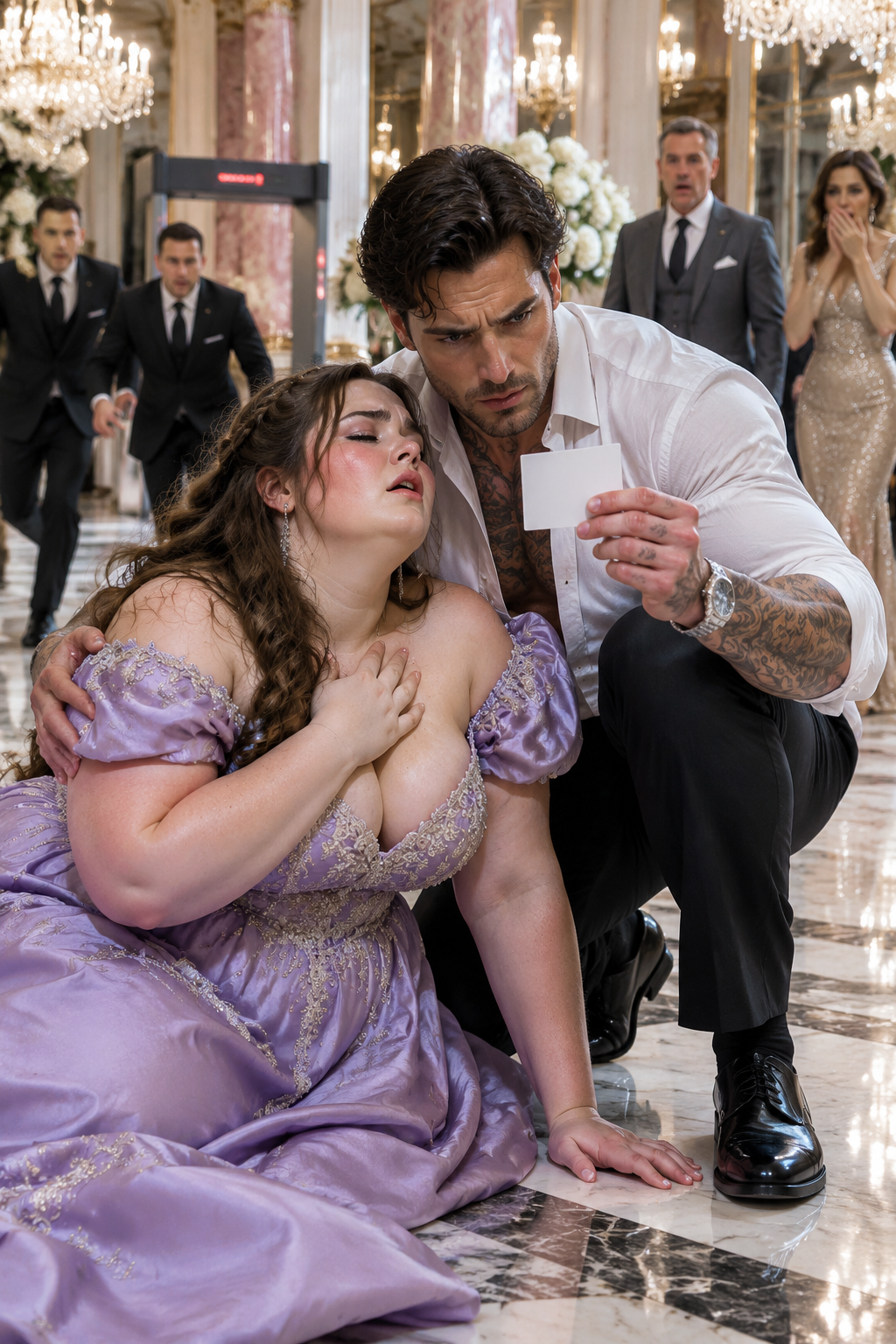
“Walk Through the Scanner, Philipper. Everyone Else Has To.” The Billionaire Humiliated His Plus-Size Wife at His Casino’s Grand Opening
“Crispen.”
The name escaped Philipper’s lips so softly that Lucius almost believed he had imagined it.
For several seconds, the billionaire remained motionless beside her hospital bed. Beyond the windows of Sunrise Hospital, the lights of Las Vegas shimmered against the desert night, illuminating a city that had always represented everything he wanted: wealth, power, success, and the admiration of people who barely knew him.
Yet none of those things could protect him from the truth his wife had just revealed.
“My brother?” he whispered.
Philipper closed her eyes. A tear slipped down her cheek.
“Lucius, please don’t do anything until you’ve heard everything.”
He pulled a chair closer, carefully wrapping both hands around hers.
“Then tell me everything. No more secrets.”
She studied his face, searching for the anger she had learned to anticipate whenever his family’s reputation was threatened. Instead, she found something unfamiliar.
Fear.
Not fear for his fortune or his empire.
Fear of losing her.
“Two years ago,” Philipper began, “I went into your study because I wanted to surprise you. You’d been working fourteen-hour days, and I thought perhaps we could have dinner together.”
Lucius remembered that evening. He had dismissed her invitation, promising they would celebrate after another important business deal.
He had forgotten the conversation almost immediately.
Philipper had remembered every word.
“When I entered the room, I noticed something strange beneath your chair. There was a small electrical component connected to the power system. It didn’t belong there.”
She paused, gathering her strength.
“I called your name, but you were speaking on the telephone. Then I heard someone moving outside the study.”
“Who?”
“Crispen.”
Lucius felt his jaw tighten.
“He was standing near the hallway. When he saw me looking at the equipment, he told me it was part of a security upgrade.”
“Why didn’t you believe him?”
“Because he looked frightened.”
Philipper’s fingers trembled against the blanket.
“I bent down to inspect it. There was a damaged connection, and when I reached toward the chair, I received the shock.”
Lucius looked toward the cardiac monitor.
The steady rhythm seemed suddenly unbearable.
“You almost died because of something intended for me?”
“I didn’t know that then,” she whispered. “Not until afterward.”
He leaned forward.
“What happened afterward?”
Philipper hesitated.
“When I woke up in the hospital, Crispen was there before you arrived. He told me the electrical system had malfunctioned and that an investigation would damage the company. He said you were already under tremendous pressure.”
Lucius stared at her.
“And you believed him?”
“At first.”
Her expression darkened.
“But three weeks later, I overheard him speaking to someone in the parking garage. He said the wrong person had been hurt.”
The room seemed to grow colder.
Lucius slowly released her hand and stood.
For the first time in his life, he understood that the brother he had trusted with his fortune might have tried to take something infinitely more valuable.
His life.
And the woman lying before him had paid the price.
“Why didn’t you tell me?” he asked.
Philipper looked away.
“Because I was afraid you wouldn’t believe me.”
The words struck harder than any accusation.
Lucius wanted to protest. He wanted to insist that he would always have trusted his wife.
But memories flooded his mind.
The times he had dismissed her concerns.
The evenings he had interrupted her to answer Crispen’s calls.
The family dinners where his brother mocked her appearance and Lucius remained silent because he considered the remarks harmless.
He remembered Crispen once describing Philipper as an embarrassment to the Vaneer name.
Lucius had told her not to take it personally.
Now he understood how deeply his silence had wounded her.
“Philipper,” he whispered, “I gave you every reason to think your voice didn’t matter.”
She said nothing.
“I thought providing you with a beautiful home meant I was being a good husband. I thought expensive gifts could replace attention.”
His voice broke.
“But when you needed me most, you were alone.”
Philipper reached toward him.
“Lucius, I never wanted you to blame yourself.”
“Then who should I blame?”
She met his eyes.
“The person responsible. But please don’t become someone I no longer recognize.”
Before he could answer, his telephone vibrated.
Marcus Hale.
Lucius stepped into the hallway.
“Tell me you found something.”
Marcus sounded unusually tense.
“We recovered the maintenance records from the Henderson estate. The original inspection company never authorized the electrical work.”
Lucius pressed a hand against the wall.
“Who did?”
“Crispen signed the order through a subsidiary company. But there’s more.”
Marcus explained that the technician listed on the paperwork had disappeared from Nevada shortly after Philipper’s accident. His name was Daniel Mercer, a former electrical contractor who had recently returned to Las Vegas.
“Find him,” Lucius ordered.
“We already have.”
Lucius straightened.
“Where?”
“At a small motel near Boulder Highway. He’s willing to speak, but he wants protection.”
“From whom?”
Marcus hesitated.
“Your brother.”
Within an hour, Lucius had arranged for Marcus to meet Daniel at a secure location while he remained at the hospital.
He refused to leave Philipper again.
At midnight, a physician entered her room and explained that her condition had stabilized. Her implanted cardiac device had registered a dangerous rhythm disturbance around the time of her collapse, though the exact cause required further evaluation.
The doctor advised that she remain under observation.
Lucius listened carefully, asking questions about her treatment, medications, and follow-up appointments.
For two years, he had known almost nothing about his wife’s medical condition.
Now he wanted to understand every detail.
When the physician left, Philipper watched him with quiet surprise.
“You don’t have to stay awake all night,” she said.
“Yes, I do.”
“Lucius—”
“Not because I feel guilty,” he interrupted gently. “Because I want to be here.”
For the first time since entering the hospital, she smiled.
It was a small smile.
But it reminded him of the woman he had married seven years earlier, before business meetings and family expectations had gradually replaced the tenderness between them.
Meanwhile, across Las Vegas, Crispen Vaneer sat alone inside his luxurious penthouse office.
A glass of untouched whiskey stood beside his laptop.
His telephone had been ringing for nearly twenty minutes.
Investors wanted explanations about the disastrous casino opening.
Reporters were requesting statements.
Members of the Vaneer board were demanding an emergency meeting.
But Crispen was worried about something else.
Daniel Mercer had stopped answering his calls.
He opened a locked drawer and removed an old photograph.
Two young men stood beside their father outside the family’s first hotel in downtown Las Vegas.
Lucius was smiling proudly.
Crispen stood slightly behind him.
Their father had placed one hand on Lucius’s shoulder.
Even in the photograph, Crispen remembered feeling invisible.
He had spent his entire life believing his younger brother received everything without deserving it.
The family business.
Their father’s approval.
The respect of investors.
And eventually, the beautiful woman who had refused Crispen’s attention long before she married Lucius.
That rejection had become another grievance he carried in silence.
His resentment had grown slowly, until he convinced himself that taking control of the Vaneer empire was not betrayal.
It was justice.
But justice had never required hurting an innocent woman.
And somewhere beneath his ambition, Crispen knew that.
At 1:17 a.m., his telephone finally rang.
An unfamiliar number.
“Mr. Vaneer,” a man’s voice said, “Daniel Mercer has been located.”
Crispen stood abruptly.
“Where?”
“That’s the problem. He’s talking to your brother’s security director.”
For several seconds, Crispen couldn’t breathe.
Then he made a decision that would destroy whatever remained of his carefully constructed life.
He opened his laptop and began transferring millions of dollars from a private company account.
He intended to disappear before sunrise.
But Marcus Hale had anticipated that possibility.
At 2:06 a.m., Lucius received a secure video call.
Marcus appeared inside a quiet conference room, with Daniel Mercer seated beside him.
The contractor looked older than his records suggested. His hands trembled around a paper cup of coffee.
“Mr. Vaneer,” Daniel began, “I should have come forward two years ago.”
Lucius kept his expression controlled.
“Tell me what happened.”
Daniel swallowed.
“Your brother hired me to modify an electrical connection inside your study. He said it was part of a security demonstration. But the instructions didn’t make sense.”
“What instructions?”
“He wanted the connection arranged so that someone using the chair could receive a severe electrical shock.”
Lucius felt sick.
“I refused when I realized what he was asking.”
Daniel lowered his eyes.
“He offered me more money. I was in debt, and my daughter needed surgery. I told myself nobody would actually use the equipment.”
His voice cracked.
“I was wrong.”
Marcus placed several documents on the table.
Bank transfers.
Contractor invoices.
Archived messages.
A recorded conversation Daniel had preserved because he feared Crispen might eventually turn against him.
“I kept everything,” Daniel said. “I knew one day I might need proof.”
Lucius stared at the screen.
“Why didn’t you go to the police?”
“Because your brother threatened my family.”
Silence filled the hospital room.
Finally, Lucius spoke.
“You’ll give everything to the authorities.”
Daniel nodded.
“I already agreed.”
Marcus leaned toward the camera.
“There’s another issue, sir. Crispen is moving money out of the company.”
Lucius’s expression hardened.
“Freeze every account he can access through the business. Notify our attorneys and the financial institutions immediately.”
“And Crispen?”
Lucius looked toward Philipper, sleeping peacefully beneath the hospital blankets.
“Let the authorities handle him.”
Marcus seemed surprised.
“You don’t want to confront him?”
“I do,” Lucius replied. “But I won’t risk my wife’s safety to satisfy my anger.”
By dawn, the Vaneer family’s carefully polished reputation had begun to unravel.
Federal financial investigators were alerted to suspicious transfers, while local authorities reviewed the evidence concerning the incident at the Henderson estate.
Crispen’s attempt to move company funds triggered additional scrutiny.
His private driver refused to take him to the airport after receiving instructions from the company’s legal department.
His corporate access was suspended.
His attorneys advised him not to contact witnesses.
For the first time in decades, Crispen Vaneer discovered that money could not immediately solve every problem.
At 8:30 a.m., he received a telephone call from Lucius.
“Come to the hospital,” Lucius said.
Crispen laughed nervously.
“Brother, I’m busy handling the disaster at the casino.”
“The casino can wait.”
“Lucius, whatever Philipper told you—”
“Don’t say her name.”
The coldness in Lucius’s voice silenced him.
“Come alone. Marcus and our attorneys will be present.”
Crispen understood that his brother already knew.
And for the first time, he wondered whether he had underestimated the woman he had spent years dismissing.
Two hours later, Crispen entered a private conference room at Sunrise Hospital.
Lucius stood beside the window.
Marcus occupied a chair near the door.
Two attorneys sat across from an empty seat.
On the table lay copies of the contractor’s records and a transcript of Daniel Mercer’s statement.
Crispen glanced at the documents.
His face changed.
“Lucius, I can explain.”
“Then explain.”
Crispen sat down slowly.
“It wasn’t supposed to happen that way.”
Lucius turned.
“Which part? The attempt to hurt me, or the fact that my wife nearly died instead?”
Crispen’s mouth opened, but no words emerged.
“You knew she needed a pacemaker,” Lucius continued. “You knew what happened to her heart. And you let me believe it was an accident.”
“I never wanted Philipper hurt.”
“But you were willing to hurt me.”
Crispen stared at the floor.
The silence was answer enough.
Lucius walked toward the table.
“For years, I defended you. When investors questioned your decisions, I supported you. When employees complained about your behavior, I gave you another chance.”
His voice trembled.
“You were my brother.”
Crispen suddenly looked up.
“And you were always Father’s favorite!”
The accusation echoed through the room.
Lucius froze.
Crispen stood, years of resentment spilling into the open.
“You inherited everything that mattered! His respect, his confidence, the company! I spent my entire life standing behind you while everyone acted as though I should be grateful!”
Lucius studied him with disbelief.
“You had half the opportunities I had. You had your own businesses, your own fortune, and a place beside me.”
“A place beside you!” Crispen repeated bitterly. “Never above you!”
For a moment, Lucius saw the frightened, jealous boy hidden beneath the expensive suit.
But understanding his brother’s resentment did not excuse what he had done.
“You could have told me you were unhappy,” Lucius said quietly.
Crispen gave a humorless laugh.
“Would you have listened?”
Lucius hesitated.
Perhaps he wouldn’t have.
He had spent years believing success proved that his decisions were correct.
But nothing justified the choice Crispen had made.
“You could have walked away,” Lucius replied. “You could have built something of your own. Instead, you chose to destroy me.”
Crispen’s shoulders sagged.
“I never expected Philipper to enter the study.”
“And afterward?”
Crispen said nothing.
“After she nearly died, why didn’t you confess?”
“Because I was afraid.”
Lucius looked at him for a long moment.
“So you let her carry the consequences while you protected yourself.”
Crispen lowered his head.
For the first time, there was no clever explanation.
No accusation against their father.
No complaint about unfair treatment.
Only the truth.
Then the conference room door opened.
Philipper stood in the doorway, supported by a nurse.
She was wearing a soft blue cardigan over her hospital clothes, her face pale but determined.
“Philipper,” Lucius exclaimed, immediately moving toward her. “You shouldn’t be out of bed.”
“The doctor said I could walk a little,” she answered.
Her gaze settled on Crispen.
He looked away.
“I heard enough,” she said.
Lucius guided her into a chair.
“You don’t have to be here.”
“Yes,” she replied gently. “I do.”
Crispen struggled to meet her eyes.
For two years, he had avoided being alone with her.
Now he found himself unable to escape her quiet presence.
“Why?” Philipper asked.
It was such a simple question.
Yet Crispen could not answer.
“Why did you hate him so much that you were willing to destroy everything?”
Crispen rubbed his forehead.
“I thought he had taken my life away from me.”
Philipper shook her head.
“No, Crispen. You spent so much time watching what Lucius had that you stopped seeing what you still possessed.”
His eyes filled unexpectedly.
“You don’t understand.”
“I understand more than you think,” she said.
She glanced at Lucius.
“I know what it feels like to be overlooked. I know what it’s like to stand beside someone everyone admires and wonder whether anybody notices you.”
Lucius lowered his eyes.
“But being overlooked doesn’t give us permission to hurt people.”
Crispen covered his face with both hands.
For the first time, the powerful businessman looked genuinely ashamed.
Lucius stepped forward.
“You will surrender your position in every Vaneer company. You will have no authority over our employees, our finances, or our properties.”
Crispen nodded faintly.
“And you will never come near Philipper again.”
“Lucius—”
“I’m not finished.”
Lucius placed the documents on the table.
“The evidence has already been turned over to the authorities. I won’t interfere with their investigation, and I won’t use our family name to protect you from the consequences.”
Crispen looked terrified.
“Please. I’m your brother.”
Lucius’s expression tightened.
“You were my brother when you made those choices.”
Crispen sank into his chair.
Then Lucius spoke again, his voice dangerously quiet.
“You should be grateful that Philipper is alive. Because when I first learned what you’d done, I wanted to make you suffer.”
“Lucius.”
Philipper’s voice interrupted him.
He turned.
She reached for his hand.
“Please don’t let what happened turn you into someone cruel.”
He stared at her.
“This man nearly killed you.”
“I know.”
“He betrayed us.”
“I know that too.”
“Then how can you ask me to show him mercy?”
Philipper’s eyes shone with tears.
“Because mercy doesn’t mean pretending nothing happened.”
She squeezed his hand.
“It means choosing not to become the thing that hurt you.”
The room fell silent.
“I don’t want revenge,” she continued. “I want safety. I want the truth acknowledged. And I want us to finally have a life that isn’t controlled by fear.”
Lucius looked at his wife.
The woman he had once considered too quiet for the ruthless world of business had just demonstrated a strength he had never possessed.
He knelt beside her chair.
“I promise you,” he whispered, “I won’t seek revenge.”
Philipper touched his cheek.
“But I will protect you,” he added. “And I will never allow him to threaten our family again.”
Crispen began to cry.
Not because he had escaped punishment.
He hadn’t.
But because the woman he had nearly destroyed had refused to wish destruction upon him.
Within days, Crispen resigned from every Vaneer company and relinquished his access to the family businesses.
He was formally barred from contacting Philipper or entering the couple’s private properties.
The criminal investigation continued, and Crispen ultimately accepted responsibility for his actions through the legal process.
His wealth could not erase the evidence.
His family name could not restore the trust he had broken.
And the consequences followed him long after the headlines faded.
Lucius never attempted to shield him from accountability.
But he also refused to pursue personal vengeance.
For Philipper, that distinction mattered more than any public apology.
Three weeks after the casino opening, she returned home.
The doctors had adjusted her treatment and confirmed that her cardiac device was functioning appropriately. They also explained that future security screenings should follow the manufacturer’s guidance and her cardiologist’s recommendations, rather than relying on assumptions about every metal detector.
Lucius listened to every instruction.
He kept copies of her medical information and learned how to recognize warning signs requiring urgent care.
But the most important change had nothing to do with medicine.
He began listening.
Really listening.
When Philipper spoke about her fears, he didn’t interrupt.
When she expressed an opinion about the business, he didn’t dismiss it.
When she wanted to spend a quiet evening at home, he no longer treated the request as an inconvenience.
One afternoon, he found her sitting in their garden, watching the sunlight settle across the mountains surrounding Henderson.
She wore a simple cream-colored dress and held a cup of tea between her hands.
Lucius sat beside her.
“There’s something I want to ask you.”
Philipper smiled.
“That sounds serious.”
“It is.”
He took a breath.
“Why did you stay with me?”
She looked surprised.
“Lucius—”
“No. I need to know. I was arrogant. I embarrassed you in public. I ignored your concerns. You deserved better.”
Philipper remained quiet for a moment.
“Because I remembered the man who once drove three hours through a thunderstorm just to bring me my favorite peach pie.”
Lucius laughed softly.
“That was a long time ago.”
“Yes,” she replied. “It was.”
Her smile faded.
“I stayed because I believed that man was still somewhere inside you.”
He looked down.
“But I also need you to understand something,” she continued.
He raised his eyes.
“I love you, Lucius. But I won’t spend the rest of my life trying to prove that I deserve your respect.”
He nodded slowly.
“You shouldn’t have to.”
“I need a partner. Not a protector who makes every decision for me.”
Lucius took her hand.
“Then that’s what I’ll learn to be.”
Philipper studied him carefully.
“Promises are easy.”
“I know.”
“Change takes longer.”
He smiled.
“Then I’ll spend the time proving it.”
Six months later, the Vaneer Grand Casino hosted a second celebration.
This time, the occasion was not about Lucius’s wealth.
It was the opening of the Philipper Vaneer Wellness Foundation, an organization dedicated to helping patients and families facing serious cardiac conditions.
The foundation funded patient education, transportation assistance, and support programs for people recovering from major medical emergencies.
Philipper had insisted that the organization serve ordinary families, not simply wealthy donors seeking publicity.
Lucius agreed.
He had also insisted that she be its chairwoman.
But Philipper had corrected him.
“I don’t need you to give me a title,” she said. “I want to earn it by doing the work.”
And she had.
She spent months meeting physicians, nonprofit leaders, and families who struggled to afford transportation to medical appointments.
She listened to stories from people whose lives had changed overnight.
People who had lost jobs.
People who had become caregivers.
People who had discovered that surviving an emergency was only the beginning of a much longer journey.
For the first time, Philipper felt that her experience could become something meaningful beyond her own suffering.
On the evening of the foundation’s opening, the casino glittered beneath the same magnificent chandeliers.
Guests arrived in elegant gowns and tailored suits.
Photographers gathered near the entrance.
And the security team stood ready to welcome everyone.
Lucius and Philipper approached together.
She wore a beautiful midnight-blue gown that complemented her full figure, her hair falling softly over her shoulders.
For a brief moment, she stopped.
The memory of that terrible night returned.
The cold marble.
The sudden fear.
The sound of Lucius calling her name.
He noticed immediately.
“Are you all right?” he asked.
Philipper nodded.
“Just remembering.”
Lucius looked toward the security checkpoint.
Then he turned to the security director.
“My wife will use the alternative screening procedure arranged with her medical team.”
The director nodded respectfully.
“Of course, Mr. Vaneer.”
Lucius offered Philipper his arm.
But she smiled and took his hand instead.
“Together?” she asked.
He squeezed her fingers.
“Always.”
They walked through the designated entrance side by side, following the agreed security procedure without embarrassment or unnecessary attention.
No photographers shouted questions.
No guests whispered.
No one demanded an explanation.
For the first time, Philipper felt that her husband was protecting her dignity rather than defending his pride.
Inside the ballroom, hundreds of guests rose to applaud.
Lucius stepped onto the stage and approached the microphone.
He looked across the room, then toward his wife.
“Six months ago,” he began, “I believed this casino was my greatest achievement.”
The audience listened.
“I thought success meant building something people would admire. I measured my life in contracts, properties, and numbers.”
He paused.
“But I learned something that changed everything.”
Philipper watched him from the front row.
“The most important person in my life was standing beside me all along, and I was too distracted by my own importance to recognize her strength.”
A hush settled over the ballroom.
“My wife saved my life in ways I didn’t understand. And when I finally learned the truth, she taught me something even more extraordinary.”
His voice softened.
“That strength isn’t measured by how much power we hold over others. Sometimes it’s measured by how gently we treat the people who trust us.”
Lucius stepped away from the microphone.
Then he extended his hand toward Philipper.
She hesitated, surprised.
The audience began applauding again.
Philipper joined him onstage.
Lucius kissed her hand.
“This foundation exists because of her courage, her compassion, and her determination to turn a painful experience into hope for others.”
He turned toward the audience.
“Ladies and gentlemen, please welcome the woman who has taught me what real success looks like.”
Philipper’s eyes filled with tears.
But when she approached the microphone, her voice was steady.
“Thank you,” she began.
She looked around the ballroom.
“Many people believe that being strong means never being afraid. But I have learned that courage often begins when we admit that we’re frightened.”
She paused.
“Two years ago, I believed silence would protect the people I loved. I thought keeping my pain hidden would prevent more suffering.”
Lucius watched her carefully.
“I was wrong.”
The room grew quiet.
“Love should never require us to disappear. It should never make us feel that our fears are inconvenient or our voices unimportant.”
She glanced at her husband.
“And forgiveness doesn’t mean forgetting what happened. It means deciding what kind of future we want to build after the truth has been faced.”
Several guests wiped tears from their eyes.
Philipper smiled.
“Tonight, I hope this foundation reminds every person facing a difficult medical journey that they deserve to be heard, supported, and treated with dignity.”
The applause that followed was unlike anything Lucius had experienced at a business celebration.
It wasn’t admiration for money.
It was gratitude for something real.
Later that evening, after the guests had departed and the casino lights had softened, Lucius found Philipper standing on a balcony overlooking the Las Vegas Strip.
The desert breeze moved gently through her hair.
He approached quietly.
“Mrs. Vaneer,” he said, “may I have this dance?”
She laughed.
“There’s no music.”
Lucius held out his hand.
“Then we’ll make our own.”
She stepped into his arms.
For several minutes, they swayed beneath the stars, surrounded by the distant sounds of the city.
No cameras.
No investors.
No expectations.
Just a husband and wife rediscovering the tenderness they had nearly lost.
After a while, Philipper rested her head against his chest.
“Do you ever think about Crispen?” she asked.
Lucius sighed.
“Sometimes.”
“Do you hate him?”
He considered the question.
“I hate what he did. I hate the pain he caused you.”
He paused.
“But I don’t want to spend my life carrying hatred for him.”
Philipper looked up.
“That’s enough.”
Lucius kissed her forehead.
“I used to believe protecting someone meant controlling everything around them.”
“And now?”
“Now I know it means respecting their choices, listening when they’re afraid, and standing beside them when life becomes difficult.”
She smiled.
“That’s a much better definition.”
He held her a little closer.
Below them, thousands of lights glittered across Las Vegas.
Somewhere in that enormous city, people were chasing fortunes, recognition, and dreams they believed would finally make them happy.
Lucius had once been exactly like them.
He had spent years building an empire while overlooking the woman who made his house feel like home.
He had believed his brother’s loyalty was guaranteed by blood.
He had mistaken his wife’s quietness for weakness.
And he had nearly lost everything that truly mattered before understanding how wrong he had been.
Now, standing beneath the Nevada sky, he felt wealthier than he ever had inside a boardroom.
Not because his fortune had increased.
Not because his enemies had fallen.
But because the woman in his arms no longer had to wonder whether she mattered.
“Philipper?” he whispered.
“Yes?”
“Thank you for giving us another chance.”
She lifted her head.
“Don’t thank me for staying, Lucius.”
He looked into her eyes.
“Then what should I thank you for?”
“For reminding you that love is something we choose to practice every day.”
He smiled.
“And tomorrow?”
She laughed softly.
“Tomorrow, you can start by making breakfast.”
Lucius pretended to look offended.
“The owner of the Vaneer Grand Casino making breakfast?”
“Exactly.”
“What would you like?”
“Pancakes. With strawberries.”
He nodded solemnly.
“Consider it done.”
“And Lucius?”
“Yes, sweetheart?”
“Don’t burn them this time.”
Their laughter drifted into the warm desert night.
A year later, a framed photograph stood on the mantelpiece of their Henderson home.
It showed Lucius and Philipper standing together at the foundation’s opening, their hands intertwined, their smiles genuine.
Beside it rested a smaller photograph taken years earlier, when they were newly married and had little understanding of the challenges ahead.
Lucius had placed the pictures together deliberately.
One represented the love they had promised.
The other represented the love they had learned to protect.
Their marriage was not suddenly perfect.
There were still difficult conversations, moments of disagreement, and days when old habits threatened to return.
But now they faced those moments together.
Philipper no longer hid her worries to preserve the peace.
Lucius no longer confused authority with wisdom.
And when either of them made a mistake, they chose honesty over pride.
As for Crispen, the consequences of his betrayal remained his to face. Philipper never sought another meeting, and Lucius respected that boundary. Their mercy had never been an invitation to return.
The family empire continued, but its greatest change could not be measured in profits.
It was visible in the way Lucius reached for his wife’s hand before entering a crowded room.
In the way he listened when she spoke.
And in the quiet confidence with which Philipper now walked beside him, no longer feeling she had to make herself smaller to belong.
Because in the end, the most precious thing Lucius Vaneer ever possessed was never the casino, the fortune, or the powerful name he had inherited.
It was the trust of a woman who had once risked everything for him.
And the greatest lesson of his life was learning that such love should never be taken for granted.
True love is not proven by how loudly we promise to protect someone. It is proven by how faithfully we respect, cherish, and stand beside them when nobody is watching.
And sometimes, the greatest victory isn’t defeating the person who betrayed us.
It’s refusing to let that betrayal destroy the kindness, dignity, and love that make life worth living.
THE END.