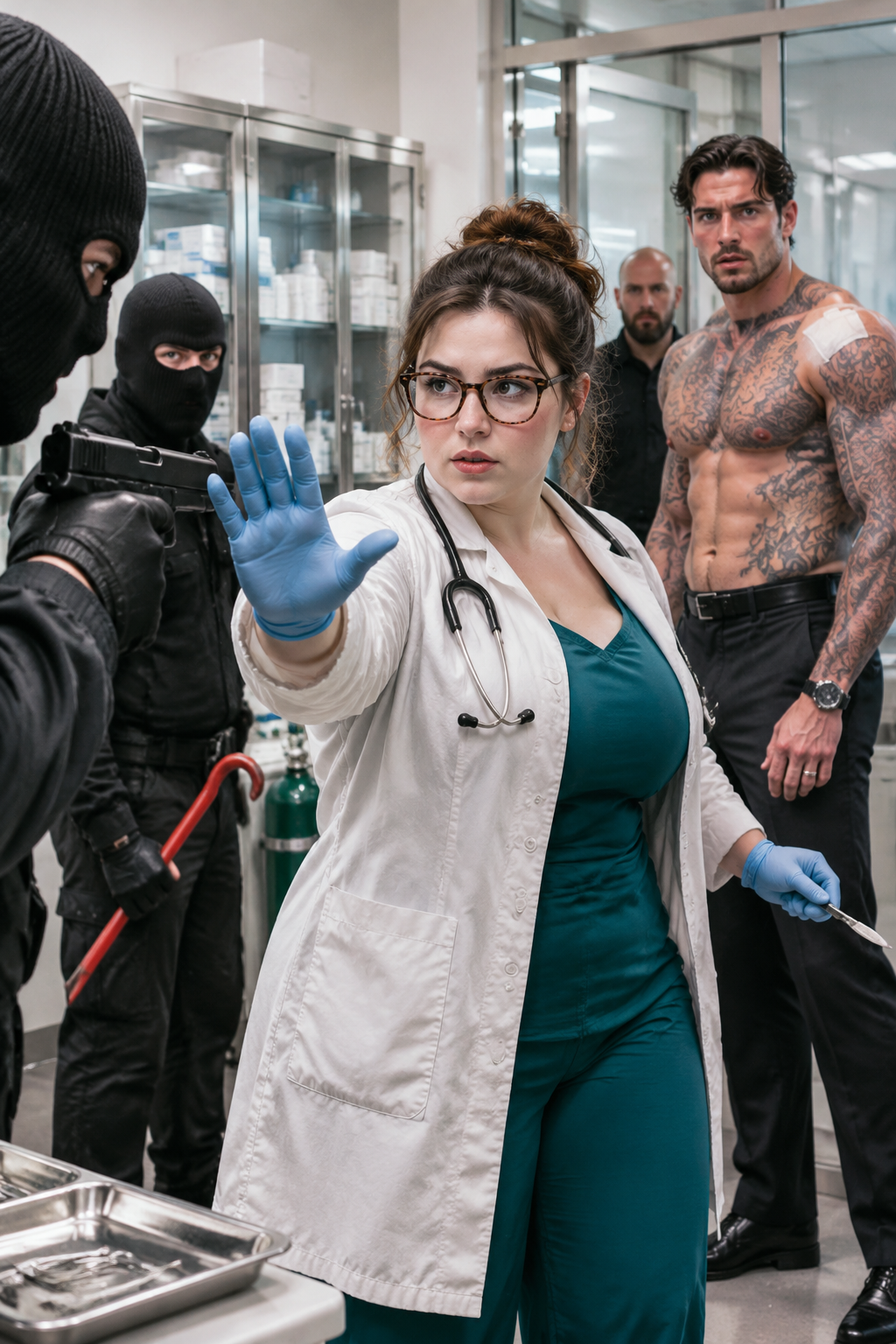
THREE MASKED MEN WALKED INTO HER BROOKLYN CLINIC WITH GUNS. BUT THE DOCTOR WASN’T AFRAID—BECAUSE SHE ALREADY KNEW WHO HAD SENT THEM.
Leandro Soanu stared at the name on the phone screen, and for the first time since Elena had met him, the powerful man’s composure visibly cracked. His jaw tightened, his shoulders stiffened, and something resembling genuine disbelief passed through his dark eyes. Elena had expected anger, perhaps even a threat. What she saw instead was recognition. The name belonged to Dr. Adrian Whitmore, the celebrated Manhattan medical philanthropist who had chaired her mother’s foundation for nearly fifteen years. Adrian had delivered the eulogy at her mother’s funeral. He had held Elena’s hand beside the grave and promised that her mother’s work would never be forgotten. Now his name appeared in a message connected to three armed intruders, a forged multimillion-dollar loan, and a dangerous substance that someone had apparently used to silence witnesses.
“How do you know Adrian Whitmore?” Elena demanded.
Leandro looked toward the examination room, where paramedics were preparing to transport the youngest intruder. He waited until they had passed before answering.
“Because twelve years ago, that man helped destroy my family.”
The words settled between them with an almost physical weight. Outside, the rain continued beating against the clinic windows, and somewhere along the Brooklyn waterfront, a ship sounded its horn. Elena felt as though the entire city had suddenly become unfamiliar.
Leandro explained that his younger sister, Sofia, had once worked as a research coordinator for a private medical foundation associated with Whitmore. She had discovered irregularities involving charitable donations, experimental research funding, and payments routed through companies that existed only on paper. Before she could present her findings to federal investigators, she disappeared. Her death was eventually ruled an accident, and the records she had collected vanished.
“Whitmore signed the final report that buried her complaints,” Leandro said. “I spent twelve years looking for proof that he knew more than he admitted.”
Elena’s thoughts immediately returned to her mother’s locked cabinet. Margaret Callahan had been meticulous, sometimes frustratingly so. She kept copies of everything, from ordinary utility bills to handwritten notes about patients she had treated decades earlier. Elena had always assumed the cabinet contained sentimental belongings and outdated research. Now she wondered whether her mother had been protecting evidence.
“Did my mother know Sofia?” she asked.
Leandro hesitated.
“I believe your mother was the person Sofia intended to meet before she died.”
Elena stepped backward, catching the edge of the counter for support. Her mother had never mentioned Sofia Soanu. Yet Elena remembered something strange from the final months of Margaret’s life: a series of unexplained trips to Manhattan, anxious telephone calls, and an insistence that Elena never allow anyone to remove the old research archives from the clinic.
At the time, Elena had attributed those changes to stress. Margaret was managing a growing charitable organization while receiving treatment for a chronic illness. She had died after a sudden deterioration that her physicians described as an unfortunate complication. Elena had accepted their explanation because she trusted the medical professionals surrounding her mother.
Now that trust felt dangerously misplaced.
“We need to open that cabinet,” Elena said.
Leandro shook his head.
“Not tonight. Whoever sent those men knows something is inside it. We need independent investigators and a documented search before anyone can accuse you of tampering with evidence.”
Elena wanted to argue, but she knew he was right. She had spent years teaching younger physicians that careful documentation mattered as much as clinical judgment. If her mother’s records contained evidence of a serious crime, every page needed to be preserved properly.
The police arrived shortly afterward. Elena gave a detailed statement, identified Caspian as a possible person of interest, and surrendered copies of the threatening messages. She also requested toxicology testing for the intruders, explaining that their symptoms were consistent with possible exposure to a hazardous substance but could not establish its identity without laboratory confirmation.
Leandro remained nearby throughout the interviews, saying little. His security team provided footage from the clinic’s exterior cameras, showing the intruders arriving in a vehicle registered to a company associated with one of Caspian’s business partners.
By dawn, the clinic was quiet again. Elena stood beside the observation window, staring at the examination room where she had nearly lost everything.
“You should go somewhere safe,” Leandro said.
“I need to go home.”
“Your fiancé may be waiting.”
“That’s exactly why I need to go.”
Leandro studied her face. He recognized the determination of someone who had moved beyond fear and into something more dangerous: certainty.
“Then you won’t go alone.”
Elena agreed to discreet protection but refused to let anyone confront Caspian without evidence. She understood that an accusation, however justified, could collapse if it was made before investigators had secured the records.
At seven thirty that morning, she entered the elegant Brooklyn Heights townhouse she shared with Caspian. Sunlight streamed through the tall windows, illuminating expensive furniture, wedding magazines, and a crystal vase filled with white roses. Everything looked exactly as it had the previous evening. That normality was almost unbearable.
Belle was sitting at the kitchen island wearing one of Elena’s silk robes.
The sight would once have been ordinary. Belle frequently stayed overnight after late dinners, and Elena had never questioned her younger stepsister’s familiarity with the house.
Now every small detail carried a different meaning.
“Elena!” Belle exclaimed, setting down her coffee. “You look terrible. Were you at the clinic all night?”
Elena forced a tired smile.
“Emergency patient. Complicated case.”
Belle’s eyes flickered toward Elena’s handbag.
“Did Caspian call you?”
“Not yet.”
For a moment, Belle seemed relieved. Then she stood and embraced Elena, pressing her cheek against her sister’s shoulder.
Elena returned the hug, though the familiar perfume made her stomach tighten. She remembered buying that fragrance for Belle’s birthday. She remembered defending Belle when relatives called her irresponsible. Most painfully, she remembered asking Belle to stand beside her at the wedding.
“You’re shaking,” Belle whispered.
“Long night.”
Elena pulled away and noticed a small adhesive bandage on Belle’s wrist.
“What happened?”
Belle instinctively covered it.
“Nothing. I scratched myself.”
Elena’s medical instincts sharpened. Belle’s fingers trembled slightly as she reached for her cup, and there was an unusual pallor beneath her carefully applied makeup.
“Have you been feeling sick?”
“Just tired.”
“Nausea? Tingling in your hands?”
Belle stared at her.
“How would you know that?”
Elena kept her expression neutral.
“Those symptoms can have several causes. You should get checked.”
Belle lowered her gaze.
“Caspian said it was probably stress.”
There it was again. Caspian, explaining away symptoms before anyone else could investigate them.
Elena gently asked whether Belle had recently taken any medication or supplements. Belle mentioned a private wellness treatment arranged through Whitmore’s foundation, along with several appointments at a Manhattan clinic. Elena advised her to seek an independent medical evaluation and asked permission to document the treatment details.
Belle agreed reluctantly, then added something that made Elena’s heart pound.
“Adrian said the treatment was completely safe. He uses it for important donors.”
Elena realized Belle might not simply be an accomplice. She might also be another person Caspian and Whitmore considered expendable.
Before Elena could ask more, the front door opened.
Caspian entered carrying a leather briefcase and wearing the charcoal-gray coat Elena had bought him for Christmas. He looked immaculate, as though he had spent the night attending a medical conference rather than arranging an attack on his fiancée.
“Darling,” he said warmly. “I was worried about you.”
Elena turned toward him.
“Why?”
He blinked.
“You didn’t answer my calls.”
“My phone died.”
His eyes traveled over her face, searching for something.
“Everything all right at the clinic?”
“Busy night.”
Caspian smiled, but Elena noticed his hand tightening around the briefcase handle.
Belle suddenly announced that she needed to leave. Caspian’s expression changed almost imperceptibly, and he followed her toward the hallway.
Elena remained in the kitchen, listening to their muffled voices. She could not distinguish every word, but she heard Belle say, “You promised this would be finished.”
Then Caspian answered, “Keep your voice down.”
A moment later, Belle hurried out.
Caspian returned with his usual effortless charm.
“Wedding planner called,” he said. “Apparently there’s a problem with the seating arrangements.”
Elena looked at the man she had loved for two years and wondered how someone could lie so comfortably.
“We can discuss it later.”
She walked upstairs before her composure failed.
Inside her bedroom, Elena locked the bathroom door and contacted Detective Rachel Morgan, the investigator assigned to the clinic incident. She reported Belle’s symptoms, the reference to Whitmore’s wellness treatments, and Caspian’s apparent concern about the previous night.
Morgan listened carefully.
“Don’t confront him,” she warned. “We’re already coordinating with financial investigators. The loan documents are more complicated than they first appeared.”
“How complicated?”
“The lender may not have been a legitimate lending institution.”
Elena closed her eyes.
“Then where did the money go?”
“We’re tracing it.”
After ending the call, Elena opened her mother’s old email archive on her laptop. She had preserved the account after Margaret’s death but rarely visited it because the messages were painful reminders of their final conversations.
Searching Whitmore’s name produced hundreds of results. Most concerned fundraising dinners and research proposals. Then Elena found an email dated three weeks before her mother’s hospitalization.
The subject line contained only two words: PRIVATE REVIEW.
Margaret had written to an attorney named Daniel Mercer, requesting an urgent meeting regarding financial irregularities and patient safety concerns at Whitmore’s foundation.
Attached was a photograph of a handwritten note.
Elena enlarged it.
“Trust the original records, not the copies. If anything happens, the answer is where we first began.”
Elena read the sentence repeatedly.
Where we first began.
Her mother had founded the clinic in a converted warehouse near the Red Hook waterfront. Before that, she had operated a free medical outreach program from a church basement in Sunset Park.
Elena remembered spending childhood Saturdays there, helping arrange donated blankets while her mother examined patients who could not afford insurance.
But there was another beginning, something more personal.
When Elena was eight, Margaret had given her a small wooden music box shaped like a lighthouse. Inside, beneath the velvet lining, she had hidden Elena’s first handwritten birthday letter.
The box still sat on a shelf in Elena’s childhood bedroom at her mother’s old house.
Elena immediately called Detective Morgan.
By noon, investigators had obtained authorization to preserve records from the clinic and Whitmore’s foundation. Meanwhile, Elena arranged to meet Morgan at Margaret’s house in Bay Ridge.
Leandro insisted on accompanying her, but Elena made one condition clear.
“No intimidation. No private revenge. Whatever happened to your sister, we do this legally.”
Leandro looked at her for a long moment.
“You think I haven’t imagined what I’d do if I found him?”
“I think you loved your sister.”
His expression softened.
“More than anything.”
“Then help me make sure the truth survives.”
They arrived at the old house shortly after one. The property had remained empty since Margaret’s death, its modest garden overgrown and its windows covered with dust. Elena felt a sudden ache as she stepped through the front door.
Everything smelled faintly of lavender and old books.
She walked directly upstairs, accompanied by Morgan and a forensic technician. The music box was exactly where she remembered it, resting beneath a framed photograph of Elena and her mother at Coney Island.
Morgan documented the box before Elena opened it.
Inside lay the familiar velvet lining, faded from years of sunlight. Beneath it, the technician discovered a narrow compartment containing a small digital storage device and a folded letter.
Elena recognized her mother’s handwriting immediately.
“My darling Elena, if you’re reading this because something has gone wrong, I need you to understand that I never wanted my work to become your burden. But there are people who have used the suffering of others to build fortunes, and I cannot remain silent. I trusted Adrian Whitmore once. I was wrong. Whatever happens, remember that your worth has never depended on the money I leave behind. It depends on what you choose to protect.”
Elena pressed the letter against her chest.
For several seconds, she could not speak.
Leandro stood quietly beside the doorway, giving her the privacy of her grief.
The forensic technician secured the storage device for examination. Its contents would require authentication, but the accompanying documents suggested that Margaret had been collecting evidence of fraudulent charitable transfers, unauthorized research activities, and concealed adverse medical events.
One name appeared repeatedly.
Sofia Soanu.
Leandro turned away when he saw it.
Elena approached him.
“She wasn’t forgotten.”
He nodded, unable to answer.
That afternoon, Morgan received preliminary information from financial investigators. The $3.2 million loan had been arranged through a shell company whose ownership ultimately connected to Whitmore’s private investment network. Caspian had allegedly used Elena’s forged signature to pledge assets associated with the clinic, intending to seize control when the debt came due.
The $2.4 million endowment was the real prize. With Elena removed from its governing structure, Caspian expected to install trustees loyal to Whitmore, giving them access to funds and the authority to dispose of sensitive archives.
But the financial scheme was only one part of the investigation.
A hospital laboratory had identified evidence consistent with thallium exposure in samples collected from two of the intruders. Confirmatory testing was underway, and specialists were evaluating possible sources. The findings did not establish who had exposed them, but they strengthened the suspicion that someone had attempted to harm the very men hired to intimidate Elena.
Elena also learned that Belle had been admitted to a Manhattan hospital after collapsing at home.
She went immediately.
Belle lay in a private room, pale and frightened, with monitoring equipment beside her bed. Her carefully maintained confidence had disappeared.
When Elena entered, Belle began crying.
“I’m sorry.”
Elena stood at the foot of the bed.
“For what, Belle?”
Her stepsister covered her face.
“For Caspian. For everything.”
The confession came slowly, interrupted by tears and long silences. Belle admitted that her relationship with Caspian had begun almost a year earlier. He had told her Elena was emotionally distant, that their engagement was merely a financial arrangement, and that he intended to end it after resolving certain business obligations.
Belle had believed him because she wanted to.
Then he had persuaded her to help locate documents relating to Margaret’s foundation. He claimed Elena was mismanaging charitable funds and that Whitmore needed the records to protect patients.
“I never knew about the men at the clinic,” Belle whispered. “I swear.”
Elena watched her carefully.
“Did you know about the forged loan?”
Belle hesitated.
“Not at first.”
“That’s not an answer.”
“I found out two months ago. Caspian said it was temporary. He promised he’d fix everything.”
Elena felt the familiar sting of betrayal, but beneath it was something more complicated. Belle had made terrible choices, yet she was now lying in a hospital bed because the people she trusted had apparently placed her in danger.
“Did you help him access Mother’s medical records?”
Belle nodded.
“I gave him the spare key.”
Elena turned toward the window, struggling to control her anger.
“She treated you like her own daughter.”
“I know.”
“She paid for your college. She helped you when nobody else would.”
“I know, Elena.”
“Then why?”
Belle’s answer was barely audible.
“Because I wanted someone to choose me first.”
Elena looked back at her.
For the first time, she understood the insecurity beneath Belle’s cruelty. It did not excuse what she had done, but it explained why Caspian had found her so easy to manipulate.
“Being loved isn’t the same as being used,” Elena said.
Belle began sobbing again.
Before leaving, Elena encouraged her to tell investigators everything and cooperate fully with her physicians. Belle agreed to provide her communications with Caspian and Whitmore, including messages about the wellness appointments.
By evening, the investigation had accelerated.
The storage device contained financial ledgers, internal correspondence, and recordings that appeared to connect Whitmore’s foundation to years of concealed misconduct. One recording captured Margaret confronting Whitmore about Sofia’s research findings.
“You cannot call this charity while hiding what happened to those patients,” Margaret said.
Whitmore’s recorded response was chillingly calm.
“Margaret, you need to understand how much money is involved.”
“Then perhaps you need to understand how little that matters to me.”
Elena listened with tears streaming down her face.
Her mother had been frightened, but she had refused to surrender.
A second recording suggested that Whitmore knew Margaret intended to contact federal authorities. Investigators also discovered communications indicating that Caspian had helped restrict access to her medical information during her final illness.
The evidence raised serious questions about the circumstances of her death, though investigators cautioned that no conclusion could be reached without reviewing her complete medical history.
For Elena, the uncertainty was agonizing.
She had spent months blaming herself for not recognizing how quickly her mother was deteriorating. Now she wondered whether the people entrusted with Margaret’s care had concealed information from her.
Leandro found Elena sitting alone in the clinic’s waiting room that night.
“You should rest,” he said.
“Everyone keeps telling me that.”
“Because you haven’t slept.”
Elena gave a tired laugh.
“Neither have you.”
He sat beside her, leaving a respectful distance between them.
For several minutes, neither spoke.
Then Leandro said something Elena had not expected.
“I spent twelve years believing that if I found the man responsible for Sofia’s death, everything would finally make sense.”
“And now?”
“Now I realize I lost twelve years waiting for someone else’s punishment to give my life meaning.”
Elena turned toward him.
“What will you do?”
“Help the investigators. Tell them everything I know. And then perhaps find a way to honor my sister that doesn’t involve chasing ghosts.”
Elena rested her hands in her lap.
“My mother would have liked that.”
Leandro smiled faintly.
“I think I would have liked her.”
Their conversation was interrupted by Morgan’s telephone call.
Caspian had disappeared.
His apartment in Manhattan was empty, his hospital credentials had been deactivated, and his car had been found abandoned near the Brooklyn Bridge.
Investigators believed he was preparing to leave New York.
But there was something else.
Whitmore had scheduled an emergency meeting of the foundation’s board for the following morning. The agenda included a proposal to transfer management of the Callahan endowment to a newly established medical organization.
Despite everything happening around him, Whitmore was still trying to secure the money.
Elena stared at Morgan.
“He’s going to pretend none of this happened.”
“Possibly.”
“Then I want to be there.”
Morgan considered the request carefully. Investigators were already preparing legal action, and Elena’s presence could create complications.
Finally, they agreed she could attend the meeting with counsel, provided she followed their instructions and made no attempt to conduct her own confrontation.
The next morning, the foundation’s board gathered inside a polished conference room overlooking Central Park. Manhattan’s skyline glittered beyond the enormous windows, and silver coffee service sat beside neatly arranged folders.
Whitmore stood at the head of the table, wearing an expensive navy suit and the reassuring smile that had helped him raise millions for charitable causes.
When Elena entered, his expression faltered.
“Elena,” he said. “What an unexpected pleasure.”
She took a seat opposite him.
“I thought I should attend a meeting about my mother’s money.”
Whitmore adjusted his glasses.
“Of course. But given your recent difficulties, perhaps this isn’t the appropriate time.”
“My recent difficulties?”
“Your fiancé’s unfortunate situation. The incident at your clinic. You’ve been under tremendous stress.”
Elena looked around the table.
Several trustees appeared uncomfortable.
“My mother created this endowment to treat people who couldn’t afford medical care. I’d like to know why we’re discussing transferring it to an organization none of us has previously approved.”
Whitmore’s smile tightened.
“The proposal is entirely legitimate.”
“Then it should survive independent review.”
He closed the folder in front of him.
“Elena, you’re allowing personal emotions to interfere with professional judgment.”
She felt anger rise, but she remembered her mother’s voice.
Facts first. Always facts.
“My attorney has requested a postponement pending a review of the foundation’s financial records.”
Whitmore leaned forward.
“You have no idea what you’re interfering with.”
The room fell silent.
Elena met his eyes.
“I think I’m beginning to understand.”
At that moment, the conference room doors opened.
Detective Morgan entered with federal investigators and presented the necessary legal documents. Whitmore’s expression changed from irritation to disbelief as he was informed that investigators were executing warrants related to financial fraud, obstruction, and suspected criminal conduct connected to the foundation.
He attempted to protest, but his attorney quietly advised him to stop speaking.
Across the room, two trustees immediately began asking questions about records they had previously approved without scrutiny.
Elena watched as the powerful man who had once delivered speeches about compassion was escorted away to face questioning.
She expected satisfaction.
Instead, she felt exhausted.
The following forty-eight hours brought further revelations.
Caspian was located at a private airfield in New Jersey, where investigators detained him before he could board a chartered aircraft. Financial records and communications recovered from his devices linked him to the forged loan and the attempted takeover of the endowment.
One series of messages also suggested that he had arranged for the intruders to be exposed to a hazardous substance, apparently intending to prevent them from identifying him afterward.
The evidence was turned over to prosecutors, and formal charges followed.
Whitmore faced separate allegations involving financial misconduct, obstruction, and concealed research violations. Investigators continued examining the deaths of Sofia Soanu and Margaret Callahan, carefully distinguishing documented wrongdoing from suspicions that still required proof.
For Elena, that distinction mattered.
She wanted justice, not a story that sounded convincing.
Belle survived her medical crisis and eventually gave investigators a complete account of her involvement. She also accepted responsibility for helping Caspian obtain confidential records.
When Elena visited her several weeks later, their conversation was quiet and painful.
“I don’t expect you to forgive me,” Belle said.
Elena sat beside the window.
“I don’t know if I ever will.”
Belle nodded, tears gathering in her eyes.
“But I hope you get better,” Elena continued. “And I hope you become someone who doesn’t need to hurt another person to feel important.”
It was not reconciliation.
It was the beginning of honesty.
Months passed before the legal and financial consequences became clearer. The fraudulent loan was challenged, protective orders preserved the clinic’s assets, and independent trustees were appointed to oversee the endowment while the investigation continued.
The clinic remained open.
That mattered more to Elena than any headline.
On a cold Monday morning in early spring, she returned to the same examination room where three masked men had once threatened her. The walls had been repainted, the damaged counter replaced, and the observation window cleaned until it reflected the pale Brooklyn sunlight.
A little girl sat on the examination table while her mother filled out paperwork.
Elena smiled and handed the child a small stuffed rabbit.
“What’s his name?” the girl asked.
Elena considered the question.
“Hope.”
The child laughed.
“That’s a funny name for a rabbit.”
“Maybe,” Elena said. “But it’s a good name for something you want to keep.”
Later that afternoon, Leandro arrived carrying a modest wooden plaque. He had arranged for a donation to establish a new patient assistance program in Sofia’s memory, administered independently through the clinic.
Elena examined the plaque.
It bore two names.
Margaret Callahan and Sofia Soanu.
Beneath them were the words: FOR THOSE WHO CHOSE TO SPEAK.
Leandro watched her reaction.
“I thought they deserved to be remembered together.”
Elena touched the lettering.
“They do.”
He looked around the busy waiting room, where volunteers were helping patients complete forms and nurses were preparing examination rooms.
“Your mother built something extraordinary.”
“She built something ordinary,” Elena replied. “A place where people could come when they needed help. That’s what made it extraordinary.”
Leandro smiled.
Outside, Brooklyn continued moving at its usual relentless pace. Trucks rumbled along the waterfront, commuters hurried toward subway stations, and the city seemed completely unaware of how close one small clinic had come to disappearing.
Elena stood beside the window for a moment, watching the afternoon sunlight settle across the street.
She had lost the future she once imagined with Caspian. She had discovered that someone she considered family could betray her, and that respected people could conceal terrible wrongdoing behind beautiful promises.
But she had also learned something her mother had tried to teach her all along.
Trust was not proven by expensive gifts, impressive titles, or declarations of love. It was proven by what people chose to do when telling the truth might cost them everything.
Her mother’s legacy had never been the $2.4 million endowment.
It was the courage to protect people who had no one else.
And Elena finally understood that surviving betrayal did not require becoming cold, suspicious, or cruel. It required learning to recognize the difference between those who demanded loyalty and those who earned it.
That evening, she placed her mother’s letter inside the lighthouse music box and set it on the shelf in her clinic office.
Then she turned off the light and walked into the waiting room, where another patient was already asking for her.
For the first time in months, Elena did not feel as though she was walking away from the life she had lost.
She was walking toward the life she had chosen.
And somewhere in the quiet corners of New York City, two women whose voices had nearly been erased were finally being heard.
Because the greatest inheritance a person can leave behind is not wealth, power, or a famous name. It is the courage to do what is right—and the kindness that continues long after they are gone.
THE END.