The woman wearing Levvenia’s grandmother’s sapphire brooch was standing beside her husband.
For several seconds, Levvenia did not move.
The rain continued against the windows of Bellweather Cottage, soft and persistent, while Edmund Vale sat opposite her with the expression of a man who had spent too many years carrying something that did not belong to him.
“He asked you to destroy it?” she repeated.
Mr. Vale lowered his gaze to the envelope resting between them.
“Yes.”
“And you agreed?”
“No, my lady. But I allowed him to believe I had.”
Hester stood beside the door, her hands folded tightly at her waist. Levvenia had known her for nearly twelve years and had rarely seen her look so unsettled.
“Then perhaps,” Levvenia said, “someone should finally tell me what my grandmother wished me to know.”
Mr. Vale pushed the envelope toward her.
The wax seal bore the impression of a small flowering branch. Her grandmother had used that seal on birthday letters, Christmas parcels, and the occasional note reminding Levvenia to wear warmer stockings.
Seeing it now, after so many years, brought a pressure behind her eyes that she refused to acknowledge.
She slipped a letter opener beneath the wax.
Inside were two folded sheets, a smaller sealed document, and a short letter written in the unmistakable slant of her grandmother’s handwriting.
Levvenia unfolded the letter first.
My dearest girl,
If you are reading this, then the circumstances I feared have come to pass, and you have found your way to Bellweather without being brought here by anyone else’s wishes.
I had hoped to explain everything myself. Age, however, has a habit of interrupting our arrangements.
There are things about this house that belong to you, and things I kept from you because I wanted you to choose your own life before discovering what had been provided for it.
Do not mistake a comfortable cage for a home.
And never confuse a man’s willingness to provide for you with his willingness to respect you.
The rest is in Mr. Vale’s keeping.
With all my love,
Grandmother.
Levvenia read the final line twice.
The familiar voice seemed almost audible in the little room, dry and affectionate, with that slight impatience her grandmother had reserved for unnecessary tears.
She laid the letter down carefully.
“What exactly did she leave me?”
Mr. Vale opened the smaller document.
“Bellweather Cottage, the surrounding farmland, the old northern mill, and an investment trust established in your name.”
Levvenia blinked.
“The mill?”
“And considerably more than the mill, my lady.”
He placed a ledger before her.
The figures were arranged in tidy columns. Rental payments, interest, timber rights, and accumulated income stretched across several pages.
Even without examining the totals, Levvenia understood that the estate was larger than Russell had ever allowed her to believe.
“How much?”
Mr. Vale gave her the figure.
Hester made a small sound.
Levvenia remained still.
It was not the sort of fortune that purchased palaces or political influence. But it was enough to repair Bellweather, restore the mill, employ workers, and ensure that she would never again need to ask Russell for money.
More importantly, it had been hers all along.
“Why wasn’t I told?”
“Your grandmother placed the property under trusteeship until you reached thirty or until certain conditions were fulfilled. Those conditions included independent residence at Bellweather and a written declaration that you wished to assume responsibility for the estate.”
Levvenia looked at the documents.
“Russell knew?”
“He discovered the existence of the trust during an inquiry concerning your marriage settlement.”
“And he said nothing.”
Mr. Vale’s silence was answer enough.
Then he spoke more carefully.
“He requested information about whether the assets could be transferred into a joint arrangement. When I informed him that your grandmother had specifically prohibited such a transfer without your independent consent, he became displeased.”
Levvenia remembered Russell returning home one winter evening, unusually quiet, then announcing over dinner that Bellweather was an inconvenient property best left neglected.
She remembered how he had laughed when she suggested visiting it.
A damp little house in the middle of nowhere, darling. Whatever would you do there?
She had accepted his judgment.
Not because she believed herself incapable of deciding.
Because, at the time, trusting him had seemed a natural part of loving him.
Now she understood that trust had been useful to him in ways she had never considered.
“Why would he want the documents destroyed?”
Mr. Vale adjusted his spectacles.
“That,” he said, “is where the matter becomes rather more serious.”
He opened his leather case again.
This time, he withdrew a second ledger.
Its cover was newer, its edges worn from handling.
“Your husband has been experiencing financial difficulties.”
Levvenia gave a faint, humorless smile.
“Russell has expensive tastes. That is hardly news.”
“His difficulties go beyond expensive tastes.”
Mr. Vale turned the book toward her.
“There are debts. Several substantial ones. And an agreement concerning a proposed development on land adjoining Bellweather.”
He pointed to the map.
The old mill stood beside a narrow stream that crossed the northern boundary before continuing toward the neighboring estate.
“The proposed buyers require access through your land. Without it, their plans become considerably less profitable.”
Levvenia studied the map.
“Russell intended to sell them access?”
“He appears to have represented himself as possessing influence over the property.”
“Influence.”
She repeated the word softly.
It was a neat expression for something ugly.
Mr. Vale hesitated.
“There is also a preliminary document carrying what appears to be your signature.”
The room seemed to contract around her.
He placed a sheet of paper on the table.
There it was.
Levvenia Ashcombe.
Her married name.
Written in an imitation of her handwriting.
Close enough to fool a stranger.
Not close enough to fool her.
The second letter leaned too far to the right. The final stroke was too elaborate.
She had spent years signing household accounts, charitable subscriptions, and invitations.
Russell had evidently paid attention.
“That is not my signature.”
“I suspected as much.”
“Does it have legal force?”
“Not without examination and proper execution. I have already taken steps to preserve the original and prevent its being relied upon. But someone has attempted to create the appearance of your consent.”
Levvenia looked at the paper until the letters blurred.
The sapphire brooch had seemed the final insult of her marriage.
Now it appeared merely the smallest.
Hester moved toward the fireplace and stirred the embers, although the fire needed no attention.
Mr. Vale gathered the documents.
“I must advise you to take independent legal counsel.”
Levvenia raised her head.
“Not Russell’s solicitor.”
“Certainly not.”
She looked at the ledger again.
Then at the unfinished gowns on the sewing table beyond the open doorway.
“Can I protect the women working here?”
Mr. Vale seemed surprised.
“Your workers?”
“If this becomes a dispute, I won’t have their wages endangered.”
His expression softened.
“Yes, my lady. With proper arrangements, the enterprise can remain entirely separate.”
“Then that is what we shall do.”
For the first time since arriving, the old gentleman smiled.
“Your grandmother would have approved.”
Levvenia folded the letter and placed it inside her dress, close to the brooch.
“No,” she said quietly. “She would have asked why I hadn’t begun sooner.”
By the following morning, Bellweather Cottage had acquired a new atmosphere.
Hester had brought out her largest account book.
Mr. Vale had sent instructions to an independent solicitor in town.
And Levvenia had pinned a fresh sheet of paper above the sewing machine.
It contained a list of repairs, materials, wages, and possible customers.
At the bottom, she had written two words.
Bellweather Atelier.
Hester examined the name with considerable suspicion.
“Sounds expensive.”
“It will be,” Levvenia said, measuring a length of blue wool.
“Then we’d better make certain our stitching deserves it.”
They began with four workers.
Mrs. Pike, a widow whose husband had left debts and three children.
Clara Finch, seventeen, whose delicate embroidery had once earned her sixpence a day.
Martha Bell, a quiet woman dismissed from a fashionable dressmaker’s shop after an injury left her unable to stand for long hours.
And Hester, who insisted she was not an employee despite keeping firmer control of the establishment than anyone else.
The first weeks were exhausting.
Orders arrived late. Fabric prices rose. The sewing machine broke a needle in the middle of an urgent commission.
One customer refused to pay because a gown made her look older than she wished.
Hester returned the gown with a politely worded bill.
The customer paid the following afternoon.
Levvenia discovered that independence did not feel like standing triumphantly beneath an open sky.
Most days, it felt like ink on her fingers, sore shoulders, and arguing over the price of good linen.
She preferred it.
There was something deeply satisfying about solving problems that did not require guessing what another person wanted her to pretend.
As winter approached, the old mill became her next concern.
Its roof needed replacing, and one wall leaned badly toward the stream.
Yet the building was solid beneath its neglect.
With repairs, the upper rooms could accommodate cutting tables and sewing machines, while the lower floor could store cloth and completed orders.
More importantly, it offered something Bellweather Cottage could not.
Room to grow.
One afternoon, as Levvenia stood inside the mill with a local carpenter, a carriage appeared on the lane.
She recognized it immediately.
Russell stepped down before the wheels had stopped turning.
He looked thinner.
His coat was immaculate, but there were shadows beneath his eyes, and the confident ease with which he had once entered every room seemed to have deserted him.
The carpenter withdrew discreetly.
Russell approached.
“Levvenia.”
She remained beside the window.
“Russell.”
For a moment, he seemed uncertain what to do with his hands.
“I’ve written several times.”
“I received the letters.”
“You didn’t answer.”
“I had nothing to say.”
He glanced around the dusty mill.
“You cannot seriously intend to turn this place into a business.”
“I already have.”
“You know nothing of managing such an undertaking.”
Levvenia looked toward the measuring marks the carpenter had left along the wall.
“I knew very little when I began.”
“Then why make things harder for yourself?”
She turned to face him.
“Because the difficulty belongs to me.”
Russell drew a slow breath.
“I came to apologize.”
She waited.
His gaze fell to the sapphire at her collar.
“What happened with Adelaide was unforgivable.”
“Yes.”
“I was foolish.”
“Yes.”
He looked almost relieved that she was answering him.
“I never intended to hurt you.”
Levvenia’s expression did not change.
“But you knew the brooch was mine.”
He lowered his eyes.
“I did.”
“And you knew what it meant to me.”
“Yes.”
“Then whatever you intended, you knew what you were doing.”
The old mill creaked in the wind.
Russell stood silent.
Finally, he said, “I miss my wife.”
Levvenia looked at him for a long moment.
Then she answered with an unexpected gentleness.
“I believe you.”
Hope flickered across his face.
“But I don’t believe you know who she was.”
He stepped toward her.
“Levvenia—”
“Did you sign my name to an agreement concerning this property?”
He stopped.
The change was immediate.
His shoulders stiffened. His eyes shifted toward the doorway.
“Who told you that?”
“Is it true?”
“It was a preliminary arrangement.”
“Did you sign my name?”
Russell pressed his lips together.
“I was trying to secure our future.”
“Whose future?”
He did not answer.
Levvenia took one step closer.
For years, he had been accustomed to speaking while she listened.
Now he waited while she decided whether he deserved another question.
“Did Adelaide know?”
Russell’s face tightened.
“No.”
“Are you certain?”
“Yes.”
Something in his answer troubled her.
Not the words.
The speed.
She studied him.
Then she turned toward the doorway.
“You should leave.”
“Levvenia, please.”
“You came here without invitation, Russell. You have admitted enough for today.”
He remained where he was.
She looked directly at him.
“Don’t make me ask twice.”
He left.
But two days later, Adelaide Voss arrived at Bellweather.
Unlike Russell, she sent a note ahead.
Levvenia considered refusing the visit.
Then she remembered the hesitation in Russell’s voice.
She agreed to receive her.
Adelaide entered the sitting room wearing a plain gray dress and a hat without decoration. Without the glittering assembly hall behind her, she seemed younger, though no less carefully composed.
Hester brought tea and placed the tray between them.
Neither woman touched it.
“I assume you’ve come about Russell,” Levvenia said.
Adelaide removed her gloves.
“I’ve come because he has told you a lie.”
Levvenia waited.
Adelaide opened her handbag and withdrew a folded letter.
“He told me he was separated from you long before the assembly.”
Levvenia said nothing.
“He said your marriage existed only for appearances.”
“And the brooch?”
Adelaide swallowed.
“He told me it had belonged to his family.”
The admission hung between them.
Levvenia watched her fingers tighten around the letter.
“I knew there were things he wasn’t telling me,” Adelaide continued. “I chose not to ask because I liked the answers he did give.”
It was the first entirely unguarded thing she had said.
Levvenia sat back.
“Why tell me now?”
“Because the men involved in the development agreement have been visiting my brother.”
Adelaide placed the letter on the table.
“My brother was meant to introduce Russell to the investors. When the arrangement failed, they began demanding repayment of an advance.”
Levvenia unfolded the paper.
It contained dates, sums, and instructions written by one of the prospective buyers.
At the bottom was a reference to the forged agreement.
“He told me you had consented,” Adelaide said. “Then I heard you had moved to Bellweather and were refusing every approach.”
“You could have stayed out of this.”
“Yes.”
“Why didn’t you?”
Adelaide looked toward the rain-darkened window.
“Because I have spent enough time being useful to a man who tells people whatever allows him to leave a room comfortably.”
Levvenia folded the letter.
There was no friendship between them.
Perhaps there never would be.
But as Adelaide rose to leave, Levvenia found that she no longer wished to humiliate her.
At the door, Adelaide paused.
“I am sorry about your grandmother’s brooch.”
Levvenia touched the sapphire.
“I believe you.”
Adelaide nodded once and departed.
That evening, Levvenia sent the letter to her solicitor.
Within a fortnight, the proposed development became the subject of a formal inquiry.
Russell’s creditors demanded explanations.
The investors denied knowledge of any forged signature, although the correspondence suggested that several people had been remarkably willing to avoid asking questions.
Russell’s reputation, once protected by dinners, acquaintances, and his family name, began to erode.
Invitations stopped arriving.
His household expenses were reduced.
The grand house was eventually offered for sale.
One cold morning, he appeared at Mr. Vale’s office carrying a sealed packet.
Inside were the original development papers, correspondence with the investors, and a signed statement admitting that he had authorized the imitation of Levvenia’s signature.
He had written the statement himself.
His solicitor read it in silence.
“Do you understand what this may cost you?”
Russell looked down at his hands.
“Yes.”
“Then why bring it?”
For a long time, Russell did not answer.
Finally, he said, “Because everything I’ve done to avoid losing her has made certain that I deserved to.”
The statement did not erase his conduct.
It did, however, help establish the facts.
The questionable agreement was formally abandoned, Bellweather’s ownership and boundaries were confirmed, and the financial claims against Russell were pursued without involving Levvenia’s estate.
He faced serious financial consequences and the loss of much of the life he had once considered permanent.
Levvenia followed the proceedings through her own solicitor.
She neither sought to protect Russell from the consequences nor took pleasure in his humiliation.
She had come to understand that those were two different kinds of involvement, and she wanted neither.
Spring arrived slowly.
The stream beside the mill swelled with melted frost and rain. Small green shoots appeared between the stones, and sunlight reached into rooms that had remained dark for years.
Bellweather Atelier moved into the restored mill in April.
By then, twelve women were employed there.
The workroom smelled of pressed cotton, clean wood, and the faint metallic warmth of sewing machines.
Orders came from neighboring villages, then from the county town.
A fashionable dressmaker in London agreed to purchase a small collection of embroidered collars and tailored jackets.
Clara Finch designed the embroidery.
Mrs. Pike managed the cutting room.
Martha supervised finishing work from a comfortable chair beside the largest window.
Hester kept the accounts.
And Levvenia learned to make decisions that affected more lives than her own.
Not all of them were easy.
When a supplier delivered inferior cloth, she refused the shipment despite the risk of missing a deadline.
When demand increased, she declined orders that would have required the women to work through the night.
When the first profitable quarter ended, she raised wages before purchasing new furniture for the cottage.
Hester discovered the changes in the ledger.
“You know,” she remarked, “you might eventually make yourself a respectable businesswoman.”
Levvenia looked up from her desk.
“I had hoped to be an unreasonable one.”
Hester sniffed.
“There’s still time.”
The mill filled with laughter.
One evening in early summer, a letter arrived from Russell.
It was unlike the others.
No explanation.
No appeal to their shared history.
No suggestion that she might reconsider.
He wrote that the house had been sold and that he intended to take a position managing a small estate in the north, far from the society in which he had once been admired.
He had accepted legal responsibility for the false documents and arranged what restitution he could.
He did not ask for forgiveness.
He simply acknowledged that he had taken her possessions, her trust, and her right to make decisions about her own property.
Then came a final paragraph.
I used to believe that being forgiven meant things could return to the way they were. I understand now that the way things were is precisely what I must not ask you to return to.
Levvenia folded the letter.
She carried it into the garden, where the last sunlight rested on the stone wall.
For several minutes, she stood among the roses her grandmother had planted.
Then she went inside and wrote a reply.
It was brief.
She acknowledged his confession and his efforts to correct the legal wrongs.
She wished him the opportunity to become a man who could be trusted without requiring anyone else to become smaller.
And she told him that she would proceed with the permanent legal dissolution of their marriage.
She did not leave a question at the end.
That autumn, the separation was completed.
Levvenia did not celebrate with a grand dinner or a gathering of friends.
She spent the morning at the mill, reviewing orders.
At noon, Hester brought bread, cheese, and a small plum cake to the workroom.
“An occasion ought to be marked,” she declared.
Levvenia glanced at the cake.
“What occasion?”
“The end of an extremely tiresome chapter.”
Mrs. Pike laughed.
Clara found a knife.
Someone opened the windows to let in the afternoon breeze.
They ate at the long cutting table among folded patterns and reels of thread.
It was the happiest meal Levvenia could remember in years.
Yet Bellweather’s greatest change came several months later, when a young woman appeared at the mill carrying a traveling bag and a child.
Her name was Eleanor Reed.
She had worked as a maid in a neighboring household before losing her position after refusing the advances of her employer’s son.
She had no references.
She had almost no money.
And she could sew.
Levvenia listened while Eleanor stood opposite her desk, gripping the handle of her bag so tightly that her knuckles whitened.
“I don’t need charity, ma’am,” Eleanor said. “Only work.”
Levvenia studied the careful repairs on the child’s coat.
“Did you make those stitches?”
Eleanor nodded.
“They’re excellent.”
The young woman looked startled.
“I could begin tomorrow,” she whispered.
Levvenia glanced toward Hester, who was pretending not to listen from the doorway.
“There’s a room above the old storeroom,” Levvenia said. “It will need cleaning.”
Eleanor’s eyes filled.
She blinked rapidly, looking down at her child.
“I can manage that.”
“And we have a nursery planned for the eastern room. I suppose this gives us a reason to finish it sooner.”
Hester raised an eyebrow.
“A very good reason.”
Eleanor stayed.
So did several others who came after her.
Some were widows. Others had escaped unhappy households or simply wanted wages of their own.
Not all arrived with tragic histories.
Some came because they enjoyed fine needlework.
Some wanted to earn enough to travel.
One young woman wished to save for a bookshop.
Levvenia made room for them where she could.
Bellweather gradually became something more than a profitable enterprise.
It became a place where ability mattered more than introductions, where a woman could make a mistake without having it used against her forever, and where wages were paid directly into the hands that had earned them.
There were disagreements, certainly.
A spoiled order once caused an argument loud enough to frighten the mill cat.
Two workers refused to speak to each other for nearly a week over the disappearance of a pair of scissors.
Hester threatened to resign every other Thursday.
Yet the work continued.
And each year, it improved.
Three years after Levvenia first arrived at Bellweather Cottage, Mr. Vale visited on a bright September afternoon.
He found her in the garden, kneeling beside a rosebush with soil on her sleeves.
The sapphire brooch rested at her collar, catching sunlight rather than candlelight.
“Your grandmother would scarcely recognize the place,” he observed.
Levvenia stood, brushing earth from her hands.
“I think she would recognize the roses.”
Mr. Vale smiled.
They walked toward the mill, where open windows carried the steady hum of sewing machines into the garden.
He told her that the trust’s remaining affairs had been settled and that no further legal obstacles stood between her and the full management of her property.
Then, rather unexpectedly, he produced a small parcel.
“I found this among your grandmother’s personal effects. It was entrusted to me with instructions that it should be delivered only when Bellweather had become your permanent home.”
Levvenia unwrapped the paper.
Inside was a small brass key and a note.
For the room you will someday need.
She looked at him.
“What room?”
Mr. Vale nodded toward the cottage.
“The old library, I believe.”
Levvenia had never found a locked library.
But Hester, when questioned, gave a suspiciously innocent smile.
“Oh, that old room.”
“Hester.”
“I wondered when you’d ask about it.”
Behind a tall cupboard in the eastern corridor, they discovered a narrow door concealed beneath faded wallpaper.
The brass key turned reluctantly.
Inside was a room filled with dust, shuttered windows, and shelves of books.
A writing desk stood beneath a sheet-covered window.
On the wall hung a portrait of Levvenia’s grandmother as a young woman.
Not the stern elderly lady Levvenia remembered, but a woman with bright eyes, a crooked smile, and her hair escaping its pins.
Levvenia stood before the painting for a long time.
On the desk lay a journal.
She opened it.
Its pages contained household accounts, sketches of the estate, notes about local families, and plans for a small school where village girls could learn reading, mathematics, and practical trades.
Many entries had been crossed out.
Others ended unfinished.
On the final page, her grandmother had written:
I have spent too many years waiting for the proper moment to do what I know is right. Perhaps my granddaughter will have more courage than I did.
Levvenia ran her fingers over the faded ink.
For the first time, she saw her grandmother not as a woman who had possessed all the answers, but as someone who had carried dreams she had never quite found the freedom to fulfill.
She closed the journal.
Then she turned to Hester.
“How soon can we repair this room?”
Hester looked around at the dusty shelves.
“For what purpose?”
“A school.”
The older woman sighed.
“Of course.”
But she was smiling.
The school opened the following spring.
Children learned their letters in the mornings.
Older girls and women attended lessons in accounts, pattern cutting, and business correspondence in the afternoons.
There were books, maps, and a blackboard large enough to make Hester complain about the cost of chalk.
Levvenia paid the teachers from a portion of the atelier’s profits, supported by contributions from several local families.
The first year was untidy.
The second was better.
By the third, two former pupils had opened small businesses of their own.
One became a dressmaker.
The other established a shop selling household goods.
Both sent Levvenia letters written in strong, confident hands.
She kept them in the library desk.
Years passed.
The sapphire brooch remained one of her most treasured possessions, though its meaning had changed.
Once, she had worn it as a reminder of belonging to a family.
Then she had reclaimed it as proof that she could refuse to be diminished.
Now she wore it because it reminded her of two women: one who had struggled to create choices for the next generation, and another who had finally learned to use them.
Occasionally, news of Russell reached Bellweather.
He remained in the north.
He worked steadily, lived modestly, and never married again.
Once, after many years, he sent a letter congratulating her on the atelier’s success.
Levvenia answered with sincere thanks.
There was no bitterness in her words.
Nor was there an invitation.
Some losses could teach a person to live differently without granting them the right to reclaim what they had lost.
She had made peace with that.
One late afternoon, long after the mill had become a familiar landmark in the county, Levvenia stood at its upper window watching the workers depart.
The sky was turning pale gold above the fields.
Below, Eleanor’s daughter hurried along the path carrying a bundle of books, while Clara discussed a new design with two apprentices.
Hester appeared beside Levvenia, holding the latest accounts.
“A rather impressive year,” she said.
Levvenia glanced at the figures.
“Yes.”
“Better than you expected?”
“Much.”
Hester closed the ledger.
“Do you ever regret leaving?”
Levvenia looked beyond the mill toward the narrow lane where Russell’s carriage had once disappeared.
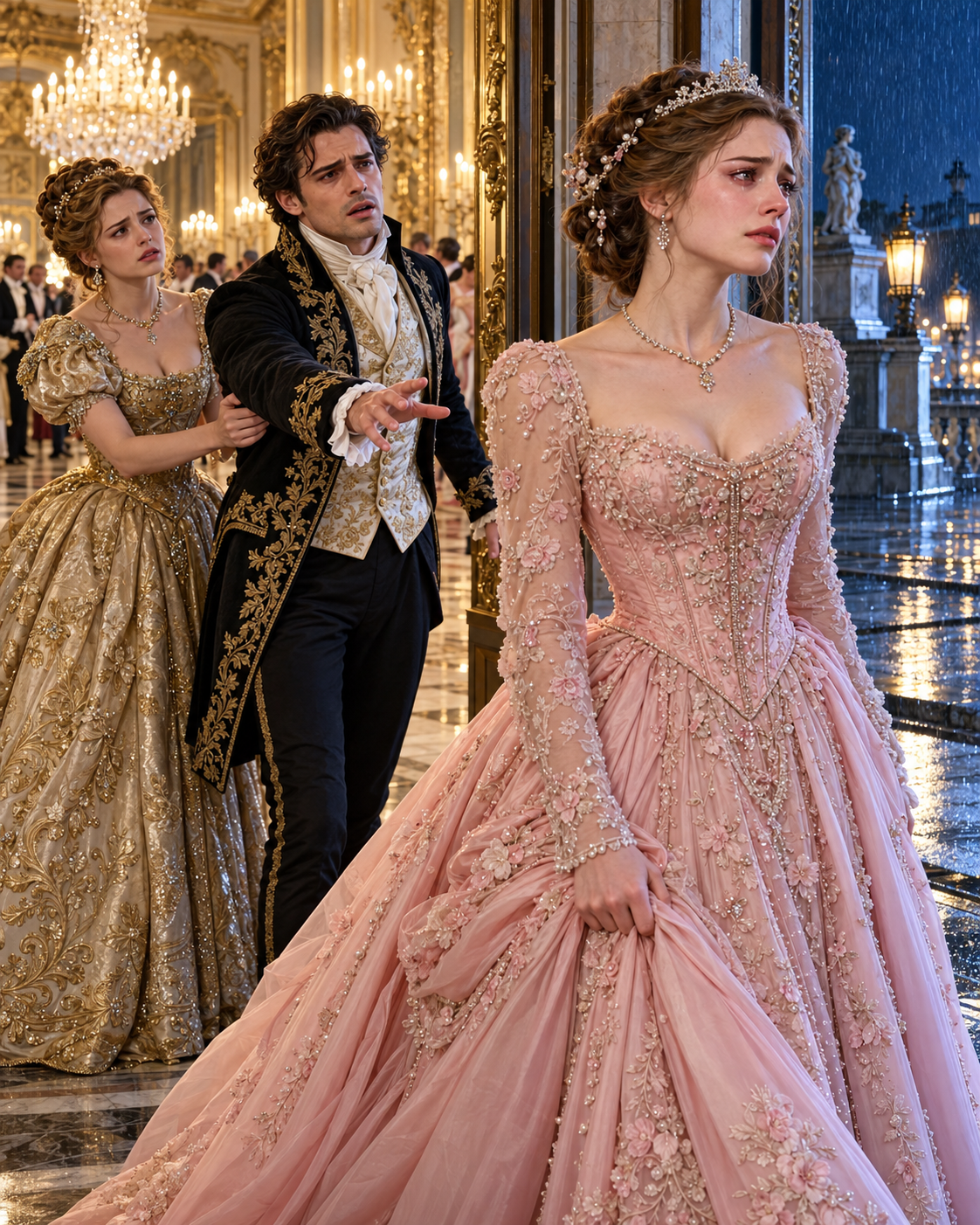
She thought of the grand house, the glittering assembly, and the night she had stood before Adelaide with her grandmother’s sapphire in her hand.
For years, she had believed that moment was the beginning of her ruin.
Now, from the window of a building filled with work, voices, and opportunity, it seemed almost impossibly distant.
“I regret how long I believed I had nowhere else to go,” she said.
Hester nodded.
Then she glanced toward the garden.
“The roses need pruning.”
Levvenia smiled.
“They always do.”
Together, they went downstairs.
Outside, the evening air smelled of fresh grass and warm stone.
Levvenia paused beneath the old flowering branch beside the cottage door, its leaves moving gently in the breeze.
For a moment, she touched the sapphire at her throat.
The stone was cool beneath her fingertips.
Once, it had been stolen from her and given away as though her memories, her history, and her dignity were things another person could distribute.
But the greatest thing she had recovered was not the brooch.
It was the right to decide what her life would become.
Her grandmother had left her property, money, and a place to begin again.
Yet none of those gifts could have built the life she now possessed without the choices she had made, the work she had undertaken, and the people who had stood beside her.
Levvenia looked toward the mill’s illuminated windows.
Tomorrow would bring more orders, more disagreements, more accounts to balance, and a hundred small decisions.
She welcomed them.
Because a life worth living was not one in which nothing ever went wrong.
It was one in which she no longer had to surrender herself to make everything appear right.
Hester called from the doorway.
“Are you coming in, or shall I eat your supper as well?”
Levvenia laughed and turned toward the warm light of the cottage.
“I’m coming.”
And as the evening settled over Bellweather, she stepped inside a home where nothing precious had to be hidden, no affection had to be purchased with obedience, and no woman had to wait for someone else’s permission to begin again.
The sapphire caught the last sunlight before the door closed.
This time, it belonged exactly where it was.
THE END.