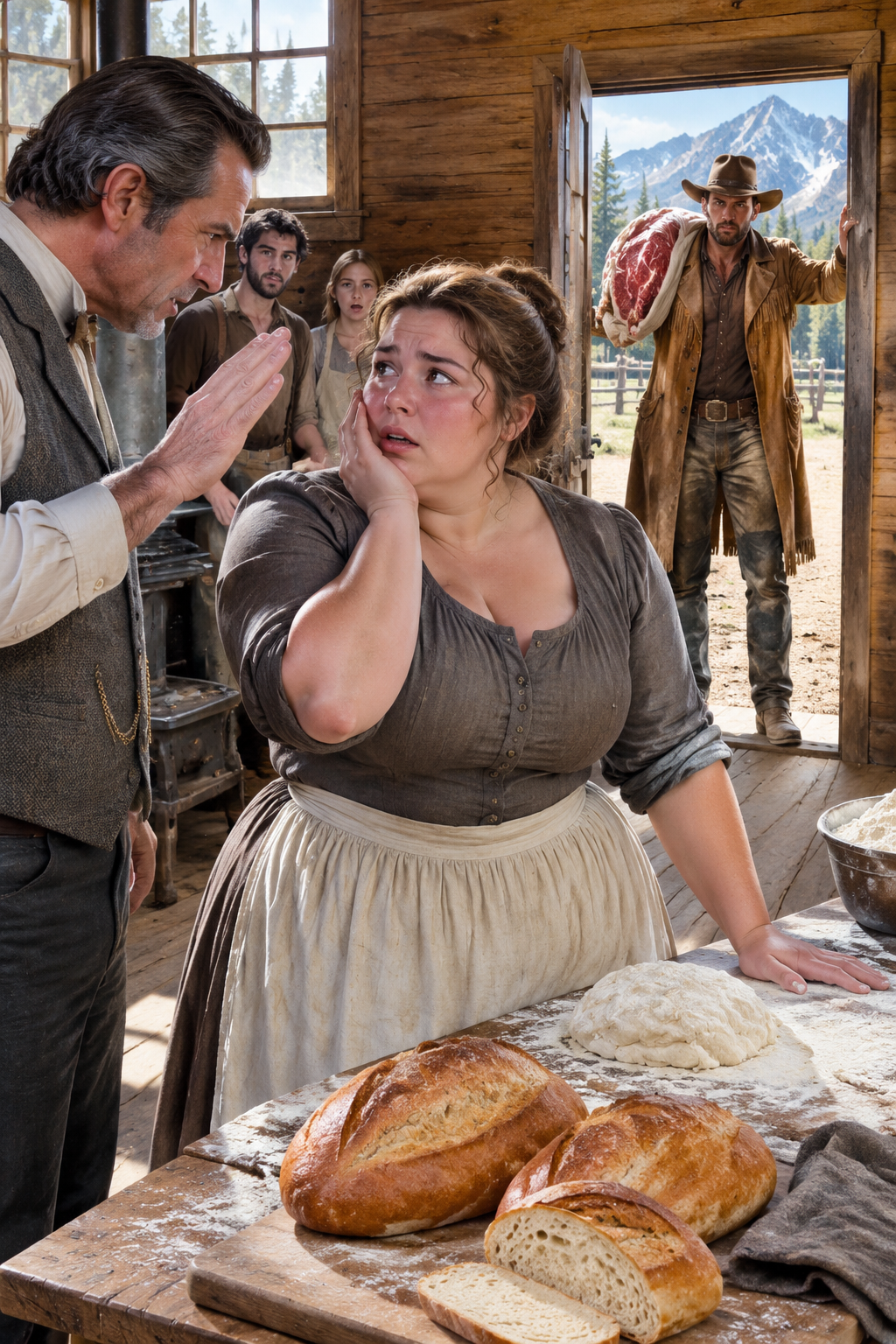
The saloon owner slapped me beside a barrel of spoiled pork, then laughed when I demanded my wages, unaware I had discovered his darkest secret.
The voice outside the storage shed belonged to Silas Harlan, and the moment he mentioned my husband, the twelve years I had spent trying to bury my grief came rushing back with such force that I nearly dropped the wooden chest.
My husband, Jonathan Marsh, had disappeared in the mountains during the winter of 1875, leaving behind a bloodstained coat, an unpaid wage envelope, and a sheriff’s declaration that he had probably fallen into a ravine.
For twelve years, I had believed the mountains had swallowed him, but now the man who had stolen my wages and treated me like property was standing outside a locked shed, speaking as though he knew exactly what had happened.
Emmett moved closer to the door, shielding me with his body while the wind pushed icy air through the cracks between the wooden boards.
“Step away from the door, Harlan.”
Silas laughed softly, and I heard another pair of boots scraping across the frozen ground.
“You always were too trusting, Crowder, just like your father.”
Emmett’s face tightened, but he remained silent as I searched the darkness for another exit.
Behind several stacked crates, I noticed a narrow ventilation opening beneath the roof, barely large enough for a person to squeeze through.
Silas continued talking, apparently enjoying the knowledge that we were trapped.
“Your brother wants the records, Emmett, and he’s willing to forgive a great deal if you hand them over.”
I pressed my fingers against Emmett’s sleeve and pointed toward the opening, but he shook his head when he realized how high it was.
Before either of us could move, the sound of liquid splashing against the outside wall made my stomach turn.
The sharp smell of kerosene reached us almost immediately.
“They’re going to burn us alive,” I whispered.
Emmett seized a heavy iron pry bar from the workbench and drove it beneath the boards covering a narrow rear service hatch.
The first board resisted, and the second cracked loudly enough for Silas to hear.
“Don’t make this difficult.”
Emmett struck again, splintering the wood while I dragged the chest toward the opening.
A match flared outside, illuminating the cracks in the wall with a brief orange glow.
Then flames began crawling along the lower boards.
I pushed the chest through the opening first, ignoring the pain as rough timber tore the skin from my hands.
Emmett helped me squeeze through, and together we tumbled into a snowbank behind the shed just as smoke began pouring through the roof.
We ran toward the trees, carrying the chest between us while voices shouted behind the burning building.
Only when we reached the creek did Emmett stop and look back at the orange flames rising against the black mountain sky.
“They’ll think we’re dead for a few minutes,” he said.
Those few minutes were all we had.
We followed the frozen creek toward an abandoned trapping cabin Emmett remembered from his childhood, stumbling through waist-deep snow until my lungs felt ready to burst.
By the time we reached shelter, my dress was soaked, my hands were bleeding, and the wooden chest seemed heavier than a coffin.
Emmett built a small fire while I opened my notebook and searched for the entry that had first connected Silas Harlan to Nathaniel Crowder.
There it was, written in my careful handwriting beside a payment made the previous autumn.
Three hundred dollars had been transferred to a man identified as J.M., with a note reading, “Final settlement for northern claim.”
I had assumed those initials belonged to some dishonest supplier.
Now I could barely breathe.
“Jonathan Marsh,” I whispered.
Emmett looked up from the stove, and the expression on his face told me he understood.
I opened the chest and spread the letters across the rough wooden table, searching desperately for anything bearing my husband’s name.
Near the bottom, beneath a stack of forged payroll receipts, I found a folded document tied with faded blue ribbon.
The handwriting on the envelope was unmistakable.
Jonathan had always formed the letter D in my name with an exaggerated curve, a habit I had teased him about during our first year of marriage.
My fingers shook so violently that Emmett offered to open the envelope for me, but I refused.
Whatever waited inside belonged to me.
The letter was dated January 1876, several weeks after Jonathan had supposedly died.
He wrote that he had discovered fraudulent land transfers involving Nathaniel Crowder and several businessmen in Silver Creek.
According to Jonathan, the men had been purchasing timber rights through false claims, then charging workers for equipment and supplies they had never received.
When Jonathan threatened to expose them, he was accused of stealing company money and taken to a remote logging settlement under armed supervision.
He had written the letter secretly, hoping someone trustworthy would deliver it to me.
The final paragraph made my heart ache.
“If this reaches you, Delphine, please know that I never left because I stopped loving you, and every day I am alive, I am trying to find my way home.”
I read those words three times before the tears finally came.
For twelve years, I had imagined my husband dying alone in the snow, calling my name while nobody came to help him.
Now I knew he had survived his disappearance, at least long enough to write that letter.
But the document dated from twelve years earlier, and the recent payment bearing his initials offered no proof that he was still alive.
Emmett sat across from me without speaking, allowing me the dignity of grieving without demanding that I explain myself.
Eventually, I looked at him through swollen eyes.
“Did your father know what happened to Jonathan?”
Emmett lowered his gaze.
“I don’t know, Delphine, but I’m beginning to fear that my family’s business was built on more suffering than I ever understood.”
His admission surprised me because I had grown accustomed to powerful men defending their reputations even when the truth stood directly before them.
Emmett did not make excuses.
Instead, he helped me examine every document until the first gray light of morning appeared beyond the mountains.
We discovered that Nathaniel had created a network of false debts designed to keep laborers working long after their wages should have paid their obligations.
Some men had been charged for tools they never used, while others had been billed for medical care following accidents caused by unsafe equipment.
The workers who protested were dismissed, threatened, or transferred to isolated camps where their families could no longer find them.
Silas Harlan had operated one of the places where those workers were held through debt, using his saloon and boarding rooms to extract whatever money remained.
I realized with growing horror that my own years of unpaid labor had not been an isolated cruelty.
They were part of a deliberate system.
By sunrise, Emmett and I had identified fourteen workers whose names appeared in both the timber records and my notebook.
One of them was Samuel Price.
Beside Samuel’s name was an address near the abandoned Silver Fork Mine, twenty miles east of Blackwater Ridge.
Emmett recognized the location immediately.
“That mine closed years ago, but there’s an old freight road leading to it.”
I wanted to leave at once, yet Emmett insisted we first return to the camp and warn the men.
If Nathaniel believed we had died in the fire, he might attempt to destroy the remaining records before anyone could investigate.
We approached the camp shortly after dawn, keeping to the trees until we saw several lumbermen gathered around the smoking remains of the storage shed.
Thomas Reed stood near the ashes, arguing with Vernon Pike, who had apparently returned during the night.
Vernon was telling the men that Emmett and I had stolen company funds before setting the building on fire.
My stomach tightened when I heard the accusation.
It was the same trick Silas had used whenever someone challenged his accounts.
Emmett stepped from the trees before I could stop him.
“Then perhaps you’d like to explain that story to me, Vernon.”
Every man in the yard turned.
Vernon’s face drained of color, and he took one step backward before Thomas caught his arm.
Emmett walked into the center of the gathering with his coat torn, his face blackened by smoke, and the wooden chest balanced against his hip.
He placed it on an overturned barrel.
“Someone tried to kill Delphine and me last night, and I believe the reason is inside this chest.”
The men crowded closer as I opened my notebook and began reading the names of workers whose wages had been stolen.
At first, nobody spoke.
Then Walter pushed forward, his weathered face trembling with anger.
“My boy worked here three winters ago, and they told me he owed more money when he left than when he arrived.”
Another man recognized his dead brother’s signature on a payroll receipt dated months after the funeral.
Thomas stared at the forged documents, his damaged hand resting against his chest.
For years, these men had believed their poverty was the result of personal failure.
Now they were seeing evidence that someone had carefully manufactured their debts.
Vernon tried to slip away, but two lumbermen blocked his path.
“I only followed instructions,” he protested.
I stepped toward him, holding the notebook open.
“Then tell us whose instructions.”
His eyes moved toward the office, where a curtain shifted behind the window.
For one terrible moment, I thought Nathaniel Crowder had already returned.
Instead, a young clerk named Peter emerged carrying a leather satchel.
He was barely twenty, with frightened eyes and a face that looked as though he had not slept in days.
“I know where Samuel Price is,” he said.
The entire yard fell silent.
Peter explained that Nathaniel had forced him to prepare false payroll records while threatening to imprison his father over an invented debt.
Samuel had discovered the fraud and tried to send evidence to the county authorities.
Nathaniel’s men intercepted him before he reached town.
Since then, Samuel and several other workers had been confined near Silver Fork Mine, repairing equipment and loading timber shipments under threats of violence.
Peter had secretly copied portions of the accounts, hoping to escape with the evidence.
He reached into his satchel and produced a small ledger wrapped in oilcloth.
“This is the real book,” he whispered.
Emmett opened it and found page after page of payments, property transfers, and names of officials who had accepted money to ignore complaints.
Near the back was an entry that made him stop breathing.
A payment had been recorded to Sheriff Daniel Mercer of Silver Creek, the same man who had declared Jonathan Marsh dead twelve years earlier.
I felt the ground shift beneath me.
The sheriff had not simply failed to find my husband.
He had been paid to stop looking.
Emmett immediately sent two trusted riders toward the county seat at Fairhaven, where a district judge was scheduled to hear land disputes that week.
He instructed them to deliver copies of the documents to the judge and request the assistance of a United States marshal.
Meanwhile, the workers agreed to remain together and protect the camp until lawful authorities arrived.
Vernon was confined in an empty cabin under guard, not because Emmett wanted revenge, but because he feared the man would warn Nathaniel.
I spent the afternoon preparing food for the men who volunteered to accompany us toward Silver Fork.
As I kneaded dough, I remembered the first meal I had cooked at Crowder’s camp, when I had been desperate to prove that I deserved a place at the table.
Now the same men who had once regarded me as a stranger were carrying supplies, checking horses, and asking how they could help.
Thomas approached while I was wrapping bread in clean cloth.
“You don’t have to go, Miss Marsh.”
I looked at his injured hand, remembering the wages he had lost and the shame he had carried.
“Someone once told my husband that nobody would believe him, Thomas, and I won’t let those words be the last thing he ever heard.”
We left before sunset, traveling along the old freight road with Emmett, Thomas, Walter, Peter, and four other men.
Snow fell steadily as we climbed through narrow passes, and the forest seemed to swallow every sound except the creaking harnesses.
Near midnight, we reached a ridge overlooking Silver Fork Mine.
Below us stood three wooden buildings, a fenced equipment yard, and a long barracks with smoke rising from its chimney.
Several lanterns burned near the entrance, where two armed guards paced beneath the falling snow.
Emmett studied the compound through a small brass telescope.
“We need to know how many men are inside before we do anything.”
Peter pointed toward a narrow trail behind the barracks.
He had once delivered supplies there and remembered a drainage passage running beneath the old ore-loading platform.
Thomas volunteered to investigate, but I insisted on accompanying him because Samuel might trust someone who knew his name.
We moved through the trees until the barracks stood only a few yards away.
Through a narrow window, I saw men sleeping on rough bunks beneath threadbare blankets.
One sat awake near the stove, holding his injured shoulder.
I recognized him immediately.
Samuel Price looked thinner than he had at Harlan’s Saloon, but the scar beside his eyebrow was unmistakable.
I tapped softly against the glass.
He turned, startled, then pressed a finger to his lips when he recognized my face.
A moment later, he opened the window just enough to whisper.
“Delphine, you shouldn’t be here.”
I told him we had found the records and that Emmett had sent for the authorities.
Samuel closed his eyes, struggling to control his emotions.
Then he said something I had waited twelve years to hear.
“Jonathan was here.”
My breath caught.
Samuel explained that Jonathan had been forced to work at Silver Fork for years after discovering Nathaniel’s fraud.
He had survived an illness, an attempted escape, and repeated threats against my life.
Whenever Jonathan refused to sign a false confession, Nathaniel told him that I would suffer for his disobedience.
Eventually, Jonathan agreed to maintain the mine’s accounts in exchange for a promise that I would be left alone.
I thought of all the years I had spent scrubbing floors and cooking for Silas, unaware that my husband had been sacrificing his freedom to protect me.
“Where is he now?” I whispered.
Samuel’s expression changed.
“Three nights ago, Nathaniel took him away after discovering he’d hidden copies of the original land deeds.”
Before I could ask where they had gone, a lantern swung around the corner of the barracks.
Thomas pulled me behind a stack of timber just as a guard approached.
We remained motionless until he passed, then retreated toward the ridge with Samuel’s information.
Emmett listened without interrupting, but I could see the terrible conflict growing in his face.
Nathaniel was his brother, the last living member of his immediate family, and every new discovery revealed another cruelty committed in the Crowder name.
“I won’t ask you to choose between your brother and me,” I told him.
He looked at me beneath the falling snow.
“There’s no choice to make between protecting innocent people and protecting a criminal.”
We decided against attacking the compound, knowing the guards might harm the imprisoned workers if they felt threatened.
Instead, Peter offered to approach the supply entrance carrying a forged delivery order bearing Nathaniel’s signature.
While the guards inspected the wagon, Thomas and two men would open the barracks from the rear and guide the workers into the trees.
The plan depended on timing, darkness, and a little luck.
It nearly failed when one guard recognized Peter and demanded to know why he had returned.
Peter swallowed hard but held out the delivery paper.
“Mr. Crowder ordered extra provisions before the storm closes the road.”
The guard examined the signature, grumbled about the weather, and waved him forward.
From my hiding place, I watched Thomas disappear behind the barracks.
Minutes passed without movement.
Then a small figure slipped between the buildings, followed by another.
Soon a line of exhausted men was moving silently toward the trees.
Samuel emerged last, helping an older worker whose legs could barely support him.
We had almost reached the horses when a shout shattered the darkness.
A guard had discovered the empty barracks.
Lanterns swung wildly, and several men rushed toward the fence.
Emmett stepped into the open and called out that the workers were leaving voluntarily and that evidence of their unlawful confinement had already been delivered to the authorities.
One guard raised his rifle, but another caught his arm.
Nobody fired.
Perhaps they understood that the workers outnumbered them, or perhaps they were simply unwilling to risk their lives for Nathaniel Crowder.
We led the rescued men into the forest and continued toward Blackwater Ridge until dawn.
By the time we reached camp, the first riders from Fairhaven had returned with encouraging news.
A deputy marshal was gathering men to investigate the mine, and the district judge had ordered the disputed financial records preserved.
But Nathaniel was still missing.
So was Jonathan.
Two days later, a messenger arrived carrying a sealed letter addressed to Emmett.
The handwriting belonged to Nathaniel.
He demanded that Emmett meet him alone at the abandoned Crowder family sawmill before sunset, promising to reveal Jonathan’s location in exchange for the original deeds.
Emmett showed me the letter without hesitation.
I read it carefully, then noticed something strange about the final sentence.
Nathaniel had written that Jonathan would be released once the family property was restored to its rightful owner.
The phrase troubled me because Emmett already owned the timber camp through a legally recorded inheritance.
When I examined the deeds we had recovered, I discovered that one document contained a different description of the northern boundary.
The disputed land included Silver Fork Mine and a valuable stretch of forest that Nathaniel had been secretly harvesting.
Jonathan had apparently uncovered evidence that Nathaniel’s claim was fraudulent.
If those records became public, Nathaniel would lose not only the property but the fortune he had accumulated through stolen timber.
We sent a rider to inform the deputy marshal of the meeting, then traveled to the old sawmill with copies of the documents.
I refused to remain behind.
For twelve years, men had decided what I should know, where I should work, and how much freedom I deserved.
I would not surrender another decision about my own life.
The abandoned sawmill stood beside a frozen river, its broken waterwheel hanging motionless beneath a roof heavy with snow.
Nathaniel waited inside, dressed in an expensive dark coat that seemed absurd against the ruined machinery.
He resembled Emmett enough to make my chest tighten, but his eyes were colder, and his smile held none of his brother’s quiet kindness.
“Delphine Marsh,” he said, studying me with open curiosity.
“I wondered how long it would take you to understand what your husband discovered.”
I stepped forward before Emmett could answer.
“Where is Jonathan?”
Nathaniel gestured toward a small office at the rear of the mill.
The door opened, and an older man emerged slowly, leaning against the frame.
His hair had turned almost completely gray, and a deep scar crossed one side of his forehead.
But I knew his face.
I knew the shape of his shoulders, the careful way he stood, and the familiar sadness in his eyes.
“Delphine?”
My knees nearly gave way.
Jonathan took one uncertain step toward me, then stopped as though afraid I might disappear.
I crossed the room before anyone could speak.
When I reached him, I pressed my hands against his face, feeling the roughness of his beard and the warmth of skin I had mourned for twelve years.
He began crying before I did.
“I’m sorry,” he whispered.
I held him tighter.
“You’re here.”
For a few precious seconds, the ruined sawmill, Nathaniel’s threats, and the years of suffering vanished beneath the simple miracle of holding my husband again.
Then Nathaniel cleared his throat.
“A touching reunion, but we still have business.”
He demanded the deeds and the original ledger, promising to release Jonathan if we surrendered everything.
Emmett placed the copies on a nearby table.
Nathaniel glanced at them, immediately recognizing that several pages were missing.
His smile disappeared.
“Where are the originals?”
“With the authorities,” Emmett answered.
Nathaniel’s expression twisted with rage.
He reached inside his coat, but before he could draw the revolver concealed there, Jonathan seized his wrist.
The two men struggled against the table, sending papers scattering across the floor.
Emmett rushed forward and forced Nathaniel’s arm downward while I pulled Jonathan away.
A shot cracked through the mill, splintering a wooden beam above us.
Then another voice rang out from the entrance.
“Drop the weapon.”
Deputy Marshal Isaac Bennett stood in the doorway with three armed officers behind him.
Nathaniel froze.
For the first time since I had met him, he looked like a frightened man rather than someone who believed the world belonged to him.
The marshal stepped forward and took the revolver.
Nathaniel began protesting that the entire affair was a misunderstanding, but Emmett quietly handed over the threatening letters and the records we had recovered.
Jonathan told the marshal about the years of confinement, the forged land deeds, and the payments made to Sheriff Mercer.
Nathaniel was arrested before sunset.
Silas Harlan was taken into custody three days later after investigators discovered additional false debt records hidden beneath the floorboards of his saloon.
Sheriff Mercer attempted to flee Colorado, but authorities detained him near the territorial border.
The investigation lasted months.
Workers traveled from distant settlements to testify about stolen wages, fabricated debts, and threats made against their families.
Some had believed they were alone in their suffering until they heard their own experiences repeated by strangers.
The court eventually ordered restitution from the property and funds investigators were able to recover, although not every stolen dollar could be returned.
Nathaniel received a prison sentence for his role in the fraud and unlawful confinement, while Silas and Mercer faced separate judgments for their crimes.
The proceedings could not restore the years we had lost, but they finally established that the men who had controlled our lives had no lawful claim to them.
Jonathan returned with me to Blackwater Ridge, where Emmett offered him work maintaining the legitimate timber accounts.
At first, my husband struggled with ordinary freedom.
He startled whenever someone entered a room unexpectedly and sometimes woke believing he was still locked inside the mine barracks.
I understood those moments better than anyone.
There were mornings when I reached for my notebook before remembering that nobody could deduct money from my wages without explanation.
There were evenings when Jonathan stood beside the window for hours, staring toward the mountains that had kept us apart.
We did not pretend that love could erase twelve years of pain.
Instead, we learned each other again through small, ordinary acts.
He carried firewood into my kitchen without being asked.
I saved him the crispiest corner of the skillet bread because I remembered how much he loved it.
Sometimes we sat together without speaking, grateful simply to hear the other breathing.
One afternoon, Emmett approached me with a proposal that changed the direction of my life.
He wanted to build a proper dining hall for the camp, with safe storage rooms, a larger kitchen, and enough space for workers to eat together without crowding around rough benches.
He offered me the position of kitchen manager, complete with authority over supplies, wages, and hiring.
I read the proposed agreement carefully.
Then I returned it with several changes.
The kitchen workers would receive written contracts, regular pay, and access to the accounts affecting their earnings.
Anyone injured on the job would receive assistance without being charged invented fees.
And no worker would ever be required to surrender personal documents or accept an unexplained debt as a condition of employment.
Emmett studied the pages for a long moment.
Then he signed.
The following spring, the new dining hall opened beneath a bright Colorado sky.
Thomas Reed became responsible for inventory and purchasing, a position that allowed him to work without risking further injury to his damaged hand.
Walter helped supervise the storerooms, while Peter maintained the payroll records under Emmett’s direction.
Samuel Price eventually returned to his family, carrying the wages recovered through the investigation and a letter confirming that the accusations against him had been false.
I hired two women who had previously worked at Harlan’s Saloon, both of whom arrived frightened and suspicious of promises.
I understood their hesitation.
On their first morning, I placed their employment agreements on the kitchen table and gave them as much time as they needed to read.
One woman looked at the paper, then at me.
“You mean I can leave if I don’t like it here?”
I smiled.
“Of course you can.”
She began crying so quietly that I pretended not to notice until she was ready to speak.
By summer, the dining hall had become the heart of Blackwater Ridge.
Men who once ate in silence now gathered around long tables, exchanging stories while the smell of fresh bread drifted through the open windows.
Jonathan began helping me keep the kitchen accounts in the evenings, his handwriting appearing beside mine in the same ledger.
Sometimes I caught him watching me with an expression I could not quite understand.
One night, I finally asked what he was thinking.
He reached across the table and took my hand.
“I spent twelve years dreaming about coming home to you, Delphine, but I never imagined you’d build a home big enough for so many people.”
I looked around the kitchen, remembering the spoiled pork, the slap across my face, and the laughter that had followed me through Harlan’s Saloon.
Back then, I had believed survival meant enduring whatever cruelty the world placed before me.
Now I understood that survival could also mean refusing to let cruelty become the foundation of someone else’s life.
On the first anniversary of my arrival at Crowder’s camp, Emmett presented me with a small wooden cabinet made from polished pine.
Inside were shelves designed to hold my notebooks and the new employment records.
A brass plate on the front bore three simple words.
“Every Name Matters.”
I ran my fingers across the letters, thinking of the workers who had died without receiving their wages, the families who had searched for missing husbands and sons, and the women who had been told their suffering was merely the price of having nowhere else to go.
I placed my original leather notebook on the highest shelf.
Its pages were worn, stained, and crowded with the desperate handwriting of a woman who had once been afraid to speak.
I would never destroy it.
Years later, when people asked how Blackwater Ridge became known as a place where workers were treated fairly, some credited Emmett’s leadership, others mentioned the investigation, and a few remembered the extraordinary meal I had prepared from nearly empty cupboards.
But I always remembered something smaller.
I remembered the moment I stood in that saloon, bleeding and humiliated, and refused to serve spoiled meat to men who trusted me with their lives.
That refusal had cost me dearly, yet it had also been the first time in years that I chose my conscience over my fear.
Jonathan and I never recovered the twelve years stolen from our marriage, and some wounds remained even after the courts delivered their judgments.
But we filled the years that followed with work, friendship, laughter, and the quiet happiness of making our own decisions.
And whenever a frightened stranger arrived at our kitchen door asking whether there might be a place for them, I remembered what it felt like to have nothing except the hope that someone would finally listen.
I always invited them inside before asking their name.
Because I had learned that freedom is not simply the absence of chains, and justice is not merely the punishment of cruel men.
Freedom is having the right to decide where your life goes next, and justice begins when someone refuses to look away from another person’s suffering.
The last page of my old notebook remained blank for many years, until one winter evening when Jonathan asked why I had never written anything there.
I thought for a moment, then took my pen and carefully wrote a single sentence.
“They tried to make me believe I was worth nothing, but they never understood that a woman’s worth was never theirs to decide.”
I closed the notebook, placed it beside the warm stove, and reached for my husband’s hand.
Outside, snow was falling over Blackwater Ridge, just as it had on the night I arrived frightened, exhausted, and uncertain whether I would ever truly be free.
But this time, the doors were unlocked, the kitchen was warm, and every person beneath our roof knew they had the right to leave.
And for the first time in my life, I understood the beautiful difference between having nowhere else to go and finally having somewhere I wanted to stay.