The morning my foreman called Grace Holloway a thief before twenty-two cowboys, I ordered him silent, unaware she had uncovered a betrayal inside my ranch.
The young woman stood beside the sheriff’s vehicle, clutching a photograph against her chest as the Wyoming wind whipped her brown hair across her face.
I had buried my daughter twenty-eight years earlier, and yet there she was, standing in my driveway with my dead wife’s eyes.
For several seconds, I forgot how to breathe.
The sheriff stepped forward, but I barely noticed him.
My attention remained fixed on the stranger who looked so painfully familiar.
Her face was older than the little girl I had imagined growing up in my dreams, but something about her expression reminded me of Eleanor on the morning we married.
Grace touched my arm gently.
“Arthur, you need to sit down.”
I shook my head.
“Who is she?”
Nobody answered.
Then the young woman climbed the porch steps, her boots leaving wet marks on the wood.
She looked at me as though she had spent her entire life preparing for this moment, only to discover she had no idea what to say.
“Are you Arthur Nolan?”
I nodded.
Her lower lip trembled.
“My name is Clara Whitmore. I think you might be my father.”
Behind me, something crashed against the floor.
Walter Mercer had dropped the chair he was standing beside.
The sound broke the terrible silence.
I turned and saw his face, pale and twisted with a fear I had never witnessed in all our years together.
For the first time, I understood that whatever secret Eleanor had discovered, Walter had known about it long before her death.
Sheriff Daniel Reeves removed his hat.
“Arthur, I’m sorry to arrive like this, but Miss Whitmore came to my office with information concerning an old hospital investigation.”
I stepped aside and allowed them into the house.
Clara entered slowly, looking around the hallway as though she were searching for memories she had never been allowed to make.
Her gaze settled on Eleanor’s portrait above the fireplace.
She stopped walking.
“Oh, God.”
I watched her press the photograph against her mouth.
“That’s her.”
My throat tightened.
“That’s my wife.”
Clara approached the portrait, staring at the painted face with tears gathering along her eyelashes.
“She came to see me once.”
The words nearly brought me to my knees.
“When?”
“Six years ago, just before she died.”
I gripped the back of a chair.
Eleanor had never mentioned visiting a young woman.
She had never told me there was even a possibility our daughter had survived.
Clara turned toward me.
“She said she was an old friend of my adoptive mother. She asked strange questions about my birthday, my childhood, and whether I’d ever been sick.”
Her voice began to shake.
“I thought she was just a lonely woman. I didn’t know who she was until last month.”
I looked toward Grace.
She was crying silently.
Before I could ask another question, Mercer headed toward the kitchen.
Sheriff Reeves blocked his path.
“Stay where you are, Walter.”
Mercer’s expression hardened.
“I have ranch business to attend to.”
“That can wait.”
The sheriff’s tone made it clear that the conversation was no longer optional.
Clara placed her photograph on the table.
It showed a newborn wrapped in a pale blue blanket.
Around the baby’s wrist was a hospital identification band.
I leaned closer.
The name written across it was Eleanor Nolan.
My knees weakened.
I remembered that blanket.
Eleanor had knitted it during the winter storms, sitting beside our fireplace while I read aloud from old western novels.
She had stitched tiny white flowers along its edges.
After the delivery, the doctor told us our daughter had died before taking her first breath.
I remembered Eleanor begging to hold the baby.
I remembered being told it was impossible.
And I remembered carrying my wife home while she stared through the wagon window without speaking.
For twenty-eight years, I believed grief had taken our daughter.
Now I wondered whether another human being had taken her instead.
“Where did you find this?” I asked.
Clara swallowed.
“My adoptive mother left it in a box after she passed away last spring.”
She opened her coat and removed a second photograph.
It showed Clara as a little girl standing beside a woman I didn’t recognize.
On the back, someone had written a date.
February 17, 1998.
The day my daughter was born.
Grace covered her mouth.
“I remember that day.”
We all turned toward her.
She looked at me with an expression so full of regret that I almost couldn’t bear it.
“I was working the night shift at the county hospital. I wasn’t a nurse, Arthur. I cleaned rooms and delivered linens.”
Her fingers twisted together.
“When your wife went into labor, the doctor ordered everyone out except the head nurse.”
I remembered the doctor’s name.
Harold Voss.
He had died twelve years earlier.
Grace continued.
“I heard the baby crying.”
The room seemed to disappear around me.
“What?”
“I heard her crying, Arthur. I know what I heard.”
A violent ache spread through my chest.
“But they told us she was dead.”
“They told me the same thing the next morning. They said I’d heard another baby.”
Grace’s voice cracked.
“I believed them because I was young, poor, and afraid of losing my job.”
Clara began crying.
I reached toward her but stopped halfway, uncertain whether I had any right to touch a woman who had spent her whole life without me.
She closed the distance herself.
Her fingers wrapped around mine.
And when I felt the warmth of her hand, something inside me that had been frozen for twenty-eight years began to break.
I wanted to hold her.
I wanted to ask about every birthday, every scraped knee, every Christmas morning.
But the terrible truth stood between us.
I had missed her entire childhood.
And somebody had made sure of it.
Mercer suddenly spoke.
“This is nonsense. Anyone can produce an old photograph.”
Sheriff Reeves turned toward him.
“Then you won’t mind explaining why your name appears on the hospital’s private payment records.”
Mercer went completely still.
The sheriff removed a folded document from his coat.
“Miss Whitmore hired an attorney to examine her adoption after discovering inconsistencies in her birth certificate. The investigation uncovered a payment made three days after her birth.”
I stared at the document.
A payment of twelve thousand dollars.
Authorized by Walter Mercer.
I looked at my old friend.
“Tell me this isn’t true.”
He said nothing.
“Tell me you didn’t sell my daughter.”
His eyes flashed.
“I didn’t sell anybody!”
“Then explain the money!”
The force of my voice startled even me.
Mercer stepped backward.
For a moment, I thought he might collapse.
Then he looked toward Clara.
“Your father doesn’t understand what happened.”
Clara straightened.
“Then tell him.”
Mercer stared at the floor.
“I was desperate.”
Those three words opened a door into a darkness I had never imagined.
He told us that in 1998, he had borrowed heavily to purchase cattle on his own account.
A disease outbreak destroyed most of the animals, leaving him owing money to men who threatened his family.
Dr. Voss had known about the debt.
And when Eleanor delivered a healthy daughter, the doctor made Mercer an offer.
A wealthy couple from Colorado had been waiting years to adopt a child.
They were willing to pay privately, without questions, for a newborn girl.
Mercer insisted the doctor had arranged everything.
He claimed he had only signed documents and helped move the money.
I listened without moving.
Every sentence made me feel as though someone were tearing pages from the life I should have lived.
“You knew she was alive,” I whispered.
He couldn’t meet my eyes.
“And you watched Eleanor mourn?”
His silence was unbearable.
“You stood beside her coffin six years ago.”
Mercer finally looked up.
His face had crumpled.
“I was going to tell you.”
“When, Walter? After another twenty-eight years?”
He began crying.
But I felt nothing for his tears.
I remembered the countless evenings he had sat at my dinner table.
The times he had asked about my wife.
The anniversary cards he had sent after her death.
I had mistaken familiarity for loyalty.
And my daughter had paid the price.
Sheriff Reeves stepped closer.
“Walter Mercer, you’re coming with me.”
Mercer didn’t resist.
But before the sheriff led him away, he turned toward Grace.
“You don’t know what you’re doing. That key will ruin everything.”
Grace lifted her chin.
“Some things deserve to be ruined.”
The sheriff guided him toward the door.
And for the first time in seventeen years, I watched Walter Mercer leave my house without wishing him a safe journey.
When the door closed, the silence felt almost unbearable.
Clara stood beside Eleanor’s portrait, wiping her cheeks with the sleeve of her coat.
I wanted to tell her she belonged here.
But I knew belonging could not be demanded, even by a father.
“Would you like some coffee?” I asked.
She laughed softly through her tears.
“That would be nice.”
Grace went into the kitchen.
I followed, finding her standing motionless beside the stove.
Her shoulders were shaking.
“Grace?”
She turned away.
“I’m sorry.”
I stared at her.
“For what?”
“For not trusting what I heard that night. For not asking more questions. For letting Eleanor carry this alone.”
I gently took the coffee pot from her trembling hands.
“You didn’t steal my daughter.”
“But I could have helped.”
“You are helping now.”
She shook her head.
“Arthur, there’s something you still need to see.”
She pointed toward the brass key lying on the counter.
“The old property east of here has a locked cellar. Eleanor told me everything she discovered was hidden there.”
I remembered the invoices.
The missing flour.
The cured meat.
The oil.
And suddenly I understood something that frightened me.
The thefts weren’t random.
Someone had been supplying that abandoned property for months.
“Does anyone live there?” I asked.
Grace hesitated.
“I don’t know.”
Outside, the storm had begun to weaken.
By evening, the snowplows had cleared enough of the county road for a truck to pass.
Sheriff Reeves returned after securing Mercer at the county jail.
He had already contacted the state investigators.
The old case would require evidence, witnesses, and records that might no longer exist.
But the suspicious invoices gave him a reason to examine the eastern property.
I insisted on going.
Clara refused to stay behind.
Grace pulled on her worn winter coat.
And together, we drove through the darkening fields toward a place I hadn’t visited in years.
The property had once belonged to Eleanor’s grandfather.
After his death, we had allowed the buildings to fall into disrepair.
I remembered an old barn, a collapsed fence, and a stone house surrounded by cottonwood trees.
But when our headlights reached the driveway, I saw fresh tire tracks cutting through the snow.
The sheriff noticed them too.
“Someone’s been here recently.”
The house looked abandoned from the road.
Its windows were boarded.
The porch sagged beneath a heavy blanket of snow.
But behind the barn, a narrow path had been shoveled.
We followed it to a wooden cellar door.
Grace reached into her pocket.
The brass key fitted perfectly.
When I pulled the door open, a strange smell rose from below.
Kerosene.
Fresh sawdust.
And something unmistakably human.
The sheriff switched on his flashlight.
“Stay behind me.”
We descended the steps slowly.
The cellar was much larger than I remembered.
Wooden shelves lined the walls.
Sacks of flour were stacked near barrels of lamp oil.
Crates of cured meat stood beneath a canvas covering.
Every missing supply from the ranch seemed to be there.
But the strangest thing wasn’t the food.
It was the small iron stove burning in the corner.
Someone had been living beneath that abandoned house.
And whoever it was had left only minutes before we arrived.
Clara pointed toward a table.
“There’s something over there.”
A lantern stood beside several notebooks.
Above them hung a photograph of Eleanor.
I stepped closer.
The picture showed her standing outside the county hospital.
Beside her was Grace, much younger, holding a bundle of clean linens.
Underneath the photograph lay a handwritten message.
“If Arthur comes here, tell him I tried.”
I knew Eleanor’s handwriting.
My hands began trembling.
The sheriff searched the adjoining room while Grace opened the first notebook.
Inside were dates, names, and payments.
Not just records from 1998.
There were entries covering more than twenty years.
Some referred to hospital employees.
Others listed private adoption payments.
One name appeared repeatedly.
Margaret Bell.
Grace gasped.
“She was the head nurse.”
I remembered her.
A tall woman with silver hair who had held Eleanor’s hand after the delivery.
She had told us our daughter never suffered.
She had looked me in the eyes while speaking those words.
I had thanked her.
The memory sickened me.
Sheriff Reeves returned carrying a suitcase.
“There’s clothing in the back room, and medicine. Whoever stayed here was elderly.”
He opened the suitcase.
Inside were documents, newspaper clippings, and several unopened letters addressed to me.
Every letter carried Eleanor’s handwriting.
My chest tightened.
“Why would they be here?”
Grace began turning the pages of another notebook.
Then she stopped.
“Arthur, look at this.”
The final entry was dated three weeks earlier.
It described food deliveries, medical expenses, and payments made through ranch accounts.
At the bottom was a signature.
Margaret Bell.
The sheriff exhaled sharply.
“She’s still alive.”
Before anyone could respond, headlights flashed through the cellar’s small window.
A vehicle had pulled into the driveway.
The sheriff motioned for us to remain silent.
Footsteps crossed the snow.
Then a woman’s voice called from above.
“Walter? Is that you?”
The sheriff climbed the stairs.
“Margaret Bell?”
There was a gasp.
Then the sound of someone running.
I heard Reeves shout for her to stop.
By the time I reached the yard, an elderly woman was struggling beside a rusted pickup truck.
The sheriff caught her before she could open the driver’s door.
She looked frail, but her eyes were sharp and frightened.
When she saw Clara standing beside me, her expression changed.
“Oh, sweetheart.”
Clara froze.
“You know me?”
Margaret began crying.
“I held you the day you were born.”
I wanted to scream.
Instead, I asked the only question that mattered.
“Why?”
Margaret looked at me.
For a moment, I saw something like genuine sorrow.
Then she lowered her head.
“Because I thought I was helping.”
The sheriff led her inside.
Under questioning, Margaret admitted that Dr. Voss had arranged several illegal adoptions.
Some children had been born to women who were vulnerable and frightened.
Others, like Clara, had been taken from parents who were deliberately told their babies had died.
The doctor had controlled the records.
Margaret had helped falsify them.
Mercer had provided transportation and accepted money for his role.
And when Eleanor began investigating years later, Margaret had been terrified.
“She came to me six years ago,” Margaret whispered.
“She had found a discrepancy in an old medical insurance claim. She wanted to know why the hospital had billed for newborn care after her daughter supposedly died.”
I gripped the edge of the table.
“What did you tell her?”
“The truth. Not all of it, but enough.”
Eleanor had discovered that Clara was alive.
She had found her adoptive family.
And she had traveled to Colorado to see her.
But according to Margaret, Eleanor had been afraid of what revealing the truth might do to Clara.
“She wanted proof before she approached Arthur,” Margaret said.
“She was afraid the people involved would destroy the records.”
I looked at Clara.
Her cheeks were wet again.
“She knew I was alive?”
Margaret nodded.
“She wanted to bring you home.”
The words struck me with unbearable force.
My wife had died carrying hope and fear that I had never known existed.
Six years earlier, Eleanor had been killed when her car slipped from an icy mountain road.
The authorities called it an accident.
I had never questioned it.
Until that night.
“Did Walter know she was investigating?” I asked.
Margaret’s face drained.
“He found out.”
The sheriff leaned forward.
“What happened to Eleanor’s car?”
Margaret began shaking.
“I don’t know.”
“Margaret.”
She covered her face.
“I heard Walter arguing with Dr. Voss about Eleanor before the doctor died. Years later, when Eleanor started asking questions again, Walter told me he would handle it.”
My stomach turned.
The sheriff’s expression hardened.
“Did he threaten her?”
Margaret nodded slowly.
“He said if she went to Arthur, everyone would lose everything.”
I stared at the floor.
For six years, I had blamed the weather.
Now I wondered whether my wife had ever stood a chance on that mountain road.
But Margaret had no evidence of tampering, and I knew suspicion was not the same as proof.
The sheriff promised the investigation would include Eleanor’s death.
I accepted his words because I had nothing else to hold on to.
By midnight, Margaret had been taken into custody.
Investigators were coming for the notebooks.
The stolen supplies would be returned.
And the state would begin examining the old hospital records.
But I barely cared about the flour anymore.
I stood outside the cellar while snow drifted beneath the cottonwood trees.
Clara joined me.
For a while, neither of us spoke.
Then she asked a question that nearly broke my heart.
“Did you ever stop thinking about me?”
I turned toward her.
“No.”
She looked down.
“Even when you thought I was dead?”
“Especially then.”
I told her about the little wooden cradle I had built before she was born.
About the yellow nursery Eleanor had decorated.
About the tiny pair of boots I had purchased, knowing it would be years before she could wear them.
Clara listened with tears in her eyes.
Then she reached into her coat and removed a small silver bracelet.
“My adoptive mother gave me this when I turned eighteen. She said it came with me when I was a baby.”
I recognized it immediately.
Eleanor had worn the bracelet since childhood.
Before going into labor, she’d told me she wanted our daughter to have it.
Clara held it between us.
“I always wondered why it had two initials engraved inside.”
I leaned closer.
E.N.
Eleanor Nolan.
My wife had somehow managed to give our daughter one piece of herself before they were separated.
I could no longer contain my grief.
I covered my face and cried.
Not the restrained tears I had shed at Eleanor’s funeral.
These were the broken, helpless sobs of a man discovering how much of his life had been stolen.
Clara wrapped her arms around me.
And for the first time in twenty-eight years, I held my daughter.
I don’t know how long we stood there.
I only remember the snow falling around us and the strange feeling that Eleanor was no longer quite so far away.
The following weeks brought more revelations.
Investigators confirmed that the hospital records had been altered.
A court-authorized DNA test established what my heart had already begun to believe.
Clara was my daughter.
Mercer eventually admitted helping arrange the illegal adoption, though he continued denying involvement in Eleanor’s death.
Margaret cooperated with investigators and identified several other families affected by the scheme.
The case grew beyond our small Wyoming county.
Reporters began calling.
Attorneys arrived.
And people who had spent decades believing their children were dead began searching for answers.
The investigation into Eleanor’s accident remained open.
I learned that not every question receives an answer simply because someone finally asks it.
Some truths take years to uncover.
Others leave scars that no courtroom can erase.
But amid all the turmoil, Grace kept our house standing.
Every morning, she prepared breakfast.
Every evening, she checked the kitchen accounts.
She made sure Mrs. Bennett received proper treatment and continued receiving financial support while she recovered.
She ensured the cowboys were paid on time.
And when the reporters gathered outside our gate, Grace quietly brought Clara through the back garden so she wouldn’t have to face them.
One morning, I found her alone at the kitchen table.
She was examining the ranch’s finances again.
Her spectacles had slipped down her nose.
A cup of cold coffee sat beside her.
“You’re working too hard,” I said.
She smiled faintly.
“Someone has to keep you from going bankrupt.”
I pulled out the chair opposite her.
“Grace, I owe you more than wages.”
She shook her head.
“You don’t owe me anything.”
“That’s where you’re wrong.”
I told her how much her courage had changed my life.
How easily I might have dismissed her suspicions.
How close I had come to spending the rest of my years believing my daughter was buried beneath a small white stone.
Grace listened without interrupting.
Then she said something I have never forgotten.
“Arthur, I spent most of my life thinking being useful was the same as being valued.”
Her eyes shone.
“When my husband died, people stopped asking how I was doing. They only asked whether I could work.”
I felt ashamed remembering how little attention I had paid her.
She continued.
“Your wife was different. She always asked whether I’d eaten. She remembered my birthday. When I couldn’t afford medicine, she quietly paid the bill.”
Grace looked toward Eleanor’s portrait in the hallway.
“I couldn’t save her, Arthur. But I could keep trying to finish what she started.”
I reached across the table and took her hand.
“You did more than finish it.”
She smiled through her tears.
For the first time, I understood that Grace had not simply uncovered a crime.
She had kept Eleanor’s love alive when the rest of us believed the story was over.
Spring arrived slowly that year.
The snow melted from the valley, revealing fences that needed repairing and fields waiting to be planted.
Clara began visiting every weekend.
At first, our conversations were awkward.
She had a life in Colorado.
A job teaching elementary school.
Friends.
Memories that didn’t include me.
And loving her didn’t give me the right to pretend those years had never happened.
I learned to ask instead of assume.
I listened when she talked about her childhood.
I thanked her adoptive parents for the love they had given her, even while grieving the terrible way she had been placed in their care.
Clara’s adoptive mother had apparently believed the adoption was legitimate.
Her father, who had died several years earlier, had never known about the deception.
I refused to make Clara feel guilty for loving the people who raised her.
One afternoon, she found me repairing the old cradle in the barn.
It had been stored beneath a dusty canvas for almost three decades.
I was sanding a broken rail when she stepped inside.
“What’s that?”
I looked up.
“Something I made for you.”
She ran her fingers along the wood.
“You kept it?”
“I couldn’t throw it away.”
For a long time, she stood beside me without speaking.
Then she smiled.
“Maybe someday you can make another one.”
I looked at her.
Her cheeks turned pink.
“I’m not saying anything is happening soon. But if I ever have children, I’d like them to know you.”
My hands began trembling.
After years of believing my family had ended, I suddenly saw a future stretching beyond my own lifetime.
“I’d like that very much,” I whispered.
She hugged me.
And I knew then that our relationship wasn’t built by blood alone.
It would be built by showing up.
Again and again.
For however many years we were given.
That summer, I made another decision.
I converted the abandoned eastern property into a community pantry and emergency shelter.
The stolen supplies had exposed how vulnerable our workers and neighboring families could become during severe weather.
I didn’t want another Grace Holloway waking at three in the morning because she feared twenty-two hungry men would have nothing to eat.
We repaired the stone house.
Installed a new stove.
Stocked shelves with food, blankets, and medicine.
And established a fund to help ranch workers facing illness or hardship.
I asked Grace to oversee it.
She protested immediately.
“Arthur, I’m a cook, not some fancy administrator.”
I smiled.
“You’re the best administrator I’ve ever met.”
She laughed, but I could see how much the offer meant to her.
We named the place Eleanor’s House.
On opening day, dozens of neighbors gathered beneath the cottonwood trees.
Mrs. Bennett attended, finally healthy enough to leave her home.
Several cowboys brought their families.
Clara stood beside me, holding a framed photograph of her mother.
And Grace, wearing a simple blue dress, welcomed everyone through the front door.
I watched her greeting people, remembering that snowy morning when she had hesitated at my own entrance.
Some wounds heal slowly.
But dignity can begin returning in a single moment.
Later that afternoon, Clara approached me with a small wooden box.
“We found this among Mom’s things at the cellar.”
Inside was one final letter.
The envelope bore my name.
I recognized Eleanor’s handwriting and felt the old ache return.
Clara squeezed my hand.
“I think you should read it.”
I stepped outside onto the porch, where the evening sun painted the fields gold.
Then I opened the letter.
My dearest Arthur,
If you are holding this, I hope it means the truth has finally found its way home.
I have been afraid for so long.
Afraid of what I discovered.
Afraid of what might happen if I speak.
And most of all, afraid that after everything we’ve lost, hope might hurt you more than grief.
But I need you to know something.
Our daughter lived.
She grew into a kind young woman with your eyes when you smile and your stubborn way of lifting your chin when you’re frightened.
I have seen her.
I have heard her laugh.
And though she doesn’t yet know who I am, she carries pieces of both of us.
I wanted to tell you sooner.
Please forgive me for waiting.
I thought I could make everything certain before asking you to believe the impossible.
Perhaps I was wrong.
Perhaps love doesn’t require certainty before it deserves courage.
If I cannot finish this journey, please don’t spend the rest of your life hating the people who hurt us.
Seek justice.
Protect those who cannot protect themselves.
But don’t let bitterness steal the years we still have.
You’ve already lost too many.
And Arthur, if someone kind reaches for your hand when I’m gone, please don’t turn away because you think loving again would betray me.
Love was never meant to become another prison.
It was always meant to open doors.
Forever yours,
Eleanor.
By the time I finished reading, tears had blurred the fields before me.
I sat on the porch steps, holding the letter against my chest.
For years, I had imagined Eleanor waiting somewhere beyond death, perhaps disappointed that I had continued living without her.
But now I understood what she had wanted.
Not for me to remain trapped in sorrow.
Not for our home to become a monument to everything we’d lost.
She wanted life to continue.
She wanted love to survive.
I heard footsteps behind me.
Grace stood in the doorway.
She didn’t ask what the letter said.
She simply sat beside me.
We watched the sun sink behind the mountains.
After a while, I reached for her hand.
She looked surprised.
But she didn’t pull away.
I didn’t know what the future would bring for us.
We were no longer young, and both carried histories too complicated for easy promises.
But for once, I wasn’t afraid of beginning something slowly.
That evening, Clara joined us on the porch.
She rested her head against my shoulder while Grace brought three cups of coffee.
The ranch stretched quietly before us.
Somewhere in the distance, cattle moved through the summer grass.
And the house that had been silent for so many years finally sounded like a home.
Months later, Mercer was convicted for his role in the illegal adoption scheme and the thefts from my ranch.
Other charges connected to the hospital investigation followed as more evidence emerged.
The authorities continued reviewing Eleanor’s death, but they never established that Mercer had caused the accident.
I had to learn to live with that uncertainty.
Justice did not bring back the years we had lost.
It did not return Eleanor.
It did not give Clara the childhood we should have shared.
But it ended the silence that had allowed so much cruelty to survive.
And sometimes, ending that silence is where healing begins.
The following winter, another blizzard swept across Wyoming.
It arrived just after midnight, carrying fierce winds and heavy snow.
At three in the morning, I woke to the familiar smell of fresh bread.
For a moment, I thought I had traveled backward in time.
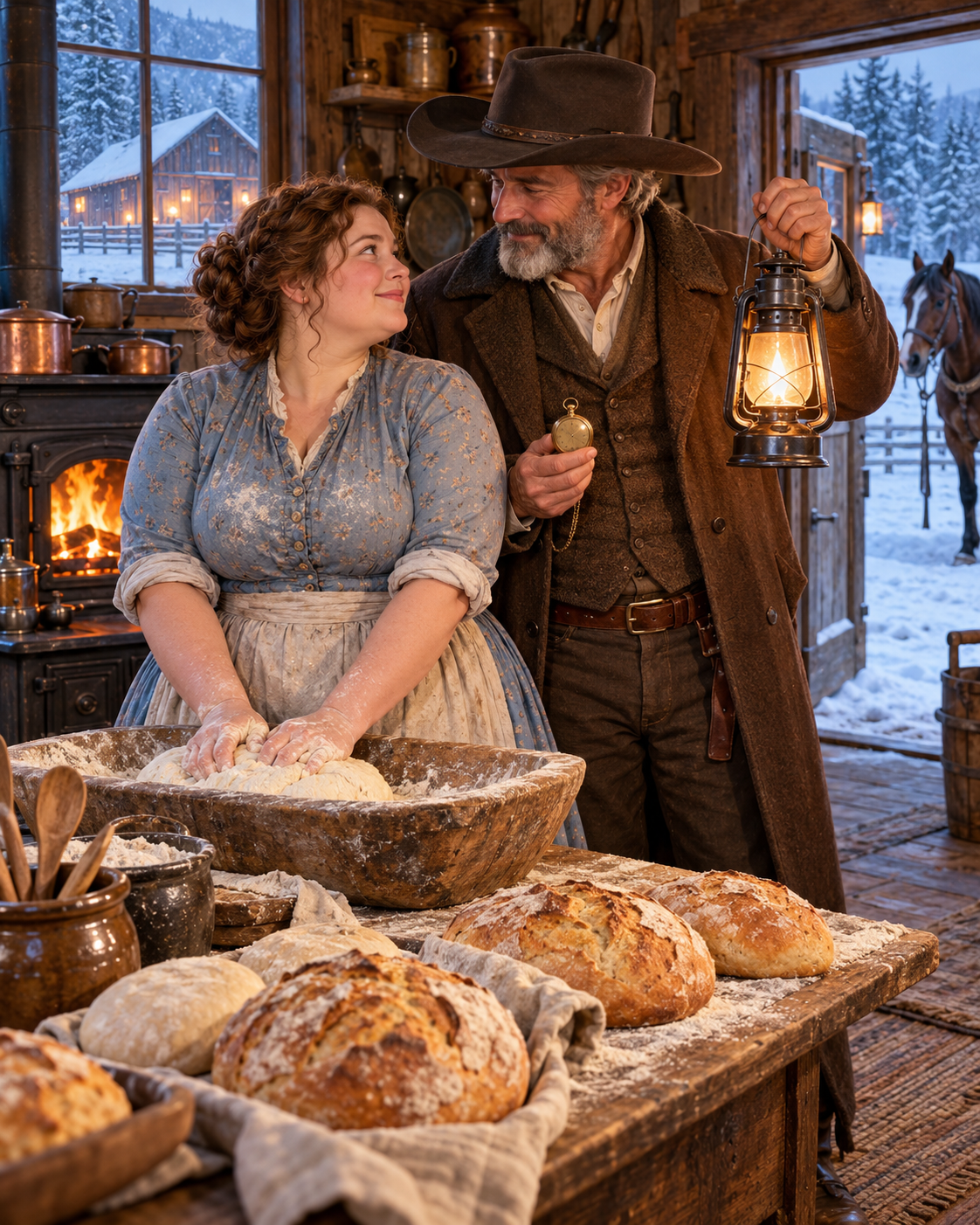
I walked downstairs and found Grace standing beside the stove.
She was kneading dough, humming softly to herself.
But this time, she wasn’t alone.
Clara stood beside her, laughing as she struggled to shape a loaf.
Mrs. Bennett sat nearby, supervising with the authority of a woman who had spent forty years feeding hungry cowboys.
And on the table were three cups of coffee.
One for Grace.
One for Clara.
And one waiting for me.
“You’re late,” Grace said without looking up.
I smiled.
“Didn’t realize I had an appointment.”
Clara held up her crooked loaf.
“Grace says this one’s going to look like a saddle.”
I laughed harder than I had in years.
Then I rolled up my sleeves and joined them.
Outside, the storm howled against the windows.
Inside, the kitchen glowed with warmth.
I looked at the two women beside me and thought about how strangely life had brought us together.
One had been stolen from me before I could learn the sound of her voice.
The other had spent years walking quietly through my home, carrying burdens I had never bothered to notice.
Both had changed my life.
And both had taught me something no amount of money or land could ever purchase.
That love is not proven by the grand promises we make when life is easy.
It is proven by the doors we open when someone has been left outside.
By the truth we defend when silence would be safer.
By the people we choose to see when the rest of the world looks away.
I had spent most of my life believing a man was wealthy because of the land he owned, the cattle he raised, and the money he kept in the bank.
But standing in that kitchen, flour on my hands and laughter filling the room, I finally understood how wrong I’d been.
Real wealth was having someone save you a cup of coffee.
It was hearing your daughter call you Dad.
It was knowing that kindness given quietly could survive longer than cruelty guarded by powerful men.
And it was recognizing that sometimes the person who saves your family isn’t the one who makes the loudest promises.
Sometimes she’s the woman standing in your kitchen at three in the morning, baking bread for twenty-two hungry cowboys, asking for nothing because she believes everyone deserves to be fed.
That morning, I watched Grace open the oven and lift out a perfect golden loaf.
She placed it on the table and smiled at me.
“Breakfast is ready, Arthur.”
I looked toward the window, where snow covered the fields as far as the eye could see.
Then I looked at the people around my table.
For the first time in twenty-eight years, I wasn’t thinking about everything the storm had taken from me.
I was thinking about everything that had finally found its way home.
And when Clara slipped her hand into mine, I silently thanked Eleanor for leaving one final truth behind.
The greatest tragedy isn’t always what life takes from us. Sometimes it’s the love we fail to recognize while it’s standing right in front of us.
THE END.