The mechanic was halfway under Dominic Moretti’s SUV when she spotted something that made her stop breathing for a second.
Norah read the three words again.
“Ask about Marcus.”
For a moment, the sounds of the garage seemed to fade around her. Somewhere behind the service bays, an air compressor kicked on. A mechanic laughed at something on the radio. Outside, Chicago traffic moved through the cold evening as if nothing had changed.
But Norah knew better.
She looked at Evelyn Price, whose hands were trembling around the envelope.
“What exactly am I supposed to ask him?”
Evelyn glanced toward the office window.
“Ask why he knew Dominic’s brakes had been tampered with before anyone showed him the damage.”
Norah felt a cold sensation settle in her stomach.
Marcus Bennett had been standing beside Dominic in the museum garage that night. He had examined the severed brake line after Norah discovered it. At least, that was how she remembered it.
“What are you saying?”
“I’m saying someone sent Marcus a warning that afternoon. Hours before Dominic left the museum.”
“Who?”
Evelyn shook her head.
“I don’t know. But I saw the message.”
Norah studied her face. Evelyn looked frightened, but fear wasn’t proof of honesty. She had already admitted hiding financial irregularities, and she had every reason to redirect attention toward someone else.
“Why didn’t you tell Dominic?”
“Because Marcus was the one who told me to stay quiet.”
That was enough to change Norah’s plans.
She didn’t take the envelope into Dominic’s office. Instead, she photographed its exterior, placed it in a clean plastic document sleeve, and called the independent attorney who had been advising the company’s board.
Then she called Dominic.
“Come outside,” she said. “Alone.”
He appeared two minutes later, still wearing the charcoal suit he’d had on all day.
“What’s wrong?”
Norah watched his face carefully.
“Evelyn says Marcus knew about the brake line before I found it.”
Dominic didn’t answer immediately.
Then he looked through the window toward Marcus.
“That’s impossible.”
“That’s what you said about Evelyn.”
The words landed harder than Norah intended.
Dominic turned back to her.
“Do you believe her?”
“I believe we need to find out.”
He studied the envelope in her hand.
“What’s that?”
“Something Evelyn brought. I’m not giving it to anyone until her attorney and the investigators know it exists.”
Dominic’s jaw tightened.
“You’re telling me I can’t see evidence concerning an attempt on my life?”
“I’m telling you that evidence has to survive whatever happens next.”
For several seconds, neither spoke.
Then Dominic took out his phone.
“What do you need?”
“First, don’t tell Marcus about this conversation.”
Dominic stared at her.
“You’re asking me to hide something from the man responsible for keeping me alive.”
“No,” Norah replied. “I’m asking you to consider that the man responsible for keeping you alive might be connected to the reason someone wants you dead.”
That night, Dominic made the hardest telephone call of his career.
He contacted Detective Elena Ruiz, the Chicago police investigator working the vehicle-tampering case, and told her his security chief might possess undisclosed evidence.
He didn’t ask her to arrest Marcus.
He asked her to investigate him.
By morning, Marcus Bennett had been placed on leave, his company access suspended pending review. Ruiz arranged for the preservation of his communications and security records through appropriate legal procedures.
Marcus didn’t argue when Dominic informed him.
That bothered Norah more than anger would have.
He simply looked at Dominic and said, “I wondered when this would happen.”
Dominic went pale.
“When what would happen?”
“When someone finally found out I made a mistake.”
Marcus sat across from them in the conference room, his hands resting on the polished table.
He had protected Dominic for almost eight years. Before joining Moretti Logistics, he had worked in corporate investigations, handling threats against executives whose money attracted dangerous attention.
He had always seemed careful.
Now he looked exhausted.
“Three weeks before the museum incident,” Marcus began, “I received an anonymous message warning me that someone inside Moretti Logistics was planning to hurt you.”
Dominic leaned forward.
“And you didn’t tell me?”
“I didn’t think the threat was credible.”
“Someone cut my brakes.”
“I know.”
Marcus swallowed.
“The message said there would be an accident. It mentioned a vehicle from the executive fleet, but it gave no date or location. I checked the maintenance reports. Everything showed clear.”
Norah folded her arms.
“And the second message?”
Marcus looked at her sharply.
Evelyn had been right.
“There was another warning the afternoon of the museum event,” he admitted.
“What did it say?”
“That Dominic shouldn’t leave in his usual vehicle.”
The room fell silent.
Dominic pushed back his chair.
“You knew.”
“I knew someone was threatening you. I didn’t know the brakes had been cut.”
“You had a warning about my vehicle, and you let me walk into that garage?”
Marcus lowered his eyes.
“I had the SUV moved to a secured section for a quick inspection. My deputy reported nothing unusual.”
“Who was your deputy?” Norah asked.
“Daniel Cross.”
Norah remembered the name.
Daniel had appeared on several fleet-access records connected to the suspicious maintenance approvals.
A detail that had seemed unimportant now demanded attention.
“Where is he?”
Marcus hesitated.
“He resigned yesterday.”
Dominic stood so abruptly that his chair struck the wall.
“Yesterday?”
“He said his mother was ill.”
Norah reached for her phone.
She pulled up the spreadsheet she had been building from the fleet records.
There it was.
Daniel Cross had used his security clearance to enter the executive parking garage on four occasions involving vehicles later found to have suspicious damage.
He had also been assigned to escort outside contractors during overnight maintenance.
“Marcus,” Norah said quietly, “who hired Daniel?”
Marcus looked up.
“Thomas Greer recommended him.”
The room seemed to shrink.
Thomas, the chief financial officer under investigation for fraudulent maintenance payments, had helped place someone inside Dominic’s security team.
And Marcus, without realizing it, had given that person access to almost everything.
Detective Ruiz arrived an hour later.
She listened without interruption while Marcus repeated his account and provided the original messages. Investigators would have to determine why he had withheld them and whether his actions amounted to negligence, misconduct, or something worse.
What mattered immediately was finding Daniel Cross.
His company phone had been turned off.
His apartment was empty.
And a security camera near the company’s southern distribution terminal had recorded him entering the property shortly before dawn.
That terminal employed nearly four hundred people.
It also held financial records connected to the subsidiary Evelyn had described.
Dominic understood the significance before anyone explained it.
“He’s going after the records.”
“Maybe,” Ruiz said. “Or he’s trying to get something out before investigators seize it.”
Norah had been listening quietly.
Now she opened another document.
“There’s a bigger problem.”
She showed them a list of vehicles stationed at the terminal.
Six heavy trucks had received questionable maintenance approvals during the previous month.
Two were scheduled to leave that afternoon.
“If the same people who tampered with Dominic’s SUV were working on those trucks,” she said, “we can’t assume they’re safe.”
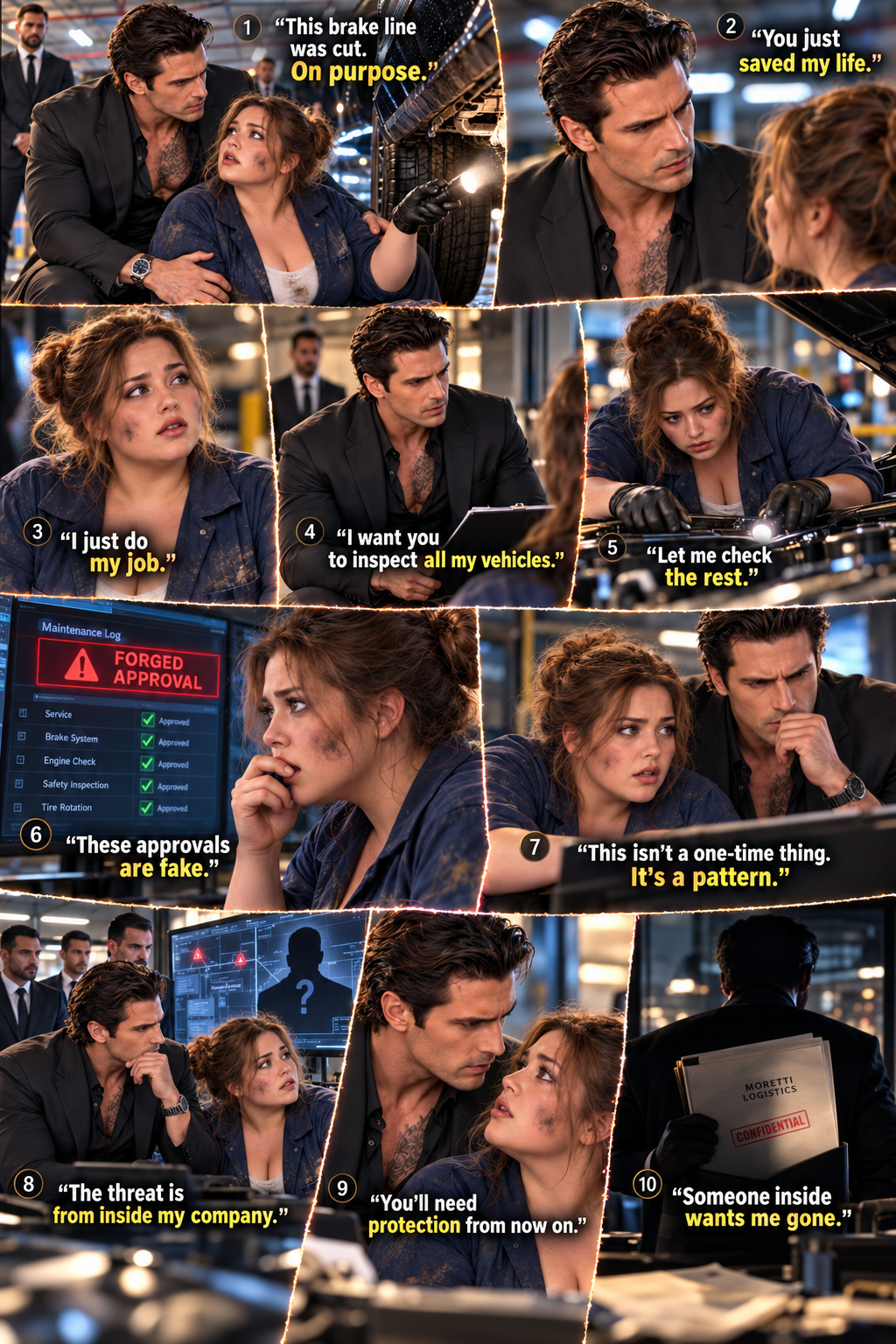
Dominic reached for his phone.
“Then we stop them.”
His operations director warned that delaying those deliveries could cost the company millions in penalties.
Dominic didn’t hesitate.
“Park every truck that hasn’t passed an independent inspection.”
The director started protesting.
Dominic interrupted him.
“I can replace a contract. I can’t replace a driver.”
For the first time, Norah saw him make a decision that had nothing to do with protecting his reputation or maintaining control.
And she respected him for it.
By noon, the terminal was in chaos.
Drivers demanded explanations. Dispatchers scrambled to rearrange routes. Customers called threatening legal action.
Norah and two trusted mechanics began examining the affected trucks, documenting everything they found.
Inside the third vehicle, she discovered damage that made her stop working.
A retaining component in the steering assembly had been deliberately loosened.
Under ordinary conditions, the truck might have traveled hundreds of miles before the problem became obvious.
At highway speed, the consequences could have been catastrophic.
Norah climbed down and found Dominic waiting near the inspection area.
“Someone was willing to put a driver at risk to keep this quiet,” she told him.
Dominic looked toward the loading docks, where workers stood beside parked trucks.
For years, he had measured the success of his company in revenue, contracts, and expansion.
Now he was looking at men and women who had trusted him to provide vehicles safe enough to drive home in.
“How many?” he asked.
“We don’t know yet.”
He nodded once.
“Then inspect them all.”
Meanwhile, investigators uncovered the first solid evidence connecting Daniel Cross to the forged maintenance approvals.
The fraudulent system hadn’t required someone to physically alter every record.
Thomas Greer’s team had arranged for a maintenance contractor to retain administrative access after its service agreement expired. The credentials allowed approvals to be entered without corresponding inspection work.
Daniel had used his security position to coordinate access to selected vehicles.
Thomas controlled the payments.
And the fleet supervisor ensured the official paperwork appeared legitimate.
For months, the arrangement had generated money through inflated invoices and nonexistent repairs.
Then Dominic began questioning the proposed acquisition.
Thomas feared that a full financial review would expose the scheme.
The sabotage had escalated from accounting fraud to an attempt to silence the man who could uncover it.
But there was still one unresolved question.
Who had ordered Daniel to damage Dominic’s brakes?
Investigators suspected Thomas.
They didn’t yet have proof.
Then Evelyn’s envelope provided something unexpected.
Inside were copies of internal financial correspondence, handwritten notes, and a record of an unusually large payment authorized four days before the museum fundraiser.
The money had been transferred from a consulting account controlled by Thomas to a company associated with Daniel.
Beside the payment, Evelyn had written a date and a brief description.
“Security contingency.”
Dominic read it twice.
His hands began shaking.
“This was four days before they tried to kill me.”
Ruiz took the document.
“It may help establish a connection. We still need the underlying records and communications.”
Evelyn nodded.
“I know where those records are.”
Everyone turned toward her.
“They’re stored on a restricted accounting server connected to the southern terminal. Thomas told me it was part of our disaster-recovery system.”
“Can you access it?” Ruiz asked.
“Not anymore.”
“Who can?”
Evelyn looked at Dominic.
“Daniel Cross had emergency access credentials.”
The meaning was immediate.
Daniel wasn’t necessarily at the terminal to destroy evidence.
He might have been there to retrieve it.
Ruiz instructed Dominic and Norah to remain at the office while police coordinated with personnel at the terminal.
Dominic agreed.
Norah didn’t.
“My mechanics are still there.”
“Then call them out,” Ruiz said.
Norah did.
Both mechanics answered.
They had finished their assigned inspections and were preparing to leave.
The relief lasted less than a minute.
Then Norah received a call from Miguel Alvarez, one of the terminal’s most experienced drivers.
“Norah, I think we’ve got a problem.”
“What kind?”
“There’s a security guy in the old dispatch office. He’s telling everyone there’s a system emergency and we need to clear the building.”
Norah looked at Dominic.
“What’s his name?”
Miguel lowered his voice.
“Cross. Daniel Cross.”
“Get away from him,” Norah said. “Don’t argue. Just leave the building.”
“I can’t.”
“Why?”
“Because he’s got Jamie in there.”
Jamie was a nineteen-year-old dispatch assistant who had been helping Norah gather old maintenance paperwork.
Norah remembered the young woman with the bright blue glasses and the habit of apologizing whenever she asked a question.
“What do you mean, he’s got her?”
Miguel’s voice trembled.
“She went inside to get her bag. He locked the door behind her.”
Norah immediately handed the phone to Ruiz.
The detective began issuing instructions while another officer contacted responding units.
Dominic stood motionless.
The attack on his SUV had nearly killed him.
Now a nineteen-year-old employee was trapped inside a building because of a conspiracy that had grown under his leadership.
“I need to go,” he said.
Ruiz shook her head.
“Absolutely not.”
“That’s my employee.”
“And your presence could make this worse.”
Dominic looked toward Norah.
For once, he seemed to be asking rather than demanding.
She shook her head.
“Listen to her.”
He stayed.
It was one of the hardest things he’d ever done.
Over the next forty minutes, police established contact with Daniel inside the dispatch building.
He claimed Jamie was there voluntarily and insisted that he had done nothing wrong.
But when asked to let her leave, he refused.
He demanded access to a secure company laptop and a written guarantee that Dominic would withdraw the allegations against him.
Ruiz refused to negotiate away a criminal investigation.
Instead, trained officers continued talking while other personnel secured the surrounding area.
Norah remained near Dominic in the office, listening to updates.
He paced.
She sat beside the window, twisting a clean rag between her fingers.
Finally, Dominic stopped.
“I should have seen it.”
“Seen what?”
“The invoices. The suspicious repairs. Thomas getting defensive every time I asked a question.”
Norah looked up.
“You should have asked better questions.”
He flinched.
She didn’t soften it.
“You built a company where people were afraid to bring you bad news. Evelyn knew something was wrong and kept quiet. Marcus got a warning and decided to handle it himself. How many people thought telling you the truth was more dangerous than hiding it?”
Dominic lowered himself into the chair opposite her.
He didn’t answer.
Because he didn’t have one.
For years, he had believed that strength meant having the final word.
Norah was showing him how much damage that belief could cause.
At the terminal, Daniel finally allowed Jamie to speak with a police negotiator.
She was frightened but unharmed.
Through the conversation, officers learned that Daniel believed Thomas intended to blame him for everything.
He had come to the terminal searching for financial records he thought would prove the scheme belonged to someone higher up.
Jamie had surprised him while he was accessing an office computer.
He panicked.
And now he had trapped himself.
After nearly two hours, Daniel agreed to release her.
Jamie emerged shaking, escorted by an officer.
Daniel surrendered shortly afterward.
Nobody was injured.
Dominic sat with his head in his hands when Ruiz called with the news.
Norah quietly placed a cup of coffee beside him.
He looked up.
“Thank you.”
“For the coffee?”
“For telling me things I don’t want to hear.”
She gave him a tired smile.
“That’s going to get expensive.”
He laughed.
It was the first time she’d heard him laugh since the museum garage.
But the case was far from over.
Daniel’s arrest provided investigators with access to a larger body of evidence through subsequent legal proceedings.
The recovered records included payment histories, contractor communications, and messages discussing Dominic’s planned financial review.
One message from Thomas stood out.
“Make sure he doesn’t get another chance to ask questions.”
It had been sent shortly before the museum event.
Investigators found additional communications connecting Daniel to the SUV and the unauthorized maintenance access.
Thomas was arrested and charged in connection with the alleged fraud and conspiracy, with the attempted killing becoming a central part of the continuing investigation.
The fleet supervisor also faced charges related to falsified maintenance records and his role in the scheme.
Evelyn agreed to cooperate fully.
Her testimony helped investigators reconstruct the financial misconduct, but it did not erase her own responsibility for concealing warning signs.
She resigned from Moretti Logistics and faced the consequences of her decisions.
Marcus cooperated too.
Investigators found no evidence that he had helped plan the attack. His failure to disclose the warnings, however, had left Dominic exposed and allowed Daniel to continue operating inside the security team.
Dominic couldn’t ignore that.
When Marcus returned to collect his personal belongings, the two men met privately.
“I never wanted you hurt,” Marcus said.
“I believe you.”
“Then why can’t I stay?”
Dominic looked at the man who had protected him for years.
“Because you decided what I needed to know instead of giving me the truth.”
Marcus’s eyes filled.
“I thought I was protecting you from a threat I could manage.”
“And that nearly cost someone their life.”
They shook hands.
It wasn’t forgiveness, exactly.
But it wasn’t hatred either.
It was the painful acknowledgment that good intentions cannot undo dangerous choices.
Three weeks later, the independent inspection of the fleet was completed.
More vehicles required repairs than Dominic had anticipated. Some problems were ordinary wear, others reflected neglected maintenance, and several were linked directly to the fraudulent approvals.
Moretti Logistics paid for every repair, compensated affected drivers for lost work where appropriate, and introduced an independent safety-reporting system.
Employees could report problems without going through their direct supervisors.
Dominic also established an external audit committee with authority to examine financial and maintenance records.
The reforms were expensive.
They were embarrassing.
And they were necessary.
The company lost two major contracts.
The acquisition fell apart.
Dominic’s photograph appeared beside headlines about the fraud investigation for weeks.
Investors questioned his leadership.
Competitors circled.
For the first time in years, Dominic couldn’t solve a problem by acquiring another company or replacing an executive.
He had to rebuild trust.
That proved much harder.
One afternoon in November, he visited Norah’s repair shop on Chicago’s South Side.
He arrived without his usual driver or security entourage.
Norah was changing the brakes on an aging pickup when she noticed him standing near the entrance.
“You lost?” she asked.
“Possibly.”
“There’s a luxury dealership about eight miles north.”
“I wasn’t looking for a dealership.”
She lowered the vehicle lift and wiped her hands.
“Then what do you need?”
He held out a folder.
Inside was a proposal to make her company the independent safety auditor for Moretti Logistics.
The contract offered substantial compensation, a dedicated inspection budget, and the freedom to hire additional mechanics.
Norah read the first page.
Then the second.
Then she closed it.
“No.”
Dominic blinked.
“You haven’t finished reading.”
“I read enough.”
“What’s wrong with it?”
“You’re offering me a very comfortable job where your company becomes most of my income.”
“Isn’t that the point?”
“No. That’s the problem.”
He looked genuinely confused.
Norah leaned against her workbench.
“If you become my only major client, how independent am I? What happens when I find something that costs you another ten million dollars?”
“I wouldn’t interfere.”
“Maybe not. But independence shouldn’t depend on whether you’re having a good day.”
Dominic stood quietly, considering her words.
“What would you suggest?”
“A smaller contract. Limited scope. Outside auditors reviewing my findings. And I keep serving my regular customers.”
He smiled.
“You drive a hard bargain.”
“I fix what needs fixing.”
“Apparently that includes me.”
Norah raised an eyebrow.
“That’s a much bigger job than I’m willing to take.”
He laughed.
Then he asked something she hadn’t expected.
“Would you have told me the truth if you knew I might fire you?”
“Yes.”
“Why?”
She looked around her shop.
There were oil stains on the floor, old tools hanging from the walls, and a calendar her father had given her years before he died.
“Because my dad taught me that a machine doesn’t care how rich you are. If something’s wrong and you ignore it, eventually somebody pays for it.”
Dominic followed her gaze.
“Your father was a mechanic?”
“Thirty-seven years. He used to say the most dangerous phrase in a garage was ‘It’s probably fine.’”
Dominic nodded slowly.
“My father used to say that if you wanted something done right, you had to be the toughest man in the room.”
“And how’s that working out?”
“Not particularly well.”
For the first time, there was no business negotiation between them.
Just two people who had grown up believing different things about strength.
Dominic had learned to command.
Norah had learned to inspect, question, and repair.
Both had built lives around those lessons.
Only one of them had been willing to admit when something wasn’t working.
He accepted her revised terms.
But before he left, Norah stopped him.
“Dominic?”
He turned.
“You still haven’t asked how Jamie is doing.”
His expression changed.
He had paid for her counseling and approved her requested leave, but he hadn’t spoken to her personally since the incident.
“I didn’t want to intrude.”
“Maybe she needs to know you remember her name.”
The following morning, Dominic visited the terminal.
He met with Jamie in a conference room, with her supervisor present at her request.
He didn’t make a speech.
He didn’t offer an explanation for everything that had happened.
He simply said, “I’m sorry the company failed to keep you safe.”
Jamie looked at him for a long time.
“Are you going to fire everyone who knew something?”
“I’m going to make sure people are held responsible for what they actually did.”
“And the rest of us?”
“What do you mean?”
She twisted the sleeve of her sweater.
“Are we supposed to go back to work like nothing happened?”
Dominic felt the weight of the question.
“No,” he said. “You’re not.”
They talked for nearly an hour.
Jamie told him about supervisors who discouraged maintenance complaints, drivers who feared losing shifts, and office workers who had noticed suspicious paperwork but assumed someone more important would handle it.
Dominic listened.
He took notes.
And when she finished, he thanked her without asking her to keep the conversation private.
Over the following months, he began spending time at the company’s terminals without advance ceremonies or carefully prepared presentations.
He ate in break rooms.
He attended safety meetings.
He asked employees what they needed.
Sometimes the answers irritated him.
Sometimes they embarrassed him.
But he stopped treating disagreement as disloyalty.
Norah watched these changes from a distance.
She was too busy running her shop to become part of Dominic’s daily life, and neither of them tried to pretend that the previous months had created a simple friendship.
There was respect between them.
And something warmer that neither felt ready to define.
One evening, just before Christmas, Dominic stopped by her shop carrying two coffees.
Norah was closing for the night.
“No emergency?” she asked.
“No emergency.”
“No suspicious brake lines?”
“Not that I’m aware of.”
“No million-dollar contract?”
He handed her a cup.
“Just coffee.”
She accepted it.
They sat on the old wooden bench outside the garage, watching the streetlights come on.
Snow had begun collecting along the curb.
Dominic looked at the cracked concrete beneath his expensive shoes.
“You know what’s strange?”
“Several things about you, actually.”
He smiled.
“I spent twenty years building a company because I thought money would make me feel secure.”
“And?”
“And the richest I’ve ever been was the night somebody nearly killed me.”
Norah took a sip of coffee.
“Money’s useful. Doesn’t make bad people honest.”
“No,” he said. “It doesn’t.”
He was quiet for a moment.
“I used to think trust meant knowing someone would never challenge me.”
Norah turned toward him.
“What do you think it means now?”
“Knowing someone will tell me the truth even when they’d be better off staying quiet.”
She considered that.
“That’s a start.”
Dominic glanced at her.
“Would you have dinner with me sometime?”
Norah nearly laughed into her coffee.
“Is that a business meeting?”
“No.”
“An attempt to negotiate my contract?”
“Definitely not.”
“Then you should know I don’t do fancy restaurants where they serve three bites of food on a plate.”
He smiled.
“I know a place with excellent burgers.”
“Now you’re making sense.”
She didn’t give him an immediate answer.
Instead, she told him to ask again after the holidays, when the investigations had progressed further and neither of them was making decisions in the middle of a crisis.
Dominic agreed.
And for once, he didn’t push.
The criminal case continued into the following year.
Thomas and Daniel faced serious charges, and the evidence gathered from company records became central to the prosecution. Their responsibility would be determined through the courts, not by Dominic’s anger.
Evelyn’s cooperation mattered, but it couldn’t return the trust she had damaged.
Marcus eventually found work outside executive security. Dominic heard about it through a former colleague and quietly wished him well.
There were no miraculous reconciliations.
No sudden return to the way things had been.
Some relationships survived the truth.
Others didn’t.
And that was part of the cost of finally facing it.
In the spring, Moretti Logistics released its first independent safety report.
The findings were uncomfortable.
There were still deficiencies to correct, procedures to improve, and employees who doubted management’s promises.
But the report was published without hiding its worst conclusions.
Norah had insisted on that.
Dominic had agreed.
After the announcement, a reporter asked him what had changed his approach to leadership.
He could have talked about corporate reforms, accountability, or financial recovery.
Instead, he remembered a woman in grease-stained coveralls sliding out from beneath his SUV.
“She told me not to drive,” he said.
The reporter smiled.
“And that saved your life?”
“Yes. But what mattered was that she wasn’t afraid to tell me something was wrong.”
Later that evening, Dominic drove to Norah’s shop.
This time, he arrived in an ordinary company sedan that had passed its inspection.
Norah was standing beneath the open garage door, reviewing paperwork.
“You’re early,” she said.
“For what?”
“Our dinner.”
He stared at her.
“You remembered?”
“I remember everything involving a vehicle I’m responsible for.”
“And people?”
She looked at him over the paperwork.
“Depends on the person.”
He smiled and opened the passenger door.
Norah locked the garage, climbed into the car, and fastened her seat belt.
Then she looked at him.
“Before we go, one question.”
“Anything.”
“When was the last time you had these brakes checked?”
Dominic laughed.
“Yesterday.”
“By who?”
“Your shop.”
She nodded with satisfaction.
“Then we can go.”
As they pulled away, Norah glanced back at the building she had spent years creating with her own hands.
She hadn’t become wealthy overnight.
Dominic hadn’t suddenly become perfect.
His company still faced difficult years, and their relationship, whatever it might become, would require patience and boundaries.
But something important had changed.
Dominic had stopped confusing authority with wisdom.
Norah had learned that accepting help didn’t mean surrendering her independence.
And hundreds of people who worked for Moretti Logistics now had something they had been missing for too long: the right to speak up when something was wrong.
Months earlier, Norah had crawled beneath a luxury SUV and discovered a damaged brake line.
She thought she was preventing one accident.
Instead, she’d exposed an entire system built on silence.
The lesson stayed with Dominic long after the headlines disappeared.
A successful company isn’t one where nobody reports problems.
It’s one where people feel safe enough to report them before somebody gets hurt.
And sometimes, the person who saves your life isn’t the one standing closest to you with a security badge.
It’s the one willing to get her hands dirty, look beneath the surface, and tell you the truth when everyone else is afraid.
Because the people who care enough to challenge you may be the very people you need most.
THE END.