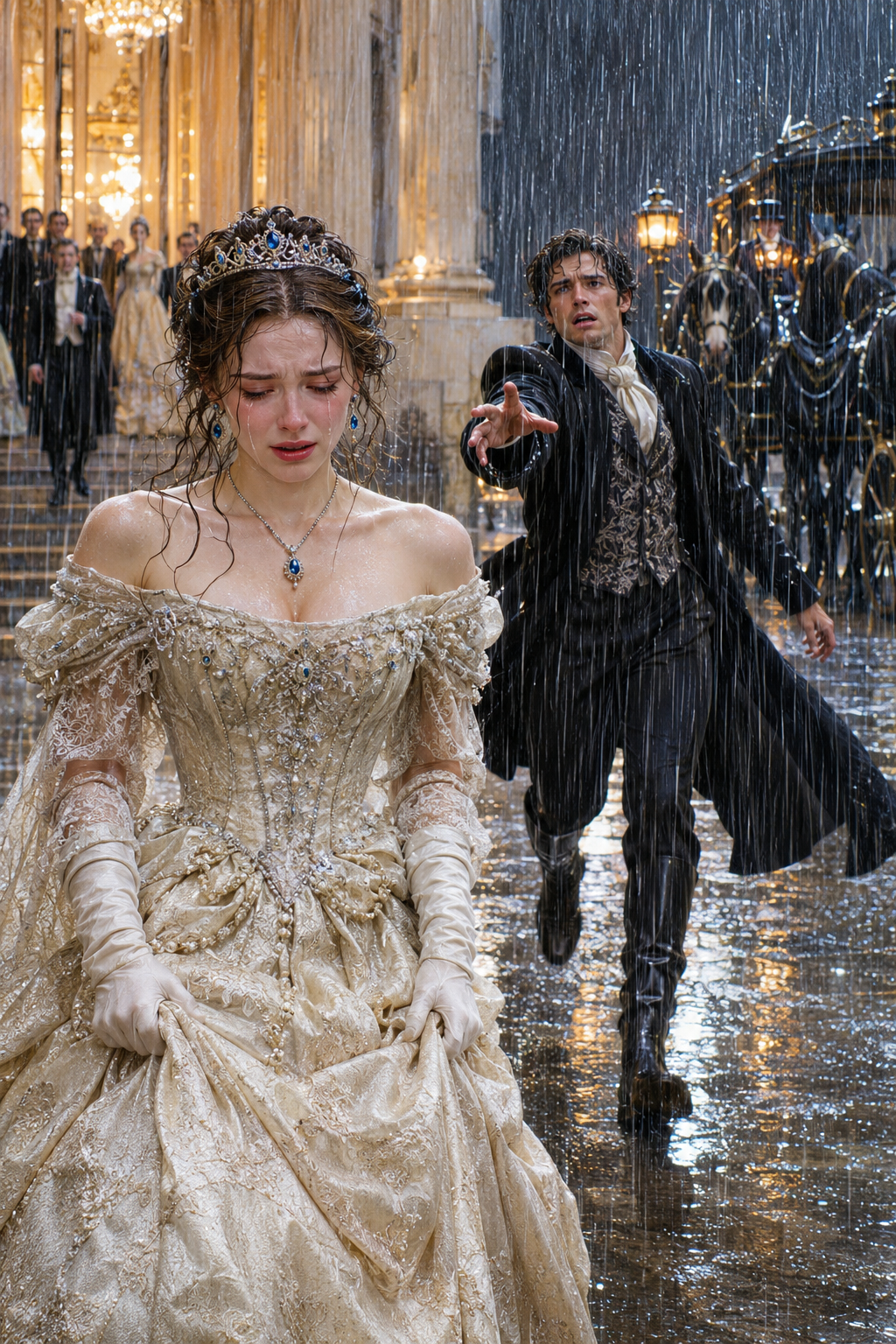
The man Evelyn Hartwell had loved for four years announced his engagement to another woman—and then ordered the ballroom doors closed before Evelyn could leave.
“If this document is presented after my death, the person claiming authority over the Vale inheritance must be considered responsible for the circumstances surrounding it.”
Evelyn read the sentence twice.
Her father’s handwriting was unmistakable. The deliberate curve of the capital letters, the narrow spacing between words, even the small correction above the final line belonged to the man who had taught her to read legal documents before she was old enough to attend a proper ball.
But the words beneath it were not part of the testament.
They were a warning.
Across the drawing room, her mother lowered herself into a chair. The morning sunlight illuminated her face, revealing an exhaustion Evelyn had never noticed beneath her usual composure.
“Mother,” Evelyn said quietly, “what happened to Father?”
Margaret Hartwell closed her eyes.
For several seconds, the only sound was the faint ticking of the mantel clock.
“Your father did not die believing his affairs were settled,” she finally answered. “He died believing someone would come for the papers he had hidden.”
Clara stepped away from the window.
“Someone?”
Margaret looked toward Nathaniel.
“The duke knows.”
Evelyn turned sharply.
Nathaniel remained beside the writing desk, his expression controlled, although his fingers tightened around the leather portfolio.
“I know part of it,” he said. “Your father contacted mine shortly before his death. He believed the Vale trusteeship had been used to conceal years of fraudulent transfers.”
“And you knew this when you offered me your carriage?”
“Yes.”
The admission struck harder than Evelyn expected.
She had spent four years trusting a man who concealed his intentions behind affection. Now another gentleman stood before her, admitting that their apparently accidental meeting had not been entirely accidental.
“Was I simply convenient, Your Grace?”
Nathaniel did not look away.
“No. But I knew you were in danger before you did.”
“That is not an answer.”
“No,” he said. “It isn’t.”
The restraint in his voice prevented the conversation from becoming an argument, but it did nothing to soften the distance suddenly opening between them.
Margaret reached beneath her shawl and withdrew a small brass key.
“Your father made me promise never to use this unless the family was threatened.”
She placed it on the desk.
“He said you would know where it belonged.”
Evelyn recognized the key immediately.
Her father’s study contained an old walnut cabinet with seven drawers. The lowest drawer had remained locked since his death, and Margaret had always insisted it held nothing but private correspondence.
Evelyn took the key.
“Then I believe we should stop waiting.”
The study smelled of leather, dust, and the faint lavender polish their housekeeper used on the furniture. Nothing had changed in four years. Her father’s spectacles still rested beside an empty inkstand, and a narrow strip of sunlight fell across the worn arm of his favorite chair.
Evelyn knelt before the cabinet.
The key turned reluctantly.
Inside lay a packet wrapped in faded blue cloth, a small account book, and a letter addressed to her in her father’s handwriting.
Her fingers paused over the envelope.
For a moment, she was nineteen again, standing outside this room while her mother told her that her father would never come home.
She broke the seal.
“My dearest Evelyn,” the letter began, “if you are reading this, I have failed to protect you from a burden that should never have become yours.”
She swallowed.
Nathaniel remained near the doorway, deliberately allowing her privacy.
The letter described a trust established by Cassandra Vale’s grandfather to provide income for widows, orphaned children, and impoverished tenants on several family estates. Over the years, enormous sums had disappeared from its accounts.
Evelyn’s father had discovered that the missing money was being transferred through companies controlled by the current Vale estate administrator, Sir Alistair Vale, Cassandra’s uncle.
The final paragraph was written in a hurried hand.
“I have placed the original ledgers beyond their reach. The key to their location is not in the cabinet, but in the account book. Remember what I taught you: when figures appear too perfect, examine what has been omitted.”
Evelyn lowered the letter.
Her father had left her something more dangerous than an inheritance.
He had left her the means to expose a crime.
She opened the account book.
Each page contained carefully recorded payments, dates, and references to properties scattered across the countryside. At first glance, the entries appeared ordinary.
Then she noticed the pattern.
Every seventh entry lacked a corresponding receipt.
Beside those entries, her father had written the names of different charitable institutions.
St. Agnes Hospital.
The Whitmore School.
The Northbridge Almshouses.
Evelyn traced the final name with her fingertip.
“Northbridge,” she murmured.
Nathaniel approached.
“What is it?”
“My father visited Northbridge the week before he died. He told us he was attending a property hearing.”
Nathaniel examined the page.
“There is an abandoned chapel near the almshouses. My father mentioned it in his correspondence.”
Evelyn looked up.
“Then that is where we begin.”
Before Nathaniel could answer, Clara appeared in the doorway.
“The carriage across the street has moved,” she whispered. “Two men have entered the courtyard.”
A heavy knock sounded at the front door.
Then another.
Nathaniel immediately closed the account book.
“Do not answer.”
But the housekeeper’s footsteps were already approaching the entrance.
A man’s voice carried through the hallway.
“By authority of Lord Everheart, we are here to collect documents improperly retained by Miss Hartwell.”
Evelyn rose.
For the first time that morning, a faint smile touched her lips.
“Improperly retained?”
She placed her father’s letter inside her sleeve.
“Then they have made their first mistake.”
The men waiting in the entrance hall wore dark coats and expressions of practiced indifference. The taller one held a folded paper bearing Julian’s signature.
Evelyn descended the stairs with Nathaniel several steps behind her.
“Miss Hartwell,” the man began, “we have instructions to recover certain confidential agreements.”
“On whose legal authority?”
“Lord Everheart’s.”
“Lord Everheart is not a magistrate.”
The man shifted his weight.
“We have written authorization.”
“From a private individual who possesses no right to search this residence.”
She extended her hand.
“May I see it?”
He hesitated before surrendering the paper.
Evelyn read it slowly.
Then she folded it and returned it.
“This is a demand for voluntary surrender. It is not a warrant, nor does it establish ownership of anything in this house.”
The second man glanced toward Nathaniel.
Only then did he recognize the duke.
His posture changed immediately.
“Your Grace.”
Nathaniel offered no greeting.
“You have been asked to leave,” he said.
The men departed without another word.
From the upstairs landing, Clara released a breath she had been holding.
Evelyn watched the carriage disappear beyond the iron gates.
Julian had moved quickly.
Too quickly for a man who believed his plans remained undiscovered.
“He knows,” she said.
Nathaniel nodded.
“And now he knows we are looking.”
By afternoon, they were traveling toward Northbridge beneath a sky heavy with gathering clouds.
Margaret and Clara remained at the townhouse under the protection of two trusted servants Nathaniel had arranged, while Evelyn carried her father’s account book concealed beneath her cloak.
The countryside unfolded beyond the carriage windows in long stretches of winter fields and bare hedgerows.
For nearly an hour, neither spoke.
Finally, Nathaniel broke the silence.
“You were right to question my intentions.”
Evelyn kept her eyes on the passing landscape.
“Were you expecting forgiveness?”
“No.”
“Then why mention it?”
“Because you deserve to know that I attended the ball specifically to speak with you.”
She turned toward him.
Nathaniel continued.
“My father died six months after yours. Before his death, he gave me correspondence suggesting that the Vale trust had been compromised. I spent years trying to obtain the original accounts.”
“And you believed I possessed them?”
“I believed your father had entrusted them to someone he considered capable of understanding their importance.”
Evelyn glanced at the book beneath her cloak.
“He entrusted them to me without telling me.”
“He may have hoped you would never need them.”
The carriage passed beneath an avenue of ancient trees.
After a moment, Nathaniel added, “I did not expect Lord Everheart to humiliate you publicly.”
“No,” Evelyn replied. “Neither did I.”
He looked at her.
“Had I known what he intended, I would have intervened.”
“And deprived me of the opportunity to discover his character?”
A trace of amusement crossed Nathaniel’s face.
“I suspect you would have objected.”
“Quite strongly.”
For the first time since the ball, Evelyn laughed.
It was brief and unexpected, but it belonged entirely to her.
Northbridge appeared shortly before dusk.
The village consisted of narrow stone cottages clustered around a small church, with the almshouses standing beyond a neglected garden.
The chapel was older than Evelyn expected.
Its roof sagged near the eastern wall, and ivy had climbed over the windows, obscuring the remaining fragments of stained glass.
A caretaker named Mrs. Bell greeted them at the entrance.
She was a small woman with silver hair and sharp, observant eyes.
When Evelyn introduced herself, the woman’s expression changed.
“Hartwell?”
“Yes. My father was Thomas Hartwell.”
Mrs. Bell stared at her for several seconds.
Then she stepped aside.
“I wondered when someone would come.”
Inside, the chapel smelled of damp stone and extinguished candles.
Mrs. Bell led them toward a narrow room behind the altar.
“Your father visited shortly before he passed,” she explained. “He left a wooden chest in my keeping. Told me no one was to open it without proof of his identity.”
Evelyn showed her the letter.
The older woman’s hands trembled slightly as she recognized the handwriting.
“I remember him,” she whispered. “He looked terribly tired.”
She unlocked a cupboard and withdrew a small oak chest.
Its brass fittings were tarnished, but the seal remained intact.
Evelyn opened it.
Inside were three thick ledgers, dozens of signed receipts, and a collection of letters tied with black ribbon.
She examined the first ledger.
The figures were devastating.
Money intended for hospitals had financed private estates. Funds designated for widows had purchased horses, jewelry, and foreign investments. Payments recorded as charitable distributions had been transferred into accounts controlled by Sir Alistair Vale.
And Julian Everheart.
Evelyn stopped turning the pages.
His name appeared repeatedly.
Not as a recent participant.
As a beneficiary dating back almost five years.
He had been receiving stolen funds before he ever met her.
The realization settled with an unpleasant clarity.
Julian had not merely exploited her affection after discovering her abilities.
He had approached her because of them.
She remembered their first meeting at a legal reception, his apparent fascination with her knowledge, his repeated questions about her father’s unfinished work.
Every compliment now carried a different meaning.
Nathaniel noticed her expression.
“What have you found?”
Evelyn turned the ledger toward him.
“Julian was involved from the beginning.”
Nathaniel studied the entries.
Then he opened one of the letters.
His face hardened.
“This is correspondence between Sir Alistair and a physician who attended your father during his final illness.”
Evelyn reached for it.
The letter contained no confession, only a troubling instruction to administer a particular preparation and ensure that Thomas Hartwell remained too weak to travel.
At the bottom was a payment authorization signed by Sir Alistair.
Evelyn’s hands went cold.
Her father’s final illness had begun suddenly.
He had complained of exhaustion, dizziness, and a strange metallic taste after taking the medicine prescribed for his recurring headaches.
She had accepted the physician’s explanation.
Now she could no longer be certain.
“Can we prove what happened?” she asked.
Nathaniel read the letter again.
“Not from this alone.”
She nodded.
The answer hurt, but she preferred it to false certainty.
Outside, footsteps sounded across the chapel courtyard.
Mrs. Bell moved toward the window.
A moment later, her face drained of color.
“Miss Hartwell,” she whispered, “you must leave.”
Through the narrow glass, Evelyn saw three riders dismounting beside the gate.
Julian stood among them.
His polished boots were already stained with mud, and his usual pleasant expression had disappeared.
Nathaniel gathered the ledgers.
“There is another entrance?”
Mrs. Bell pointed toward a small wooden door behind the altar.
“It leads through the burial ground.”
They moved quickly.
But before Evelyn reached the passage, Julian’s voice echoed through the chapel.
“Evelyn.”
She stopped.
He stood beneath the archway, rain darkening the shoulders of his coat.
For several seconds, they regarded each other across the empty pews.
“You have something that belongs to my future family,” he said.
Evelyn stepped away from Nathaniel.
“Your future family seems to have stolen a great deal from other people.”
Julian’s eyes moved toward the chest.
“Give me the papers.”
“No.”
His expression tightened.
“You do not understand what you are interfering with.”
“I understand more than you intended.”
He took a step forward.
“Evelyn, listen to me. I never wanted matters to become unpleasant.”
She looked at the man she had once imagined marrying.
His familiar features were unchanged.
Only her understanding of them had altered.
“You spent four years allowing me to believe I mattered to you.”
“You did matter.”
“Then why did you choose me?”
Julian hesitated.
It was a small movement, barely visible.
But Evelyn saw it.
“You knew about my father’s investigation before we met,” she continued. “You knew he had hidden evidence. You thought I would lead you to it.”
Julian said nothing.
The silence answered her.
Behind him, one of the riders shifted toward the doorway.
Nathaniel stepped forward.
“Lord Everheart, I suggest you reconsider your position.”
Julian gave a humorless smile.
“Your Grace. I wondered how long you would continue interfering.”
“As long as necessary.”
“And do you imagine your title protects you from consequences?”
“No,” Nathaniel replied. “I imagine the witnesses waiting outside the village will prove rather more useful.”
Julian’s expression changed.
Nathaniel had not come to Northbridge unprepared.
Two magistrate’s officers, alerted before their departure, were stationed near the main road with instructions to investigate any attempt to seize the documents.
Julian understood the implication immediately.
He stepped back.
“This is not finished.”
Evelyn met his gaze.
“For you, perhaps not.”
He departed without another word.
Only when the hoofbeats faded did Evelyn realize she had been gripping her father’s letter so tightly that the paper had creased.
Nathaniel looked toward the doorway.
“He will go directly to Sir Alistair.”
“Then we must reach the authorities first.”
They returned to London after nightfall.
By morning, Nathaniel’s solicitor had secured the ledgers, and Evelyn had prepared a detailed account identifying the altered agreements, fraudulent transfers, and suspicious correspondence.
She worked without interruption, checking each figure against the original receipts.
Nathaniel occasionally brought her tea, which she forgot to drink.
At dawn, he found her standing beside the window, watching the city emerge beneath a pale winter sky.
“You should rest,” he said.
“So should you.”
“I am considerably less stubborn.”
She turned toward him.
“That is an extraordinary claim.”
He smiled faintly.
Then his expression grew serious.
“Evelyn, there is something else.”
She waited.
“The Vale family has requested a private hearing tomorrow. Sir Alistair intends to challenge the authenticity of your father’s records.”
“On what grounds?”
“He claims your father fabricated the accounts after being dismissed as trustee.”
Evelyn’s face became still.
Her father had spent his life protecting people who could not afford legal representation. His reputation had been the one possession he valued beyond his family.
Now the men who had profited from his work intended to destroy his name.
“Then I shall attend.”
Nathaniel hesitated.
“You need not expose yourself to further humiliation.”
Evelyn looked at him.
“Your Grace, I have already survived the worst evening society could arrange for me.”
She returned to the desk.
“I believe I can manage a hearing.”
The proceedings took place in a private chamber adjoining the Court of Chancery, before a senior legal officer and representatives of the interested families.
Sir Alistair Vale arrived wearing a dark green coat and an expression of cultivated indignation.
Cassandra accompanied him.
She appeared pale, her usual confidence diminished by the presence of solicitors and officials who were less easily impressed by diamonds.
Julian stood near the windows.
He did not look at Evelyn when she entered.
The hearing began with Sir Alistair’s solicitor questioning the reliability of Thomas Hartwell’s records.
He described inconsistencies, missing signatures, and alleged personal grievances.
Evelyn listened without interruption.
Then Nathaniel’s solicitor presented the original ledgers.
The atmosphere changed.
Dates were compared.
Receipts were examined.
Banking instructions were read aloud.
One by one, the discrepancies became impossible to dismiss.
Sir Alistair’s composure began to fracture.
“These documents prove nothing,” he insisted. “Mr. Hartwell had access to the accounts. He could have altered them.”
Evelyn rose.
“May I direct attention to the payments recorded on the seventh day of each month?”
The presiding officer nodded.
She approached the table.
“Every fraudulent transfer follows the same accounting pattern. But the corresponding bank instructions bear signatures from individuals who controlled the receiving accounts.”
She placed three receipts beside the ledger.
“Those individuals include Sir Alistair Vale and Lord Everheart.”
Julian finally looked at her.
His face had lost its color.
Sir Alistair leaned forward.
“Miss Hartwell is motivated by personal resentment. Her association with Lord Everheart ended under unfortunate circumstances.”
A faint murmur passed through the chamber.
Evelyn remained motionless.
Then she looked directly at him.
“My private disappointment is not evidence, Sir Alistair.”
She touched the ledger.
“These signatures are.”
The room fell silent.
Cassandra lowered her eyes.
But Evelyn noticed something unexpected.
Her hands were shaking.
Not with embarrassment.
With fear.
During a brief recess, Cassandra approached Evelyn in the corridor.
For several moments, neither spoke.
Then Cassandra removed her gloves.
The ink stain Evelyn had noticed at the ball was still faintly visible beside her thumb.
“I wrote the amendments,” Cassandra whispered.
Evelyn stared at her.
“Under whose instructions?”
“My uncle’s.”
“And Julian knew?”
Cassandra nodded.
“He told me the documents would protect the inheritance. I believed him until I discovered the money had been taken from the charitable trust.”
“Why didn’t you come forward?”
Cassandra looked toward the closed chamber doors.
“Because my uncle threatened to have my younger brother declared incapable of managing his own affairs. He controls the evidence of my brother’s medical history, and he promised to use it against him.”
Evelyn studied her.
The woman who had smiled beside Julian beneath the chandeliers now stood with reddened eyes and trembling fingers.
For the first time, Evelyn saw not a triumphant rival, but another person trapped by the same men.
“Do you have proof?” she asked.
Cassandra reached into her reticule.
She withdrew a folded letter.
“Julian wrote this after our engagement. He instructed me to destroy the earlier agreements and replace them with the amended copies.”
Evelyn accepted the letter.
It was the final connection they needed.
“Will you testify?”
Cassandra swallowed.
“If my brother can be protected.”
Evelyn considered the question.
Then she answered with the certainty of someone who had spent years understanding the difference between threats and lawful authority.
“Your uncle cannot simply declare your brother incapable. He would need evidence and a legal determination. We can challenge anything he attempts.”
Cassandra’s eyes filled.
“After what I did to you, why would you help me?”
Evelyn looked toward the chamber.
“Because I know what it costs to trust the wrong person.”
When the hearing resumed, Cassandra took her place before the legal officer.
Her testimony was quiet.
Precise.
Devastating.
She described the altered agreements, the instructions from her uncle, and Julian’s role in securing Evelyn’s signature.
Then she produced the letter.
Julian rose abruptly.
“She is lying.”
Cassandra turned toward him.
“No, Julian. I am finally telling the truth.”
His expression twisted.
“You have no idea what your uncle will do.”
“Perhaps,” she replied. “But I know what you have already done.”
Sir Alistair attempted to leave.
The presiding officer ordered him to remain while the evidence was formally recorded and referred for criminal investigation.
Julian moved toward the door.
Nathaniel stepped into his path.
“Stand aside,” Julian hissed.
Nathaniel did not move.
“You may explain your departure to the officers waiting outside.”
For one dangerous moment, Julian looked prepared to strike him.
Then his shoulders sagged.
The confidence that had carried him through crowded ballrooms and private negotiations deserted him beneath the weight of documented facts.
He turned toward Evelyn.
“You could have come to me,” he said bitterly. “We could have settled this.”
Evelyn regarded him without anger.
“You had four years to tell me the truth.”
Julian opened his mouth.
Nothing came.
The hearing ended with orders preserving the disputed assets, suspending the contested transfers, and referring the evidence to the appropriate authorities.
The criminal proceedings that followed would take months.
But the immediate danger to the Hartwell estate had passed.
Outside, the winter sun shone across the courthouse steps.
Evelyn descended beside Nathaniel, carrying her father’s letter.
For the first time in days, the air seemed easy to breathe.
“Your father would have been proud,” Nathaniel said.
Evelyn looked down at the envelope.
“I hope so.”
“He trusted you with the truth.”
She considered that.
“He also trusted me to decide what to do with it.”
Nathaniel offered his arm.
She accepted.
The months that followed were not without difficulty.
Julian and Sir Alistair faced formal proceedings concerning fraud, forged instruments, and misappropriation of trust funds. The suspicious circumstances surrounding Thomas Hartwell’s final illness were separately investigated, although the surviving evidence could not conclusively establish the cause of his death.
Evelyn learned to live with that uncertainty.
Some questions, she discovered, could be pursued honestly without being answered completely.
The financial evidence, however, was overwhelming.
The fraudulent agreements were set aside, the Hartwell estate was released from the fabricated obligations, and the remaining trust assets were placed under independent administration.
Cassandra testified despite considerable pressure from her relatives.
Her brother’s affairs were reviewed under proper legal supervision, and Sir Alistair’s threats lost their power.
The friendship that eventually developed between Cassandra and Evelyn surprised them both.
It began with a letter.
Then another.
Neither woman pretended the past had been harmless.
But both understood that remorse mattered most when accompanied by action.
As spring approached, Evelyn established a legal advisory office devoted to assisting widows, unmarried women, and families who could not afford the services of prominent solicitors.
She worked alongside qualified practitioners where formal representation was required, preparing documents, examining accounts, and helping clients understand the agreements placed before them.
Her first client was an elderly widow threatened with eviction over a debt she had already repaid.
Evelyn discovered the missing receipt within an afternoon.
The widow cried when she learned she could remain in her home.
Evelyn did not.
She simply smiled, handed the woman her papers, and asked whether she would like another cup of tea.
Within months, the office became busier than she had imagined.
Clara helped organize correspondence.
Margaret welcomed clients who arrived frightened and uncertain.
And Nathaniel visited often enough that the housekeeper eventually stopped announcing him with surprise.
One evening, as rain whispered against the drawing-room windows, Evelyn found him examining the shelves in her father’s study.
“You are becoming rather familiar with this house,” she observed.
Nathaniel turned.
“I had hoped you might consider that a favorable development.”
“An ambitious assumption.”
“I have been accused of worse.”
She approached the desk.
A small vase of fresh flowers stood beside her father’s old inkstand.
Nathaniel glanced at it.
“You have changed the room.”
“Only what needed changing.”
“And the rest?”
She looked around at the books, the cabinet, and the chair where her father had spent so many evenings.
“The rest deserves to remain.”
Nathaniel was silent for a moment.
Then he withdrew a small velvet box from his coat.
Evelyn looked at it.
“Your Grace.”
“Nathaniel,” he corrected gently.
She raised an eyebrow.
“You have become very confident.”
“Not particularly.”
He opened the box.
Inside lay a simple ring set with a single sapphire.
“I cannot promise that life beside me will be uncomplicated,” he said. “Nor would I ask you to abandon the work you have begun.”
Evelyn looked at him steadily.
“Then what are you asking?”
“That you allow me to stand beside you while you continue it.”
There was no audience.
No orchestra.
No carefully arranged announcement beneath glittering chandeliers.
Only the soft rain, the warmth of the fire, and a man who had learned that her independence was not an obstacle to loving her.
Evelyn closed the box gently.
Nathaniel’s expression changed.
She smiled.
“I haven’t refused.”
He released a quiet breath.
“But I will not accept a proposal made because you admire the woman who survived a scandal.”
His gaze remained on hers.
“Then I shall ask because I admire the woman who builds something useful from what she has learned.”
Evelyn considered him for a long moment.
Then she opened the box again.
“Yes, Nathaniel.”
His smile came slowly.
It was the first time she had seen him entirely unguarded.
A year later, Evelyn stood before the windows of a newly established charitable legal office, watching a young woman cross the courtyard with a bundle of documents clutched against her chest.
The woman hesitated at the entrance.
Her dress was worn, her expression anxious, and she looked as though she expected to be turned away.
Evelyn opened the door herself.
“May I help you?”
The young woman swallowed.
“I was told you assist women who have nowhere else to go.”
Evelyn stepped aside.
“Come in.”
Behind her, the office hummed with quiet activity. Clerks examined ledgers, Clara arranged appointments, and Margaret poured tea for a nervous elderly gentleman.
Nathaniel stood near the fireplace, speaking with a solicitor about funding another branch of the service.
He glanced toward Evelyn.
Their eyes met.
Nothing needed to be said.
She guided the young woman toward an empty chair and placed a clean sheet of paper on the desk.
“Tell me what happened,” she said.
Outside, the morning rain began to ease.
Evelyn remembered another rainstorm, another doorway, and the terrible loneliness of walking away from a room where she had once believed she belonged.
For years, she had measured her worth by the affection of someone who needed her usefulness but resented her strength.
Now she understood the difference.
Love did not require her to become smaller.
Respect did not disappear when she spoke.
And a life was not ruined simply because the future she had imagined failed to arrive.
Sometimes the most important thing a person could recover was not a fortune, a reputation, or even a lost love.
It was the freedom to decide what came next.
Evelyn dipped her pen into the ink and listened as the young woman began her story.
This time, someone was listening.
And this time, no one would have to face the truth alone.
THE END.