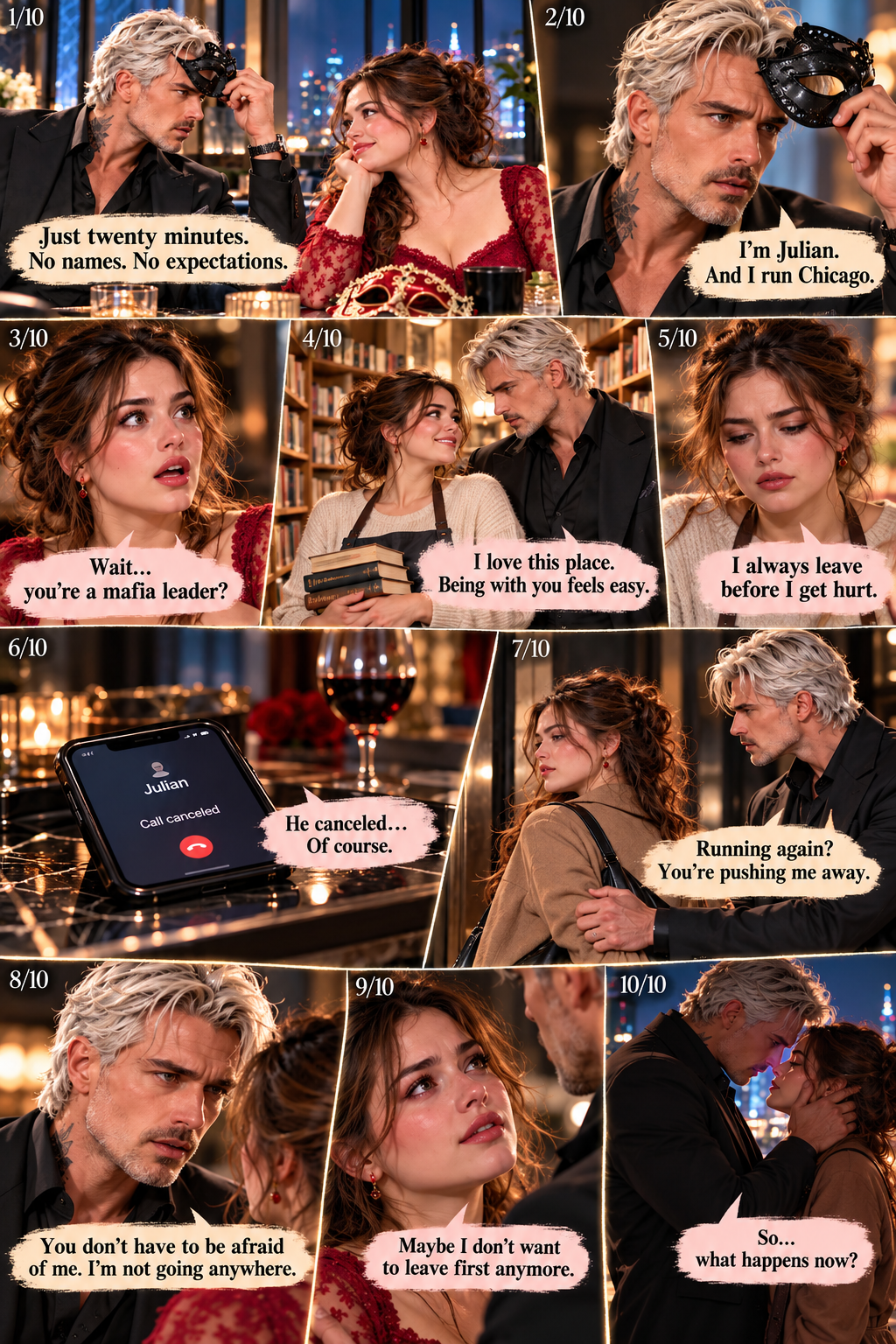
The man across from Mara had twenty minutes to make an impression. They were both wearing black masks, neither had given a last name, and she had already set a timer on her phone.
Mara didn’t get an answer to that question until eleven days later, when a man in a charcoal-gray coat walked into her bookstore and asked whether Julian Vale was worth dying for.
It was a little after four on a Wednesday afternoon. Rain tapped against the windows, the old radiator hissed beneath the poetry shelf, and Mara was helping a college student find a used copy of Jane Eyre.
The stranger waited until the student left before approaching the counter.
“Beautiful place,” he said, looking around.
“Thanks. Can I help you find something?”
“Actually, I’m looking for someone.”
Mara felt a faint uneasiness when he smiled.
“Julian Vale.”
She kept her expression neutral.
“This is a bookstore.”
“I noticed.”
“Then perhaps you’d like a book.”
The man chuckled, but his eyes remained cold.
“Tell Julian that Peter Rourke stopped by. Tell him old arrangements don’t disappear just because someone develops a conscience.”
He placed a business card on the counter.
“And tell him he should reconsider what happens when he makes his personal life public.”
Mara stared at the card.
“Are you threatening me?”
“Not at all, Miss Bennett.”
Her stomach tightened.
She hadn’t told him her last name.
Rourke adjusted his cuffs.
“I’m simply reminding you that some people have very complicated friends.”
He left without buying anything.
For almost a minute, Mara stood behind the counter, listening to the rain.
Then she locked the front door.
Her first instinct was familiar: call Julian, tell him everything was over, and remove herself from whatever trouble he’d brought into her life.
But something stopped her.
She remembered sitting across from him in her apartment, asking whether he’d tell her the truth if his dangerous world ever reached her door.
Now it had.
And she wanted to see what he would do.
She called him.
He answered on the second ring.
“Mara?”
“Someone came into the store.”
The background noise disappeared.
“Who?”
“Peter Rourke.”
Silence.
“Where are you?”
“Behind the counter.”
“Is he still there?”
“No.”
“Lock the door. Don’t open it for anyone you don’t know. I’m coming.”
“Julian—”
“Please.”
His voice wasn’t commanding.
It was frightened.
That scared her more than anything Rourke had said.
Twenty-three minutes later, Julian arrived with a man Mara had never seen before.
The stranger remained outside while Julian entered.
He took one look at her face and crossed the room.
“Did he touch you?”
“No.”
“Did he say anything else?”
“He asked whether you were worth dying for.”
Something changed in Julian’s expression.
Not surprise.
Recognition.
Mara stepped away before he could take her hand.
“Tell me who he is.”
Julian glanced toward the front window.
“Someone I used to do business with.”
“What kind of business?”
He hesitated.
And there it was.
The moment she had been afraid of since their first date.
Julian could either tell her the truth or decide she was better off knowing nothing.
“He handles money for people who don’t want their names attached to it,” Julian said finally. “Some of those people are involved in organized crime.”
Mara swallowed.
“And you?”
“My company used to hold commercial properties for investors connected to him. I knew more about their activities than I wanted to admit.”
“That’s not an answer.”
“No,” Julian said quietly. “It isn’t.”
He pulled out a chair.
“Five years ago, I took over a failing property company my father had helped build. Rourke’s people had money tied up in several buildings. I convinced myself that because I wasn’t involved in their violence, I wasn’t involved in their crimes.”
Mara said nothing.
“I was wrong. I spent three years trying to separate the legitimate businesses from the people financing them. I got out of some arrangements. Others have been harder.”
“Why?”
“Because people like Rourke don’t respond well when someone starts looking closely at old records.”
She studied him.
“Are you telling me you were part of the mafia?”
“No. But I did business with men who were. And I benefited from those relationships.”
His honesty did not make the answer easier to hear.
“You should have told me.”
“I know.”
“When?”
“Before you had a reason to be afraid.”
Mara folded her arms tightly across her chest.
“Why would he come here?”
“Because I’ve refused to sign over my interest in a building he wants. He thinks frightening you will change my mind.”
“Will it?”
Julian looked at her.
“It changes how seriously I take his threats. It doesn’t change what I’m willing to sign.”
A bitter laugh escaped her.
“That’s comforting.”
“Mara—”
“No. You don’t get to tell me I’m safe when a stranger knows my name, my workplace, and apparently enough about us to use me against you.”
Julian accepted that without arguing.
“You’re right.”
The simplicity of his answer nearly undid her.
She wanted him to defend himself.
She wanted him to say something arrogant enough that leaving would become easy.
Instead, he stood in her bookstore looking like a man who had finally discovered the cost of keeping too many things separate.
“I can arrange for someone to stay nearby until this is handled,” he said.
“I don’t want one of your people following me around.”
“Then I won’t do it without your permission.”
“What happens if I say no?”
“I’ll respect it. But I need to tell you the risk may not disappear immediately.”
Mara looked at the business card on the counter.
For the first time, she understood that walking away from Julian wouldn’t necessarily erase what had happened.
Rourke already knew who she was.
And she hated that the choice had been taken from her before she’d understood she was making one.
“I want you to leave,” she said.
Julian flinched.
Only slightly.
But she saw it.
“Okay.”
He took a step toward the door.
“Julian?”
He turned.
“I’m not saying we’re over.”
Something in his face softened.
“I understand.”
“I’m saying I need to think. And I need to decide what happens in my own life.”
He nodded.
“I won’t take that away from you.”
After he left, Mara sat on the floor behind the counter until the rain stopped.
She didn’t cry.
She was too angry.
At Julian.
At Rourke.
And a little at herself for realizing that, despite everything, she still wanted Julian to come back.
The following morning, Mara found an envelope slipped beneath the bookstore door.
Her name was written on the front.
Inside was a photograph.
It showed her leaving the store with Julian two weeks earlier, his hand resting against the small of her back.
On the reverse, someone had written:
He won’t always be there.
Mara stared at the words until the letters blurred.
This time, she didn’t call Julian first.
She called the police.
A detective named Elena Morales arrived before noon, examined the photograph, and listened carefully as Mara described Rourke’s visit.
“Do you have security cameras?” Morales asked.
“One above the register. Another by the entrance.”
“Good. Don’t delete anything.”
Mara handed over the business card.
“Do you know this man?”
Morales studied it.
“I know the name.”
“Is he dangerous?”
“Potentially. But I don’t want to speculate. Right now, you’ve done the right thing reporting this.”
She gave Mara a case number and explained how to document any further contact.
When Julian arrived later, Mara was sitting at the counter with a notebook open in front of her.
He stopped when he saw the photograph.
“Where did that come from?”
“Under the door.”
He reached for it.
She moved it away.
“The police have already photographed it.”
Julian looked up.
“You called the police?”
“Yes.”
A muscle tightened in his jaw.
For one awful second, Mara thought he was angry.
Then he said, “Good.”
She blinked.
“Good?”
“You shouldn’t have to deal with this privately because of me.”
She watched him carefully.
“Are you willing to speak to the detective?”
“Yes.”
“Even if she asks about your business?”
Julian looked at the photograph again.
“Even then.”
It was the first time Mara believed he might be capable of choosing something other than control.
But believing was not the same as trusting.
And she was beginning to understand that trust wasn’t a feeling Julian could create with one honest conversation.
It would be built, or destroyed, by what he did next.
Over the following days, Julian cooperated with the investigation.
Mara learned that his attorney had been working with outside accountants to review several older property transactions. The building Rourke wanted was a warehouse near the Chicago River, one of the last properties still entangled in a business arrangement Julian had inherited and then prolonged through his own choices.
Rourke wanted Julian to approve a transfer that would conceal who truly controlled the property.
Julian had refused.
But Mara discovered something else.
He hadn’t gone to the authorities when he first suspected criminal activity.
He’d tried to resolve everything quietly.
When she asked why, he gave her an answer she hadn’t expected.
“Because I was ashamed.”
They were sitting in her apartment, a full week after Rourke’s visit.
Outside, a delivery truck rumbled through the alley.
“I spent years telling myself I was different from my father,” Julian said. “He believed every problem could be handled through influence. If something was ugly enough, he’d pay someone to make it disappear.”
“And you?”
“I thought I could clean up what he left without letting anyone see how dirty it was.”
Mara leaned against the kitchen counter.
“You thought admitting what happened would make you weak.”
“Yes.”
“And now?”
Julian looked exhausted.
“Now I’m starting to think pretending I could handle it alone was the weakest thing I’ve ever done.”
Mara watched him for a long moment.
Then she asked the question that had been growing inside her.
“Have you ever ordered someone hurt?”
“No.”
“Have you ever helped cover up someone being hurt?”
He lowered his eyes.
“Years ago, an employee reported that Rourke’s associates threatened him. I moved the employee to another property and paid him a settlement. I didn’t report the threats.”
“Why not?”
“Because I wanted the problem to go away.”
Mara felt sick.
“What happened to him?”
“He’s alive. He left Chicago. I haven’t spoken to him in years.”
“Then you don’t know how it affected him.”
“No,” Julian said. “I don’t.”
She turned away.
That evening, Julian went home alone.
For three days, Mara didn’t see him.
They exchanged only a handful of messages.
There were no dramatic declarations.
No expensive flowers.
No attempts to win her back with a beautiful apology.
And strangely, the absence of those things made Mara think harder.
She had always looked for a single moment that would tell her whether someone deserved to stay.
One canceled dinner.
One forgotten promise.
One lie.
But Julian wasn’t a simple man with a simple mistake.
He had done things she couldn’t excuse.
He was also doing things now that would cost him something.
The question was whether those changes were real.
And whether she could love someone without taking responsibility for fixing him.
On Saturday morning, Mara’s best friend, Claire, arrived with bagels and the expression of a woman prepared to hear something terrible.
Mara told her everything.
Not just about Rourke.
About Julian’s history.
About the photograph.
About the detective.
About the shame in Julian’s voice.
When she finished, Claire sat quietly.
“Do you want my opinion?”
“Not particularly.”
“Good. Because you’re getting it.”
Mara sighed.
Claire leaned forward.
“You don’t have to stay with someone just because they’re finally learning how to be honest.”
“I know.”
“And you don’t have to leave just because you’re scared.”
“I know that, too.”
“Then what are you actually afraid of?”
Mara looked toward the bookshelves.
“That I’ll wake up one day and realize I’ve become someone who makes excuses for things she used to believe were wrong.”
Claire nodded slowly.
“That’s a reasonable fear.”
Mara looked surprised.
“You think so?”
“Of course. You’re dating a man whose business history has attracted criminals to your front door. That’s not an imaginary problem.”
She reached across the table.
“But there’s another question. Can you tell him no? Can you disagree with him? Can you walk away without him making you pay for it?”
Mara considered that.
“So far,” she admitted, “yes.”
“Then keep paying attention to his actions. Not his money. Not his reputation. Not how he looks at you when he thinks you’re not watching.”
Mara smiled faintly.
“You’ve noticed that?”
“Everyone has noticed that.”
For the first time in days, Mara laughed.
Then Claire squeezed her hand.
“Whatever you choose, make sure you’re choosing it because it’s what you want. Not because you’re afraid of being abandoned. And not because you’re afraid of being alone.”
Two days later, the bookstore’s front window shattered.
It happened at 6:17 in the morning.
Mara was upstairs making coffee when the sound jolted her awake.
She rushed to the window and saw broken glass scattered across the sidewalk.
Someone had thrown a brick through the display.
Wrapped around it was a piece of paper.
She didn’t go downstairs.
She called 911.
By the time officers arrived, Mara was trembling so badly she couldn’t hold her mug.
The note was short.
Last warning.
Julian arrived twenty minutes after she called him.
He looked at the broken window, then at Mara standing beside the responding officer.
His expression turned frighteningly still.
“Who did this?”
“We don’t know,” the officer answered.
Julian glanced toward the street.
Mara recognized the look.
She’d seen it once before, when Rourke’s name had first been mentioned.
It was the face of a man accustomed to solving problems through power.
“Julian,” she said.
He turned.
“Look at me.”
His eyes found hers.
“If you go after him yourself, I’m done.”
The words came out before she’d fully decided to say them.
But once spoken, she knew they were true.
Julian stared at her.
“Mara—”
“No. I won’t live in a world where every threat becomes a private war. I won’t spend my life wondering what you’re doing to people in my name.”
He looked toward the broken window.
For several seconds, he said nothing.
Then he reached for his phone.
Mara’s heart sank.
But he wasn’t calling one of his security men.
He called his attorney.
“Tell the investigators I’ll provide the complete records,” he said. “All of them. Including the transactions I approved.”
The attorney apparently objected.
Julian closed his eyes.
“I understand what that could mean.”
Another pause.
“Do it anyway.”
When he ended the call, Mara stood motionless.
“What did you just do?”
“Something I should’ve done a long time ago.”
“Julian, what records?”
“Everything connected to Rourke. Including things that could damage me.”
“You could lose your company.”
“Yes.”
“Your money?”
“Some of it. Maybe a great deal.”
She searched his face.
“And you’re okay with that?”
“No,” he said. “I’m terrified.”
It was the most human answer he’d ever given her.
For weeks, she’d been trying to decide whether Julian was strong enough to protect her.
Now she understood that the more important question was whether he was brave enough to stop protecting his own image.
The investigation intensified.
Rourke’s attorneys denied that he had anything to do with the threats against Mara.
Police collected security footage from neighboring businesses. Investigators reviewed financial documents Julian supplied, and authorities began examining transactions connected to the warehouse.
There were interviews.
Subpoenas.
Headlines.
Reporters appeared outside the bookstore, hoping for photographs of the mysterious woman dating Chicago’s most controversial businessman.
Mara hated every second.
One morning, she opened a local news website and saw a photograph of herself carrying a box of books.
The headline implied that she had been enjoying the benefits of Julian’s fortune while ignoring his connections.
She shut her laptop so hard the screen rattled.
Julian offered to hire a public relations consultant.
She refused.
Then she asked him to stop visiting the store while reporters were gathering outside.
He agreed.
It hurt more than she expected when he did.
For nearly a month, their relationship existed in quiet phone calls, occasional walks in places where they could avoid attention, and dinners neither of them knew how to enjoy.
One evening, Julian admitted that investigators were examining whether his earlier decisions had violated financial reporting laws.
“I could face penalties,” he said.
Mara stared at him across the table.
“Criminal charges?”
“I don’t know.”
She looked down at her hands.
“Why didn’t you tell me sooner?”
“I only learned how broad the review was this morning.”
“That’s not what I mean.”
Julian went quiet.
Mara met his eyes.
“Why didn’t you tell me at the beginning how much of your life was built on things you regretted?”
His answer came slowly.
“Because I wanted you to meet the man I was trying to become before you met the man I’d been.”
Mara’s eyes filled.
“But they’re the same person, Julian.”
“I know.”
“And I can’t love half of you while pretending the other half doesn’t exist.”
He nodded.
“I wouldn’t ask you to.”
She looked away.
For the first time, she understood that love could survive honesty and still fail to survive its consequences.
Two weeks later, Julian received news that changed everything.
One of Rourke’s former associates had agreed to cooperate with investigators.
The man identified himself as Daniel Mercer.
He was the former employee Julian had relocated years earlier after the threats.
Mercer had kept records of what happened.
Emails.
Copies of property agreements.
Contemporaneous notes about meetings that powerful people had spent years pretending never occurred.
When Julian told Mara, she listened without interrupting.
“Is he going to testify?”
“His attorney says he’s willing to provide evidence.”
“Have you spoken to him?”
“Not yet.”
“Will you?”
“If he agrees.”
Mara studied him.
“What would you say?”
Julian looked down.
“I think I’d start by apologizing without explaining why I thought I was doing the right thing.”
A week later, Mercer agreed to meet Julian with attorneys present.
Mara didn’t attend.
She didn’t ask for a detailed account afterward.
But when Julian called that evening, his voice sounded different.
“How did it go?” she asked.
“He told me something I deserved to hear.”
“What?”
“That I wasn’t protecting him when I paid him to leave. I was protecting myself.”
Mara closed her eyes.
“Was he right?”
“Yes.”
Julian paused.
“He said the threats changed how he lived for years. He couldn’t trust employers. He worried someone might follow him. Meanwhile, I congratulated myself for getting him out of a bad situation.”
“Did he forgive you?”
“No.”
Mara waited.
“And I didn’t ask him to.”
Something loosened in her chest.
Not because Julian had been forgiven.
Because he’d finally begun to understand that accountability wasn’t a transaction.
You couldn’t buy it.
You couldn’t negotiate it.
And you couldn’t demand that the people you’d hurt make you feel better about changing.
Spring arrived slowly in Chicago.
The snow disappeared from the sidewalks. The bookstore’s damaged window was replaced, although a faint scratch remained along the wooden frame.
Mara reopened her little reading corner and started hosting Saturday afternoon book discussions.
Business was still difficult.
The heating bill had been replaced by a plumbing problem, and three customers complained that the new coffee machine made terrible espresso.
For the first time in months, these ordinary frustrations felt like gifts.
Julian’s legal problems, however, were far from over.
His attorneys negotiated with regulators and prosecutors while investigators pursued the evidence connected to Rourke.
Julian gave statements and turned over additional records.
Several former business partners distanced themselves from him.
A lender withdrew financing from one of his developments.
His company began selling properties to cover obligations.
He didn’t lose everything.
But he lost enough that people who had once rushed to answer his calls stopped returning them.
One evening, Julian arrived at Mara’s apartment carrying a paper bag of takeout.
No expensive coat.
No driver waiting downstairs.
Just a tired man holding Thai food and looking uncertain whether he was welcome.
Mara opened the door.
“You look terrible.”
“Thank you.”
“Have you eaten?”
“No.”
“Then come in.”
They sat on her kitchen floor because she’d taken the dining table apart to repair one of its legs.
For a while, they ate in comfortable silence.
Then Julian said, “I sold the house.”
Mara looked up.
“The one by the lake?”
He nodded.
“I thought you’d miss it.”
“I barely went there.”
“But you loved the view.”
“I loved that you liked it.”
She smiled faintly.
“That’s different.”
He set down his fork.
“I’ve been thinking about something.”
“That sounds dangerous.”
Julian gave a tired laugh.
“I think I spent most of my life believing that if I had enough money, enough influence, enough people afraid to disappoint me, I’d never have to feel helpless again.”
“And now?”
“Now half the people who called themselves my friends have disappeared.”
Mara studied him.
“Does that bother you?”
“Less than I expected.”
He glanced around her small apartment.
“This is the only place I’ve been lately where nobody wants anything from me.”
Mara raised an eyebrow.
“That’s not true. I want you to wash the dishes.”
Julian laughed.
A real laugh.
The kind that made him look younger.
Then his expression grew serious.
“I know I can’t ask you to trust me because I’ve had a difficult few months.”
“Good.”
“And I know you don’t owe me a relationship because I’m trying to make things right.”
“Also good.”
He took a breath.
“But I need to ask whether you still want this.”
Mara looked at the two takeout containers between them.
She thought about the masked stranger who’d asked for twenty extra minutes.
The man who had remembered that she hated eating dinner alone.
The frightened voice on the phone when Rourke visited her store.
The broken window.
The photograph.
The painful conversations.
The mistakes that couldn’t be erased.
She also thought about herself.
How often she’d nearly ended things before there was anything to end.
How she’d mistaken emotional distance for independence.
How she’d spent years treating love like a doorway she needed to stand beside, ready to escape.
“I do,” she said.
Julian didn’t move.
“But not the way we were doing it before.”
“What do you mean?”
“I can’t be the quiet corner of your life where you come to forget everything else. I need to be part of your real life, even when it’s messy.”
“You have been.”
“No. Sometimes you’ve let me see things. Other times you’ve decided what I could handle.”
Julian absorbed that.
“You’re right.”
“And I need to work on my own side of it. I can’t punish you for every promise someone else broke.”
He reached for her hand.
“So what happens now?”
Mara intertwined her fingers with his.
“We find out whether two people who’ve spent their lives protecting themselves can learn to be honest without hurting each other.”
Julian smiled.
“That sounds difficult.”
“It probably will be.”
“Do I at least get another twenty minutes?”
She laughed.
“You can have dinner.”
“And tomorrow?”
Mara looked at him for a long moment.
“Ask me tomorrow.”
Three months later, Peter Rourke was arrested as part of a broader investigation into financial crimes and intimidation connected to several business arrangements.
The arrest did not magically resolve everything.
His attorneys contested the allegations. Investigators continued gathering evidence. Julian remained under scrutiny for his own past conduct.
Mara followed the news carefully, but she learned not to confuse an arrest with justice or a cooperating witness with an innocent man.
Julian’s business was smaller.
His reputation was damaged.
And some people would never trust him again.
He accepted that.
One afternoon, he stopped by the bookstore with a cardboard box.
Mara looked up from a stack of invoices.
“If those are more terrible business books, I’m charging you storage.”
“They’re not.”
Inside were six novels.
Used copies, with cracked spines and handwritten notes in the margins.
Mara picked up the first.
“Where did you find these?”
“A little store in Evanston.”
“You went to another bookstore?”
“I knew you’d take that personally.”
She smiled.
Then she noticed a folded envelope beneath the books.
Her smile faded.
“What’s this?”
Julian leaned against the counter.
“A letter.”
“From whom?”
“Me.”
She gave him a suspicious look.
“You’re standing right here.”
“I know.”
“Then why didn’t you just tell me?”
“Because I wanted you to have something you could read when I wasn’t around.”
Mara opened the envelope.
Inside was a single handwritten page.
Julian’s handwriting was surprisingly messy.
Mara,
When we met, I thought twenty minutes would be enough to know whether someone was worth seeing again.
I was wrong.
Twenty minutes wasn’t enough to understand you.
And it certainly wasn’t enough for you to understand me.
I used to believe being loved meant someone would accept whatever parts of me I decided to show them.
You taught me that real love requires the courage to be seen completely, including the things we’re ashamed of.
I don’t know what my life will look like in another year.
I don’t know whether everyone I’ve hurt will ever forgive me.
Some shouldn’t have to.
But I know I want to keep becoming someone whose promises mean something.
Not because I’m afraid you’ll leave.
Because I finally understand the kind of man I want to be.
And if you choose to walk beside me, I’ll never mistake that choice for something I’m entitled to.
Julian
Mara read the letter twice.
When she looked up, Julian was pretending to examine the mystery shelf.
“You could’ve just bought me flowers,” she said.
“I considered it.”
“Probably would’ve been cheaper.”
He smiled.
She folded the letter carefully.
“Julian?”
“Yes?”
“I’m glad I stayed for coffee.”
His expression softened.
“So am I.”
She walked around the counter and kissed him.
Not because everything was fixed.
Not because their future was guaranteed.
But because she wanted to.
And for Mara, that distinction mattered more than she’d ever imagined.
Later that evening, after Julian left, she placed the letter inside her favorite novel and locked the bookstore.
Outside, the streetlights reflected off the damp sidewalk.
A year earlier, she would have considered herself lucky to avoid getting hurt.
Now she knew something she hadn’t understood then.
You could protect yourself so carefully that nothing terrible ever reached your heart.
But eventually, nothing beautiful could reach it either.
That didn’t mean ignoring danger.
It didn’t mean forgiving every betrayal or staying with someone who refused to change.
Mara had learned that courage sometimes meant leaving.
And sometimes it meant staying long enough to have an honest conversation.
The difficult part was knowing the difference.
She was still learning.
Julian was, too.
There were days when his past returned in the form of legal appointments, uncomfortable headlines, and questions neither of them enjoyed answering.
There were days when Mara felt the familiar temptation to retreat into silence.
But now, instead of immediately saying she was fine, she sometimes admitted, “I’m scared.”
And instead of trying to solve everything for her, Julian learned to ask, “What do you need from me?”
Sometimes she needed reassurance.
Sometimes she needed space.
Sometimes she needed him to tell her a truth neither of them wanted to hear.
And sometimes all she needed was for him to show up with dinner and remember that the radiator still made too much noise.
On the anniversary of their first date, Julian reserved a table at the same little restaurant where they’d met.
When Mara arrived, she found him wearing a black mask.
She stopped in the doorway and laughed.
“Oh, absolutely not.”
Julian stood.
“Twenty minutes?”
Mara approached the table.
“That’s all you think you’re getting?”
“I was hoping to negotiate.”
She removed his mask and set it beside her purse.
“Here’s the thing,” she said, taking her seat. “I don’t want a relationship with an expiration date anymore.”
Julian looked at her.
“Neither do I.”
She reached across the table and took his hand.
“But if you cancel dinner again, you’re buying dessert for a month.”
He grinned.
“That seems fair.”
The waiter brought coffee.
Outside, Chicago continued moving with all its noise and uncertainty.
Inside, two people who had once hidden behind masks sat across from each other without them.
They hadn’t become fearless.
They hadn’t become perfect.
They had simply stopped treating love like a contest to see who could leave first.
And as Mara watched Julian reach for the terrible restaurant coffee he’d somehow grown fond of, she realized something wonderfully ordinary.
She wasn’t wondering how the evening would end.
She was looking forward to tomorrow.
For a woman who had once measured every relationship by how safely she could escape it, that was more than enough.
Because the greatest proof of love wasn’t that someone promised never to disappoint you.
It was that both people could face disappointment honestly, take responsibility for their choices, respect each other’s boundaries, and still decide whether there was something worth building.
And sometimes, the bravest words weren’t “I’ll never leave.”
They were much quieter.
“I’m here today. I’m telling you the truth. And if you’ll let me, I’d like to keep showing up.”
THE END.