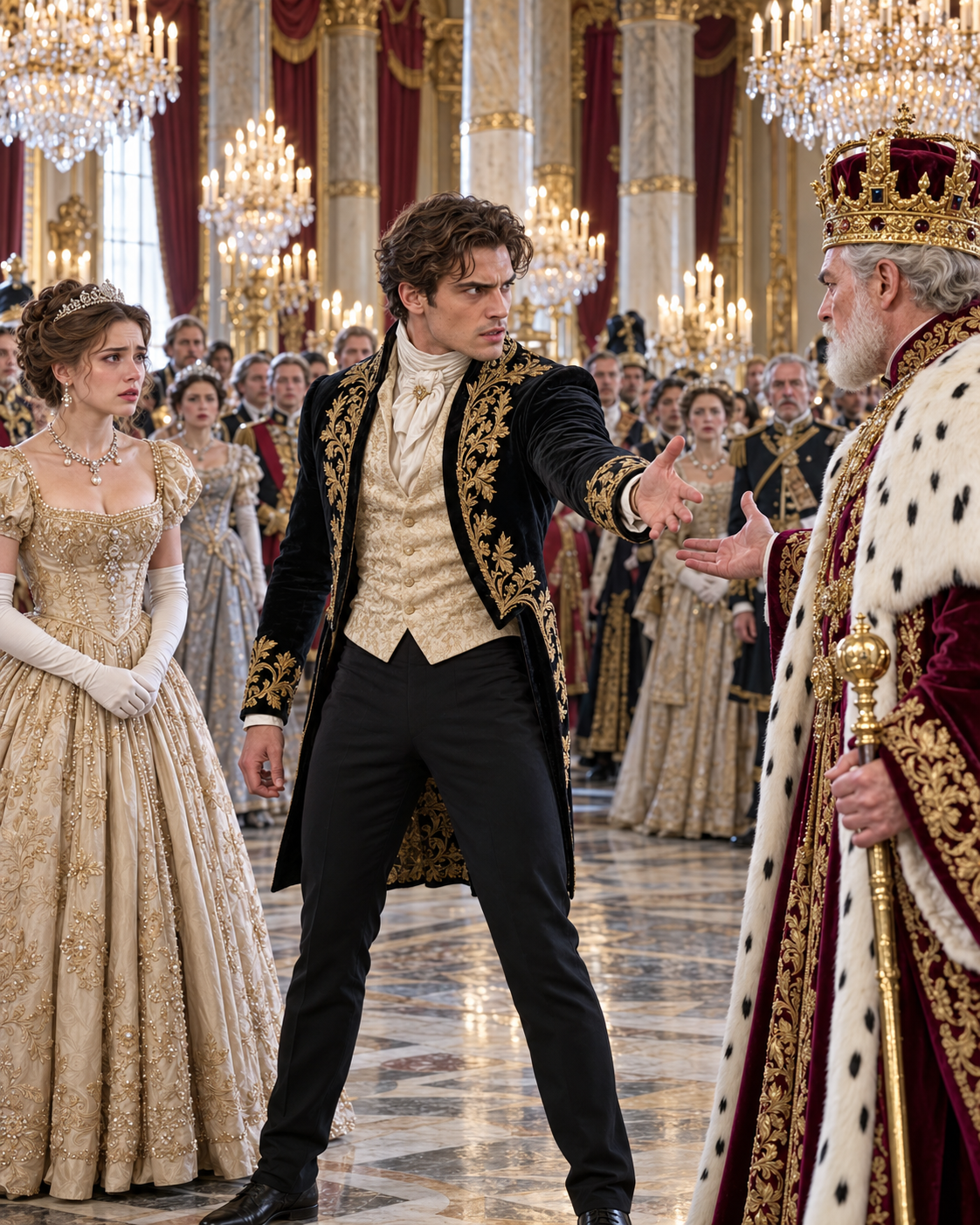
The King of England walked past a duke without so much as a nod—then stopped before the duke’s wife, a woman the entire court had been taught to overlook.
The Duke of Holstead stood motionless, staring at his wife as though she had spoken in a language he no longer understood.
Around them, the magnificent hall of St. James’s Palace had fallen into a silence so complete that the distant ticking of the clock could be heard.
His mother gripped the back of her chair.
“That is an outrageous accusation.”
Her voice was sharp, but Beatrice noticed the way her fingers trembled against the polished wood.
Beatrice did not look away.
“I haven’t accused you of anything, Your Grace. I have merely read what is written.”
The Duchess Dowager turned toward the King, her expression gathering the injured dignity of a woman accustomed to having every unpleasant conversation end in her favour.
“Your Majesty, surely you cannot permit a vicar’s daughter to humiliate one of England’s oldest families with such absurdities.”
The King regarded her for a moment.
“Madam, I have been listening to that vicar’s daughter for nearly ten years. I suggest you begin.”
A faint movement passed through the crowd.
Beatrice lowered her eyes to the decoded message.
Three days before her wedding.
The date was unmistakable.
She remembered that morning. Her father had stood in the doorway of their small parish house, holding a letter that had arrived without a signature. He had looked unusually pale.
When she asked what troubled him, he had folded the paper and placed it inside his Bible.
“It is nothing you need concern yourself with, my dear.”
He had died six months later.
For years, Beatrice had believed his death was simply one of those quiet losses that came without warning.
Now she was no longer certain.
The King stepped closer.
“Lady Beatrice, what exactly does the message say?”
She hesitated.
Not because she feared the truth, but because the man standing beside her was still her husband.
For five years, she had shared his house, carried his name, and endured the small, carefully measured humiliations of his family.
She had once believed that patience might soften him.
Instead, her silence had become something he expected.
She unfolded the paper completely.
“The message instructs someone to retrieve a document from Lord Holstead’s private cabinet. It names a payment and refers to an agreement made in February 1816.”
The Duke frowned.
“Our marriage took place in February 1816.”
“Yes,” Beatrice answered.
The King glanced between them.
“What agreement?”
Beatrice read the final sentence again.
Then she looked at her mother-in-law.
“An agreement concerning my father’s silence.”
The Duchess Dowager’s chair scraped against the floor.
“This performance has gone far enough.”
She turned as though to leave.
Two royal guards quietly moved before the doors.
The King had not raised his voice or given an audible command, yet the movement was enough to stop her.
“Remain where you are, madam.”
The Duke stepped toward his mother.
“Your Majesty, whatever has occurred, my family has always served the Crown faithfully.”
“Then you should welcome the opportunity to establish that fact.”
The King turned to one of his attendants.
“Send for Sir Edmund Vale. Tell him I require the records from the intelligence office concerning the correspondence of January and February 1816.”
The attendant bowed and departed.
Beatrice watched him go.
Sir Edmund Vale.
The name stirred something unpleasant.
During the war, she had known him as a capable but cautious officer who carried sensitive messages between London and the coast.
He had been among the very few people permitted to see her work.
And he was one of the three people who had learned the cipher concealed in the intercepted letter.
A thought came to her, so sudden that she almost spoke.
But then she noticed her husband’s face.
He was no longer watching his mother.
He was watching Beatrice.
For the first time since their marriage, there was something in his expression beyond irritation or embarrassment.
There was fear.
The King ordered the remaining guests to withdraw into the adjoining gallery.
The ceremony had been interrupted, and whispers followed the departing nobles like the rustle of dry leaves.
Within minutes, the grand hall contained only the royal party, the Holstead family, several guards, and a handful of trusted officials.
Beatrice remained beside the writing table.
The Duke approached her while the King spoke quietly with his secretary.
“Why did you never tell me?”
His question was almost inaudible.
She looked at him.
“About the war?”
“About your importance.”
For a moment, she studied the face she had once loved.
She remembered their first meeting at a country gathering, when he had spoken kindly of her father and asked whether she enjoyed music.
He had seemed different then.
Gentler.
Interested in the things she thought rather than the things she possessed.
But the man standing before her now had not asked why she had been forced into secrecy, or what she had sacrificed.
He wanted to know why he had been denied the advantage of her reputation.
“I did not believe my importance was a matter for discussion,” she said.
“You allowed my family to believe you were merely—”
“A vicar’s daughter?”
He fell silent.
Beatrice folded the decoded message.
“I have always been my father’s daughter. Nothing the King has said changes that.”
The Duke’s gaze dropped.
Across the room, his mother watched them with an expression Beatrice could not read.
Then the Duchess Dowager spoke.
“Beatrice, I would like a private word.”
The Duke immediately turned.
“Mother, perhaps this is not—”
“Not with you, Charles.”
The interruption was so abrupt that he stepped back.
Beatrice considered the older woman.
“Anything you wish to say may be said here.”
For the first time, the Duchess Dowager seemed uncertain.
Her eyes moved toward the guards.
Then toward the King.
Finally, she lowered her voice.
“Your father was not the man you believed him to be.”
The words struck with greater force than Beatrice expected.
She kept her hands steady.
“Explain yourself.”
“He became involved in matters he did not understand.”
“My father understood more than most men who called themselves educated.”
“He was reckless.”
Beatrice moved closer.
“What happened to him?”
The older woman pressed her lips together.
Before she could answer, the doors opened.
Sir Edmund Vale entered wearing a dark military coat.
He bowed before the King.
Then he saw Beatrice.
His steps faltered.
It lasted only a moment, but she noticed.
So did the King.
“Sir Edmund,” His Majesty said, “I understand you were responsible for preserving certain intelligence records during the war.”
“Yes, Your Majesty.”
“Then perhaps you can explain why a message written in a restricted cipher has been found bearing the seal of the Holstead family.”
Sir Edmund’s eyes moved toward the parchment.
His expression remained composed.
“I should need to examine it.”
Beatrice held out the paper.
He reached for it.
But just before his fingers touched the page, she withdrew her hand.
“Tell me something first, Sir Edmund.”
He looked at her.
“Of course, Your Grace.”
“Where were you on the evening of the seventeenth of January, 1816?”
The question seemed to surprise everyone except the Duchess Dowager.
Sir Edmund answered slowly.
“I cannot possibly remember a particular evening from ten years ago.”
“Nine years and nine months,” Beatrice corrected softly.
His mouth tightened.
“The distinction is hardly relevant.”
“It was the evening a courier arrived at my father’s vicarage carrying a diplomatic pouch. The man was wounded. He died before sunrise.”
Sir Edmund said nothing.
Beatrice watched his hands.
They were clasped neatly behind his back.
Yet his right thumb repeatedly rubbed against the knuckle of his left forefinger.
She remembered that habit.
He had done the same thing whenever an intelligence report contained news he did not wish to deliver.
“The courier carried a warning,” she continued. “Someone inside the government had been selling information that compromised British operations.”
The King turned sharply.
“Why was this never reported?”
“It was reported, Your Majesty. To Sir Edmund himself.”
Silence.
Sir Edmund’s expression hardened.
“That is not true.”
Beatrice reached into the small velvet reticule hanging from her wrist.
From its lining, she withdrew a narrow strip of folded paper.
Its corners had darkened with age.
“I kept the receipt.”
Sir Edmund stared at it.
She had preserved the acknowledgment for nearly ten years, not because she suspected a conspiracy, but because her father had asked her never to destroy it.
The paper bore Sir Edmund’s signature.
And beneath it, in the precise handwriting of the intelligence office, were four words.
Matter closed by authority.
The King held out his hand.
Beatrice gave him the document.
He read it once.
Then again.
“By whose authority, Sir Edmund?”
The officer remained silent.
The King looked up.
“I asked you a question.”
Sir Edmund swallowed.
“Your Majesty, there were considerations of national security.”
“Whose security?”
No answer came.
The King turned to the guards.
“Sir Edmund Vale is not to leave this palace.”
For the first time, the officer’s composure collapsed.
He looked directly at the Duchess Dowager.
And Beatrice understood that the two of them had been waiting for the same person to speak.
The Duchess Dowager rose slowly.
“I will not permit an officer who served his country honourably to be treated like a criminal because of an old misunderstanding.”
The King regarded her.
“Then perhaps you will explain the misunderstanding.”
She drew herself upright.
“My late husband was approached by men who claimed they could help secure our family’s financial interests abroad. He was told the information he provided concerned commercial shipments.”
Sir Edmund closed his eyes briefly.
The Duke turned toward her.
“What information?”
His mother ignored him.
“The arrangement was supposed to end when the war ended. But certain gentlemen refused to release us from our obligations.”
Beatrice listened without moving.
She had spent years working with intercepted correspondence. She knew the difference between a confession and an explanation designed to conceal another truth.
The Duchess Dowager was offering just enough information to appear cooperative.
Not enough to account for the message.
“Your husband died in 1815,” Beatrice said. “Why would the arrangement continue into 1816?”
The older woman’s gaze sharpened.
“Because debts do not die with the men who incur them.”
The Duke took a step backward.
“Mother?”
She looked at him, and something like weariness passed across her features.
“Your father left this family in a more difficult position than you were led to believe.”
Beatrice suddenly remembered the negotiations preceding her marriage.
The Duke had proposed unexpectedly, only weeks after visiting her father’s parish.
His mother had opposed the match publicly, condemning Beatrice’s lack of fortune and connections.
Yet the wedding had taken place with astonishing speed.
At the time, Beatrice had believed Charles had defied his family for love.
Now she wondered whether the opposition itself had been carefully staged.
“Why did you want me to marry your son?” she asked.
The Duke looked offended.
“Beatrice—”
“Please, Charles.”
Her voice was quiet.
He stopped.
The Duchess Dowager stared at the floor.
Finally, she spoke.
“Because your father possessed something we needed.”
A cold understanding began to settle over Beatrice.
“The documents.”
“Yes.”
The King approached.
“What documents?”
Beatrice turned toward him.
“Before my marriage, my father received evidence identifying the men who had financed the sale of British military intelligence. He hid it because he feared the information would disappear if he surrendered it to the wrong official.”
Sir Edmund shifted toward the doors.
A guard moved immediately to block his path.
The Duke looked between his mother and his wife.
“You arranged my marriage because of papers?”
The Duchess Dowager gave him a bitter glance.
“I arranged your marriage because I was trying to preserve everything your father had left you.”
“And you allowed me to believe you disapproved of her?”
“I did disapprove.”
Beatrice’s face remained still.
The older woman continued.
“But a young woman who believed herself loved would be easier to persuade than one who knew she was being watched.”
The Duke opened his mouth, then closed it.
The words seemed to have stripped him of the last comforting explanation available.
Beatrice looked at him.
“Did you know?”
He shook his head.
“No.”
She wanted to believe him.
Once, she would have accepted the answer without hesitation.
But love had taught her how easily certainty could become a form of blindness.
She turned back to the Duchess Dowager.
“Where are my father’s papers?”
“I do not know.”
Beatrice studied her face.
That answer, strangely, she believed.
The King ordered a search of the Holstead residence before nightfall.
Sir Edmund was placed under guard, and the Duchess Dowager was instructed to remain at the palace while the investigation continued.
The Duke stood apart from his mother, his expression grey and exhausted.
Beatrice asked permission to accompany the officers.
The King regarded her thoughtfully.
“Do you believe you know where the papers are?”
“No, Your Majesty. But I believe I know where they are not.”
A faint expression of interest crossed his face.
“Go on.”
“My husband’s study contains a cabinet that has been searched repeatedly. If the documents had ever been kept there, someone would have found them long ago.”
“Then why does the intercepted message mention it?”
“Because the sender wants someone to look there.”
The King considered this.
“A diversion?”
“Possibly. Or a trap.”
She paused.
“The cipher is one I designed, yet the message contains an error I would never have made.”
Sir Edmund looked up sharply.
Beatrice noticed.
“It instructs the reader to begin with every seventh word. But the substitution in the final line requires the eighth.”
The King turned toward Sir Edmund.
“Would you care to explain?”
The officer said nothing.
Beatrice looked down at the paper.
“Whoever wrote this wanted me to decipher most of it. They wanted me to discover the family seal and the reference to my marriage.”
Her voice grew quieter.
“But the final instruction was meant for someone else.”
The King held her gaze.
“What does it say?”
Beatrice unfolded the parchment again.
This time, she began with the eighth word.
When she finished, the meaning became clear.
Burn the parish register before she remembers.
She stared at the sentence.
For nearly ten years, she had carried an ordinary memory of her father’s final winter.
The parish church.
The worn stone steps.
The register he had insisted on keeping personally, even after his eyesight had begun to fail.
And a small brass key he had placed in her hand shortly before her wedding.
She had believed it opened his desk.
It had never fitted.
“Your Majesty,” she said, “I must return to my father’s church.”
By late afternoon, the rain had eased into a thin mist.
A royal carriage carried Beatrice toward the village where she had spent her childhood.
Two officers accompanied her, along with a young secretary appointed by the King.
The Duke had insisted upon joining them.
Beatrice had not objected.
During the journey, he sat opposite her, his gloves untouched beside him.
Several times he appeared about to speak.
Each time, he looked toward the window instead.
At last, as the carriage passed a line of bare elms, he broke the silence.
“I thought my mother was protecting our family.”
Beatrice watched the countryside move past.
“Perhaps she believed she was.”
“That does not excuse what she did.”
“No.”
He leaned forward.
“And what I did to you?”
She looked at him then.
He seemed older than he had that morning.
The confidence that had once made every room appear to belong to him had disappeared.
“You embarrassed me because you were embarrassed by me,” she said.
Charles lowered his eyes.
“I was afraid of losing the respect of people whose opinions mattered.”
“And now?”
He looked at her.
“Now I know how little I understood.”
Beatrice returned her gaze to the window.
It was not forgiveness.
But neither was it nothing.
They reached the village shortly before dusk.
The church stood at the end of a narrow lane, its stone walls darkened by rain.
A few cottages glowed faintly through the mist.
Beatrice stepped down from the carriage and breathed in the familiar scent of damp earth and woodsmoke.
For a moment, she was no duchess.
She was simply the vicar’s daughter returning home.
The old churchwarden came forward carrying a lantern.
When he recognized her, his face softened.
“Miss Beatrice.”
She smiled faintly.
“Good evening, Mr. Finch.”
He glanced at the royal carriage with visible alarm.
“Is something wrong, miss?”
“I hope not.”
But as they entered the church, Beatrice noticed that the cabinet beside the vestry door stood open.
Its lock had been broken.
Mr. Finch saw where she was looking.
“Two gentlemen came this morning. Said they were from the diocese.”
“What did they want?”
“The old parish records.”
Beatrice stopped.
“Did you give them anything?”
The elderly man shook his head.
“Your father made me promise never to surrender those books without your permission.”
He lifted the lantern.
“So I moved them.”
Beatrice looked at him.
For the first time that day, a genuine smile touched her lips.
“Where?”
Mr. Finch nodded toward the altar.
“Somewhere your father said no thief would think to look.”
The church was cold enough that Beatrice could see her breath.
Mr. Finch led them behind the altar to a small wooden panel concealed beneath the carved memorial of a long-dead parish benefactor.
Inside lay three leather-bound registers wrapped in linen.
Beatrice knelt beside them.
Her hands moved carefully over the bindings.
She remembered her father sitting beside the fire, repairing those same books with thread and paste.
She remembered his gentle impatience when she questioned why he spent so many hours on records of births, marriages, and deaths.
“Names matter, Beatrice,” he had told her. “Especially the names powerful people would rather forget.”
She opened the oldest volume.
Several pages had been marked with narrow strips of faded blue ribbon.
Inside the binding, almost invisible beneath the stitching, was a small brass keyhole.
Her breath caught.
The key.
She had carried it for years in a box containing her father’s letters.
After her marriage, she had moved the box into her private sitting room at Holstead House.
Then, remembering something, she reached beneath the collar of her gown.
A thin chain rested against her skin.
At its end hung a small brass key.
Charles stared at it.
“You have worn that all these years?”
“It was the last gift my father gave me.”
She inserted it into the hidden lock.
A quiet click sounded.
The register’s spine opened, revealing a narrow compartment.
Inside lay a folded packet sealed with plain black wax.
There was no crest.
Only her name.
For Beatrice, when silence is no longer safe.
She recognized her father’s handwriting immediately.
For a moment, the church seemed to recede around her.
She broke the seal.
The first page was a letter.
Her father had written it in a careful hand, though the final lines were uneven.
My dearest child,
If you are reading this, then I have failed to shield you from the burden I hoped would never reach your life.
You once told me that a cipher is only a lock, and that every lock reveals something about the person who made it.
I fear I have spent too long protecting men who did not deserve protection.
Beatrice stopped reading.
Charles waited beside her.
The churchwarden quietly moved away.
She continued.
Her father explained that he had discovered a network of noblemen and officials who had profited from the sale of intelligence during the war.
Some had acted out of greed.
Others had been blackmailed.
A few had knowingly assisted enemy agents while publicly celebrating British victories.
Among the names were Sir Edmund Vale and the late Duke of Holstead.
But there was another.
A name Beatrice had not expected.
Lord Ashcombe.
The King’s trusted adviser.
The man who had stood beside His Majesty that very morning, arranging the order of the royal ceremony.
Beatrice read the name twice.
The final paragraph made her blood run cold.
Ashcombe is not merely involved. He directs them. If I should die before I can place the evidence in trustworthy hands, do not take it to the ministry. Take it to the King himself.
Beneath the letter lay copies of financial accounts, intercepted messages, and signed acknowledgments.
Enough to destroy reputations.
Enough to expose a conspiracy that had survived the war itself.
Charles leaned closer.
“Beatrice, what is it?”
She slowly folded the letter.
“We must return to London.”
Night had fallen when the carriage reached St. James’s Palace.
The corridors were quieter now, the ceremonial splendour replaced by pools of candlelight and the measured footsteps of guards.
Beatrice asked to be taken directly to the King.
An attendant hesitated.
“His Majesty is in conference with Lord Ashcombe.”
She stopped.
“Since when?”
“For nearly an hour, Your Grace.”
Charles looked at her.
She said nothing, but her expression was enough.
Together they moved quickly down the corridor.
Outside the King’s private chamber stood two guards.
Before Beatrice could speak, raised voices sounded from within.
The King’s voice was unmistakable.
“You are asking me to believe that an entire intelligence operation was compromised without the knowledge of my ministers?”
Another voice answered.
Smooth.
Controlled.
Lord Ashcombe.
“I am asking Your Majesty to consider how dangerous it would be to expose these allegations without proper examination.”
Beatrice stepped forward.
The guard barred her way.
“His Majesty is not receiving visitors.”
She drew herself upright.
“Tell the King that the Duchess of Holstead has brought him a letter from the Reverend Thomas Ellery.”
The guard hesitated.
Then the door opened from within.
Lord Ashcombe stood in the doorway.
His silver hair was immaculate, his expression composed.
Yet when he heard her father’s name, something hardened around his eyes.
“Your Grace,” he said pleasantly. “What an unexpected pleasure.”
Beatrice met his gaze.
“I believe you knew my father.”
Ashcombe smiled.
“I knew many clergymen.”
“Did you know him well enough to arrange his death?”
The smile vanished.
Behind him, the King rose from his chair.
“Lady Beatrice?”
She stepped into the chamber.
Charles followed.
Beatrice placed the packet on the King’s desk.
“My father left these documents in the parish records. I believe they explain the conspiracy Sir Edmund helped conceal.”
Lord Ashcombe moved forward.
“Your Majesty, I strongly advise against accepting papers of uncertain origin.”
The King raised a hand.
“Stand back, Ashcombe.”
The adviser stopped.
His eyes moved toward the door.
Beatrice noticed.
So did Charles.
The Duke quietly shifted his position, placing himself between Ashcombe and the corridor.
For the first time in their marriage, he acted without waiting for his mother’s approval.
The King read the first letter.
His expression changed.
Then he examined the accounts.
For several minutes, the only sound was the turning of paper.
Finally, he looked up.
“Lord Ashcombe, is this your signature?”
Ashcombe glanced at the document.
“I would need time to examine it.”
“You have had nearly ten years.”
The older man’s jaw tightened.
“Your Majesty, I have served the Crown for thirty years.”
“And I have trusted you for most of them.”
The King’s voice was low.
That quiet disappointment seemed to trouble Ashcombe more than anger would have.
For an instant, his polished manner disappeared.
“You have no understanding of what was necessary to preserve the stability of this country.”
The King stared at him.
“By selling the movements of our soldiers?”
“By ensuring that certain men remained in positions of influence after the war.”
Beatrice felt the final pieces settle into place.
The financial accounts were not merely records of wartime betrayal.
They documented payments continuing long after Napoleon’s defeat.
The conspirators had used secrets gathered during the war to control powerful families in peacetime.
The Holsteads had been among those families.
And Beatrice, who had unknowingly possessed the evidence, had been brought into their household so she could be watched.
Her marriage had been intended as a prison with gilded doors.
Ashcombe looked at her.
“Your father was offered a generous arrangement. He chose to refuse it.”
Beatrice’s hands remained still.
“Did you order his death?”
For a moment, the older man said nothing.
Then he looked away.
“I gave instructions that he should be prevented from speaking.”
It was not an admission phrased as a confession.
But everyone in the room understood.
Charles stepped toward him.
“You murdered her father.”
Ashcombe drew back.
“I did what was required.”
“No,” Beatrice said.
Her voice carried clearly through the room.
“You did what was convenient.”
The King reached for the bell beside his desk.
Before his hand touched it, Ashcombe pulled a small pistol from inside his coat.
The movement was so sudden that the nearest guard had no time to react.
“Nobody move.”
The weapon trembled slightly in his hand.
Its barrel pointed toward the King.
Charles stepped forward.
Ashcombe turned the pistol toward him.
“Stand aside, Holstead.”
Charles stopped.
Beatrice studied the weapon.
A single-shot pocket pistol.
Its hammer was cocked.
Ashcombe held it too tightly, his finger pressed awkwardly against the trigger.
She had seen frightened men handle weapons before.
He was not a soldier.
He was a man accustomed to letting others commit violence on his behalf.
The King remained standing behind his desk.
“Ashcombe, put it down.”
The adviser shook his head.
“You cannot allow those papers to become public.”
“That is no longer your decision.”
Ashcombe’s eyes flicked toward the fire burning in the grate.
Beatrice understood what he intended.
He needed only a few seconds.
He would force the King away from the desk, seize the packet, and throw it into the flames.
The originals would be gone.
And he believed that would be enough.
Beatrice moved one step to the side.
“Lord Ashcombe.”
His eyes snapped toward her.
“My father made copies.”
The pistol steadied.
“You are lying.”
“Perhaps.”
She let the word hang between them.
“But would you risk your life on it?”
For the first time, uncertainty crossed his face.
Charles moved.
He struck Ashcombe’s wrist just as the older man turned toward Beatrice.
The pistol discharged.
The report shattered the silence.
A mirror beside the fireplace exploded, scattering glass across the carpet.
Charles staggered backward.
Beatrice caught his arm.
Blood spread rapidly through the sleeve of his coat.
The guards rushed forward.
Within seconds, Ashcombe was pinned against the floor, the pistol kicked beyond his reach.
The King called for a physician.
Charles sank into a chair, pressing his hand against his wounded upper arm.
Beatrice knelt beside him.
“Let me see.”
He tried to smile.
“It appears I have finally done something useful.”
She tore a strip from the linen handkerchief in her reticule and pressed it firmly against the wound.
“Be still, Charles.”
He obeyed.
Around them, guards secured the room.
Ashcombe was dragged to his feet.
As he passed Beatrice, he stopped.
“Your father was a fool.”
Beatrice looked up at him.
“No. He trusted the wrong men.”
The guard pushed him toward the door.
“And that,” she added, “is a mistake I do not intend to repeat.”
The investigation that followed lasted several weeks.
Sir Edmund Vale, confronted with the documents and Ashcombe’s arrest, finally admitted that he had concealed reports identifying the conspirators.
Under questioning, the Duchess Dowager acknowledged her role in arranging Beatrice’s marriage.
She maintained that she had never intended harm to come to Beatrice, but her correspondence told a less innocent story.
There had been instructions to monitor her letters.
To restrict her visits to her father’s parish.
To prevent her from meeting former intelligence officers.
Beatrice read those instructions in a quiet chamber at the palace.
She did not weep.
She simply placed the papers on the table and sat for a long while, watching the afternoon light move across the carpet.
Five years.
Five years spent believing that every closed door, every withheld invitation, every slight from her husband’s family was punishment for her birth.
Now she understood that some of those doors had been closed because people feared what she might discover beyond them.
The knowledge did not make the humiliation easier.
But it gave her something she had lacked for years.
An explanation.
The King ordered a full inquiry into the conspiracy.
Several officials resigned.
Others were arrested.
The surviving financial records were transferred to trusted investigators, and the Crown began the difficult work of identifying those harmed by the wartime betrayals.
The Duchess Dowager was removed from the management of the Holstead estates pending further proceedings.
Her social influence, once exercised with such effortless certainty, vanished almost overnight.
Beatrice received the news without satisfaction.
She had learned during the war that the downfall of a guilty person did not restore the lives already lost.
Her father would not return.
Neither would the soldiers whose movements had been sold to enemy agents.
Justice could not undo the past.
It could only prevent the past from continuing unchecked.
One afternoon, Charles came to see her.
His wound was healing, though his arm remained in a sling.
He found her in a small drawing room overlooking the palace gardens.
She was reading a letter from the parish churchwarden.
Mr. Finch had written to say that the church roof needed repairs.
Charles stood in the doorway.
“May I come in?”
Beatrice set the letter aside.
“Of course.”
He entered slowly.
There was an unfamiliar hesitation in his movements.
He had once crossed rooms as though every chair and conversation belonged to him.
Now he waited until she invited him to sit.
“I have spoken with the solicitors,” he said.
She watched him.
“They have prepared the arrangements you requested.”
Beatrice nodded.
For several days, she had been discussing her future with the King’s advisers.
The law did not make it easy for a married woman to live independently.
But the King had offered his support, and Charles had agreed to a formal separation, together with financial provisions that would give her control over her own household.
It was more than many women in her position could hope to obtain.
Still, the arrangement had come at a cost neither of them could ignore.
Charles looked down at his gloved hands.
“I owe you an apology.”
Beatrice waited.
“Not for what my mother did. Not for what I failed to know.”
He drew a breath.
“For what I chose to see.”
Outside, a gardener crossed the path carrying a basket of fallen branches.
Charles continued.
“I saw the way people treated you. I knew it hurt you. And I allowed it because their approval mattered more to me than your dignity.”
Beatrice’s expression softened, but she did not interrupt.
“I thought being a duke made me a man worth respecting.”
He looked at her.
“You were the one who understood what respect required.”
For a moment, the room was very quiet.
Then Beatrice spoke.
“I did love you, Charles.”
His eyes closed briefly.
“I know.”
“I wanted our marriage to be a place where neither of us had to prove our worth.”
He nodded.
“I wish I had understood that sooner.”
“So do I.”
There was no dramatic embrace.
No sudden promise that everything could begin again.
Some wounds were not healed by finding the correct words.
Charles rose.
At the door, he paused.
“Will you be happy?”
Beatrice considered the question.
“I intend to find out.”
He gave a small, sad smile.
Then he bowed.
Not the careless acknowledgment he had offered her for years.
A genuine bow.
And he left.
In December, Beatrice returned to St. James’s Palace.
This time, she arrived without the Holstead family.
She wore a gown of dark blue silk, simple in its design, with a single pearl pinned near her collar.
The pearl had belonged to her mother.
She had chosen it herself.
The royal gathering was smaller than the ceremony that had changed her life, but many familiar faces were present.
Several noblewomen approached her with smiles far warmer than those they had offered before.
Beatrice received their greetings politely.
She did not mistake them for friendship.
Near the entrance, she passed Lady Wetherby, who had once laughed when the Duchess Dowager called her an unsuitable addition to the aristocracy.
The woman lowered her eyes.
“Your Grace, I hope you will forgive my earlier behaviour.”
Beatrice regarded her calmly.
“I hope, Lady Wetherby, that you will remember it the next time you meet someone whose family is less fortunate than your own.”
The woman coloured.
Beatrice continued into the hall.
The King stood beside a long table on which several documents had been arranged.
When he saw her, he smiled.
“Lady Beatrice.”
She curtsied.
“Your Majesty.”
“I trust your journey was comfortable.”
“Very, sir.”
He gestured toward the papers.
“I have something I wish you to consider.”
Beatrice approached.
The documents concerned a new effort to preserve and organize intelligence records from the recent wars, with particular attention to the contributions of individuals whose work had never been publicly acknowledged.
The King had also authorized a fund to assist the widows and children of men who had died while carrying sensitive information for the Crown.
Beatrice read the proposal carefully.
Then she looked up.
“You wish me to oversee this?”
“If you are willing.”
She studied the pages again.
In the margins were notes concerning pensions, education, and financial support.
There were spaces for names.
Many names.
People whose service had been conducted in silence.
People who had never worn uniforms or received medals.
She thought of the wounded courier at her father’s door.
Of the frightened young clerks who had carried coded messages through dangerous territory.
Of her father, sitting beside a lamp in the parish house, guarding evidence he knew could cost him his life.
“I would be honoured,” she said.
The King nodded.
“Then England remains in your debt.”
Beatrice smiled faintly.
“Perhaps, Your Majesty, we might begin by paying some of the debts owed to others.”
The King looked at her for a moment.
Then he laughed softly.
“A most reasonable correction.”
He signed the papers.
And for the first time in her life, Beatrice felt that her years of secrecy had led somewhere beyond survival.
The following spring, the bells of St. Mary’s Church rang across the village.
Not for a wedding.
Not for a funeral.
But for the reopening of the parish school.
The old building had been repaired with funds Beatrice had arranged through her newly established charitable trust.
Its roof no longer leaked.
The windows had been replaced.
Fresh books lined the shelves, and sunlight fell across the desks where village children sat waiting for their lessons to begin.
Beatrice stood near the doorway.
Mr. Finch, looking pleased beyond measure, handed her a small brass key.
“The schoolroom, miss.”
She accepted it.
“Thank you.”
He smiled.
“Your father would have liked this.”
She looked across the room.
A young girl sat near the front, her hair escaping from a ribbon.
Before her lay a slate covered in carefully written numbers.
When the teacher asked a question, the girl raised her hand immediately.
Several boys laughed.
The girl began to lower it.
Beatrice walked toward her.
“What is your name?”
“Margaret, ma’am.”
“Do you know the answer?”
Margaret glanced at the boys.
“I think so.”
“Then I should very much like to hear it.”
The girl answered.
She was correct.
Beatrice smiled.
“And how did you work it out?”
Margaret explained her reasoning, slowly at first, then with growing confidence.
When she finished, Beatrice nodded.
“Very good.”
One of the boys muttered that girls had no need for difficult mathematics.
Beatrice turned toward him.
“Do you believe numbers behave differently when a girl writes them?”
The classroom fell silent.
The boy looked embarrassed.
“No, ma’am.”
“Neither do I.”
A few children smiled.
Beatrice returned her attention to Margaret.
“Keep asking questions.”
The girl nodded solemnly.
“I shall.”
Outside, the church bells continued ringing.
Beatrice stepped into the sunlight.
Across the lane stood the little house where her father had once lived.
Its windows were open, and the scent of spring flowers drifted from the garden.
She walked toward it slowly.
For years, she had remembered that house as the place where her former life had ended.
Now it was becoming something else.
A beginning.
She had arranged for it to be used as a small library and study room, open to any village child who wished to learn.
No title would be required to enter.
No family name would matter.
Only curiosity.
Inside, her father’s old writing desk stood beneath the window.
Beatrice placed the brass schoolroom key beside his worn Bible.
Then she opened the book.
Between its pages lay a small note, written in his familiar hand.
She had discovered it only the previous evening.
My dear Beatrice,
There will always be people who measure another person’s worth by the doors they are permitted to enter.
Do not spend your life waiting for those people to open a door.
Learn enough to build one yourself.
She read the words once more.
Then she folded the note and placed it carefully in her reticule.
Outside, the sound of children’s voices drifted through the open window.
Beatrice turned toward the doorway.
A young girl stood there, clutching a book against her chest.
“Your Grace?”
“Yes?”
The girl hesitated.
“Is it true that you once helped the King?”
Beatrice considered her.
“It is true that I was fortunate enough to be useful when he needed help.”
The girl looked impressed.
“Do you think someone like me could do something important?”
Beatrice glanced at the book in her hands.
Its pages were worn, the corners bent from frequent reading.
She remembered a time when she had been a young vicar’s daughter, sitting beside a candle and learning to recognize patterns hidden in unfamiliar letters.
No one had imagined that such quiet work might one day save lives.
Not even she had understood where it might lead.
Beatrice knelt so their eyes were level.
“What do you enjoy learning?”
“Everything,” the girl whispered.
Beatrice smiled.
“Then I should say you have already made an excellent beginning.”
The child grinned and hurried toward the school.
Beatrice watched her disappear through the gate.
For a long moment, she remained beneath the doorway, listening to the bells.
She thought of the grand hall at St. James’s Palace, where her husband had made her stand three paces behind him.
She remembered the weight of his family’s judgment, the careful silence she had worn like another layer of clothing, and the afternoon when the King had crossed that magnificent room to acknowledge her.
Once, she had believed that moment was the greatest honour she would ever receive.
But standing in the doorway of her father’s house, watching children carry books along the village lane, she understood that the King’s recognition had not made her valuable.
It had merely revealed a value that had existed all along.
Her courage had belonged to her before anyone praised it.
Her intelligence had been hers before anyone believed in it.
And her dignity had never depended upon the name printed beside her own.
Beatrice closed the door gently and walked toward the school.
The day was bright.
There was work waiting to be done.
And this time, she did not walk three paces behind anyone.
She walked at her own pace, toward a future she had finally been allowed to choose.
For the truest measure of a person’s worth is not the honour others bestow upon them, but the good they choose to do when no one is watching.
THE END.